
List復(fù)制:深拷貝和淺拷貝用法及區(qū)別
作者:DeMonnnnnn
blog.csdn.net/demonliuhui/article/details/54572908
List淺拷貝
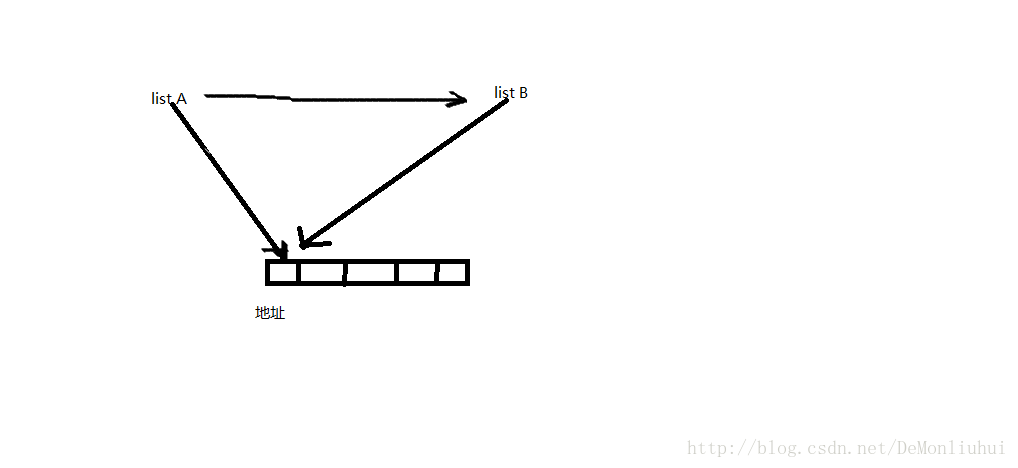
眾所周知,list本質(zhì)上是數(shù)組,而數(shù)組的是以地址的形式進(jìn)行存儲(chǔ)。
如上圖將list A淺拷貝給list B,由于進(jìn)行的是淺拷貝,所以直接將A的內(nèi)容復(fù)制給了B,java中相同內(nèi)容的數(shù)組指向同一地址,即進(jìn)行淺拷貝后A與B指向同一地址。
造成的后果就是,改變B的同時(shí)也會(huì)改變A,因?yàn)楦淖傿就是改變B所指向地址的內(nèi)容,由于A也指向同一地址,所以A與B一起改變。
幾種淺拷貝
1、遍歷循環(huán)復(fù)制
List<Person> destList=new ArrayList<Person>(srcList.size());
for(Person p : srcList){
    destList.add(p);
}
2、使用List實(shí)現(xiàn)類的構(gòu)造方法
List<Person> destList=new ArrayList<Person>(srcList);
3、使用list.addAll()方法
List<Person> destList=new ArrayList<Person>();
destList.addAll(srcList);
4、使用System.arraycopy()方法
Person[] srcPersons=srcList.toArray(new Person[0]);
Person[] destPersons=new Person[srcPersons.length];
System.arraycopy(srcPersons, 0, destPersons, 0, srcPersons.length);
測(cè)試及結(jié)果
printList(destList); //打印未改變B之前的A
srcList.get(0).setAge(100);//改變B
printList(destList); //打印改變B后的A

//打印結(jié)果
123-->20
ABC-->21
abc-->22
123-->100
ABC-->21
abc-->22
List深拷貝

如圖,深拷貝就是將A復(fù)制給B的同時(shí),給B創(chuàng)建新的地址,再將地址A的內(nèi)容傳遞到地址B。ListA與ListB內(nèi)容一致,但是由于所指向的地址不同,所以改變相互不受影響。
深拷貝的方法
1.使用序列化方法
public static <T> List<T> deepCopy(List<T> src) throws IOException, ClassNotFoundException {
    ByteArrayOutputStream byteOut = new ByteArrayOutputStream();
    ObjectOutputStream out = new ObjectOutputStream(byteOut);
    out.writeObject(src);

    ByteArrayInputStream byteIn = new ByteArrayInputStream(byteOut.toByteArray());
    ObjectInputStream in = new ObjectInputStream(byteIn);
    @SuppressWarnings("unchecked")
    List<T> dest = (List<T>) in.readObject();
    return dest;
}

List<Person> destList=deepCopy(srcList);  //調(diào)用該方法
2.clone方法
public class A implements Cloneable {
    public String name[];

    public A(){
        name=new String[2];
    }

    public Object clone() {
        A o = null;
        try {
            o = (A) super.clone();
        } catch (CloneNotSupportedException e) {
            e.printStackTrace();
        }
        return o;
    }
}
for(int i=0;i<n;i+=){
copy.add((A)src.get(i).clone());
}
Java對(duì)對(duì)象和基本的數(shù)據(jù)類型的處理是不一樣的。在Java中用對(duì)象的作為入口參數(shù)的傳遞則缺省為”引用傳遞”,也就是說(shuō)僅僅傳遞了對(duì)象的一個(gè)”引用”,這個(gè)”引用”的概念同C語(yǔ)言中的指針引用是一樣的。
當(dāng)函數(shù)體內(nèi)部對(duì)輸入變量改變時(shí),實(shí)質(zhì)上就是在對(duì)這個(gè)對(duì)象的直接操作。除了在函數(shù)傳值的時(shí)候是”引用傳遞”,在任何用”=”向?qū)ο笞兞抠x值的時(shí)候都是”引用傳遞”。
測(cè)試及結(jié)果
printList(destList); //打印未改變B之前的A
srcList.get(0).setAge(100);//改變B
printList(destList); //打印改變B后的A

123-->20
ABC-->21
abc-->22
123-->20
ABC-->21
abc-->22
在淺復(fù)制的情況下,源數(shù)據(jù)被修改破壞之后,使用相同引用指向該數(shù)據(jù)的目標(biāo)集合中的對(duì)應(yīng)元素也就發(fā)生了相同的變化。
因此,在需求要求必須深復(fù)制的情況下,要是使用上面提到的方法,請(qǐng)確保List中的T類對(duì)象是不易被外部修改和破壞的。
參考
http://blog.csdn.net/lian_1988/article/details/45970927 http://blog.sina.com.cn/s/blog_605f78830102uy6x.html
分享一下我寫(xiě)的《10萬(wàn)字Springboot經(jīng)典學(xué)習(xí)筆記》中,點(diǎn)擊下面小卡片,進(jìn)入【Java禿頭哥】,回復(fù):筆記,即可免費(fèi)獲取。
點(diǎn)贊是最大的支持
