
面試官:@Transactional 注解是如何實現(xiàn)的?面試必問!

@Transactional注解簡介
@Transactional是spring中聲明式事務(wù)管理的注解配置方式,相信這個注解的作用大家都很清楚。@Transactional注解可以幫助我們把事務(wù)開啟、提交或者回滾的操作,通過aop的方式進行管理。
通過@Transactional注解就能讓spring為我們管理事務(wù),免去了重復(fù)的事務(wù)管理邏輯,減少對業(yè)務(wù)代碼的侵入,使我們開發(fā)人員能夠?qū)W⒂跇I(yè)務(wù)層面開發(fā)。
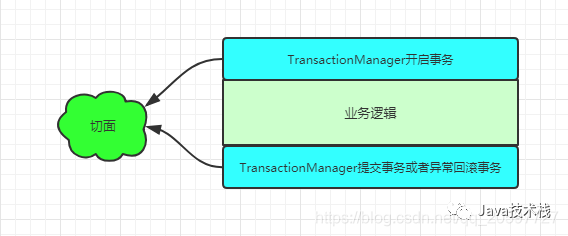
我們知道實現(xiàn)@Transactional原理是基于spring aop,aop又是動態(tài)代理模式的實現(xiàn),通過對源碼的閱讀,總結(jié)出下面的步驟來了解實際中,在spring 是如何利用aop來實現(xiàn)@Transactional的功能的。
spring中聲明式事務(wù)實現(xiàn)原理猜想
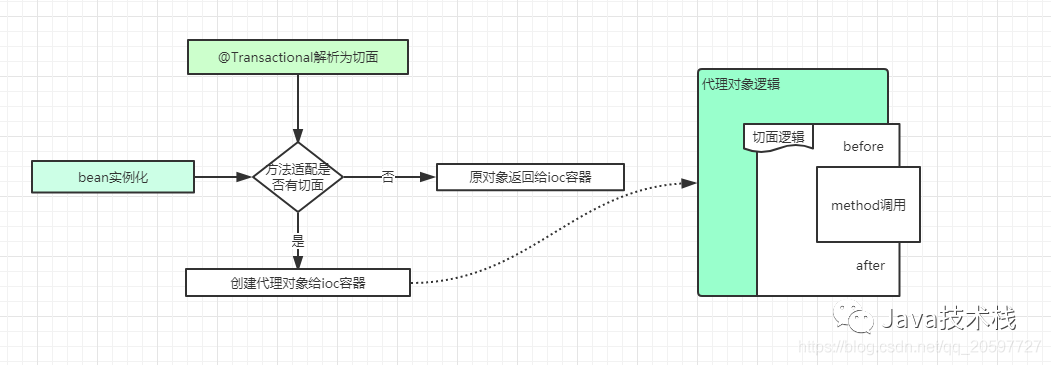
首先,對于spring中aop實現(xiàn)原理有了解的話,應(yīng)該知道想要對一個方法進行代理的話,肯定需要定義切點。在@Transactional的實現(xiàn)中,同樣如此,spring為我們定義了以 @Transactional 注解為植入點的切點,這樣才能知道@Transactional注解標(biāo)注的方法需要被代理。
有了切面定義之后,在spring的bean的初始化過程中,就需要對實例化的bean進行代理,并且生成代理對象。
生成代理對象的代理邏輯中,進行方法調(diào)用時,需要先獲取切面邏輯,@Transactional注解的切面邏輯類似于@Around,在spring中是實現(xiàn)一種類似代理邏輯。
@Transactional作用
根據(jù)上面的原理猜想,下面簡單介紹每個步驟的源碼以進行驗證。
首先是@Transactional,作用是定義代理植入點。我們知道代理對象創(chuàng)建的通過BeanPostProcessor的實現(xiàn)類AnnotationAwareAspectJAutoProxyCreator的postProcessAfterInstantiation方法來實現(xiàn)個,如果需要進行代理,那么在這個方法就會返回一個代理對象給容器,同時判斷植入點也是在這個方法中。
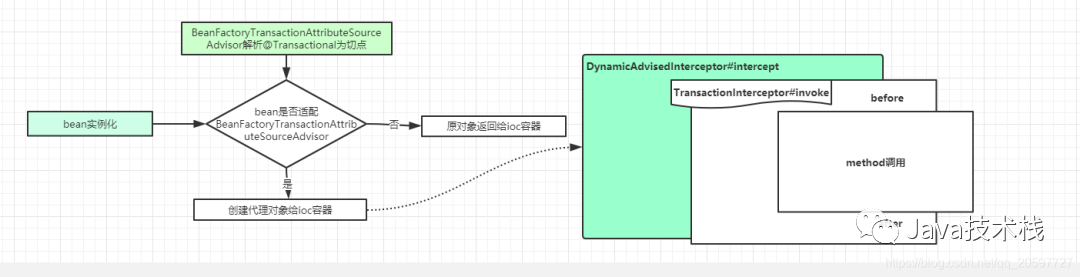
那么下面開始分析,在配置好注解驅(qū)動方式的事務(wù)管理之后,spring會在ioc容器創(chuàng)建一個BeanFactoryTransactionAttributeSourceAdvisor實例,這個實例可以看作是一個切點,在判斷一個bean在初始化過程中是否需要創(chuàng)建代理對象,都需要驗證一次BeanFactoryTransactionAttributeSourceAdvisor是否是適用這個bean的切點。如果是,就需要創(chuàng)建代理對象,并且把BeanFactoryTransactionAttributeSourceAdvisor實例注入到代理對象中。
前文我們知道在AopUtils#findAdvisorsThatCanApply中判斷切面是否適用當(dāng)前bean,可以在這個地方斷點分析調(diào)用堆棧,AopUtils#findAdvisorsThatCanApply一致調(diào)用,最終通過以下代碼判斷是否適用切點。
AbstractFallbackTransactionAttributeSource#computeTransactionAttribute(Method method, Class targetClass)這里可以根據(jù)參數(shù)打上條件斷點進行調(diào)試分析調(diào)用棧,targetClass就是目標(biāo)class …一系列調(diào)用最終 SpringTransactionAnnotationParser#parseTransactionAnnotation(java.lang.reflect.AnnotatedElement)
@Override
public TransactionAttribute parseTransactionAnnotation(AnnotatedElement ae) {
    //這里就是分析Method是否被@Transactional注解標(biāo)注,有的話,不用說BeanFactoryTransactionAttributeSourceAdvisor適配當(dāng)前bean,進行代理,并且注入切點
    //BeanFactoryTransactionAttributeSourceAdvisor
   AnnotationAttributes attributes = AnnotatedElementUtils.getMergedAnnotationAttributes(ae, Transactional.class);
   if (attributes != null) {
      return parseTransactionAnnotation(attributes);
   }
   else {
      return null;
   }
}
上面就是判斷是否需要根據(jù)@Transactional進行代理對象創(chuàng)建的判斷過程。@Transactional的作用一個就是標(biāo)識方法需要被代理,一個就是攜帶事務(wù)管理需要的一些屬性信息。
動態(tài)代理邏輯實現(xiàn)
【aop實現(xiàn)原理分析】中知道,aop最終的代理對象的代理方法是
DynamicAdvisedInterceptor#intercept
所以我們可以在這個方法斷點分析代理邏輯。
@Override
public Object intercept(Object proxy, Method method, Object[] args, MethodProxy methodProxy) throws Throwable {
   Object oldProxy = null;
   boolean setProxyContext = false;
   Class<?> targetClass = null;
   Object target = null;
   try {
      if (this.advised.exposeProxy) {
         // Make invocation available if necessary.
         oldProxy = AopContext.setCurrentProxy(proxy);
         setProxyContext = true;
      }
      // May be null. Get as late as possible to minimize the time we
      // "own" the target, in case it comes from a pool...
      target = getTarget();
      if (target != null) {
         targetClass = target.getClass();
      }
       //follow
      List<Object> chain = this.advised.getInterceptorsAndDynamicInterceptionAdvice(method, targetClass);
      Object retVal;
      // Check whether we only have one InvokerInterceptor: that is,
      // no real advice, but just reflective invocation of the target.
      if (chain.isEmpty() && Modifier.isPublic(method.getModifiers())) {
         // We can skip creating a MethodInvocation: just invoke the target directly.
         // Note that the final invoker must be an InvokerInterceptor, so we know
         // it does nothing but a reflective operation on the target, and no hot
         // swapping or fancy proxying.
         Object[] argsToUse = AopProxyUtils.adaptArgumentsIfNecessary(method, args);
         retVal = methodProxy.invoke(target, argsToUse);
      }
      else {
         // We need to create a method invocation...
         retVal = new CglibMethodInvocation(proxy, target, method, args, targetClass, chain, methodProxy).proceed();
      }
      retVal = processReturnType(proxy, target, method, retVal);
      return retVal;
   }
   finally {
      if (target != null) {
         releaseTarget(target);
      }
      if (setProxyContext) {
         // Restore old proxy.
         AopContext.setCurrentProxy(oldProxy);
      }
   }
}
通過分析 List chain = this.advised.getInterceptorsAndDynamicInterceptionAdvice(method, targetClass)返回的是TransactionInterceptor,利用TransactionInterceptor是如何實現(xiàn)代理邏輯調(diào)用的?
跟蹤new CglibMethodInvocation(proxy, target, method, args, targetClass, chain, methodProxy).proceed();
發(fā)現(xiàn)最終是調(diào)用TransactionInterceptor#invoke方法,并且把CglibMethodInvocation注入到invoke方法中,從上面可以看到CglibMethodInvocation是包裝了目標(biāo)對象的方法調(diào)用的所有必須信息,因此,在TransactionInterceptor#invoke里面也是可以調(diào)用目標(biāo)方法的,并且還可以實現(xiàn)類似@Around的邏輯,在目標(biāo)方法調(diào)用前后繼續(xù)注入一些其他邏輯,比如事務(wù)管理邏輯。
TransactionInterceptor–最終事務(wù)管理者
下面看代碼。
TransactionInterceptor#invoke
@Override
public Object invoke(final MethodInvocation invocation) throws Throwable {
 // Work out the target class: may be {@code null}.
 // The TransactionAttributeSource should be passed the target class
 // as well as the method, which may be from an interface.
 Class<?> targetClass = (invocation.getThis() != null ? AopUtils.getTargetClass(invocation.getThis()) : null);

 // Adapt to TransactionAspectSupport's invokeWithinTransaction...
 return invokeWithinTransaction(invocation.getMethod(), targetClass, new InvocationCallback() {
  @Override
  public Object proceedWithInvocation() throws Throwable {
   return invocation.proceed();
  }
 });
}
繼續(xù)跟蹤invokeWithinTransaction,下面的代碼中其實就可以看出一些邏輯端倪,就是我們猜想的實現(xiàn)方式,事務(wù)管理。
protected Object invokeWithinTransaction(Method method, Class<?> targetClass, final InvocationCallback invocation)
      throws Throwable {

   // If the transaction attribute is null, the method is non-transactional.
   final TransactionAttribute txAttr = getTransactionAttributeSource().getTransactionAttribute(method, targetClass);
   final PlatformTransactionManager tm = determineTransactionManager(txAttr);
   final String joinpointIdentification = methodIdentification(method, targetClass);

   if (txAttr == null || !(tm instanceof CallbackPreferringPlatformTransactionManager)) {
      // Standard transaction demarcation with getTransaction and commit/rollback calls.
       //開啟事務(wù)
      TransactionInfo txInfo = createTransactionIfNecessary(tm, txAttr, joinpointIdentification);
      Object retVal = null;
      try {
         // This is an around advice: Invoke the next interceptor in the chain.
         // This will normally result in a target object being invoked.
          //方法調(diào)用
         retVal = invocation.proceedWithInvocation();
      }
      catch (Throwable ex) {
         // target invocation exception
     //回滾事務(wù)
         completeTransactionAfterThrowing(txInfo, ex);
         throw ex;
      }
      finally {
         cleanupTransactionInfo(txInfo);
      }
       //提交事務(wù)
      commitTransactionAfterReturning(txInfo);
      return retVal;
   }

   else {
      // It's a CallbackPreferringPlatformTransactionManager: pass a TransactionCallback in.
      try {
         Object result = ((CallbackPreferringPlatformTransactionManager) tm).execute(txAttr,
               new TransactionCallback<Object>() {
                  @Override
                  public Object doInTransaction(TransactionStatus status) {
                     TransactionInfo txInfo = prepareTransactionInfo(tm, txAttr, joinpointIdentification, status);
                     try {
                        return invocation.proceedWithInvocation();
                     }
                     catch (Throwable ex) {
                        if (txAttr.rollbackOn(ex)) {
                           // A RuntimeException: will lead to a rollback.
                           if (ex instanceof RuntimeException) {
                              throw (RuntimeException) ex;
                           }
                           else {
                              throw new ThrowableHolderException(ex);
                           }
                        }
                        else {
                           // A normal return value: will lead to a commit.
                           return new ThrowableHolder(ex);
                        }
                     }
                     finally {
                        cleanupTransactionInfo(txInfo);
                     }
                  }
               });

         // Check result: It might indicate a Throwable to rethrow.
         if (result instanceof ThrowableHolder) {
            throw ((ThrowableHolder) result).getThrowable();
         }
         else {
            return result;
         }
      }
      catch (ThrowableHolderException ex) {
         throw ex.getCause();
      }
   }
}
總結(jié)
最終可以總結(jié)一下整個流程,跟開始的猜想對照。
分析源碼后對照
原文鏈接:https://blog.csdn.net/qq_20597727/article/details/84868035
最近面試BAT,整理一份面試資料《Java面試BATJ通關(guān)手冊》,覆蓋了Java核心技術(shù)、JVM、Java并發(fā)、SSM、微服務(wù)、數(shù)據(jù)庫、數(shù)據(jù)結(jié)構(gòu)等等。
獲取方式:點“在看”,關(guān)注公眾號并回復(fù) Java 領(lǐng)取,更多內(nèi)容陸續(xù)奉上。
文章有幫助的話,在看,轉(zhuǎn)發(fā)吧。
謝謝支持喲 (*^__^*)
