
Java多線程?一篇就夠了
點(diǎn)擊上方藍(lán)色字體,選擇“標(biāo)星公眾號(hào)”
優(yōu)質(zhì)文章,第一時(shí)間送達(dá)
一.認(rèn)識(shí)線程及線程的創(chuàng)建
1.線程的概念
2.線程的特性
3.線程的創(chuàng)建方式
<1>繼承Thread類
class MyThread extends Thread{
    @Override
    public void run() {
        System.out.println("繼承Thread類創(chuàng)建線程");
    }
}
 public static void main(String[] args) {
        //1.繼承Thread類創(chuàng)建線程
        MyThread t=new MyThread();
        t.start();
        }
<2>實(shí)現(xiàn)Runnable接口
class MyRunnable implements Runnable{
    @Override
    public void run() {
        System.out.println("繼承Runnable接口,創(chuàng)建描述任務(wù)對(duì)象,實(shí)現(xiàn)多線程");
    }
}
  public static void main(String[] args) {

        //2.實(shí)現(xiàn)Runnable接口
        Thread t1=new Thread(new MyRunnable());
        t1.start();
        }
 Thread t2=new Thread(new Runnable() {
            @Override
            public void run() {
                System.out.println("使用Runnable接口,創(chuàng)建匿名內(nèi)部類實(shí)現(xiàn)");
            }
        });
        t2.start();
<3>實(shí)現(xiàn)Callable接口
class MyCallable implements Callable<String> {
    //允許拋出異常,允許帶有返回值,返回?cái)?shù)據(jù)類型為接口上的泛型
    @Override
    public String call() throws Exception {
        System.out.println("實(shí)現(xiàn)了Callable接口");
        return "這不是一個(gè)線程類,而是一個(gè)任務(wù)類";
    }
}
public static void main(String[] args) throws ExecutionException, InterruptedException {
        //方法三:實(shí)現(xiàn)Callable接口,是一個(gè)任務(wù)類
        //FutureTask底層也實(shí)現(xiàn)了Runnable接口
        FutureTask<String> task=new FutureTask<>(new MyCallable());
        new Thread(task).start();
        System.out.println(task.get());
    }
二.線程的常用方法
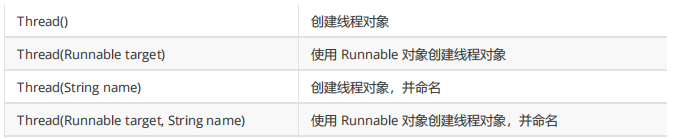
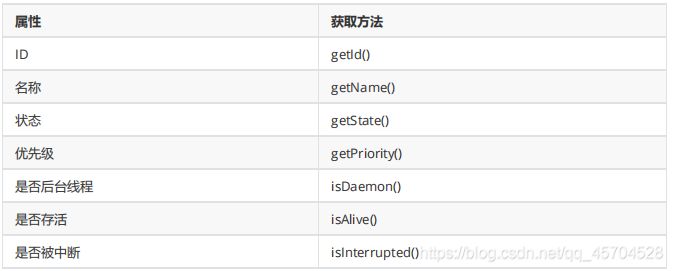
1.構(gòu)造方法和屬性的獲取方法
2.常用方法
<1>run()和start()
public class Thread_Run_VS_Start {
    public static void main(String[] args) {
        new Thread(new Runnable() {
            @Override
            public void run() {
                while (true){

                }
            }
        }).run();
        /**
         * main線程直接調(diào)用Thread對(duì)象的run方法會(huì)直接在main線程
         * 運(yùn)行Thread對(duì)象的run()方法---->傳入的runnable對(duì)象.run()
         * 結(jié)果,main線程直接運(yùn)行while(true)
         *
         * start()是啟動(dòng)一個(gè)線程,調(diào)用新線程的while(true)方法
         * 對(duì)比通過(guò)start()調(diào)用的結(jié)果區(qū)別
         */

        new Thread(new Runnable() {
            @Override
            public void run() {
                while (true){

                }
            }
        }).start();
    }
}
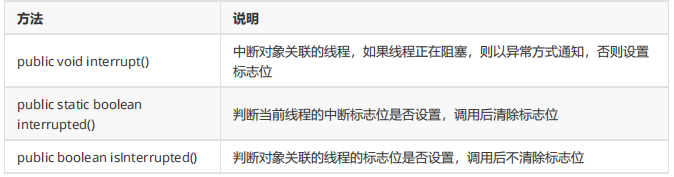
<2>interrupt()方法
public class Interrupt {
    public static void main(String[] args) throws InterruptedException {
        Thread t=new Thread(new Runnable() {
            @Override
            public void run() {

                //...執(zhí)行任務(wù),執(zhí)行時(shí)間可能比較長(zhǎng)
               //運(yùn)行到這里,在t的構(gòu)造方法中不能引用t使用Thread.currentThread()方法,獲取當(dāng)前代碼行所在線程的引用
                for (int i = 0; i <10000&&!Thread.currentThread().isInterrupted() ; i++) {
                    System.out.println(i);
                    //模擬中斷線程
                    try {
                        Thread.sleep(1000);
                        //通過(guò)標(biāo)志位自行實(shí)現(xiàn),無(wú)法解決線程阻塞導(dǎo)致無(wú)法中斷
                        //Thread,sleep(100000)
                    } catch (InterruptedException e) {
                        e.printStackTrace();
                    }
                }
            }
        });
        t.start();//線程啟動(dòng),中斷標(biāo)志位=false
        System.out.println("t start");
        //模擬,t執(zhí)行了5秒,進(jìn)程沒(méi)有結(jié)束,要中斷,停止t線程
        Thread.sleep(5000);

        //未設(shè)置時(shí),isInterrupt為false

        //如果t線程處于阻塞狀態(tài)(休眠等),會(huì)拋出InterruptedException異常
        //并且會(huì)重置isInterrupt中斷標(biāo)志位位false
        t.interrupt();//告訴t線程,要中斷(設(shè)置t線程的中斷標(biāo)志位為true),由t的代碼自行決定是否要中斷
        //isInterrupt設(shè)置為true
        //t.isInterrupted();  Interrupted是線程中的標(biāo)志位
        System.out.println("t stop");


        //注:Thread.interrupted(); 返回當(dāng)前線程的中斷標(biāo)志位,然后重置中斷標(biāo)志位

    }
}
<3>join方法


//join方法:實(shí)例方法:
// 1.無(wú)參:t.join:當(dāng)前線程無(wú)條件等待,直到t線程運(yùn)行完畢
//  2.有參:t.join(1000)等待1秒,或者t線程結(jié)束,哪個(gè)條件滿足,當(dāng)前線程繼續(xù)往下執(zhí)行
public class Join {
    public static void main(String[] args) throws InterruptedException {
        Thread t=new Thread(new Runnable() {
            @Override
            public void run() {
                System.out.println("1");
            }
        });
        t.start();

        t.join();//當(dāng)前線程main線程無(wú)條件等待,直到t線程執(zhí)行完畢,當(dāng)前線程再往后執(zhí)行
       // t.join(1000);當(dāng)前線程等到1秒,或者等t線程執(zhí)行完畢
        System.out.println("ok");

    }
}
<4>獲取當(dāng)前線程的引用currentThread();方法

public class ThreadDemo {
public static void main(String[] args) {
Thread thread = Thread.currentThread();
System.out.println(thread.getName());
}
}
<5>休眠當(dāng)前線程sleep();方法

Thread.sleep(1000);
<6>線程讓步y(tǒng)ield();方法
public class Yield {
    public static void main(String[] args) {
        for(int i=0;i<20;i++){
            final int n=i;
            Thread t=new Thread(new Runnable() {
                @Override
                public void run() {
                    System.out.println(n);
                }
            });
            t.start();
        }
        //判斷:如果活躍的線程數(shù)量大于1,main線程讓步
        while (Thread.activeCount()>1){//記錄活躍線程的數(shù)量
            Thread.yield();
        }//注意:要用debug方式,因?yàn)閞un方式,idea后臺(tái)還會(huì)啟動(dòng)一個(gè)線程
        //實(shí)現(xiàn)ok在1到二十之后打印
        System.out.println("ok");
    }
}
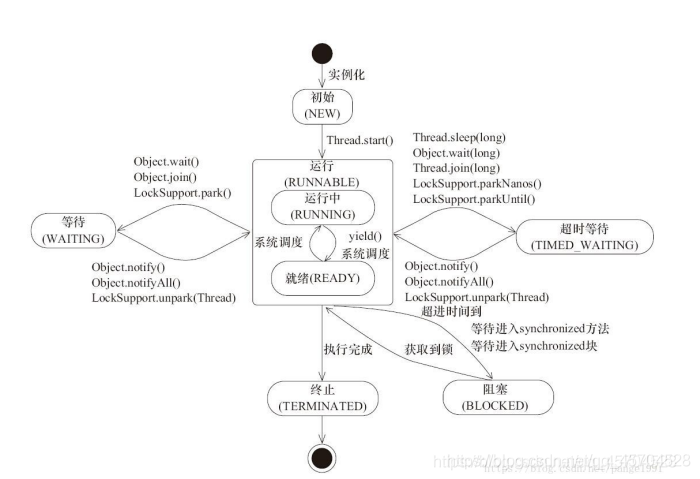
三.線程的生命周期和狀態(tài)轉(zhuǎn)換
四.線程間的通信
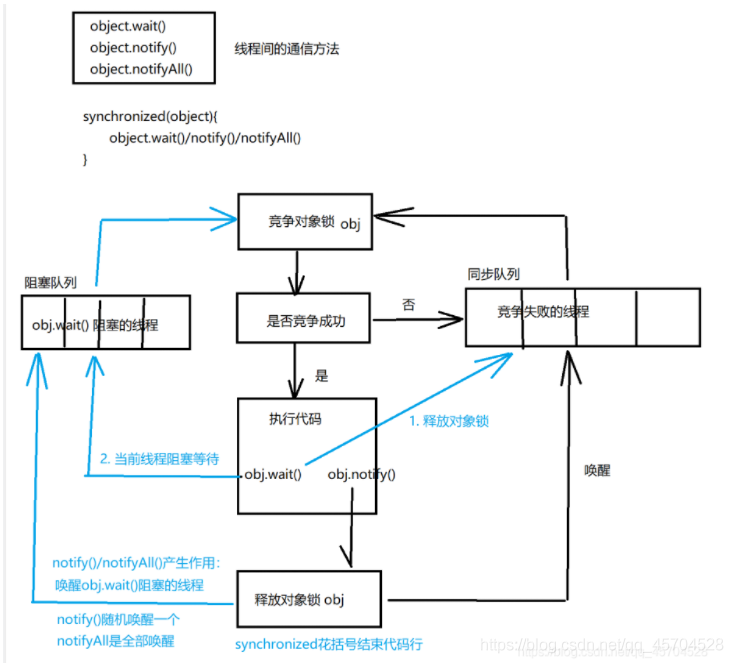
public class SequencePrintHomeWork {
    //有三個(gè)線程,每個(gè)線程只能打印A,B或C
    //要求:同時(shí)執(zhí)行三個(gè)線程,按ABC順序打印,依次打印十次
    //ABC換行 ABC換行。。。。
    //考察知識(shí)點(diǎn):代碼設(shè)計(jì),多線程通信

    public static void main(String[] args) {
        Thread a = new Thread(new Task("A"));
        Thread b = new Thread(new Task("B"));
        Thread c = new Thread(new Task("C"));
        c.start();
        b.start();
        a.start();
    }

    private static class Task implements Runnable{

        private String content;
        //順序打印的內(nèi)容:可以循環(huán)打印
        private static String[] ARR = {"A", "B", "C"};
        private static int INDEX;//從數(shù)組哪個(gè)索引打印

        public Task(String content) {
            this.content = content;
        }

        @Override
        public void run() {
            try {
                for(int i=0; i<10; i++){
                    synchronized (ARR){//三個(gè)線程使用同一把鎖
                        //從數(shù)組索引位置打印,如果當(dāng)前線程要打印的內(nèi)容不一致,釋放對(duì)象鎖等待
                        while(!content.equals(ARR[INDEX])){
                            ARR.wait();
                        }
                        //如果數(shù)組要打印的內(nèi)容和當(dāng)前線程要打印的一致,
                        // 就打印,并把數(shù)組索引切換到一個(gè)位置,通知其他線程
                        System.out.print(content);
                        if(INDEX==ARR.length-1){
                            System.out.println();
                        }
                        INDEX = (INDEX+1)%ARR.length;
                        ARR.notifyAll();
                    }
                }
            } catch (InterruptedException e) {
                e.printStackTrace();
            }
        }
    }
}
五.多線程的安全及解決
1.原子性
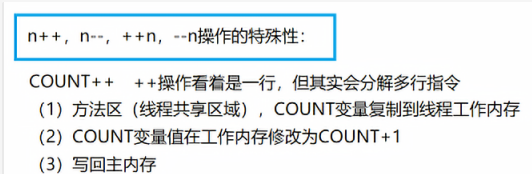
2.可見性
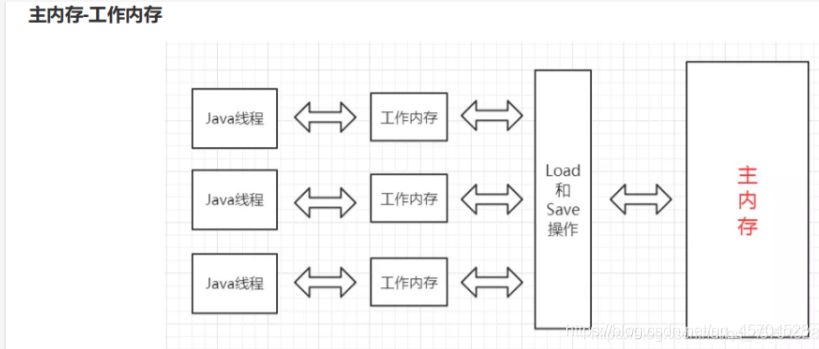
3.代碼的順序性
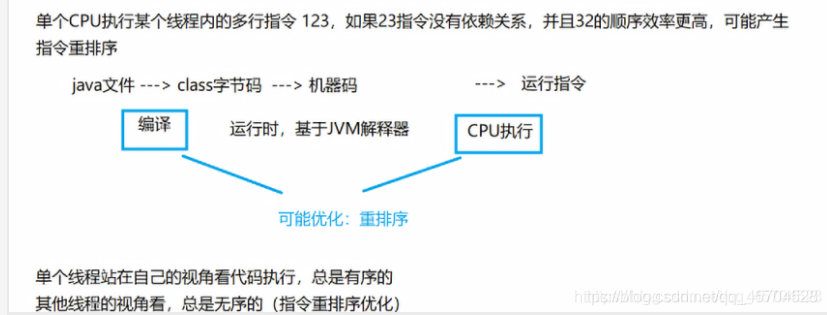
4.線程不安全問(wèn)題的解決
<1>synchronized 關(guān)鍵字
<2>volatile 關(guān)鍵字
public class Test {
    private static boolean flag = true;
    public static void main(String[] args) {
        //創(chuàng)建一個(gè)線程并啟動(dòng)
        new Thread(new Runnable() {
            int i=0;
            @Override
            public void run() {
                while(flag){
                    //這個(gè)語(yǔ)句底層使用了synchronized,保證了可見性
                    //System.out.println("=============");

                    i++;
                }
            }
        }).start();
        try {
            Thread.sleep(1000);
        } catch (InterruptedException e) {
            e.printStackTrace();
        }
        //即使改了,上面的線程flag也不會(huì)改,會(huì)一直循環(huán)
        flag = false;
    }
}
六.鎖體系
1.Synchronized加鎖方式
<1>Synchronized的加鎖方式及語(yǔ)法基礎(chǔ)
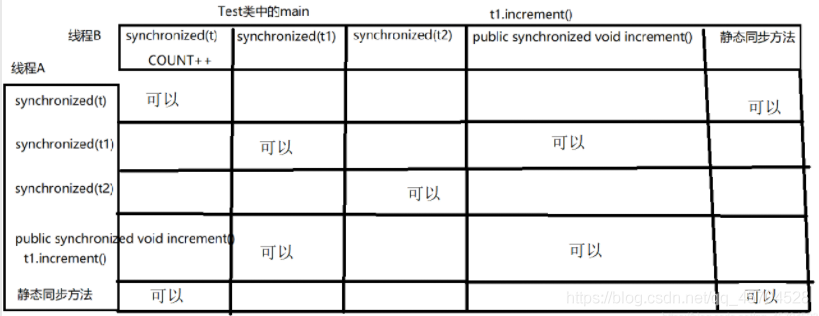
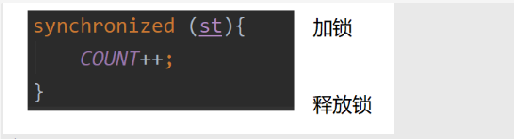
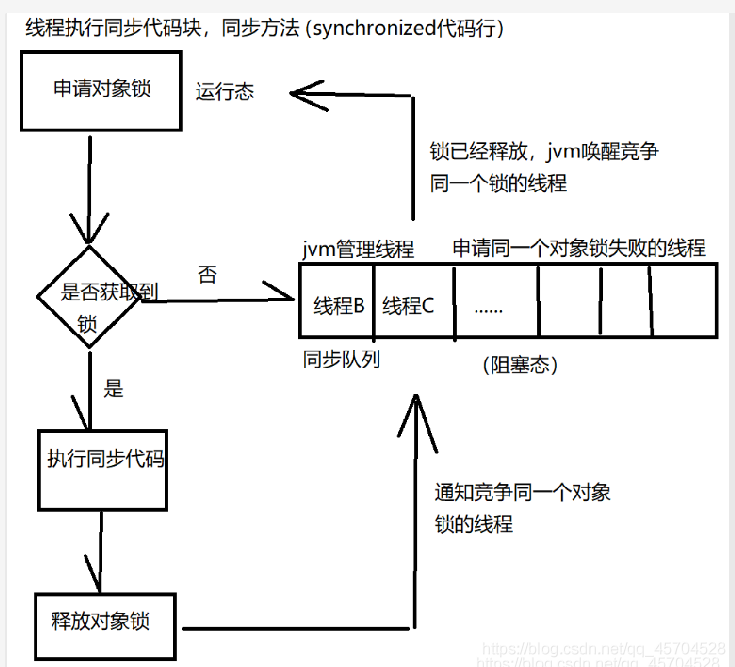
public class SafeThread {
    //有一個(gè)遍歷COUNT=0;同時(shí)啟動(dòng)20個(gè)線程,每個(gè)線程循環(huán)1000次,每次循環(huán)把COUNT++
    //等待二十個(gè)子線程執(zhí)行完畢之后,再main中打印COUNT的值
    //(預(yù)期)count=20000
    private static int COUNT=0;

    //對(duì)當(dāng)前類對(duì)象進(jìn)行加鎖,線程間同步互斥
//    public synchronized static void increment(){
//        COUNT++;
//    }


    //使用不同的對(duì)象加鎖,沒(méi)有同步互斥的效果,并發(fā)并行
//    public static void increment(){
//        synchronized (new SafeThread()){
//            COUNT++;
//        }
//    }
    public static void main(String[] args) throws InterruptedException {
        //盡量同時(shí)啟動(dòng),不讓new線程操作影響
        Class clazz=SafeThread.class;
      Thread[]threads=new Thread[20];
        for (int i = 0; i <20 ; i++) {
            threads[i]=new Thread(new Runnable() {
                @Override
                public void run() {
                    for (int j = 0; j <1000 ; j++) {
                        //給SafeThread對(duì)象加一把鎖
                        synchronized (clazz){
                            COUNT++;
                        }
                    }
                }
            });
        }
        for (int i = 0; i <20 ; i++) {
            threads[i].start();
        }

        //讓main線程等待20個(gè)子線程運(yùn)行完畢
        for (int i = 0; i <20 ; i++) {
            threads[i].join();
        }

        System.out.println(COUNT);
    }
}
<2>Synchronized的原理及實(shí)現(xiàn)
public class Test1 {
    public Test1() {
    }

    public static void main(String[] args) {
        Class var1 = Test1.class;
        synchronized(Test1.class) {
            System.out.println("hello");
        }
    }
}
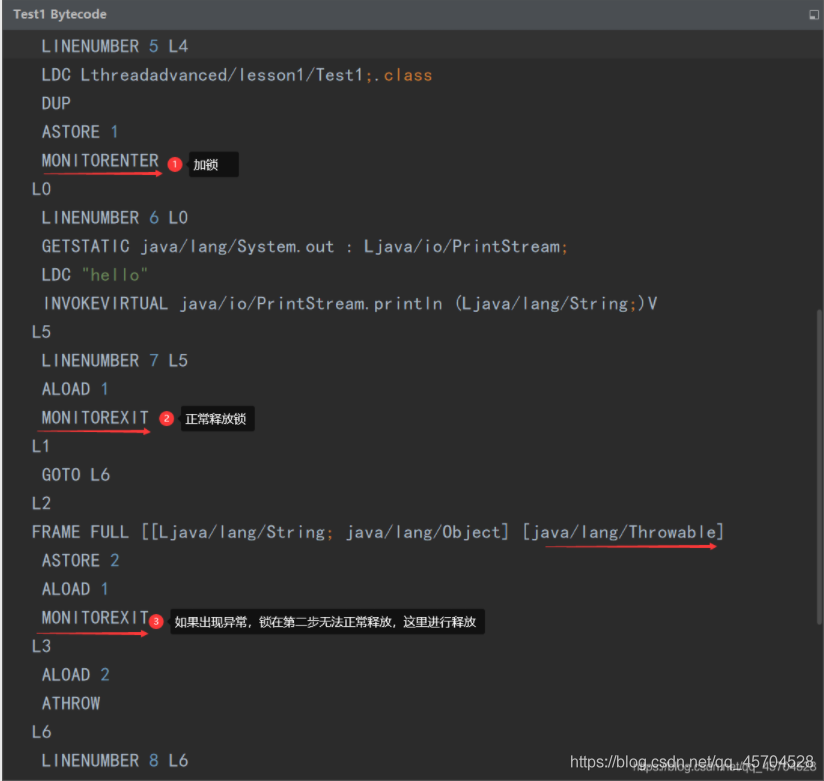
<3>JVM對(duì)Synchronized的優(yōu)化
(1).對(duì)鎖的優(yōu)化
(2).鎖粗話
public class Test {
    private static StringBuffer sb;
    public static void main(String[] args) {
        sb.append("1").append("2").append("3");
    }
}
(3).鎖消除
public class Test {
    public static void main(String[] args) {
        StringBuffer sb=new StringBuffer();
        sb.append("1");
        sb.append("2");
        sb.append("3");
    }
}
2.常見的鎖策略及CAS
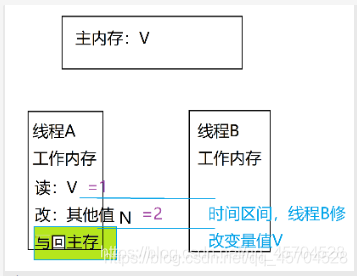
<1>.樂(lè)觀鎖和悲觀鎖
<2>自旋鎖
while(搶鎖(lock)==失敗{}
<3>可重入鎖
public class Test2 {
    public static synchronized void t1(){
        t2();
    }
    public static synchronized void t2(){

    }
    public static void main(String[] args) {
        t1();
    }
}
3.Lock體系
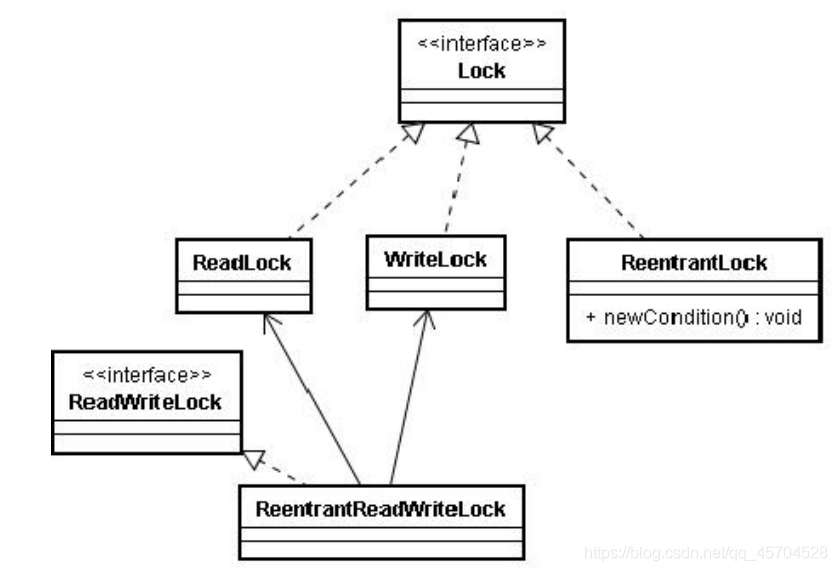
<1>Lock接口
(1)使用Lock鎖實(shí)現(xiàn)線程同步
public class AccountRunnable implements  Runnable {
    private Account account = new Account();
    //買一把鎖
    Lock lock = new ReentrantLock(); //Re-entrant-Lock  可重入鎖
    @Override
    public void run() {
        //此處省略300句
        try{
//上鎖
            lock.lock();
            //判斷余額是否足夠,夠,取之;不夠,不取之;
            if(account.getBalance()>=400){
                try {
                    Thread.sleep(1);
                } catch (InterruptedException e) {
                    e.printStackTrace();
                }
                method1();
                //取之
                account.withDraw(400);
                //輸出信息
                System.out.println(Thread.currentThread().getName()+
                   "取款成功,現(xiàn)在的余額是"+account.getBalance());
            }else{
                 System.out.println("余額不足,"+Thread.currentThread().getName()
                 +"取款失敗,現(xiàn)在的余額是"   +account.getBalance());
            }
        }finally {
            //解鎖
            lock.unlock();
        }
        //此處省略100句
    }
}
(2)Lock加鎖的四種方式
<2>AQS簡(jiǎn)單認(rèn)識(shí)

<3>ReentrantLock
(1)ReentrantLock基本概念
(2)自己實(shí)現(xiàn)一個(gè)簡(jiǎn)單的ReentrantLock
public class Test2 {
    volatile int status=0;
    Queue parkQueue;//集合 數(shù)組  list
    void lock(){
        while(!compareAndSet(0,1)){
            //這里不能用sleep或yield實(shí)現(xiàn)
            //sleep無(wú)法確定睡眠的時(shí)間
            //yield只能用于兩個(gè)線程競(jìng)爭(zhēng),當(dāng)有多個(gè)線程之后,t1搶不到鎖,yield會(huì)讓出cpu,但是可能下一次cpu還是調(diào)t1
            park();
        }
        unlock();
    }
    void unlock(){
        lock_notify();
    }
    void park(){
        //將當(dāng)期線程加入到等待隊(duì)列
        parkQueue.add(currentThread);
        //將當(dāng)期線程釋放cpu  阻塞   睡眠
        releaseCpu();
    }
    void lock_notify(){
        //status=0
        //得到要喚醒的線程頭部線程
        Thread t=parkQueue.header();
        //喚醒等待線程
        unpark(t);
    }
}
(3)ReentrantLock部分源碼分析
//非公平鎖
 public ReentrantLock() {
        sync = new NonfairSync();
    }
//公平鎖
 public ReentrantLock(boolean fair) {
        sync = fair ? new FairSync() : new NonfairSync();
    }
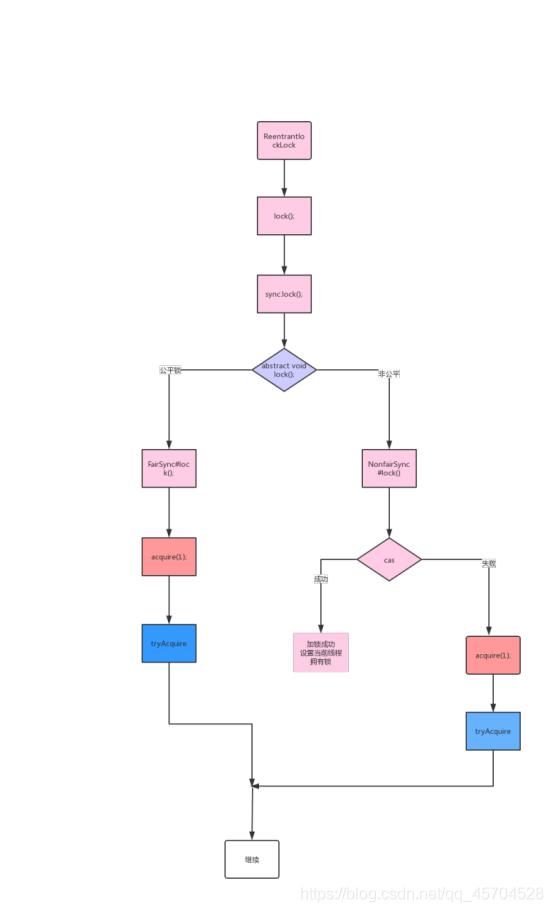
final void lock() {
    if (compareAndSetState(0, 1))//首先用一個(gè)CAS操作,判斷state是否是0(表示當(dāng)前鎖未被占用)
        setExclusiveOwnerThread(Thread.currentThread());//設(shè)置當(dāng)前占有鎖的線程為該線程
    else
        acquire(1);
}
public final void acquire(int arg) {
    //首先看看自己要不要排隊(duì),如果不用排隊(duì),獲取鎖,要排隊(duì),加入AQS隊(duì)列
    if (!tryAcquire(arg) &&
        acquireQueued(addWaiter(Node.EXCLUSIVE), arg))
        selfInterrupt();
}
tryAcquire(arg)
final boolean nonfairTryAcquire(int acquires) {
    //獲取當(dāng)前線程
    final Thread current = Thread.currentThread();
    //獲取state變量值
    int c = getState();
    if (c == 0) { //沒(méi)有線程占用鎖
        if (compareAndSetState(0, acquires)) {
            //占用鎖成功,設(shè)置獨(dú)占線程為當(dāng)前線程
            setExclusiveOwnerThread(current);
            return true;
        }
    } else if (current == getExclusiveOwnerThread()) { //當(dāng)前線程已經(jīng)占用該鎖 重入鎖
        int nextc = c + acquires;
        if (nextc < 0) // overflow
            throw new Error("Maximum lock count exceeded");
        // 更新state值為新的重入次數(shù)
        setState(nextc);
        return true;
    }
    //獲取鎖失敗
    return false;
}
<4>ReadWriteLock鎖
public   interface   ReadWriteLock {
      Lock readLock();
      Lock writeLock();
}
public class TestLock {
    public static void main(String[] args) {
//默認(rèn)也是非公平鎖  也是可重入鎖
        ReadWriteLock rwl = new ReentrantReadWriteLock();
        //多次返回的都是同一把讀鎖 同一把寫鎖
        Lock readLock = rwl.readLock();
        Lock readLock2 = rwl.readLock();
        Lock writeLock = rwl.writeLock();
        readLock.lock();
        readLock.unlock();
        System.out.println(readLock==readLock2);
    }
}
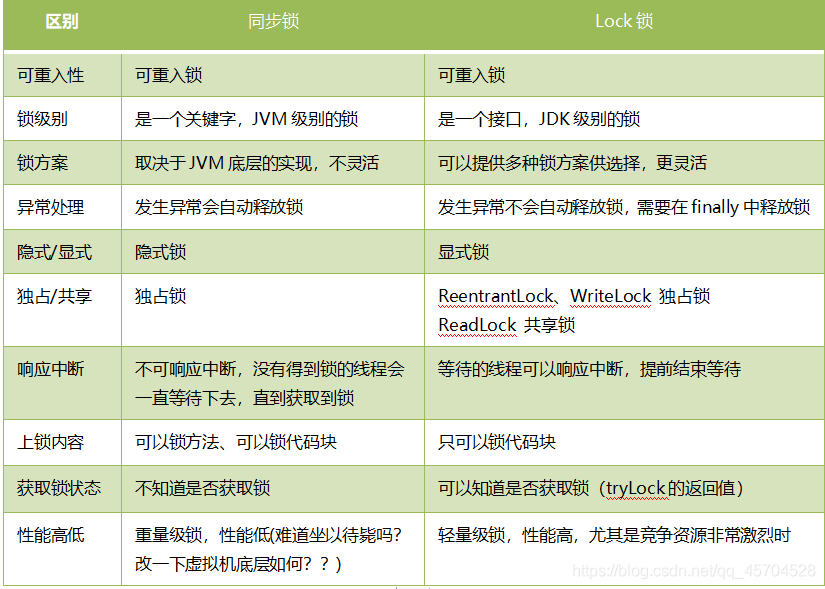
4.Lock鎖和同步鎖(synchronized)的區(qū)別
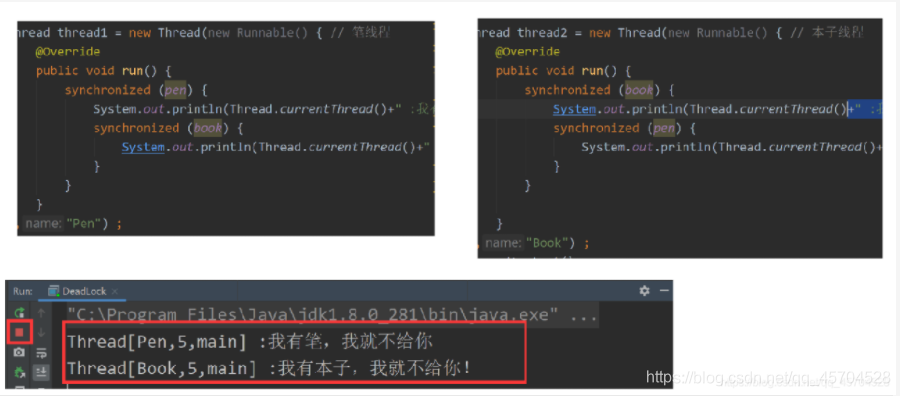
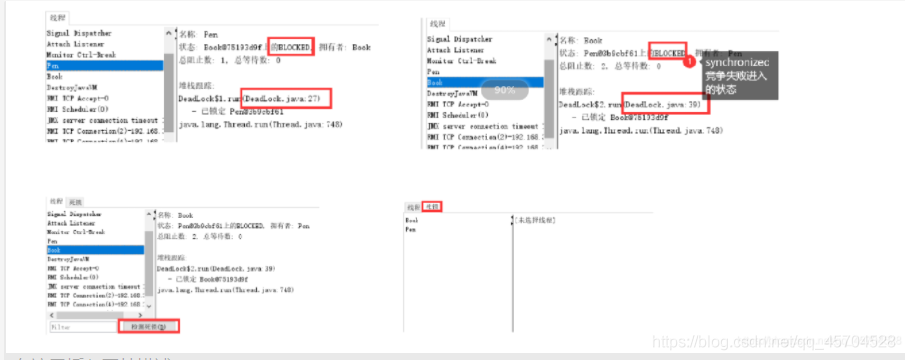
5.死鎖
package threadadvanced.lesson1;

class Pen {
 private String pen = "筆" ;
 public String getPen() {
  return pen;
 }
}
class Book {
 private String book = "本" ;
 public String getBook() {
  return book;
 }
}
public class DeadLock {
 private static Pen pen = new Pen() ;
 private static Book book = new Book() ;
 public static void main(String[] args) {
  new DeadLock().deadLock();
 }
 public void deadLock() {
  Thread thread1 = new Thread(new Runnable() { // 筆線程
   @Override
   public void run() {
    synchronized (pen) {
     try {
      Thread.sleep(1000);
     } catch (InterruptedException e) {
      e.printStackTrace();
     }
     System.out.println(Thread.currentThread()+" :我有筆,我就不給你");
     synchronized (book) {
      System.out.println(Thread.currentThread()+" :把你的本給我!");
     }
    }
   }
  },"Pen") ;

  Thread thread2 = new Thread(new Runnable() { // 本子線程
   @Override
   public void run() {
    synchronized (book) {
     System.out.println(Thread.currentThread()+" :我有本子,我就不給你!");
     synchronized (pen) {
      System.out.println(Thread.currentThread()+" :把你的筆給我!");
     }
    }

   }
  },"Book") ;
  thread1.start();
  thread2.start();
 }
}
七.多線程案例
1.生產(chǎn)者消費(fèi)者問(wèn)題
/**
* 面包店
* 10個(gè)生產(chǎn)者,每個(gè)每次生產(chǎn)3個(gè)
* 20個(gè)消費(fèi)者,每個(gè)每次消費(fèi)一個(gè)
*
* 進(jìn)階版需求
* 面包師傅每個(gè)最多生產(chǎn)30次,面包店每天生產(chǎn)10*30*3=900個(gè)面包
* 消費(fèi)者也不是一直消費(fèi)。把900個(gè)面包消費(fèi)完結(jié)束
*
* 隱藏信息:面包店每天生產(chǎn)面包的最大數(shù)量為900個(gè)
* 消費(fèi)者把900個(gè)面包消費(fèi)完結(jié)束
*/
public class AdvancedBreadShop {
//面包店庫(kù)存數(shù)
private static int COUNT;
//面包店生產(chǎn)面包的總數(shù),不會(huì)消費(fèi)的
private static int PRODUCE_NUMBER;
public static class Consumer implements Runnable{
private String name;
public Consumer(String name) {
this.name = name;
}
@Override
public void run() {
try {
while (true){
synchronized (AdvancedBreadShop.class){
if(PRODUCE_NUMBER==900&&COUNT==0){
System.out.println("今天面包已經(jīng)賣完了");
break;
}else {
if(COUNT==0){
AdvancedBreadShop.class.wait();
}else {
System.out.printf("%s消費(fèi)了一個(gè)面包\n",this.name);
COUNT--;
AdvancedBreadShop.class.notifyAll();
Thread.sleep(100);
}
}
}
Thread.sleep(100);
}
} catch (InterruptedException e) {
e.printStackTrace();
}
}
}
private static class Producer implements Runnable{
private String name;
public Producer(String name) {
this.name = name;
}
@Override
public void run() {
try {
//生產(chǎn)者生產(chǎn)30次,結(jié)束循環(huán)
for(int i=0;i<=30;i++) {
synchronized (AdvancedBreadShop.class){
if(i==30){
System.out.println("今天面包生產(chǎn)完了");
break;
}else {
if(COUNT>97){
AdvancedBreadShop.class.wait();
}else {
COUNT=COUNT+3;
PRODUCE_NUMBER=PRODUCE_NUMBER+3;
System.out.printf("%s生產(chǎn)了三個(gè)面包\n",this.name);
AdvancedBreadShop.class.notifyAll();
Thread.sleep(100);
}
}
}
Thread.sleep(100);
}
} catch (InterruptedException e) {
e.printStackTrace();
}
}
}
public static void main(String[] args) {
Thread[] Consumers=new Thread[20];
Thread[] Producers=new Thread[10];
for (int i = 0; i <20 ; i++) {
Consumers[i]=new Thread(new Consumer(String.valueOf(i)));
}
for (int i = 0; i <10 ; i++) {
Producers[i]=new Thread(new Producer(String.valueOf(i)));
}
for (int i = 0; i <20 ; i++) {
Consumers[i].start();
}
for (int i = 0; i <10 ; i++) {
Producers[i].start();
}
}
}2.單例模式
public class Singleton {
    //volatile關(guān)鍵字修飾,保證的可見性和代碼的順序性
    private static volatile Singleton instance = null;

    private Singleton() {
    }

    public static Singleton getInstance() {
        //判斷instance是否為空,競(jìng)爭(zhēng)鎖的條件
        if (instance == null) {
            //保證線程安全,為Singleton.class加鎖
            synchronized (Singleton.class) {
                //再次判斷instance是否為空,防止多個(gè)線程進(jìn)入第一個(gè)if后
                //對(duì)synchronized鎖競(jìng)爭(zhēng)失敗進(jìn)入阻塞狀態(tài)后,再次進(jìn)入運(yùn)行態(tài)時(shí)
                //new了多個(gè)Singleton,不符合單例模式
                //保證線程安全
                if (instance == null) {
                    instance = new Singleton();
                }
            }
        }
        return instance;
        }
        }
3.阻塞式隊(duì)列
/**
 * 實(shí)現(xiàn)阻塞隊(duì)列
 * 1.線程安全問(wèn)題:在多線程情況下,put,take不具有原子性,4個(gè)屬性,不具有可見性
 * 2.put操作:如果存滿了,需要阻塞等待。take操作:如果是空,阻塞等待
 * @param <T>
 */
public class MyBlockingQueue <T>{
    //使用數(shù)組實(shí)現(xiàn)循環(huán)隊(duì)列
    private Object[] queue;

    //存放元素的索引
    private int putIndex ;

    //取元素的索引
    private int takeIndex;

    //當(dāng)前存放元素的數(shù)量
    private int size;
    public MyBlockingQueue(int len){
        queue=new Object[len];
    }

    //存放元素,需要考慮:
    //1.putIndex超過(guò)數(shù)組長(zhǎng)度
    //2.size達(dá)到數(shù)組最大長(zhǎng)度
    public synchronized void put(T e) throws InterruptedException {
        //不滿足執(zhí)行條件時(shí),一直阻塞等待
        //當(dāng)阻塞等待都被喚醒并再次競(jìng)爭(zhēng)成功對(duì)象鎖,回復(fù)往下執(zhí)行時(shí),條件可能被其他線程修改
        while (size==queue.length){
            this.wait();
        }
        //存放到數(shù)組中放元素的索引位置
        queue[putIndex]=e;
        putIndex=(putIndex+1)%queue.length;
        size++;
        notifyAll();
    }

    //取元素
    public synchronized T take() throws InterruptedException {
       while (size==0){
            this.wait();
        }
        T t= (T) queue[takeIndex];
        queue[takeIndex]=null;
        takeIndex=(takeIndex+1)%queue.length;
        size--;
        notifyAll();
        return t;
    }

    public int size(){
        return size;
    }

    public static void main(String[] args) {
        MyBlockingQueue<Integer>queue=new MyBlockingQueue<>(10);
        //多線程的調(diào)試方式:1.寫打印語(yǔ)句 2.jconsole
        for (int i = 0; i <3 ; i++) {
            new Thread(new Runnable() {
                @Override
                public void run() {
                    try {
                        for (int j = 0; j <100 ; j++) {
                            queue.put(j);
                        }
                    } catch (InterruptedException e) {
                        e.printStackTrace();
                    }
                }
            }).start();
        }

        for (int i = 0; i <3 ; i++) {
            new Thread(new Runnable() {
                @Override
                public void run() {
                    try {
                       while (true){
                          int t= queue.take();
                           System.out.println(Thread.currentThread().getName()+":"+t);
                       }
                    } catch (InterruptedException e) {
                        e.printStackTrace();
                    }
                }
            }).start();
        }
    }
}
4.線程池
import java.util.concurrent.*;

public class ThreadPoolExecutorTest {
    public static void main(String[] args) {
        //以快遞公司,快遞員,快遞業(yè)務(wù)為模型
        ThreadPoolExecutor pool=new ThreadPoolExecutor(
                5,//核心線程數(shù)---->正式員工數(shù)
                10,//最大線程數(shù)-->正式員工+臨時(shí)員工
                60,//臨時(shí)工的最大等待時(shí)間
                TimeUnit.SECONDS,//idle線程的空閑時(shí)間-->臨時(shí)工最大的存活時(shí)間,超過(guò)就解雇
                new LinkedBlockingQueue<>(),//阻塞隊(duì)列,任務(wù)存放的地方--->快遞倉(cāng)庫(kù)
                new ThreadFactory() {
                    @Override
                    public Thread newThread(Runnable r) {
                        return new Thread(new Runnable() {
                            @Override
                            public void run() {
                                //r對(duì)象是線程池內(nèi)部封裝過(guò)的工作任務(wù)類(Worker),會(huì)一直循環(huán)等待的方式從阻塞隊(duì)列中拿取任務(wù)并執(zhí)行
                                //所以不能調(diào)用r.run();方法
                                System.out.println(Thread.currentThread().getName()+"開始執(zhí)行了");
                            }
                        });
                    }
                },//創(chuàng)建線程的工廠類  線程池創(chuàng)建線程時(shí),調(diào)用該工廠類的方法創(chuàng)建線程(滿足該工廠創(chuàng)建線程的要求)
                   //---->對(duì)應(yīng)招聘員工的標(biāo)準(zhǔn)

                /**
                 * 拒絕策略:達(dá)到最大線程數(shù)且阻塞隊(duì)列已滿,采取拒絕策略
                 * AbortPolicy:直接拋出RejectedExecutionException(不提供handler時(shí)的默認(rèn)策略)
                 * CallerRunsPolicy:誰(shuí)(某個(gè)線程)交給我(線程池)的任務(wù),我拒絕執(zhí)行,由誰(shuí)自己去執(zhí)行
                 * DiscardPolicy:交給我的任務(wù)直接丟棄掉
                 * DiscardOldestPolicy:阻塞隊(duì)列中最舊的任務(wù)丟棄
                 */
                new ThreadPoolExecutor.AbortPolicy()//拒絕策略-->達(dá)到最大線程數(shù),且阻塞隊(duì)列已滿,采取的拒絕策略
        );//線程池創(chuàng)建以后,只要有任務(wù)們就會(huì)自動(dòng)執(zhí)行

        for (int i = 0; i <20 ; i++) {
            //線程池執(zhí)行任務(wù):execute方法,submit方法--->提交執(zhí)行一個(gè)任務(wù)
            //區(qū)別:返回值不同
            pool.execute(new Runnable() {
                @Override
                public void run() {
                    try {
                        Thread.sleep(1000);
                    } catch (InterruptedException e) {
                        e.printStackTrace();
                    }
                }
            });
        }
        //線程池有4個(gè)快捷的創(chuàng)建方式(實(shí)際工作不使用,作為面試了解)
        //實(shí)際工作需要使用ThreadPoolExecutor,構(gòu)造參數(shù)是我們自己指定,比較靈活
        ExecutorService pool2=Executors.newSingleThreadExecutor();//創(chuàng)建單線程池
        ExecutorService pool3=Executors.newCachedThreadPool();//緩存的線程池
        ExecutorService pool5=Executors.newFixedThreadPool(4);//固定大小線程池
        ScheduledExecutorService pool4=Executors.newScheduledThreadPool(4);//計(jì)劃任務(wù)線程池

        //兩秒中之后執(zhí)行這個(gè)任務(wù)
        pool4.schedule(new Runnable() {
            @Override
            public void run() {
                System.out.println("hello");
            }
        }, 2, TimeUnit.SECONDS);

        //一直執(zhí)行任務(wù)
        pool4.scheduleAtFixedRate(new Runnable() {
            @Override
            public void run() {
                System.out.println("hello");
            }
        }, 2, 1,TimeUnit.SECONDS);//比如一個(gè)腦子,兩秒后開始叫我,然后每隔一秒叫我一次
    }
}
————————————————
版權(quán)聲明:本文為CSDN博主「Serendipity  sn」的原創(chuàng)文章,遵循CC 4.0 BY-SA版權(quán)協(xié)議,轉(zhuǎn)載請(qǐng)附上原文出處鏈接及本聲明。
原文鏈接:https://blog.csdn.net/qq_45704528/article/details/117353110
版權(quán)聲明:本文為博主原創(chuàng)文章,遵循 CC 4.0 BY-SA 版權(quán)協(xié)議,轉(zhuǎn)載請(qǐng)附上原文出處鏈接和本聲明。
本文鏈接:
https://blog.csdn.net/qq_45704528/article/details/117353110

評(píng)論
圖片
表情