
Controller 層代碼就該這么寫(xiě),簡(jiǎn)潔又優(yōu)雅!

說(shuō)到 Controller,相信大家都不陌生,它可以很方便地對(duì)外提供數(shù)據(jù)接口。它的定位,我認(rèn)為是「不可或缺的配角」,說(shuō)它不可或缺是因?yàn)闊o(wú)論是傳統(tǒng)的三層架構(gòu)還是現(xiàn)在的COLA架構(gòu),Controller 層依舊有一席之地,說(shuō)明他的必要性;說(shuō)它是配角是因?yàn)?Controller 層的代碼一般是不負(fù)責(zé)具體的邏輯業(yè)務(wù)邏輯實(shí)現(xiàn),但是它負(fù)責(zé)接收和響應(yīng)請(qǐng)求
從現(xiàn)狀看問(wèn)題
Controller 主要的工作有以下幾項(xiàng)
-
接收請(qǐng)求并解析參數(shù) -
調(diào)用 Service 執(zhí)行具體的業(yè)務(wù)代碼(可能包含參數(shù)校驗(yàn)) -
捕獲業(yè)務(wù)邏輯異常做出反饋 -
業(yè)務(wù)邏輯執(zhí)行成功做出響應(yīng)
//DTO
@Data
public class TestDTO {
    private Integer num;
    private String type;
}


//Service
@Service
public class TestService {

    public Double service(TestDTO testDTO) throws Exception {
        if (testDTO.getNum() <= 0) {
            throw new Exception("輸入的數(shù)字需要大于0");
        }
        if (testDTO.getType().equals("square")) {
            return Math.pow(testDTO.getNum(), 2);
        }
        if (testDTO.getType().equals("factorial")) {
            double result = 1;
            int num = testDTO.getNum();
            while (num > 1) {
                result = result * num;
                num -= 1;
            }
            return result;
        }
        throw new Exception("未識(shí)別的算法");
    }
}


//Controller
@RestController
public class TestController {

    private TestService testService;

    @PostMapping("/test")
    public Double test(@RequestBody TestDTO testDTO) {
        try {
            Double result = this.testService.service(testDTO);
            return result;
        } catch (Exception e) {
            throw new RuntimeException(e);
        }
    }

    @Autowired
    public DTOid setTestService(TestService testService) {
        this.testService = testService;
    }
}
如果真的按照上面所列的工作項(xiàng)來(lái)開(kāi)發(fā) Controller 代碼會(huì)有幾個(gè)問(wèn)題
-
參數(shù)校驗(yàn)過(guò)多地耦合了業(yè)務(wù)代碼,違背單一職責(zé)原則 -
可能在多個(gè)業(yè)務(wù)中都拋出同一個(gè)異常,導(dǎo)致代碼重復(fù) -
各種異常反饋和成功響應(yīng)格式不統(tǒng)一,接口對(duì)接不友好
改造 Controller 層邏輯
統(tǒng)一返回結(jié)構(gòu)
統(tǒng)一返回值類型無(wú)論項(xiàng)目前后端是否分離都是非常必要的,方便對(duì)接接口的開(kāi)發(fā)人員更加清晰地知道這個(gè)接口的調(diào)用是否成功(不能僅僅簡(jiǎn)單地看返回值是否為 null 就判斷成功與否,因?yàn)橛行┙涌诘脑O(shè)計(jì)就是如此),使用一個(gè)狀態(tài)碼、狀態(tài)信息就能清楚地了解接口調(diào)用情況
//定義返回?cái)?shù)據(jù)結(jié)構(gòu)
public interface IResult {
    Integer getCode();
    String getMessage();
}

//常用結(jié)果的枚舉
public enum ResultEnum implements IResult {
    SUCCESS(2001, "接口調(diào)用成功"),
    VALIDATE_FAILED(2002, "參數(shù)校驗(yàn)失敗"),
    COMMON_FAILED(2003, "接口調(diào)用失敗"),
    FORBIDDEN(2004, "沒(méi)有權(quán)限訪問(wèn)資源");

    private Integer code;
    private String message;

    //省略get、set方法和構(gòu)造方法
}

//統(tǒng)一返回?cái)?shù)據(jù)結(jié)構(gòu)
@Data
@NoArgsConstructor
@AllArgsConstructor
public class Result<T> {
    private Integer code;
    private String message;
    private T data;

    public static <T> Result<T> success(T data) {
        return new Result<>(ResultEnum.SUCCESS.getCode(), ResultEnum.SUCCESS.getMessage(), data);
    }

    public static <T> Result<T> success(String message, T data) {
        return new Result<>(ResultEnum.SUCCESS.getCode(), message, data);
    }

    public static Result<?> failed() {
        return new Result<>(ResultEnum.COMMON_FAILED.getCode(), ResultEnum.COMMON_FAILED.getMessage(), null);
    }

    public static Result<?> failed(String message) {
        return new Result<>(ResultEnum.COMMON_FAILED.getCode(), message, null);
    }

    public static Result<?> failed(IResult errorResult) {
        return new Result<>(errorResult.getCode(), errorResult.getMessage(), null);
    }

    public static <T> Result<T> instance(Integer code, String message, T data) {
        Result<T> result = new Result<>();
        result.setCode(code);
        result.setMessage(message);
        result.setData(data);
        return result;
    }
}
統(tǒng)一返回結(jié)構(gòu)后,在 Controller 中就可以使用了,但是每一個(gè) Controller 都寫(xiě)這么一段最終封裝的邏輯,這些都是很重復(fù)的工作,所以還要繼續(xù)想辦法進(jìn)一步處理統(tǒng)一返回結(jié)構(gòu)
統(tǒng)一包裝處理
Spring 中提供了一個(gè)類 ResponseBodyAdvice ,能幫助我們實(shí)現(xiàn)上述需求
ResponseBodyAdvice 是對(duì) Controller 返回的內(nèi)容在 HttpMessageConverter 進(jìn)行類型轉(zhuǎn)換之前攔截,進(jìn)行相應(yīng)的處理操作后,再將結(jié)果返回給客戶端。那這樣就可以把統(tǒng)一包裝的工作放到這個(gè)類里面。
public interface ResponseBodyAdvice<T> {
    boolean supports(MethodParameter returnType, Class<? extends HttpMessageConverter<?>> converterType);

    @Nullable
    T beforeBodyWrite(@Nullable T body, MethodParameter returnType, MediaType selectedContentType, Class<? extends HttpMessageConverter<?>> selectedConverterType, ServerHttpRequest request, ServerHttpResponse response);
}
-
supports:判斷是否要交給 beforeBodyWrite 方法執(zhí)行,ture:需要;false:不需要 -
beforeBodyWrite:對(duì) response 進(jìn)行具體的處理
// 如果引入了swagger或knife4j的文檔生成組件,這里需要僅掃描自己項(xiàng)目的包,否則文檔無(wú)法正常生成
@RestControllerAdvice(basePackages = "com.example.demo")
public class ResponseAdvice implements ResponseBodyAdvice<Object> {
    @Override
    public boolean supports(MethodParameter returnType, Class<? extends HttpMessageConverter<?>> converterType) {
        // 如果不需要進(jìn)行封裝的,可以添加一些校驗(yàn)手段,比如添加標(biāo)記排除的注解
        return true;
    }


    @Override
    public Object beforeBodyWrite(Object body, MethodParameter returnType, MediaType selectedContentType, Class<? extends HttpMessageConverter<?>> selectedConverterType, ServerHttpRequest request, ServerHttpResponse response) {
        // 提供一定的靈活度,如果body已經(jīng)被包裝了,就不進(jìn)行包裝
        if (body instanceof Result) {
            return body;
        }
        return Result.success(body);
    }
}
經(jīng)過(guò)這樣改造,既能實(shí)現(xiàn)對(duì) Controller 返回的數(shù)據(jù)進(jìn)行統(tǒng)一包裝,又不需要對(duì)原有代碼進(jìn)行大量的改動(dòng)
處理 cannot be cast to java.lang.String 問(wèn)題
如果直接使用 ResponseBodyAdvice,對(duì)于一般的類型都沒(méi)有問(wèn)題,當(dāng)處理字符串類型時(shí),會(huì)拋出 xxx.包裝類 cannot be cast to java.lang.String 的類型轉(zhuǎn)換的異常
在 ResponseBodyAdvice 實(shí)現(xiàn)類中 debug 發(fā)現(xiàn),只有 String 類型的 selectedConverterType 參數(shù)值是 org.springframework.http.converter.StringHttpMessageConverter,而其他數(shù)據(jù)類型的值是 org.springframework.http.converter.json.MappingJackson2HttpMessageConverter
-
String 類型
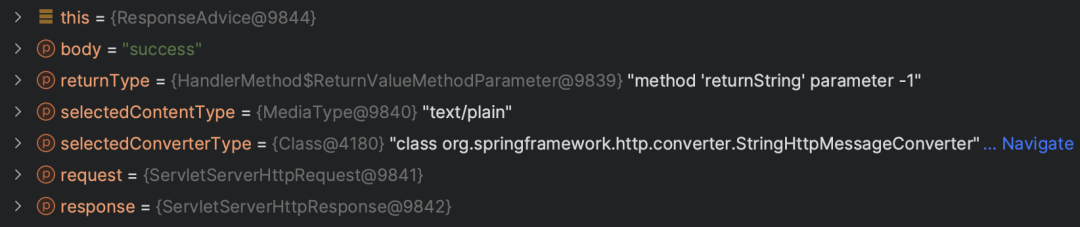
-
其他類型 (如 Integer 類型)

現(xiàn)在問(wèn)題已經(jīng)較為清晰了,因?yàn)槲覀冃枰祷匾粋€(gè) Result 對(duì)象
所以使用 MappingJackson2HttpMessageConverter 是可以正常轉(zhuǎn)換的
而使用 StringHttpMessageConverter 字符串轉(zhuǎn)換器會(huì)導(dǎo)致類型轉(zhuǎn)換失敗
現(xiàn)在處理這個(gè)問(wèn)題有兩種方式
-
在
beforeBodyWrite方法處進(jìn)行判斷,如果返回值是 String 類型就對(duì)Result對(duì)象手動(dòng)進(jìn)行轉(zhuǎn)換成 JSON 字符串,另外方便前端使用,最好在@RequestMapping中指定 ContentType@RestControllerAdvice(basePackages = "com.example.demo")
public class ResponseAdvice implements ResponseBodyAdvice<Object> {
...
@Override
public Object beforeBodyWrite(Object body, MethodParameter returnType, MediaType selectedContentType, Class<? extends HttpMessageConverter<?>> selectedConverterType, ServerHttpRequest request, ServerHttpResponse response) {
// 提供一定的靈活度,如果body已經(jīng)被包裝了,就不進(jìn)行包裝
if (body instanceof Result) {
return body;
}
// 如果返回值是String類型,那就手動(dòng)把Result對(duì)象轉(zhuǎn)換成JSON字符串
if (body instanceof String) {
try {
return this.objectMapper.writeValueAsString(Result.success(body));
} catch (JsonProcessingException e) {
throw new RuntimeException(e);
}
}
return Result.success(body);
}
...
}
@GetMapping(value = "/returnString", produces = "application/json; charset=UTF-8")
public String returnString() {
return "success";
} -
修改
HttpMessageConverter實(shí)例集合中MappingJackson2HttpMessageConverter的順序。因?yàn)榘l(fā)生上述問(wèn)題的根源所在是集合中StringHttpMessageConverter的順序先于MappingJackson2HttpMessageConverter的,調(diào)整順序后即可從根源上解決這個(gè)問(wèn)題 -
網(wǎng)上有不少做法是直接在集合中第一位添加
MappingJackson2HttpMessageConverter@Configuration
public class WebConfiguration implements WebMvcConfigurer {
@Override
public void configureMessageConverters(List<HttpMessageConverter<?>> converters) {
converters.add(0, new MappingJackson2HttpMessageConverter());
}
} -
誠(chéng)然,這種方式可以解決問(wèn)題,但其實(shí)問(wèn)題的根源不是集合中缺少這一個(gè)轉(zhuǎn)換器,而是轉(zhuǎn)換器的順序?qū)е碌模宰詈侠淼淖龇☉?yīng)該是調(diào)整
MappingJackson2HttpMessageConverter在集合中的順序@Configuration
public class WebMvcConfiguration implements WebMvcConfigurer {
/**
* 交換MappingJackson2HttpMessageConverter與第一位元素
* 讓返回值類型為String的接口能正常返回包裝結(jié)果
*
* @param converters initially an empty list of converters
*/
@Override
public void configureMessageConverters(List<HttpMessageConverter<?>> converters) {
for (int i = 0; i < converters.size(); i++) {
if (converters.get(i) instanceof MappingJackson2HttpMessageConverter) {
MappingJackson2HttpMessageConverter mappingJackson2HttpMessageConverter = (MappingJackson2HttpMessageConverter) converters.get(i);
converters.set(i, converters.get(0));
converters.set(0, mappingJackson2HttpMessageConverter);
break;
}
}
}
}
參數(shù)校驗(yàn)
Java API 的規(guī)范 JSR303 定義了校驗(yàn)的標(biāo)準(zhǔn) validation-api ,其中一個(gè)比較出名的實(shí)現(xiàn)是 hibernate validation ,spring validation 是對(duì)其的二次封裝,常用于 SpringMVC 的參數(shù)自動(dòng)校驗(yàn),參數(shù)校驗(yàn)的代碼就不需要再與業(yè)務(wù)邏輯代碼進(jìn)行耦合了
@PathVariable 和 @RequestParam 參數(shù)校驗(yàn)
Get 請(qǐng)求的參數(shù)接收一般依賴這兩個(gè)注解,但是處于 url 有長(zhǎng)度限制和代碼的可維護(hù)性,超過(guò) 5 個(gè)參數(shù)盡量用實(shí)體來(lái)傳參
對(duì) @PathVariable 和 @RequestParam 參數(shù)進(jìn)行校驗(yàn)需要在入?yún)⒙暶骷s束的注解
如果校驗(yàn)失敗,會(huì)拋出 MethodArgumentNotValidException 異常
@RestController(value = "prettyTestController")
@RequestMapping("/pretty")
@Validated
public class TestController {

    private TestService testService;

    @GetMapping("/{num}")
    public Integer detail(@PathVariable("num") @Min(1) @Max(20) Integer num) {
        return num * num;
    }

    @GetMapping("/getByEmail")
    public TestDTO getByAccount(@RequestParam @NotBlank @Email String email) {
        TestDTO testDTO = new TestDTO();
        testDTO.setEmail(email);
        return testDTO;
    }

    @Autowired
    public void setTestService(TestService prettyTestService) {
        this.testService = prettyTestService;
    }
}
校驗(yàn)原理
在 SpringMVC 中,有一個(gè)類是 RequestResponseBodyMethodProcessor ,這個(gè)類有兩個(gè)作用(實(shí)際上可以從名字上得到一點(diǎn)啟發(fā))
-
用于解析 @RequestBody 標(biāo)注的參數(shù) -
處理 @ResponseBody 標(biāo)注方法的返回值
解析 @RequestBoyd 標(biāo)注參數(shù)的方法是 resolveArgument
public class RequestResponseBodyMethodProcessor extends AbstractMessageConverterMethodProcessor {
      /**
     * Throws MethodArgumentNotValidException if validation fails.
     * @throws HttpMessageNotReadableException if {@link RequestBody#required()}
     * is {@code true} and there is no body content or if there is no suitable
     * converter to read the content with.
     */
    @Override
    public Object resolveArgument(MethodParameter parameter, @Nullable ModelAndViewContainer mavContainer,
        NativeWebRequest webRequest, @Nullable WebDataBinderFactory binderFactory) throws Exception {

      parameter = parameter.nestedIfOptional();
      //把請(qǐng)求數(shù)據(jù)封裝成標(biāo)注的DTO對(duì)象
      Object arg = readWithMessageConverters(webRequest, parameter, parameter.getNestedGenericParameterType());
      String name = Conventions.getVariableNameForParameter(parameter);

      if (binderFactory != null) {
        WebDataBinder binder = binderFactory.createBinder(webRequest, arg, name);
        if (arg != null) {
          //執(zhí)行數(shù)據(jù)校驗(yàn)
          validateIfApplicable(binder, parameter);
          //如果校驗(yàn)不通過(guò),就拋出MethodArgumentNotValidException異常
          //如果我們不自己捕獲,那么最終會(huì)由DefaultHandlerExceptionResolver捕獲處理
          if (binder.getBindingResult().hasErrors() && isBindExceptionRequired(binder, parameter)) {
            throw new MethodArgumentNotValidException(parameter, binder.getBindingResult());
          }
        }
        if (mavContainer != null) {
          mavContainer.addAttribute(BindingResult.MODEL_KEY_PREFIX + name, binder.getBindingResult());
        }
      }

      return adaptArgumentIfNecessary(arg, parameter);
    }
}

public abstract class AbstractMessageConverterMethodArgumentResolver implements HandlerMethodArgumentResolver {
  /**
    * Validate the binding target if applicable.
    * <p>The default implementation checks for {@code @javax.validation.Valid},
    * Spring's {@link org.springframework.validation.annotation.Validated},
    * and custom annotations whose name starts with "Valid".
    * @param binder the DataBinder to be used
    * @param parameter the method parameter descriptor
    * @since 4.1.5
    * @see #isBindExceptionRequired
    */
   protected void validateIfApplicable(WebDataBinder binder, MethodParameter parameter) {
    //獲取參數(shù)上的所有注解
      Annotation[] annotations = parameter.getParameterAnnotations();
      for (Annotation ann : annotations) {
      //如果注解中包含了@Valid、@Validated或者是名字以Valid開(kāi)頭的注解就進(jìn)行參數(shù)校驗(yàn)
         Object[] validationHints = ValidationAnnotationUtils.determineValidationHints(ann);
         if (validationHints != null) {
        //實(shí)際校驗(yàn)邏輯,最終會(huì)調(diào)用Hibernate Validator執(zhí)行真正的校驗(yàn)
        //所以Spring Validation是對(duì)Hibernate Validation的二次封裝
            binder.validate(validationHints);
            break;
         }
      }
   }
}
@RequestBody 參數(shù)校驗(yàn)
Post、Put 請(qǐng)求的參數(shù)推薦使用 @RequestBody 請(qǐng)求體參數(shù)
對(duì) @RequestBody 參數(shù)進(jìn)行校驗(yàn)需要在 DTO 對(duì)象中加入校驗(yàn)條件后,再搭配 @Validated 即可完成自動(dòng)校驗(yàn)
如果校驗(yàn)失敗,會(huì)拋出 ConstraintViolationException 異常
//DTO
@Data
public class TestDTO {
    @NotBlank
    private String userName;

    @NotBlank
    @Length(min = 6, max = 20)
    private String password;

    @NotNull
    @Email
    private String email;
}

//Controller
@RestController(value = "prettyTestController")
@RequestMapping("/pretty")
public class TestController {

    private TestService testService;

    @PostMapping("/test-validation")
    public void testValidation(@RequestBody @Validated TestDTO testDTO) {
        this.testService.save(testDTO);
    }

    @Autowired
    public void setTestService(TestService testService) {
        this.testService = testService;
    }
}
校驗(yàn)原理
聲明約束的方式,注解加到了參數(shù)上面,可以比較容易猜測(cè)到是使用了 AOP 對(duì)方法進(jìn)行增強(qiáng)
而實(shí)際上 Spring 也是通過(guò) MethodValidationPostProcessor 動(dòng)態(tài)注冊(cè) AOP 切面,然后使用 MethodValidationInterceptor 對(duì)切點(diǎn)方法進(jìn)行織入增強(qiáng)
public class MethodValidationPostProcessor extends AbstractBeanFactoryAwareAdvisingPostProcessor implements InitializingBean {

    //指定了創(chuàng)建切面的Bean的注解
   private Class<? extends Annotation> validatedAnnotationType = Validated.class;

    @Override
    public void afterPropertiesSet() {
        //為所有@Validated標(biāo)注的Bean創(chuàng)建切面
        Pointcut pointcut = new AnnotationMatchingPointcut(this.validatedAnnotationType, true);
        //創(chuàng)建Advisor進(jìn)行增強(qiáng)
        this.advisor = new DefaultPointcutAdvisor(pointcut, createMethodValidationAdvice(this.validator));
    }

    //創(chuàng)建Advice,本質(zhì)就是一個(gè)方法攔截器
    protected Advice createMethodValidationAdvice(@Nullable Validator validator) {
        return (validator != null ? new MethodValidationInterceptor(validator) : new MethodValidationInterceptor());
    }
}

public class MethodValidationInterceptor implements MethodInterceptor {
    @Override
    public Object invoke(MethodInvocation invocation) throws Throwable {
        //無(wú)需增強(qiáng)的方法,直接跳過(guò)
        if (isFactoryBeanMetadataMethod(invocation.getMethod())) {
            return invocation.proceed();
        }

        Class<?>[] groups = determineValidationGroups(invocation);
        ExecutableValidator execVal = this.validator.forExecutables();
        Method methodToValidate = invocation.getMethod();
        Set<ConstraintViolation<Object>> result;
        try {
            //方法入?yún)⑿r?yàn),最終還是委托給Hibernate Validator來(lái)校驗(yàn)
             //所以Spring Validation是對(duì)Hibernate Validation的二次封裝
            result = execVal.validateParameters(
                invocation.getThis(), methodToValidate, invocation.getArguments(), groups);
        }
        catch (IllegalArgumentException ex) {
            ...
        }
        //校驗(yàn)不通過(guò)拋出ConstraintViolationException異常
        if (!result.isEmpty()) {
            throw new ConstraintViolationException(result);
        }
        //Controller方法調(diào)用
        Object returnValue = invocation.proceed();
        //下面是對(duì)返回值做校驗(yàn),流程和上面大概一樣
        result = execVal.validateReturnValue(invocation.getThis(), methodToValidate, returnValue, groups);
        if (!result.isEmpty()) {
            throw new ConstraintViolationException(result);
        }
        return returnValue;
    }
}
自定義校驗(yàn)規(guī)則
有些時(shí)候 JSR303 標(biāo)準(zhǔn)中提供的校驗(yàn)規(guī)則不滿足復(fù)雜的業(yè)務(wù)需求,也可以自定義校驗(yàn)規(guī)則
自定義校驗(yàn)規(guī)則需要做兩件事情
-
自定義注解類,定義錯(cuò)誤信息和一些其他需要的內(nèi)容 -
注解校驗(yàn)器,定義判定規(guī)則
//自定義注解類
@Target({ElementType.METHOD, ElementType.FIELD, ElementType.ANNOTATION_TYPE, ElementType.CONSTRUCTOR, ElementType.PARAMETER})
@Retention(RetentionPolicy.RUNTIME)
@Documented
@Constraint(validatedBy = MobileValidator.class)
public @interface Mobile {
    /**
     * 是否允許為空
     */
    boolean required() default true;

    /**
     * 校驗(yàn)不通過(guò)返回的提示信息
     */
    String message() default "不是一個(gè)手機(jī)號(hào)碼格式";

    /**
     * Constraint要求的屬性,用于分組校驗(yàn)和擴(kuò)展,留空就好
     */
    Class<?>[] groups() default {};
    Class<? extends Payload>[] payload() default {};
}

//注解校驗(yàn)器
public class MobileValidator implements ConstraintValidator<Mobile, CharSequence> {

    private boolean required = false;

    private final Pattern pattern = Pattern.compile("^1[34578][0-9]{9}$"); // 驗(yàn)證手機(jī)號(hào)

    /**
     * 在驗(yàn)證開(kāi)始前調(diào)用注解里的方法,從而獲取到一些注解里的參數(shù)
     *
     * @param constraintAnnotation annotation instance for a given constraint declaration
     */
    @Override
    public void initialize(Mobile constraintAnnotation) {
        this.required = constraintAnnotation.required();
    }

    /**
     * 判斷參數(shù)是否合法
     *
     * @param value   object to validate
     * @param context context in which the constraint is evaluated
     */
    @Override
    public boolean isValid(CharSequence value, ConstraintValidatorContext context) {
        if (this.required) {
            // 驗(yàn)證
            return isMobile(value);
        }
        if (StringUtils.hasText(value)) {
            // 驗(yàn)證
            return isMobile(value);
        }
        return true;
    }

    private boolean isMobile(final CharSequence str) {
        Matcher m = pattern.matcher(str);
        return m.matches();
    }
}
自動(dòng)校驗(yàn)參數(shù)真的是一項(xiàng)非常必要、非常有意義的工作。JSR303 提供了豐富的參數(shù)校驗(yàn)規(guī)則,再加上復(fù)雜業(yè)務(wù)的自定義校驗(yàn)規(guī)則,完全把參數(shù)校驗(yàn)和業(yè)務(wù)邏輯解耦開(kāi),代碼更加簡(jiǎn)潔,符合單一職責(zé)原則。
自定義異常與統(tǒng)一攔截異常
原來(lái)的代碼中可以看到有幾個(gè)問(wèn)題
-
拋出的異常不夠具體,只是簡(jiǎn)單地把錯(cuò)誤信息放到了 Exception 中 -
拋出異常后,Controller 不能具體地根據(jù)異常做出反饋 -
雖然做了參數(shù)自動(dòng)校驗(yàn),但是異常返回結(jié)構(gòu)和正常返回結(jié)構(gòu)不一致 -
微信搜索公眾號(hào):架構(gòu)師指南,回復(fù):架構(gòu)師 領(lǐng)取資料 。
自定義異常是為了后面統(tǒng)一攔截異常時(shí),對(duì)業(yè)務(wù)中的異常有更加細(xì)顆粒度的區(qū)分,攔截時(shí)針對(duì)不同的異常作出不同的響應(yīng)
而統(tǒng)一攔截異常的目的一個(gè)是為了可以與前面定義下來(lái)的統(tǒng)一包裝返回結(jié)構(gòu)能對(duì)應(yīng)上,另一個(gè)是我們希望無(wú)論系統(tǒng)發(fā)生什么異常,Http 的狀態(tài)碼都要是 200 ,盡可能由業(yè)務(wù)來(lái)區(qū)分系統(tǒng)的異常
//自定義異常
public class ForbiddenException extends RuntimeException {
    public ForbiddenException(String message) {
        super(message);
    }
}

//自定義異常
public class BusinessException extends RuntimeException {
    public BusinessException(String message) {
        super(message);
    }
}

//統(tǒng)一攔截異常
@RestControllerAdvice(basePackages = "com.example.demo")
public class ExceptionAdvice {

    /**
     * 捕獲 {@code BusinessException} 異常
     */
    @ExceptionHandler({BusinessException.class})
    public Result<?> handleBusinessException(BusinessException ex) {
        return Result.failed(ex.getMessage());
    }

    /**
     * 捕獲 {@code ForbiddenException} 異常
     */
    @ExceptionHandler({ForbiddenException.class})
    public Result<?> handleForbiddenException(ForbiddenException ex) {
        return Result.failed(ResultEnum.FORBIDDEN);
    }

    /**
     * {@code @RequestBody} 參數(shù)校驗(yàn)不通過(guò)時(shí)拋出的異常處理
     */
    @ExceptionHandler({MethodArgumentNotValidException.class})
    public Result<?> handleMethodArgumentNotValidException(MethodArgumentNotValidException ex) {
        BindingResult bindingResult = ex.getBindingResult();
        StringBuilder sb = new StringBuilder("校驗(yàn)失敗:");
        for (FieldError fieldError : bindingResult.getFieldErrors()) {
            sb.append(fieldError.getField()).append(":").append(fieldError.getDefaultMessage()).append(", ");
        }
        String msg = sb.toString();
        if (StringUtils.hasText(msg)) {
            return Result.failed(ResultEnum.VALIDATE_FAILED.getCode(), msg);
        }
        return Result.failed(ResultEnum.VALIDATE_FAILED);
    }

    /**
     * {@code @PathVariable} 和 {@code @RequestParam} 參數(shù)校驗(yàn)不通過(guò)時(shí)拋出的異常處理
     */
    @ExceptionHandler({ConstraintViolationException.class})
    public Result<?> handleConstraintViolationException(ConstraintViolationException ex) {
        if (StringUtils.hasText(ex.getMessage())) {
            return Result.failed(ResultEnum.VALIDATE_FAILED.getCode(), ex.getMessage());
        }
        return Result.failed(ResultEnum.VALIDATE_FAILED);
    }

    /**
     * 頂級(jí)異常捕獲并統(tǒng)一處理,當(dāng)其他異常無(wú)法處理時(shí)候選擇使用
     */
    @ExceptionHandler({Exception.class})
    public Result<?> handle(Exception ex) {
        return Result.failed(ex.getMessage());
    }

}
總結(jié)
做好了這一切改動(dòng)后,可以發(fā)現(xiàn) Controller 的代碼變得非常簡(jiǎn)潔,可以很清楚地知道每一個(gè)參數(shù)、每一個(gè) DTO 的校驗(yàn)規(guī)則,可以很明確地看到每一個(gè) Controller 方法返回的是什么數(shù)據(jù),也可以方便每一個(gè)異常應(yīng)該如何進(jìn)行反饋
這一套操作下來(lái)后,我們能更加專注于業(yè)務(wù)邏輯的開(kāi)發(fā),代碼簡(jiǎn)潔、功能完善,何樂(lè)而不為呢?
來(lái)源:juejin.cn/post/7123091045071454238
關(guān)注公眾號(hào):Java后端編程,回復(fù)下面關(guān)鍵字
要Java學(xué)習(xí)完整路線,回復(fù) 路線
缺Java入門(mén)視頻,回復(fù): 視頻
要Java面試經(jīng)驗(yàn),回復(fù) 面試
缺Java項(xiàng)目,回復(fù): 項(xiàng)目
進(jìn)Java粉絲群: 加群
PS:如果覺(jué)得我的分享不錯(cuò),歡迎大家隨手點(diǎn)贊、在看。
(完)
加我"微信" 獲取一份 最新Java面試題資料 請(qǐng)備注:666,不然不通過(guò)~
最近好文
2、無(wú)意中發(fā)現(xiàn)了一位清華妹子的資料庫(kù)!
3、Spring Boot + Gzip 壓縮超大 JSON 對(duì)象,傳輸大小減少一半!
最近面試BAT,整理一份面試資料《Java面試BAT通關(guān)手冊(cè)》,覆蓋了Java核心技術(shù)、JVM、Java并發(fā)、SSM、微服務(wù)、數(shù)據(jù)庫(kù)、數(shù)據(jù)結(jié)構(gòu)等等。 獲取方式:關(guān)注公眾號(hào)并回復(fù) java 領(lǐng)取,更多內(nèi)容陸續(xù)奉上。 明天見(jiàn)(??ω??)??