
MyBatis-Plus常用API全套教程,看完沒(méi)有不懂的
鏈接: https://www.toutiao.com/i6869621037831717387 前言
官網(wǎng):
https://baomidou.com/
創(chuàng)建數(shù)據(jù)庫(kù)
數(shù)據(jù)庫(kù)名為mybatis_plus
創(chuàng)建表
創(chuàng)建user表
DROP TABLE IF EXISTS user;
CREATE TABLE user
(
id BIGINT(20) NOT NULL COMMENT '主鍵ID',
name VARCHAR(30) NULL DEFAULT NULL COMMENT '姓名',
age INT(11) NULL DEFAULT NULL COMMENT '年齡',
email VARCHAR(50) NULL DEFAULT NULL COMMENT '郵箱',
PRIMARY KEY (id)
);
INSERT INTO user (id, name, age, email) VALUES
(1, 'Jone', 18, '[email protected]'),
(2, 'Jack', 20, '[email protected]'),
(3, 'Tom', 28, '[email protected]'),
(4, 'Sandy', 21, '[email protected]'),
(5, 'Billie', 24, '[email protected]');注意:-- 真實(shí)開(kāi)發(fā)中往往都會(huì)有這四個(gè)字段,version(樂(lè)觀鎖)、deleted(邏輯刪除)、gmt_create(創(chuàng)建時(shí)間)、gmt_modified(修改時(shí)間)
初始化項(xiàng)目
使用SpringBoot器 初始化!
導(dǎo)入依賴
<!-- 數(shù)據(jù)庫(kù)驅(qū)動(dòng) -->
<dependency>
<groupId>mysql</groupId>
<artifactId>mysql-connector-java</artifactId>
</dependency>
<!-- lombok -->
<dependency>
<groupId>org.projectlombok</groupId>
<artifactId>lombok</artifactId>
</dependency>
<!-- mybatis-plus -->
<!-- mybatis-plus 是自己開(kāi)發(fā),并非官方的! -->
<dependency>
<groupId>com.baomidou</groupId>
<artifactId>mybatis-plus-boot-starter</artifactId>
<version>3.0.5</version>
</dependency>注意:盡量不要同時(shí)導(dǎo)入 mybatis 和 mybatis-plus!避免版本的差異造成無(wú)法預(yù)知的問(wèn)題。
連接數(shù)據(jù)庫(kù)
創(chuàng)建application.yml
spring:
profiles:
active: dev
datasource:
# 驅(qū)動(dòng)不同 mysql 5 com.mysql.jdbc.Driver
# mysql 8 com.mysql.cj.jdbc.Driver、需要增加時(shí)區(qū)的配置serverTimezone=GMT%2B8
url: jdbc:mysql://localhost:3306/mybatis_plus?useSSL=false&useUnicode=true&characterEncoding=utf-8&serverTimezone=GMT%2B8
driver-class-name: com.mysql.cj.jdbc.Driver
username: root
password: root業(yè)務(wù)代碼
實(shí)體類(lèi)
@Data
@AllArgsConstructor
@NoArgsConstructor
public class User {
private Long id;
private String name;
private Integer age;
private String email;
}mapper接口
import com.baomidou.mybatisplus.core.mapper.BaseMapper;
import com.kuang.pojo.User;
import org.springframework.stereotype.Repository;
// 在對(duì)應(yīng)的Mapper上面繼承基本的類(lèi) BaseMapper
@Repository // 代表持久層
public interface UserMapper extends BaseMapper<User> {
// 所有的CRUD操作都已經(jīng)編寫(xiě)完成了
}注意點(diǎn),我們需要在主啟動(dòng)類(lèi)上去掃描我們的mapper包下的所有接口 @MapperScan(“com.kwhua.mapper”)
測(cè)試
@SpringBootTest
class MybatisPlusApplicationTests {
// 繼承了BaseMapper,所有的方法都來(lái)自己父類(lèi)
// 我們也可以編寫(xiě)自己的擴(kuò)展方法!
@Autowired
private UserMapper userMapper;
@Test
void contextLoads() {
// 參數(shù)是一個(gè) Wrapper ,條件構(gòu)造器,這里我們先設(shè)置條件為空,查詢所有。
List<User> users = userMapper.selectList(null);
users.forEach(System.out::println);
}
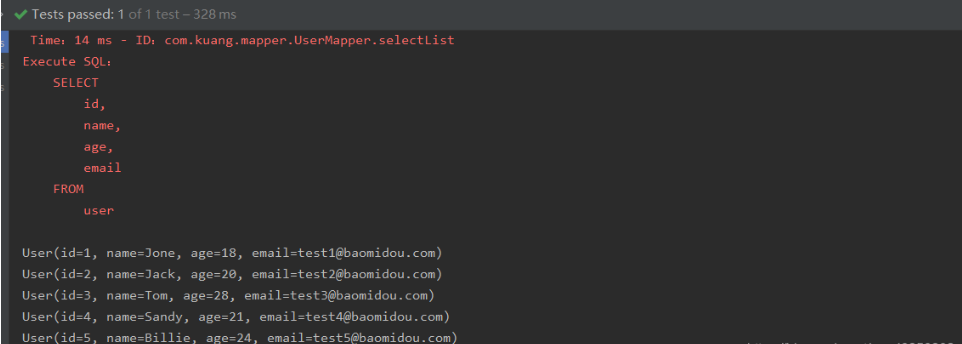
}所有數(shù)據(jù)輸出
配置日志
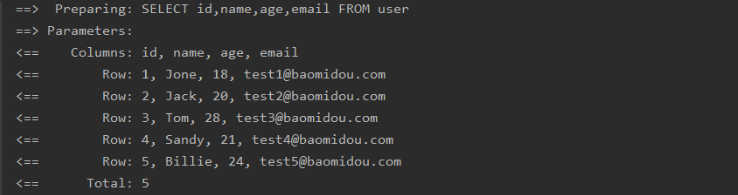
我們所有的sql現(xiàn)在是不可見(jiàn)的,我們希望知道它是怎么執(zhí)行的,所有我們要配置日志的輸出 application.yml文件添加日志配置
#配置日志
mybatis-plus:
configuration:
log-impl: org.apache.ibatis.logging.stdout.StdOutImpl查看執(zhí)行sql的日志信息
三.Mybatis-plus的CRUD
插入操作
// 測(cè)試插入
@Test
public void testInsert(){
User user = new User();
user.setName("kwhua_mybatis-plus_insertTest");
user.setAge(15);
user.setEmail("[email protected]");
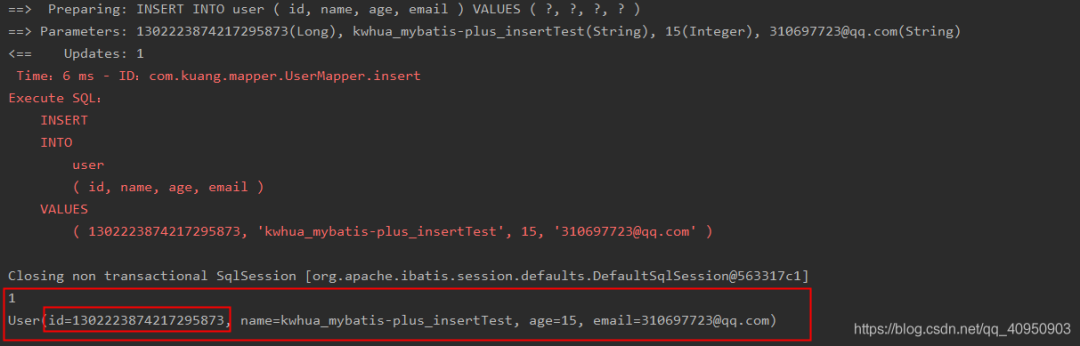
int result = userMapper.insert(user); // 幫我們自動(dòng)生成id
System.out.println(result); // 受影響的行數(shù)
System.out.println(user); // 看到id會(huì)自動(dòng)填充。 }
看到id會(huì)自動(dòng)填充。數(shù)據(jù)庫(kù)插入的id的默認(rèn)值為:全局的唯一id
主鍵生成策略
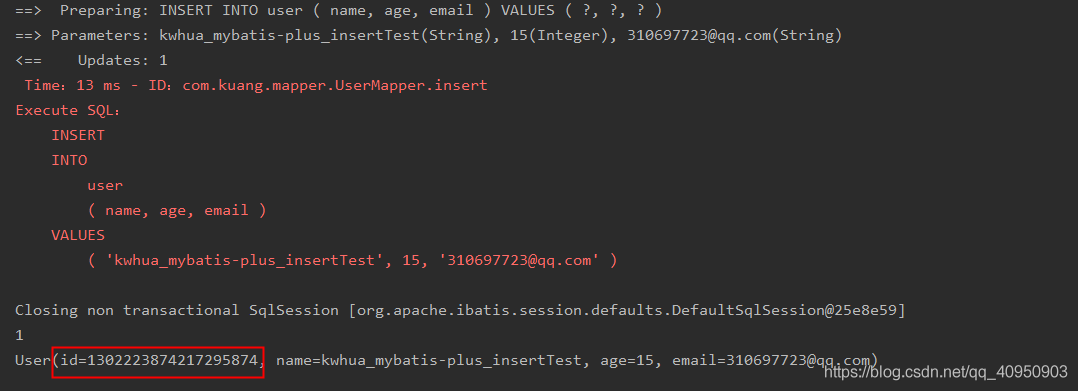
1)主鍵自增 1、實(shí)體類(lèi)字段上 @TableId(type = IdType.AUTO)
2、數(shù)據(jù)庫(kù)id字段設(shè)置為自增!
3、再次測(cè)試(可以看到id值比上次插入的大1)id的生成策略源碼解釋
圖片 public enum IdType {
AUTO(0), // 數(shù)據(jù)庫(kù)id自增
NONE(1), // 未設(shè)置主鍵
INPUT(2), // 手動(dòng)輸入
ID_WORKER(3), // 默認(rèn)的方式,全局唯一id
UUID(4), // 全局唯一id uuid
ID_WORKER_STR(5); //ID_WORKER 字符串表示法
}以上不再逐一測(cè)試。
更新操作
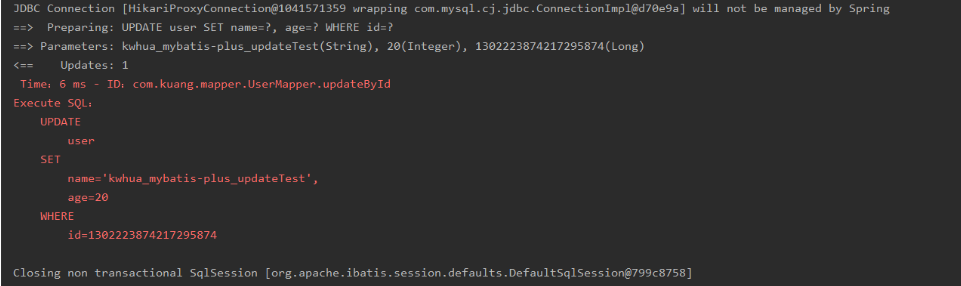
@Test
public void testUpdate(){
User user = new User();
// 通過(guò)條件自動(dòng)拼接動(dòng)態(tài)sql
user.setId(1302223874217295874L);
user.setName("kwhua_mybatis-plus_updateTest");
user.setAge(20);
// 注意:updateById 但是參數(shù)是一個(gè)對(duì)象!
int i = userMapper.updateById(user);
System.out.println(i);
}圖片 自動(dòng)填充
創(chuàng)建時(shí)間、修改時(shí)間!這兩個(gè)字段操作都是自動(dòng)化完成的,我們不希望手動(dòng)更新!阿里巴巴開(kāi)發(fā)手冊(cè):所有的數(shù)據(jù)庫(kù)表都要配置上gmt_create、gmt_modified!而且需要自動(dòng)化!
方式一:數(shù)據(jù)庫(kù)級(jí)別(工作中一般不用)
1、在表中新增字段 gmt_create, gmt_modified
2、把實(shí)體類(lèi)同步
private Date gmtCreate;
private Date gmtModified;3、再次查看
方式二:代碼級(jí)別 1、刪除數(shù)據(jù)庫(kù)的默認(rèn)值、更新操作!
2、實(shí)體類(lèi)字段屬性上需要增加注解
// 字段添加填充內(nèi)容
@TableField(fill = FieldFill.INSERT)
private Date gmt_create;
@TableField(fill = FieldFill.INSERT_UPDATE)
private Date gmt_modified;3、編寫(xiě)處理器來(lái)處理這個(gè)注解即可!
@Slf4j
@Component // 一定不要忘記把處理器加到IOC容器中!
public class MyMetaObjectHandler implements MetaObjectHandler {
// 插入時(shí)的填充策略
@Override
public void insertFill(MetaObject metaObject) {
log.info("start insert fill.....");
// setFieldValByName(String fieldName, Object fieldVal, MetaObject metaObject
this.setFieldValByName("gmt_create",new Date(),metaObject);
this.setFieldValByName("gmt_modified",new Date(),metaObject);
}
// 更新時(shí)的填充策略
@Override
public void updateFill(MetaObject metaObject) {
log.info("start update fill.....");
this.setFieldValByName("gmt_modified",new Date(),metaObject);
}
}4、測(cè)試插入和更新,檢查時(shí)間變化。
樂(lè)觀鎖
樂(lè)觀鎖 : 顧名思義,十分樂(lè)觀,它總是認(rèn)為不會(huì)出現(xiàn)問(wèn)題,無(wú)論干什么不去上鎖!如果出現(xiàn)了問(wèn)題, 再次更新值測(cè)試 悲觀鎖:顧名思義,十分悲觀,它總是認(rèn)為總是出現(xiàn)問(wèn)題,無(wú)論干什么都會(huì)上鎖!再去操作!
樂(lè)觀鎖實(shí)現(xiàn)方式:
取出記錄時(shí),獲取當(dāng)前version 更新時(shí),帶上這個(gè)version 執(zhí)行更新時(shí), set version = newVersion where version = oldVersion 如果version不對(duì),就更新失敗
樂(lè)觀鎖:1、先查詢,獲得版本號(hào) version = 1
-- A
update user set name = "kwhua", version = version + 1
where id = 2 and version = 1
-- B 線程搶先完成,這個(gè)時(shí)候 version = 2,會(huì)導(dǎo)致 A 修改失敗!
update user set name = "kwhua", version = version + 1
where id = 2 and version = 1樂(lè)觀鎖測(cè)試
1、給數(shù)據(jù)庫(kù)中增加version字段!
圖片 2、實(shí)體類(lèi)加對(duì)應(yīng)的字段
@Version //樂(lè)觀鎖Version注解
private Integer version;3、注冊(cè)組件
// 掃描我們的 mapper 文件夾
@MapperScan("com.kwhua.mapper")
@EnableTransactionManagement
@Configuration // 配置類(lèi)
public class MyBatisPlusConfig {
// 注冊(cè)樂(lè)觀鎖插件
@Bean
public OptimisticLockerInterceptor optimisticLockerInterceptor() {
return new OptimisticLockerInterceptor();
}
}4、測(cè)試
// 測(cè)試樂(lè)觀鎖成功!
@Test
public void testOptimisticLocker(){
// 1、查詢用戶信息
User user = userMapper.selectById(1L);
// 2、修改用戶信息
user.setName("kwhua");
user.setEmail("[email protected]");
// 3、執(zhí)行更新操作
userMapper.updateById(user);
}version字段已經(jīng)由1變成了2
// 測(cè)試樂(lè)觀鎖失敗!多線程下
@Test
public void testOptimisticLocker2(){
// 線程 1
User user = userMapper.selectById(1L);
user.setName("kwhua111");
user.setEmail("[email protected]");
// 模擬另外一個(gè)線程執(zhí)行了插隊(duì)操作
User user2 = userMapper.selectById(1L);
user2.setName("kwhua222");
user2.setEmail("[email protected]");
userMapper.updateById(user2);
// 自旋鎖來(lái)多次嘗試提交!
userMapper.updateById(user); // 如果沒(méi)有樂(lè)觀鎖就會(huì)覆蓋插隊(duì)線程的值!
}圖片 可以看到線程1執(zhí)行更新失敗
查詢操作
// 測(cè)試查詢
@Test
public void testSelectById(){
User user = userMapper.selectById(1L);
System.out.println(user);
}
// 測(cè)試批量查詢!
@Test
public void testSelectByBatchId(){
List<User> users = userMapper.selectBatchIds(Arrays.asList(1, 2, 3));
users.forEach(System.out::println);
}
// 按條件查詢之一使用map操作
@Test
public void testSelectByBatchIds(){
HashMap<String, Object> map = new HashMap<>();
// 自定義要查詢
map.put("name","kwhua");
map.put("age",15);
List<User> users = userMapper.selectByMap(map);
users.forEach(System.out::println);
}1、配置攔截器組件
// 分頁(yè)插件
@Bean
public PaginationInterceptor paginationInterceptor() {
return new PaginationInterceptor();
}2、直接使用Page對(duì)象即可!
// 測(cè)試分頁(yè)查詢
@Test
public void testPage(){
// 參數(shù)一:當(dāng)前頁(yè)
// 參數(shù)二:頁(yè)面大小
Page<User> page = new Page<>(2,5);
userMapper.selectPage(page,null);
page.getRecords().forEach(System.out::println);
System.out.println(page.getTotal());
}物理刪除
// 測(cè)試刪除
@Test
public void testDeleteById(){
userMapper.deleteById(1L);
}
// 通過(guò)id批量刪除
@Test
public void testDeleteBatchId(){
userMapper.deleteBatchIds(Arrays.asList(2L,3L));
}
// 通過(guò)map刪除
@Test
public void testDeleteMap(){
HashMap<String, Object> map = new HashMap<>();
map.put("name","kwhua");
userMapper.deleteByMap(map);
}邏輯刪除
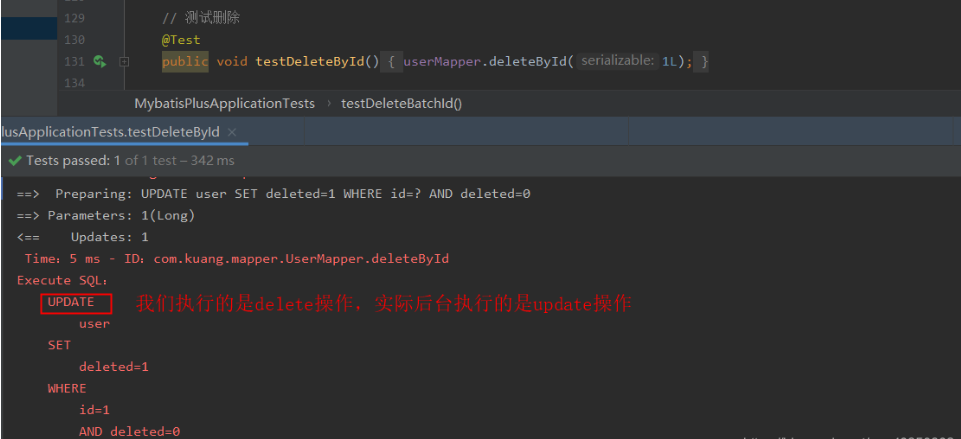
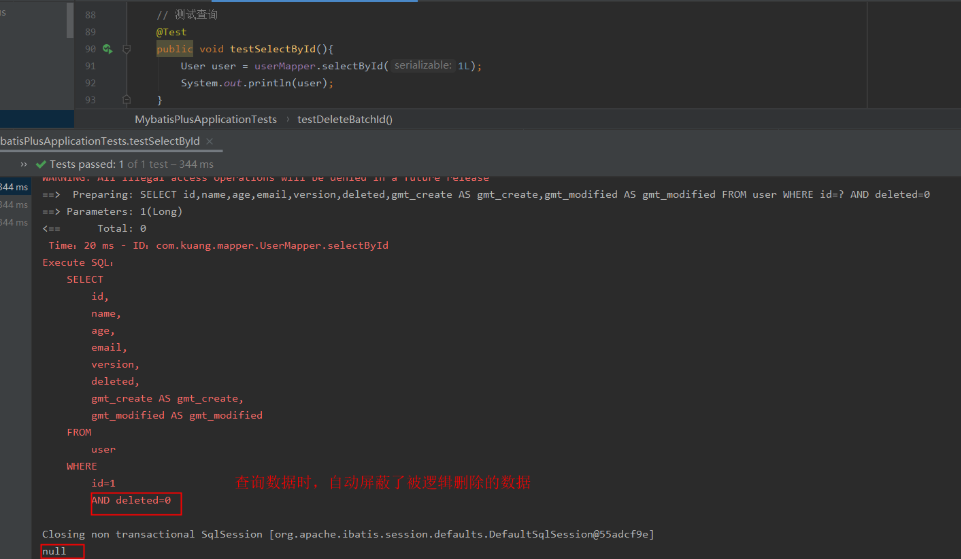
物理刪除 :從數(shù)據(jù)庫(kù)中直接移除 邏輯刪除 :在數(shù)據(jù)庫(kù)中沒(méi)有被移除,而是通過(guò)一個(gè)變量來(lái)讓它失效!deleted = 0 => deleted = 1 管理員可以查看被刪除的記錄!防止數(shù)據(jù)的丟失,類(lèi)似于回收站!
1、在數(shù)據(jù)表中增加一個(gè) deleted 字段2、實(shí)體類(lèi)中增加屬性
@TableLogic //邏輯刪除
private Integer deleted;3、配置
// 邏輯刪除組件!
@Bean
public ISqlInjector sqlInjector() {
return new LogicSqlInjector();
}配置文件配置
global-config:
db-config:
logic-delete-value: 1
logic-not-delete-value: 04、測(cè)試 測(cè)試刪除
圖片 字段值也從0修改成了1測(cè)試查詢
圖片 性能分析插件
作用:性能分析攔截器,用于輸出每條 SQL 語(yǔ)句及其執(zhí)行時(shí)間 MP也提供性能分析插件,如果超過(guò)這個(gè)時(shí)間就停止運(yùn)行!1、導(dǎo)入插件
/**
* SQL執(zhí)行效率插件
*/
@Bean
@Profile({"dev","test"})// 設(shè)置 dev test 環(huán)境開(kāi)啟,保證我們的效率
public PerformanceInterceptor performanceInterceptor() {
PerformanceInterceptor performanceInterceptor = new PerformanceInterceptor();
performanceInterceptor.setMaxTime(100); //ms 設(shè)置sql執(zhí)行的最大時(shí)間,如果超過(guò)了則不執(zhí)行
performanceInterceptor.setFormat(true);
return performanceInterceptor;
}圖片 條件構(gòu)造器(Wrapper)
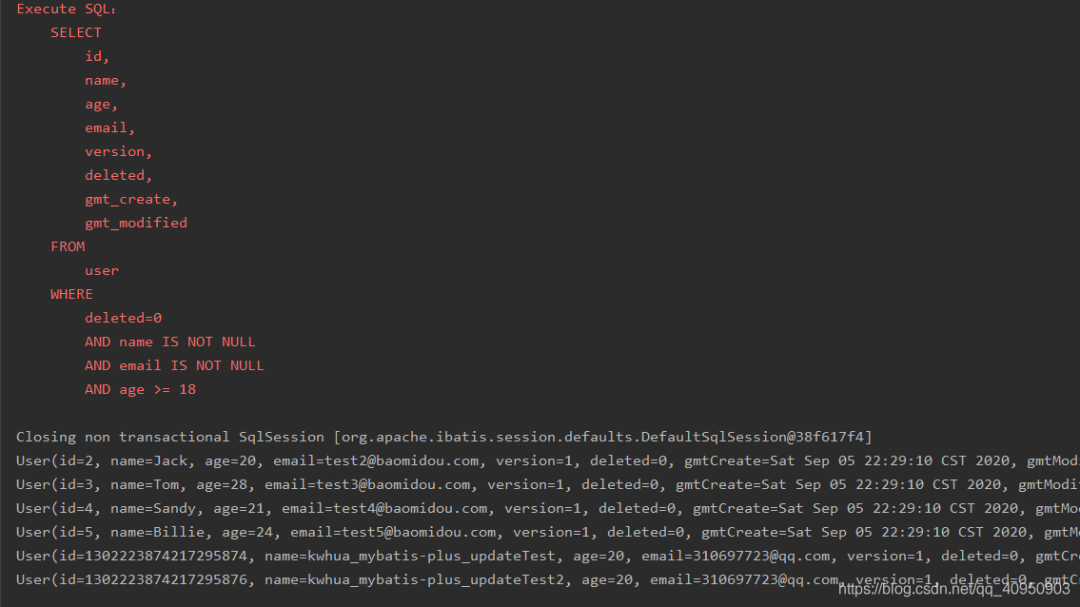
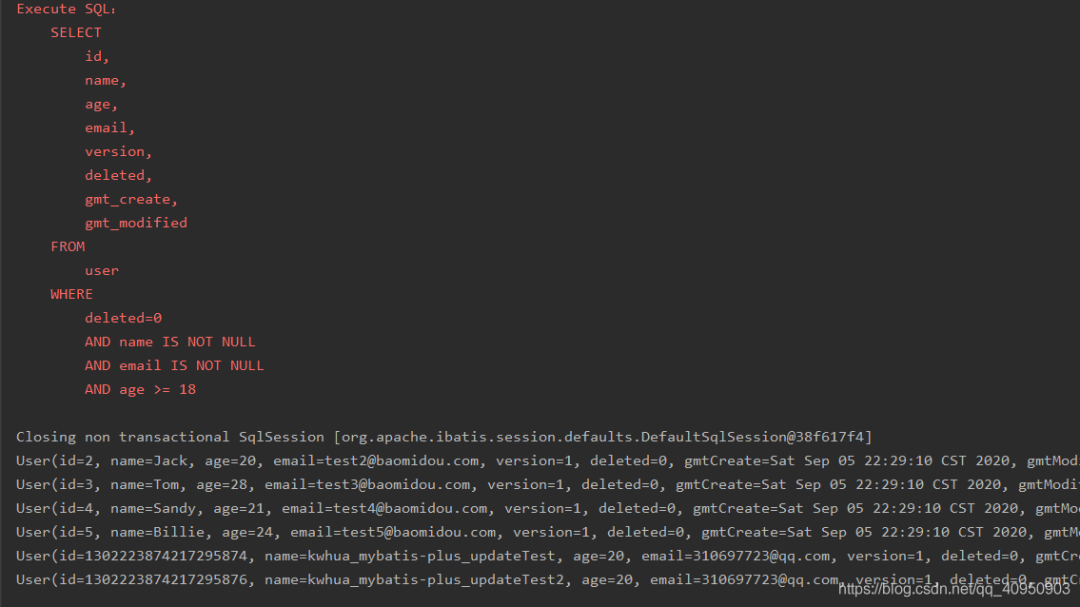
isNotNull .gt
@Test
void contextLoads() {
// 查詢name不為空的用戶,并且郵箱不為空的用戶,年齡大于等于12
QueryWrapper<User> wrapper = new QueryWrapper<>();
wrapper
.isNotNull("name") //不為空
.isNotNull("email")
.ge("age",18);
userMapper.selectList(wrapper).forEach(System.out::println); // 和我們剛才學(xué)習(xí)的map對(duì)比一下
}圖片 .eq
@Test
void test2(){
// 查詢名字kwhua
QueryWrapper<User> wrapper = new QueryWrapper<>();
wrapper.eq("name","kwhua");
User user = userMapper.selectOne(wrapper); // 查詢一個(gè)數(shù)據(jù)用selectOne,查詢多個(gè)結(jié)果使用List 或者 Map
System.out.println(user);
}其他方法可以自己測(cè)試...
代碼自動(dòng)生成器
// 代碼自動(dòng)生成器
public class generateCode {
public static void main(String[] args) {
// 需要構(gòu)建一個(gè) 代碼自動(dòng)生成器 對(duì)象
AutoGenerator mpg = new AutoGenerator();
// 配置策略
// 1、全局配置
GlobalConfig gc = new GlobalConfig();
String projectPath = System.getProperty("user.dir");
gc.setOutputDir(projectPath+"/src/main/java");
gc.setAuthor("kwhua");//作者名稱(chēng)
gc.setOpen(false);
gc.setFileOverride(false); // 是否覆蓋
gc.setIdType(IdType.ID_WORKER);
gc.setDateType(DateType.ONLY_DATE);
gc.setSwagger2(true);//實(shí)體屬性 Swagger2 注解
// 自定義文件命名,注意 %s 會(huì)自動(dòng)填充表實(shí)體屬性!
gc.setServiceName("%sService");
gc.setControllerName("%sController");
gc.setServiceName("%sService");
gc.setServiceImplName("%sServiceImpl");
gc.setMapperName("%sMapper");
gc.setXmlName("%sMapper");
mpg.setGlobalConfig(gc);
//2、設(shè)置數(shù)據(jù)源
DataSourceConfig dsc = new DataSourceConfig();
dsc.setUrl("jdbc:mysql://localhost:3306/kwhua_test?
useSSL=false&useUnicode=true&characterEncoding=utf-8&serverTimezone=GMT%2B8");
dsc.setDriverName("com.mysql.cj.jdbc.Driver");
// dsc.setDriverName("com.mysql.jdbc.Driver"); //mysql5.6以下的驅(qū)動(dòng)
dsc.setUsername("root");
dsc.setPassword("root");
dsc.setDbType(DbType.MYSQL);
mpg.setDataSource(dsc);
//3、包的配置
PackageConfig pc = new PackageConfig();
pc.setParent("com.kwhua"); //包名
pc.setModuleName("model"); //模塊名
pc.setEntity("entity");
pc.setMapper("mapper");
pc.setService("service");
pc.setController("controller");
mpg.setPackageInfo(pc);
//4、策略配置
StrategyConfig strategy = new StrategyConfig();
strategy.setInclude("user","course"); // 設(shè)置要映射的表名
strategy.setNaming(NamingStrategy.underline_to_camel);
strategy.setColumnNaming(NamingStrategy.underline_to_camel);
strategy.setEntityLombokModel(true); // 自動(dòng)lombok;
strategy.setLogicDeleteFieldName("deleted");
// 自動(dòng)填充配置
TableFill gmtCreate = new TableFill("gmt_create", FieldFill.INSERT);
TableFill gmtModified = new TableFill("gmt_modified",FieldFill.INSERT_UPDATE);
ArrayList<TableFill> tableFills = new ArrayList<>();
tableFills.add(gmtCreate);
tableFills.add(gmtModified);
strategy.setTableFillList(tableFills);
// 樂(lè)觀鎖
strategy.setVersionFieldName("version");
//根據(jù)你的表名來(lái)建對(duì)應(yīng)的類(lèi)名,如果你的表名沒(méi)有下劃線,比如test,那么你就可以取消這一步
strategy.setTablePrefix("t_");
strategy.setRestControllerStyle(true); //rest請(qǐng)求
//自動(dòng)轉(zhuǎn)下劃線,比如localhost:8080/hello_id_2
strategy.setControllerMappingHyphenStyle(true);
mpg.setStrategy(strategy);
mpg.execute(); //執(zhí)行
}
}執(zhí)行主方法即可生成對(duì)應(yīng)代碼
—————END————— 推薦閱讀:




IDEA 永久注冊(cè)碼來(lái)了!!! 一個(gè)非常好的行為驗(yàn)證碼Java開(kāi)源項(xiàng)目! Google 開(kāi)源的依賴注入庫(kù),比 Spring 更小更快! GitHub 近兩萬(wàn) Star,無(wú)需編碼,可一鍵生成前后端代碼 Spring Boot 中引入 MyBatisPlus 的常規(guī)流程 免費(fèi)版的 IDEA 為啥不能使用 Tomcat ? 給新手的 11 個(gè) Docker 免費(fèi)上手項(xiàng)目
最近面試BAT,整理一份面試資料《Java面試BAT通關(guān)手冊(cè)》,覆蓋了Java核心技術(shù)、JVM、Java并發(fā)、SSM、微服務(wù)、數(shù)據(jù)庫(kù)、數(shù)據(jù)結(jié)構(gòu)等等。 獲取方式:關(guān)注公眾號(hào)并回復(fù) java 領(lǐng)取,更多內(nèi)容陸續(xù)奉上。
