
如何優(yōu)化執(zhí)行大數(shù)據(jù)量的SQL

有一張財務(wù)流水表,未分庫分表,目前的數(shù)據(jù)量為9555695,分頁查詢使用到了limit,優(yōu)化之前的查詢耗時16 s 938 ms (execution: 16 s 831 ms, fetching: 107 ms),按照下文的方式調(diào)整SQL后,耗時347 ms (execution: 163 ms, fetching: 184 ms);
操作:查詢條件放到子查詢中,子查詢只查主鍵ID,然后使用子查詢中確定的主鍵關(guān)聯(lián)查詢其他的屬性字段;
原理:減少回表操作;
-- 優(yōu)化前SQL
SELECT  各種字段
FROM `table_name`
WHERE 各種條件
LIMIT 0,10;
-- 優(yōu)化后SQL
SELECT  各種字段
FROM `table_name` main_tale
RIGHT JOIN
(
SELECT  子查詢只查主鍵
FROM `table_name`
WHERE 各種條件
LIMIT 0,10;
) temp_table ON temp_table.主鍵 = main_table.主鍵
一,前言
首先說明一下MySQL的版本:
mysql> select version();
+-----------+
| version() |
+-----------+
| 5.7.17    |
+-----------+
1 row in set (0.00 sec)
表結(jié)構(gòu):
mysql> desc test;
+--------+---------------------+------+-----+---------+----------------+
| Field  | Type                | Null | Key | Default | Extra          |
+--------+---------------------+------+-----+---------+----------------+
| id     | bigint(20) unsigned | NO   | PRI | NULL    | auto_increment |
| val    | int(10) unsigned    | NO   | MUL | 0       |                |
| source | int(10) unsigned    | NO   |     | 0       |                |
+--------+---------------------+------+-----+---------+----------------+
3 rows in set (0.00 sec)
id為自增主鍵,val為非唯一索引。
灌入大量數(shù)據(jù),共500萬:
mysql> select count(*) from test;
+----------+
| count(*) |
+----------+
|  5242882 |
+----------+
1 row in set (4.25 sec)
我們知道,當(dāng)limit offset rows中的offset很大時,會出現(xiàn)效率問題:
mysql> select * from test where val=4 limit 300000,5;
+---------+-----+--------+
| id      | val | source |
+---------+-----+--------+
| 3327622 |   4 |      4 |
| 3327632 |   4 |      4 |
| 3327642 |   4 |      4 |
| 3327652 |   4 |      4 |
| 3327662 |   4 |      4 |
+---------+-----+--------+
5 rows in set (15.98 sec)
為了達(dá)到相同的目的,我們一般會改寫成如下語句:
mysql> select * from test a inner join (select id from test where val=4 limit 300000,5) b on a.id=b.id;
+---------+-----+--------+---------+
| id      | val | source | id      |
+---------+-----+--------+---------+
| 3327622 |   4 |      4 | 3327622 |
| 3327632 |   4 |      4 | 3327632 |
| 3327642 |   4 |      4 | 3327642 |
| 3327652 |   4 |      4 | 3327652 |
| 3327662 |   4 |      4 | 3327662 |
+---------+-----+--------+---------+
5 rows in set (0.38 sec)
時間相差很明顯。
為什么會出現(xiàn)上面的結(jié)果?我們看一下select * from test where val=4 limit 300000,5;的查詢過程:
查詢到索引葉子節(jié)點(diǎn)數(shù)據(jù)。
根據(jù)葉子節(jié)點(diǎn)上的主鍵值去聚簇索引上查詢需要的全部字段值。
類似于下面這張圖:
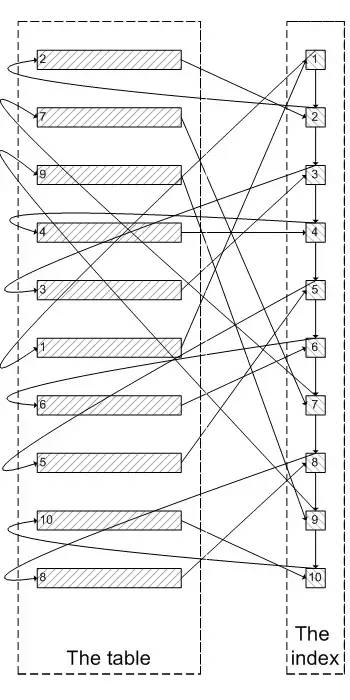
像上面這樣,需要查詢300005次索引節(jié)點(diǎn),查詢300005次聚簇索引的數(shù)據(jù),最后再將結(jié)果過濾掉前300000條,取出最后5條。MySQL耗費(fèi)了大量隨機(jī)I/O在查詢聚簇索引的數(shù)據(jù)上,而有300000次隨機(jī)I/O查詢到的數(shù)據(jù)是不會出現(xiàn)在結(jié)果集當(dāng)中的。
肯定會有人問:既然一開始是利用索引的,為什么不先沿著索引葉子節(jié)點(diǎn)查詢到最后需要的5個節(jié)點(diǎn),然后再去聚簇索引中查詢實(shí)際數(shù)據(jù)。這樣只需要5次隨機(jī)I/O,類似于下面圖片的過程:
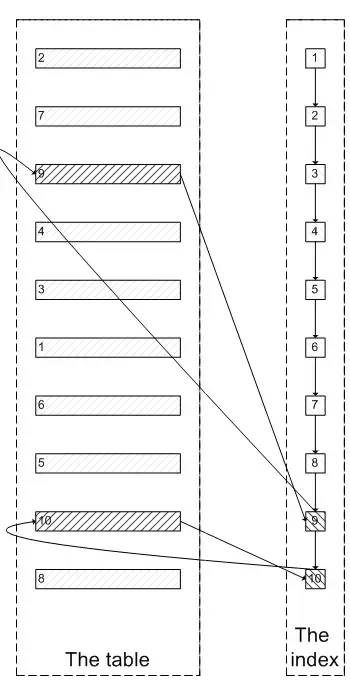
其實(shí)我也想問這個問題。
證實(shí)
下面我們實(shí)際操作一下來證實(shí)上述的推論:
為了證實(shí)select * from test where val=4 limit 300000,5是掃描300005個索引節(jié)點(diǎn)和300005個聚簇索引上的數(shù)據(jù)節(jié)點(diǎn),我們需要知道MySQL有沒有辦法統(tǒng)計在一個sql中通過索引節(jié)點(diǎn)查詢數(shù)據(jù)節(jié)點(diǎn)的次數(shù)。我先試了Handler_read_*系列,很遺憾沒有一個變量能滿足條件。更多參考:索引很難么?帶你從頭到尾捋一遍MySQL索引結(jié)構(gòu),不信你學(xué)不會!
我只能通過間接的方式來證實(shí):
InnoDB中有buffer pool。里面存有最近訪問過的數(shù)據(jù)頁,包括數(shù)據(jù)頁和索引頁。所以我們需要運(yùn)行兩個sql,來比較buffer pool中的數(shù)據(jù)頁的數(shù)量。預(yù)測結(jié)果是運(yùn)行select * from test a inner join (select id from test where val=4 limit 300000,5); 之后,buffer pool中的數(shù)據(jù)頁的數(shù)量遠(yuǎn)遠(yuǎn)少于select * from test where val=4 limit 300000,5;對應(yīng)的數(shù)量,因?yàn)榍耙粋€sql只訪問5次數(shù)據(jù)頁,而后一個sql訪問300005次數(shù)據(jù)頁。
select * from test where val=4 limit 300000,5
mysql> select index_name,count(*) from
information_schema.INNODB_BUFFER_PAGE where
INDEX_NAME in('val','primary') and TABLE_NAME like '%test%'
group by index_name;Empty set (0.04 sec)
可以看出,目前buffer pool中沒有關(guān)于test表的數(shù)據(jù)頁。
mysql> select * from test where val=4 limit 300000,5;
+---------+-----+--------+
| id      | val | source |
+---------+-----+--------+|
3327622 |   4 |      4 |
| 3327632 |   4 |      4 |
| 3327642 |   4 |      4 |
| 3327652 |   4 |      4 |
| 3327662 |   4 |      4 |
+---------+-----+--------+
5 rows in set (26.19 sec)

mysql> select index_name,count(*) from information_schema.INNODB_BUFFER_PAGE where INDEX_NAME in('val','primary') and TABLE_NAME like '%test%' group by index_name;
+------------+----------+
| index_name | count(*) |
+------------+----------+
| PRIMARY    |     4098 |
| val        |      208 |
+------------+----------+2 rows in set (0.04 sec)
可以看出,此時buffer pool中關(guān)于test表有4098個數(shù)據(jù)頁,208個索引頁。
select * from test a inner join (select id from test where val=4 limit 300000,5) ;為了防止上次試驗(yàn)的影響,我們需要清空buffer pool,重啟mysql。
mysqladmin shutdown
/usr/local/bin/mysqld_safe &
mysql> select index_name,count(*) from information_schema.INNODB_BUFFER_PAGE where INDEX_NAME in('val','primary') and TABLE_NAME like '%test%' group by index_name;

Empty set (0.03 sec)
運(yùn)行sql:
mysql> select * from test a inner join (select id from test where val=4 limit 300000,5) b on a.id=b.id;
+---------+-----+--------+---------+
| id      | val | source | id      |
+---------+-----+--------+---------+
| 3327622 |   4 |      4 | 3327622 |
| 3327632 |   4 |      4 | 3327632 |
| 3327642 |   4 |      4 | 3327642 |
| 3327652 |   4 |      4 | 3327652 |
| 3327662 |   4 |      4 | 3327662 |
+---------+-----+--------+---------+
5 rows in set (0.09 sec)

mysql> select index_name,count(*) from information_schema.INNODB_BUFFER_PAGE where INDEX_NAME in('val','primary') and TABLE_NAME like '%test%' group by index_name;
+------------+----------+
| index_name | count(*) |
+------------+----------+
| PRIMARY    |        5 |
| val        |      390 |
+------------+----------+
2 rows in set (0.03 sec)
我們可以看明顯的看出兩者的差別:第一個sql加載了4098個數(shù)據(jù)頁到buffer pool,而第二個sql只加載了5個數(shù)據(jù)頁到buffer pool。符合我們的預(yù)測。也證實(shí)了為什么第一個sql會慢:讀取大量的無用數(shù)據(jù)行(300000),最后卻拋棄掉。
而且這會造成一個問題:加載了很多熱點(diǎn)不是很高的數(shù)據(jù)頁到buffer pool,會造成buffer pool的污染,占用buffer pool的空間。遇到的問題
為了在每次重啟時確保清空buffer pool,我們需要關(guān)閉innodb_buffer_pool_dump_at_shutdown和innodb_buffer_pool_load_at_startup,這兩個選項(xiàng)能夠控制數(shù)據(jù)庫關(guān)閉時dump出buffer pool中的數(shù)據(jù)和在數(shù)據(jù)庫開啟時載入在磁盤上備份buffer pool的數(shù)據(jù)。
參考資料:
1.https://explainextended.com/2009/10/23/mysql-order-by-limit-performance-late-row-lookups/
2.https://dev.mysql.com/doc/refman/5.7/en/innodb-information-schema-buffer-pool-tables.html