
再見MybatisPlus,阿里推出新ORM框架!
往期熱門文章:
1、為什么不推薦使用BeanUtils屬性轉(zhuǎn)換工具
2、SpringBoot巧用 @Async 提升API接口并發(fā)能力
3、一個Bug能有多大影響:虧損30億、致6人死亡、甚至差點毀滅世界...
5、Spring Boot + MyBatis + MySQL讀寫分離
來源:juejin.cn/post/6886019929519177735
使用fluent mybatis也可以不用寫具體的 xml 文件,通過 java api 可以構(gòu)造出比較復(fù)雜的業(yè)務(wù) sql 語句,做到代碼邏輯和 sql 邏輯的合一。不再需要在 Dao 中組裝查詢或更新操作,或在 xml 與 mapper 中再組裝參數(shù)。那對比原生 Mybatis,Mybatis Plus 或者其他框架,FluentMybatis提供了哪些便利呢?
需求場景設(shè)置
我們通過一個比較典型的業(yè)務(wù)需求來具體實現(xiàn)和對比下,假如有學(xué)生成績表結(jié)構(gòu)如下:
create table `student_score`
(
    id           bigint auto_increment comment '主鍵ID' primary key,
    student_id   bigint            not null comment '學(xué)號',
    gender_man   tinyint default 0 not null comment '性別, 0:女; 1:男',
    school_term  int               null comment '學(xué)期',
    subject      varchar(30)       null comment '學(xué)科',
    score        int               null comment '成績',
    gmt_create   datetime          not null comment '記錄創(chuàng)建時間',
    gmt_modified datetime          not null comment '記錄最后修改時間',
    is_deleted   tinyint default 0 not null comment '邏輯刪除標識'
) engine = InnoDB default charset=utf8;
現(xiàn)在有需求:
「統(tǒng)計 2000 年三門學(xué)科('英語', '數(shù)學(xué)', '語文')及格分數(shù)按學(xué)期,學(xué)科統(tǒng)計最低分,最高分和平均分, 且樣本數(shù)需要大于 1 條,統(tǒng)計結(jié)果按學(xué)期和學(xué)科排序」
我們可以寫 SQL 語句如下
select school_term,
       subject,
       count(score) as count,
       min(score)   as min_score,
       max(score)   as max_score,
       avg(score)   as max_score
from student_score
where school_term >= 2000
  and subject in ('英語', '數(shù)學(xué)', '語文')
  and score >= 60
  and is_deleted = 0
group by school_term, subject
having count(score) > 1
order by school_term, subject;
那上面的需求,分別用fluent mybatis, 原生mybatis和Mybatis plus來實現(xiàn)一番。
三者實現(xiàn)對比
使用fluent mybatis 來實現(xiàn)上面的功能
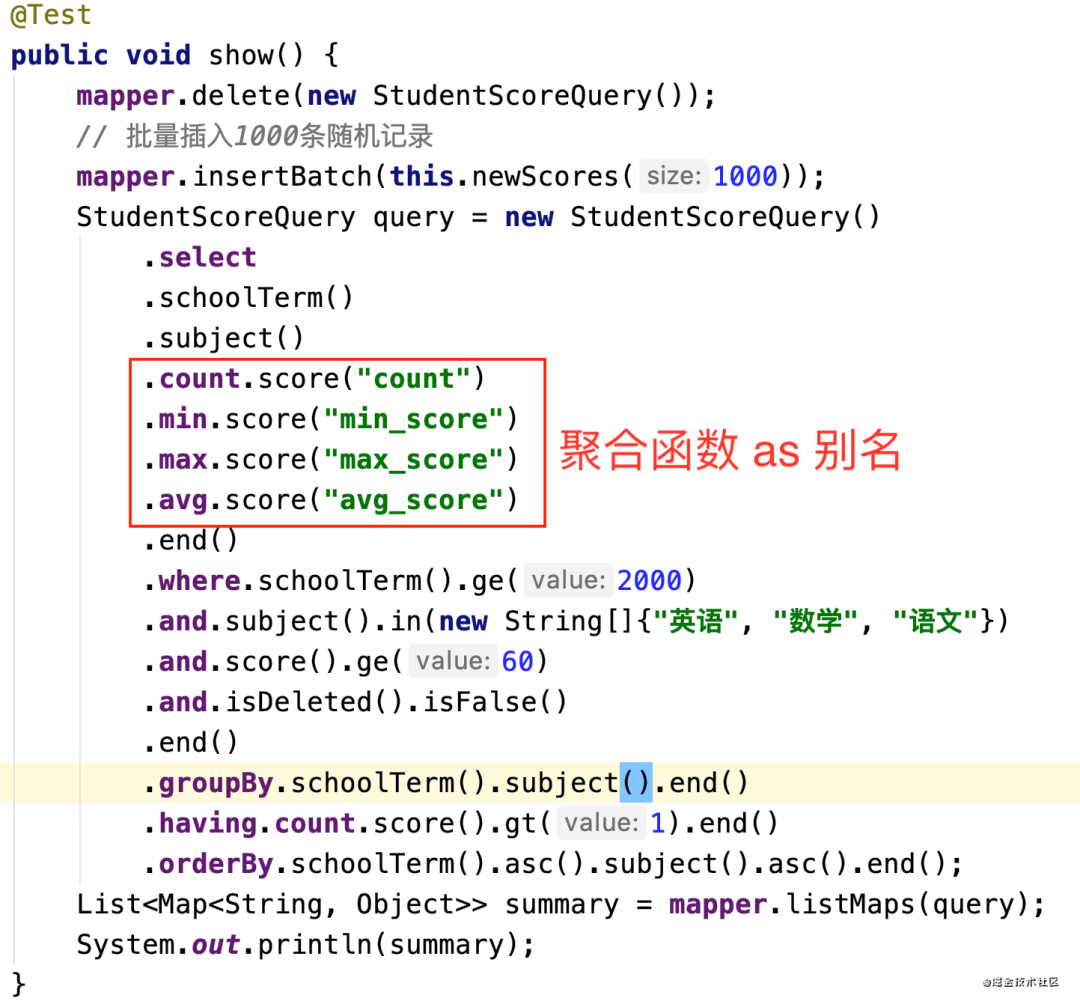
需要本文具體演示代碼可加我微信:codedq,免費獲取!
我們可以看到fluent api的能力,以及 IDE 對代碼的渲染效果。
換成mybatis原生實現(xiàn)效果
定義Mapper接口
public interface MyStudentScoreMapper {
    List<Map<String, Object>> summaryScore(SummaryQuery paras);
}
定義接口需要用到的參數(shù)實體 SummaryQuery
@Data
@Accessors(chain = true)
public class SummaryQuery {
    private Integer schoolTerm;

    private List<String> subjects;

    private Integer score;

    private Integer minCount;
}
定義實現(xiàn)業(yè)務(wù)邏輯的 mapper xml文件
<select id="summaryScore" resultType="map" parameterType="cn.org.fluent.mybatis.springboot.demo.mapper.SummaryQuery">
    select school_term,
    subject,
    count(score) as count,
    min(score) as min_score,
    max(score) as max_score,
    avg(score) as max_score
    from student_score
    where school_term >= #{schoolTerm}
    and subject in
    <foreach collection="subjects" item="item" open="(" close=")" separator=",">
        #{item}
    </foreach>
    and score >= #{score}
    and is_deleted = 0
    group by school_term, subject
    having count(score) > #{minCount}
    order by school_term, subject
</select>
實現(xiàn)業(yè)務(wù)接口(這里是測試類,實際應(yīng)用中應(yīng)該對應(yīng) Dao 類)
@RunWith(SpringRunner.class)
@SpringBootTest(classes = QuickStartApplication.class)
public class MybatisDemo {
    @Autowired
    private MyStudentScoreMapper mapper;

    @Test
    public void mybatis_demo() {
        // 構(gòu)造查詢參數(shù)
        SummaryQuery paras = new SummaryQuery()
            .setSchoolTerm(2000)
            .setSubjects(Arrays.asList("英語", "數(shù)學(xué)", "語文"))
            .setScore(60)
            .setMinCount(1);

        List<Map<String, Object>> summary = mapper.summaryScore(paras);
        System.out.println(summary);
    }
}
總之,直接使用 mybatis,實現(xiàn)步驟還是相當?shù)姆爆崳侍汀D菗Q成mybatis plus的效果怎樣呢?
換成mybatis plus實現(xiàn)效果
mybatis plus的實現(xiàn)比mybatis會簡單比較多,實現(xiàn)效果如下
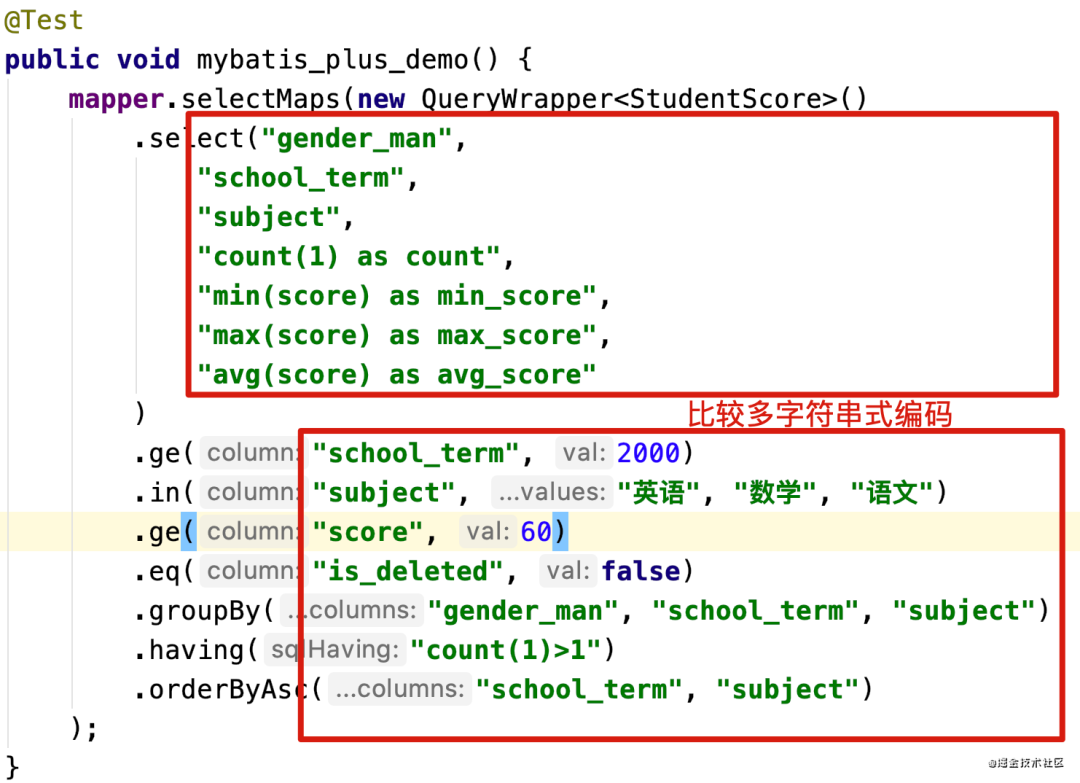
如紅框圈出的,寫mybatis plus實現(xiàn)用到了比較多字符串的硬編碼(可以用 Entity 的 get lambda 方法部分代替字符串編碼)。字符串的硬編碼,會給開發(fā)同學(xué)造成不小的使用門檻,個人覺的主要有 2 點:
字段名稱的記憶和敲碼困難 Entity 屬性跟隨數(shù)據(jù)庫字段發(fā)生變更后的運行時錯誤
其他框架,比如TkMybatis在封裝和易用性上比mybatis plus要弱,就不再比較了。
生成代碼編碼比較
fluent mybatis生成代碼設(shè)置
public class AppEntityGenerator {
    static final String url = "jdbc:mysql://localhost:3306/fluent_mybatis_demo?useSSL=false&useUnicode=true&characterEncoding=utf-8";

    public static void main(String[] args) {
        FileGenerator.build(Abc.class);
    }

    @Tables(
        /** 數(shù)據(jù)庫連接信息 **/
        url = url, username = "root", password = "password",
        /** Entity類parent package路徑 **/
        basePack = "cn.org.fluent.mybatis.springboot.demo",
        /** Entity代碼源目錄 **/
        srcDir = "spring-boot-demo/src/main/java",
        /** Dao代碼源目錄 **/
        daoDir = "spring-boot-demo/src/main/java",
        /** 如果表定義記錄創(chuàng)建,記錄修改,邏輯刪除字段 **/
        gmtCreated = "gmt_create", gmtModified = "gmt_modified", logicDeleted = "is_deleted",
        /** 需要生成文件的表 ( 表名稱:對應(yīng)的Entity名稱 ) **/
        tables = @Table(value = {"student_score"})
    )
    static class Abc {
    }
}
mybatis plus代碼生成設(shè)置
public class CodeGenerator {

    static String dbUrl = "jdbc:mysql://localhost:3306/fluent_mybatis_demo?useSSL=false&useUnicode=true&characterEncoding=utf-8";

    @Test
    public void generateCode() {
        GlobalConfig config = new GlobalConfig();
        DataSourceConfig dataSourceConfig = new DataSourceConfig();
        dataSourceConfig.setDbType(DbType.MYSQL)
            .setUrl(dbUrl)
            .setUsername("root")
            .setPassword("password")
            .setDriverName(Driver.class.getName());
        StrategyConfig strategyConfig = new StrategyConfig();
        strategyConfig
            .setCapitalMode(true)
            .setEntityLombokModel(false)
            .setNaming(NamingStrategy.underline_to_camel)
            .setColumnNaming(NamingStrategy.underline_to_camel)
            .setEntityTableFieldAnnotationEnable(true)
            .setFieldPrefix(new String[]{"test_"})
            .setInclude(new String[]{"student_score"})
            .setLogicDeleteFieldName("is_deleted")
            .setTableFillList(Arrays.asList(
                new TableFill("gmt_create", FieldFill.INSERT),
                new TableFill("gmt_modified", FieldFill.INSERT_UPDATE)));

        config
            .setActiveRecord(false)
            .setIdType(IdType.AUTO)
            .setOutputDir(System.getProperty("user.dir") + "/src/main/java/")
            .setFileOverride(true);

        new AutoGenerator().setGlobalConfig(config)
            .setDataSource(dataSourceConfig)
            .setStrategy(strategyConfig)
            .setPackageInfo(
                new PackageConfig()
                    .setParent("com.mp.demo")
                    .setController("controller")
                    .setEntity("entity")
            ).execute();
    }
}
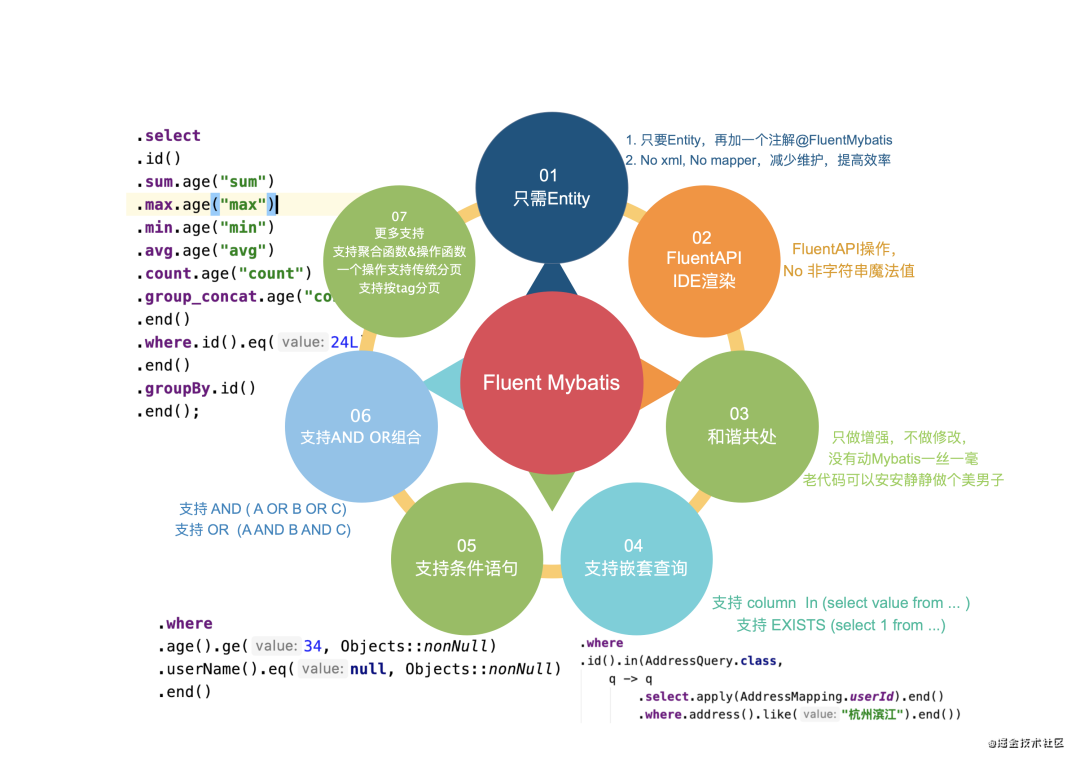
FluentMybatis特性一覽
三者對比總結(jié)
看完 3 個框架對同一個功能點的實現(xiàn), 各位看官肯定會有自己的判斷,筆者這里也總結(jié)了一份比較。
對 Fluent Mybatis 感興趣的網(wǎng)友,支持大家去閱讀官方源碼,發(fā)現(xiàn)更多新大陸!
最近熱文閱讀:
1、為什么不推薦使用BeanUtils屬性轉(zhuǎn)換工具 2、SpringBoot巧用 @Async 提升API接口并發(fā)能力 3、一個Bug能有多大影響:虧損30億、致6人死亡、甚至差點毀滅世界... 4、Java17,有史以來最快 JDK! 5、Spring Boot + MyBatis + MySQL讀寫分離 6、從MySQL 5.6升級到8.0,F(xiàn)acebook付出了慘痛代價…… 7、吊打 ThreadLocal,談?wù)凢astThreadLocal為啥能這么快? 8、手寫了一個簡單的JSON解析器,網(wǎng)友直乎:牛! 9、代碼寫的垃圾被嫌棄? 10、Redis的這些拓展方案 關(guān)注公眾號,你想要的Java都在這里