
分析 kubernetes 中的事件機(jī)制
我們通過 kubectl describe [資源]?命令,可以在看到Event輸出,并且經(jīng)常依賴event進(jìn)行問題定位,從event中可以分析整個(gè)POD的運(yùn)行軌跡,為服務(wù)的客觀測(cè)性提供數(shù)據(jù)來源,由此可見,event在Kubernetes中起著舉足輕重的作用。

event并不只是kubelet中都有的,關(guān)于event的操作被封裝在client-go/tools/record包,我們完全可以在寫入自定義的event。
現(xiàn)在讓我們來一步步揭開event的面紗。
Event定義
其實(shí)event也是一個(gè)資源對(duì)象,并且通過apiserver將event存儲(chǔ)在etcd中,所以我們也可以通過 kubectl get event 命令查看對(duì)應(yīng)的event對(duì)象。
以下是一個(gè)event的yaml文件:
apiVersion: v1
count: 1
eventTime: null
firstTimestamp: "2020-03-02T13:08:22Z"
involvedObject:
  apiVersion: v1
  kind: Pod
  name: example-foo-d75d8587c-xsf64
  namespace: default
  resourceVersion: "429837"
  uid: ce611c62-6c1a-4bd8-9029-136a1adf7de4
kind: Event
lastTimestamp: "2020-03-02T13:08:22Z"
message: Pod sandbox changed, it will be killed and re-created.
metadata:
  creationTimestamp: "2020-03-02T13:08:30Z"
  name: example-foo-d75d8587c-xsf64.15f87ea1df862b64
  namespace: default
  resourceVersion: "479466"
  selfLink: /api/v1/namespaces/default/events/example-foo-d75d8587c-xsf64.15f87ea1df862b64
  uid: 9fe6f72a-341d-4c49-960b-e185982d331a
reason: SandboxChanged
reportingComponent: ""
reportingInstance: ""
source:
  component: kubelet
  host: minikube
type: Normal
主要字段說明:
involvedObject:觸發(fā)event的資源類型 lastTimestamp:最后一次觸發(fā)的時(shí)間 message:事件說明 metadata :event的元信息,name,namespace等 reason:event的原因 source:上報(bào)事件的來源,比如kubelet中的某個(gè)節(jié)點(diǎn) type:事件類型,Normal或Warning
event字段定義可以看這里:types.go#L5078
接下來我們來看看,整個(gè)event是如何下入的。
寫入事件
1、這里以kubelet為例,看看是如何進(jìn)行事件寫入的
2、代碼是在Kubernetes 1.17.3基礎(chǔ)上進(jìn)行分析
先以一幅圖來看下整個(gè)的處理流程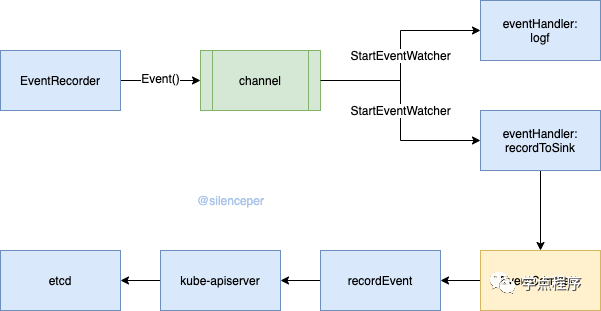
創(chuàng)建操作事件的客戶端:
kubelet/app/server.go#L461
// makeEventRecorder sets up kubeDeps.Recorder if it's nil. It's a no-op otherwise.
func makeEventRecorder(kubeDeps *kubelet.Dependencies, nodeName types.NodeName) {
	if kubeDeps.Recorder != nil {
		return
	}
    //事件廣播
	eventBroadcaster := record.NewBroadcaster()
    //創(chuàng)建EventRecorder
	kubeDeps.Recorder = eventBroadcaster.NewRecorder(legacyscheme.Scheme, v1.EventSource{Component: componentKubelet, Host: string(nodeName)})
	//發(fā)送event至log輸出
    eventBroadcaster.StartLogging(klog.V(3).Infof)
	if kubeDeps.EventClient != nil {
		klog.V(4).Infof("Sending events to api server.")
        //發(fā)送event至apiserver
		eventBroadcaster.StartRecordingToSink(&v1core.EventSinkImpl{Interface: kubeDeps.EventClient.Events("")})
	} else {
		klog.Warning("No api server defined - no events will be sent to API server.")
	}
}
通過 makeEventRecorder?創(chuàng)建了 EventRecorder?實(shí)例,這是一個(gè)事件廣播器,通過它提供了StartLogging和StartRecordingToSink兩個(gè)事件處理函數(shù),分別將event發(fā)送給log和apiserver。NewRecorder創(chuàng)建了 EventRecorder?的實(shí)例,它提供了 Event?,Eventf?等方法供事件記錄。
EventBroadcaster
我們來看下EventBroadcaster接口定義:event.go#L113
// EventBroadcaster knows how to receive events and send them to any EventSink, watcher, or log.
type EventBroadcaster interface {
    //
	StartEventWatcher(eventHandler func(*v1.Event)) watch.Interface
	StartRecordingToSink(sink EventSink) watch.Interface
	StartLogging(logf func(format string, args ...interface{})) watch.Interface
	NewRecorder(scheme *runtime.Scheme, source v1.EventSource) EventRecorder

	Shutdown()
}
具體實(shí)現(xiàn)是通過 eventBroadcasterImpl ?struct來實(shí)現(xiàn)了各個(gè)方法。
其中StartLogging 和 StartRecordingToSink 其實(shí)就是完成了對(duì)事件的消費(fèi),EventRecorder實(shí)現(xiàn)對(duì)事件的寫入,中間通過channel實(shí)現(xiàn)了生產(chǎn)者消費(fèi)者模型。
EventRecorder
我們先來看下EventRecorder?接口定義:event.go#L88,提供了以下4個(gè)方法
// EventRecorder knows how to record events on behalf of an EventSource.
type EventRecorder interface {
	// Event constructs an event from the given information and puts it in the queue for sending.
	// 'object' is the object this event is about. Event will make a reference-- or you may also
	// pass a reference to the object directly.
	// 'type' of this event, and can be one of Normal, Warning. New types could be added in future
	// 'reason' is the reason this event is generated. 'reason' should be short and unique; it
	// should be in UpperCamelCase format (starting with a capital letter). "reason" will be used
	// to automate handling of events, so imagine people writing switch statements to handle them.
	// You want to make that easy.
	// 'message' is intended to be human readable.
	//
	// The resulting event will be created in the same namespace as the reference object.
	Event(object runtime.Object, eventtype, reason, message string)

	// Eventf is just like Event, but with Sprintf for the message field.
	Eventf(object runtime.Object, eventtype, reason, messageFmt string, args ...interface{})

	// PastEventf is just like Eventf, but with an option to specify the event's 'timestamp' field.
	PastEventf(object runtime.Object, timestamp metav1.Time, eventtype, reason, messageFmt string, args ...interface{})

	// AnnotatedEventf is just like eventf, but with annotations attached
	AnnotatedEventf(object runtime.Object, annotations map[string]string, eventtype, reason, messageFmt string, args ...interface{})
}
主要參數(shù)說明:
object?對(duì)應(yīng)event資源定義中的involvedObjecteventtype?對(duì)應(yīng)event資源定義中的type,可選Normal,Warning.reason?:事件原因message?:事件消息
我們來看下當(dāng)我們調(diào)用 Event(object runtime.Object, eventtype, reason, message string)?的整個(gè)過程。
發(fā)現(xiàn)最終都調(diào)用到了 generateEvent?方法:event.go#L316
func (recorder *recorderImpl) generateEvent(object runtime.Object, annotations map[string]string, timestamp metav1.Time, eventtype, reason, message string) {
    .....
	event := recorder.makeEvent(ref, annotations, eventtype, reason, message)
	event.Source = recorder.source
	go func() {
		// NOTE: events should be a non-blocking operation
		defer utilruntime.HandleCrash()
		recorder.Action(watch.Added, event)
	}()
}
最終事件在一個(gè) goroutine?中通過調(diào)用 recorder.Action?進(jìn)入處理,這里保證了每次調(diào)用event方法都是非阻塞的。
其中 makeEvent?的作用主要是構(gòu)造了一個(gè)event對(duì)象,事件name根據(jù)InvolvedObject中的name加上時(shí)間戳生成:
注意看:對(duì)于一些非namespace資源產(chǎn)生的event,event的namespace是default
func (recorder *recorderImpl) makeEvent(ref *v1.ObjectReference, annotations map[string]string, eventtype, reason, message string) *v1.Event {
	t := metav1.Time{Time: recorder.clock.Now()}
	namespace := ref.Namespace
	if namespace == "" {
		namespace = metav1.NamespaceDefault
	}
	return &v1.Event{
		ObjectMeta: metav1.ObjectMeta{
			Name:        fmt.Sprintf("%v.%x", ref.Name, t.UnixNano()),
			Namespace:   namespace,
			Annotations: annotations,
		},
		InvolvedObject: *ref,
		Reason:         reason,
		Message:        message,
		FirstTimestamp: t,
		LastTimestamp:  t,
		Count:          1,
		Type:           eventtype,
	}
}
進(jìn)一步跟蹤Action方法,apimachinery/blob/master/pkg/watch/mux.go#L188:23
// Action distributes the given event among all watchers.
func (m *Broadcaster) Action(action EventType, obj runtime.Object) {
	m.incoming <- Event{action, obj}
}
將event寫入到了一個(gè)channel里面。
注意:
這個(gè)Action方式是apimachinery包中的方法,因?yàn)閷?shí)現(xiàn)的sturt?recorderImpl
將 *watch.Broadcaster?作為一個(gè)匿名struct,并且在 NewRecorder?進(jìn)行 Broadcaster?賦值,這個(gè)Broadcaster其實(shí)就是 eventBroadcasterImpl?中的Broadcaster。
到此,基本清楚了event最終被寫入到了 Broadcaster?中的 incoming?channel中,下面看下是怎么進(jìn)行消費(fèi)的。
消費(fèi)事件
在 makeEventRecorder?調(diào)用的 StartLogging?和 StartRecordingToSink?其實(shí)就是完成了對(duì)事件的消費(fèi)。
StartLogging直接將event輸出到日志StartRecordingToSink將事件寫入到apiserver
兩個(gè)方法內(nèi)部都調(diào)用了 StartEventWatcher?方法,并且傳入一個(gè) eventHandler?方法對(duì)event進(jìn)行處理
func (e *eventBroadcasterImpl) StartEventWatcher(eventHandler func(*v1.Event)) watch.Interface {
	watcher := e.Watch()
	go func() {
		defer utilruntime.HandleCrash()
		for watchEvent := range watcher.ResultChan() {
			event, ok := watchEvent.Object.(*v1.Event)
			if !ok {
				// This is all local, so there's no reason this should
				// ever happen.
				continue
			}
			eventHandler(event)
		}
	}()
	return watcher
}
其中 watcher.ResultChan?方法就拿到了事件,這里是在一個(gè)goroutine中通過func (m *Broadcaster) loop() ==>func (m *Broadcaster) distribute(event Event)?方法調(diào)用將event又寫入了broadcasterWatcher.result
主要看下 StartRecordingToSink?提供的的eventHandler, recordToSink?方法:
func recordToSink(sink EventSink, event *v1.Event, eventCorrelator *EventCorrelator, sleepDuration time.Duration) {
	// Make a copy before modification, because there could be multiple listeners.
	// Events are safe to copy like this.
	eventCopy := *event
	event = &eventCopy
	result, err := eventCorrelator.EventCorrelate(event)
	if err != nil {
		utilruntime.HandleError(err)
	}
	if result.Skip {
		return
	}
	tries := 0
	for {
		if recordEvent(sink, result.Event, result.Patch, result.Event.Count > 1, eventCorrelator) {
			break
		}
		tries++
		if tries >= maxTriesPerEvent {
			klog.Errorf("Unable to write event '%#v' (retry limit exceeded!)", event)
			break
		}
		// Randomize the first sleep so that various clients won't all be
		// synced up if the master goes down.
        // 第一次重試增加隨機(jī)性,防止 apiserver 重啟的時(shí)候所有的事件都在同一時(shí)間發(fā)送事件
		if tries == 1 {
			time.Sleep(time.Duration(float64(sleepDuration) * rand.Float64()))
		} else {
			time.Sleep(sleepDuration)
		}
	}
}
其中event被經(jīng)過了一個(gè) eventCorrelator.EventCorrelate(event)?方法做預(yù)處理,主要是聚合相同的事件(避免產(chǎn)生的事件過多,增加 etcd 和 apiserver 的壓力,也會(huì)導(dǎo)致查看 pod 事件很不清晰)
下面一個(gè)for循環(huán)就是在進(jìn)行重試,最大重試次數(shù)是12次,調(diào)用 recordEvent? 方法才真正將event寫入到了apiserver。
事件處理
我們來看下EventCorrelate方法:
// EventCorrelate filters, aggregates, counts, and de-duplicates all incoming events
func (c *EventCorrelator) EventCorrelate(newEvent *v1.Event) (*EventCorrelateResult, error) {
	if newEvent == nil {
		return nil, fmt.Errorf("event is nil")
	}
	aggregateEvent, ckey := c.aggregator.EventAggregate(newEvent)
	observedEvent, patch, err := c.logger.eventObserve(aggregateEvent, ckey)
	if c.filterFunc(observedEvent) {
		return &EventCorrelateResult{Skip: true}, nil
	}
	return &EventCorrelateResult{Event: observedEvent, Patch: patch}, err
}
分別調(diào)用了 aggregator.EventAggregate?,logger.eventObserve?, filterFunc?三個(gè)方法,分別作用是:
aggregator.EventAggregate:聚合event,如果在最近 10 分鐘出現(xiàn)過 10 個(gè)相似的事件(除了 message 和時(shí)間戳之外其他關(guān)鍵字段都相同的事件),aggregator 會(huì)把它們的 message 設(shè)置為?(combined from similar events)+event.Messagelogger.eventObserve:它會(huì)把相同的事件以及包含aggregator?被聚合了的相似的事件,通過增加Count?字段來記錄事件發(fā)生了多少次。filterFunc: 這里實(shí)現(xiàn)了一個(gè)基于令牌桶的限流算法,如果超過設(shè)定的速率則丟棄,保證了apiserver的安全。
我們主要來看下aggregator.EventAggregate方法:
func (e *EventAggregator) EventAggregate(newEvent *v1.Event) (*v1.Event, string) {
	now := metav1.NewTime(e.clock.Now())
	var record aggregateRecord
	// eventKey is the full cache key for this event
    //eventKey 是將除了時(shí)間戳外所有字段結(jié)合在一起
	eventKey := getEventKey(newEvent)
	// aggregateKey is for the aggregate event, if one is needed.
    //aggregateKey 是除了message和時(shí)間戳外的字段結(jié)合在一起,localKey 是message
	aggregateKey, localKey := e.keyFunc(newEvent)

	// Do we have a record of similar events in our cache?
	e.Lock()
	defer e.Unlock()
    //從cache中根據(jù)aggregateKey查詢是否存在,如果是相同或者相類似的事件會(huì)被放入cache中
	value, found := e.cache.Get(aggregateKey)
	if found {
		record = value.(aggregateRecord)
	}

    //判斷上次事件產(chǎn)生的時(shí)間是否超過10分鐘,如何操作則重新生成一個(gè)localKeys集合(集合中存放message)
	maxInterval := time.Duration(e.maxIntervalInSeconds) * time.Second
	interval := now.Time.Sub(record.lastTimestamp.Time)
	if interval > maxInterval {
		record = aggregateRecord{localKeys: sets.NewString()}
	}

	// Write the new event into the aggregation record and put it on the cache
    //將locakKey也就是message放入集合中,如果message相同就是覆蓋了
	record.localKeys.Insert(localKey)
	record.lastTimestamp = now
	e.cache.Add(aggregateKey, record)

	// If we are not yet over the threshold for unique events, don't correlate them
	//判斷l(xiāng)ocalKeys集合中存放的類似事件是否超過10個(gè),
    if uint(record.localKeys.Len()) < e.maxEvents {
		return newEvent, eventKey
	}

	// do not grow our local key set any larger than max
	record.localKeys.PopAny()

	// create a new aggregate event, and return the aggregateKey as the cache key
	// (so that it can be overwritten.)
	eventCopy := &v1.Event{
		ObjectMeta: metav1.ObjectMeta{
			Name:      fmt.Sprintf("%v.%x", newEvent.InvolvedObject.Name, now.UnixNano()),
			Namespace: newEvent.Namespace,
		},
		Count:          1,
		FirstTimestamp: now,
		InvolvedObject: newEvent.InvolvedObject,
		LastTimestamp:  now,
        //這里會(huì)對(duì)message加個(gè)前綴:(combined from similar events):
		Message:        e.messageFunc(newEvent),
		Type:           newEvent.Type,
		Reason:         newEvent.Reason,
		Source:         newEvent.Source,
	}
	return eventCopy, aggregateKey
}
aggregator.EventAggregate方法中其實(shí)就是判斷了通過cache和localKeys判斷事件是否相似,如果最近 10 分鐘出現(xiàn)過 10 個(gè)相似的事件就合并并加上前綴,后續(xù)通過logger.eventObserve方法進(jìn)行count累加,如果message也相同,肯定就是直接count++。
總結(jié)
好了,event處理的整個(gè)流程基本就是這樣,我們可以概括一下,可以結(jié)合文中的圖對(duì)比一起看下:
創(chuàng)建 EventRecorder?對(duì)象,通過其提供的Event?等方法,創(chuàng)建好event對(duì)象將創(chuàng)建出來的對(duì)象發(fā)送給 EventBroadcaster?中的channel中EventBroadcaster?通過后臺(tái)運(yùn)行的goroutine,從管道中取出事件,并廣播給提前注冊(cè)好的handler處理當(dāng)輸出log的handler收到事件就直接打印事件 當(dāng) EventSink?handler收到處理事件就通過預(yù)處理之后將事件發(fā)送給apiserver其中預(yù)處理包含三個(gè)動(dòng)作,1、限流 2、聚合 3、計(jì)數(shù) apiserver收到事件處理之后就存儲(chǔ)在etcd中
回顧event的整個(gè)流程,可以看到event并不是保證100%事件寫入(從預(yù)處理的過程來看),這樣做是為了后端服務(wù)etcd的可用性,因?yàn)閑vent事件在整個(gè)集群中產(chǎn)生是非常頻繁的,尤其在服務(wù)不穩(wěn)定的時(shí)候,而相比Deployment,Pod等其他資源,又沒那么的重要。所以這里做了個(gè)取舍。
參考文檔:
https://cizixs.com/2017/06/22/kubelet-source-code-analysis-part4-event/ https://github.com/kubernetes/kubernetes/blob/v1.17.3/staging/src/k8s.io/client-go/tools/record
 ?點(diǎn)擊屏末?|?閱讀原文?|?即刻學(xué)習(xí)