SpringIOC容器初始化流程12大步源碼解析
點(diǎn)擊上方藍(lán)色字體,選擇“標(biāo)星公眾號(hào)”
優(yōu)質(zhì)文章,第一時(shí)間送達(dá)
1.概要及IOC容器初始化流程圖
下面是IOC初始化的完整流程圖
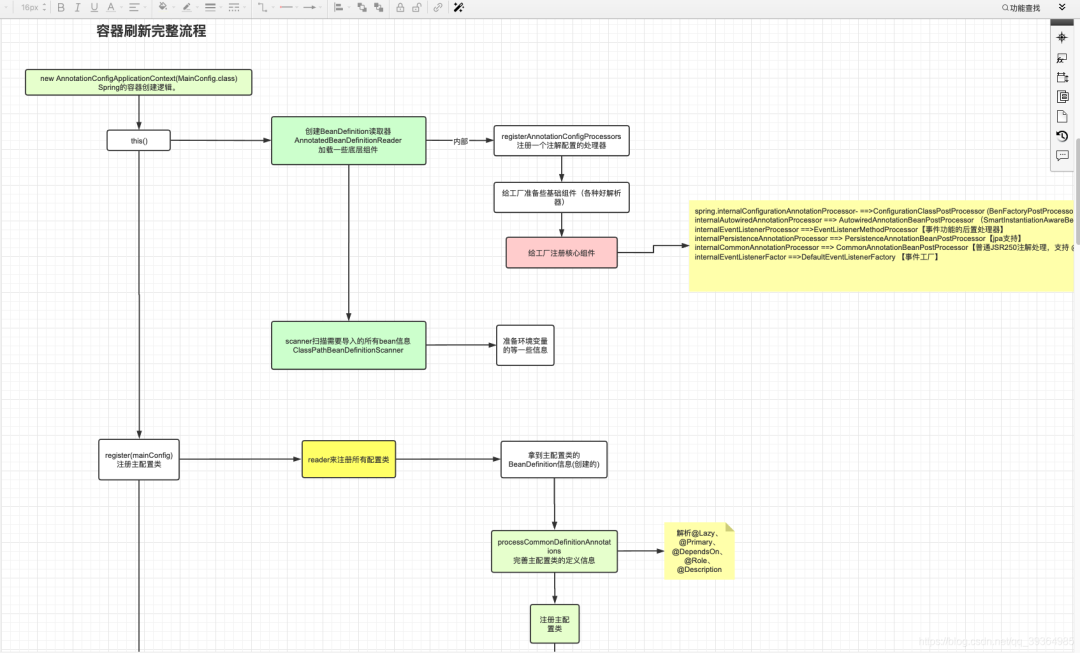
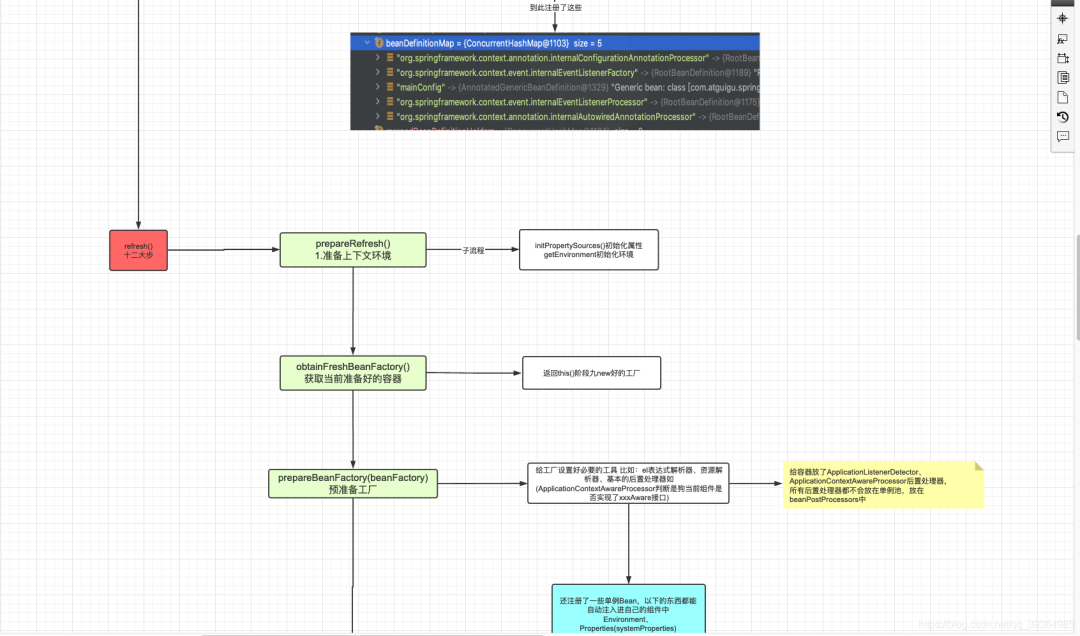
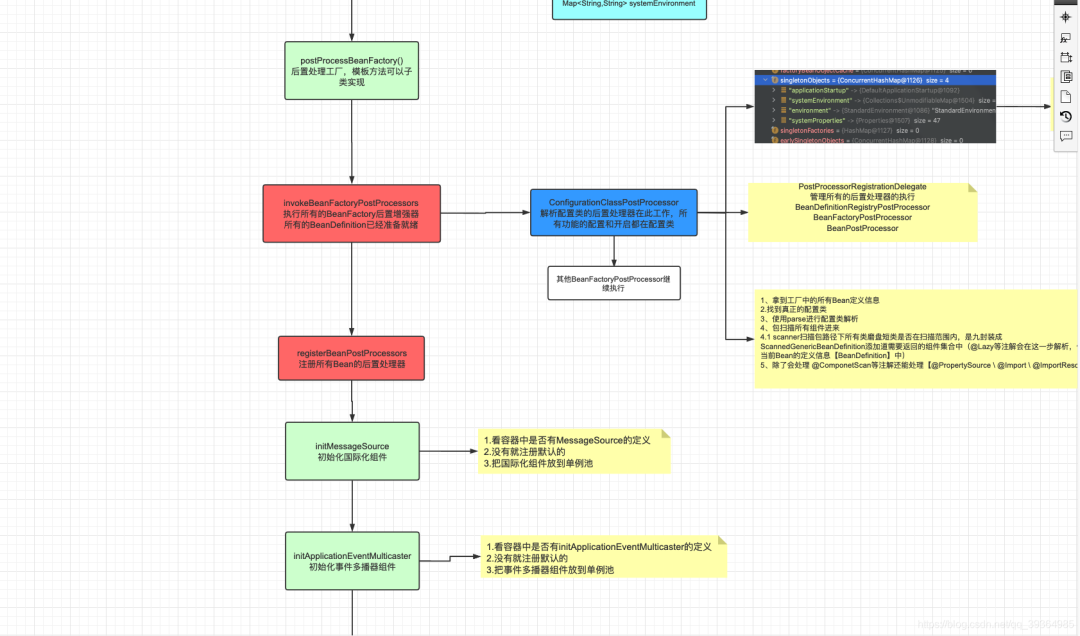

就以我們new了一個(gè)AnnotationConfigApplicationContext 為例,參數(shù)穿傳的是我們的是我們的主配置類(lèi), 配置類(lèi)就簡(jiǎn)單加倆注解@Configuration、@ComponentScan("com.xixi") ,new 一個(gè)AnnotationConfigApplicationContext 就是創(chuàng)建了一個(gè)IOC容器,里面就進(jìn)行了12個(gè)步驟來(lái)初始化容器
//偽代碼 簡(jiǎn)單寫(xiě)下
ApplicationContext applicationContext = new AnnotationConfigApplicationContext(MainConfig.class);

@ComponentScan("com")
@Configuration
public class MainConfig {

}
以下是Spring刷新容器的代碼,Spring中起了個(gè)名叫刷新,其實(shí)就是創(chuàng)建IOC容器,一共就12步 debug逐個(gè)擊破就完了 非常的easy
 @Override  //容器刷新的十二大步。模板模式
 public void refresh() throws BeansException, IllegalStateException {
  synchronized (this.startupShutdownMonitor) {
   StartupStep contextRefresh = this.applicationStartup.start("spring.context.refresh");

   //1.準(zhǔn)備上下文環(huán)境 Prepare this context for refreshing.
   prepareRefresh();

   // Tell the subclass to refresh the internal bean factory.
   // 2.工廠創(chuàng)建:BeanFactory第一次開(kāi)始創(chuàng)建的時(shí)候,有xml解析邏輯。
   ConfigurableListableBeanFactory beanFactory = obtainFreshBeanFactory();

   //3.給容器中注冊(cè)了環(huán)境信息作為單實(shí)例Bean方便后續(xù)自動(dòng)裝配;放了一些后置處理器處理(監(jiān)聽(tīng)、xxAware功能) Prepare the bean factory for use in this context.
   prepareBeanFactory(beanFactory);

   try {
    //4.留給子類(lèi)的模板方法,允許子類(lèi)繼續(xù)對(duì)工廠執(zhí)行一些處理; Allows post-processing of the bean factory in context subclasses.
    postProcessBeanFactory(beanFactory);

    StartupStep beanPostProcess = this.applicationStartup.start("spring.context.beans.post-process");
    //5.【大核心】工廠增強(qiáng):執(zhí)行所有的BeanFactory后置增強(qiáng)器;利用BeanFactory后置增強(qiáng)器對(duì)工廠進(jìn)行修改或者增強(qiáng),配置類(lèi)會(huì)在這里進(jìn)行解析。 Invoke factory processors registered as beans in the context.
    invokeBeanFactoryPostProcessors(beanFactory);

    //6.【核心】注冊(cè)所有的Bean的后置處理器 Register bean processors that intercept bean creation.
    registerBeanPostProcessors(beanFactory);
    beanPostProcess.end();

    //7.初始化國(guó)際化功能 Initialize message source for this context.
    initMessageSource();

    //8.初始化事件多播功能(事件派發(fā)) Initialize event multicaster for this context.
    initApplicationEventMulticaster();

    //9. Initialize other special beans in specific context subclasses.
    onRefresh();

    //10.注冊(cè)監(jiān)聽(tīng)器,從容器中獲取所有的ApplicationListener; Check for listener beans and register them.
    registerListeners();

    // Instantiate all remaining (non-lazy-init) singletons.
    //11.【大核心】bean創(chuàng)建;完成 BeanFactory 初始化。(工廠里面所有的組件都好了)
    finishBeanFactoryInitialization(beanFactory);

    //12.發(fā)布事件 Last step: publish corresponding event.
    finishRefresh();
   }

   catch (BeansException ex) {
    if (logger.isWarnEnabled()) {
     logger.warn("Exception encountered during context initialization - " +
       "cancelling refresh attempt: " + ex);
    }

    // Destroy already created singletons to avoid dangling resources.
    destroyBeans();

    // Reset 'active' flag.
    cancelRefresh(ex);

    // Propagate exception to caller.
    throw ex;
   }

   finally {
    // Reset common introspection caches in Spring's core, since we
    // might not ever need metadata for singleton beans anymore...
    resetCommonCaches();
    contextRefresh.end();
   }
  }
 }
2.AnnotationConfigApplicationContext構(gòu)造器
分析12大步之前先看下this()里邊干了啥
public AnnotationConfigApplicationContext(Class<?>... componentClasses) {
  this();
  register(componentClasses);
  refresh(); //容器完整刷新(創(chuàng)建出所有組件,組織好所有功能)
 }
下面是this中的代碼,可以看到主要就創(chuàng)建了倆基礎(chǔ)組件 AnnotatedBeanDefinitionReader Bean定義的讀取器,ClassPathBeanDefinitionScanner bean定義的掃描器,用來(lái)掃描指定路徑下所有的bean信息
public AnnotationConfigApplicationContext() {
  StartupStep createAnnotatedBeanDefReader = this.getApplicationStartup().start("spring.context.annotated-bean-reader.create");
  this.reader = new AnnotatedBeanDefinitionReader(this);
  createAnnotatedBeanDefReader.end();
  this.scanner = new ClassPathBeanDefinitionScanner(this);
 }
重點(diǎn)看下創(chuàng)建讀取器過(guò)程,里面調(diào)用了registerAnnotationConfigProcessors方法給工廠創(chuàng)建了很多基礎(chǔ)組件,各種解析器
 public AnnotatedBeanDefinitionReader(BeanDefinitionRegistry registry, Environment environment) {
  Assert.notNull(registry, "BeanDefinitionRegistry must not be null");
  Assert.notNull(environment, "Environment must not be null");
  this.registry = registry;
  this.conditionEvaluator = new ConditionEvaluator(registry, environment, null);
  AnnotationConfigUtils.registerAnnotationConfigProcessors(this.registry);
 }
可以看到里面注冊(cè)了ConfigurationClassPostProcessor 配置類(lèi)的后置處理器,我們加了@Configuration注解的類(lèi)就是用這個(gè)處理器來(lái)解析的,還有AutowiredAnnotationBeanPostProcessor自動(dòng)化裝配相關(guān)的后置處理器等等
 public static Set<BeanDefinitionHolder> registerAnnotationConfigProcessors(
   BeanDefinitionRegistry registry, @Nullable Object source) {

  DefaultListableBeanFactory beanFactory = unwrapDefaultListableBeanFactory(registry);
  if (beanFactory != null) {
   if (!(beanFactory.getDependencyComparator() instanceof AnnotationAwareOrderComparator)) {
    beanFactory.setDependencyComparator(AnnotationAwareOrderComparator.INSTANCE);
   }
   if (!(beanFactory.getAutowireCandidateResolver() instanceof ContextAnnotationAutowireCandidateResolver)) {
    beanFactory.setAutowireCandidateResolver(new ContextAnnotationAutowireCandidateResolver());
   }
  }

  Set<BeanDefinitionHolder> beanDefs = new LinkedHashSet<>(8);
  //注冊(cè)底層的  配置文件處理器
  if (!registry.containsBeanDefinition(CONFIGURATION_ANNOTATION_PROCESSOR_BEAN_NAME)) {
   RootBeanDefinition def = new RootBeanDefinition(ConfigurationClassPostProcessor.class);
   def.setSource(source);
   beanDefs.add(registerPostProcessor(registry, def, CONFIGURATION_ANNOTATION_PROCESSOR_BEAN_NAME));
  }
        //注冊(cè)底層的自動(dòng)裝配處理器
  if (!registry.containsBeanDefinition(AUTOWIRED_ANNOTATION_PROCESSOR_BEAN_NAME)) {
   RootBeanDefinition def = new RootBeanDefinition(AutowiredAnnotationBeanPostProcessor.class);
   def.setSource(source);
   beanDefs.add(registerPostProcessor(registry, def, AUTOWIRED_ANNOTATION_PROCESSOR_BEAN_NAME));
  }
        //注冊(cè)支持JSR-250的處理
  // Check for JSR-250 support, and if present add the CommonAnnotationBeanPostProcessor.
  if (jsr250Present && !registry.containsBeanDefinition(COMMON_ANNOTATION_PROCESSOR_BEAN_NAME)) {
   RootBeanDefinition def = new RootBeanDefinition(CommonAnnotationBeanPostProcessor.class);
   def.setSource(source);
   beanDefs.add(registerPostProcessor(registry, def, COMMON_ANNOTATION_PROCESSOR_BEAN_NAME));
  }

  // Check for JPA support, and if present add the PersistenceAnnotationBeanPostProcessor.
  if (jpaPresent && !registry.containsBeanDefinition(PERSISTENCE_ANNOTATION_PROCESSOR_BEAN_NAME)) {
   RootBeanDefinition def = new RootBeanDefinition();
   try {
    def.setBeanClass(ClassUtils.forName(PERSISTENCE_ANNOTATION_PROCESSOR_CLASS_NAME,
      AnnotationConfigUtils.class.getClassLoader()));
   }
   catch (ClassNotFoundException ex) {
    throw new IllegalStateException(
      "Cannot load optional framework class: " + PERSISTENCE_ANNOTATION_PROCESSOR_CLASS_NAME, ex);
   }
   def.setSource(source);
   beanDefs.add(registerPostProcessor(registry, def, PERSISTENCE_ANNOTATION_PROCESSOR_BEAN_NAME));
  }

  if (!registry.containsBeanDefinition(EVENT_LISTENER_PROCESSOR_BEAN_NAME)) {
   RootBeanDefinition def = new RootBeanDefinition(EventListenerMethodProcessor.class);
   def.setSource(source);
   beanDefs.add(registerPostProcessor(registry, def, EVENT_LISTENER_PROCESSOR_BEAN_NAME));
  }

  if (!registry.containsBeanDefinition(EVENT_LISTENER_FACTORY_BEAN_NAME)) {
   RootBeanDefinition def = new RootBeanDefinition(DefaultEventListenerFactory.class);
   def.setSource(source);
   beanDefs.add(registerPostProcessor(registry, def, EVENT_LISTENER_FACTORY_BEAN_NAME));
  }

  return beanDefs;
 }
this()里邊就是定義一些Spring容器底層用到的一些基礎(chǔ)組件。
然后看下一步register(componentClasses);方法,componentClasses是我們的主配置類(lèi),是個(gè)可變參數(shù)我們可以傳多個(gè),然后i就全部注冊(cè)到工廠里存著 也是解析成BeanDefinition存到Map里
 @Override
 public void register(Class<?>... componentClasses) {
  Assert.notEmpty(componentClasses, "At least one component class must be specified");
  StartupStep registerComponentClass = this.getApplicationStartup().start("spring.context.component-classes.register")
    .tag("classes", () -> Arrays.toString(componentClasses));
  this.reader.register(componentClasses);
  registerComponentClass.end();
 }
3.第一步--prepareRefresh()準(zhǔn)備上下文環(huán)境
容器刷新的12大步是在 AbstractApplicationContext 抽象類(lèi)中進(jìn)行,說(shuō)明AbstractApplicationContext是個(gè)模板類(lèi),定義了容器初始化的基本步驟,不一定每個(gè)方法都是他來(lái)實(shí)現(xiàn)。
 protected void prepareRefresh() {
  // Switch to active.
  this.startupDate = System.currentTimeMillis();
  this.closed.set(false);
  this.active.set(true);

  if (logger.isDebugEnabled()) {
   if (logger.isTraceEnabled()) {
    logger.trace("Refreshing " + this);
   }
   else {
    logger.debug("Refreshing " + getDisplayName());
   }
  }

  //其他子容器自行實(shí)現(xiàn)(比如:WebApplicationContext) Initialize any placeholder property sources in the context environment.
  initPropertySources();

  //準(zhǔn)備環(huán)境變量信息 Validate that all properties marked as required are resolvable:
  // see ConfigurablePropertyResolver#setRequiredProperties
  getEnvironment().validateRequiredProperties();

  // 存儲(chǔ)子容器早期運(yùn)行的一些監(jiān)聽(tīng)器; Store pre-refresh ApplicationListeners...
  if (this.earlyApplicationListeners == null) {
   this.earlyApplicationListeners = new LinkedHashSet<>(this.applicationListeners);
  }
  else {
   // Reset local application listeners to pre-refresh state.
   this.applicationListeners.clear();
   this.applicationListeners.addAll(this.earlyApplicationListeners);
  }

  //早期的一些時(shí)間存儲(chǔ)到這里 Allow for the collection of early ApplicationEvents,
  // to be published once the multicaster is available...
  this.earlyApplicationEvents = new LinkedHashSet<>();
 }
1.前邊三行代碼記錄下容器啟動(dòng)時(shí)間,關(guān)閉狀態(tài)設(shè)置成false,活躍狀態(tài)設(shè)置為true,很好理解。
2.然后 initPropertySources 這個(gè)方法在AbstractApplicationContext中就沒(méi)有實(shí)現(xiàn),而是交給子類(lèi)實(shí)現(xiàn),這個(gè)方法可以定義一些自己的初始化操作。比如Web環(huán)境下的IOC容器就在這加載一些應(yīng)用上下文信息
3.getEnvironment().validateRequiredProperties(); 方法創(chuàng)建了 StandardEnvironment環(huán)境對(duì)象,debug下可以看到首先拿到了一些我們系統(tǒng)的環(huán)境變量,比如JAVA_HOME ,系統(tǒng)時(shí)間等等

4.存儲(chǔ)一些早期的監(jiān)聽(tīng)器,如果是單純的IOC環(huán)境,暫時(shí)沒(méi)有任何監(jiān)聽(tīng)器存在,到此IOC容器刷新第一步準(zhǔn)備環(huán)境上下文就結(jié)束了
4.第二步創(chuàng)建工廠實(shí)例
obtainFreshBeanFactory方法返回了在this()階段就創(chuàng)建好的工廠實(shí)例, 說(shuō)明ApplicationContext其實(shí)并沒(méi)有實(shí)現(xiàn)任何的創(chuàng)建bean的功能,而是組合持有了工廠來(lái)配合實(shí)現(xiàn)整個(gè)流程
   // 2.工廠創(chuàng)建:BeanFactory第一次開(kāi)始創(chuàng)建的時(shí)候,有xml解析邏輯。
   ConfigurableListableBeanFactory beanFactory = obtainFreshBeanFactory();
5. 第三步預(yù)準(zhǔn)備工廠
這個(gè)階段繼續(xù)創(chuàng)建了一些Spring底層用到的基礎(chǔ)組件,例如StandardBeanExpressionResolver EL表達(dá)式的解析器 解析 ${}這些玩意的,還有ResourceEditorRegistrar資源解析器,基礎(chǔ)的后置處理器ApplicationContextAwareProcessor(判斷那些實(shí)現(xiàn)Aware接口)等
最后還把一些默認(rèn)組件放到了單例池子
protected void prepareBeanFactory(ConfigurableListableBeanFactory beanFactory) {
  // Tell the internal bean factory to use the context's class loader etc.
  beanFactory.setBeanClassLoader(getClassLoader());
  if (!shouldIgnoreSpel) { //解釋器模式  ${ }
   beanFactory.setBeanExpressionResolver(new StandardBeanExpressionResolver(beanFactory.getBeanClassLoader()));
  }
  beanFactory.addPropertyEditorRegistrar(new ResourceEditorRegistrar(this, getEnvironment()));

  // Configure the bean factory with context callbacks.
  beanFactory.addBeanPostProcessor(new ApplicationContextAwareProcessor(this)); //準(zhǔn)備一個(gè)處理Aware接口功能的后置處理器
  beanFactory.ignoreDependencyInterface(EnvironmentAware.class); //告訴Spring先別管這些接口
  beanFactory.ignoreDependencyInterface(EmbeddedValueResolverAware.class);
  beanFactory.ignoreDependencyInterface(ResourceLoaderAware.class);
  beanFactory.ignoreDependencyInterface(ApplicationEventPublisherAware.class);
  beanFactory.ignoreDependencyInterface(MessageSourceAware.class);
  beanFactory.ignoreDependencyInterface(ApplicationContextAware.class);
  beanFactory.ignoreDependencyInterface(ApplicationStartupAware.class);

  //注冊(cè)可以解析到的依賴(lài) BeanFactory interface not registered as resolvable type in a plain factory.
  // MessageSource registered (and found for autowiring) as a bean.
  beanFactory.registerResolvableDependency(BeanFactory.class, beanFactory);
  beanFactory.registerResolvableDependency(ResourceLoader.class, this);
  beanFactory.registerResolvableDependency(ApplicationEventPublisher.class, this);
  beanFactory.registerResolvableDependency(ApplicationContext.class, this);

  // Register early post-processor for detecting inner beans as ApplicationListeners.
  beanFactory.addBeanPostProcessor(new ApplicationListenerDetector(this));

  // Detect a LoadTimeWeaver and prepare for weaving, if found.
  if (!NativeDetector.inNativeImage() && beanFactory.containsBean(LOAD_TIME_WEAVER_BEAN_NAME)) {
   beanFactory.addBeanPostProcessor(new LoadTimeWeaverAwareProcessor(beanFactory));
   // Set a temporary ClassLoader for type matching.
   beanFactory.setTempClassLoader(new ContextTypeMatchClassLoader(beanFactory.getBeanClassLoader()));
  }

  //注冊(cè)默認(rèn)組件: Register default environment beans.
  if (!beanFactory.containsLocalBean(ENVIRONMENT_BEAN_NAME)) {
   beanFactory.registerSingleton(ENVIRONMENT_BEAN_NAME, getEnvironment());
  }
  if (!beanFactory.containsLocalBean(SYSTEM_PROPERTIES_BEAN_NAME)) {
   beanFactory.registerSingleton(SYSTEM_PROPERTIES_BEAN_NAME, getEnvironment().getSystemProperties());
  }
  if (!beanFactory.containsLocalBean(SYSTEM_ENVIRONMENT_BEAN_NAME)) {
   beanFactory.registerSingleton(SYSTEM_ENVIRONMENT_BEAN_NAME, getEnvironment().getSystemEnvironment());
  }
  if (!beanFactory.containsLocalBean(APPLICATION_STARTUP_BEAN_NAME)) {
   beanFactory.registerSingleton(APPLICATION_STARTUP_BEAN_NAME, getApplicationStartup());
  }
 }
6.第四步postProcessBeanFactory
postProcessBeanFactory這個(gè)方法工廠沒(méi)有實(shí)現(xiàn) 是留給子類(lèi)的模板方法,允許子類(lèi)繼承對(duì)工廠執(zhí)行一些處理
7. 第五步執(zhí)行所有的BeanFactory后置增強(qiáng)器
這里邊調(diào)用了
PostProcessorRegistrationDelegate.invokeBeanFactoryPostProcessors(beanFactory, getBeanFactoryPostProcessors());來(lái)執(zhí)行所有的工廠增強(qiáng)器
PostProcessorRegistrationDelegate類(lèi)可以說(shuō)是一個(gè)門(mén)面模式或者一個(gè)裝飾者,他用來(lái)處理Spring的所有后置處理器
 protected void invokeBeanFactoryPostProcessors(ConfigurableListableBeanFactory beanFactory) {
  PostProcessorRegistrationDelegate.invokeBeanFactoryPostProcessors(beanFactory, getBeanFactoryPostProcessors()); //執(zhí)行所有的工廠增強(qiáng)器
  //上面的類(lèi)叫:后置處理器的注冊(cè)代理(門(mén)面模式-裝飾模式)
  // Detect a LoadTimeWeaver and prepare for weaving, if found in the meantime
  // (e.g. through an @Bean method registered by ConfigurationClassPostProcessor)
  if (!NativeDetector.inNativeImage() && beanFactory.getTempClassLoader() == null && beanFactory.containsBean(LOAD_TIME_WEAVER_BEAN_NAME)) {
   beanFactory.addBeanPostProcessor(new LoadTimeWeaverAwareProcessor(beanFactory));
   beanFactory.setTempClassLoader(new ContextTypeMatchClassLoader(beanFactory.getBeanClassLoader()));
  }
 }
此方法執(zhí)行了所有的BeanFactory的后置處理器,BeanFactory的后置處理器一共兩種 BeanDefinitionRegistryPostProcessor 和 BeanFactoryPostProcessor。
先執(zhí)行默認(rèn)的處理器,-> 然后再取出實(shí)現(xiàn)了PriorityOrdered排序接口的處理器進(jìn)行排序,執(zhí)行處理器 ->接下來(lái)取出實(shí)現(xiàn)了Ordered排序接口的的處理器,排序然后執(zhí)行。 兩類(lèi)處理器都是這個(gè)執(zhí)行流程
 //執(zhí)行工廠的后置處理器
 public static void invokeBeanFactoryPostProcessors(
   ConfigurableListableBeanFactory beanFactory, List<BeanFactoryPostProcessor> beanFactoryPostProcessors) {

  // WARNING: Although it may appear that the body of this method can be easily
  // refactored to avoid the use of multiple loops and multiple lists, the use
  // of multiple lists and multiple passes over the names of processors is
  // intentional. We must ensure that we honor the contracts for PriorityOrdered
  // and Ordered processors. Specifically, we must NOT cause processors to be
  // instantiated (via getBean() invocations) or registered in the ApplicationContext
  // in the wrong order.
  //
  // Before submitting a pull request (PR) to change this method, please review the
  // list of all declined PRs involving changes to PostProcessorRegistrationDelegate
  // to ensure that your proposal does not result in a breaking change:
  // https://github.com/spring-projects/spring-framework/issues?q=PostProcessorRegistrationDelegate+is%3Aclosed+label%3A%22status%3A+declined%22

  // Invoke BeanDefinitionRegistryPostProcessors first, if any.
  Set<String> processedBeans = new HashSet<>();

  if (beanFactory instanceof BeanDefinitionRegistry) {
   BeanDefinitionRegistry registry = (BeanDefinitionRegistry) beanFactory;
   List<BeanFactoryPostProcessor> regularPostProcessors = new ArrayList<>();
   List<BeanDefinitionRegistryPostProcessor> registryProcessors = new ArrayList<>();
   //先拿到底層默認(rèn)有的BeanFactoryPostProcessor
   for (BeanFactoryPostProcessor postProcessor : beanFactoryPostProcessors) {
    if (postProcessor instanceof BeanDefinitionRegistryPostProcessor) {
     BeanDefinitionRegistryPostProcessor registryProcessor =
       (BeanDefinitionRegistryPostProcessor) postProcessor;
     registryProcessor.postProcessBeanDefinitionRegistry(registry);
     registryProcessors.add(registryProcessor);
    }
    else {
     regularPostProcessors.add(postProcessor);
    }
   }

   // Do not initialize FactoryBeans here: We need to leave all regular beans
   // uninitialized to let the bean factory post-processors apply to them!
   // Separate between BeanDefinitionRegistryPostProcessors that implement
   // PriorityOrdered, Ordered, and the rest.
   List<BeanDefinitionRegistryPostProcessor> currentRegistryProcessors = new ArrayList<>();

   // 首先:從工廠中獲取所有的實(shí)現(xiàn)了 PriorityOrdered 接口的 BeanDefinitionRegistryPostProcessor; First, invoke the BeanDefinitionRegistryPostProcessors that implement PriorityOrdered.
   String[] postProcessorNames =
     beanFactory.getBeanNamesForType(BeanDefinitionRegistryPostProcessor.class, true, false); //拿到系統(tǒng)中每一個(gè)組件的BD信息,進(jìn)行類(lèi)型對(duì)比,是否匹配指定的類(lèi)型
   for (String ppName : postProcessorNames) {
    if (beanFactory.isTypeMatch(ppName, PriorityOrdered.class)) {
     currentRegistryProcessors.add(beanFactory.getBean(ppName, BeanDefinitionRegistryPostProcessor.class));//從工廠中獲取這個(gè)組件【getBean整個(gè)組件創(chuàng)建的流程】并放到這個(gè)集合
     processedBeans.add(ppName);
    }
   } //下面利用優(yōu)先級(jí)排序
   sortPostProcessors(currentRegistryProcessors, beanFactory);
   registryProcessors.addAll(currentRegistryProcessors);
   invokeBeanDefinitionRegistryPostProcessors(currentRegistryProcessors, registry, beanFactory.getApplicationStartup()); //執(zhí)行這些BeanDefinitionRegistryPostProcessor的
   currentRegistryProcessors.clear();

   // 接下來(lái),獲取所有實(shí)現(xiàn)了Ordered接口的 BeanDefinitionRegistryPostProcessor Next, invoke the BeanDefinitionRegistryPostProcessors that implement Ordered.
   postProcessorNames = beanFactory.getBeanNamesForType(BeanDefinitionRegistryPostProcessor.class, true, false);
   for (String ppName : postProcessorNames) {
    if (!processedBeans.contains(ppName) && beanFactory.isTypeMatch(ppName, Ordered.class)) {
     currentRegistryProcessors.add(beanFactory.getBean(ppName, BeanDefinitionRegistryPostProcessor.class));
     processedBeans.add(ppName); //即使實(shí)現(xiàn)了 PriorityOrdered 和Ordered,也是以 PriorityOrdered
    }
   }//排序
   sortPostProcessors(currentRegistryProcessors, beanFactory);
   registryProcessors.addAll(currentRegistryProcessors);
   invokeBeanDefinitionRegistryPostProcessors(currentRegistryProcessors, registry, beanFactory.getApplicationStartup()); //執(zhí)行
   currentRegistryProcessors.clear();

   // 最后,我們自定義的一般沒(méi)有任何優(yōu)先級(jí)和排序接口   Finally, invoke all other BeanDefinitionRegistryPostProcessors until no further ones appear.
   boolean reiterate = true;
   while (reiterate) {
    reiterate = false;
    postProcessorNames = beanFactory.getBeanNamesForType(BeanDefinitionRegistryPostProcessor.class, true, false);//拿到所有的BeanDefinitionRegistryPostProcessor
    for (String ppName : postProcessorNames) {
     if (!processedBeans.contains(ppName)) {
      currentRegistryProcessors.add(beanFactory.getBean(ppName, BeanDefinitionRegistryPostProcessor.class));
      processedBeans.add(ppName);
      reiterate = true;
     }
    }//排序,根據(jù)類(lèi)名大小寫(xiě)進(jìn)行排序
    sortPostProcessors(currentRegistryProcessors, beanFactory);
    registryProcessors.addAll(currentRegistryProcessors);
    invokeBeanDefinitionRegistryPostProcessors(currentRegistryProcessors, registry, beanFactory.getApplicationStartup());
    currentRegistryProcessors.clear(); //防止重復(fù)執(zhí)行
   }

   // 接下來(lái),再來(lái)執(zhí)行postProcessBeanFactory的回調(diào), Now, invoke the postProcessBeanFactory callback of all processors handled so far.
   invokeBeanFactoryPostProcessors(registryProcessors, beanFactory);
   invokeBeanFactoryPostProcessors(regularPostProcessors, beanFactory);
  }

  else {
   // Invoke factory processors registered with the context instance.
   invokeBeanFactoryPostProcessors(beanFactoryPostProcessors, beanFactory);
  }
  //以前在執(zhí)行 BeanDefinitionRegistryPostProcessor ,以后來(lái)執(zhí)行 BeanFactoryPostProcessor
  // Do not initialize FactoryBeans here: We need to leave all regular beans
  // uninitialized to let the bean factory post-processors apply to them!
  String[] postProcessorNames =
    beanFactory.getBeanNamesForType(BeanFactoryPostProcessor.class, true, false);

  // Separate between BeanFactoryPostProcessors that implement PriorityOrdered,
  // Ordered, and the rest.
  List<BeanFactoryPostProcessor> priorityOrderedPostProcessors = new ArrayList<>();
  List<String> orderedPostProcessorNames = new ArrayList<>();
  List<String> nonOrderedPostProcessorNames = new ArrayList<>();
  for (String ppName : postProcessorNames) {
   if (processedBeans.contains(ppName)) {
    // skip - already processed in first phase above
   }
   else if (beanFactory.isTypeMatch(ppName, PriorityOrdered.class)) {
    priorityOrderedPostProcessors.add(beanFactory.getBean(ppName, BeanFactoryPostProcessor.class));
   }
   else if (beanFactory.isTypeMatch(ppName, Ordered.class)) {
    orderedPostProcessorNames.add(ppName);
   }
   else {
    nonOrderedPostProcessorNames.add(ppName);
   }
  }

  // 首先執(zhí)行所有實(shí)現(xiàn)了 PriorityOrdered 的 BeanFactoryPostProcessor;First, invoke the BeanFactoryPostProcessors that implement PriorityOrdered.
  sortPostProcessors(priorityOrderedPostProcessors, beanFactory);
  invokeBeanFactoryPostProcessors(priorityOrderedPostProcessors, beanFactory);

  // 接下來(lái)執(zhí)行,實(shí)現(xiàn)了 Ordered 接口的 BeanFactoryPostProcessor  Next, invoke the BeanFactoryPostProcessors that implement Ordered.
  List<BeanFactoryPostProcessor> orderedPostProcessors = new ArrayList<>(orderedPostProcessorNames.size());
  for (String postProcessorName : orderedPostProcessorNames) {
   orderedPostProcessors.add(beanFactory.getBean(postProcessorName, BeanFactoryPostProcessor.class));
  }
  sortPostProcessors(orderedPostProcessors, beanFactory);
  invokeBeanFactoryPostProcessors(orderedPostProcessors, beanFactory);

  // 最后執(zhí)行沒(méi)有任何優(yōu)先級(jí)和排序接口的 BeanFactoryPostProcessor Finally, invoke all other BeanFactoryPostProcessors.
  List<BeanFactoryPostProcessor> nonOrderedPostProcessors = new ArrayList<>(nonOrderedPostProcessorNames.size());
  for (String postProcessorName : nonOrderedPostProcessorNames) {
   nonOrderedPostProcessors.add(beanFactory.getBean(postProcessorName, BeanFactoryPostProcessor.class));
  }
  invokeBeanFactoryPostProcessors(nonOrderedPostProcessors, beanFactory); //執(zhí)行所有的 BeanFactoryPostProcessor

  // Clear cached merged bean definitions since the post-processors might have
  // modified the original metadata, e.g. replacing placeholders in values...
  beanFactory.clearMetadataCache();
 }
8. 第六步注冊(cè)所有的bean的后置處理器 BeanPostProcessors
取出所有的BeanPostProcessor后置處理器,該排序的排序,然后全都放到容器的集合中
容器有一個(gè)集合屬性來(lái)保存所有的BeanPostProcessor
/** BeanPostProcessors to apply. 保存了所有的Bean后置增強(qiáng)器 */
private final List<BeanPostProcessor> beanPostProcessors = new BeanPostProcessorCacheAwareList();
 public static void registerBeanPostProcessors(
   ConfigurableListableBeanFactory beanFactory, AbstractApplicationContext applicationContext) {

  // WARNING: Although it may appear that the body of this method can be easily
  // refactored to avoid the use of multiple loops and multiple lists, the use
  // of multiple lists and multiple passes over the names of processors is
  // intentional. We must ensure that we honor the contracts for PriorityOrdered
  // and Ordered processors. Specifically, we must NOT cause processors to be
  // instantiated (via getBean() invocations) or registered in the ApplicationContext
  // in the wrong order.
  //
  // Before submitting a pull request (PR) to change this method, please review the
  // list of all declined PRs involving changes to PostProcessorRegistrationDelegate
  // to ensure that your proposal does not result in a breaking change:
  // https://github.com/spring-projects/spring-framework/issues?q=PostProcessorRegistrationDelegate+is%3Aclosed+label%3A%22status%3A+declined%22
  //獲取到容器中所有的 BeanPostProcessor; Bean的后置處理器
  String[] postProcessorNames = beanFactory.getBeanNamesForType(BeanPostProcessor.class, true, false);

  // Register BeanPostProcessorChecker that logs an info message when
  // a bean is created during BeanPostProcessor instantiation, i.e. when
  // a bean is not eligible for getting processed by all BeanPostProcessors.
  int beanProcessorTargetCount = beanFactory.getBeanPostProcessorCount() + 1 + postProcessorNames.length;
  beanFactory.addBeanPostProcessor(new BeanPostProcessorChecker(beanFactory, beanProcessorTargetCount));

  // Separate between BeanPostProcessors that implement PriorityOrdered,
  // Ordered, and the rest.
  List<BeanPostProcessor> priorityOrderedPostProcessors = new ArrayList<>();
  List<BeanPostProcessor> internalPostProcessors = new ArrayList<>();
  List<String> orderedPostProcessorNames = new ArrayList<>();
  List<String> nonOrderedPostProcessorNames = new ArrayList<>();
  for (String ppName : postProcessorNames) {
   if (beanFactory.isTypeMatch(ppName, PriorityOrdered.class)) {  //獲取所有實(shí)現(xiàn)了 PriorityOrdered 的 BeanPostProcessor
    BeanPostProcessor pp = beanFactory.getBean(ppName, BeanPostProcessor.class);
    priorityOrderedPostProcessors.add(pp);
    if (pp instanceof MergedBeanDefinitionPostProcessor) {
     internalPostProcessors.add(pp);
    }
   }
   else if (beanFactory.isTypeMatch(ppName, Ordered.class)) {
    orderedPostProcessorNames.add(ppName);
   }
   else {
    nonOrderedPostProcessorNames.add(ppName);
   }
  }

  //首先,注冊(cè)所有的實(shí)現(xiàn)了 PriorityOrdered 的 BeanPostProcessor ;  First, register the BeanPostProcessors that implement PriorityOrdered.
  sortPostProcessors(priorityOrderedPostProcessors, beanFactory);
  registerBeanPostProcessors(beanFactory, priorityOrderedPostProcessors);

  //接下來(lái),注冊(cè)所有的實(shí)現(xiàn)了 Ordered 的 BeanPostProcessor  Next, register the BeanPostProcessors that implement Ordered.
  List<BeanPostProcessor> orderedPostProcessors = new ArrayList<>(orderedPostProcessorNames.size());
  for (String ppName : orderedPostProcessorNames) {
   BeanPostProcessor pp = beanFactory.getBean(ppName, BeanPostProcessor.class); //獲取后置處理器對(duì)象
   orderedPostProcessors.add(pp);
   if (pp instanceof MergedBeanDefinitionPostProcessor) {
    internalPostProcessors.add(pp);
   }
  }
  sortPostProcessors(orderedPostProcessors, beanFactory);
  registerBeanPostProcessors(beanFactory, orderedPostProcessors);

  // 最后,注冊(cè)所有普通的 BeanPostProcessor ;Now, register all regular BeanPostProcessors.
  List<BeanPostProcessor> nonOrderedPostProcessors = new ArrayList<>(nonOrderedPostProcessorNames.size());
  for (String ppName : nonOrderedPostProcessorNames) {
   BeanPostProcessor pp = beanFactory.getBean(ppName, BeanPostProcessor.class); //從容器中獲取這個(gè)組件
   nonOrderedPostProcessors.add(pp);
   if (pp instanceof MergedBeanDefinitionPostProcessor) {
    internalPostProcessors.add(pp);
   }
  }
  registerBeanPostProcessors(beanFactory, nonOrderedPostProcessors);

  //最后,重新注冊(cè)所有internal的BeanPostProcessors  Finally, re-register all internal BeanPostProcessors.
  sortPostProcessors(internalPostProcessors, beanFactory);
  registerBeanPostProcessors(beanFactory, internalPostProcessors);

  // 重新注冊(cè)一下這個(gè)后置處理器 Re-register post-processor for detecting inner beans as ApplicationListeners,
  // 把他放到后置處理器的最后一位; moving it to the end of the processor chain (for picking up proxies etc).
  beanFactory.addBeanPostProcessor(new ApplicationListenerDetector(applicationContext));
 }
9. 第七步初始化國(guó)際化組件
MESSAGE_SOURCE_BEAN_NAME 對(duì)應(yīng)的值是 "messageSource", 先從容器中拿一個(gè)名為 “messageSource” 類(lèi)型為MessageSource的組件,拿到就賦值給工廠,拿不到就創(chuàng)建個(gè)DelegatingMessageSource類(lèi)型的組件
 protected void initMessageSource() {
  ConfigurableListableBeanFactory beanFactory = getBeanFactory();
  if (beanFactory.containsLocalBean(MESSAGE_SOURCE_BEAN_NAME)) {
   this.messageSource = beanFactory.getBean(MESSAGE_SOURCE_BEAN_NAME, MessageSource.class);
   // Make MessageSource aware of parent MessageSource.
   if (this.parent != null && this.messageSource instanceof HierarchicalMessageSource) {
    HierarchicalMessageSource hms = (HierarchicalMessageSource) this.messageSource;
    if (hms.getParentMessageSource() == null) {
     // Only set parent context as parent MessageSource if no parent MessageSource
     // registered already.
     hms.setParentMessageSource(getInternalParentMessageSource());
    }
   }
   if (logger.isTraceEnabled()) {
    logger.trace("Using MessageSource [" + this.messageSource + "]");
   }
  }
  else {
   // Use empty MessageSource to be able to accept getMessage calls.
   DelegatingMessageSource dms = new DelegatingMessageSource();
   dms.setParentMessageSource(getInternalParentMessageSource());
   this.messageSource = dms;
   beanFactory.registerSingleton(MESSAGE_SOURCE_BEAN_NAME, this.messageSource);
   if (logger.isTraceEnabled()) {
    logger.trace("No '" + MESSAGE_SOURCE_BEAN_NAME + "' bean, using [" + this.messageSource + "]");
   }
  }
 }
10. 第八步初始化事件多播器組件
先從容器中拿一個(gè)名為applicationEventMulticaster的組件,拿到設(shè)置給容器。拿不到就創(chuàng)建一個(gè)簡(jiǎn)單的事件多播器
Spring監(jiān)聽(tīng)器是觀察者模式的應(yīng)用。
 protected void initApplicationEventMulticaster() {
  ConfigurableListableBeanFactory beanFactory = getBeanFactory();
  if (beanFactory.containsLocalBean(APPLICATION_EVENT_MULTICASTER_BEAN_NAME)) {
   this.applicationEventMulticaster =
     beanFactory.getBean(APPLICATION_EVENT_MULTICASTER_BEAN_NAME, ApplicationEventMulticaster.class);
   if (logger.isTraceEnabled()) {
    logger.trace("Using ApplicationEventMulticaster [" + this.applicationEventMulticaster + "]");
   }
  }
  else {
   this.applicationEventMulticaster = new SimpleApplicationEventMulticaster(beanFactory);
   beanFactory.registerSingleton(APPLICATION_EVENT_MULTICASTER_BEAN_NAME, this.applicationEventMulticaster); //注冊(cè)一個(gè)事件派發(fā)器
   if (logger.isTraceEnabled()) {
    logger.trace("No '" + APPLICATION_EVENT_MULTICASTER_BEAN_NAME + "' bean, using " +
      "[" + this.applicationEventMulticaster.getClass().getSimpleName() + "]");
   }
  }
 }
11. 第九步onRefresh
這一步啥也沒(méi)實(shí)現(xiàn),也是留給子類(lèi)實(shí)現(xiàn)的
12. 第十步注冊(cè)早期的監(jiān)聽(tīng)器
 /** 多播器和監(jiān)聽(tīng)器是觀察者模式(里面包含了所有的監(jiān)聽(tīng)器)
  * Add beans that implement ApplicationListener as listeners.
  * Doesn't affect other listeners, which can be added without being beans.
  */
 protected void registerListeners() {
  //把所有監(jiān)聽(tīng)器保存到多播器的集合中 Register statically specified listeners first.
  for (ApplicationListener<?> listener : getApplicationListeners()) {
   getApplicationEventMulticaster().addApplicationListener(listener);
  }

  // Do not initialize FactoryBeans here: We need to leave all regular beans
  // uninitialized to let post-processors apply to them! 獲取ApplicationListener在ioc容器中注冊(cè)的bean的名字
  String[] listenerBeanNames = getBeanNamesForType(ApplicationListener.class, true, false);
  for (String listenerBeanName : listenerBeanNames) {
   getApplicationEventMulticaster().addApplicationListenerBean(listenerBeanName); //獲取所有的容器中的監(jiān)聽(tīng)器,并保存他們的名字
  }

  //派發(fā)之前攢的一些早期事件 Publish early application events now that we finally have a multicaster...
  Set<ApplicationEvent> earlyEventsToProcess = this.earlyApplicationEvents;
  this.earlyApplicationEvents = null;
  if (!CollectionUtils.isEmpty(earlyEventsToProcess)) {
   for (ApplicationEvent earlyEvent : earlyEventsToProcess) {
    getApplicationEventMulticaster().multicastEvent(earlyEvent);
   }
  }
 }
13. 第十一步大大核心 完成BeanFactory初始化, 創(chuàng)建所有組件
這個(gè)方法最重要一步是preInstantiateSingletons()方法,這里面初始化所有非懶加載的單例bean
 protected void finishBeanFactoryInitialization(ConfigurableListableBeanFactory beanFactory) {
  // 給工廠設(shè)置好 ConversionService【負(fù)責(zé)類(lèi)型轉(zhuǎn)換的組件服務(wù)】, Initialize conversion service for this context.
  if (beanFactory.containsBean(CONVERSION_SERVICE_BEAN_NAME) &&
    beanFactory.isTypeMatch(CONVERSION_SERVICE_BEAN_NAME, ConversionService.class)) {
   beanFactory.setConversionService(
     beanFactory.getBean(CONVERSION_SERVICE_BEAN_NAME, ConversionService.class));
  }

  // 注冊(cè)一個(gè)默認(rèn)的值解析器("${}")  ;Register a default embedded value resolver if no BeanFactoryPostProcessor
  // (such as a PropertySourcesPlaceholderConfigurer bean) registered any before:
  // at this point, primarily for resolution in annotation attribute values.
  if (!beanFactory.hasEmbeddedValueResolver()) {
   beanFactory.addEmbeddedValueResolver(strVal -> getEnvironment().resolvePlaceholders(strVal));
  }

  // LoadTimeWeaverAware;aspectj:加載時(shí)織入功能【aop】。 Initialize LoadTimeWeaverAware beans early to allow for registering their transformers early.
  String[] weaverAwareNames = beanFactory.getBeanNamesForType(LoadTimeWeaverAware.class, false, false);
  for (String weaverAwareName : weaverAwareNames) {
   getBean(weaverAwareName); //從容器中獲取組件,有則直接獲取,沒(méi)則進(jìn)行創(chuàng)建
  }

  // Stop using the temporary ClassLoader for type matching.
  beanFactory.setTempClassLoader(null);

  // Allow for caching all bean definition metadata, not expecting further changes.
  beanFactory.freezeConfiguration();

  // Instantiate all remaining (non-lazy-init) singletons.
  //初始化所有的非懶加載的單實(shí)例Bean
  beanFactory.preInstantiateSingletons();
 }
這個(gè)方法維護(hù)了Bean的整個(gè)生命周期, 其中包含 實(shí)例化Bean ->屬性注入 -> 到初始化Bean,以及在實(shí)例化前后,屬性注入的自動(dòng)裝配,初始化前后執(zhí)行了所有的BeanPostProcessor后置處理器,例如AOP,事務(wù)等就是利用后置處理器在Bean的生命周期的某個(gè)時(shí)期進(jìn)行干預(yù)的。
里面代碼量很大不在此文中詳細(xì)展開(kāi)講了。大致邏輯就是 遍歷所有BeanName 然后通過(guò)BeanName獲取Bean的定義BeanDefinition,接著一些華麗唿哨判斷,例如是否單例,是否抽象,是否是FactoryBean類(lèi)型的,不是的話(huà)走普通創(chuàng)建邏輯, 還有處理循環(huán)依賴(lài)等等很多很多
Spring中所有組件都是通過(guò)getBean方法獲取的,getBean里邊邏輯就是先從單例池獲取,獲取不到再創(chuàng)建。
Spring容器刷新最重要的部分就在這了
 @Override
 public void preInstantiateSingletons() throws BeansException {
  if (logger.isTraceEnabled()) {
   logger.trace("Pre-instantiating singletons in " + this);
  }

  // Iterate over a copy to allow for init methods which in turn register new bean definitions.
  // While this may not be part of the regular factory bootstrap, it does otherwise work fine.
  List<String> beanNames = new ArrayList<>(this.beanDefinitionNames);

  // 創(chuàng)建出所有的單實(shí)例Bean;Trigger initialization of all non-lazy singleton beans...
  for (String beanName : beanNames) {
   RootBeanDefinition bd = getMergedLocalBeanDefinition(beanName); //開(kāi)始解析文件的時(shí)候每一個(gè)bean標(biāo)簽被解析封裝成一個(gè)BeanDefinition
   if (!bd.isAbstract() && bd.isSingleton() && !bd.isLazyInit()) {
    if (isFactoryBean(beanName)) { //如果是FactoryBean則執(zhí)行下面邏輯
     Object bean = getBean(FACTORY_BEAN_PREFIX + beanName); //得到HelloFactory
     if (bean instanceof FactoryBean) {
      FactoryBean<?> factory = (FactoryBean<?>) bean;
      boolean isEagerInit;
      if (System.getSecurityManager() != null && factory instanceof SmartFactoryBean) {
       isEagerInit = AccessController.doPrivileged(
         (PrivilegedAction<Boolean>) ((SmartFactoryBean<?>) factory)::isEagerInit,
         getAccessControlContext());
      }
      else {
       isEagerInit = (factory instanceof SmartFactoryBean &&
         ((SmartFactoryBean<?>) factory).isEagerInit());
      }
      if (isEagerInit) {
       getBean(beanName);
      }
     }
    }
    else { //不是FactoryBean則執(zhí)行這個(gè),普通的單實(shí)例非懶加載bean的創(chuàng)建
     getBean(beanName); //
    }
   }
  }

  // 觸發(fā) post-initialization 邏輯;  Trigger post-initialization callback for all applicable beans...
  for (String beanName : beanNames) {
   Object singletonInstance = getSingleton(beanName);
   if (singletonInstance instanceof SmartInitializingSingleton) {
    StartupStep smartInitialize = this.getApplicationStartup().start("spring.beans.smart-initialize")
      .tag("beanName", beanName);
    SmartInitializingSingleton smartSingleton = (SmartInitializingSingleton) singletonInstance;
    if (System.getSecurityManager() != null) {
     AccessController.doPrivileged((PrivilegedAction<Object>) () -> {
      smartSingleton.afterSingletonsInstantiated();
      return null;
     }, getAccessControlContext());
    }
    else {
     smartSingleton.afterSingletonsInstantiated();
    }
    smartInitialize.end();
   }
  }
 }
14. 第十二步 收尾工作finishRefresh
最后收尾工作很簡(jiǎn)單了 清理下不用的緩存 ,初始化個(gè)LifecycleProcessor類(lèi)型處理器,干嘛用的我也不知道,發(fā)布下容器刷新完成的事件。完事 至此SpringIOC容器的創(chuàng)建過(guò)程就完全結(jié)束了。
 protected void finishRefresh() {
  // Clear context-level resource caches (such as ASM metadata from scanning).
  clearResourceCaches();

  // Initialize lifecycle processor for this context.
  initLifecycleProcessor();

  //告訴LifecycleProcessor容器onRefresh Propagate refresh to lifecycle processor first.
  getLifecycleProcessor().onRefresh();

  //發(fā)布事件 Publish the final event.
  publishEvent(new ContextRefreshedEvent(this));

  //jconsole(暴露MBean端點(diǎn)信息) Participate in LiveBeansView MBean, if active.
  if (!NativeDetector.inNativeImage()) {
   LiveBeansView.registerApplicationContext(this);
  }
 }
————————————————
版權(quán)聲明:本文為CSDN博主「飛翔的小羊」的原創(chuàng)文章,遵循CC 4.0 BY-SA版權(quán)協(xié)議,轉(zhuǎn)載請(qǐng)附上原文出處鏈接及本聲明。
原文鏈接:
https://blog.csdn.net/qq_39364985/article/details/115308960
鋒哥最新SpringCloud分布式電商秒殺課程發(fā)布
??????
??長(zhǎng)按上方微信二維碼 2 秒
感謝點(diǎn)贊支持下哈