SpringCloud的負(fù)載均衡
點(diǎn)擊上方藍(lán)色字體,選擇“標(biāo)星公眾號(hào)”
優(yōu)質(zhì)文章,第一時(shí)間送達(dá)
作者 | 拾萬(wàn)個(gè)為什么
來(lái)源 | urlify.cn/iuQJv2
一.什么是負(fù)載均衡
負(fù)載均衡(Load-balance LB),指的是將用戶的請(qǐng)求平攤分配到各個(gè)服務(wù)器上,從而達(dá)到系統(tǒng)的高可用。常見(jiàn)的負(fù)載均衡軟件有Nginx、lvs等。
二.負(fù)載均衡的簡(jiǎn)單分類
1)集中式LB:集中式負(fù)載均衡指的是,在服務(wù)消費(fèi)者(client)和服務(wù)提供者(provider)之間提供負(fù)載均衡設(shè)施,通過(guò)該設(shè)施把消費(fèi)者(client)的請(qǐng)求通過(guò)某種策略轉(zhuǎn)發(fā)給服務(wù)提供者(provider),常見(jiàn)的集中式負(fù)載均衡是Nginx;
2)進(jìn)程式LB:將負(fù)載均衡的邏輯集成到消費(fèi)者(client)身上,即消費(fèi)者從服務(wù)注冊(cè)中心獲取服務(wù)列表,獲知有哪些地址可用,再?gòu)倪@些地址里選出合適的服務(wù)器,springCloud的Ribbon就是一個(gè)進(jìn)程式的負(fù)載均衡工具。
三.為什么需要做負(fù)載均衡
1) 不做負(fù)載均衡,可能導(dǎo)致某臺(tái)機(jī)子負(fù)荷太重而掛掉;
2)導(dǎo)致資源浪費(fèi),比如某些機(jī)子收到太多的請(qǐng)求,肯定會(huì)導(dǎo)致某些機(jī)子收到很少請(qǐng)求甚至收不到請(qǐng)求,這樣會(huì)浪費(fèi)系統(tǒng)資源。
四.springCloud如何開(kāi)啟負(fù)載均衡
1)在消費(fèi)者子工程的pom.xml文件的加入相關(guān)依賴(https://mvnrepository.com/artifact/org.springframework.cloud/spring-cloud-starter-ribbon/1.4.7.RELEASE);
<!-- https://mvnrepository.com/artifact/org.springframework.cloud/spring-cloud-starter-ribbon -->
<dependency>
    <groupId>org.springframework.cloud</groupId>
    <artifactId>spring-cloud-starter-ribbon</artifactId>
    <version>1.4.7.RELEASE</version>
</dependency>
消費(fèi)者需要獲取服務(wù)注冊(cè)中心的注冊(cè)列表信息,把Eureka的依賴包也放進(jìn)pom.xml
 <dependency>
         <groupId>org.springframework.cloud</groupId>
         <artifactId>spring-cloud-starter-eureka-server</artifactId>
         <version>1.4.7.RELEASE</version>
  </dependency>
2)在application.yml里配置服務(wù)注冊(cè)中心的信息
在該消費(fèi)者(client)的application.yml里配置Eureka的信息,至于如何啟動(dòng)一個(gè)springCloud項(xiàng)目,請(qǐng)看這篇博客https://www.cnblogs.com/fengrongriup/p/14464208.html
#配置Eureka
eureka:
  client:
    #是否注冊(cè)自己到服務(wù)注冊(cè)中心,消費(fèi)者不用提供服務(wù)
    register-with-eureka: false
    service-url:
      #訪問(wèn)的url
      defaultZone: http://localhost:8002/eureka/
3)在消費(fèi)者啟動(dòng)類上面加上注解@EnableEurekaClient
@EnableEurekaClient
4)在配置文件的Bean上加上
    @Bean
    @LoadBalanced
    public RestTemplate getRestTemplate(){
        return new RestTemplate();
    }
五.IRule
什么是IRule
IRule接口代表負(fù)載均衡的策略,它的不同的實(shí)現(xiàn)類代表不同的策略,它的四種實(shí)現(xiàn)類和它的關(guān)系如下()
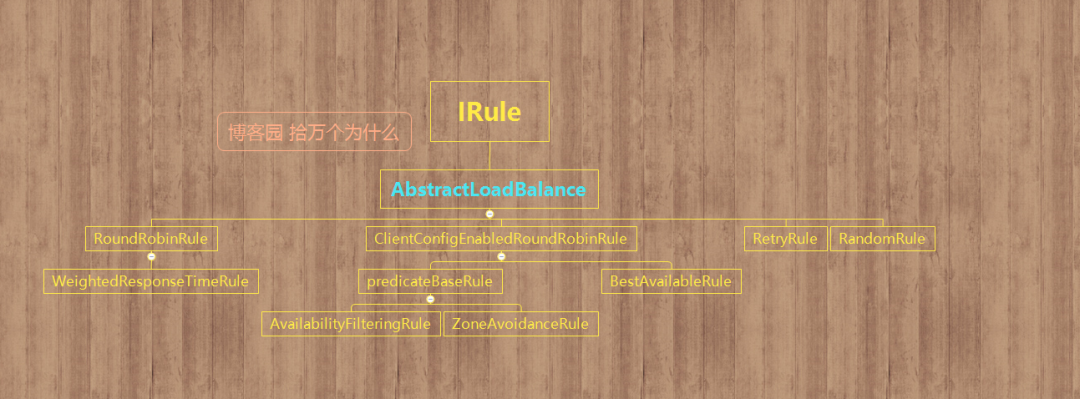
說(shuō)明一下(idea找Irule的方法:ctrl+n 填入IRule進(jìn)行查找)
1.RandomRule:表示隨機(jī)策略,它將從服務(wù)清單中隨機(jī)選擇一個(gè)服務(wù);
public class RandomRule extends AbstractLoadBalancerRule {
    public RandomRule() {
    }

    @SuppressWarnings({"RCN_REDUNDANT_NULLCHECK_OF_NULL_VALUE"})
    //傳入一個(gè)負(fù)載均衡器
    public Server choose(ILoadBalancer lb, Object key) {
        if (lb == null) {
            return null;
        } else {
            Server server = null;
            while(server == null) {
                if (Thread.interrupted()) {
                    return null;
                }
                //通過(guò)負(fù)載均衡器獲取對(duì)應(yīng)的服務(wù)列表
                List<Server> upList = lb.getReachableServers();
                //通過(guò)負(fù)載均衡器獲取全部服務(wù)列表
                List<Server> allList = lb.getAllServers();
                int serverCount = allList.size();
                if (serverCount == 0) {
                    return null;
                }
                //獲取一個(gè)隨機(jī)數(shù)
                int index = this.chooseRandomInt(serverCount);
                //通過(guò)這個(gè)隨機(jī)數(shù)從列表里獲取服務(wù)
                server = (Server)upList.get(index);
                if (server == null) {
                    //當(dāng)前線程轉(zhuǎn)為就緒狀態(tài),讓出cpu
                    Thread.yield();
                } else {
                    if (server.isAlive()) {
                        return server;
                    }

                    server = null;
                    Thread.yield();
                }
            }

            return server;
        }
    }
小結(jié):通過(guò)獲取到的所有服務(wù)的數(shù)量,以這個(gè)數(shù)量為標(biāo)準(zhǔn)獲取一個(gè)(0,服務(wù)數(shù)量)的數(shù)作為獲取服務(wù)實(shí)例的下標(biāo),從而獲取到服務(wù)實(shí)例
2.ClientConfigEnabledRoundRobinRule:ClientConfigEnabledRoundRobinRule并沒(méi)有實(shí)現(xiàn)什么特殊的處理邏輯,但是他的子類可以實(shí)現(xiàn)一些高級(jí)策略, 當(dāng)一些本身的策略無(wú)法實(shí)現(xiàn)某些需求的時(shí)候,它也可以做為父類幫助實(shí)現(xiàn)某些策略,一般情況下我們都不會(huì)使用它;
public class ClientConfigEnabledRoundRobinRule extends AbstractLoadBalancerRule {
    //使用“4”中的RoundRobinRule策略
    RoundRobinRule roundRobinRule = new RoundRobinRule();

    public ClientConfigEnabledRoundRobinRule() {
    }

    public void initWithNiwsConfig(IClientConfig clientConfig) {
        this.roundRobinRule = new RoundRobinRule();
    }

    public void setLoadBalancer(ILoadBalancer lb) {
        super.setLoadBalancer(lb);
        this.roundRobinRule.setLoadBalancer(lb);
    }

    public Server choose(Object key) {
        if (this.roundRobinRule != null) {
            return this.roundRobinRule.choose(key);
        } else {
            throw new IllegalArgumentException("This class has not been initialized with the RoundRobinRule class");
        }
    }
}
小結(jié):用來(lái)作為父類,子類通過(guò)實(shí)現(xiàn)它來(lái)實(shí)現(xiàn)一些高級(jí)負(fù)載均衡策略
1)ClientConfigEnabledRoundRobinRule的子類BestAvailableRule:從該策略的名字就可以知道,bestAvailable的意思是最好獲取的,該策略的作用是獲取到最空閑的服務(wù)實(shí)例;
public class BestAvailableRule extends ClientConfigEnabledRoundRobinRule {
//注入負(fù)載均衡器,它可以選擇服務(wù)實(shí)例
private LoadBalancerStats loadBalancerStats;
public BestAvailableRule() {
}
public Server choose(Object key) {
//假如負(fù)載均衡器實(shí)例為空,采用它父類的負(fù)載均衡機(jī)制,也就是輪詢機(jī)制,因?yàn)樗母割惒捎玫木褪禽喸儥C(jī)制
if (this.loadBalancerStats == null) {
return super.choose(key);
} else {
//獲取所有服務(wù)實(shí)例并放入列表里
List<Server> serverList = this.getLoadBalancer().getAllServers();
//并發(fā)量
int minimalConcurrentConnections = 2147483647;
long currentTime = System.currentTimeMillis();
Server chosen = null;
Iterator var7 = serverList.iterator();
//遍歷服務(wù)列表
while(var7.hasNext()) {
Server server = (Server)var7.next();
ServerStats serverStats = this.loadBalancerStats.getSingleServerStat(server);
//淘汰掉已經(jīng)負(fù)載的服務(wù)實(shí)例
if (!serverStats.isCircuitBreakerTripped(currentTime)) {
//獲得當(dāng)前服務(wù)的請(qǐng)求量(并發(fā)量)
int concurrentConnections = serverStats.getActiveRequestsCount(currentTime);
//找出并發(fā)了最小的服務(wù)
if (concurrentConnections < minimalConcurrentConnections) {
minimalConcurrentConnections = concurrentConnections;
chosen = server;
}
}
}
if (chosen == null) {
return super.choose(key);
} else {
return chosen;
}
}
}
public void setLoadBalancer(ILoadBalancer lb) {
super.setLoadBalancer(lb);
if (lb instanceof AbstractLoadBalancer) {
this.loadBalancerStats = ((AbstractLoadBalancer)lb).getLoadBalancerStats();
}
}
}
小結(jié):ClientConfigEnabledRoundRobinRule子類之一,獲取到并發(fā)了最少的服務(wù)
2)ClientConfigEnabledRoundRobinRule的另一個(gè)子類是PredicateBasedRule:通過(guò)源碼可以看出它是一個(gè)抽象類,它的抽象方法getPredicate()返回一個(gè)AbstractServerPredicate的實(shí)例,然后它的choose方法調(diào)用AbstractServerPredicate類的chooseRoundRobinAfterFiltering方法獲取具體的Server實(shí)例并返回
public abstract class PredicateBasedRule extends ClientConfigEnabledRoundRobinRule {
    public PredicateBasedRule() {
    }
    //獲取AbstractServerPredicate對(duì)象
    public abstract AbstractServerPredicate getPredicate();

    public Server choose(Object key) {
        //獲取當(dāng)前策略的負(fù)載均衡器
        ILoadBalancer lb = this.getLoadBalancer();
        //通過(guò)AbstractServerPredicate的子類過(guò)濾掉一部分實(shí)例(它實(shí)現(xiàn)了Predicate)
        //以輪詢的方式從過(guò)濾后的服務(wù)里選擇一個(gè)服務(wù)
        Optional<Server> server = this.getPredicate().chooseRoundRobinAfterFiltering(lb.getAllServers(), key);
        return server.isPresent() ? (Server)server.get() : null;
    }
}
再看看它的chooseRoundRobinAfterFiltering()方法是如何實(shí)現(xiàn)的
public Optional<Server> chooseRoundRobinAfterFiltering(List<Server> servers, Object loadBalancerKey) {
        List<Server> eligible = this.getEligibleServers(servers, loadBalancerKey);
        return eligible.size() == 0 ? Optional.absent() : Optional.of(eligible.get(this.incrementAndGetModulo(eligible.size())));
    }
是這樣的,先通過(guò)this.getEligibleServers(servers, loadBalancerKey)方法獲取一部分實(shí)例,然后判斷這部分實(shí)例是否為空,如果不為空則調(diào)用eligible.get(this.incrementAndGetModulo(eligible.size())方法從這部分實(shí)例里獲取一個(gè)服務(wù),點(diǎn)進(jìn)this.getEligibleServers看
public List<Server> getEligibleServers(List<Server> servers, Object loadBalancerKey) {
        if (loadBalancerKey == null) {
            return ImmutableList.copyOf(Iterables.filter(servers, this.getServerOnlyPredicate()));
        } else {
            List<Server> results = Lists.newArrayList();
            Iterator var4 = servers.iterator();

            while(var4.hasNext()) {
                Server server = (Server)var4.next();
                //條件滿足
                if (this.apply(new PredicateKey(loadBalancerKey, server))) {
                    //添加到集合里
                    results.add(server);
                }
            }

            return results;
        }
    }
getEligibleServers方法是根據(jù)this.apply(new PredicateKey(loadBalancerKey, server))進(jìn)行過(guò)濾的,如果滿足,就添加到返回的集合中。符合什么條件才可以進(jìn)行過(guò)濾呢?可以發(fā)現(xiàn),apply是用this調(diào)用的,this指的是AbstractServerPredicate(它的類對(duì)象),但是,該類是個(gè)抽象類,該實(shí)例是不存在的,需要子類去實(shí)現(xiàn),它的子類在這里暫時(shí)不是看了,以后有空再深入學(xué)習(xí)下,它的子類如下,實(shí)現(xiàn)哪個(gè)子類,就用什么 方式過(guò)濾。

再回到chooseRoundRobinAfterFiltering()方法,剛剛說(shuō)完它通過(guò) getEligibleServers方法過(guò)濾并獲取到一部分實(shí)例,然后再通過(guò)this.incrementAndGetModulo(eligible.size())方法從這部分實(shí)例里選擇一個(gè)實(shí)例返回,該方法的意思是直接返回下一個(gè)整數(shù)(索引值),通過(guò)該索引值從返回的實(shí)例列表中取得Server實(shí)例。
private int incrementAndGetModulo(int modulo) {
        //當(dāng)前下標(biāo)
        int current;
        //下一個(gè)下標(biāo)
        int next;
        do {
            //獲得當(dāng)前下標(biāo)值
            current = this.nextIndex.get();
            next = (current + 1) % modulo;
        } while(!this.nextIndex.compareAndSet(current, next) || current >= modulo);

        return current;
    }
源碼擼明白了,再來(lái)理一下chooseRoundRobinAfterFiltering()的思路:先通過(guò)getEligibleServers()方法獲得一部分服務(wù)實(shí)例,再?gòu)倪@部分服務(wù)實(shí)例里拿到當(dāng)前服務(wù)實(shí)例的下一個(gè)服務(wù)對(duì)象使用。
小結(jié):通過(guò)AbstractServerPredicate的chooseRoundRobinAfterFiltering方法進(jìn)行過(guò)濾,獲取備選的服務(wù)實(shí)例清單,然后用線性輪詢選擇一個(gè)實(shí)例,是一個(gè)抽象類,過(guò)濾策略在AbstractServerPredicate的子類中具體實(shí)現(xiàn)
3.RetryRule:是對(duì)選定的負(fù)載均衡策略加上重試機(jī)制,即在一個(gè)配置好的時(shí)間段內(nèi)(默認(rèn)500ms),當(dāng)選擇實(shí)例不成功,則一直嘗試使用subRule的方式選擇一個(gè)可用的實(shí)例,在調(diào)用時(shí)間到達(dá)閥值的時(shí)候還沒(méi)找到可用服務(wù),則返回空,如果沒(méi)有配置負(fù)載策略,默認(rèn)輪詢(即“4”中的輪詢);
先貼上它的源碼
public class RetryRule extends AbstractLoadBalancerRule {
    //從這可以看出,默認(rèn)使用輪詢機(jī)制
    IRule subRule = new RoundRobinRule();
    //500秒的閥值
    long maxRetryMillis = 500L;
    //無(wú)參構(gòu)造函數(shù)
    public RetryRule() {
    }
    //使用輪詢機(jī)制
    public RetryRule(IRule subRule) {
        this.subRule = (IRule)(subRule != null ? subRule : new RoundRobinRule());
    }

    public RetryRule(IRule subRule, long maxRetryMillis) {
        this.subRule = (IRule)(subRule != null ? subRule : new RoundRobinRule());
        this.maxRetryMillis = maxRetryMillis > 0L ? maxRetryMillis : 500L;
    }

    public void setRule(IRule subRule) {
        this.subRule = (IRule)(subRule != null ? subRule : new RoundRobinRule());
    }

    public IRule getRule() {
        return this.subRule;
    }
    //設(shè)置最大耗時(shí)時(shí)間(閥值),最多重試多久
    public void setMaxRetryMillis(long maxRetryMillis) {
        if (maxRetryMillis > 0L) {
            this.maxRetryMillis = maxRetryMillis;
        } else {
            this.maxRetryMillis = 500L;
        }

    }
    //獲取重試的時(shí)間
    public long getMaxRetryMillis() {
        return this.maxRetryMillis;
    }
    //設(shè)置負(fù)載均衡器,用以獲取服務(wù)
    public void setLoadBalancer(ILoadBalancer lb) {
        super.setLoadBalancer(lb);
        this.subRule.setLoadBalancer(lb);
    }
    //通過(guò)負(fù)載均衡器選擇服務(wù)
    public Server choose(ILoadBalancer lb, Object key) {
        long requestTime = System.currentTimeMillis();
        //當(dāng)前時(shí)間+閥值 = 截止時(shí)間
        long deadline = requestTime + this.maxRetryMillis;
        Server answer = null;
        answer = this.subRule.choose(key);
        //獲取到服務(wù)直接返回
        if ((answer == null || !answer.isAlive()) && System.currentTimeMillis() < deadline) {
            InterruptTask task = new InterruptTask(deadline - System.currentTimeMillis());
            //獲取不到服務(wù)的情況下反復(fù)獲取
            while(!Thread.interrupted()) {
                answer = this.subRule.choose(key);
                if (answer != null && answer.isAlive() || System.currentTimeMillis() >= deadline) {
                    break;
                }

                Thread.yield();
            }

            task.cancel();
        }

        return answer != null && answer.isAlive() ? answer : null;
    }

    public Server choose(Object key) {
        return this.choose(this.getLoadBalancer(), key);
    }

    public void initWithNiwsConfig(IClientConfig clientConfig) {
    }
}
小結(jié):采用RoundRobinRule的選擇機(jī)制,進(jìn)行反復(fù)嘗試,當(dāng)花費(fèi)時(shí)間超過(guò)設(shè)置的閾值maxRetryMills時(shí),就返回null
4.RoundRobinRule:輪詢策略,它會(huì)從服務(wù)清單中按照輪詢的方式依次選擇每個(gè)服務(wù)實(shí)例,它的工作原理是:直接獲取下一個(gè)可用實(shí)例,如果超過(guò)十次沒(méi)有獲取到可用的服務(wù)實(shí)例,則返回空且報(bào)出異常信息;
public class RoundRobinRule extends AbstractLoadBalancerRule {
    private AtomicInteger nextServerCyclicCounter;
    private static final boolean AVAILABLE_ONLY_SERVERS = true;
    private static final boolean ALL_SERVERS = false;
    private static Logger log = LoggerFactory.getLogger(RoundRobinRule.class);

    public RoundRobinRule() {
        this.nextServerCyclicCounter = new AtomicInteger(0);
    }

    public RoundRobinRule(ILoadBalancer lb) {
        this();
        this.setLoadBalancer(lb);
    }

    public Server choose(ILoadBalancer lb, Object key) {
        if (lb == null) {
            log.warn("no load balancer");
            return null;
        } else {
            Server server = null;
            int count = 0;

            while(true) {
                //選擇十次,十次都沒(méi)選到可用服務(wù)就返回空
                if (server == null && count++ < 10) {
                    List<Server> reachableServers = lb.getReachableServers();
                    List<Server> allServers = lb.getAllServers();
                    int upCount = reachableServers.size();
                    int serverCount = allServers.size();
                    if (upCount != 0 && serverCount != 0) {
                        int nextServerIndex = this.incrementAndGetModulo(serverCount);
                        server = (Server)allServers.get(nextServerIndex);
                        if (server == null) {
                            Thread.yield();
                        } else {
                            if (server.isAlive() && server.isReadyToServe()) {
                                return server;
                            }

                            server = null;
                        }
                        continue;
                    }

                    log.warn("No up servers available from load balancer: " + lb);
                    return null;
                }

                if (count >= 10) {

                    log.warn("No available alive servers after 10 tries from load balancer: " + lb);
                }

                return server;
            }
        }
    }

    //遞增的形式實(shí)現(xiàn)輪詢
    private int incrementAndGetModulo(int modulo) {
        int current;
        int next;
        do {
            current = this.nextServerCyclicCounter.get();
            next = (current + 1) % modulo;
        } while(!this.nextServerCyclicCounter.compareAndSet(current, next));

        return next;
    }

    public Server choose(Object key) {
        return this.choose(this.getLoadBalancer(), key);
    }

    public void initWithNiwsConfig(IClientConfig clientConfig) {
    }
}
小結(jié):采用線性輪詢機(jī)制循環(huán)依次選擇每個(gè)服務(wù)實(shí)例,直到選擇到一個(gè)不為空的服務(wù)實(shí)例或循環(huán)次數(shù)達(dá)到10次
它有個(gè)子類WeightedResponseTimeRule,WeightedResponseTimeRule是對(duì)RoundRobinRule的優(yōu)化。WeightedResponseTimeRule在其父類的基礎(chǔ)上,增加了定時(shí)任務(wù)這個(gè)功能,通過(guò)啟動(dòng)一個(gè)定時(shí)任務(wù)來(lái)計(jì)算每個(gè)服務(wù)的權(quán)重,然后遍歷服務(wù)列表選擇服務(wù)實(shí)例,從而達(dá)到更加優(yōu)秀的分配效果。我們這里把這個(gè)類分為三部分:定時(shí)任務(wù),計(jì)算權(quán)值,選擇服務(wù)
1)定時(shí)任務(wù)
//定時(shí)任務(wù)
void initialize(ILoadBalancer lb) {
        if (this.serverWeightTimer != null) {
            this.serverWeightTimer.cancel();
        }

        this.serverWeightTimer = new Timer("NFLoadBalancer-serverWeightTimer-" + this.name, true);
       //開(kāi)啟一個(gè)任務(wù),每30秒執(zhí)行一次
        this.serverWeightTimer.schedule(new WeightedResponseTimeRule.DynamicServerWeightTask(), 0L, (long)this.serverWeightTaskTimerInterval);
        WeightedResponseTimeRule.ServerWeight sw = new WeightedResponseTimeRule.ServerWeight();
        sw.maintainWeights();
        Runtime.getRuntime().addShutdownHook(new Thread(new Runnable() {
            public void run() {
                WeightedResponseTimeRule.logger.info("Stopping NFLoadBalancer-serverWeightTimer-" + WeightedResponseTimeRule.this.name);
                WeightedResponseTimeRule.this.serverWeightTimer.cancel();
            }
        }));
    }
DynamicServerWeightTask()任務(wù)如下:
class DynamicServerWeightTask extends TimerTask {
        DynamicServerWeightTask() {
        }

        public void run() {
            WeightedResponseTimeRule.ServerWeight serverWeight = WeightedResponseTimeRule.this.new ServerWeight();

            try {
                //計(jì)算權(quán)重
                serverWeight.maintainWeights();
            } catch (Exception var3) {
                WeightedResponseTimeRule.logger.error("Error running DynamicServerWeightTask for {}", WeightedResponseTimeRule.this.name, var3);
            }

        }
    }
小結(jié):調(diào)用initialize方法開(kāi)啟定時(shí)任務(wù),再在任務(wù)里計(jì)算服務(wù)的權(quán)重
2)計(jì)算權(quán)重:第一步,先算出所有實(shí)例的響應(yīng)時(shí)間;第二步,再根據(jù)所有實(shí)例響應(yīng)時(shí)間,算出每個(gè)實(shí)例的權(quán)重
//用來(lái)存儲(chǔ)權(quán)重
private volatile List<Double> accumulatedWeights = new ArrayList();

//內(nèi)部類
class ServerWeight {
        ServerWeight() {
        }
        //該方法用于計(jì)算權(quán)重
        public void maintainWeights() {
            //獲取負(fù)載均衡器
            ILoadBalancer lb = WeightedResponseTimeRule.this.getLoadBalancer();
            if (lb != null) {
                if (WeightedResponseTimeRule.this.serverWeightAssignmentInProgress.compareAndSet(false, true)) {
                    try {
                        WeightedResponseTimeRule.logger.info("Weight adjusting job started");
                        AbstractLoadBalancer nlb = (AbstractLoadBalancer)lb;
                        //獲得每個(gè)服務(wù)實(shí)例的信息
                        LoadBalancerStats stats = nlb.getLoadBalancerStats();
                        if (stats != null) {
                            //實(shí)例的響應(yīng)時(shí)間
                            double totalResponseTime = 0.0D;

                            ServerStats ss;
                            //累加所有實(shí)例的響應(yīng)時(shí)間
                            for(Iterator var6 = nlb.getAllServers().iterator(); var6.hasNext(); totalResponseTime += ss.getResponseTimeAvg()) {
                                Server server = (Server)var6.next();
                                ss = stats.getSingleServerStat(server);
                            }

                            Double weightSoFar = 0.0D;
                            List<Double> finalWeights = new ArrayList();
                            Iterator var20 = nlb.getAllServers().iterator();
                            //計(jì)算負(fù)載均衡器所有服務(wù)的權(quán)重,公式是weightSoFar = weightSoFar + weight-實(shí)例平均響應(yīng)時(shí)間
                            while(var20.hasNext()) {
                                Server serverx = (Server)var20.next();
                                ServerStats ssx = stats.getSingleServerStat(serverx);
                                double weight = totalResponseTime - ssx.getResponseTimeAvg();
                                weightSoFar = weightSoFar + weight;
                                finalWeights.add(weightSoFar);
                            }

                            WeightedResponseTimeRule.this.setWeights(finalWeights);
                            return;
                        }
                    } catch (Exception var16) {
                        WeightedResponseTimeRule.logger.error("Error calculating server weights", var16);
                        return;
                    } finally {
                        WeightedResponseTimeRule.this.serverWeightAssignmentInProgress.set(false);
                    }

                }
            }
        }
    }
3)選擇服務(wù)
@SuppressWarnings({"RCN_REDUNDANT_NULLCHECK_OF_NULL_VALUE"})
    public Server choose(ILoadBalancer lb, Object key) {
        if (lb == null) {
            return null;
        } else {
            Server server = null;

            while(server == null) {
                List<Double> currentWeights = this.accumulatedWeights;
                if (Thread.interrupted()) {
                    return null;
                }

                List<Server> allList = lb.getAllServers();
                int serverCount = allList.size();
                if (serverCount == 0) {
                    return null;
                }

                int serverIndex = 0;

                double maxTotalWeight = currentWeights.size() == 0 ? 0.0D : (Double)currentWeights.get(currentWeights.size() - 1);
                if (maxTotalWeight >= 0.001D && serverCount == currentWeights.size()) {
                    //生產(chǎn)0到最大權(quán)重值的隨機(jī)數(shù)
                    double randomWeight = this.random.nextDouble() * maxTotalWeight;
                    int n = 0;
                    //循環(huán)權(quán)重區(qū)間
                    for(Iterator var13 = currentWeights.iterator(); var13.hasNext(); ++n) {
                        //獲取到循環(huán)的數(shù)
                        Double d = (Double)var13.next();
                        //假如隨機(jī)數(shù)在這個(gè)區(qū)間內(nèi),就拿該索引d服務(wù)列表獲取對(duì)應(yīng)的實(shí)例
                        if (d >= randomWeight) {
                            serverIndex = n;
                            break;
                        }
                    }

                    server = (Server)allList.get(serverIndex);
                } else {
                    server = super.choose(this.getLoadBalancer(), key);
                    if (server == null) {
                        return server;
                    }
                }

                if (server == null) {
                    Thread.yield();
                } else {
                    if (server.isAlive()) {
                        return server;
                    }

                    server = null;
                }
            }

            return server;
        }
    }
小結(jié):首先生成了一個(gè)[0,最大權(quán)重值) 區(qū)間內(nèi)的隨機(jī)數(shù),然后遍歷權(quán)重列表,假如當(dāng)前隨機(jī)數(shù)在這個(gè)區(qū)間內(nèi),就通過(guò)該下標(biāo)獲得對(duì)應(yīng)的服務(wù)。
鋒哥最新SpringCloud分布式電商秒殺課程發(fā)布
??????
??長(zhǎng)按上方微信二維碼 2 秒
感謝點(diǎn)贊支持下哈