
都給你整理好了,Java 各種隨機(jī)方式對(duì)比!

 戳這里,加關(guān)注哦~
1. Math.random() 靜態(tài)方法
產(chǎn)生的隨機(jī)數(shù)是 0 - 1 之間的一個(gè) double,即 0 <= random <= 1。
for?(int?i?=?0;?i???System.out.println(Math.random());
}
結(jié)果:
0.3598613895606426
0.2666778145365811
0.25090731064243355
0.011064998061666276
0.600686228175639
0.9084006027629496
0.12700524654847833
0.6084605849069343
0.7290804782514261
0.9923831908303121
實(shí)現(xiàn)原理:
When this method is first called, it creates a single new pseudorandom-number generator, exactly as if by the expression new java.util.Random() This new pseudorandom-number generator is used thereafter for all calls to this method and is used nowhere else.
當(dāng)?shù)谝淮握{(diào)用 Math.random() 方法時(shí),自動(dòng)創(chuàng)建了一個(gè)偽隨機(jī)數(shù)生成器,實(shí)際上用的是 new java.util.Random()。當(dāng)接下來繼續(xù)調(diào)用 Math.random() 方法時(shí),就會(huì)使用這個(gè)新的偽隨機(jī)數(shù)生成器。
源碼如下:
public?static?double?random()?{
????Random?rnd?=?randomNumberGenerator;
????if?(rnd?==?null)?rnd?=?initRNG();?//?第一次調(diào)用,創(chuàng)建一個(gè)偽隨機(jī)數(shù)生成器
????return?rnd.nextDouble();
}

private?static?synchronized?Random?initRNG()?{
????Random?rnd?=?randomNumberGenerator;
????return?(rnd?==?null)???(randomNumberGenerator?=?new?Random())?:?rnd;?//?實(shí)際上用的是new?java.util.Random()
}
This method is properly synchronized to allow correct use by more than one thread. However, if many threads need to generate pseudorandom numbers at a great rate, it may reduce contention for each thread to have its own pseudorandom-number generator.
initRNG() 方法是 synchronized 的,因此在多線程情況下,只有一個(gè)線程會(huì)負(fù)責(zé)創(chuàng)建偽隨機(jī)數(shù)生成器(使用當(dāng)前時(shí)間作為種子),其他線程則利用該偽隨機(jī)數(shù)生成器產(chǎn)生隨機(jī)數(shù)。
因此 Math.random() 方法是線程安全的。
什么情況下隨機(jī)數(shù)的生成線程不安全:
線程1在第一次調(diào)用 random() 時(shí)產(chǎn)生一個(gè)生成器 generator1,使用當(dāng)前時(shí)間作為種子。 線程2在第一次調(diào)用 random() 時(shí)產(chǎn)生一個(gè)生成器 generator2,使用當(dāng)前時(shí)間作為種子。 碰巧 generator1 和 generator2 使用相同的種子,導(dǎo)致 generator1 以后產(chǎn)生的隨機(jī)數(shù)每次都和 generator2 以后產(chǎn)生的隨機(jī)數(shù)相同。
什么情況下隨機(jī)數(shù)的生成線程安全:Math.random() 靜態(tài)方法使用
線程1在第一次調(diào)用 random() 時(shí)產(chǎn)生一個(gè)生成器 generator1,使用當(dāng)前時(shí)間作為種子。 線程2在第一次調(diào)用 random() 時(shí)發(fā)現(xiàn)已經(jīng)有一個(gè)生成器 generator1,則直接使用生成器 generator1。
public?class?JavaRandom?{
????public?static?void?main(String?args[])?{
????????new?MyThread().start();
????????new?MyThread().start();
????}
}
class?MyThread?extends?Thread?{
????public?void?run()?{
????????for?(int?i?=?0;?i?????????????System.out.println(Thread.currentThread().getName()?+?":?"?+?Math.random());
????????}
????}
}
結(jié)果:
Thread-1: 0.8043581595645333
Thread-0: 0.9338269554390357
Thread-1: 0.5571569413128877
Thread-0: 0.37484586843392464
2. java.util.Random 工具類
基本算法:linear congruential pseudorandom number generator (LGC) 線性同余法偽隨機(jī)數(shù)生成器
缺點(diǎn):可預(yù)測(cè)
An attacker will simply compute the seed from the output values observed. This takes significantly less time than 2^48 in the case of java.util.Random. 從輸出中可以很容易計(jì)算出種子值。
It is shown that you can predict future Random outputs observing only two(!) output values in time roughly 2^16. 因此可以預(yù)測(cè)出下一個(gè)輸出的隨機(jī)數(shù)。
You should never use an LCG for security-critical purposes. 在注重信息安全的應(yīng)用中,不要使用 LCG 算法生成隨機(jī)數(shù),請(qǐng)使用 SecureRandom。
使用:
Random?random?=?new?Random();

for?(int?i?=?0;?i?????System.out.println(random.nextInt());
}
結(jié)果:
-24520987
-96094681
-952622427
300260419
1489256498
Random類默認(rèn)使用當(dāng)前系統(tǒng)時(shí)鐘作為種子:
public?Random()?{
????this(seedUniquifier()?^?System.nanoTime());
}

public?Random(long?seed)?{
????if?(getClass()?==?Random.class)
????????this.seed?=?new?AtomicLong(initialScramble(seed));
????else?{
????????//?subclass?might?have?overriden?setSeed
????????this.seed?=?new?AtomicLong();
????????setSeed(seed);
????}
}
Random類提供的方法:API
nextBoolean() - 返回均勻分布的 true 或者 false nextBytes(byte[] bytes) nextDouble() - 返回 0.0 到 1.0 之間的均勻分布的 double nextFloat() - 返回 0.0 到 1.0 之間的均勻分布的 float nextGaussian()- 返回 0.0 到 1.0 之間的高斯分布(即正態(tài)分布)的 double nextInt() - 返回均勻分布的 int nextInt(int n) - 返回 0 到 n 之間的均勻分布的 int (包括 0,不包括 n) nextLong() - 返回均勻分布的 long setSeed(long seed) - 設(shè)置種子
只要種子一樣,產(chǎn)生的隨機(jī)數(shù)也一樣:因?yàn)榉N子確定,隨機(jī)數(shù)算法也確定,因此輸出是確定的!
Random?random1?=?new?Random(10000);
Random?random2?=?new?Random(10000);

for?(int?i?=?0;?i?????System.out.println(random1.nextInt()?+?"?=?"?+?random2.nextInt());
}
結(jié)果:
-498702880 = -498702880
-858606152 = -858606152
1942818232 = 1942818232
-1044940345 = -1044940345
1588429001 = 1588429001
3. java.util.concurrent.ThreadLocalRandom 工具類
ThreadLocalRandom 是 JDK 7 之后提供,也是繼承至
java.util.Random。
private?static?final?ThreadLocal?localRandom?=
????new?ThreadLocal()?{
????????protected?ThreadLocalRandom?initialValue()?{
????????????return?new?ThreadLocalRandom();
????????}
};
每一個(gè)線程有一個(gè)獨(dú)立的隨機(jī)數(shù)生成器,用于并發(fā)產(chǎn)生隨機(jī)數(shù),能夠解決多個(gè)線程發(fā)生的競(jìng)爭爭奪。效率更高!ThreadLocalRandom 不是直接用 new 實(shí)例化,而是第一次使用其靜態(tài)方法 current()得到 ThreadLocal
使用:
public?class?JavaRandom?{
????public?static?void?main(String?args[])?{
????????new?MyThread().start();
????????new?MyThread().start();
????}
}
class?MyThread?extends?Thread?{
????public?void?run()?{
????????for?(int?i?=?0;?i?????????????System.out.println(Thread.currentThread().getName()?+?":?"?+?ThreadLocalRandom.current().nextDouble());
????????}
????}
}
結(jié)果:
Thread-0: 0.13267085355389086
Thread-1: 0.1138484950410098
Thread-0: 0.17187774671469858
Thread-1: 0.9305225910262372
4. java.Security.SecureRandom
也是繼承至 java.util.Random。
Instances of java.util.Random are not cryptographically secure. Consider instead using SecureRandom to get a cryptographically secure pseudo-random number generator for use by security-sensitive applications.
SecureRandom takes Random Data from your os (they can be interval between keystrokes etc - most os collect these data store them in files - /dev/random and /dev/urandom in case of linux/solaris) and uses that as the seed.
操作系統(tǒng)收集了一些隨機(jī)事件,比如鼠標(biāo)點(diǎn)擊,鍵盤點(diǎn)擊等等,SecureRandom 使用這些隨機(jī)事件作為種子。
SecureRandom 提供加密的強(qiáng)隨機(jī)數(shù)生成器 (RNG),要求種子必須是不可預(yù)知的,產(chǎn)生非確定性輸出。
SecureRandom 也提供了與實(shí)現(xiàn)無關(guān)的算法,因此,調(diào)用方(應(yīng)用程序代碼)會(huì)請(qǐng)求特定的 RNG 算法并將它傳回到該算法的 SecureRandom 對(duì)象中。
如果僅指定算法名稱,如下所示:
SecureRandom?random?=?SecureRandom.getInstance("SHA1PRNG");
如果既指定了算法名稱又指定了包提供程序,如下所示:
SecureRandom?random?=?SecureRandom.getInstance("SHA1PRNG",?"SUN");
使用:
SecureRandom?random1?=?SecureRandom.getInstance("SHA1PRNG");
SecureRandom?random2?=?SecureRandom.getInstance("SHA1PRNG");

for?(int?i?=?0;?i?????System.out.println(random1.nextInt()?+?"?!=?"?+?random2.nextInt());
}
結(jié)果:
704046703 != 2117229935
60819811 != 107252259
425075610 != -295395347
682299589 != -1637998900
-1147654329 != 1418666937
5. 隨機(jī)字符串
可以使用 Apache Commons-Lang 包中的 RandomStringUtils 類。Maven 依賴如下:
????commons-lang
????commons-lang
????2.6
API 參考:https://commons.apache.org/proper/commons-lang/javadocs/api-2.6/org/apache/commons/lang/RandomStringUtils.html
示例:
public?class?RandomStringDemo?{
????public?static?void?main(String[]?args)?{
????????//?Creates?a?64?chars?length?random?string?of?number.
????????String?result?=?RandomStringUtils.random(64,?false,?true);
????????System.out.println("random?=?"?+?result);

????????//?Creates?a?64?chars?length?of?random?alphabetic?string.
????????result?=?RandomStringUtils.randomAlphabetic(64);
????????System.out.println("random?=?"?+?result);

????????//?Creates?a?32?chars?length?of?random?ascii?string.
????????result?=?RandomStringUtils.randomAscii(32);
????????System.out.println("random?=?"?+?result);

????????//?Creates?a?32?chars?length?of?string?from?the?defined?array?of
????????//?characters?including?numeric?and?alphabetic?characters.
????????result?=?RandomStringUtils.random(32,?0,?20,?true,?true,?"qw32rfHIJk9iQ8Ud7h0X".toCharArray());
????????System.out.println("random?=?"?+?result);

????}
}
RandomStringUtils 類的實(shí)現(xiàn)上也是依賴了 java.util.Random 工具類:
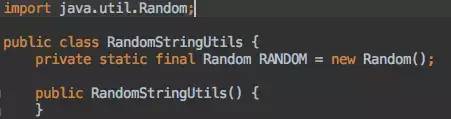
RandomStringUtils 類的定義
作者:專職跑龍?zhí)?
來源:www.jianshu.com/p/2f6acd169202
推薦閱讀