
Java 動(dòng)態(tài)代理的底層原理
原文:blog.csdn.net/weixin_45505313
1.代理模式
代理模式是常用的設(shè)計(jì)模式之一,其特征是代理類(lèi)與被代理類(lèi)有相同的接口,代理類(lèi)可以為被代理類(lèi)方法執(zhí)行進(jìn)行前置后置處理,增強(qiáng)被代理類(lèi)方法

2. 動(dòng)態(tài)代理使用
代理類(lèi)并不是在 Java 代碼中定義,而是在運(yùn)行時(shí)根據(jù)在 Java 代碼中的“指示”動(dòng)態(tài)生成(字節(jié)碼由JVM在運(yùn)行時(shí)動(dòng)態(tài)生成而非預(yù)存在任何一個(gè) .class 文件中), 這種在程序運(yùn)行時(shí)創(chuàng)建代理類(lèi)的代理方式被稱(chēng)為動(dòng)態(tài)代理,它的優(yōu)勢(shì)在于可以方便地對(duì)代理類(lèi)的函數(shù)進(jìn)行統(tǒng)一處理。
這是因?yàn)樗斜淮韴?zhí)行的方法,都是通過(guò)InvocationHandler#invoke()方法調(diào)用,相當(dāng)于給被代理類(lèi)所有方法套了一層殼,所以只要在這個(gè)方法中統(tǒng)一處理,就可以對(duì)所有被代理的方法進(jìn)行相同的操作了
以下代碼展示了動(dòng)態(tài)代理的簡(jiǎn)單使用,其基本步驟如下:
定義一個(gè)公共接口,本例中為 IHello,接口中有一個(gè)抽象方法定義一個(gè)實(shí)現(xiàn)了公共接口的實(shí)體類(lèi)作為被代理類(lèi),本例中被代理類(lèi) Hello實(shí)現(xiàn)了IHello接口,重寫(xiě)了接口中的抽象方法定義一個(gè)實(shí)現(xiàn)了 InvocationHandler接口的方法攔截類(lèi),重寫(xiě)invoke()方法實(shí)現(xiàn)攔截到被代理類(lèi)方法執(zhí)行時(shí)候的處理邏輯通過(guò) Proxy.newProxyInstance()方法生成代理對(duì)象,持有代理對(duì)象之后執(zhí)行接口方法即可
public class ServiceProxy {

    public interface IHello {
        String sayHi();
    }

    public static class Hello implements IHello {
        @Override
        public String sayHi() {
            return "Hello";
        }
    }

    // 動(dòng)態(tài)代理類(lèi)
    public static class ProxyHandler<T> implements InvocationHandler {
        private T origin;

        public ProxyHandler(T origin) {
            this.origin = origin;
        }

       /**
         * @param o 代理對(duì)象引用
         * @param method 正在執(zhí)行目標(biāo)的方法
         * @param objects 目標(biāo)方法執(zhí)行時(shí)的入?yún)?br style="margin: 0px;padding: 0px;outline: 0px;max-width: 100%;box-sizing: border-box !important;overflow-wrap: break-word !important;">        */
        @Override
        public Object invoke(Object o, Method method, Object[] objects) throws Throwable {
            String s = "proxy";
            s += method.invoke(origin, objects);
            return s;
        }
    }

    public static void main(String[] args) {
        IHello IHello = (IHello) getInstance(IHello.class, new ProxyHandler<>(new Hello()));

        System.out.println(IHello.toString());

        generateProxyClass();
    }

    // 創(chuàng)建代理對(duì)象
    public static <T> Object getInstance(Class<T> clazz, ProxyHandler<T> handler) {
        return Proxy.newProxyInstance(clazz.getClassLoader(), new Class[]{clazz}, handler);
    }

    private static void generateProxyClass() {
        byte[] classFile = ProxyGenerator.generateProxyClass("$Proxy0", Hello.class.getInterfaces());
        String path = "/Users/nathan.yang/workspace/algorithm_Java/out/StuProxy.class";
        try (FileOutputStream fos = new FileOutputStream(path)) {
            fos.write(classFile);
            fos.flush();
            System.out.println("代理類(lèi)文件寫(xiě)入成功");
        } catch (Exception e) {
            System.out.println("寫(xiě)文件錯(cuò)誤");
        }
    }
}
3. 動(dòng)態(tài)代理原理
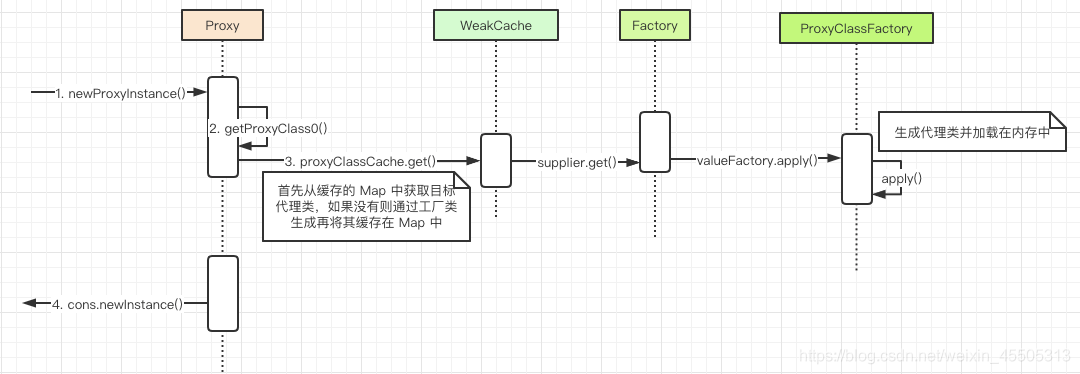
1.Proxy#newProxyInstance() 方法是動(dòng)態(tài)代理的入口,其生成動(dòng)態(tài)代理對(duì)象主要有以下幾個(gè)步驟:
getProxyClass0()方法生成代理類(lèi)獲取到代理類(lèi)后將 InvocationHandler對(duì)象入?yún)ⅲ瓷湔{(diào)用構(gòu)造方法生成動(dòng)態(tài)代理對(duì)象
public static Object newProxyInstance(ClassLoader loader,
                                       Class<?>[] interfaces,
                                       InvocationHandler h)
     throws IllegalArgumentException
 {
     Objects.requireNonNull(h);

     final Class<?>[] intfs = interfaces.clone();
     final SecurityManager sm = System.getSecurityManager();
     if (sm != null) {
         checkProxyAccess(Reflection.getCallerClass(), loader, intfs);
     }

     /*
      * Look up or generate the designated proxy class.
      */
     Class<?> cl = getProxyClass0(loader, intfs);

     /*
      * Invoke its constructor with the designated invocation handler.
      */
     try {
         if (sm != null) {
             checkNewProxyPermission(Reflection.getCallerClass(), cl);
         }

         final Constructor<?> cons = cl.getConstructor(constructorParams);
         final InvocationHandler ih = h;
         if (!Modifier.isPublic(cl.getModifiers())) {
             AccessController.doPrivileged(new PrivilegedAction<Void>() {
                 public Void run() {
                     cons.setAccessible(true);
                     return null;
                 }
             });
         }
         return cons.newInstance(new Object[]{h});
     } catch (IllegalAccessException|InstantiationException e) {
         throw new InternalError(e.toString(), e);
     } catch (InvocationTargetException e) {
         Throwable t = e.getCause();
         if (t instanceof RuntimeException) {
             throw (RuntimeException) t;
         } else {
             throw new InternalError(t.toString(), t);
         }
     } catch (NoSuchMethodException e) {
         throw new InternalError(e.toString(), e);
     }
 }
2.Proxy#getProxyClass0() 方法其實(shí)是從一個(gè) WeakCache 中去獲取代理類(lèi),其獲取邏輯是如果緩存類(lèi)中沒(méi)有代理類(lèi)的話就調(diào)用ProxyClassFactory#apply(),通過(guò)代理類(lèi)工廠去即時(shí)生成一個(gè)代理類(lèi),其步驟如下:
首先通過(guò)指定的類(lèi)加載器去驗(yàn)證目標(biāo)接口是否可被其加載 通過(guò)接口所在包等條件決定代理類(lèi)所在包及代理類(lèi)的全限定名稱(chēng),代理類(lèi)名稱(chēng)是 包名+$Proxy+id通過(guò) ProxyGenerator.generateProxyClass()生成字節(jié)碼數(shù)組,然后調(diào)用native方法defineClass0()將其動(dòng)態(tài)生成的代理類(lèi)字節(jié)碼加載到內(nèi)存中
private static Class<?> getProxyClass0(ClassLoader loader,
                                        Class<?>... interfaces) {
     if (interfaces.length > 65535) {
         throw new IllegalArgumentException("interface limit exceeded");
     }

     // If the proxy class defined by the given loader implementing
     // the given interfaces exists, this will simply return the cached copy;
     // otherwise, it will create the proxy class via the ProxyClassFactory
     return proxyClassCache.get(loader, interfaces);
 }

public Class<?> apply(ClassLoader loader, Class<?>[] interfaces) {

         Map<Class<?>, Boolean> interfaceSet = new IdentityHashMap<>(interfaces.length);
         for (Class<?> intf : interfaces) {
             /*
              * Verify that the class loader resolves the name of this
              * interface to the same Class object.
              */
             Class<?> interfaceClass = null;
             try {
                 interfaceClass = Class.forName(intf.getName(), false, loader);
             } catch (ClassNotFoundException e) {
             }
             if (interfaceClass != intf) {
                 throw new IllegalArgumentException(
                     intf + " is not visible from class loader");
             }
             /*
              * Verify that the Class object actually represents an
              * interface.
              */
             if (!interfaceClass.isInterface()) {
                 throw new IllegalArgumentException(
                     interfaceClass.getName() + " is not an interface");
             }
             /*
              * Verify that this interface is not a duplicate.
              */
             if (interfaceSet.put(interfaceClass, Boolean.TRUE) != null) {
                 throw new IllegalArgumentException(
                     "repeated interface: " + interfaceClass.getName());
             }
         }

         String proxyPkg = null;     // package to define proxy class in
         int accessFlags = Modifier.PUBLIC | Modifier.FINAL;

         /*
          * Record the package of a non-public proxy interface so that the
          * proxy class will be defined in the same package.  Verify that
          * all non-public proxy interfaces are in the same package.
          */
         for (Class<?> intf : interfaces) {
             int flags = intf.getModifiers();
             if (!Modifier.isPublic(flags)) {
                 accessFlags = Modifier.FINAL;
                 String name = intf.getName();
                 int n = name.lastIndexOf('.');
                 String pkg = ((n == -1) ? "" : name.substring(0, n + 1));
                 if (proxyPkg == null) {
                     proxyPkg = pkg;
                 } else if (!pkg.equals(proxyPkg)) {
                     throw new IllegalArgumentException(
                         "non-public interfaces from different packages");
                 }
             }
         }

         if (proxyPkg == null) {
             // if no non-public proxy interfaces, use com.sun.proxy package
             proxyPkg = ReflectUtil.PROXY_PACKAGE + ".";
         }

         /*
          * Choose a name for the proxy class to generate.
          */
         long num = nextUniqueNumber.getAndIncrement();
         String proxyName = proxyPkg + proxyClassNamePrefix + num;

         /*
          * Generate the specified proxy class.
          */
         byte[] proxyClassFile = ProxyGenerator.generateProxyClass(
             proxyName, interfaces, accessFlags);
         try {
             return defineClass0(loader, proxyName,
                                 proxyClassFile, 0, proxyClassFile.length);
         } catch (ClassFormatError e) {
             /*
              * A ClassFormatError here means that (barring bugs in the
              * proxy class generation code) there was some other
              * invalid aspect of the arguments supplied to the proxy
              * class creation (such as virtual machine limitations
              * exceeded).
              */
             throw new IllegalArgumentException(e.toString());
         }
     }
3.反射獲取到代理類(lèi)參數(shù)為 InvocationHandler.class 的構(gòu)造器,其實(shí)也就是 Proxy 的帶參構(gòu)造器,調(diào)用構(gòu)造器cons.newInstance(new Object[]{h})生成代理對(duì)象
protected Proxy(InvocationHandler h) {
     Objects.requireNonNull(h);
     this.h = h;
 }
4.通過(guò)以下代碼可以將 JVM 中加載的代理類(lèi)輸出成 class 文件,之后就可以使用反編譯工具查看代理類(lèi)的源碼
private static void generateProxyClass() {
     byte[] classFile = ProxyGenerator.generateProxyClass("$Proxy0", Hello.class.getInterfaces());
     String path = "/Users/nathan/workspace/algorithm_Java/out/StuProxy.class";
     try (FileOutputStream fos = new FileOutputStream(path)) {
         fos.write(classFile);
         fos.flush();
         System.out.println("代理類(lèi)文件寫(xiě)入成功");
     } catch (Exception e) {
         System.out.println("寫(xiě)文件錯(cuò)誤");
     }
 }
5.生成的代理類(lèi)源碼如下,很明顯可以看到該類(lèi)實(shí)現(xiàn)動(dòng)態(tài)代理的原理:
通過(guò) static代碼塊將被代理類(lèi)中每一個(gè)方法封裝為Method對(duì)象,生成方法表代理類(lèi)對(duì)象執(zhí)行被代理類(lèi)同名方法時(shí),通過(guò)其父類(lèi) Proxy保留的指向InvocationHandler對(duì)象的引用調(diào)用InvocationHandler#invoke()方法,完成動(dòng)態(tài)代理
public final class $Proxy0 extends Proxy implements IHello {
 private static Method m1;
 private static Method m3;
 private static Method m2;
 private static Method m0;

 public $Proxy0(InvocationHandler var1) throws  {
     super(var1);
 }

 public final String sayHi() throws  {
     try {
       // 父類(lèi) Proxy 保留的指向 InvocationHandler 對(duì)象的引用調(diào)用 invoke() 方法
         return (String)super.h.invoke(this, m3, (Object[])null);
     } catch (RuntimeException | Error var2) {
         throw var2;
     } catch (Throwable var3) {
         throw new UndeclaredThrowableException(var3);
     }
 }

 public final String toString() throws  {
     try {
         return (String)super.h.invoke(this, m2, (Object[])null);
     } catch (RuntimeException | Error var2) {
         throw var2;
     } catch (Throwable var3) {
         throw new UndeclaredThrowableException(var3);
     }
 }

......

// 方法表
 static {
     try {
         m1 = Class.forName("java.lang.Object").getMethod("equals", Class.forName("java.lang.Object"));
         m3 = Class.forName("ServiceProxy$IHello").getMethod("sayHi");
         m2 = Class.forName("java.lang.Object").getMethod("toString");
         m0 = Class.forName("java.lang.Object").getMethod("hashCode");
     } catch (NoSuchMethodException var2) {
         throw new NoSuchMethodError(var2.getMessage());
     } catch (ClassNotFoundException var3) {
         throw new NoClassDefFoundError(var3.getMessage());
     }
 }
}
-End-
正文結(jié)束
2.從零開(kāi)始搭建創(chuàng)業(yè)公司后臺(tái)技術(shù)棧
4.清華大學(xué):2021 元宇宙研究報(bào)告!
5.為什么國(guó)內(nèi) 996 干不過(guò)國(guó)外的 955呢?
