
C語(yǔ)言各數(shù)據(jù)類型的內(nèi)存映像
來源:網(wǎng)路素材
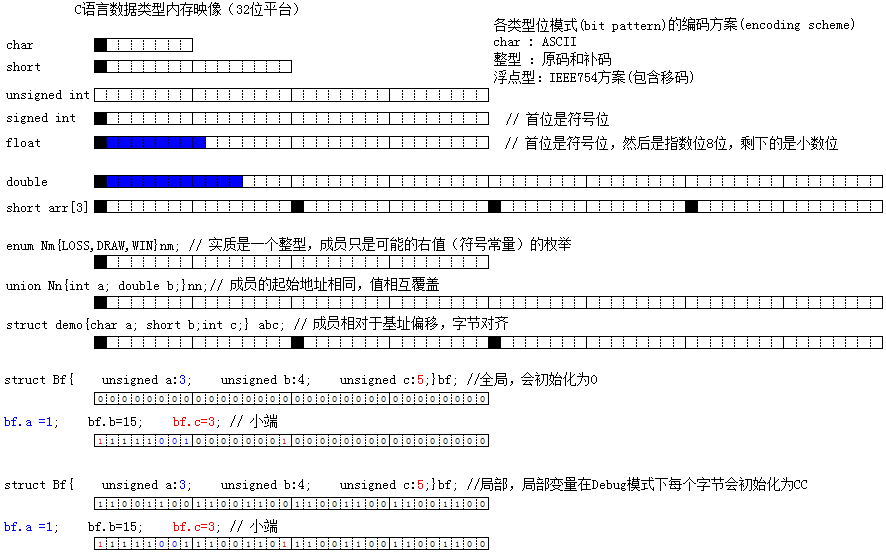
C語(yǔ)言各種數(shù)據(jù)類型的內(nèi)存映像(32位平臺(tái)):
0、signed char
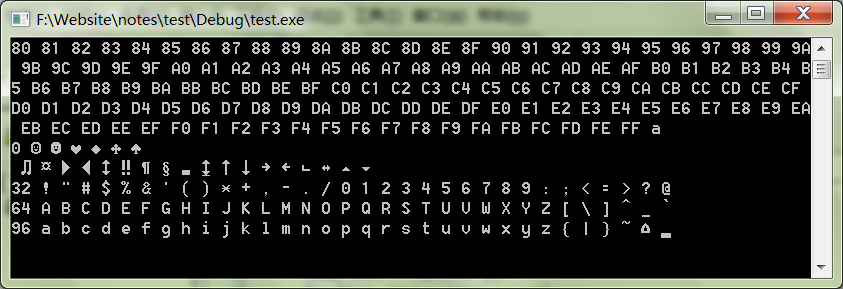
#include <stdio.h>int main(){    char min = 1<<7;    char max = (1<<7)-1;    for(int i=min;i<=max;i++)        if(i<0)            printf("%.2X ",(unsigned char)i);        else
        {            printf("%c ",i);            if(i%32==0)                printf("\n%d ",i);
        }
    getchar();
}
output:
1、整型的signed和unsigned
#include <stdio.h>int main(){    signed int smin = 1<<31;    signed int smax = (1<<31)-1;    printf("%d\n",smin);    // -2147483648
    printf("%d\n",smax);    // 2147483647
    unsigned int umax = -1;    printf("%u\n",umax);    // 4294967295
    umax = (1<<32)-1;    printf("%u\n",umax);    // 4294967295}
如果一個(gè)表達(dá)式同時(shí)包含signed和unsigned整型,signed會(huì)提升為unsgined,可能會(huì)隱藏一些意想不到的錯(cuò)誤,特別是用在比較運(yùn)算時(shí):
    unsigned int a=4294967290;    int b=-6;
    printf("%d\n",a==b); // 1 , b promotes to unsigned
2、double的二進(jìn)制位顯示
#include <stdio.h>void printByte(double d){    int bs = sizeof d;    unsigned char *ch = (unsigned char*)&d;    for(int i=0;i<bs;i++)        printf("%.2X ",*(ch+i));
}int main(){    int n = 0x01020304;    if(*(char*)&n == 4)        printf("小端:");//小端:
    double d = 15.75; // 1111.11, 指數(shù)位值:1023+3
    //0 100 0000 0010 1111100000000000000000000000000000000000000000000000
    printByte(d);//00 00 00 00 00 80 2F 40
    // 40              2F               80
    // 0100 0000 0010 1111 1000 0000
    getchar();
}
將double分成4部分顯示:
#include <stdio.h>typedef struct packed_double {
    unsigned int low32;    // 小數(shù)位 低32位
    unsigned int low20:20; // 小數(shù)位 低33-52位
    unsigned int exp11:11; // 指數(shù)位 低53-63位,移碼1023+二進(jìn)制整數(shù)位-1
    unsigned int sign:1;  // 符號(hào)位} packed_double;typedef union {    double d;
    packed_double b;
} packed;int main(){
    packed pd;
    pd.d = -15.75;
    pd.d = 12.3;    printf("%u %u %u %u\n",pd.b.sign,pd.b.exp11,pd.b.low20,pd.b.low32);
    getchar();
    return 0;
}/*
0 1026 1015808 0
*/
3、數(shù)組是相同數(shù)據(jù)類型的依次存儲(chǔ)
數(shù)組名是一個(gè)存儲(chǔ)數(shù)據(jù)首元素地址具有常量性質(zhì)的特殊指針,成員是相對(duì)于基址的偏移:
#include <stdio.h>void printArr(short arr[],int len){    for(int i=0;i<len;i++)
    {        printf("%d ",*(arr+i));
    }    printf("\n");
}int main(){
    short arr[] = {1,3,2};    int len = sizeof arr / sizeof *arr;
    printArr(arr,len);
}
4、枚舉只是枚舉可以取值的一些符號(hào)常量的一個(gè)特殊整型
#include <stdio.h>int main(){    enum Nm{LOSS,TIE,WIN}nm; // 實(shí)質(zhì)是一個(gè)整型,成員只是可能的右值(符號(hào)常量)的枚舉
    nm = LOSS;    printf("%d ",nm); // 0
    nm = TIE;    printf("%d ",nm); // 1
    nm = WIN;    printf("%d ",nm); // 2
    nm = (enum Nm)3;
    printf("%d ",nm); // 3
    printf("\n%d",sizeof(enum Nm)); // 4
    getchar();
}
枚舉讓相關(guān)符號(hào)常量?jī)?nèi)聚為一組,相對(duì)于#define,枚舉對(duì)數(shù)據(jù)的描述性更清晰。
5、共用體成員的起始地址相同,共用一塊內(nèi)存空間,值相互覆蓋
#include <stdio.h>int main(){    union Nn{int a; double b;}nn;// 成員的起始地址相同,值相互覆蓋
    nn.a = 123; //
    printf("起始地址:%X,內(nèi)存空間占用:%d\n",&nn.a,sizeof nn.a);
    nn.b = 12.3;    printf("起始地址:%X,內(nèi)存空間占用:%d\n",&nn.a,sizeof nn.b);
    nn.a = 12;    printf("起始地址:%X,內(nèi)存空間占用:%d\n",&nn.a,sizeof nn.a);
    getchar();
}/*
起始地址:12FF40,內(nèi)存空間占用:4
起始地址:12FF40,內(nèi)存空間占用:8
起始地址:12FF40,內(nèi)存空間占用:4
*/
當(dāng)一些事物具有更多共性,但有少量差異時(shí),可以只用一個(gè)內(nèi)嵌一個(gè)共用體的結(jié)構(gòu)體來描述:
#include <stdio.h>#include <string.h>#define MAXPARTS 12struct Parts{ // 零件
	int cost;	char supplier[12];	char unit[12] ;
};struct Assembly{ // 裝配件
	int n_parts;	struct {
		char partno[12];
		short quan;
	}parts[MAXPARTS];
};struct Inventory{ // 存貨類型,或是零件,或是裝配件
	char partno[10];	int quan;	enum{PART,ASSEMBLY}type; // 存貨類型
	union {		struct Parts parts;
		struct Assembly assembly;
	}info;
};int main(){	struct Inventory screen;
	strcpy(screen.partno,"p001");
	screen.quan = 12;
	screen.type = Inventory::PART;
	screen.info.parts.cost = 122;	strcpy(screen.info.parts.supplier,"hw");	strcpy(screen.info.parts.unit,"pcs");
	struct Inventory shell;
	strcpy(shell.partno,"a001");
	shell.quan = 4;
	shell.type = Inventory::ASSEMBLY;
	shell.info.assembly.n_parts=22;	strcpy(shell.info.assembly.parts[0].partno,"d001");
	shell.info.assembly.parts[1].quan = 5;	int costs;	if(shell.type == Inventory::ASSEMBLY)
		costs = shell.info.assembly.n_parts;
	printf("%d\n",costs); //22
	getchar();	return 0;
}
6、結(jié)構(gòu)體是不同數(shù)據(jù)類型的數(shù)據(jù)依次存儲(chǔ)在一起
結(jié)構(gòu)體各數(shù)據(jù)成員的引用可以通過其內(nèi)存大小和字節(jié)對(duì)齊來相對(duì)于基址偏移來計(jì)算。結(jié)構(gòu)體通常用于描述某一事物,用其成員來描述該事物的某些關(guān)鍵屬性。讓該事物既可以用結(jié)構(gòu)體變量整體表示,也可以對(duì)其成員分別引用來處理該事物的各個(gè)屬性。
#include <stdio.h>int main()
{    struct demo{char a; short b;int c;} abc; // 成員相對(duì)于基址偏移,字節(jié)對(duì)齊
    abc.b=12;    short *p = (short*)((int)&abc+sizeof(short)); // 模擬編譯器計(jì)算第2個(gè)成員的偏移地址
    printf("%d %d\n",abc.b,*p); // 12 12
    printf("%d\n",sizeof(struct demo));// 8
    getchar();
}
7、位域是對(duì)整型數(shù)據(jù)的按位處理
(一次可以處理n個(gè)位,1<=n<=整形長(zhǎng)度)
位域(全局)二進(jìn)制位顯示:
#include <stdio.h>void printBinM(unsigned int n){    for(int i=31;i>=0;i--)        printf("%d",(n & 1<<i)>>i);    printf("\n");
}struct Bf{
    unsigned a:3;
    unsigned b:4;
    unsigned c:5;
}bf;int main(){
    bf.a =1;
    bf.b=15;
    bf.c=3;    int *p = (int*)&bf; // 505
    printf("%d\n",*p);
    printBinM(*p);//00000000000000000000000111111001
    getchar();
}
位域(局部)二進(jìn)制位顯示:
#include <stdio.h>void printBinM(unsigned int n){    for(int i=31;i>=0;i--)        printf("%d",(n & 1<<i)>>i);    printf("\n");
}int main(){    struct Bf{
        unsigned a:3;
        unsigned b:4;
        unsigned c:5;
    }bf;
    bf.a =1;
    bf.b=15;
    bf.c=3;    int *p = (int*)&bf; // -858996231
    printf("%d\n",*p);
    printBinM(*p);//11001100110011001100000111111001
    getchar();
}版權(quán)聲明:本文來源網(wǎng)絡(luò),免費(fèi)傳達(dá)知識(shí),版權(quán)歸原作者所有。如涉及作品版權(quán)問題,請(qǐng)聯(lián)系我進(jìn)行刪除。
???????????????? END ???????????????
關(guān)注我的微信公眾號(hào),回復(fù)“加群”按規(guī)則加入技術(shù)交流群。
點(diǎn)擊“閱讀原文”查看更多分享,歡迎點(diǎn)分享、收藏、點(diǎn)贊、在看。