
ThreadLocal不好用?那是你沒用對!
在 Java 中,如果要問哪個類使用簡單,但用好最不簡單?我想你的腦海中一定會浮現(xiàn)出一次詞——“ThreadLocal”。
確實如此,ThreadLocal 原本設(shè)計是為了解決并發(fā)時,線程共享變量的問題,但由于過度設(shè)計,如弱引用和哈希碰撞,從而導(dǎo)致它的理解難度大和使用成本高等問題。當(dāng)然,如果稍有不慎還是導(dǎo)致臟數(shù)據(jù)、內(nèi)存溢出、共享變量更新等問題,但即便如此,ThreadLocal 依舊有適合自己的使用場景,以及無可取代的價值,比如本文要介紹了這兩種使用場景,除了 ThreadLocal 之外,還真沒有合適的替代方案。
使用場景1:本地變量
我們以多線程格式化時間為例,來演示 ThreadLocal 的價值和作用,當(dāng)我們在多個線程中格式化時間時,通常會這樣操作。
① 2個線程格式化
當(dāng)有 2 個線程進(jìn)行時間格式化時,我們可以這樣寫:
import java.text.SimpleDateFormat;
import java.util.Date;

public class Test {
    public static void main(String[] args) throws InterruptedException {
        // 創(chuàng)建并啟動線程1
        Thread t1 = new Thread(new Runnable() {
            @Override
            public void run() {
                // 得到時間對象
                Date date = new Date(1 * 1000);
                // 執(zhí)行時間格式化
                formatAndPrint(date);
            }
        });
        t1.start();
        // 創(chuàng)建并啟動線程2
        Thread t2 = new Thread(new Runnable() {
            @Override
            public void run() {
                // 得到時間對象
                Date date = new Date(2 * 1000);
                // 執(zhí)行時間格式化
                formatAndPrint(date);
            }
        });
        t2.start();
    }

    /**
     * 格式化并打印結(jié)果
     * @param date 時間對象
     */
    private static void formatAndPrint(Date date) {
        // 格式化時間對象
        SimpleDateFormat simpleDateFormat = new SimpleDateFormat("mm:ss");
        // 執(zhí)行格式化
        String result = simpleDateFormat.format(date);
        // 打印最終結(jié)果
        System.out.println("時間:" + result);
    }
}
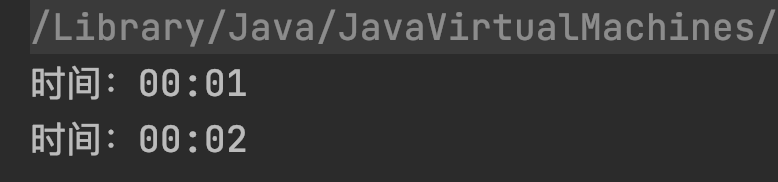
上面的代碼因為創(chuàng)建的線程數(shù)量并不多,所以我們可以給每個線程創(chuàng)建一個私有對象 SimpleDateFormat 來進(jìn)行時間格式化。
② 10個線程格式化
當(dāng)線程的數(shù)量從 2 個升級為 10 個時,我們可以使用 for 循環(huán)來創(chuàng)建多個線程執(zhí)行時間格式化,具體實現(xiàn)代碼如下:
import java.text.SimpleDateFormat;
import java.util.Date;

public class Test {
    public static void main(String[] args) throws InterruptedException {
        for (int i = 0; i < 10; i++) {
            int finalI = i;
            // 創(chuàng)建線程
            Thread thread = new Thread(new Runnable() {
                @Override
                public void run() {
                    // 得到時間對象
                    Date date = new Date(finalI * 1000);
                    // 執(zhí)行時間格式化
                    formatAndPrint(date);
                }
            });
            // 啟動線程
            thread.start();
        }
    }
    /**
     * 格式化并打印時間
     * @param date 時間對象
     */
    private static void formatAndPrint(Date date) {
        // 格式化時間對象
        SimpleDateFormat simpleDateFormat = new SimpleDateFormat("mm:ss");
        // 執(zhí)行格式化
        String result = simpleDateFormat.format(date);
        // 打印最終結(jié)果
        System.out.println("時間:" + result);
    }
}
以上程序的執(zhí)行結(jié)果為:
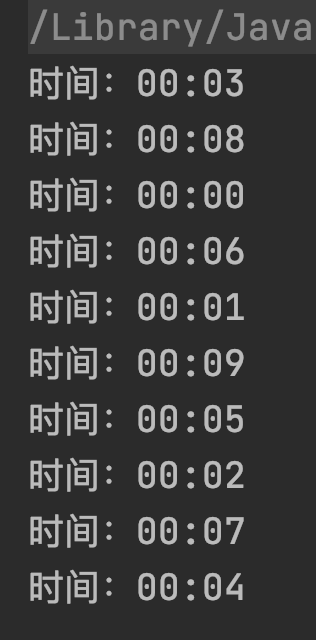
從上述結(jié)果可以看出,雖然此時創(chuàng)建的線程數(shù)和 SimpleDateFormat 的數(shù)量不算少,但程序還是可以正常運行的。
③ 1000個線程格式化
然而當(dāng)我們將線程的數(shù)量從 10 個變成 1000 個的時候,我們就不能單純的使用 for 循環(huán)來創(chuàng)建 1000 個線程的方式來解決問題了,因為這樣頻繁的新建和銷毀線程會造成大量的系統(tǒng)開銷和線程過度爭搶 CPU 資源的問題。
所以經(jīng)過一番思考后,我們決定使用線程池來執(zhí)行這 1000 次的任務(wù),因為線程池可以復(fù)用線程資源,無需頻繁的新建和銷毀線程,也可以通過控制線程池中線程的數(shù)量來避免過多線程所導(dǎo)致的 CPU 資源過度爭搶和線程頻繁切換所造成的性能問題,而且我們可以將 SimpleDateFormat 提升為全局變量,從而避免每次執(zhí)行都要新建 SimpleDateFormat 的問題,于是我們寫下了這樣的代碼:
import java.text.SimpleDateFormat;
import java.util.Date;
import java.util.concurrent.LinkedBlockingQueue;
import java.util.concurrent.ThreadPoolExecutor;
import java.util.concurrent.TimeUnit;

public class App {
    // 時間格式化對象
    private static SimpleDateFormat simpleDateFormat = new SimpleDateFormat("mm:ss");

    public static void main(String[] args) throws InterruptedException {
        // 創(chuàng)建線程池執(zhí)行任務(wù)
        ThreadPoolExecutor threadPool = new ThreadPoolExecutor(10, 10, 60,
                TimeUnit.SECONDS, new LinkedBlockingQueue<>(1000));
        for (int i = 0; i < 1000; i++) {
            int finalI = i;
            // 執(zhí)行任務(wù)
            threadPool.execute(new Runnable() {
                @Override
                public void run() {
                    // 得到時間對象
                    Date date = new Date(finalI * 1000);
                    // 執(zhí)行時間格式化
                    formatAndPrint(date);
                }
            });
        }
        // 線程池執(zhí)行完任務(wù)之后關(guān)閉
        threadPool.shutdown();
    }

    /**
     * 格式化并打印時間
     * @param date 時間對象
     */
    private static void formatAndPrint(Date date) {
        // 執(zhí)行格式化
        String result = simpleDateFormat.format(date);
        // 打印最終結(jié)果
        System.out.println("時間:" + result);
    }
}
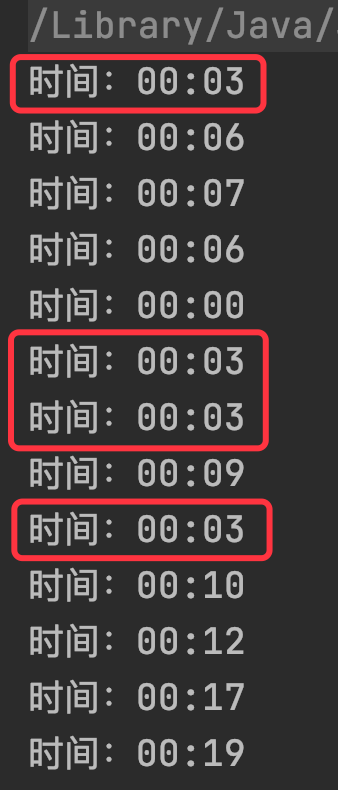
當(dāng)我們懷著無比喜悅的心情去運行程序的時候,卻發(fā)現(xiàn)意外發(fā)生了,這樣寫代碼竟然會出現(xiàn)線程安全的問題。從上述結(jié)果可以看出,程序的打印結(jié)果竟然有重復(fù)內(nèi)容的,正確的情況應(yīng)該是沒有重復(fù)的時間才對。
PS:所謂的線程安全問題是指:在多線程的執(zhí)行中,程序的執(zhí)行結(jié)果與預(yù)期結(jié)果不相符的情況。
a) 線程安全問題分析
為了找到問題所在,我們嘗試查看 SimpleDateFormat 中 format 方法的源碼來排查一下問題,format 源碼如下:
private StringBuffer format(Date date, StringBuffer toAppendTo,
                                FieldDelegate delegate) {
    // 注意此行代碼
    calendar.setTime(date);

    boolean useDateFormatSymbols = useDateFormatSymbols();

    for (int i = 0; i < compiledPattern.length; ) {
        int tag = compiledPattern[i] >>> 8;
        int count = compiledPattern[i++] & 0xff;
        if (count == 255) {
            count = compiledPattern[i++] << 16;
            count |= compiledPattern[i++];
        }

        switch (tag) {
            case TAG_QUOTE_ASCII_CHAR:
                toAppendTo.append((char)count);
                break;

            case TAG_QUOTE_CHARS:
                toAppendTo.append(compiledPattern, i, count);
                i += count;
                break;

            default:
                subFormat(tag, count, delegate, toAppendTo, useDateFormatSymbols);
                break;
        }
    }
    return toAppendTo;
}
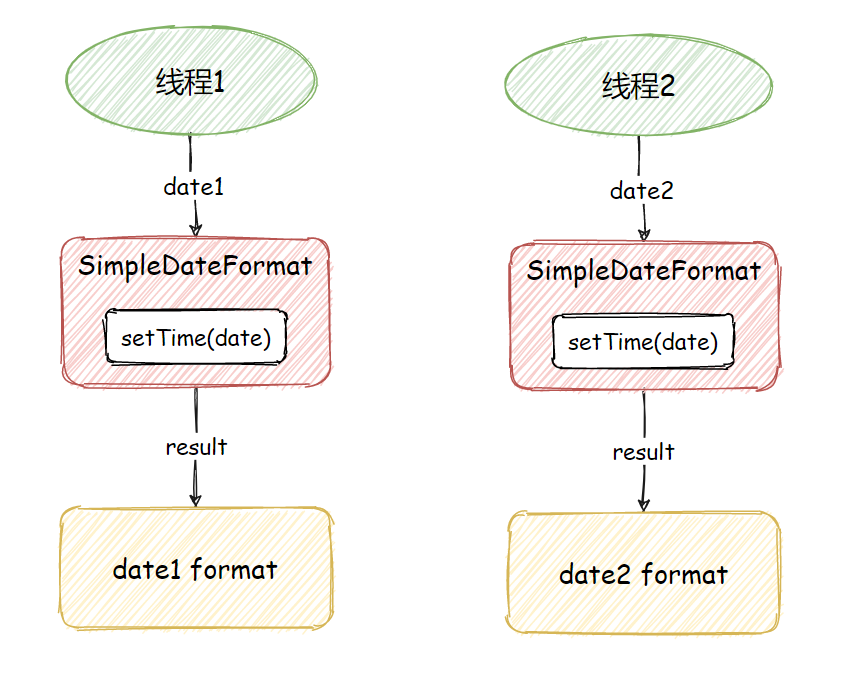
從上述源碼可以看出,在執(zhí)行 SimpleDateFormat.format 方法時,會使用 calendar.setTime 方法將輸入的時間進(jìn)行轉(zhuǎn)換,那么我們想想一下這樣的場景:
線程 1 執(zhí)行了 calendar.setTime(date)方法,將用戶輸入的時間轉(zhuǎn)換成了后面格式化時所需要的時間;線程 1 暫停執(zhí)行,線程 2 得到 CPU時間片開始執(zhí)行;線程 2 執(zhí)行了 calendar.setTime(date)方法,對時間進(jìn)行了修改;線程 2 暫停執(zhí)行,線程 1 得出 CPU時間片繼續(xù)執(zhí)行,因為線程 1 和線程 2 使用的是同一對象,而時間已經(jīng)被線程 2 修改了,所以此時當(dāng)線程 1 繼續(xù)執(zhí)行的時候就會出現(xiàn)線程安全的問題了。
正常的情況下,程序的執(zhí)行是這樣的:
非線程安全的執(zhí)行流程是這樣的: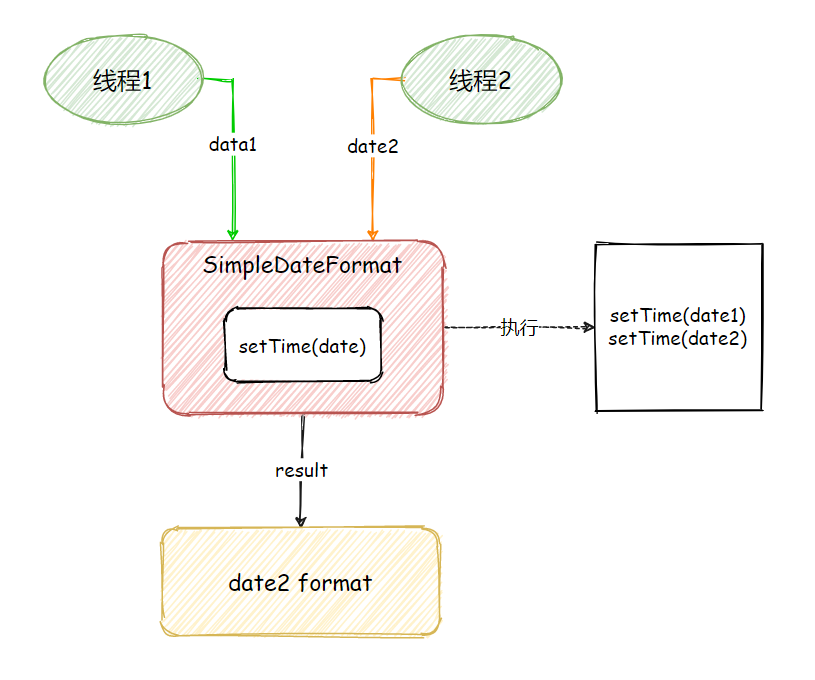
b) 解決線程安全問題:加鎖
當(dāng)出現(xiàn)線程安全問題時,我們想到的第一解決方案就是加鎖,具體的實現(xiàn)代碼如下:
import java.text.SimpleDateFormat;
import java.util.Date;
import java.util.concurrent.LinkedBlockingQueue;
import java.util.concurrent.ThreadPoolExecutor;
import java.util.concurrent.TimeUnit;

public class App {
    // 時間格式化對象
    private static SimpleDateFormat simpleDateFormat = new SimpleDateFormat("mm:ss");

    public static void main(String[] args) throws InterruptedException {
        // 創(chuàng)建線程池執(zhí)行任務(wù)
        ThreadPoolExecutor threadPool = new ThreadPoolExecutor(10, 10, 60,
                TimeUnit.SECONDS, new LinkedBlockingQueue<>(1000));
        for (int i = 0; i < 1000; i++) {
            int finalI = i;
            // 執(zhí)行任務(wù)
            threadPool.execute(new Runnable() {
                @Override
                public void run() {
                    // 得到時間對象
                    Date date = new Date(finalI * 1000);
                    // 執(zhí)行時間格式化
                    formatAndPrint(date);
                }
            });
        }
        // 線程池執(zhí)行完任務(wù)之后關(guān)閉
        threadPool.shutdown();
    }

    /**
     * 格式化并打印時間
     * @param date 時間對象
     */
    private static void formatAndPrint(Date date) {
        // 執(zhí)行格式化
        String result = null;
        // 加鎖
        synchronized (App.class) {
            result = simpleDateFormat.format(date);
        }
        // 打印最終結(jié)果
        System.out.println("時間:" + result);
    }
}
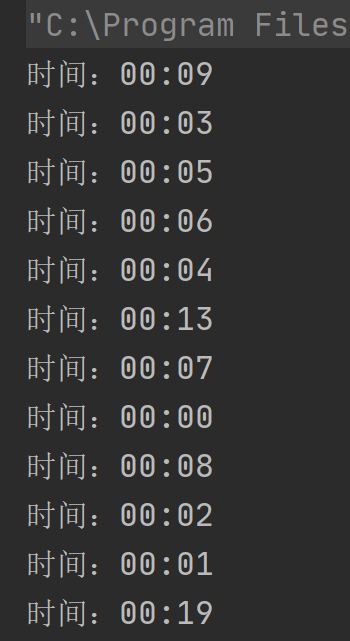
從上述結(jié)果可以看出,使用了 synchronized 加鎖之后程序就可以正常的執(zhí)行了。
加鎖的缺點
加鎖的方式雖然可以解決線程安全的問題,但同時也帶來了新的問題,當(dāng)程序加鎖之后,所有的線程必須排隊執(zhí)行某些業(yè)務(wù)才行,這樣無形中就降低了程序的運行效率了。
有沒有既能解決線程安全問題,又能提高程序的執(zhí)行速度的解決方案呢?
答案是:有的,這個時候 ThreadLocal就要上場了。
c) 解決線程安全問題:ThreadLocal
1.ThreadLocal 介紹
ThreadLocal 從字面的意思來理解是線程本地變量的意思,也就是說它是線程中的私有變量,每個線程只能使用自己的變量。
以上面線程池格式化時間為例,當(dāng)線程池中有 10 個線程時,SimpleDateFormat 會存入 ThreadLocal 中,它也只會創(chuàng)建 10 個對象,即使要執(zhí)行 1000 次時間格式化任務(wù),依然只會新建 10 個 SimpleDateFormat 對象,每個線程調(diào)用自己的 ThreadLocal 變量。
2.ThreadLocal 基礎(chǔ)使用
ThreadLocal 常用的核心方法有三個:
set 方法:用于設(shè)置線程獨立變量副本。沒有 set 操作的 ThreadLocal 容易引起臟數(shù)據(jù)。 get 方法:用于獲取線程獨立變量副本。沒有 get 操作的 ThreadLocal 對象沒有意義。 remove 方法:用于移除線程獨立變量副本。沒有 remove 操作容易引起內(nèi)存泄漏。
ThreadLocal 所有方法如下圖所示:
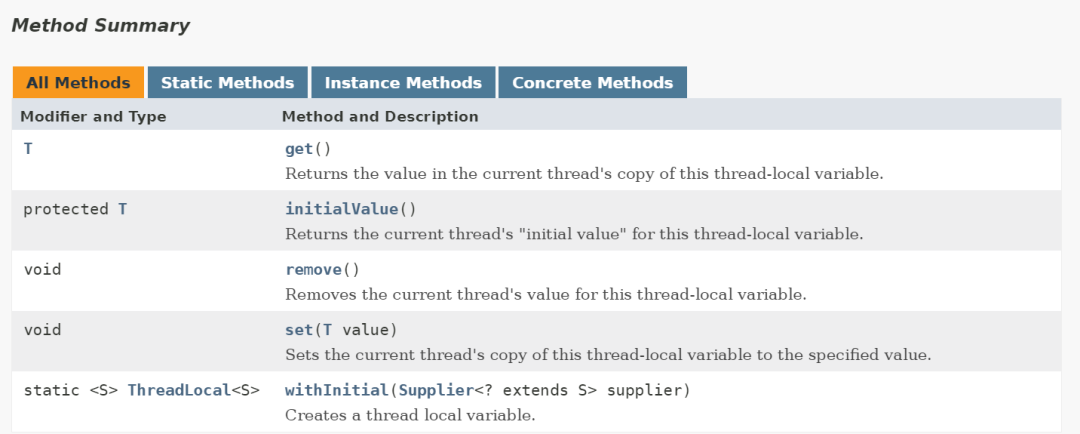
官方說明文檔:https://docs.oracle.com/javase/8/docs/api/
ThreadLocal 基礎(chǔ)用法如下:
/**
 * @公眾號:Java中文社群
 */
public class ThreadLocalExample {
    // 創(chuàng)建一個 ThreadLocal 對象
    private static ThreadLocal<String> threadLocal = new ThreadLocal<>();

    public static void main(String[] args) {
        // 線程執(zhí)行任務(wù)
        Runnable runnable = new Runnable() {
            @Override
            public void run() {
                String threadName = Thread.currentThread().getName();
                System.out.println(threadName + " 存入值:" + threadName);
                // 在 ThreadLocal 中設(shè)置值
                threadLocal.set(threadName);
                // 執(zhí)行方法,打印線程中設(shè)置的值
                print(threadName);
            }
        };
        // 創(chuàng)建并啟動線程 1
        new Thread(runnable, "MyThread-1").start();
        // 創(chuàng)建并啟動線程 2
        new Thread(runnable, "MyThread-2").start();
    }

    /**
     * 打印線程中的 ThreadLocal 值
     * @param threadName 線程名稱
     */
    private static void print(String threadName) {
        try {
            // 得到 ThreadLocal 中的值
            String result = threadLocal.get();
            // 打印結(jié)果
            System.out.println(threadName + " 取出值:" + result);
        } finally {
            // 移除 ThreadLocal 中的值(防止內(nèi)存溢出)
            threadLocal.remove();
        }
    }
}
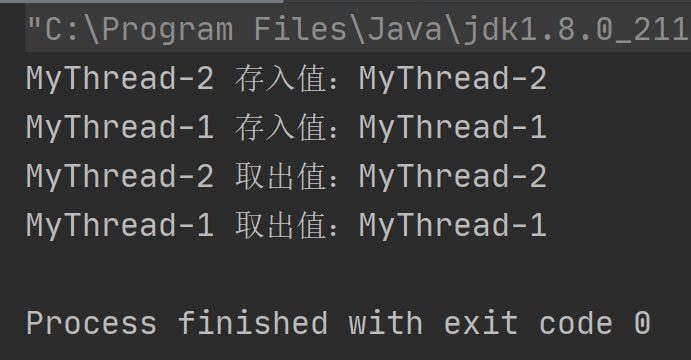
從上述結(jié)果可以看出,每個線程只會讀取到屬于自己的 ThreadLocal 值。
3.ThreadLocal 高級用法
① 初始化:initialValue
public class ThreadLocalByInitExample {
    // 定義 ThreadLocal
    private static ThreadLocal<String> threadLocal = new ThreadLocal(){
        @Override
        protected String initialValue() {
            System.out.println("執(zhí)行 initialValue() 方法");
            return "默認(rèn)值";
        }
    };

    public static void main(String[] args) {
        // 線程執(zhí)行任務(wù)
        Runnable runnable = new Runnable() {
            @Override
            public void run() {
                // 執(zhí)行方法,打印線程中數(shù)據(jù)(未設(shè)置值打印)
                print(threadName);
            }
        };
        // 創(chuàng)建并啟動線程 1
        new Thread(runnable, "MyThread-1").start();
        // 創(chuàng)建并啟動線程 2
        new Thread(runnable, "MyThread-2").start();
    }

    /**
     * 打印線程中的 ThreadLocal 值
     * @param threadName 線程名稱
     */
    private static void print(String threadName) {
        // 得到 ThreadLocal 中的值
        String result = threadLocal.get();
        // 打印結(jié)果
        System.out.println(threadName + " 得到值:" + result);
    }
}
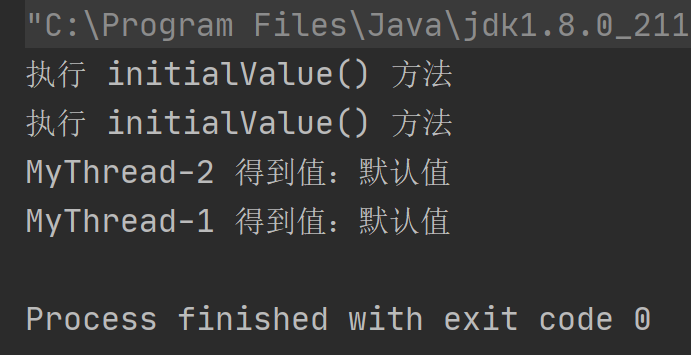
當(dāng)使用了 #threadLocal.set 方法之后,initialValue 方法就不會被執(zhí)行了,如下代碼所示:
public class ThreadLocalByInitExample {
    // 定義 ThreadLocal
    private static ThreadLocal<String> threadLocal = new ThreadLocal() {
        @Override
        protected String initialValue() {
            System.out.println("執(zhí)行 initialValue() 方法");
            return "默認(rèn)值";
        }
    };

    public static void main(String[] args) {
        // 線程執(zhí)行任務(wù)
        Runnable runnable = new Runnable() {
            @Override
            public void run() {
                String threadName = Thread.currentThread().getName();
                System.out.println(threadName + " 存入值:" + threadName);
                // 在 ThreadLocal 中設(shè)置值
                threadLocal.set(threadName);
                // 執(zhí)行方法,打印線程中設(shè)置的值
                print(threadName);
            }
        };
        // 創(chuàng)建并啟動線程 1
        new Thread(runnable, "MyThread-1").start();
        // 創(chuàng)建并啟動線程 2
        new Thread(runnable, "MyThread-2").start();
    }

    /**
     * 打印線程中的 ThreadLocal 值
     * @param threadName 線程名稱
     */
    private static void print(String threadName) {
        try {
            // 得到 ThreadLocal 中的值
            String result = threadLocal.get();
            // 打印結(jié)果
            System.out.println(threadName + "取出值:" + result);
        } finally {
            // 移除 ThreadLocal 中的值(防止內(nèi)存溢出)
            threadLocal.remove();
        }
    }
}

為什么 set 之后,初始化代碼就不執(zhí)行了?
要理解這個問題,需要從 ThreadLocal.get() 方法的源碼中得到答案,因為初始化方法 initialValue 在 ThreadLocal 創(chuàng)建時并不會立即執(zhí)行,而是在調(diào)用了 get 方法只會才會執(zhí)行,測試代碼如下:
import java.util.Date;

public class ThreadLocalByInitExample {
    // 定義 ThreadLocal
    private static ThreadLocal<String> threadLocal = new ThreadLocal() {
        @Override
        protected String initialValue() {
            System.out.println("執(zhí)行 initialValue() 方法 " + new Date());
            return "默認(rèn)值";
        }
    };
    public static void main(String[] args) {
        // 線程執(zhí)行任務(wù)
        Runnable runnable = new Runnable() {
            @Override
            public void run() {
                // 得到當(dāng)前線程名稱
                String threadName = Thread.currentThread().getName();
                // 執(zhí)行方法,打印線程中設(shè)置的值
                print(threadName);
            }
        };
        // 創(chuàng)建并啟動線程 1
        new Thread(runnable, "MyThread-1").start();
        // 創(chuàng)建并啟動線程 2
        new Thread(runnable, "MyThread-2").start();
    }

    /**
     * 打印線程中的 ThreadLocal 值
     * @param threadName 線程名稱
     */
    private static void print(String threadName) {
        System.out.println("進(jìn)入 print() 方法 " + new Date());
        try {
            // 休眠 1s
            Thread.sleep(1000);
        } catch (InterruptedException e) {
            e.printStackTrace();
        }
        // 得到 ThreadLocal 中的值
        String result = threadLocal.get();
        // 打印結(jié)果
        System.out.println(String.format("%s 取得值:%s %s",
                threadName, result, new Date()));
    }
}

initialValue 方法并不是在 ThreadLocal 創(chuàng)建時執(zhí)行的,而是在調(diào)用 Thread.get 方法時才執(zhí)行的。接下來來看 Threadlocal.get 源碼的實現(xiàn):
public T get() {
    // 得到當(dāng)前的線程
    Thread t = Thread.currentThread();
    ThreadLocalMap map = getMap(t);
    // 判斷 ThreadLocal 中是否有數(shù)據(jù)
    if (map != null) {
        ThreadLocalMap.Entry e = map.getEntry(this);
        if (e != null) {
            @SuppressWarnings("unchecked")
            T result = (T)e.value;
            // 有 set 值,直接返回數(shù)據(jù)
            return result;
        }
    }
    // 執(zhí)行初始化方法【重點關(guān)注】
    return setInitialValue();
}
private T setInitialValue() {
    // 執(zhí)行初始化方法【重點關(guān)注】
    T value = initialValue();
    Thread t = Thread.currentThread();
    ThreadLocalMap map = getMap(t);
    if (map != null)
        map.set(this, value);
    else
        createMap(t, value);
    return value;
}
從上述源碼可以看出,當(dāng) ThreadLocal 中有值時會直接返回值 e.value,只有 Threadlocal 中沒有任何值時才會執(zhí)行初始化方法 initialValue。
注意事項—類型必須保持一致
initialValue 時,返回值的類型要和 ThreadLoca 定義的數(shù)據(jù)類型保持一致,如下圖所示: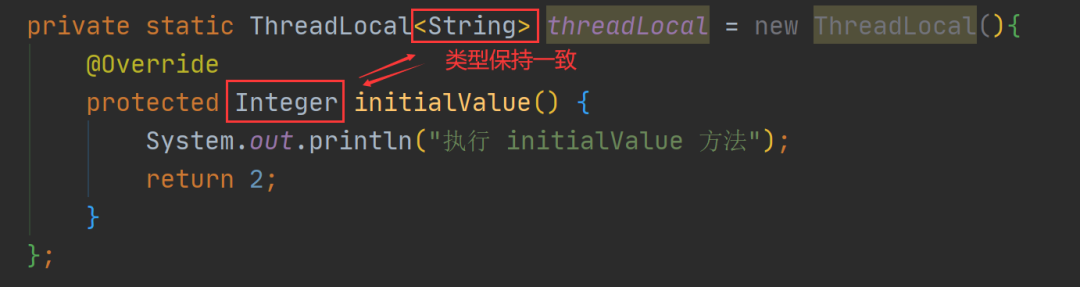
ClassCaseException 類型轉(zhuǎn)換異常,如下圖所示: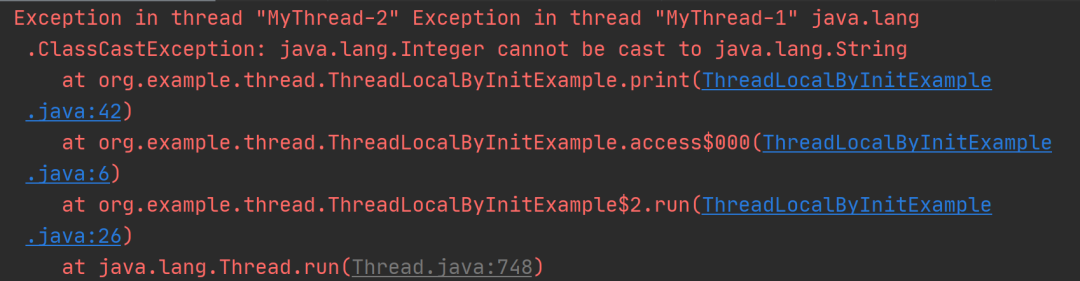
② 初始化2:withInitial
import java.util.function.Supplier;

public class ThreadLocalByInitExample {
    // 定義 ThreadLocal
    private static ThreadLocal<String> threadLocal =
            ThreadLocal.withInitial(new Supplier<String>() {
                @Override
                public String get() {
                    System.out.println("執(zhí)行 withInitial() 方法");
                    return "默認(rèn)值";
                }
            });
    public static void main(String[] args) {
        // 線程執(zhí)行任務(wù)
        Runnable runnable = new Runnable() {
            @Override
            public void run() {
                String threadName = Thread.currentThread().getName();
                // 執(zhí)行方法,打印線程中設(shè)置的值
                print(threadName);
            }
        };
        // 創(chuàng)建并啟動線程 1
        new Thread(runnable, "MyThread-1").start();
        // 創(chuàng)建并啟動線程 2
        new Thread(runnable, "MyThread-2").start();
    }

    /**
     * 打印線程中的 ThreadLocal 值
     * @param threadName 線程名稱
     */
    private static void print(String threadName) {
        // 得到 ThreadLocal 中的值
        String result = threadLocal.get();
        // 打印結(jié)果
        System.out.println(threadName + " 得到值:" + result);
    }
}
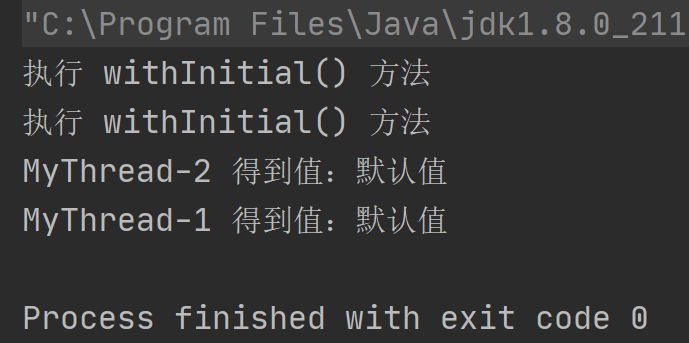
通過上述的代碼發(fā)現(xiàn),withInitial 方法的使用好和 initialValue 好像沒啥區(qū)別,那為啥還要造出兩個類似的方法呢?客官莫著急,繼續(xù)往下看。
③ 更簡潔的 withInitial 使用
withInitial 方法的優(yōu)勢在于可以更簡單的實現(xiàn)變量初始化,如下代碼所示:
public class ThreadLocalByInitExample {
    // 定義 ThreadLocal
    private static ThreadLocal<String> threadLocal = ThreadLocal.withInitial(() -> "默認(rèn)值");
    public static void main(String[] args) {
        // 線程執(zhí)行任務(wù)
        Runnable runnable = new Runnable() {
            @Override
            public void run() {
                String threadName = Thread.currentThread().getName();
                // 執(zhí)行方法,打印線程中設(shè)置的值
                print(threadName);
            }
        };
        // 創(chuàng)建并啟動線程 1
        new Thread(runnable, "MyThread-1").start();
        // 創(chuàng)建并啟動線程 2
        new Thread(runnable, "MyThread-2").start();
    }

    /**
     * 打印線程中的 ThreadLocal 值
     * @param threadName 線程名稱
     */
    private static void print(String threadName) {
        // 得到 ThreadLocal 中的值
        String result = threadLocal.get();
        // 打印結(jié)果
        System.out.println(threadName + " 得到值:" + result);
    }
}

4.ThreadLocal 版時間格式化
了解了 ThreadLocal 的使用之后,我們回到本文的主題,接下來我們將使用 ThreadLocal 來實現(xiàn) 1000 個時間的格式化,具體實現(xiàn)代碼如下:
import java.text.SimpleDateFormat;
import java.util.Date;
import java.util.concurrent.LinkedBlockingQueue;
import java.util.concurrent.ThreadPoolExecutor;
import java.util.concurrent.TimeUnit;

public class MyThreadLocalByDateFormat {
    // 創(chuàng)建 ThreadLocal 并設(shè)置默認(rèn)值
    private static ThreadLocal<SimpleDateFormat> dateFormatThreadLocal =
            ThreadLocal.withInitial(() -> new SimpleDateFormat("mm:ss"));

    public static void main(String[] args) {
        // 創(chuàng)建線程池執(zhí)行任務(wù)
        ThreadPoolExecutor threadPool = new ThreadPoolExecutor(10, 10, 60,
                TimeUnit.SECONDS, new LinkedBlockingQueue<>(1000));
        // 執(zhí)行任務(wù)
        for (int i = 0; i < 1000; i++) {
            int finalI = i;
            // 執(zhí)行任務(wù)
            threadPool.execute(new Runnable() {
                @Override
                public void run() {
                    // 得到時間對象
                    Date date = new Date(finalI * 1000);
                    // 執(zhí)行時間格式化
                    formatAndPrint(date);
                }
            });
        }
        // 線程池執(zhí)行完任務(wù)之后關(guān)閉
        threadPool.shutdown();
        // 線程池執(zhí)行完任務(wù)之后關(guān)閉
        threadPool.shutdown();
    }
    /**
     * 格式化并打印時間
     * @param date 時間對象
     */
    private static void formatAndPrint(Date date) {
        // 執(zhí)行格式化
        String result = dateFormatThreadLocal.get().format(date);
        // 打印最終結(jié)果
        System.out.println("時間:" + result);
    }
}
從上述結(jié)果可以看出,使用 ThreadLocal 也可以解決線程并發(fā)問題,并且避免了代碼加鎖排隊執(zhí)行的問題。
使用場景2:跨類傳遞數(shù)據(jù)
除了上面的使用場景之外,我們還可以使用 ThreadLocal 來實現(xiàn)線程中跨類、跨方法的數(shù)據(jù)傳遞。比如登錄用戶的 User 對象信息,我們需要在不同的子系統(tǒng)中多次使用,如果使用傳統(tǒng)的方式,我們需要使用方法傳參和返回值的方式來傳遞 User 對象,然而這樣就無形中造成了類和類之間,甚至是系統(tǒng)和系統(tǒng)之間的相互耦合了,所以此時我們可以使用 ThreadLocal 來實現(xiàn) User 對象的傳遞。
確定了方案之后,接下來我們來實現(xiàn)具體的業(yè)務(wù)代碼。我們可以先在主線程中構(gòu)造并初始化一個 User 對象,并將此 User 對象存儲在 ThreadLocal 中,存儲完成之后,我們就可以在同一個線程的其他類中,如倉儲類或訂單類中直接獲取并使用 User 對象了,具體實現(xiàn)代碼如下。
主線程中的業(yè)務(wù)代碼:
public class ThreadLocalByUser {
    public static void main(String[] args) {
        // 初始化用戶信息
        User user = new User("Java");
        // 將 User 對象存儲在 ThreadLocal 中
        UserStorage.setUser(user);
        // 調(diào)用訂單系統(tǒng)
        OrderSystem orderSystem = new OrderSystem();
        // 添加訂單(方法內(nèi)獲取用戶信息)
        orderSystem.add();
        // 調(diào)用倉儲系統(tǒng)
        RepertorySystem repertory = new RepertorySystem();
        // 減庫存(方法內(nèi)獲取用戶信息)
        repertory.decrement();
    }
}
User 實體類:
/**
 * 用戶實體類
 */
class User {
    public User(String name) {
        this.name = name;
    }
    private String name;
    public String getName() {
        return name;
    }
    public void setName(String name) {
        this.name = name;
    }
}
ThreadLocal 操作類:
/**
 * 用戶信息存儲類
 */
class UserStorage {
    // 用戶信息
    public static ThreadLocal<User> USER = new ThreadLocal();

    /**
     * 存儲用戶信息
     * @param user 用戶數(shù)據(jù)
     */
    public static void setUser(User user) {
        USER.set(user);
    }
}
訂單類:
/**
 * 訂單類
 */
class OrderSystem {
    /**
     * 訂單添加方法
     */
    public void add() {
        // 得到用戶信息
        User user = UserStorage.USER.get();
        // 業(yè)務(wù)處理代碼(忽略)...
        System.out.println(String.format("訂單系統(tǒng)收到用戶:%s 的請求。",
                user.getName()));
    }
}
倉儲類:
/**
 * 倉儲類
 */
class RepertorySystem {
    /**
     * 減庫存方法
     */
    public void decrement() {
        // 得到用戶信息
        User user = UserStorage.USER.get();
        // 業(yè)務(wù)處理代碼(忽略)...
        System.out.println(String.format("倉儲系統(tǒng)收到用戶:%s 的請求。",
                user.getName()));
    }
}
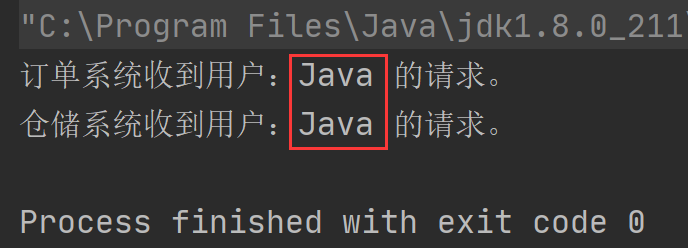
從上述結(jié)果可以看出,當(dāng)我們在主線程中先初始化了 User 對象之后,訂單類和倉儲類無需進(jìn)行任何的參數(shù)傳遞也可以正常獲得 User 對象了,從而實現(xiàn)了一個線程中,跨類和跨方法的數(shù)據(jù)傳遞。
總結(jié)
使用 ThreadLocal 可以創(chuàng)建線程私有變量,所以不會導(dǎo)致線程安全問題,同時使用 ThreadLocal 還可以避免因為引入鎖而造成線程排隊執(zhí)行所帶來的性能消耗;再者使用 ThreadLocal 還可以實現(xiàn)一個線程內(nèi)跨類、跨方法的數(shù)據(jù)傳遞。
參考 & 鳴謝
《碼出高效:Java開發(fā)手冊》
《Java 并發(fā)編程 78 講》