
C語言的高級(jí)用法,面向?qū)ο?/h1>
不知道有多少人去了解過語言的發(fā)展史,早期C語言的語法功能其實(shí)比較簡單。隨著應(yīng)用需求和場景的變化,C語言的語法功能在不斷升級(jí)變化。
雖然我們的教材有這么一個(gè)結(jié)論:C語言是面向過程的語言,C++是面向?qū)ο?/strong>的編程語言,但面向?qū)ο蟮母拍钍窃贑語言階段就有了,而且應(yīng)用到了很多地方,比如某些操作系統(tǒng)內(nèi)核、通信協(xié)議等。
面向?qū)ο缶幊蹋簿褪谴蠹艺f的OOP(Object Oriented Programming)并不是一種特定的語言或者工具,它只是一種設(shè)計(jì)方法、設(shè)計(jì)思想,它表現(xiàn)出來的三個(gè)最基本的特性就是封裝、繼承與多態(tài)。
1、為什么用C實(shí)現(xiàn)OOP? ?
閱讀文本之前肯定有讀者會(huì)問這樣的問題:我們有C++面向?qū)ο蟮恼Z言,為什么還要用C語言實(shí)現(xiàn)面向?qū)ο竽兀?/span>
C語言這種非面向?qū)ο蟮恼Z言,同樣也可以使用面向?qū)ο蟮乃悸穪砭帉懗绦虻摹?/span>
只是用面向?qū)ο蟮?strong style="margin: 0px;padding: 0px;max-width: 100%;overflow-wrap: break-word !important;box-sizing: border-box !important;visibility: visible;">C++語言來實(shí)現(xiàn)面向?qū)ο缶幊虝?huì)更簡單一些,但是C語言的高效性是其他面向?qū)ο缶幊陶Z言無法比擬的。
當(dāng)然使用C語言來實(shí)現(xiàn)面向?qū)ο蟮拈_發(fā)相對不容易理解,這就是為什么大多數(shù)人學(xué)過C語言卻看不懂Linux內(nèi)核源碼。
所以這個(gè)問題其實(shí)很好理解,只要有一定C語言編程經(jīng)驗(yàn)的讀者都應(yīng)該能明白:面向過程的C語言和面向?qū)ο蟮腃++語言相比,代碼運(yùn)行效率、代碼量都有很大差異。在性能不是很好、資源不是很多的MCU中使用C語言面向?qū)ο缶幊叹惋@得尤為重要。
2、所具備的條件? ?
要想使用C語言實(shí)現(xiàn)面向?qū)ο螅紫刃枰邆湟恍┗A(chǔ)知識(shí)。比如:(C語言中的)結(jié)構(gòu)體、函數(shù)、指針,以及函數(shù)指針等,(C++中的)基類、派生、多態(tài)、繼承等。
首先,不僅僅是了解這些基礎(chǔ)知識(shí),而是有一定的編程經(jīng)驗(yàn),因?yàn)樯厦嬲f了“面向?qū)ο笫且环N設(shè)計(jì)方法、設(shè)計(jì)思想”,如果只是停留在字面意思的理解,沒有這種設(shè)計(jì)思想肯定不行。
因此,不建議初學(xué)者使用C語言實(shí)現(xiàn)面向?qū)ο螅貏e是在真正項(xiàng)目中。建議把基本功練好,再使用。
利用C語言實(shí)現(xiàn)面向?qū)ο蟮姆椒ê芏啵旅婢蛠砻枋鲎罨镜姆庋b、繼承和多態(tài)。
3、封裝??
封裝就是把數(shù)據(jù)和函數(shù)打包到一個(gè)類里面,其實(shí)大部分C語言編程者都已近接觸過了。
C 標(biāo)準(zhǔn)庫中的 fopen(), fclose(), fread(), fwrite()等函數(shù)的操作對象就是 FILE。數(shù)據(jù)內(nèi)容就是 FILE,數(shù)據(jù)的讀寫操作就是 fread()、fwrite(),fopen() 類比于構(gòu)造函數(shù),fclose() 就是析構(gòu)函數(shù)。
這個(gè)看起來似乎很好理解,那下面我們實(shí)現(xiàn)一下基本的封裝特性。
#ifndef?SHAPE_H
#define?SHAPE_H
#include?
//?Shape?的屬性
typedef?struct?{
????int16_t?x;?
????int16_t?y;?
}?Shape;
//?Shape?的操作函數(shù),接口函數(shù)
void?Shape_ctor(Shape?*?const?me,?int16_t?x,?int16_t?y);
void?Shape_moveBy(Shape?*?const?me,?int16_t?dx,?int16_t?dy);
int16_t?Shape_getX(Shape?const?*?const?me);
int16_t?Shape_getY(Shape?const?*?const?me);
#endif?/*?SHAPE_H?*/
這是 Shape 類的聲明,非常簡單,很好理解。一般會(huì)把聲明放到頭文件里面 “Shape.h”。來看下 Shape 類相關(guān)的定義,當(dāng)然是在 “Shape.c” 里面。
#include?"shape.h"
//?構(gòu)造函數(shù)
void?Shape_ctor(Shape?*?const?me,?int16_t?x,?int16_t?y)
{
????me->x?=?x;
????me->y?=?y;
}
void?Shape_moveBy(Shape?*?const?me,?int16_t?dx,?int16_t?dy)?
{
????me->x?+=?dx;
????me->y?+=?dy;
}
//?獲取屬性值函數(shù)
int16_t?Shape_getX(Shape?const?*?const?me)?
{
????return?me->x;
}
int16_t?Shape_getY(Shape?const?*?const?me)?
{
????return?me->y;
}
再看下 main.c #include?"shape.h"??/*?Shape?class?interface?*/
#include???/*?for?printf()?*/
int?main()?
{
????Shape?s1,?s2;?/*?multiple?instances?of?Shape?*/
????Shape_ctor(&s1,?0,?1);
????Shape_ctor(&s2,?-1,?2);
????printf("Shape?s1(x=%d,y=%d)\n",?Shape_getX(&s1),?Shape_getY(&s1));
????printf("Shape?s2(x=%d,y=%d)\n",?Shape_getX(&s2),?Shape_getY(&s2));
????Shape_moveBy(&s1,?2,?-4);
????Shape_moveBy(&s2,?1,?-2);
????printf("Shape?s1(x=%d,y=%d)\n",?Shape_getX(&s1),?Shape_getY(&s1));
????printf("Shape?s2(x=%d,y=%d)\n",?Shape_getX(&s2),?Shape_getY(&s2));
????return?0;
}
編譯之后,看看執(zhí)行結(jié)果:
Shape?s1(x=0,y=1)
Shape?s2(x=-1,y=2)
Shape?s1(x=2,y=-3)
Shape?s2(x=0,y=0)
整個(gè)例子,非常簡單,非常好理解。以后寫代碼時(shí)候,要多去想想標(biāo)準(zhǔn)庫的文件IO操作,這樣也有意識(shí)的去培養(yǎng)面向?qū)ο缶幊痰乃季S。
4、繼承??
繼承就是基于現(xiàn)有的一個(gè)類去定義一個(gè)新類,這樣有助于重用代碼,更好的組織代碼。在 C 語言里面,去實(shí)現(xiàn)單繼承也非常簡單,只要把基類放到繼承類的第一個(gè)數(shù)據(jù)成員的位置就行了。
例如,我們現(xiàn)在要?jiǎng)?chuàng)建一個(gè) Rectangle 類,我們只要繼承 Shape 類已經(jīng)存在的屬性和操作,再添加不同于 Shape 的屬性和操作到 Rectangle 中。
下面是 Rectangle 的聲明與定義: #ifndef?RECT_H
#define?RECT_H
#include?"shape.h"?//?基類接口
//?矩形的屬性
typedef?struct?{
????Shape?super;?//?繼承?Shape
????//?自己的屬性
????uint16_t?width;
????uint16_t?height;
}?Rectangle;
//?構(gòu)造函數(shù)
void?Rectangle_ctor(Rectangle?*?const?me,?int16_t?x,?int16_t?y,
????????????????????uint16_t?width,?uint16_t?height);
#endif?/*?RECT_H?*/
#include?"rect.h"
//?構(gòu)造函數(shù)
void?Rectangle_ctor(Rectangle?*?const?me,?int16_t?x,?int16_t?y,
????????????????????uint16_t?width,?uint16_t?height)
{
????/*?first?call?superclass’?ctor?*/
????Shape_ctor(&me->super,?x,?y);
????/*?next,?you?initialize?the?attributes?added?by?this?subclass...?*/
????me->width?=?width;
????me->height?=?height;
}
我們來看一下 Rectangle 的繼承關(guān)系和內(nèi)存布局:
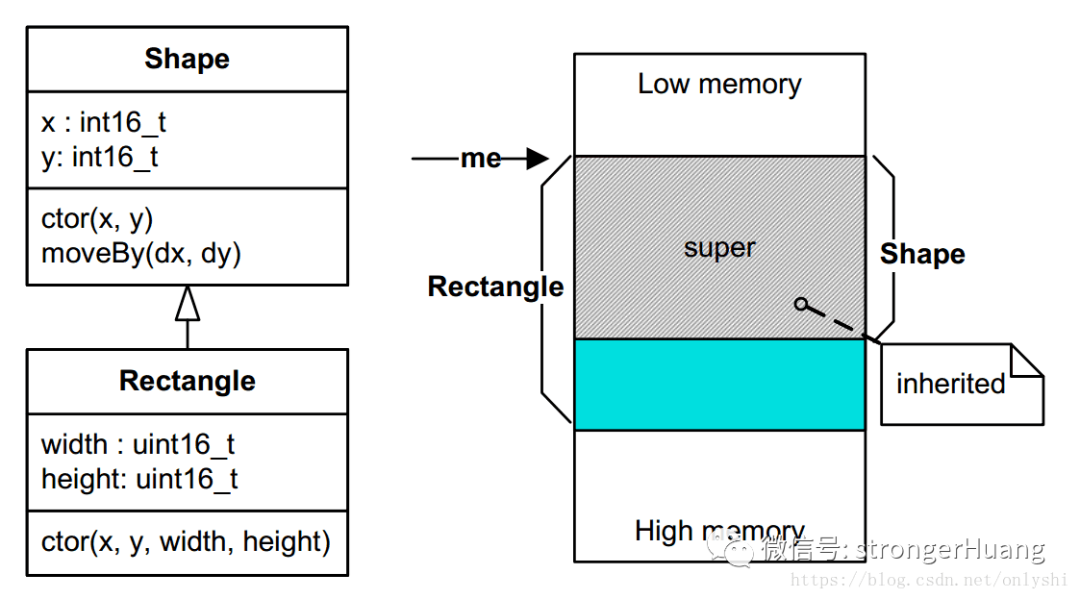
因?yàn)橛羞@樣的內(nèi)存布局,所以你可以很安全的傳一個(gè)指向 Rectangle 對象的指針到一個(gè)期望傳入 Shape 對象的指針的函數(shù)中,就是一個(gè)函數(shù)的參數(shù)是 “Shape *”,你可以傳入 “Rectangle *”,并且這是非常安全的。這樣的話,基類的所有屬性和方法都可以被繼承類繼承!
#include?"rect.h"??
#include??
int?main()?
{
????Rectangle?r1,?r2;
????//?實(shí)例化對象
????Rectangle_ctor(&r1,?0,?2,?10,?15);
????Rectangle_ctor(&r2,?-1,?3,?5,?8);
????printf("Rect?r1(x=%d,y=%d,width=%d,height=%d)\n",
???????????Shape_getX(&r1.super),?Shape_getY(&r1.super),
???????????r1.width,?r1.height);
????printf("Rect?r2(x=%d,y=%d,width=%d,height=%d)\n",
???????????Shape_getX(&r2.super),?Shape_getY(&r2.super),
???????????r2.width,?r2.height);
????//?注意,這里有兩種方式,一是強(qiáng)轉(zhuǎn)類型,二是直接使用成員地址
????Shape_moveBy((Shape?*)&r1,?-2,?3);
????Shape_moveBy(&r2.super,?2,?-1);
????printf("Rect?r1(x=%d,y=%d,width=%d,height=%d)\n",
???????????Shape_getX(&r1.super),?Shape_getY(&r1.super),
???????????r1.width,?r1.height);
????printf("Rect?r2(x=%d,y=%d,width=%d,height=%d)\n",
???????????Shape_getX(&r2.super),?Shape_getY(&r2.super),
???????????r2.width,?r2.height);
????return?0;
}
輸出結(jié)果: Rect?r1(x=0,y=2,width=10,height=15)
Rect?r2(x=-1,y=3,width=5,height=8)
Rect?r1(x=-2,y=5,width=10,height=15)
Rect?r2(x=1,y=2,width=5,height=8)
5、多態(tài)? ?
C++ 語言實(shí)現(xiàn)多態(tài)就是使用虛函數(shù)。在 C 語言里面,也可以實(shí)現(xiàn)多態(tài)。
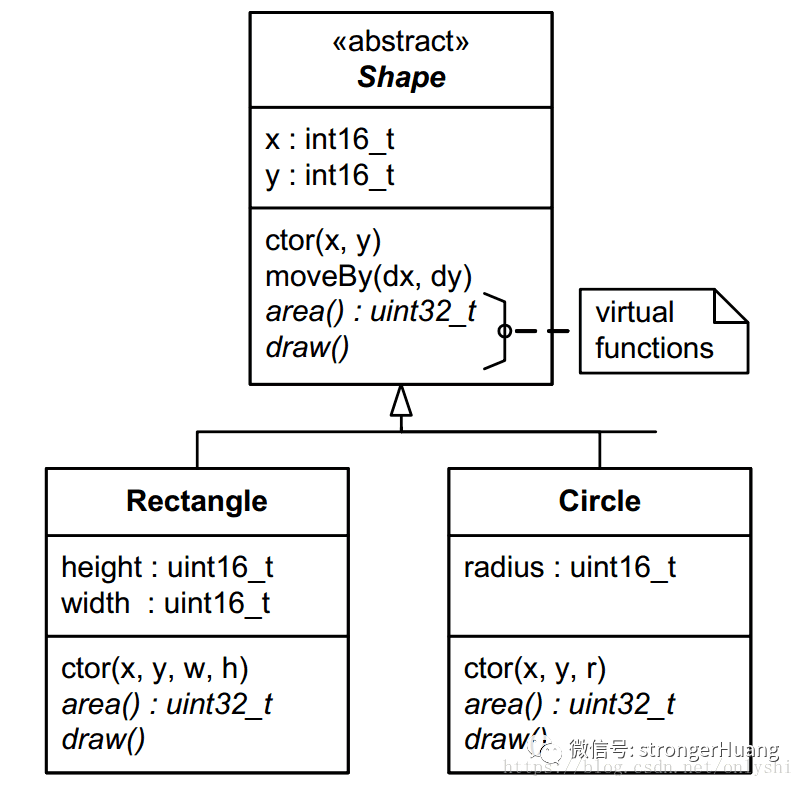
現(xiàn)在,我們又要增加一個(gè)圓形,并且在 Shape 要擴(kuò)展功能,我們要增加 area() 和 draw() 函數(shù)。但是 Shape 相當(dāng)于抽象類,不知道怎么去計(jì)算自己的面積,更不知道怎么去畫出來自己。而且,矩形和圓形的面積計(jì)算方式和幾何圖像也是不一樣的。
下面讓我們重新聲明一下 Shape 類: #ifndef?SHAPE_H
#define?SHAPE_H
#include?
struct?ShapeVtbl;
//?Shape?的屬性
typedef?struct?{
????struct?ShapeVtbl?const?*vptr;
????int16_t?x;?
????int16_t?y;?
}?Shape;
//?Shape?的虛表
struct?ShapeVtbl?{
????uint32_t?(*area)(Shape?const?*?const?me);
????void?(*draw)(Shape?const?*?const?me);
};
//?Shape?的操作函數(shù),接口函數(shù)
void?Shape_ctor(Shape?*?const?me,?int16_t?x,?int16_t?y);
void?Shape_moveBy(Shape?*?const?me,?int16_t?dx,?int16_t?dy);
int16_t?Shape_getX(Shape?const?*?const?me);
int16_t?Shape_getY(Shape?const?*?const?me);
static?inline?uint32_t?Shape_area(Shape?const?*?const?me)?
{
????return?(*me->vptr->area)(me);
}
static?inline?void?Shape_draw(Shape?const?*?const?me)
{
????(*me->vptr->draw)(me);
}
Shape?const?*largestShape(Shape?const?*shapes[],?uint32_t?nShapes);
void?drawAllShapes(Shape?const?*shapes[],?uint32_t?nShapes);
#endif?/*?SHAPE_H?*/
看下加上虛函數(shù)之后的類關(guān)系圖:
5.1 虛表和虛指針
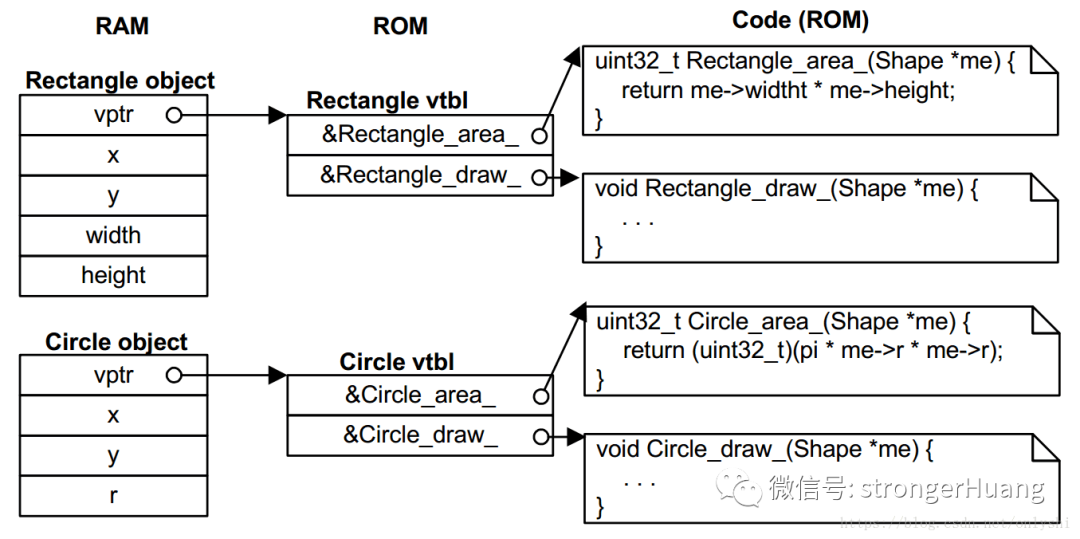
虛表(Virtual Table)是這個(gè)類所有虛函數(shù)的函數(shù)指針的集合。
虛指針(Virtual Pointer)是一個(gè)指向虛表的指針。這個(gè)虛指針必須存在于每個(gè)對象實(shí)例中,會(huì)被所有子類繼承。
在《Inside The C++ Object Model》的第一章內(nèi)容中,有這些介紹。
5.2 在構(gòu)造函數(shù)中設(shè)置vptr
在每一個(gè)對象實(shí)例中,vptr 必須被初始化指向其 vtbl。最好的初始化位置就是在類的構(gòu)造函數(shù)中。事實(shí)上,在構(gòu)造函數(shù)中,C++ 編譯器隱式的創(chuàng)建了一個(gè)初始化的vptr。在 C 語言里面, 我們必須顯示的初始化vptr。
下面就展示一下,在 Shape 的構(gòu)造函數(shù)里面,如何去初始化這個(gè) vptr。
#include?"shape.h"
#include?<assert.h>
//?Shape?的虛函數(shù)
static?uint32_t?Shape_area_(Shape?const?*?const?me);
static?void?Shape_draw_(Shape?const?*?const?me);
//?構(gòu)造函數(shù)
void?Shape_ctor(Shape?*?const?me,?int16_t?x,?int16_t?y)?
{
????//?Shape?類的虛表
????static?struct?ShapeVtbl?const?vtbl?=?
????{?
???????&Shape_area_,
???????&Shape_draw_
????};
????me->vptr?=?&vtbl;?
????me->x?=?x;
????me->y?=?y;
}
void?Shape_moveBy(Shape?*?const?me,?int16_t?dx,?int16_t?dy)
{
????me->x?+=?dx;
????me->y?+=?dy;
}
int16_t?Shape_getX(Shape?const?*?const?me)?
{
????return?me->x;
}
int16_t?Shape_getY(Shape?const?*?const?me)?
{
????return?me->y;
}
//?Shape?類的虛函數(shù)實(shí)現(xiàn)
static?uint32_t?Shape_area_(Shape?const?*?const?me)?
{
????assert(0);?//?類似純虛函數(shù)
????return?0U;?//?避免警告
}
static?void?Shape_draw_(Shape?const?*?const?me)?
{
????assert(0);?//?純虛函數(shù)不能被調(diào)用
}
Shape?const?*largestShape(Shape?const?*shapes[],?uint32_t?nShapes)?
{
????Shape?const?*s?=?(Shape?*)0;
????uint32_t?max?=?0U;
????uint32_t?i;
????for?(i?=?0U;?i?????{
????????uint32_t?area?=?Shape_area(shapes[i]);//?虛函數(shù)調(diào)用
????????if?(area?>?max)?
????????{
????????????max?=?area;
????????????s?=?shapes[i];
????????}
????}
????return?s;
}
void?drawAllShapes(Shape?const?*shapes[],?uint32_t?nShapes)?
{
????uint32_t?i;
????for?(i?=?0U;?i?????{
????????Shape_draw(shapes[i]);?//?虛函數(shù)調(diào)用
????}
}
5.3 繼承 vtbl 和 重載 vptr
上面已經(jīng)提到過,基類包含 vptr,子類會(huì)自動(dòng)繼承。但是,vptr 需要被子類的虛表重新賦值。并且,這也必須發(fā)生在子類的構(gòu)造函數(shù)中。下面是 Rectangle 的構(gòu)造函數(shù)。
#include?"rect.h"??
#include??
//?Rectangle?虛函數(shù)
static?uint32_t?Rectangle_area_(Shape?const?*?const?me);
static?void?Rectangle_draw_(Shape?const?*?const?me);
//?構(gòu)造函數(shù)
void?Rectangle_ctor(Rectangle?*?const?me,?int16_t?x,?int16_t?y,
????????????????????uint16_t?width,?uint16_t?height)
{
????static?struct?ShapeVtbl?const?vtbl?=?
????{
????????&Rectangle_area_,
????????&Rectangle_draw_
????};
????Shape_ctor(&me->super,?x,?y);?//?調(diào)用基類的構(gòu)造函數(shù)
????me->super.vptr?=?&vtbl;???????????//?重載?vptr
????me->width?=?width;
????me->height?=?height;
}
//?Rectangle's?虛函數(shù)實(shí)現(xiàn)
static?uint32_t?Rectangle_area_(Shape?const?*?const?me)?
{
????Rectangle?const?*?const?me_?=?(Rectangle?const?*)me;?//顯示的轉(zhuǎn)換
????return?(uint32_t)me_->width?*?(uint32_t)me_->height;
}
static?void?Rectangle_draw_(Shape?const?*?const?me)?
{
????Rectangle?const?*?const?me_?=?(Rectangle?const?*)me;?//顯示的轉(zhuǎn)換
????printf("Rectangle_draw_(x=%d,y=%d,width=%d,height=%d)\n",
???????????Shape_getX(me),?Shape_getY(me),?me_->width,?me_->height);
}
5.4 虛函數(shù)調(diào)用
有了前面虛表(Virtual Tables)和虛指針(Virtual Pointers)的基礎(chǔ)實(shí)現(xiàn),虛擬調(diào)用(后期綁定)就可以用下面代碼實(shí)現(xiàn)了。
uint32_t?Shape_area(Shape?const?*?const?me)
{
????return?(*me->vptr->area)(me);
}
這個(gè)函數(shù)可以放到.c文件里面,但是會(huì)帶來一個(gè)缺點(diǎn)就是每個(gè)虛擬調(diào)用都有額外的調(diào)用開銷。為了避免這個(gè)缺點(diǎn),如果編譯器支持內(nèi)聯(lián)函數(shù)(C99)。我們可以把定義放到頭文件里面,類似下面:
static?inline?uint32_t?Shape_area(Shape?const?*?const?me)?
{
????return?(*me->vptr->area)(me);
}
如果是老一點(diǎn)的編譯器(C89),我們可以用宏函數(shù)來實(shí)現(xiàn),類似下面這樣:
#define?Shape_area(me_)?((*(me_)->vptr->area)((me_)))
看一下例子中的調(diào)用機(jī)制:
5.5 main.c #include?"rect.h"??
#include?"circle.h"?
#include??
int?main()?
{
????Rectangle?r1,?r2;?
????Circle????c1,?c2;?
????Shape?const?*shapes[]?=?
????{?
????????&c1.super,
????????&r2.super,
????????&c2.super,
????????&r1.super
????};
????Shape?const?*s;
????//?實(shí)例化矩形對象
????Rectangle_ctor(&r1,?0,?2,?10,?15);
????Rectangle_ctor(&r2,?-1,?3,?5,?8);
????//?實(shí)例化圓形對象
????Circle_ctor(&c1,?1,?-2,?12);
????Circle_ctor(&c2,?1,?-3,?6);
????s?=?largestShape(shapes,?sizeof(shapes)/sizeof(shapes[0]));
????printf("largetsShape?s(x=%d,y=%d)\n",?Shape_getX(s),?Shape_getY(s));
????drawAllShapes(shapes,?sizeof(shapes)/sizeof(shapes[0]));
????return?0;
}
輸出結(jié)果:
largetsShape?s(x=1,y=-2)
Circle_draw_(x=1,y=-2,rad=12)
Rectangle_draw_(x=-1,y=3,width=5,height=8)
Circle_draw_(x=1,y=-3,rad=6)
Rectangle_draw_(x=0,y=2,width=10,height=15)
6、總結(jié)? ?
還是那句話,面向?qū)ο缶幊淌且环N方法,并不局限于某一種編程語言。用 C 語言實(shí)現(xiàn)封裝、單繼承,理解和實(shí)現(xiàn)起來比較簡單,多態(tài)反而會(huì)稍微復(fù)雜一點(diǎn),如果打算廣泛的使用多態(tài),還是推薦轉(zhuǎn)到 C++ 語言上,畢竟這層復(fù)雜性被這個(gè)語言給封裝了,你只需要簡單的使用就行了。但并不代表,C 語言實(shí)現(xiàn)不了多態(tài)這個(gè)特性。
原文地址:https://blog.csdn.net/onlyshi/article/details/81672279
文章來源:嵌入式情報(bào)局,strongerhuang
版權(quán)申明:內(nèi)容來源網(wǎng)絡(luò),版權(quán)歸原創(chuàng)者所有。除非無法確認(rèn),都會(huì)標(biāo)明作者及出處,如有侵權(quán),煩請告知,我們會(huì)立即刪除并致歉!
瀏覽
77
不知道有多少人去了解過語言的發(fā)展史,早期C語言的語法功能其實(shí)比較簡單。隨著應(yīng)用需求和場景的變化,C語言的語法功能在不斷升級(jí)變化。
雖然我們的教材有這么一個(gè)結(jié)論:C語言是面向過程的語言,C++是面向?qū)ο?/strong>的編程語言,但面向?qū)ο蟮母拍钍窃贑語言階段就有了,而且應(yīng)用到了很多地方,比如某些操作系統(tǒng)內(nèi)核、通信協(xié)議等。
面向?qū)ο缶幊蹋簿褪谴蠹艺f的OOP(Object Oriented Programming)并不是一種特定的語言或者工具,它只是一種設(shè)計(jì)方法、設(shè)計(jì)思想,它表現(xiàn)出來的三個(gè)最基本的特性就是封裝、繼承與多態(tài)。
1、為什么用C實(shí)現(xiàn)OOP? ?
閱讀文本之前肯定有讀者會(huì)問這樣的問題:我們有C++面向?qū)ο蟮恼Z言,為什么還要用C語言實(shí)現(xiàn)面向?qū)ο竽兀?/span>
C語言這種非面向?qū)ο蟮恼Z言,同樣也可以使用面向?qū)ο蟮乃悸穪砭帉懗绦虻摹?/span>
只是用面向?qū)ο蟮?strong style="margin: 0px;padding: 0px;max-width: 100%;overflow-wrap: break-word !important;box-sizing: border-box !important;visibility: visible;">C++語言來實(shí)現(xiàn)面向?qū)ο缶幊虝?huì)更簡單一些,但是C語言的高效性是其他面向?qū)ο缶幊陶Z言無法比擬的。
當(dāng)然使用C語言來實(shí)現(xiàn)面向?qū)ο蟮拈_發(fā)相對不容易理解,這就是為什么大多數(shù)人學(xué)過C語言卻看不懂Linux內(nèi)核源碼。
所以這個(gè)問題其實(shí)很好理解,只要有一定C語言編程經(jīng)驗(yàn)的讀者都應(yīng)該能明白:面向過程的C語言和面向?qū)ο蟮腃++語言相比,代碼運(yùn)行效率、代碼量都有很大差異。在性能不是很好、資源不是很多的MCU中使用C語言面向?qū)ο缶幊叹惋@得尤為重要。
2、所具備的條件? ?
要想使用C語言實(shí)現(xiàn)面向?qū)ο螅紫刃枰邆湟恍┗A(chǔ)知識(shí)。比如:(C語言中的)結(jié)構(gòu)體、函數(shù)、指針,以及函數(shù)指針等,(C++中的)基類、派生、多態(tài)、繼承等。
首先,不僅僅是了解這些基礎(chǔ)知識(shí),而是有一定的編程經(jīng)驗(yàn),因?yàn)樯厦嬲f了“面向?qū)ο笫且环N設(shè)計(jì)方法、設(shè)計(jì)思想”,如果只是停留在字面意思的理解,沒有這種設(shè)計(jì)思想肯定不行。
因此,不建議初學(xué)者使用C語言實(shí)現(xiàn)面向?qū)ο螅貏e是在真正項(xiàng)目中。建議把基本功練好,再使用。
利用C語言實(shí)現(xiàn)面向?qū)ο蟮姆椒ê芏啵旅婢蛠砻枋鲎罨镜姆庋b、繼承和多態(tài)。
3、封裝??
封裝就是把數(shù)據(jù)和函數(shù)打包到一個(gè)類里面,其實(shí)大部分C語言編程者都已近接觸過了。
C 標(biāo)準(zhǔn)庫中的 fopen(), fclose(), fread(), fwrite()等函數(shù)的操作對象就是 FILE。數(shù)據(jù)內(nèi)容就是 FILE,數(shù)據(jù)的讀寫操作就是 fread()、fwrite(),fopen() 類比于構(gòu)造函數(shù),fclose() 就是析構(gòu)函數(shù)。
這個(gè)看起來似乎很好理解,那下面我們實(shí)現(xiàn)一下基本的封裝特性。
#ifndef?SHAPE_H
#define?SHAPE_H
#include?
//?Shape?的屬性
typedef?struct?{
????int16_t?x;?
????int16_t?y;?
}?Shape;
//?Shape?的操作函數(shù),接口函數(shù)
void?Shape_ctor(Shape?*?const?me,?int16_t?x,?int16_t?y);
void?Shape_moveBy(Shape?*?const?me,?int16_t?dx,?int16_t?dy);
int16_t?Shape_getX(Shape?const?*?const?me);
int16_t?Shape_getY(Shape?const?*?const?me);
#endif?/*?SHAPE_H?*/這是 Shape 類的聲明,非常簡單,很好理解。一般會(huì)把聲明放到頭文件里面 “Shape.h”。來看下 Shape 類相關(guān)的定義,當(dāng)然是在 “Shape.c” 里面。
#include?"shape.h"
//?構(gòu)造函數(shù)
void?Shape_ctor(Shape?*?const?me,?int16_t?x,?int16_t?y)
{
????me->x?=?x;
????me->y?=?y;
}
void?Shape_moveBy(Shape?*?const?me,?int16_t?dx,?int16_t?dy)?
{
????me->x?+=?dx;
????me->y?+=?dy;
}
//?獲取屬性值函數(shù)
int16_t?Shape_getX(Shape?const?*?const?me)?
{
????return?me->x;
}
int16_t?Shape_getY(Shape?const?*?const?me)?
{
????return?me->y;
}#include?"shape.h"??/*?Shape?class?interface?*/
#include???/*?for?printf()?*/
int?main()?
{
????Shape?s1,?s2;?/*?multiple?instances?of?Shape?*/
????Shape_ctor(&s1,?0,?1);
????Shape_ctor(&s2,?-1,?2);
????printf("Shape?s1(x=%d,y=%d)\n",?Shape_getX(&s1),?Shape_getY(&s1));
????printf("Shape?s2(x=%d,y=%d)\n",?Shape_getX(&s2),?Shape_getY(&s2));
????Shape_moveBy(&s1,?2,?-4);
????Shape_moveBy(&s2,?1,?-2);
????printf("Shape?s1(x=%d,y=%d)\n",?Shape_getX(&s1),?Shape_getY(&s1));
????printf("Shape?s2(x=%d,y=%d)\n",?Shape_getX(&s2),?Shape_getY(&s2));
????return?0;
} 編譯之后,看看執(zhí)行結(jié)果:
Shape?s1(x=0,y=1)
Shape?s2(x=-1,y=2)
Shape?s1(x=2,y=-3)
Shape?s2(x=0,y=0)整個(gè)例子,非常簡單,非常好理解。以后寫代碼時(shí)候,要多去想想標(biāo)準(zhǔn)庫的文件IO操作,這樣也有意識(shí)的去培養(yǎng)面向?qū)ο缶幊痰乃季S。
4、繼承??
#ifndef?RECT_H
#define?RECT_H
#include?"shape.h"?//?基類接口
//?矩形的屬性
typedef?struct?{
????Shape?super;?//?繼承?Shape
????//?自己的屬性
????uint16_t?width;
????uint16_t?height;
}?Rectangle;
//?構(gòu)造函數(shù)
void?Rectangle_ctor(Rectangle?*?const?me,?int16_t?x,?int16_t?y,
????????????????????uint16_t?width,?uint16_t?height);
#endif?/*?RECT_H?*/#include?"rect.h"
//?構(gòu)造函數(shù)
void?Rectangle_ctor(Rectangle?*?const?me,?int16_t?x,?int16_t?y,
????????????????????uint16_t?width,?uint16_t?height)
{
????/*?first?call?superclass’?ctor?*/
????Shape_ctor(&me->super,?x,?y);
????/*?next,?you?initialize?the?attributes?added?by?this?subclass...?*/
????me->width?=?width;
????me->height?=?height;
}我們來看一下 Rectangle 的繼承關(guān)系和內(nèi)存布局:
因?yàn)橛羞@樣的內(nèi)存布局,所以你可以很安全的傳一個(gè)指向 Rectangle 對象的指針到一個(gè)期望傳入 Shape 對象的指針的函數(shù)中,就是一個(gè)函數(shù)的參數(shù)是 “Shape *”,你可以傳入 “Rectangle *”,并且這是非常安全的。這樣的話,基類的所有屬性和方法都可以被繼承類繼承!
#include?"rect.h"??
#include??
int?main()?
{
????Rectangle?r1,?r2;
????//?實(shí)例化對象
????Rectangle_ctor(&r1,?0,?2,?10,?15);
????Rectangle_ctor(&r2,?-1,?3,?5,?8);
????printf("Rect?r1(x=%d,y=%d,width=%d,height=%d)\n",
???????????Shape_getX(&r1.super),?Shape_getY(&r1.super),
???????????r1.width,?r1.height);
????printf("Rect?r2(x=%d,y=%d,width=%d,height=%d)\n",
???????????Shape_getX(&r2.super),?Shape_getY(&r2.super),
???????????r2.width,?r2.height);
????//?注意,這里有兩種方式,一是強(qiáng)轉(zhuǎn)類型,二是直接使用成員地址
????Shape_moveBy((Shape?*)&r1,?-2,?3);
????Shape_moveBy(&r2.super,?2,?-1);
????printf("Rect?r1(x=%d,y=%d,width=%d,height=%d)\n",
???????????Shape_getX(&r1.super),?Shape_getY(&r1.super),
???????????r1.width,?r1.height);
????printf("Rect?r2(x=%d,y=%d,width=%d,height=%d)\n",
???????????Shape_getX(&r2.super),?Shape_getY(&r2.super),
???????????r2.width,?r2.height);
????return?0;
} Rect?r1(x=0,y=2,width=10,height=15)
Rect?r2(x=-1,y=3,width=5,height=8)
Rect?r1(x=-2,y=5,width=10,height=15)
Rect?r2(x=1,y=2,width=5,height=8)5、多態(tài)? ?
#ifndef?SHAPE_H
#define?SHAPE_H
#include?
struct?ShapeVtbl;
//?Shape?的屬性
typedef?struct?{
????struct?ShapeVtbl?const?*vptr;
????int16_t?x;?
????int16_t?y;?
}?Shape;
//?Shape?的虛表
struct?ShapeVtbl?{
????uint32_t?(*area)(Shape?const?*?const?me);
????void?(*draw)(Shape?const?*?const?me);
};
//?Shape?的操作函數(shù),接口函數(shù)
void?Shape_ctor(Shape?*?const?me,?int16_t?x,?int16_t?y);
void?Shape_moveBy(Shape?*?const?me,?int16_t?dx,?int16_t?dy);
int16_t?Shape_getX(Shape?const?*?const?me);
int16_t?Shape_getY(Shape?const?*?const?me);
static?inline?uint32_t?Shape_area(Shape?const?*?const?me)?
{
????return?(*me->vptr->area)(me);
}
static?inline?void?Shape_draw(Shape?const?*?const?me)
{
????(*me->vptr->draw)(me);
}
Shape?const?*largestShape(Shape?const?*shapes[],?uint32_t?nShapes);
void?drawAllShapes(Shape?const?*shapes[],?uint32_t?nShapes);
#endif?/*?SHAPE_H?*/
看下加上虛函數(shù)之后的類關(guān)系圖:
5.1 虛表和虛指針
虛表(Virtual Table)是這個(gè)類所有虛函數(shù)的函數(shù)指針的集合。
虛指針(Virtual Pointer)是一個(gè)指向虛表的指針。這個(gè)虛指針必須存在于每個(gè)對象實(shí)例中,會(huì)被所有子類繼承。
在《Inside The C++ Object Model》的第一章內(nèi)容中,有這些介紹。
5.2 在構(gòu)造函數(shù)中設(shè)置vptr
在每一個(gè)對象實(shí)例中,vptr 必須被初始化指向其 vtbl。最好的初始化位置就是在類的構(gòu)造函數(shù)中。事實(shí)上,在構(gòu)造函數(shù)中,C++ 編譯器隱式的創(chuàng)建了一個(gè)初始化的vptr。在 C 語言里面, 我們必須顯示的初始化vptr。
下面就展示一下,在 Shape 的構(gòu)造函數(shù)里面,如何去初始化這個(gè) vptr。
#include?"shape.h"
#include?<assert.h>
//?Shape?的虛函數(shù)
static?uint32_t?Shape_area_(Shape?const?*?const?me);
static?void?Shape_draw_(Shape?const?*?const?me);
//?構(gòu)造函數(shù)
void?Shape_ctor(Shape?*?const?me,?int16_t?x,?int16_t?y)?
{
????//?Shape?類的虛表
????static?struct?ShapeVtbl?const?vtbl?=?
????{?
???????&Shape_area_,
???????&Shape_draw_
????};
????me->vptr?=?&vtbl;?
????me->x?=?x;
????me->y?=?y;
}
void?Shape_moveBy(Shape?*?const?me,?int16_t?dx,?int16_t?dy)
{
????me->x?+=?dx;
????me->y?+=?dy;
}
int16_t?Shape_getX(Shape?const?*?const?me)?
{
????return?me->x;
}
int16_t?Shape_getY(Shape?const?*?const?me)?
{
????return?me->y;
}
//?Shape?類的虛函數(shù)實(shí)現(xiàn)
static?uint32_t?Shape_area_(Shape?const?*?const?me)?
{
????assert(0);?//?類似純虛函數(shù)
????return?0U;?//?避免警告
}
static?void?Shape_draw_(Shape?const?*?const?me)?
{
????assert(0);?//?純虛函數(shù)不能被調(diào)用
}
Shape?const?*largestShape(Shape?const?*shapes[],?uint32_t?nShapes)?
{
????Shape?const?*s?=?(Shape?*)0;
????uint32_t?max?=?0U;
????uint32_t?i;
????for?(i?=?0U;?i?????{
????????uint32_t?area?=?Shape_area(shapes[i]);//?虛函數(shù)調(diào)用
????????if?(area?>?max)?
????????{
????????????max?=?area;
????????????s?=?shapes[i];
????????}
????}
????return?s;
}
void?drawAllShapes(Shape?const?*shapes[],?uint32_t?nShapes)?
{
????uint32_t?i;
????for?(i?=?0U;?i?????{
????????Shape_draw(shapes[i]);?//?虛函數(shù)調(diào)用
????}
}
5.3 繼承 vtbl 和 重載 vptr
上面已經(jīng)提到過,基類包含 vptr,子類會(huì)自動(dòng)繼承。但是,vptr 需要被子類的虛表重新賦值。并且,這也必須發(fā)生在子類的構(gòu)造函數(shù)中。下面是 Rectangle 的構(gòu)造函數(shù)。
#include?"rect.h"??
#include??
//?Rectangle?虛函數(shù)
static?uint32_t?Rectangle_area_(Shape?const?*?const?me);
static?void?Rectangle_draw_(Shape?const?*?const?me);
//?構(gòu)造函數(shù)
void?Rectangle_ctor(Rectangle?*?const?me,?int16_t?x,?int16_t?y,
????????????????????uint16_t?width,?uint16_t?height)
{
????static?struct?ShapeVtbl?const?vtbl?=?
????{
????????&Rectangle_area_,
????????&Rectangle_draw_
????};
????Shape_ctor(&me->super,?x,?y);?//?調(diào)用基類的構(gòu)造函數(shù)
????me->super.vptr?=?&vtbl;???????????//?重載?vptr
????me->width?=?width;
????me->height?=?height;
}
//?Rectangle's?虛函數(shù)實(shí)現(xiàn)
static?uint32_t?Rectangle_area_(Shape?const?*?const?me)?
{
????Rectangle?const?*?const?me_?=?(Rectangle?const?*)me;?//顯示的轉(zhuǎn)換
????return?(uint32_t)me_->width?*?(uint32_t)me_->height;
}
static?void?Rectangle_draw_(Shape?const?*?const?me)?
{
????Rectangle?const?*?const?me_?=?(Rectangle?const?*)me;?//顯示的轉(zhuǎn)換
????printf("Rectangle_draw_(x=%d,y=%d,width=%d,height=%d)\n",
???????????Shape_getX(me),?Shape_getY(me),?me_->width,?me_->height);
}
5.4 虛函數(shù)調(diào)用
有了前面虛表(Virtual Tables)和虛指針(Virtual Pointers)的基礎(chǔ)實(shí)現(xiàn),虛擬調(diào)用(后期綁定)就可以用下面代碼實(shí)現(xiàn)了。
uint32_t?Shape_area(Shape?const?*?const?me)
{
????return?(*me->vptr->area)(me);
}
這個(gè)函數(shù)可以放到.c文件里面,但是會(huì)帶來一個(gè)缺點(diǎn)就是每個(gè)虛擬調(diào)用都有額外的調(diào)用開銷。為了避免這個(gè)缺點(diǎn),如果編譯器支持內(nèi)聯(lián)函數(shù)(C99)。我們可以把定義放到頭文件里面,類似下面:
static?inline?uint32_t?Shape_area(Shape?const?*?const?me)?
{
????return?(*me->vptr->area)(me);
}
如果是老一點(diǎn)的編譯器(C89),我們可以用宏函數(shù)來實(shí)現(xiàn),類似下面這樣:
#define?Shape_area(me_)?((*(me_)->vptr->area)((me_)))看一下例子中的調(diào)用機(jī)制:
#include?"rect.h"??
#include?"circle.h"?
#include??
int?main()?
{
????Rectangle?r1,?r2;?
????Circle????c1,?c2;?
????Shape?const?*shapes[]?=?
????{?
????????&c1.super,
????????&r2.super,
????????&c2.super,
????????&r1.super
????};
????Shape?const?*s;
????//?實(shí)例化矩形對象
????Rectangle_ctor(&r1,?0,?2,?10,?15);
????Rectangle_ctor(&r2,?-1,?3,?5,?8);
????//?實(shí)例化圓形對象
????Circle_ctor(&c1,?1,?-2,?12);
????Circle_ctor(&c2,?1,?-3,?6);
????s?=?largestShape(shapes,?sizeof(shapes)/sizeof(shapes[0]));
????printf("largetsShape?s(x=%d,y=%d)\n",?Shape_getX(s),?Shape_getY(s));
????drawAllShapes(shapes,?sizeof(shapes)/sizeof(shapes[0]));
????return?0;
}
輸出結(jié)果:
largetsShape?s(x=1,y=-2)
Circle_draw_(x=1,y=-2,rad=12)
Rectangle_draw_(x=-1,y=3,width=5,height=8)
Circle_draw_(x=1,y=-3,rad=6)
Rectangle_draw_(x=0,y=2,width=10,height=15)
6、總結(jié)? ?
原文地址:https://blog.csdn.net/onlyshi/article/details/81672279
文章來源:嵌入式情報(bào)局,strongerhuang
版權(quán)申明:內(nèi)容來源網(wǎng)絡(luò),版權(quán)歸原創(chuàng)者所有。除非無法確認(rèn),都會(huì)標(biāo)明作者及出處,如有侵權(quán),煩請告知,我們會(huì)立即刪除并致歉!