
Go實(shí)現(xiàn)海量日志收集系統(tǒng)


再次整理了一下這個(gè)日志收集系統(tǒng)的框,如下圖
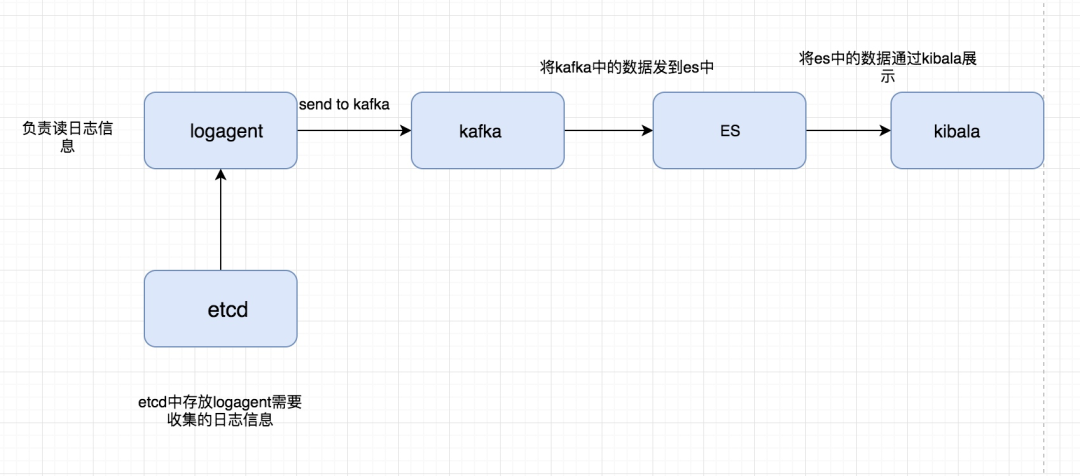 這次要實(shí)現(xiàn)的代碼的整體邏輯為:
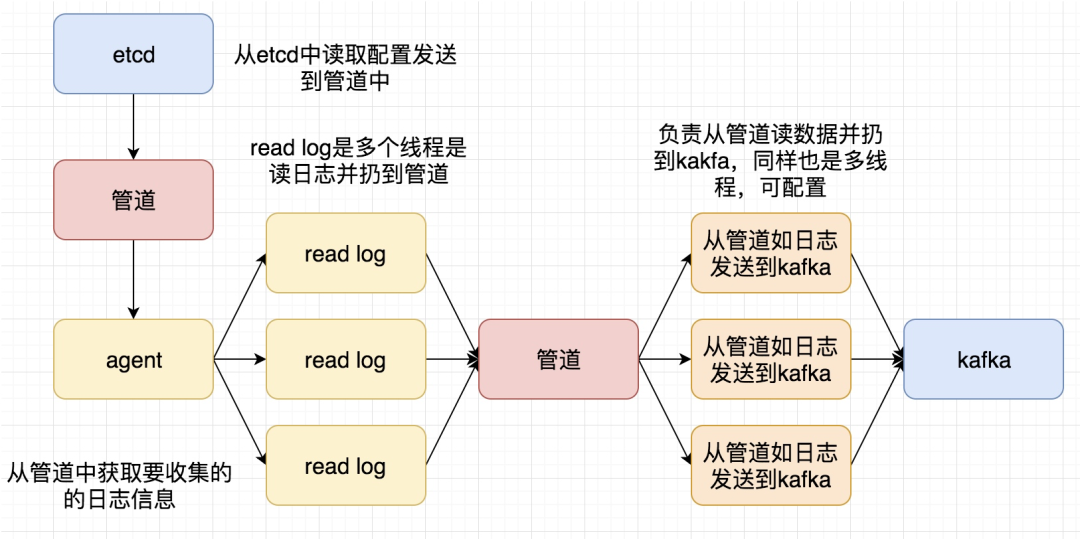
完整代碼地址為: https://github.com/pythonsite/logagent
etcd介紹
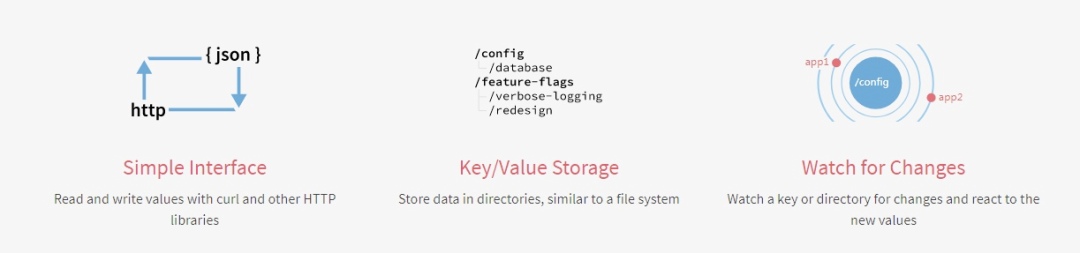
高可用的分布式key-value存儲(chǔ),可以用于配置共享和服務(wù)發(fā)現(xiàn)
類似的項(xiàng)目:zookeeper和consul
開(kāi)發(fā)語(yǔ)言:go
接口:提供restful的接口,使用簡(jiǎn)單
實(shí)現(xiàn)算法:基于raft算法的強(qiáng)一致性,高可用的服務(wù)存儲(chǔ)目錄
etcd的應(yīng)用場(chǎng)景:
服務(wù)發(fā)現(xiàn)和服務(wù)注冊(cè)
配置中心(我們實(shí)現(xiàn)的日志收集客戶端需要用到)
分布式鎖
master選舉
官網(wǎng)對(duì)etcd的有一個(gè)非常簡(jiǎn)明的介紹:
etcd搭建:
下載地址:https://github.com/coreos/etcd/releases/
根據(jù)自己的環(huán)境下載對(duì)應(yīng)的版本然后啟動(dòng)起來(lái)就可以了
啟動(dòng)之后可以通過(guò)如下命令驗(yàn)證一下:
[root@localhost etcd-v3.2.18-linux-amd64]# ./etcdctl set name zhaofan

zhaofan
[root@localhost etcd-v3.2.18-linux-amd64]# ./etcdctl get name
zhaofan
[root@localhost etcd-v3.2.18-linux-amd64]#
context 介紹和使用
其實(shí)這個(gè)東西翻譯過(guò)來(lái)就是上下文管理,那么context的作用是做什么,主要有如下兩個(gè)作用:
控制goroutine的超時(shí)
保存上下文數(shù)據(jù)
通過(guò)下面一個(gè)簡(jiǎn)單的例子進(jìn)行理解:
package main

import (
    "fmt"
    "time"
    "net/http"
    "context"
    "io/ioutil"
)


type Result struct{
    r *http.Response
    err error
}

func process(){
    ctx,cancel := context.WithTimeout(context.Background(),2*time.Second)
    defer cancel()
    tr := &http.Transport{}
    client := &http.Client{Transport:tr}
    c := make(chan Result,1)
    req,err := http.NewRequest("GET","http://www.google.com",nil)
    if err != nil{
        fmt.Println("http request failed,err:",err)
        return
    }
    // 如果請(qǐng)求成功了會(huì)將數(shù)據(jù)存入到管道中
    go func(){
        resp,err := client.Do(req)
        pack := Result{resp,err}
        c <- pack
    }()

    select{
    case <- ctx.Done():
        tr.CancelRequest(req)
        fmt.Println("timeout!")
    case res := <-c:
        defer res.r.Body.Close()
        out,_:= ioutil.ReadAll(res.r.Body)
        fmt.Printf("server response:%s",out)
    }
    return

}

func main() {
    process()
}
寫一個(gè)通過(guò)context保存上下文,代碼例子如:
package main

import (
    "github.com/Go-zh/net/context"
    "fmt"
)

func add(ctx context.Context,a,b int) int {
    traceId := ctx.Value("trace_id").(string)
    fmt.Printf("trace_id:%v\n",traceId)
    return a+b
}

func calc(ctx context.Context,a, b int) int{
    traceId := ctx.Value("trace_id").(string)
    fmt.Printf("trace_id:%v\n",traceId)
    //再將ctx傳入到add中
    return add(ctx,a,b)
}

func main() {
    //將ctx傳遞到calc中
    ctx := context.WithValue(context.Background(),"trace_id","123456")
    calc(ctx,20,30)

}
結(jié)合etcd和context使用
關(guān)于通過(guò)go連接etcd的簡(jiǎn)單例子:(這里有個(gè)小問(wèn)題需要注意就是etcd的啟動(dòng)方式,默認(rèn)啟動(dòng)可能會(huì)連接不上,尤其你是在虛擬你安裝,所以需要通過(guò)如下命令啟動(dòng):
./etcd --listen-client-urls http://0.0.0.0:2371 --advertise-client-urls http://0.0.0.0:2371 --listen-peer-urls http://0.0.0.0:2381
)
package main

import (
    etcd_client "github.com/coreos/etcd/clientv3"
    "time"
    "fmt"
)

func main() {
    cli, err := etcd_client.New(etcd_client.Config{
        Endpoints:[]string{"192.168.0.118:2371"},
        DialTimeout:5*time.Second,
    })
    if err != nil{
        fmt.Println("connect failed,err:",err)
        return
    }

    fmt.Println("connect success")
    defer cli.Close()
}
下面一個(gè)例子是通過(guò)連接etcd,存值并取值
package main

import (
    "github.com/coreos/etcd/clientv3"
    "time"
    "fmt"
    "context"
)

func main() {
    cli,err := clientv3.New(clientv3.Config{
        Endpoints:[]string{"192.168.0.118:2371"},
        DialTimeout:5*time.Second,
    })
    if err != nil{
        fmt.Println("connect failed,err:",err)
        return
    }
    fmt.Println("connect succ")
    defer cli.Close()
    ctx,cancel := context.WithTimeout(context.Background(),time.Second)
    _,err = cli.Put(ctx,"logagent/conf/","sample_value")
    cancel()
    if err != nil{
        fmt.Println("put failed,err",err)
        return
    }
    ctx, cancel = context.WithTimeout(context.Background(),time.Second)
    resp,err := cli.Get(ctx,"logagent/conf/")
    cancel()
    if err != nil{
        fmt.Println("get failed,err:",err)
        return
    }
    for _,ev := range resp.Kvs{
        fmt.Printf("%s:%s\n",ev.Key,ev.Value)
    }
}
關(guān)于context官網(wǎng)也有一個(gè)例子非常有用,用于控制開(kāi)啟的goroutine的退出,代碼如下:
package main

import (
    "context"
    "fmt"
)

func main() {
    // gen generates integers in a separate goroutine and
    // sends them to the returned channel.
    // The callers of gen need to cancel the context once
    // they are done consuming generated integers not to leak
    // the internal goroutine started by gen.
    gen := func(ctx context.Context) <-chan int {
        dst := make(chan int)
        n := 1
        go func() {
            for {
                select {
                case <-ctx.Done():
                    return // returning not to leak the goroutine
                case dst <- n:
                    n++
                }
            }
        }()
        return dst
    }

    ctx, cancel := context.WithCancel(context.Background())
    defer cancel() // cancel when we are finished consuming integers

    for n := range gen(ctx) {
        fmt.Println(n)
        if n == 5 {
            break
        }
    }
}
關(guān)于官網(wǎng)文檔中的WithDeadline演示的代碼例子:
package main


import (
    "context"
    "fmt"
    "time"
)

func main() {
    d := time.Now().Add(50 * time.Millisecond)
    ctx, cancel := context.WithDeadline(context.Background(), d)

    // Even though ctx will be expired, it is good practice to call its
    // cancelation function in any case. Failure to do so may keep the
    // context and its parent alive longer than necessary.
    defer cancel()

    select {
    case <-time.After(1 * time.Second):
        fmt.Println("overslept")
    case <-ctx.Done():
        fmt.Println(ctx.Err())
    }

}
通過(guò)上面的代碼有了一個(gè)基本的使用,那么如果我們通過(guò)etcd來(lái)做配置管理,如果配置更改之后,我們?nèi)绾瓮ㄖ獙?duì)應(yīng)的服務(wù)器配置更改,通過(guò)下面例子演示:
package main

import (
    "github.com/coreos/etcd/clientv3"
    "time"
    "fmt"
    "context"
)

func main() {
    cli,err := clientv3.New(clientv3.Config{
        Endpoints:[]string{"192.168.0.118:2371"},
        DialTimeout:5*time.Second,
    })
    if err != nil {
        fmt.Println("connect failed,err:",err)
        return
    }
    defer cli.Close()
    // 這里會(huì)阻塞
    rch := cli.Watch(context.Background(),"logagent/conf/")
    for wresp := range rch{
        for _,ev := range wresp.Events{
            fmt.Printf("%s %q : %q\n", ev.Type, ev.Kv.Key, ev.Kv.Value)
        }
    }
}
實(shí)現(xiàn)一個(gè)kafka的消費(fèi)者代碼的簡(jiǎn)單例子:
package main

import (
    "github.com/Shopify/sarama"
    "strings"
    "fmt"
    "time"
)

func main() {
    consumer,err := sarama.NewConsumer(strings.Split("192.168.0.118:9092",","),nil)
    if err != nil{
        fmt.Println("failed to start consumer:",err)
        return
    }
    partitionList,err := consumer.Partitions("nginx_log")
    if err != nil {
        fmt.Println("Failed to get the list of partitions:",err)
        return
    }
    fmt.Println(partitionList)
    for partition := range partitionList{
        pc,err := consumer.ConsumePartition("nginx_log",int32(partition),sarama.OffsetNewest)
        if err != nil {
            fmt.Printf("failed to start consumer for partition %d:%s\n",partition,err)
            return
        }
        defer pc.AsyncClose()
        go func(partitionConsumer sarama.PartitionConsumer){
            for msg := range pc.Messages(){
                fmt.Printf("partition:%d Offset:%d Key:%s Value:%s",msg.Partition,msg.Offset,string(msg.Key),string(msg.Value))
            }
        }(pc)
    }
    time.Sleep(time.Hour)
    consumer.Close()

}
但是上面的代碼并不是最佳代碼,因?yàn)槲覀冏詈笫峭ㄟ^(guò)time.sleep等待goroutine的執(zhí)行,我們可以更改為通過(guò)sync.WaitGroup方式實(shí)現(xiàn)
package main

import (
    "github.com/Shopify/sarama"
    "strings"
    "fmt"
    "sync"
)

var (
    wg sync.WaitGroup
)

func main() {
    consumer,err := sarama.NewConsumer(strings.Split("192.168.0.118:9092",","),nil)
    if err != nil{
        fmt.Println("failed to start consumer:",err)
        return
    }
    partitionList,err := consumer.Partitions("nginx_log")
    if err != nil {
        fmt.Println("Failed to get the list of partitions:",err)
        return
    }
    fmt.Println(partitionList)
    for partition := range partitionList{
        pc,err := consumer.ConsumePartition("nginx_log",int32(partition),sarama.OffsetNewest)
        if err != nil {
            fmt.Printf("failed to start consumer for partition %d:%s\n",partition,err)
            return
        }
        defer pc.AsyncClose()
        go func(partitionConsumer sarama.PartitionConsumer){
            wg.Add(1)
            for msg := range partitionConsumer.Messages(){
                fmt.Printf("partition:%d Offset:%d Key:%s Value:%s",msg.Partition,msg.Offset,string(msg.Key),string(msg.Value))
            }
            wg.Done()
        }(pc)
    }

    //time.Sleep(time.Hour)
    wg.Wait()
    consumer.Close()

}
將客戶端需要收集的日志信息放到etcd中
關(guān)于etcd處理的代碼為:
package main

import (
    "github.com/coreos/etcd/clientv3"
    "time"
    "github.com/astaxie/beego/logs"
    "context"
    "fmt"
)

var Client *clientv3.Client
var logConfChan chan string


// 初始化etcd
func initEtcd(addr []string,keyfmt string,timeout time.Duration)(err error){

    var keys []string
    for _,ip := range ipArrays{
        //keyfmt = /logagent/%s/log_config
        keys = append(keys,fmt.Sprintf(keyfmt,ip))
    }

    logConfChan = make(chan string,10)
    logs.Debug("etcd watch key:%v timeout:%v", keys, timeout)

    Client,err = clientv3.New(clientv3.Config{
        Endpoints:addr,
        DialTimeout: timeout,
    })
    if err != nil{
        logs.Error("connect failed,err:%v",err)
        return
    }
    logs.Debug("init etcd success")
    waitGroup.Add(1)
    for _, key := range keys{
        ctx,cancel := context.WithTimeout(context.Background(),2*time.Second)
        // 從etcd中獲取要收集日志的信息
        resp,err := Client.Get(ctx,key)
        cancel()
        if err != nil {
            logs.Warn("get key %s failed,err:%v",key,err)
            continue
        }

        for _, ev := range resp.Kvs{
            logs.Debug("%q : %q\n",  ev.Key, ev.Value)
            logConfChan <- string(ev.Value)
        }
    }
    go WatchEtcd(keys)
    return
}

func WatchEtcd(keys []string){
    // 這里用于檢測(cè)當(dāng)需要收集的日志信息更改時(shí)及時(shí)更新
    var watchChans []clientv3.WatchChan
    for _,key := range keys{
        rch := Client.Watch(context.Background(),key)
        watchChans = append(watchChans,rch)
    }

    for {
        for _,watchC := range watchChans{
            select{
            case wresp := <-watchC:
                for _,ev:= range wresp.Events{
                    logs.Debug("%s %q : %q\n", ev.Type, ev.Kv.Key, ev.Kv.Value)
                    logConfChan <- string(ev.Kv.Value)
                }
            default:

            }
        }
        time.Sleep(time.Second)
    }
    waitGroup.Done()
}

func GetLogConf()chan string{
    return logConfChan
}
同樣的這里增加對(duì)了限速的處理,畢竟日志收集程序不能影響了當(dāng)前業(yè)務(wù)的性能,所以增加了limit.go用于限制速度:
package main

import (
    "time"
    "sync/atomic"
    "github.com/astaxie/beego/logs"
)

type SecondLimit struct {
    unixSecond int64
    curCount int32
    limit int32
}

func NewSecondLimit(limit int32) *SecondLimit {
    secLimit := &SecondLimit{
        unixSecond:time.Now().Unix(),
        curCount:0,
        limit:limit,
    }
    return secLimit
}

func (s *SecondLimit) Add(count int) {
    sec := time.Now().Unix()
    if sec == s.unixSecond {
        atomic.AddInt32(&s.curCount,int32(count))
        return
    }
    atomic.StoreInt64(&s.unixSecond,sec)
    atomic.StoreInt32(&s.curCount, int32(count))
}

func (s *SecondLimit) Wait()bool {
    for {
        sec := time.Now().Unix()
        if (sec == atomic.LoadInt64(&s.unixSecond)) && s.curCount == s.limit {
            time.Sleep(time.Microsecond)
            logs.Debug("limit is running,limit:%d s.curCount:%d",s.limit,s.curCount)
            continue
        }

        if sec != atomic.LoadInt64(&s.unixSecond) {
            atomic.StoreInt64(&s.unixSecond,sec)
            atomic.StoreInt32(&s.curCount,0)
        }
        logs.Debug("limit is exited")
        return false
    }
}
小結(jié)
這次基本實(shí)現(xiàn)了日志收集的前半段的處理,后面將把日志扔到es中,并最終在頁(yè)面上呈現(xiàn)
來(lái)源:
https://www.toutiao.com/a6916833750924018179/
文章轉(zhuǎn)載:IT大咖說(shuō)
(版權(quán)歸原作者所有,侵刪)


點(diǎn)擊下方“閱讀原文”查看更多