
【Vue】Vue 3.0 進階之指令探秘
在 Vue 的項目中,我們經(jīng)常會遇到 v-if、v-show、v-for 或 v-model 這些內(nèi)置指令,它們?yōu)槲覀兲峁┝瞬煌墓δ堋3耸褂眠@些內(nèi)置指令之外,Vue 也允許注冊自定義指令。
接下來,阿寶哥將使用 Vue 3 官方文檔 自定義指令 章節(jié)中使用的示例,來一步步揭開自定義指令背后的秘密。
提示:在閱讀本文前,建議您先閱讀 Vue 3 官方文檔 自定義指令 章節(jié)的內(nèi)容。
一、自定義指令
1、注冊全局自定義指令
const?app?=?Vue.createApp({})

//?注冊一個全局自定義指令?v-focus
app.directive('focus',?{
??//?當被綁定的元素掛載到?DOM?中時被調(diào)用
??mounted(el)?{
????//?聚焦元素
????el.focus()
??}
})
2、使用全局自定義指令
<div?id="app">
???<input?v-focus?/>
div>
3、完整的使用示例
<div?id="app">
???<input?v-focus?/>
div>
<script>
???const?{?createApp?}?=?Vue
???
???const?app?=?Vue.createApp({})?//?①
???app.directive('focus',?{?//?②?
?????//?當被綁定的元素掛載到?DOM?中時被調(diào)用
?????mounted(el)?{
???????el.focus()?//?聚焦元素
?????}
???})
???app.mount('#app')?//?③
script>
當頁面加載完成后,頁面中的輸入框元素將自動獲得焦點。該示例的代碼比較簡單,主要包含 3 個步驟:創(chuàng)建 App 對象、注冊全局自定義指令和應(yīng)用掛載。其中創(chuàng)建 App 對象的細節(jié),阿寶哥會在后續(xù)的文章中單獨介紹,下面我們將重點分析其他 2 個步驟。首先我們先來分析注冊全局自定義指令的過程。
二、注冊全局自定義指令的過程
在以上示例中,我們使用 app 對象的 directive 方法來注冊全局自定義指令:
app.directive('focus',?{
??//?當被綁定的元素掛載到?DOM?中時被調(diào)用
??mounted(el)?{
????el.focus()?//?聚焦元素
??}
})
當然,除了注冊全局自定義指令外,我們也可以注冊局部指令,因為組件中也接受一個 directives 的選項:
directives:?{
??focus:?{
????mounted(el)?{
??????el.focus()
????}
??}
}
對于以上示例來說,我們使用的 app.directive 方法被定義在 runtime-core/src/apiCreateApp.ts 文件中:
//?packages/runtime-core/src/apiCreateApp.ts
export?function?createAppAPI<HostElement>(
??render:?RootRenderFunction,
??hydrate?:?RootHydrateFunction
):?CreateAppFunction<HostElement>?{
??return?function?createApp(rootComponent,?rootProps?=?null)?{
????const?context?=?createAppContext()
????let?isMounted?=?false

????const?app:?App?=?(context.app?=?{
??????//?省略部分代碼
??????_context:?context,
??????
??????//?用于注冊或檢索全局指令。
??????directive(name:?string,?directive?:?Directive)?{
????????if?(__DEV__)?{
??????????validateDirectiveName(name)
????????}
????????if?(!directive)?{
??????????return?context.directives[name]?as?any
????????}
????????if?(__DEV__?&&?context.directives[name])?{
??????????warn(`Directive?"${name}"?has?already?been?registered?in?target?app.`)
????????}
????????context.directives[name]?=?directive
????????return?app
??????},

????return?app
??}
}
通過觀察以上代碼,我們可以知道 directive 方法支持以下兩個參數(shù):
name:表示指令的名稱; directive(可選):表示指令的定義。
name 參數(shù)比較簡單,所以我們重點分析 directive 參數(shù),該參數(shù)的類型是 Directive 類型:
//?packages/runtime-core/src/directives.ts
export?type?Directiveany,?V?=?any>?=
??|?ObjectDirective
??|?FunctionDirective
由上可知 Directive 類型屬于聯(lián)合類型,所以我們需要繼續(xù)分析 ObjectDirective 和 FunctionDirective 類型。這里我們先來看一下 ObjectDirective 類型的定義:
//?packages/runtime-core/src/directives.ts
export?interface?ObjectDirective?{
??created?:?DirectiveHooknull,?V>
??beforeMount?:?DirectiveHooknull,?V>
??mounted?:?DirectiveHooknull,?V>
??beforeUpdate?:?DirectiveHookany,?T>,?V>
??updated?:?DirectiveHookany,?T>,?V>
??beforeUnmount?:?DirectiveHooknull,?V>
??unmounted?:?DirectiveHooknull,?V>
??getSSRProps?:?SSRDirectiveHook
}
該類型定義了對象類型的指令,對象上的每個屬性表示指令生命周期上的鉤子。而 FunctionDirective 類型則表示函數(shù)類型的指令:
//?packages/runtime-core/src/directives.ts
export?type?FunctionDirectiveany,?V?=?any>?=?DirectiveHookany,?V>
??????????????????????????????
export?type?DirectiveHookany,?Prev?=?VNode<any,?T>?|?null,?V?=?any>?=?(
??el:?T,
??binding:?DirectiveBinding,
??vnode:?VNode<any,?T>,
??prevVNode:?Prev
)?=>?void??????????????????????????????
介紹完 Directive 類型,我們再回顧一下前面的示例,相信你就會清晰很多:
app.directive('focus',?{
??//?當被綁定的元素掛載到?DOM?中時觸發(fā)
??mounted(el)?{
????el.focus()?//?聚焦元素
??}
})
對于以上示例,當我們調(diào)用 app.directive 方法注冊自定義 focus 指令時,就會執(zhí)行以下邏輯:
directive(name:?string,?directive?:?Directive)?{
??if?(__DEV__)?{?//?避免自定義指令名稱,與已有的內(nèi)置指令名稱沖突
????validateDirectiveName(name)
??}
??if?(!directive)?{?//?獲取name對應(yīng)的指令對象
????return?context.directives[name]?as?any
??}
??if?(__DEV__?&&?context.directives[name])?{
????warn(`Directive?"${name}"?has?already?been?registered?in?target?app.`)
??}
??context.directives[name]?=?directive?//?注冊全局指令
??return?app
}
當 focus 指令注冊成功之后,該指令會被保存在 context 對象的 directives 屬性中,具體如下圖所示:
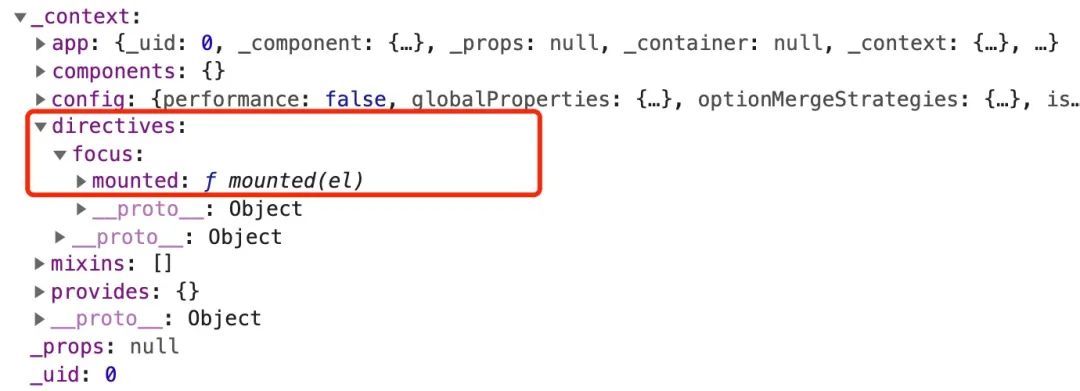
顧名思義 context 是表示應(yīng)用的上下文對象,那么該對象是如何創(chuàng)建的呢?其實,該對象是通過 createAppContext 函數(shù)來創(chuàng)建的:
const?context?=?createAppContext()
而 createAppContext 函數(shù)被定義在 runtime-core/src/apiCreateApp.ts 文件中:
//?packages/runtime-core/src/apiCreateApp.ts
export?function?createAppContext():?AppContext?{
??return?{
????app:?null?as?any,
????config:?{
??????isNativeTag:?NO,
??????performance:?false,
??????globalProperties:?{},
??????optionMergeStrategies:?{},
??????isCustomElement:?NO,
??????errorHandler:?undefined,
??????warnHandler:?undefined
????},
????mixins:?[],
????components:?{},
????directives:?{},
????provides:?Object.create(null)
??}
}
看到這里,是不是覺得注冊全局自定義指令的內(nèi)部處理邏輯其實挺簡單的。那么對于已注冊的 focus 指令,何時會被調(diào)用呢?要回答這個問題,我們就需要分析另一個步驟 —— 應(yīng)用掛載。
三、應(yīng)用掛載的過程
為了更加直觀地了解應(yīng)用掛載的過程,阿寶哥利用 Chrome 開發(fā)者工具,記錄了應(yīng)用掛載的主要過程:
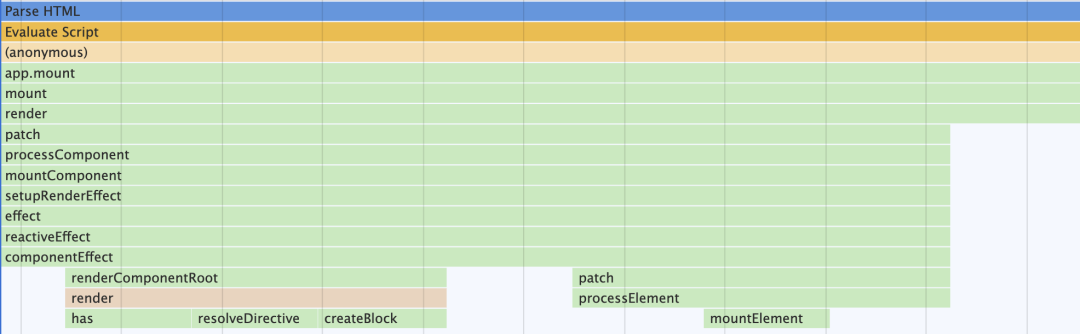
通過上圖,我們就可以知道應(yīng)用掛載期間所經(jīng)歷的主要過程。此外,從圖中我們也發(fā)現(xiàn)了一個與指令相關(guān)的函數(shù) resolveDirective。很明顯,該函數(shù)用于解析指令,且該函數(shù)在 render 方法中會被調(diào)用。在源碼中,我們找到了該函數(shù)的定義:
//?packages/runtime-core/src/helpers/resolveAssets.ts
export?function?resolveDirective(name:?string):?Directive?|?undefined?{
??return?resolveAsset(DIRECTIVES,?name)
}
在 resolveDirective 函數(shù)內(nèi)部,會繼續(xù)調(diào)用 resolveAsset 函數(shù)來執(zhí)行具體的解析操作。在分析 resolveAsset 函數(shù)的具體實現(xiàn)之前,我們在 resolveDirective 函數(shù)內(nèi)部加個斷點,來一睹 render 方法的 “芳容”:

在上圖中,我們看到了與 focus 指令相關(guān)的 _resolveDirective("focus") 函數(shù)調(diào)用。前面我們已經(jīng)知道在 resolveDirective 函數(shù)內(nèi)部會繼續(xù)調(diào)用 resolveAsset 函數(shù),該函數(shù)的具體實現(xiàn)如下:
//?packages/runtime-core/src/helpers/resolveAssets.ts
function?resolveAsset(
??type:?typeof?COMPONENTS?|?typeof?DIRECTIVES,
??name:?string,
??warnMissing?=?true
)?{
??const?instance?=?currentRenderingInstance?||?currentInstance
??if?(instance)?{
????const?Component?=?instance.type
????//?省略解析組件的處理邏輯
????const?res?=
??????//?局部注冊
??????resolve(instance[type]?||?(Component?as?ComponentOptions)[type],?name)?||
??????//?全局注冊
??????resolve(instance.appContext[type],?name)
????return?res
??}?else?if?(__DEV__)?{
????warn(
??????`resolve${capitalize(type.slice(0,?-1))}?`?+
????????`can?only?be?used?in?render()?or?setup().`
????)
??}
}
因為注冊 focus 指令時,使用的是全局注冊的方式,所以解析的過程會執(zhí)行 resolve(instance.appContext[type], name) 該語句,其中 resolve 方法的定義如下:
function?resolve(registry:?Record<string,?any>?|?undefined,?name:?string)?{
??return?(
????registry?&&
????(registry[name]?||
??????registry[camelize(name)]?||
??????registry[capitalize(camelize(name))])
??)
}
分析完以上的處理流程,我們可以知道在解析全局注冊的指令時,會通過 resolve 函數(shù)從應(yīng)用的上下文對象中獲取已注冊的指令對象。在獲取到 _directive_focus 指令對象后,render 方法內(nèi)部會繼續(xù)調(diào)用 _withDirectives 函數(shù),用于把指令添加到 VNode 對象上,該函數(shù)被定義在 runtime-core/src/directives.ts 文件中:
//?packages/runtime-core/src/directives.ts
export?function?withDirectives<T?extends?VNode>(
??vnode:?T,
??directives:?DirectiveArguments
):?T?{
??const?internalInstance?=?currentRenderingInstance?//?獲取當前渲染的實例
??const?instance?=?internalInstance.proxy
??const?bindings:?DirectiveBinding[]?=?vnode.dirs?||?(vnode.dirs?=?[])
??for?(let?i?=?0;?i?????let?[dir,?value,?arg,?modifiers?=?EMPTY_OBJ]?=?directives[i]
????//?在?mounted?和?updated?時,觸發(fā)相同行為,而不關(guān)系其他的鉤子函數(shù)
????if?(isFunction(dir))?{?//?處理函數(shù)類型指令
??????dir?=?{
????????mounted:?dir,
????????updated:?dir
??????}?as?ObjectDirective
????}
????bindings.push({
??????dir,
??????instance,
??????value,
??????oldValue:?void?0,
??????arg,
??????modifiers
????})
??}
??return?vnode
}
因為一個節(jié)點上可能會應(yīng)用多個指令,所以 withDirectives 函數(shù)在 VNode 對象上定義了一個 dirs 屬性且該屬性值為數(shù)組。對于前面的示例來說,在調(diào)用 withDirectives 函數(shù)之后,VNode 對象上就會新增一個 dirs 屬性,具體如下圖所示:

通過上面的分析,我們已經(jīng)知道在組件的 render 方法中,我們會通過 ?withDirectives 函數(shù)把指令注冊對應(yīng)的 VNode 對象上。那么 focus 指令上定義的鉤子什么時候會被調(diào)用呢?在繼續(xù)分析之前,我們先來介紹一下指令對象所支持的鉤子函數(shù)。
一個指令定義對象可以提供如下幾個鉤子函數(shù) (均為可選):
created:在綁定元素的屬性或事件監(jiān)聽器被應(yīng)用之前調(diào)用。beforeMount:當指令第一次綁定到元素并且在掛載父組件之前調(diào)用。mounted:在綁定元素的父組件被掛載后調(diào)用。beforeUpdate:在更新包含組件的 VNode 之前調(diào)用。updated:在包含組件的 VNode 及其子組件的 VNode 更新后調(diào)用。beforeUnmount:在卸載綁定元素的父組件之前調(diào)用。unmounted:當指令與元素解除綁定且父組件已卸載時,只調(diào)用一次。
介紹完這些鉤子函數(shù)之后,我們再來回顧一下前面介紹的 ObjectDirective 類型:
//?packages/runtime-core/src/directives.ts
export?interface?ObjectDirective?{
??created?:?DirectiveHooknull,?V>
??beforeMount?:?DirectiveHooknull,?V>
??mounted?:?DirectiveHooknull,?V>
??beforeUpdate?:?DirectiveHookany,?T>,?V>
??updated?:?DirectiveHookany,?T>,?V>
??beforeUnmount?:?DirectiveHooknull,?V>
??unmounted?:?DirectiveHooknull,?V>
??getSSRProps?:?SSRDirectiveHook
}
好的,接下來我們來分析一下 focus 指令上定義的鉤子什么時候被調(diào)用。同樣,阿寶哥在 focus 指令的 mounted 方法中加個斷點:
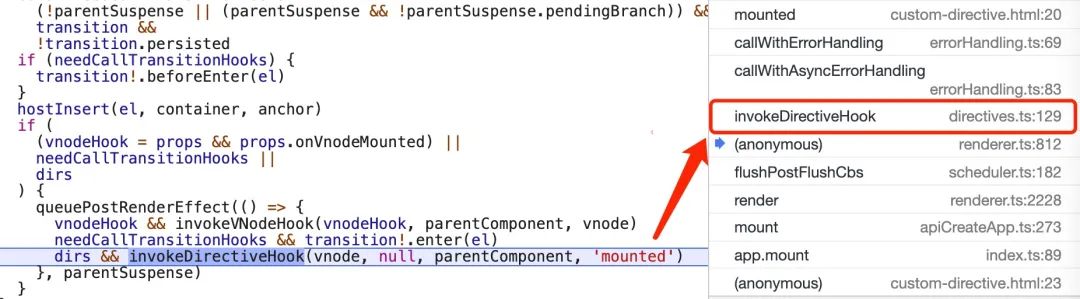
在圖中右側(cè)的調(diào)用棧中,我們看到了 invokeDirectiveHook 函數(shù),很明顯該函數(shù)的作用就是調(diào)用指令上已注冊的鉤子。出于篇幅考慮,具體的細節(jié)阿寶哥就不繼續(xù)介紹了,感興趣的小伙伴可以自行斷點調(diào)試一下。
四、阿寶哥有話說
4.1 Vue 3 有哪些內(nèi)置指令?
在介紹注冊全局自定義指令的過程中,我們看到了一個 validateDirectiveName 函數(shù),該函數(shù)用于驗證自定義指令的名稱,從而避免自定義指令名稱,與已有的內(nèi)置指令名稱沖突。
//?packages/runtime-core/src/directives.ts
export?function?validateDirectiveName(name:?string)?{
??if?(isBuiltInDirective(name))?{
????warn('Do?not?use?built-in?directive?ids?as?custom?directive?id:?'?+?name)
??}
}
在 validateDirectiveName 函數(shù)內(nèi)部,會通過 isBuiltInDirective(name) 語句來判斷是否為內(nèi)置指令:
const?isBuiltInDirective?=?/*#__PURE__*/?makeMap(
??'bind,cloak,else-if,else,for,html,if,model,on,once,pre,show,slot,text'
)
以上代碼中的 makeMap 函數(shù),用于生成一個 map 對象(Object.create(null))并返回一個函數(shù),用于檢測某個 key 是否存在 map 對象中。另外,通過以上代碼,我們就可以很清楚地了解 Vue 3 中為我們提供了哪些內(nèi)置指令。
4.2 指令有幾種類型?
在 Vue 3 中指令分為 ObjectDirective 和 FunctionDirective 兩種類型:
//?packages/runtime-core/src/directives.ts
export?type?Directiveany,?V?=?any>?=
??|?ObjectDirective
??|?FunctionDirective
ObjectDirective
export?interface?ObjectDirective?{
??created?:?DirectiveHooknull,?V>
??beforeMount?:?DirectiveHooknull,?V>
??mounted?:?DirectiveHooknull,?V>
??beforeUpdate?:?DirectiveHookany,?T>,?V>
??updated?:?DirectiveHookany,?T>,?V>
??beforeUnmount?:?DirectiveHooknull,?V>
??unmounted?:?DirectiveHooknull,?V>
??getSSRProps?:?SSRDirectiveHook
}
FunctionDirective
export?type?FunctionDirectiveany,?V?=?any>?=?DirectiveHookany,?V>
??????????????????????????????
export?type?DirectiveHookany,?Prev?=?VNode<any,?T>?|?null,?V?=?any>?=?(
??el:?T,
??binding:?DirectiveBinding,
??vnode:?VNode<any,?T>,
??prevVNode:?Prev
)?=>?void
如果你想在 mounted 和 updated 時觸發(fā)相同行為,而不關(guān)心其他的鉤子函數(shù)。那么你可以通過將回調(diào)函數(shù)傳遞給指令來實現(xiàn):
app.directive('pin',?(el,?binding)?=>?{
??el.style.position?=?'fixed'
??const?s?=?binding.arg?||?'top'
??el.style[s]?=?binding.value?+?'px'
})
4.3 注冊全局指令與局部指令有什么區(qū)別?
注冊全局指令
app.directive('focus',?{
??//?當被綁定的元素掛載到?DOM?中時被調(diào)用
??mounted(el)?{
????el.focus()?//?聚焦元素
??}
});
注冊局部指令
const?Component?=?defineComponent({
??directives:?{
????focus:?{
??????mounted(el)?{
????????el.focus()
??????}
????}
??},
??render()?{
????const?{?directives?}?=?this.$options;
????return?[withDirectives(h('input'),?[[directives.focus,?]])]
??}
});
解析全局注冊和局部注冊的指令
//?packages/runtime-core/src/helpers/resolveAssets.ts
function?resolveAsset(
??type:?typeof?COMPONENTS?|?typeof?DIRECTIVES,
??name:?string,
??warnMissing?=?true
)?{
??const?instance?=?currentRenderingInstance?||?currentInstance
??if?(instance)?{
????const?Component?=?instance.type
????//?省略解析組件的處理邏輯
????const?res?=
??????//?局部注冊
??????resolve(instance[type]?||?(Component?as?ComponentOptions)[type],?name)?||
??????//?全局注冊
??????resolve(instance.appContext[type],?name)
????return?res
??}
}
4.4 內(nèi)置指令和自定義指令生成的渲染函數(shù)有什么區(qū)別?
要了解內(nèi)置指令和自定義指令生成的渲染函數(shù)的區(qū)別,阿寶哥以 v-if 、v-show 內(nèi)置指令和 v-focus 自定義指令為例,然后使用 Vue 3 Template Explorer 這個在線工具來編譯生成渲染函數(shù):
v-if 內(nèi)置指令
if="isShow"?/>

const?_Vue?=?Vue
return?function?render(_ctx,?_cache,?$props,?$setup,?$data,?$options)?{
??with?(_ctx)?{
????const?{?createVNode:?_createVNode,?openBlock:?_openBlock,?
??????createBlock:?_createBlock,?createCommentVNode:?_createCommentVNode?}?=?_Vue

????return?isShow
????????(_openBlock(),?_createBlock("input",?{?key:?0?}))
??????:?_createCommentVNode("v-if",?true)
??}
}
對于 v-if 指令來說,在編譯后會通過 ?: 三目運算符來實現(xiàn)動態(tài)創(chuàng)建節(jié)點的功能。
v-show 內(nèi)置指令
"isShow"?/>
??
const?_Vue?=?Vue
return?function?render(_ctx,?_cache,?$props,?$setup,?$data,?$options)?{
??with?(_ctx)?{
????const?{?vShow:?_vShow,?createVNode:?_createVNode,?withDirectives:?_withDirectives,?
??????openBlock:?_openBlock,?createBlock:?_createBlock?}?=?_Vue

????return?_withDirectives((_openBlock(),?_createBlock("input",?null,?null,?512?/*?NEED_PATCH?*/)),?[
??????[_vShow,?isShow]
????])
??}
}
以上示例中的 vShow 指令被定義在 packages/runtime-dom/src/directives/vShow.ts 文件中,該指令屬于 ObjectDirective 類型的指令,該指令內(nèi)部定義了 beforeMount、mounted、updated 和 beforeUnmount 四個鉤子。
v-focus 自定義指令
const?_Vue?=?Vue
return?function?render(_ctx,?_cache,?$props,?$setup,?$data,?$options)?{
??with?(_ctx)?{
????const?{?resolveDirective:?_resolveDirective,?createVNode:?_createVNode,?
??????withDirectives:?_withDirectives,?openBlock:?_openBlock,?createBlock:?_createBlock?}?=?_Vue

????const?_directive_focus?=?_resolveDirective("focus")
????return?_withDirectives((_openBlock(),?_createBlock("input",?null,?null,?512?/*?NEED_PATCH?*/)),?[
??????[_directive_focus]
????])
??}
}
通過對比 v-focus 與 v-show 指令生成的渲染函數(shù),我們可知 v-focus 自定義指令與 v-show 內(nèi)置指令都會通過 withDirectives 函數(shù),把指令注冊到 VNode 對象上。而自定義指令相比內(nèi)置指令來說,會多一個指令解析的過程。
此外,如果在 input 元素上,同時應(yīng)用了 v-show 和 v-focus 指令,則在調(diào)用 _withDirectives 函數(shù)時,將使用二維數(shù)組:
"isShow"?v-focus?/>

const?_Vue?=?Vue
return?function?render(_ctx,?_cache,?$props,?$setup,?$data,?$options)?{
??with?(_ctx)?{
????const?{?vShow:?_vShow,?resolveDirective:?_resolveDirective,?createVNode:?_createVNode,?
??????withDirectives:?_withDirectives,?openBlock:?_openBlock,?createBlock:?_createBlock?}?=?_Vue

????const?_directive_focus?=?_resolveDirective("focus")
????return?_withDirectives((_openBlock(),?_createBlock("input",?null,?null,?512?/*?NEED_PATCH?*/)),?[
??????[_vShow,?isShow],
??????[_directive_focus]
????])
??}
}
4.5 如何在渲染函數(shù)中應(yīng)用指令?
除了在模板中應(yīng)用指令之外,利用前面介紹的 withDirectives 函數(shù),我們可以很方便地在渲染函數(shù)中應(yīng)用指定的指令:
<div?id="app">div>
<script>
???const?{?createApp,?h,?vShow,?defineComponent,?withDirectives?}?=?Vue
???const?Component?=?defineComponent({
?????data()?{
???????return?{?value:?true?}
?????},
?????render()?{
???????return?[withDirectives(h('div',?'我是阿寶哥'),?[[vShow,?this.value]])]
?????}
???});
???const?app?=?Vue.createApp(Component)
???app.mount('#app')
script>
本文阿寶哥主要介紹了在 Vue 3 中如何自定義指令、如何注冊全局和局部指令。為了讓大家能夠更深入地掌握自定義指令的相關(guān)知識,阿寶哥從源碼的角度分析了指令的注冊和應(yīng)用過程。
在后續(xù)的文章中,阿寶哥將會介紹一些特殊的指令,當然也會重點分析一下雙向綁定的原理,感興趣的小伙伴不要錯過喲。
五、參考資源
Vue 3 官網(wǎng) - 自定義指令 Vue 3 官網(wǎng) - 應(yīng)用 API
歡迎關(guān)注「前端雜貨鋪」,一個有溫度且致力于前端分享的雜貨鋪
關(guān)注回復(fù)「加群」,可加入雜貨鋪一起交流學(xué)習(xí)成長