
Spring Aop初始化源碼分析
點(diǎn)擊上方藍(lán)色字體,選擇“標(biāo)星公眾號(hào)”
優(yōu)質(zhì)文章,第一時(shí)間送達(dá)
1 工程簡(jiǎn)介

1.1 pom
<properties>
        <project.build.sourceEncoding>UTF-8</project.build.sourceEncoding>
        <maven.compiler.source>1.8</maven.compiler.source>
        <maven.compiler.target>1.8</maven.compiler.target>
        <spring.version>5.2.8.RELEASE</spring.version>
    </properties>

    <dependencies>
        <dependency>
            <groupId>junit</groupId>
            <artifactId>junit</artifactId>
            <version>4.13</version>
        </dependency>
        <dependency>
            <groupId>org.springframework</groupId>
            <artifactId>spring-context</artifactId>
            <version>${spring.version}</version>
        </dependency>
        <dependency>
            <groupId>org.projectlombok</groupId>
            <artifactId>lombok</artifactId>
            <version>1.16.20</version>
        </dependency>
        <!-- 日志相關(guān)依賴 -->
        <dependency>
            <groupId>org.slf4j</groupId>
            <artifactId>slf4j-api</artifactId>
            <version>1.7.10</version>
        </dependency>
        <dependency>
            <groupId>ch.qos.logback</groupId>
            <artifactId>logback-classic</artifactId>
            <version>1.1.2</version>
        </dependency>
        <dependency>
            <groupId>ch.qos.logback</groupId>
            <artifactId>logback-core</artifactId>
            <version>1.1.2</version>
        </dependency>

        <dependency>
            <groupId>org.springframework</groupId>
            <artifactId>spring-aspects</artifactId>
            <version>${spring.version}</version>
        </dependency>
    </dependencies>
1.2 AopConfig
@Configuration
@EnableAspectJAutoProxy
@Aspect
public class AopConfig {

    /**
     * 聲明切點(diǎn)
     */
    @Pointcut("execution(* com.rosh.service.*.*(..))")
    public void pointCut() {

    }

    @Around("pointCut()")
    public Object around(ProceedingJoinPoint proceedingJoinPoint) throws Throwable {
        System.out.println("==============調(diào)用前=================");
        Object proceed = proceedingJoinPoint.proceed();
        System.out.println("==============調(diào)用后=================");
        return proceed;
    }


}
1.3 StudentService
@Service
public class StudentService {

    public void addStudent() {
        System.out.println("添加學(xué)生");
    }


}
1.4 RoshTest
public class RoshTest {

    @Test
    public void mainTest(){

        AnnotationConfigApplicationContext applicationContext=new AnnotationConfigApplicationContext("com.rosh");

        StudentService studentService = (StudentService) applicationContext.getBean("studentService");

        studentService.addStudent();

    }

}
1.5 運(yùn)行結(jié)果

2 @EnableAspectJAutoProxy作用
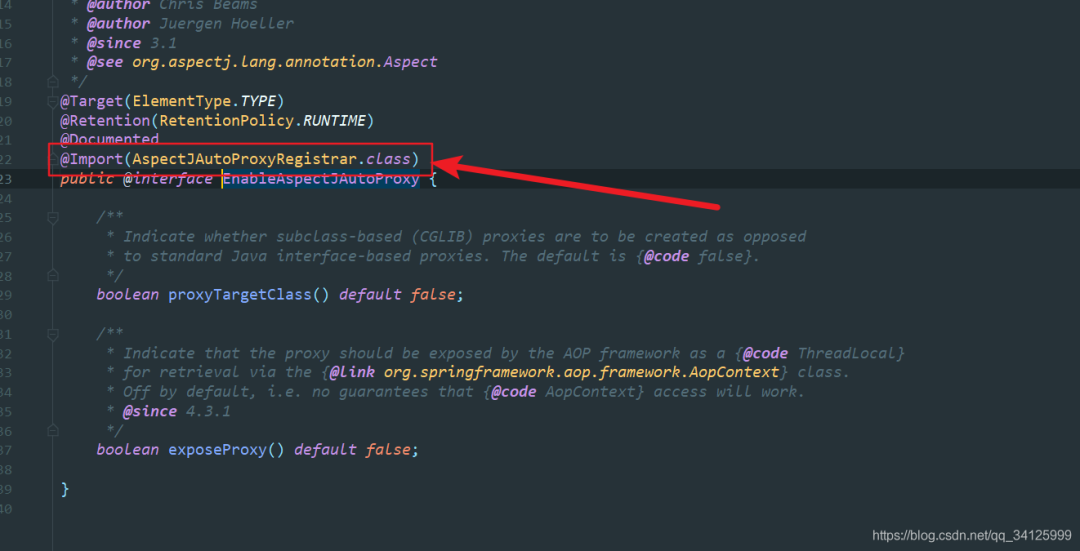
描述:開啟Spring AOP功能。
(1) IOC中加入AspectJAutoProxyRegistrar.class
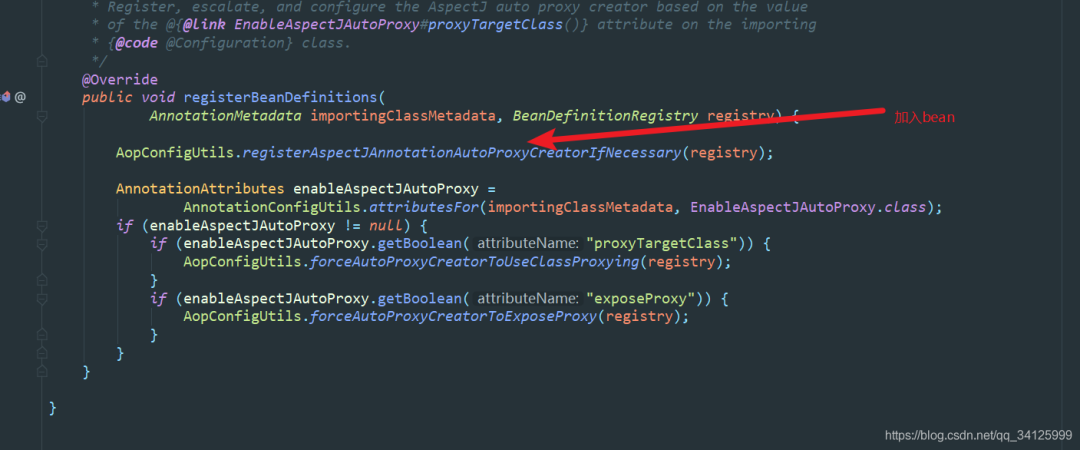
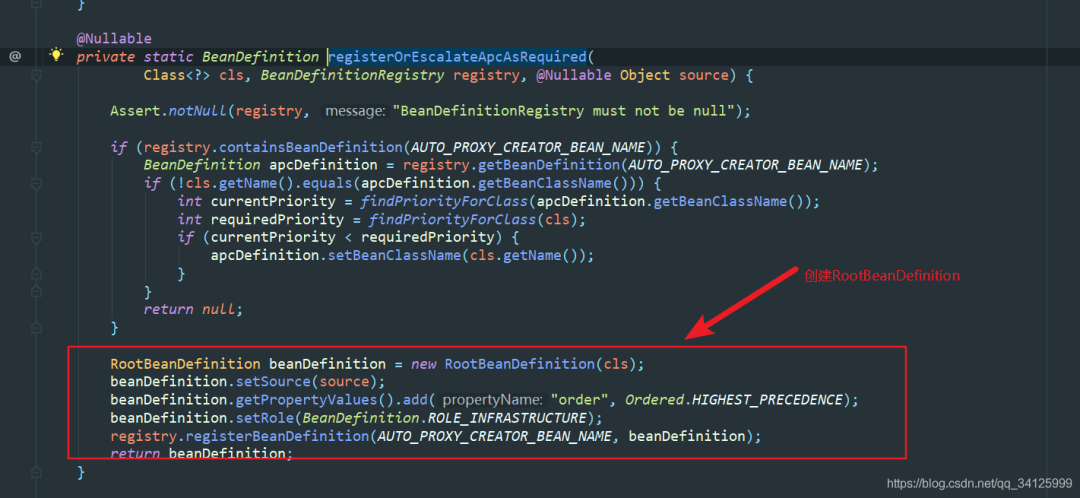
(2) 注冊(cè) AnnotationAwareAspectJAutoProxyCreator.class

3 AnnotationAwareAspectJAutoProxyCreator.class 源碼分析
描述:該類是AOP核心類。該類實(shí)現(xiàn)了BeanPostProcessor接口,說明在bean初始化時(shí),進(jìn)行后置加強(qiáng)。
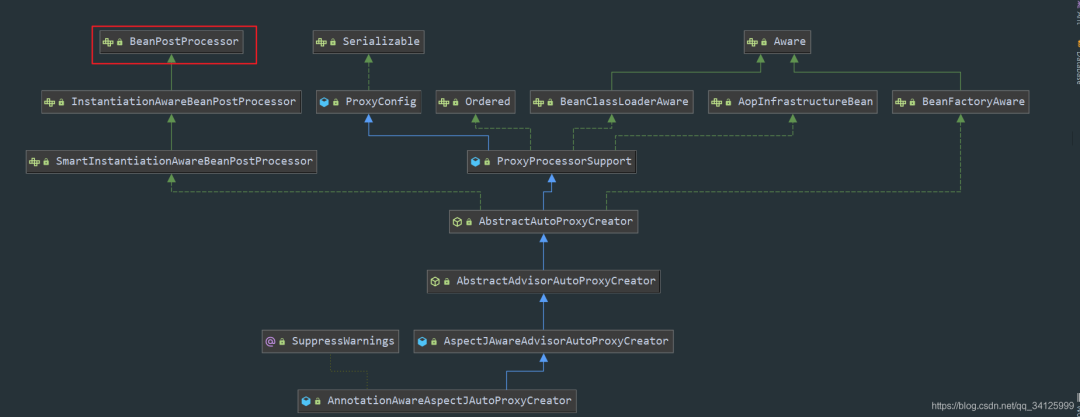
該類作用是,當(dāng)bean初始化時(shí),被該類后置加強(qiáng):
(1) 查找有效的advisor列表。(advisor=advice+pointCut)
(2) 匹配當(dāng)前bean,是否在pointCut表達(dá)式范圍,匹配方法是否需要加強(qiáng),把匹配到的advisor列表返回。
(3) 根據(jù)有效的advisor列表創(chuàng)建代理對(duì)象、
3.1 后置加強(qiáng)邏輯
@Override
 public Object postProcessAfterInitialization(@Nullable Object bean, String beanName) {
  if (bean != null) {
   Object cacheKey = getCacheKey(bean.getClass(), beanName);
   if (this.earlyProxyReferences.remove(cacheKey) != bean) {
    return wrapIfNecessary(bean, beanName, cacheKey);
   }
  }
  return bean;
 }
3.2 wrapIfNecessary方法
protected Object wrapIfNecessary(Object bean, String beanName, Object cacheKey) {
  if (StringUtils.hasLength(beanName) && this.targetSourcedBeans.contains(beanName)) {
   return bean;
  }
  if (Boolean.FALSE.equals(this.advisedBeans.get(cacheKey))) {
   return bean;
  }
  if (isInfrastructureClass(bean.getClass()) || shouldSkip(bean.getClass(), beanName)) {
   this.advisedBeans.put(cacheKey, Boolean.FALSE);
   return bean;
  }

  // Create proxy if we have advice.
  /**
   * 【1】獲取當(dāng)前bean有效的Advisor,Advisor = advice + pointCut
   */
  Object[] specificInterceptors = getAdvicesAndAdvisorsForBean(bean.getClass(), beanName, null);

  if (specificInterceptors != DO_NOT_PROXY) {
   this.advisedBeans.put(cacheKey, Boolean.TRUE);

   /**
    * 【2】創(chuàng)建代理對(duì)象
    */
   Object proxy = createProxy(
     bean.getClass(), beanName, specificInterceptors, new SingletonTargetSource(bean));
   this.proxyTypes.put(cacheKey, proxy.getClass());
   return proxy;
  }

  this.advisedBeans.put(cacheKey, Boolean.FALSE);
  return bean;
 }
3.3 getAdvicesAndAdvisorsForBean 方法解析
    @Override
 @Nullable
 protected Object[] getAdvicesAndAdvisorsForBean(
   Class<?> beanClass, String beanName, @Nullable TargetSource targetSource) {

  /**
   * 查找Advisor
   */
  List<Advisor> advisors = findEligibleAdvisors(beanClass, beanName);
  if (advisors.isEmpty()) {
   return DO_NOT_PROXY;
  }
  return advisors.toArray();
 }
描述:該方法獲取有效的Advisor,主要作用,發(fā)現(xiàn)所有的advisor其次匹配當(dāng)前bean。
protected List<Advisor> findEligibleAdvisors(Class<?> beanClass, String beanName) {

  /**
   * 【1】找到工程中所有Advisor(解析帶有@Aspect注解類生成Advisor對(duì)象)
   */
  List<Advisor> candidateAdvisors = findCandidateAdvisors();

  /**
   * 【2】 匹配當(dāng)前類
   */
  List<Advisor> eligibleAdvisors = findAdvisorsThatCanApply(candidateAdvisors, beanClass, beanName);
  extendAdvisors(eligibleAdvisors);
  if (!eligibleAdvisors.isEmpty()) {
   eligibleAdvisors = sortAdvisors(eligibleAdvisors);
  }
  return eligibleAdvisors;
 }
3.3.1 findCandidateAdvisors
作用:查找所有的advisor。
@Override
 protected List<Advisor> findCandidateAdvisors() {
  // Add all the Spring advisors found according to superclass rules.
  //找到所有的Advisor
  List<Advisor> advisors = super.findCandidateAdvisors();
  // Build Advisors for all AspectJ aspects in the bean factory.

  /**
   * 創(chuàng)建候選切面 對(duì)@Aspect注解進(jìn)行處理
   */
  if (this.aspectJAdvisorsBuilder != null) {
   advisors.addAll(this.aspectJAdvisorsBuilder.buildAspectJAdvisors());
  }
  return advisors;
 }
核心方法:buildAspectJAdvisors()
public List<Advisor> buildAspectJAdvisors() {
  List<String> aspectNames = this.aspectBeanNames;

  if (aspectNames == null) {
   synchronized (this) {
    aspectNames = this.aspectBeanNames;
    if (aspectNames == null) {
     List<Advisor> advisors = new ArrayList<>();
     aspectNames = new ArrayList<>();

     /**
      * 從spring 中獲取所有的類
      */
     String[] beanNames = BeanFactoryUtils.beanNamesForTypeIncludingAncestors(
       this.beanFactory, Object.class, true, false);
     for (String beanName : beanNames) {
      if (!isEligibleBean(beanName)) {
       continue;
      }
      // We must be careful not to instantiate beans eagerly as in this case they
      // would be cached by the Spring container but would not have been weaved.

      /**
       *  獲取beanName 的class
       */
      Class<?> beanType = this.beanFactory.getType(beanName);
      if (beanType == null) {
       continue;
      }

      /**
       *  判斷類上是否有@Aspect注解
       */
      if (this.advisorFactory.isAspect(beanType)) {
       aspectNames.add(beanName);
       AspectMetadata amd = new AspectMetadata(beanType, beanName);
       if (amd.getAjType().getPerClause().getKind() == PerClauseKind.SINGLETON) {

        //創(chuàng)建獲取有@Aspect注解類的實(shí)例工廠,負(fù)責(zé)獲取有@Aspect注解的實(shí)例
        MetadataAwareAspectInstanceFactory factory =
          new BeanFactoryAspectInstanceFactory(this.beanFactory, beanName);

        //創(chuàng)建切面Advisor對(duì)象
        List<Advisor> classAdvisors = this.advisorFactory.getAdvisors(factory);
        if (this.beanFactory.isSingleton(beanName)) {
         this.advisorsCache.put(beanName, classAdvisors);
        }
        else {
         this.aspectFactoryCache.put(beanName, factory);
        }
        advisors.addAll(classAdvisors);
       }
       else {
        // Per target or per this.
        if (this.beanFactory.isSingleton(beanName)) {
         throw new IllegalArgumentException("Bean with name '" + beanName +
           "' is a singleton, but aspect instantiation model is not singleton");
        }
        MetadataAwareAspectInstanceFactory factory =
          new PrototypeAspectInstanceFactory(this.beanFactory, beanName);
        this.aspectFactoryCache.put(beanName, factory);
        advisors.addAll(this.advisorFactory.getAdvisors(factory));
       }
      }
     }
     this.aspectBeanNames = aspectNames;
     return advisors;
    }
   }
  }

  if (aspectNames.isEmpty()) {
   return Collections.emptyList();
  }
  List<Advisor> advisors = new ArrayList<>();
  for (String aspectName : aspectNames) {
   List<Advisor> cachedAdvisors = this.advisorsCache.get(aspectName);
   if (cachedAdvisors != null) {
    advisors.addAll(cachedAdvisors);
   }
   else {
    MetadataAwareAspectInstanceFactory factory = this.aspectFactoryCache.get(aspectName);
    advisors.addAll(this.advisorFactory.getAdvisors(factory));
   }
  }
  return advisors;
 }
3.3.2 findAdvisorsThatCanApply
描述:用所有advisor匹配當(dāng)前class獲取當(dāng)前類有效的advisor列表。
protected List<Advisor> findAdvisorsThatCanApply(
   List<Advisor> candidateAdvisors, Class<?> beanClass, String beanName) {

  ProxyCreationContext.setCurrentProxiedBeanName(beanName);
  try {
   /**
    * 判斷當(dāng)前類是否在這些切面的pointCut中
    */
   return AopUtils.findAdvisorsThatCanApply(candidateAdvisors, beanClass);
  }
  finally {
   ProxyCreationContext.setCurrentProxiedBeanName(null);
  }
 }
描述:找到有效的Advisor后匹配當(dāng)前bean是否需要加強(qiáng)
public static List<Advisor> findAdvisorsThatCanApply(List<Advisor> candidateAdvisors, Class<?> clazz) {
  if (candidateAdvisors.isEmpty()) {
   return candidateAdvisors;
  }
  List<Advisor> eligibleAdvisors = new ArrayList<>();
  for (Advisor candidate : candidateAdvisors) {
   if (candidate instanceof IntroductionAdvisor && canApply(candidate, clazz)) {
    eligibleAdvisors.add(candidate);
   }
  }
  boolean hasIntroductions = !eligibleAdvisors.isEmpty();

  /**
   * 匹配
   */
  for (Advisor candidate : candidateAdvisors) {
   if (candidate instanceof IntroductionAdvisor) {
    // already processed
    continue;
   }

   /**
    * 判斷當(dāng)前類、方法是否匹配PointCut,如果匹配,把有效切面存入eligibleAdvisors
    */
   if (canApply(candidate, clazz, hasIntroductions)) {
    eligibleAdvisors.add(candidate);
   }
  }
  return eligibleAdvisors;
 }
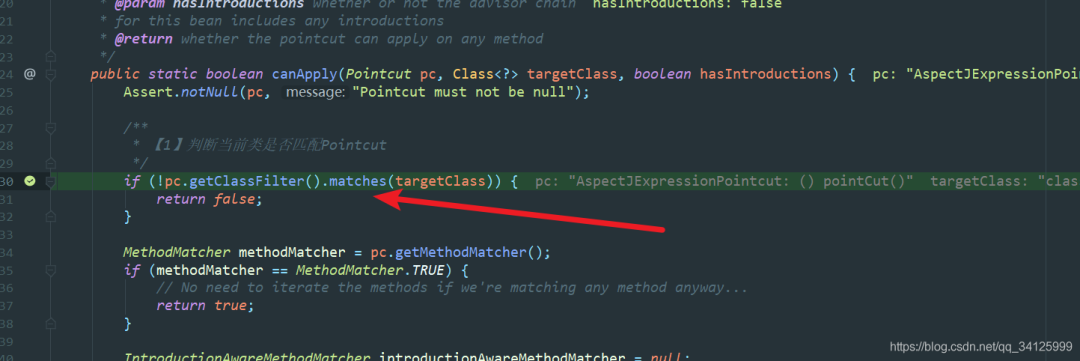
描述:真正匹配方法,判斷當(dāng)前類是否在pointCut表達(dá)式中,在匹配當(dāng)前方法是否需要加強(qiáng)。
public static boolean canApply(Pointcut pc, Class<?> targetClass, boolean hasIntroductions) {
  Assert.notNull(pc, "Pointcut must not be null");

  /**
   * 【1】判斷當(dāng)前類是否匹配Pointcut
   */
  if (!pc.getClassFilter().matches(targetClass)) {
   return false;
  }

  MethodMatcher methodMatcher = pc.getMethodMatcher();
  if (methodMatcher == MethodMatcher.TRUE) {
   // No need to iterate the methods if we're matching any method anyway...
   return true;
  }

  IntroductionAwareMethodMatcher introductionAwareMethodMatcher = null;
  if (methodMatcher instanceof IntroductionAwareMethodMatcher) {
   introductionAwareMethodMatcher = (IntroductionAwareMethodMatcher) methodMatcher;
  }

  Set<Class<?>> classes = new LinkedHashSet<>();
  if (!Proxy.isProxyClass(targetClass)) {
   classes.add(ClassUtils.getUserClass(targetClass));
  }
  classes.addAll(ClassUtils.getAllInterfacesForClassAsSet(targetClass));

  /**
   * 【2】 判斷類中方法是否匹配
   */
  for (Class<?> clazz : classes) {
   Method[] methods = ReflectionUtils.getAllDeclaredMethods(clazz);
   for (Method method : methods) {
    if (introductionAwareMethodMatcher != null ?
      introductionAwareMethodMatcher.matches(method, targetClass, hasIntroductions) :
      methodMatcher.matches(method, targetClass)) {
     return true;
    }
   }
  }

  return false;
 }
4 buildAspectJAdvisors() 方法debug
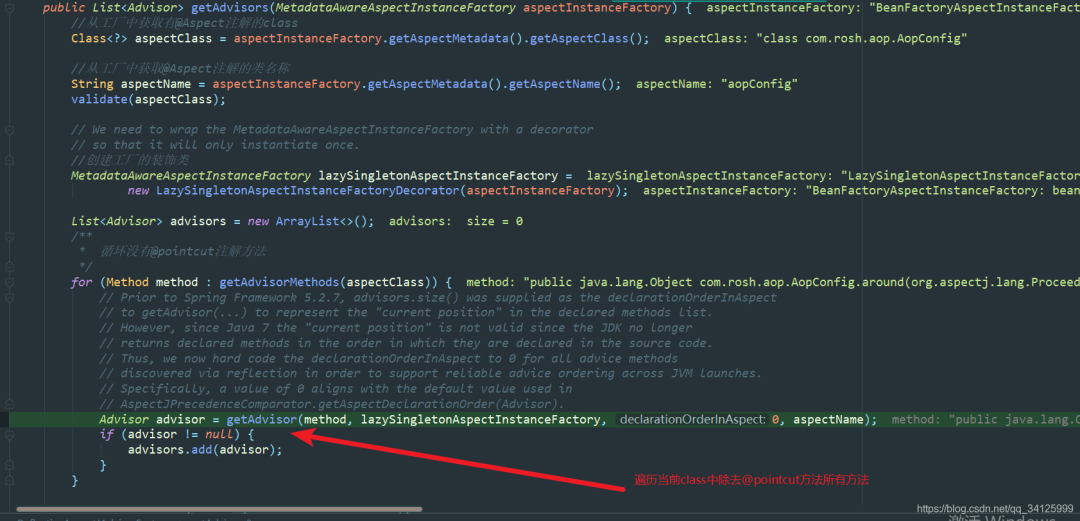
描述:該方法是獲取當(dāng)前項(xiàng)目中所有advisor。一個(gè)advisor由pointCut和advice組成,代表一個(gè)切面。
public List<Advisor> buildAspectJAdvisors() {
  List<String> aspectNames = this.aspectBeanNames;

  if (aspectNames == null) {
   synchronized (this) {
    aspectNames = this.aspectBeanNames;
    if (aspectNames == null) {
     List<Advisor> advisors = new ArrayList<>();
     aspectNames = new ArrayList<>();

     /**
      * 從spring 中獲取所有的類
      */
     String[] beanNames = BeanFactoryUtils.beanNamesForTypeIncludingAncestors(
       this.beanFactory, Object.class, true, false);
     for (String beanName : beanNames) {
      if (!isEligibleBean(beanName)) {
       continue;
      }
      // We must be careful not to instantiate beans eagerly as in this case they
      // would be cached by the Spring container but would not have been weaved.

      /**
       *  獲取beanName 的class
       */
      Class<?> beanType = this.beanFactory.getType(beanName);
      if (beanType == null) {
       continue;
      }

      /**
       *  判斷類上是否有@Aspect注解
       */
      if (this.advisorFactory.isAspect(beanType)) {
       aspectNames.add(beanName);
       AspectMetadata amd = new AspectMetadata(beanType, beanName);
       if (amd.getAjType().getPerClause().getKind() == PerClauseKind.SINGLETON) {

        //創(chuàng)建獲取有@Aspect注解類的實(shí)例工廠,負(fù)責(zé)獲取有@Aspect注解的實(shí)例
        MetadataAwareAspectInstanceFactory factory =
          new BeanFactoryAspectInstanceFactory(this.beanFactory, beanName);

        //創(chuàng)建切面Advisor對(duì)象
        List<Advisor> classAdvisors = this.advisorFactory.getAdvisors(factory);
        if (this.beanFactory.isSingleton(beanName)) {
         this.advisorsCache.put(beanName, classAdvisors);
        }
        else {
         this.aspectFactoryCache.put(beanName, factory);
        }
        advisors.addAll(classAdvisors);
       }
       else {
        // Per target or per this.
        if (this.beanFactory.isSingleton(beanName)) {
         throw new IllegalArgumentException("Bean with name '" + beanName +
           "' is a singleton, but aspect instantiation model is not singleton");
        }
        MetadataAwareAspectInstanceFactory factory =
          new PrototypeAspectInstanceFactory(this.beanFactory, beanName);
        this.aspectFactoryCache.put(beanName, factory);
        advisors.addAll(this.advisorFactory.getAdvisors(factory));
       }
      }
     }
     this.aspectBeanNames = aspectNames;
     return advisors;
    }
   }
  }

  if (aspectNames.isEmpty()) {
   return Collections.emptyList();
  }
  List<Advisor> advisors = new ArrayList<>();
  for (String aspectName : aspectNames) {
   List<Advisor> cachedAdvisors = this.advisorsCache.get(aspectName);
   if (cachedAdvisors != null) {
    advisors.addAll(cachedAdvisors);
   }
   else {
    MetadataAwareAspectInstanceFactory factory = this.aspectFactoryCache.get(aspectName);
    advisors.addAll(this.advisorFactory.getAdvisors(factory));
   }
  }
  return advisors;
 }

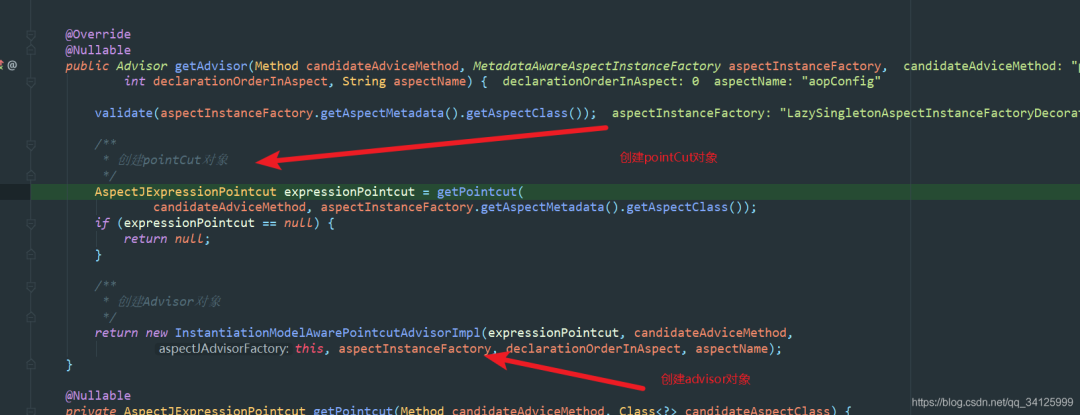
描述:創(chuàng)建pointCut對(duì)象
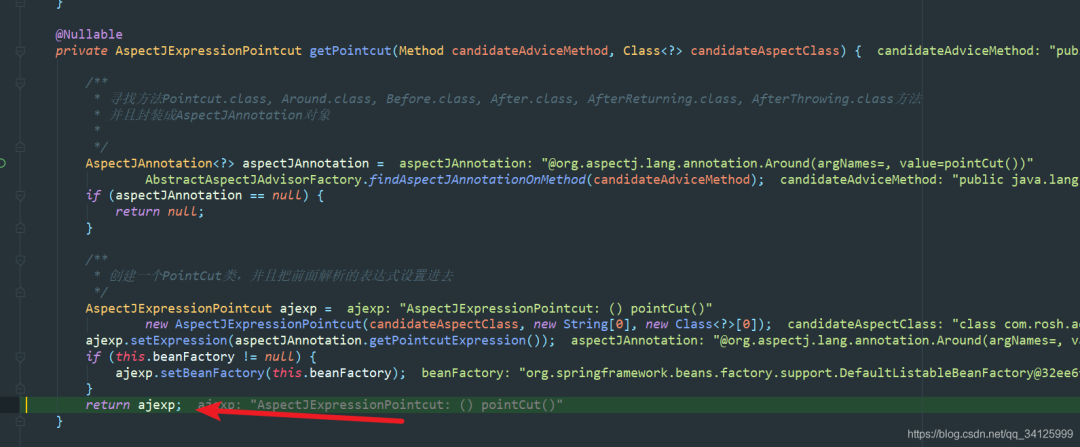
描述:創(chuàng)建advisor對(duì)象,傳入?yún)?shù)pointCut。advisor創(chuàng)建時(shí),會(huì)創(chuàng)建內(nèi)部advice對(duì)象。
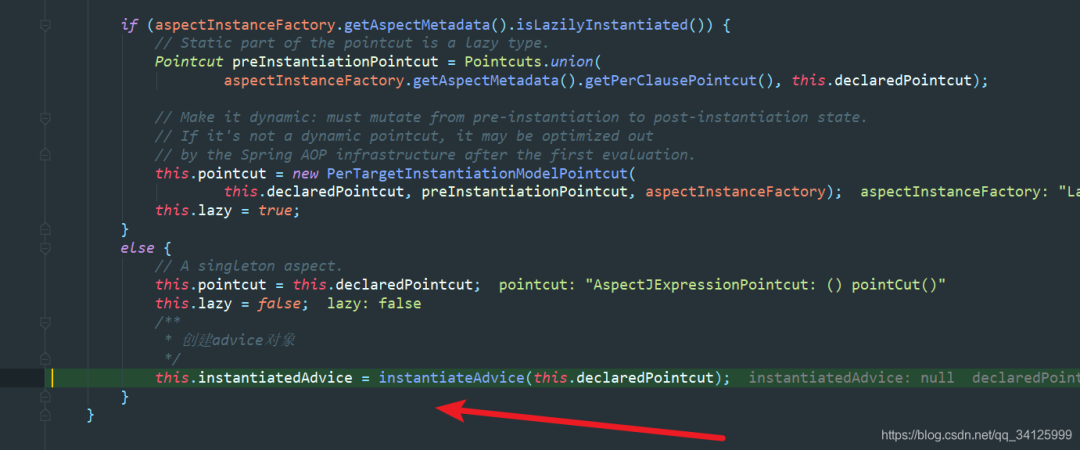
描述:創(chuàng)建advice
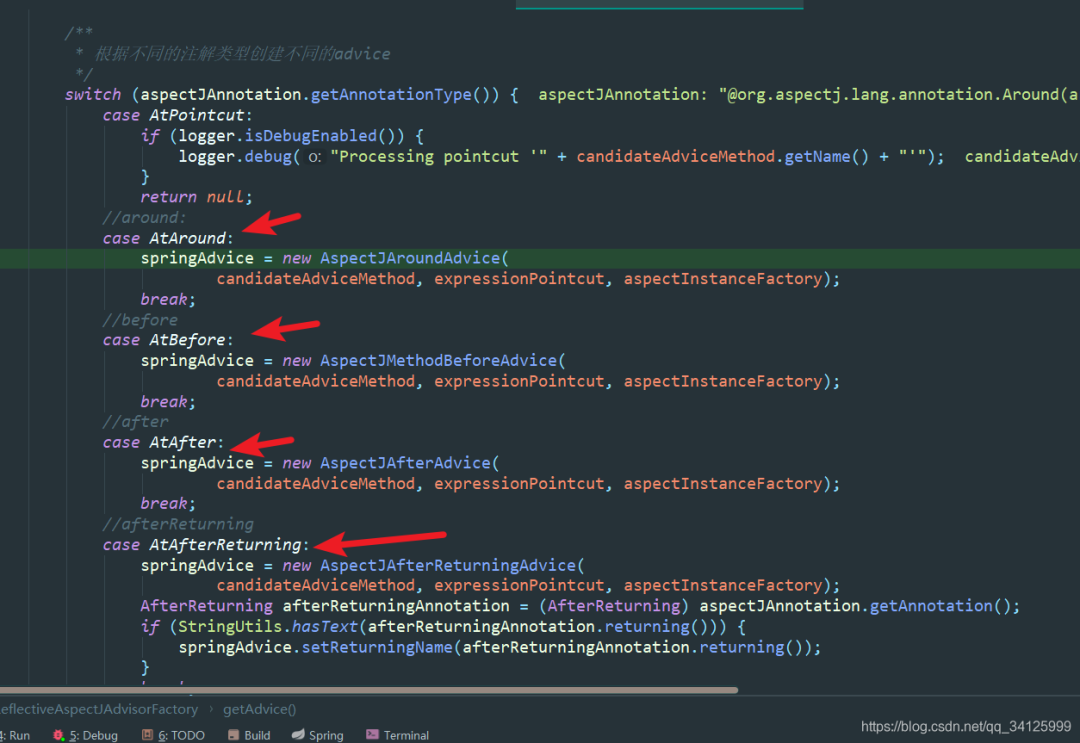


5 匹配流程debug
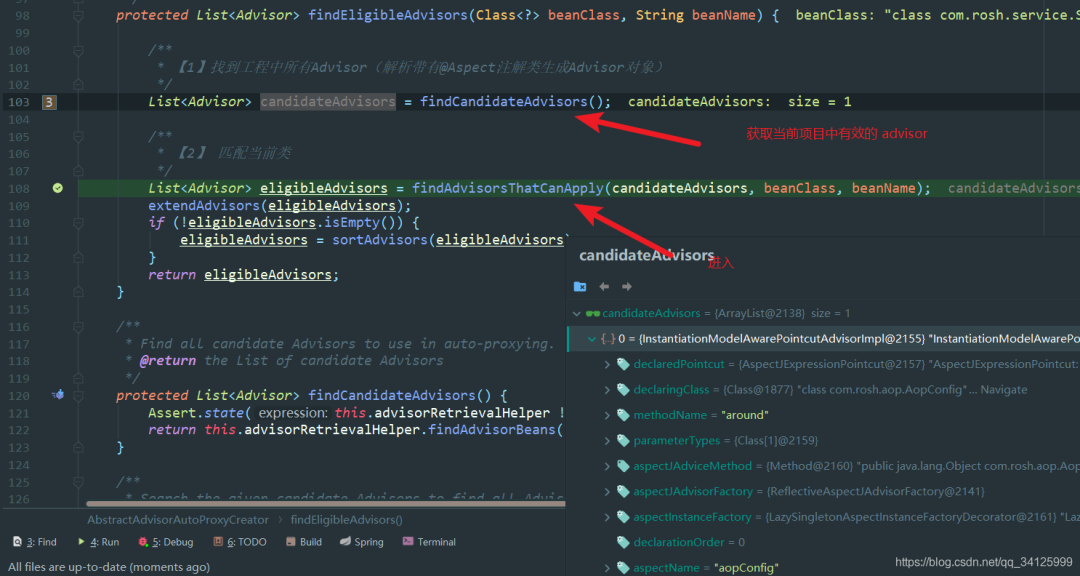

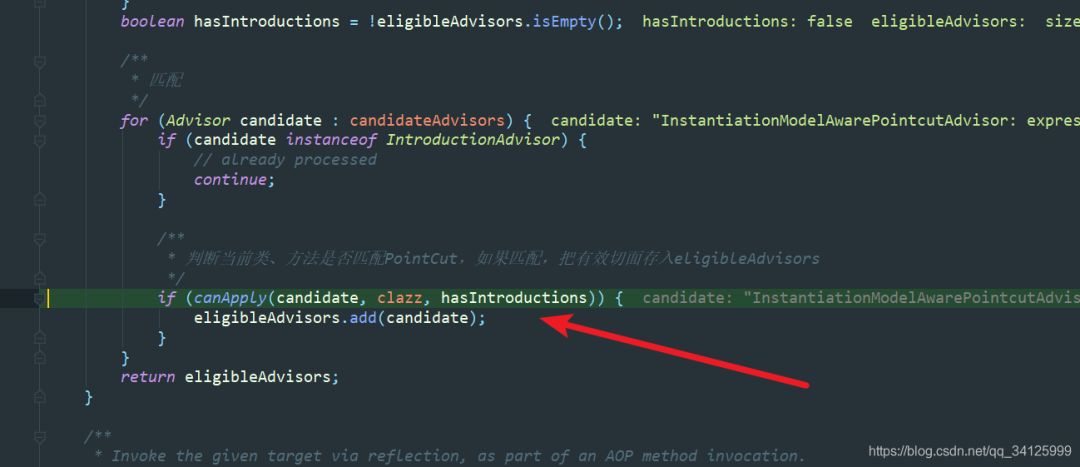

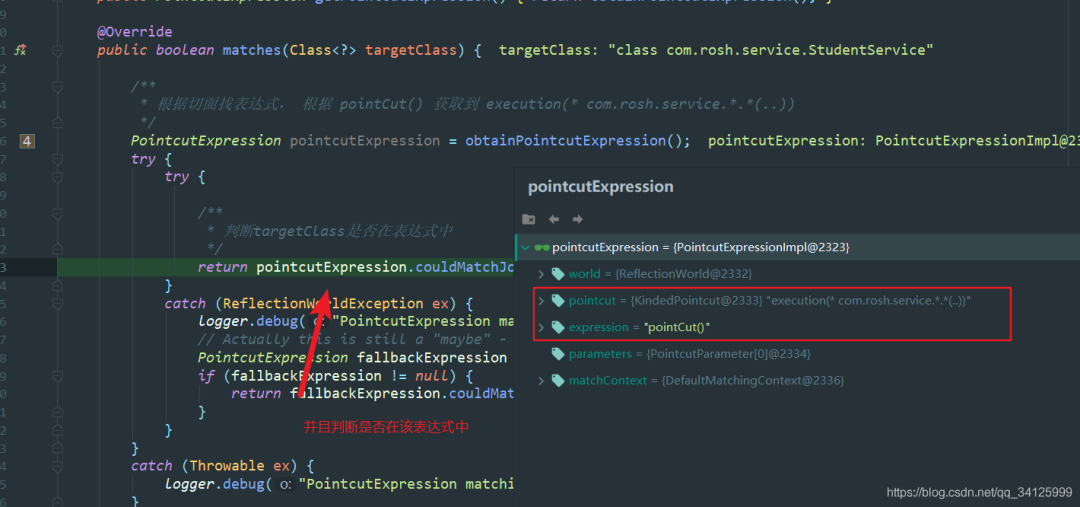
描述:匹配類,切點(diǎn)進(jìn)入當(dāng)前類,在matches方法中,會(huì)把切點(diǎn)轉(zhuǎn)成表達(dá)式。
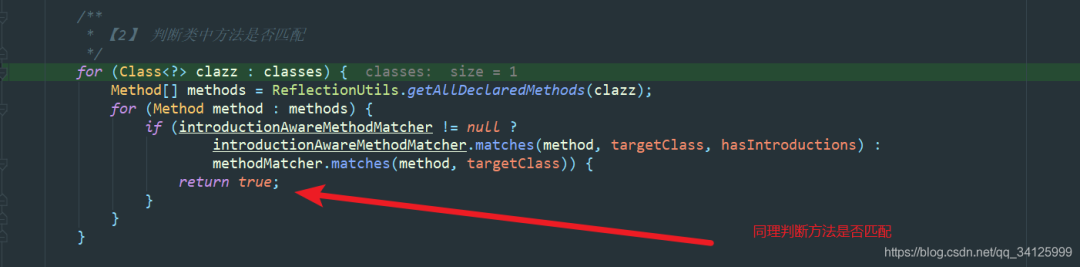
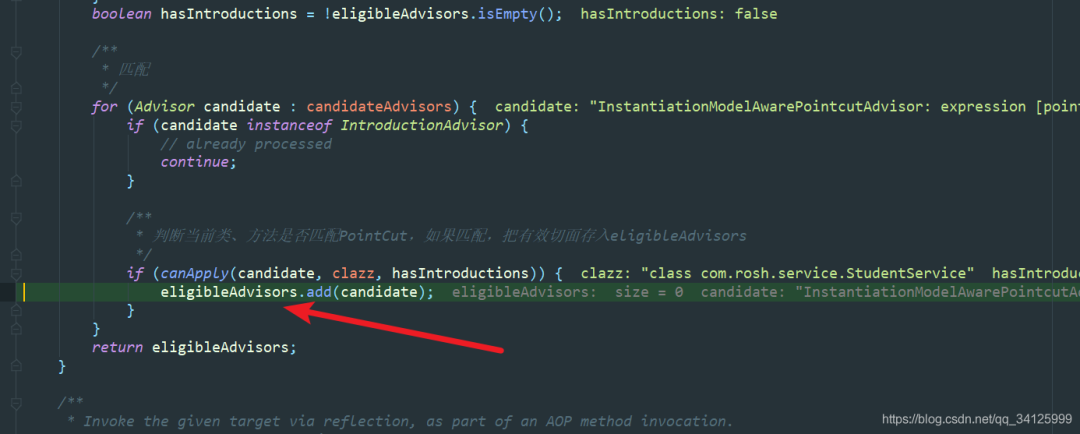
描述:如果類、方法都匹配advisor,那么當(dāng)前advisor可以加強(qiáng)當(dāng)前bean

————————————————
版權(quán)聲明:本文為CSDN博主「你攜秋月攬星河丶」的原創(chuàng)文章,遵循CC 4.0 BY-SA版權(quán)協(xié)議,轉(zhuǎn)載請(qǐng)附上原文出處鏈接及本聲明。
原文鏈接:
https://blog.csdn.net/qq_34125999/article/details/115057552
粉絲福利:Java從入門到入土學(xué)習(xí)路線圖
??????

??長(zhǎng)按上方微信二維碼 2 秒
感謝點(diǎn)贊支持下哈 