
【Vuejs】887- 深入淺出 Vue Mixin
作者:flyyang
https://flyyang.me/2019/01/24/vue-mixin/
mixin, 意為混入。
比如去買冰激凌,我先要一點奶油的,再來點香草的。我就可以吃一個奶油香草的冰激凌。如果再加點草莓,我可以同時吃三個口味的冰激凌。
代碼表示
假設(shè)把你已有的奶油味的稱為 base,把要添加的味道稱為 mixins。用 js 偽代碼可以這么來寫:
const base = {
  hasCreamFlavor() {
    return true;
  }
}
const mixins = {
  hasVanillaFlavor() {
    return true;
  },
  hasStrawberryFlavor() {
    return true;
 }
}

function mergeStrategies(base, mixins) {
  return Object.assign({}, base, mixins);
}
// newBase 就擁有了三種口味。
const newBase = mergeStrategies(base, mixins);
注意一下這個 mergeStrategies。
合并策略可以你想要的形式,也就是說你可以自定義自己的策略,這是其一。另外要解決沖突的問題。上面是通過 Object.assign 來實現(xiàn)的,那么 mixins 內(nèi)的方法會覆蓋base 內(nèi)的內(nèi)容。如果這不是你期望的結(jié)果,可以調(diào)換 mixin 和 base 的位置。
組合大于繼承 && DRY
想象一下上面的例子用繼承如何實現(xiàn)?由于 js 是單繼承語言,只能一層層繼承。寫起來很繁瑣。這里就體現(xiàn)了 mixin 的好處。符合組合大于繼承的原則。
mixin 內(nèi)通常是提取了公用功能的代碼。而不是每一個地方都寫一遍。符合 DRY 原則。
什么是 vue mixin
vue mixin 是針對組件間功能共享來做的。可以對組件的任意部分(生命周期, data等)進行mixin,但不同的 mixin 之后的合并策略不同。在源碼分析部分會介紹細節(jié)。
組件級 mixin
假設(shè)兩個功能組件 model 和 tooltip ,他們都有一個顯示和關(guān)閉的 toggle 動作:
//modal
const Modal = {
  template: '#modal',
  data() {
    return {
      isShowing: false
    }
  },
  methods: {
    toggleShow() {
      this.isShowing = !this.isShowing;
    }
  }
}

//tooltip
const Tooltip = {
  template: '#tooltip',
  data() {
    return {
      isShowing: false
    }
  },
  methods: {
    toggleShow() {
      this.isShowing = !this.isShowing;
    }
  }
}
可以用 mixin 這么寫:
const toggleMixin = {
  data() {
    return {
      isShowing: false
    }
  },
  methods: {
    toggleShow() {
      this.isShowing = !this.isShowing;
    }
  }
}

const Modal = {
  template: '#modal',
  mixins: [toggleMixin]
};

const Tooltip = {
  template: '#tooltip',
  mixins: [toggleMixin],
};
全局 mixin
全局 mixin 會作用到每一個 vue 實例上。所以使用的時候要慎重。通常會用 plugin 來顯示的聲明用到了那些 mixin。
比如 vuex。我們都知道它在每一個實例上擴展了一個 store。那么他是如何實現(xiàn)的呢?
在 src/mixin.js 內(nèi)
export default function (Vue) {
  const version = Number(Vue.version.split('.')[0])

  if (version >= 2) {
    Vue.mixin({ beforeCreate: vuexInit })
  } else {
    // override init and inject vuex init procedure
    // for 1.x backwards compatibility.
    const _init = Vue.prototype._init
    Vue.prototype._init = function (options = {}) {
      options.init = options.init
        ? [vuexInit].concat(options.init)
        : vuexInit
      _init.call(this, options)
    }
  }
  /**
   * Vuex init hook, injected into each instances init hooks list.
   */

  function vuexInit () {
    const options = this.$options
    // store injection
    if (options.store) {
      this.$store = typeof options.store === 'function'
        ? options.store()
        : options.store
    } else if (options.parent && options.parent.$store) {
      this.$store = options.parent.$store
    }
  }
}
我們看到 在 Vue 2.0 以上版本,通過 Vue.mixin({ beforeCreate: vuexInit })實現(xiàn)了在每一個實例的 beforeCreate 生命周期調(diào)用vuexInit 方法。
而 vuexInit 方法則是:在跟節(jié)點我們會直接把store 注入,在其他節(jié)點則拿父級節(jié)點的 store,這樣this.$store 永遠是你在根節(jié)點注入的那個store。
vue mixin 源碼實現(xiàn)
在 Vuex 的例子中,我們通過 Vue.mixin({ beforeCreate: vuexInit }) 實現(xiàn)對實例的 $store 擴展。
全局 mixin 注冊
我們先看一下 mixin 是如何掛載到原型上的。
在 src/core/index.js 中:
import Vue from './instance/index'
import { initGlobalAPI } from './global-api/index'

initGlobalAPI(Vue)

export default Vue
我們發(fā)現(xiàn)有一個 initGlobalAPI。在 src/global-api/index 中:
/* @flow */

import config from '../config'
import { initUse } from './use'
import { initMixin } from './mixin'
import { initExtend } from './extend'
import { initAssetRegisters } from './assets'
import { set, del } from '../observer/index'
import { ASSET_TYPES } from 'shared/constants'
import builtInComponents from '../components/index'

import {
  warn,
  extend,
  nextTick,
  mergeOptions,
  defineReactive
} from '../util/index'

export function initGlobalAPI (Vue: GlobalAPI) {
  // config
  const configDef = {}
  configDef.get = () => config
  if (process.env.NODE_ENV !== 'production') {
    configDef.set = () => {
      warn(
        'Do not replace the Vue.config object, set individual fields instead.'
      )
    }
  }
  Object.defineProperty(Vue, 'config', configDef)

  // exposed util methods.
  // NOTE: these are not considered part of the public API - avoid relying on
  // them unless you are aware of the risk.
  Vue.util = {
    warn,
    extend,
    mergeOptions,
    defineReactive
  }

  Vue.set = set
  Vue.delete = del
  Vue.nextTick = nextTick

  Vue.options = Object.create(null)
  ASSET_TYPES.forEach(type => {
    Vue.options[type + 's'] = Object.create(null)
  })

  // this is used to identify the "base" constructor to extend all plain-object
  // components with in Weex's multi-instance scenarios.
  Vue.options._base = Vue

  extend(Vue.options.components, builtInComponents)

  initUse(Vue)
  initMixin(Vue)
  initExtend(Vue)
  initAssetRegisters(Vue)
}
所有全局的方法都在這里注冊。我們關(guān)注 initMixin 方法,定義在 src/core/global-api/mixin.js:
import { mergeOptions } from '../util/index'

export function initMixin (Vue: GlobalAPI) {
  Vue.mixin = function (mixin: Object) {
    this.options = mergeOptions(this.options, mixin)
    return this
  }
}
至此我們發(fā)現(xiàn)了 Vue 如何掛載全局 mixin。
mixin 合并策略
vuex 通過 beforeCreate Hook 實現(xiàn)為所有 vm 添加 $store 實例。讓我們先把 hook 的事情放一邊。看一看 beforeCreate 如何實現(xiàn)。
在 src/core/instance/init.js 中:
export function initMixin (Vue: Class<Component>) {
  Vue.prototype._init = function (options?: Object) {
    // remove unrelated code
    initLifecycle(vm)
    initEvents(vm)
    initRender(vm)
    callHook(vm, 'beforeCreate')
    initInjections(vm) // resolve injections before data/props
    initState(vm)
    initProvide(vm) // resolve provide after data/props
    callHook(vm, 'created')

    // remove unrelated code
    if (vm.$options.el) {
      vm.$mount(vm.$options.el)
    }
  }
}
我們可以看到在 initRender 完成后,會調(diào)用 callHook(vm, 'beforeCreate')。而 init 實在 vue 實例化會執(zhí)行的。
在 src/core/instance/lifecycle.js 中:
export function callHook (vm: Component, hook: string) {
  // #7573 disable dep collection when invoking lifecycle hooks
  pushTarget()
  const handlers = vm.$options[hook]
  if (handlers) {
    for (let i = 0, j = handlers.length; i < j; i++) {
      try {
        handlers[i].call(vm)
      } catch (e) {
        handleError(e, vm, `${hook} hook`)
      }
    }
  }
  if (vm._hasHookEvent) {
    vm.$emit('hook:' + hook)
  }
  popTarget()
}
在對 beforeCreate 執(zhí)行 callHook 過程中,會先從 vue 實例的 options 中取出所有掛載的 handlers。然后循環(huán)調(diào)用 call 方法執(zhí)行所有的 hook:
handlers[i].call(vm)
由此我們可以了解到全局的 hook mixin 會和要 mixin 的組件合并 hook,最后生成一個數(shù)組。
回頭再看:
import { mergeOptions } from '../util/index'

export function initMixin (Vue: GlobalAPI) {
  Vue.mixin = function (mixin: Object) {
    this.options = mergeOptions(this.options, mixin)
    return this
  }
}
this.options 默認是 vue 內(nèi)置的一些 option:
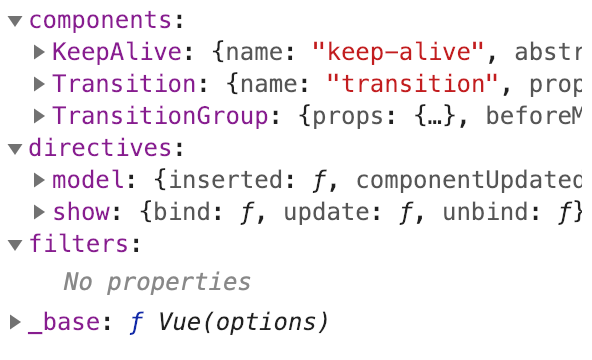
mixin 就是你要混入的對象。我們來看一看 mergeOptions。定義在 src/core/util/options.js:
export function mergeOptions (
  parent: Object,
  child: Object,
  vm?: Component
): Object {
  if (process.env.NODE_ENV !== 'production') {
    checkComponents(child)
  }

  if (typeof child === 'function') {
    child = child.options
  }

  normalizeProps(child, vm)
  normalizeInject(child, vm)
  normalizeDirectives(child)
  const extendsFrom = child.extends
  if (extendsFrom) {
    parent = mergeOptions(parent, extendsFrom, vm)
  }
  if (child.mixins) {
    for (let i = 0, l = child.mixins.length; i < l; i++) {
      parent = mergeOptions(parent, child.mixins[i], vm)
    }
  }
  const options = {}
  let key
  for (key in parent) {
    mergeField(key)
  }
  for (key in child) {
    if (!hasOwn(parent, key)) {
      mergeField(key)
    }
  }
  function mergeField (key) {
    const strat = strats[key] || defaultStrat
    options[key] = strat(parent[key], child[key], vm, key)
  }
  return options
}
忽略不相干代碼我們直接跳到:
  for (key in child) {
    if (!hasOwn(parent, key)) {
      mergeField(key)
    }
  }
  function mergeField (key) {
    const strat = strats[key] || defaultStrat
    options[key] = strat(parent[key], child[key], vm, key)
  }
此時 child 為 { beforeCreate: vuexInit }。走入到 mergeField 流程。mergeField 先取合并策略。
const strat = strats[key] || defaultStrat,相當(dāng)于取 strats['beforeCreate'] 的合并策略。定義在通文件的上方:
/**
 * Hooks and props are merged as arrays.
 */
function mergeHook (
  parentVal: ?Array<Function>,
  childVal: ?Function | ?Array<Function>
): ?Array<Function> {
  return childVal
    ? parentVal
      ? parentVal.concat(childVal)
      : Array.isArray(childVal)
        ? childVal
        : [childVal]
    : parentVal
}

LIFECYCLE_HOOKS.forEach(hook => {
  strats[hook] = mergeHook
})

// src/shared/constants.js

export const LIFECYCLE_HOOKS = [
  'beforeCreate',
  'created',
  'beforeMount',
  'mounted',
  'beforeUpdate',
  'updated',
  'beforeDestroy',
  'destroyed',
  'activated',
  'deactivated',
  'errorCaptured'
]
在 mergeHook 中的合并策略是把所有的 hook 生成一個函數(shù)數(shù)組。其他相關(guān)策略可以在options 文件中查找(如果是對象,組件本身的會覆蓋上層,data 會執(zhí)行結(jié)果,返回再merge,hook則生成數(shù)組)。
mixin 早于實例化
mergeOptions 會多次調(diào)用,正如其注釋說描述的那樣:
/**
 * Merge two option objects into a new one.
 * Core utility used in both instantiation and inheritance.
 */
上面介紹了全局 mixin 的流程,我們來看下 實例化部分的流程。在 src/core/instance/init.js 中:
export function initMixin (Vue: Class<Component>) {
  Vue.prototype._init = function (options?: Object) {
    if (options && options._isComponent) {
      // optimize internal component instantiation
      // since dynamic options merging is pretty slow, and none of the
      // internal component options needs special treatment.
      initInternalComponent(vm, options)
    } else {
      vm.$options = mergeOptions(
        resolveConstructorOptions(vm.constructor),
        options || {},
        vm
      )
    }
    // expose real self
    vm._self = vm
    initLifecycle(vm)
    initEvents(vm)
    initRender(vm)
    callHook(vm, 'beforeCreate')
    initInjections(vm) // resolve injections before data/props
    initState(vm)
    initProvide(vm) // resolve provide after data/props
    callHook(vm, 'created')
    if (vm.$options.el) {
      vm.$mount(vm.$options.el)
    }
  }
}
由于 全局 mixin 通常放在最上方。所以一個 vue 實例,通常是內(nèi)置的 options + 全局 mixin 的 options +用戶自定義options,加上合并策略生成最終的 options.
那么對于 hook 來說是[mixinHook, userHook]。mixin 的hook 函數(shù)優(yōu)先于用戶自定義的 hook 執(zhí)行。
local mixin
在 組件中書寫 mixin 過程中:
const Tooltip = {
  template: '#tooltip',
  mixins: [toggleMixin],
};
在 mergeOptions 的過程中有下面一段代碼:
  if (child.mixins) {
    for (let i = 0, l = child.mixins.length; i < l; i++) {
      parent = mergeOptions(parent, child.mixins[i], vm)
    }
  }
當(dāng) tooltip 實例化時,會將對應(yīng)的參數(shù) merge 到實例中。
定制合并策略
Vue.config.optionMergeStrategies.myOption = function (toVal, fromVal) {
  // return mergedVal
}
以上。
參考
http://techsith.com/mixins-in-javascript/ https://vuejs.org/v2/guide/mixins.html https://css-tricks.com/using-mixins-vue-js/

回復(fù)“加群”與大佬們一起交流學(xué)習(xí)~
點擊“閱讀原文”查看 100+ 篇原創(chuàng)文章