
簡單、易用的 MySQL 官方壓測工具,建議收藏!
往期熱門文章:
1、臥槽?運(yùn)行 ping 命令執(zhí)行結(jié)果的卻是 rm -rf,我太難了……
2、為什么我決定要放棄 okhttp、httpClient?
3、再見了SpringMVC,這個(gè)框架有點(diǎn)厲害,甚至干掉了Servlet!
4、推薦一款國產(chǎn)開源監(jiān)控系統(tǒng),太強(qiáng)大了!!
來源:toutiao.com/i6843323300764975628/
一、MySQL自帶的壓力測試工具 Mysqlslap
mysqlslap是mysql自帶的基準(zhǔn)測試工具,該工具查詢數(shù)據(jù),語法簡單,靈活容易使用.該工具可以模擬多個(gè)客戶端同時(shí)并發(fā)的向服務(wù)器發(fā)出查詢更新,給出了性能測試數(shù)據(jù)而且提供了多種引擎的性能比較。mysqlslap為mysql性能優(yōu)化前后提供了直觀的驗(yàn)證依據(jù),系統(tǒng)運(yùn)維和DBA人員應(yīng)該掌握一些常見的壓力測試工具,才能準(zhǔn)確的掌握線上數(shù)據(jù)庫支撐的用戶流量上限及其抗壓性等問題。
1、更改其默認(rèn)的最大連接數(shù)
在對MySQL進(jìn)行壓力測試之前,需要更改其默認(rèn)的最大連接數(shù),如下:
[root@mysql?~]#?vim?/etc/my.cnf
................
[mysqld]
max_connections=1024

[root@mysql?~]#?systemctl?restart?mysqld
查看最大連接數(shù)
mysql>?show?variables?like?'max_connections';
+-----------------+-------+
|?Variable_name???|?Value?|
+-----------------+-------+
|?max_connections?|?1024??|
+-----------------+--------+
1?row?in?set?(0.00?sec)
進(jìn)行壓力測試:
[root@mysql?~]#?mysqlslap?--defaults-file=/etc/my.cnf?--concurrency=100,200?--iterations=1?--number-int-cols=20?--number-char-cols=30?\

--auto-generate-sql?--auto-generate-sql-add-autoincrement?--auto-generate-sql-load-type=mixed?--engine=myisam,innodb?--number-of-queries=2000?-uroot?-p123?--verbose
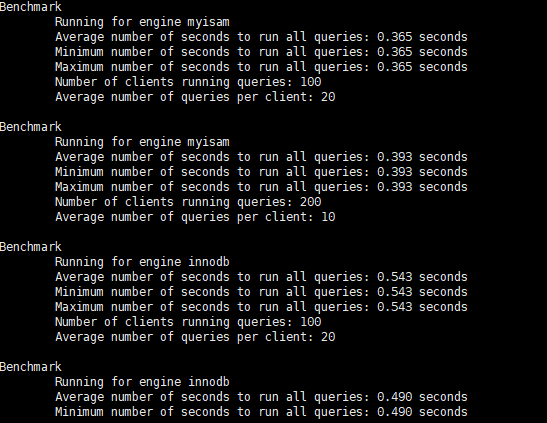
上述命令測試說明:模擬測試兩次讀寫并發(fā),第一次100,第二次200,自動(dòng)生成SQL腳本,測試表包含20個(gè)init字段,30個(gè)char字段,每次執(zhí)行2000查詢請求。測試引擎分別是myisam,innodb。(上述選項(xiàng)中有很多都是默認(rèn)值,可以省略,如果想要了解各個(gè)選項(xiàng)的解釋,可以使用mysqlslap --help進(jìn)行查詢)。
測試結(jié)果說明:
Myisam第一次100客戶端同時(shí)發(fā)起增查用0.557/s,第二次200客戶端同時(shí)發(fā)起增查用0.522/s Innodb第一次100客戶端同時(shí)發(fā)起增查用0.256/s,第二次200客戶端同時(shí)發(fā)起增查用0.303/s
可以根據(jù)實(shí)際需求,一點(diǎn)點(diǎn)的加大并發(fā)數(shù)量進(jìn)行壓力測試。
二、使用第三方sysbench工具進(jìn)行壓力測試
1、安裝sysbench工具
[root@mysql?~]#?yum?-y?install?epel-release?#安裝第三方epel源

[root@mysql?~]#?yum?-y?install?sysbench?#安裝sysbench工具

[root@mysql?~]#?sysbench?--version?#確定工具已安裝
sysbench?1.0.17
sysbench可以進(jìn)行以下測試:
CPU 運(yùn)算性能測試 磁盤 IO 性能測試 調(diào)度程序性能測試 內(nèi)存分配及傳輸速度測試 POSIX 線程性能測試
數(shù)據(jù)庫性能測試(OLTP 基準(zhǔn)測試,需要通過 /usr/share/sysbench/ 目錄中的 Lua 腳本執(zhí)行,例如 oltp_read_only.lua 腳本執(zhí)行只讀測試)。
sysbench 還可以通過運(yùn)行命令時(shí)指定自己的 Lua 腳本來自定義測試。
2、查看sysbench工具的幫助選項(xiàng)
[root@mysql?~]#?sysbench?--help
Usage:
sysbench?[options]...?[testname]?[command]
Commands?implemented?by?most?tests:?prepare?run?cleanup?help?#?可用的命令,四個(gè)
General?options:?#?通用選項(xiàng)
--threads=N?要使用的線程數(shù),默認(rèn)?1?個(gè)?[1]
--events=N?最大允許的事件個(gè)數(shù)?[0]
--time=N?最大的總執(zhí)行時(shí)間,以秒為單位?[10]
--forced-shutdown=STRING?在?--time?時(shí)間限制到達(dá)后,強(qiáng)制關(guān)閉之前等待的秒數(shù),默認(rèn)“off”禁用(number?of?seconds?to?wait?after?the?--time?limit?before?forcing?shutdown,?or?'off'?to?disable)?[off]
--thread-stack-size=SIZE?每個(gè)線程的堆棧大小?[64K]
--rate=N 平均傳輸速率。0?則無限制?[0]
--report-interval=N?以秒為單位定期報(bào)告具有指定間隔的中間統(tǒng)計(jì)信息?0?禁用中間報(bào)告?[0]
--report-checkpoints=[LIST,...]?轉(zhuǎn)儲完整的統(tǒng)計(jì)信息并在指定的時(shí)間點(diǎn)重置所有計(jì)數(shù)器。參數(shù)是一個(gè)逗號分隔的值列表,表示從測試開始經(jīng)過這個(gè)時(shí)間量時(shí)必須執(zhí)行報(bào)告檢查點(diǎn)(以秒為單位)。報(bào)告檢查點(diǎn)默認(rèn)關(guān)閉。?[]
--debug[=on|off]?打印更多?debug?信息?[off]
--validate[=on|off]?盡可能執(zhí)行驗(yàn)證檢查?[off]
--help[=on|off]?顯示幫助信息并退出?[off]
--version[=on|off]?顯示版本信息并退出?[off]
--config-file=FILENAME?包含命令行選項(xiàng)的文件
--tx-rate=N?廢棄,改用?--rate?[0]
--max-requests=N?廢棄,改用?--events?[0]
--max-time=N?廢棄,改用?--time?[0]
--num-threads=N?廢棄,改用?--threads?[1]
Pseudo-Random?Numbers?Generator?options:?#?偽隨機(jī)數(shù)發(fā)生器選項(xiàng)
--rand-type=STRING?random?numbers?distribution?{uniform,gaussian,special,pareto}?[special]
--rand-spec-iter=N?number?of?iterations?used?for?numbers?generation?[12]
--rand-spec-pct=N?percentage?of?values?to?be?treated?as?'special'?(for?special?distribution)?[1]
--rand-spec-res=N?percentage?of?'special'?values?to?use?(for?special?distribution)?[75]
--rand-seed=N?seed?for?random?number?generator.?When?0,?the?current?time?is?used?as?a?RNG?seed.?[0]
--rand-pareto-h=N?parameter?h?for?pareto?distribution?[0.2]
Log?options:?#?日志選項(xiàng)
--verbosity=N?verbosity?level?{5?-?debug,?0?-?only?critical?messages}?[3]
--percentile=N?percentile?to?calculate?in?latency?statistics?(1-100).?Use?the?special?value?of?0?to?disable?percentile?calculations?[95]
--histogram[=on|off]?print?latency?histogram?in?report?[off]
General?database?options:?#?通用的數(shù)據(jù)庫選項(xiàng)
--db-driver=STRING?指定要使用的數(shù)據(jù)庫驅(qū)動(dòng)程序?('help'?to?get?list?of?available?drivers)
--db-ps-mode=STRING?prepared?statements?usage?mode?{auto,?disable}?[auto]
--db-debug[=on|off]?print?database-specific?debug?information?[off]
Compiled-in?database?drivers:?#?內(nèi)建的數(shù)據(jù)庫驅(qū)動(dòng)程序,默認(rèn)支持?MySQL?和?PostgreSQL
mysql?-?MySQL?driver
pgsql?-?PostgreSQL?driver
mysql?options:?#?MySQL?數(shù)據(jù)庫專用選項(xiàng)
--mysql-host=[LIST,...]?MySQL?server?host?[localhost]
--mysql-port=[LIST,...]?MySQL?server?port?[3306]
--mysql-socket=[LIST,...]?MySQL?socket
--mysql-user=STRING?MySQL?user?[sbtest]
--mysql-password=STRING?MySQL?password?[]
--mysql-db=STRING?MySQL?database?name?[sbtest]
--mysql-ssl[=on|off]?use?SSL?connections,?if?available?in?the?client?library?[off]
--mysql-ssl-cipher=STRING?use?specific?cipher?for?SSL?connections?[]
--mysql-compression[=on|off]?use?compression,?if?available?in?the?client?library?[off]
--mysql-debug[=on|off]?trace?all?client?library?calls?[off]
--mysql-ignore-errors=[LIST,...]?list?of?errors?to?ignore,?or?"all"?[1213,1020,1205]
--mysql-dry-run[=on|off]?Dry?run,?pretend?that?all?MySQL?client?API?calls?are?successful?without?executing?them?[off]
pgsql?options:?#?PostgreSQL?數(shù)據(jù)庫專用選項(xiàng)
--pgsql-host=STRING?PostgreSQL?server?host?[localhost]
--pgsql-port=N?PostgreSQL?server?port?[5432]
--pgsql-user=STRING?PostgreSQL?user?[sbtest]
--pgsql-password=STRING?PostgreSQL?password?[]
--pgsql-db=STRING?PostgreSQL?database?name?[sbtest]
Compiled-in?tests:?#?內(nèi)建測試類型
fileio?-?File?I/O?test
cpu?-?CPU?performance?test
memory?-?Memory?functions?speed?test
threads?-?Threads?subsystem?performance?test
mutex?-?Mutex?performance?test
See?'sysbench??help' ?for?a?list?of?options?for?each?test.
3、sysbench測試MySQL數(shù)據(jù)庫性能
1)準(zhǔn)備測試數(shù)據(jù)
#查看sysbench自帶的lua腳本使用方法
[root@mysql?~]#?sysbench?/usr/share/sysbench/oltp_common.lua?help

#必須創(chuàng)建sbtest庫,sbtest是sysbench默認(rèn)使用的庫名
[root@mysql?~]#?mysqladmin?-uroot?-p123?create?sbtest;

#然后,準(zhǔn)備測試所用的表,這些測試表放在測試庫sbtest中。這里使用的lua腳本為/usr/share/sysbench/oltp_common.lua。
[root@mysql?~]#?sysbench?--mysql-host=127.0.0.1?\
--mysql-port=3306?\
--mysql-user=root?\
--mysql-password=123?\
/usr/share/sysbench/oltp_common.lua?\
--tables=10?\
--table_size=100000?\
prepare

#其中--tables=10表示創(chuàng)建10個(gè)測試表,
#--table_size=100000表示每個(gè)表中插入10W行數(shù)據(jù),
#prepare表示這是準(zhǔn)備數(shù)的過程。
2)確認(rèn)測試數(shù)據(jù)以存在
[root@mysql?~]#?mysql?-uroot?-p123?sbtest;?#登錄到sbtest庫

mysql>?show?tables;?#查看相應(yīng)的表
+------------------+
|?Tables_in_sbtest?|
+------------------+
|?sbtest1?|
|?sbtest10?|
|?sbtest2?|
|?sbtest3?|
|?sbtest4?|
|?sbtest5?|
|?sbtest6?|
|?sbtest7?|
|?sbtest8?|
|?sbtest9?|
+------------------+
10?rows?in?set?(0.00?sec)
mysql>?select?count(*)?from?sbtest1;?#隨機(jī)選擇一個(gè)表,確認(rèn)其有100000條數(shù)據(jù)
+----------+
|?count(*)?|
+----------+
|?100000?|
+----------+
1?row?in?set?(0.01?sec)
3)數(shù)據(jù)庫測試和結(jié)果分析
稍微修改下之前準(zhǔn)備數(shù)據(jù)的語句,就可以拿來測試了。需要注意的是,之前使用的lua腳本為oltp_common.lua,它是一個(gè)通用腳本,是被其它lua腳本調(diào)用的,它不能直接拿來測試。
所以,我這里用oltp_read_write.lua腳本來做讀、寫測試。還有很多其它類型的測試,比如只讀測試、只寫測試、刪除測試、大批量插入測試等等。可找到對應(yīng)的lua腳本進(jìn)行調(diào)用即可。
#執(zhí)行測試命令如下:
[root@mysql?~]#?sysbench?--threads=4?\
--time=20?\
--report-interval=5?\
--mysql-host=127.0.0.1?\
--mysql-port=3306?\
--mysql-user=root?\
--mysql-password=123?\
/usr/share/sysbench/oltp_read_write.lua?\
--tables=10?\
--table_size=100000?\
run
上述命令返回的結(jié)果如下:
[root@mysql?~]#?sysbench?--threads=4?--time=20?--report-interval=5?--mysql-host=127.0.0.1?--mysql-port=3306?--mysql-user=root?--mysql-password=123?/usr/share/sysbench/oltp_read_write.lua?--tables=10?--table_size=100000?run

sysbench?1.0.17?(using?system?LuaJIT?2.0.4)
Running?the?test?with?following?options:
Number?of?threads:?4
Report?intermediate?results?every?5?second(s)
Initializing?random?number?generator?from?current?time
Initializing?worker?threads...
Threads?started!

#以下是每5秒返回一次的結(jié)果,統(tǒng)計(jì)的指標(biāo)包括:
#?線程數(shù)、tps(每秒事務(wù)數(shù))、qps(每秒查詢數(shù))、
#?每秒的讀/寫/其它次數(shù)、延遲、每秒錯(cuò)誤數(shù)、每秒重連次數(shù)
[?5s?]?thds:?4?tps:?1040.21?qps:?20815.65?(r/w/o:?14573.17/4161.25/2081.22)?lat?(ms,95%):?7.17?err/s:?0.00?reconn/s:?0.00
[?10s?]?thds:?4?tps:?1083.34?qps:?21667.15?(r/w/o:?15165.93/4334.55/2166.68)?lat?(ms,95%):?6.55?err/s:?0.00?reconn/s:?0.00
[?15s?]?thds:?4?tps:?1121.57?qps:?22429.09?(r/w/o:?15700.64/4485.30/2243.15)?lat?(ms,95%):?6.55?err/s:?0.00?reconn/s:?0.00
[?20s?]?thds:?4?tps:?1141.69?qps:?22831.98?(r/w/o:?15982.65/4566.16/2283.18)?lat?(ms,95%):?6.09?err/s:?0.00?reconn/s:?0.00

SQL?statistics:

queries?performed:
read:?307146?#?執(zhí)行的讀操作數(shù)量
write:?87756?#?執(zhí)行的寫操作數(shù)量
other:?43878?#?執(zhí)行的其它操作數(shù)量

total:?438780
transactions:?21939?(1096.57?per?sec.)?#?執(zhí)行事務(wù)的平均速率
queries:?438780?(21931.37?per?sec.)?#?平均每秒能執(zhí)行多少次查詢
ignored?errors:?0?(0.00?per?sec.)
reconnects:?0?(0.00?per?sec.)

General?statistics:
total?time:?20.0055s?#?總消耗時(shí)間
total?number?of?events:?21939?#?總請求數(shù)量(讀、寫、其它)

Latency?(ms):
min:?1.39
avg:?3.64
max:?192.05
95th?percentile:?6.67?#?采樣計(jì)算的平均延遲
sum:?79964.26

Threads?fairness:
events?(avg/stddev):?5484.7500/15.12
execution?time?(avg/stddev):?19.9911/0.00
4、cpu/io/內(nèi)存等測試
sysbench內(nèi)置的幾個(gè)測試指標(biāo)如下:
[root@mysql?~]#?sysbench?--help
..........?#?省略部分內(nèi)容
Compiled-in?tests:
fileio?-?File?I/O?test
cpu?-?CPU?performance?test
memory?-?Memory?functions?speed?test
threads?-?Threads?subsystem?performance?test
mutex?-?Mutex?performance?test
可以直接help輸出測試方法,例如,fileio測試:
[root@mysql?~]#?sysbench?fileio?help
sysbench?1.0.17?(using?system?LuaJIT?2.0.4)

fileio?options:
--file-num=N?number?of?files?to?create?[128]
--file-block-size=N?block?size?to?use?in?all?IO?operations?[16384]
--file-total-size=SIZE?total?size?of?files?to?create?[2G]
--file-test-mode=STRING?test?mode?{seqwr,?seqrewr,?seqrd,?rndrd,?rndwr,?rndrw}
--file-io-mode=STRING?file?operations?mode?{sync,async,mmap}?[sync]
--file-async-backlog=N?number?of?asynchronous?operatons?to?queue?per?thread?[128]
--file-extra-flags=[LIST,...]?list?of?additional?flags?to?use?to?open?files?{sync,dsync,direct}?[]
--file-fsync-freq=N?do?fsync()?after?this?number?of?requests?(0?-?don't?use?fsync())?[100]
--file-fsync-all[=on|off]?do?fsync()?after?each?write?operation?[off]
--file-fsync-end[=on|off]?do?fsync()?at?the?end?of?test?[on]
--file-fsync-mode=STRING?which?method?to?use?for?synchronization?{fsync,?fdatasync}?[fsync]
--file-merged-requests=N?merge?at?most?this?number?of?IO?requests?if?possible?(0?-?don't?merge)?[0]
--file-rw-ratio=N?reads/writes?ratio?for?combined?test?[1.5]
1)測試io性能
例如,創(chuàng)建5個(gè)文件,總共2G,每個(gè)文件大概400M。
[root@mysql?~]#?sysbench?fileio?--file-num=5?--file-total-size=2G?prepare
[root@mysql?~]#?ll?-lh?test*
-rw-------?1?root?root?410M?May?26?16:05?test_file.0
-rw-------?1?root?root?410M?May?26?16:05?test_file.1
-rw-------?1?root?root?410M?May?26?16:05?test_file.2
-rw-------?1?root?root?410M?May?26?16:05?test_file.3
-rw-------?1?root?root?410M?May?26?16:05?test_file.4
然后運(yùn)行測試:
[root@mysql?~]#?sysbench?--events=5000?\
--threads=16?\
fileio?\
--file-num=5?\
--file-total-size=2G?\
--file-test-mode=rndrw?\
--file-fsync-freq=0?\
--file-block-size=16384?\
run
返回的結(jié)果如下:
Running?the?test?with?following?options:
Number?of?threads:?16
Initializing?random?number?generator?from?current?time
Extra?file?open?flags:?(none)
5?files,?409.6MiB?each
2GiB?total?file?size
Block?size?16KiB
Number?of?IO?requests:?5000
Read/Write?ratio?for?combined?random?IO?test:?1.50
Calling?fsync()?at?the?end?of?test,?Enabled.
Using?synchronous?I/O?mode
Doing?random?r/w?test
Initializing?worker?threads...

Threads?started!

File?operations:
reads/s:?9899.03
writes/s:?6621.38
fsyncs/s:?264.33
Throughput:?#?吞吐量
read,?MiB/s:?154.66?#表示讀帶寬
written,?MiB/s:?103.46?#表示寫的帶寬

General?statistics:
total?time:?0.3014s
total?number?of?events:?5000

Latency?(ms):
min:?0.00
avg:?0.81
max:?53.56
95th?percentile:?4.10
sum:?4030.48

Threads?fairness:
events?(avg/stddev):?312.5000/27.64
execution?time?(avg/stddev):?0.2519/0.02
2)測試cpu性能
[root@mysql?~]#?sysbench?cpu?--threads=40?--events=10000?--cpu-max-prime=20000?run
壓測時(shí),還請小心謹(jǐn)慎!!!!
最近熱文閱讀:
1、臥槽?運(yùn)行 ping 命令執(zhí)行結(jié)果的卻是 rm -rf,我太難了…… 2、為什么我決定要放棄 okhttp、httpClient? 3、再見了SpringMVC,這個(gè)框架有點(diǎn)厲害,甚至干掉了Servlet! 4、推薦一款國產(chǎn)開源監(jiān)控系統(tǒng),太強(qiáng)大了!! 5、把 Spring Cloud 給拆了!詳解每個(gè)組件的作用 6、牛逼了!這款軟件幾乎可以操作所有數(shù)據(jù)庫! 7、Feed流系統(tǒng)設(shè)計(jì) 8、面試官:String長度有限制嗎?是多少?還好我看過 9、Java 如何精確統(tǒng)計(jì)頁面停留時(shí)長? 10、花30分鐘,用Jenkins部署碼云上的SpringBoot項(xiàng)目 關(guān)注公眾號,你想要的Java都在這里