
看看別人家 SpringBoot 的全局異常處理,多么優(yōu)雅....
點擊上方“程序員大白”,選擇“星標(biāo)”公眾號
重磅干貨,第一時間送達


來源:cnblogs.com/xuwujing/p/10933082.html
前言
本篇文章主要介紹的是SpringBoot項目進行全局異常的處理。
SpringBoot全局異常準(zhǔn)備
說明:如果想直接獲取工程那么可以直接跳到底部,通過鏈接下載工程代碼。
開發(fā)準(zhǔn)備
環(huán)境要求
JDK:1.8 SpringBoot:1.5.17.RELEASE
首先還是Maven的相關(guān)依賴:
  <properties>
        <project.build.sourceEncoding>UTF-8</project.build.sourceEncoding>
        <java.version>1.8</java.version>
        <maven.compiler.source>1.8</maven.compiler.source>
        <maven.compiler.target>1.8</maven.compiler.target>
    </properties>
    <parent>
        <groupId>org.springframework.boot</groupId>
        <artifactId>spring-boot-starter-parent</artifactId>
        <version>1.5.17.RELEASE</version>
        <relativePath />
    </parent>
    <dependencies>
        <!-- Spring Boot Web 依賴 核心 -->
        <dependency>
            <groupId>org.springframework.boot</groupId>
            <artifactId>spring-boot-starter-web</artifactId>
        </dependency>
        <!-- Spring Boot Test 依賴 -->
        <dependency>
            <groupId>org.springframework.boot</groupId>
            <artifactId>spring-boot-starter-test</artifactId>
            <scope>test</scope>
        </dependency>

        <dependency>
            <groupId>com.alibaba</groupId>
            <artifactId>fastjson</artifactId>
            <version>1.2.41</version>
        </dependency>
    </dependencies>
配置文件這塊基本不需要更改,全局異常的處理只需在代碼中實現(xiàn)即可。
代碼編寫
SpringBoot的項目已經(jīng)對有一定的異常處理了,但是對于我們開發(fā)者而言可能就不太合適了,因此我們需要對這些異常進行統(tǒng)一的捕獲并處理。
SpringBoot中有一個ControllerAdvice的注解,使用該注解表示開啟了全局異常的捕獲,我們只需在自定義一個方法使用ExceptionHandler注解然后定義捕獲異常的類型即可對這些捕獲的異常進行統(tǒng)一的處理。
我們根據(jù)下面的這個示例來看該注解是如何使用吧。
示例代碼:
@ControllerAdvice
public class MyExceptionHandler {

    @ExceptionHandler(value =Exception.class)
 public String exceptionHandler(Exception e){
  System.out.println("未知異常!原因是:"+e);
        return e.getMessage();
    }
}
上述的示例中,我們對捕獲的異常進行簡單的二次處理,返回異常的信息,雖然這種能夠讓我們知道異常的原因,但是在很多的情況下來說,可能還是不夠人性化,不符合我們的要求。
那么我們這里可以通過自定義的異常類以及枚舉類來實現(xiàn)我們想要的那種數(shù)據(jù)吧。
自定義基礎(chǔ)接口類
首先定義一個基礎(chǔ)的接口類,自定義的錯誤描述枚舉類需實現(xiàn)該接口。
代碼如下:
public interface BaseErrorInfoInterface {
    /** 錯誤碼*/
  String getResultCode();

 /** 錯誤描述*/
  String getResultMsg();
}
自定義枚舉類
然后我們這里在自定義一個枚舉類,并實現(xiàn)該接口。
代碼如下:
public enum CommonEnum implements BaseErrorInfoInterface {
 // 數(shù)據(jù)操作錯誤定義
 SUCCESS("200", "成功!"),
 BODY_NOT_MATCH("400","請求的數(shù)據(jù)格式不符!"),
 SIGNATURE_NOT_MATCH("401","請求的數(shù)字簽名不匹配!"),
 NOT_FOUND("404", "未找到該資源!"),
 INTERNAL_SERVER_ERROR("500", "服務(wù)器內(nèi)部錯誤!"),
 SERVER_BUSY("503","服務(wù)器正忙,請稍后再試!")
 ;

 /** 錯誤碼 */
 private String resultCode;

 /** 錯誤描述 */
 private String resultMsg;

 CommonEnum(String resultCode, String resultMsg) {
  this.resultCode = resultCode;
  this.resultMsg = resultMsg;
 }

 @Override
 public String getResultCode() {
  return resultCode;
 }

 @Override
 public String getResultMsg() {
  return resultMsg;
 }

}
自定義異常類
然后我們在來自定義一個異常類,用于處理我們發(fā)生的業(yè)務(wù)異常。
代碼如下:
public class BizException extends RuntimeException {

 private static final long serialVersionUID = 1L;

 /**
  * 錯誤碼
  */
 protected String errorCode;
 /**
  * 錯誤信息
  */
 protected String errorMsg;

 public BizException() {
  super();
 }

 public BizException(BaseErrorInfoInterface errorInfoInterface) {
  super(errorInfoInterface.getResultCode());
  this.errorCode = errorInfoInterface.getResultCode();
  this.errorMsg = errorInfoInterface.getResultMsg();
 }

 public BizException(BaseErrorInfoInterface errorInfoInterface, Throwable cause) {
  super(errorInfoInterface.getResultCode(), cause);
  this.errorCode = errorInfoInterface.getResultCode();
  this.errorMsg = errorInfoInterface.getResultMsg();
 }

 public BizException(String errorMsg) {
  super(errorMsg);
  this.errorMsg = errorMsg;
 }

 public BizException(String errorCode, String errorMsg) {
  super(errorCode);
  this.errorCode = errorCode;
  this.errorMsg = errorMsg;
 }

 public BizException(String errorCode, String errorMsg, Throwable cause) {
  super(errorCode, cause);
  this.errorCode = errorCode;
  this.errorMsg = errorMsg;
 }


 public String getErrorCode() {
  return errorCode;
 }

 public void setErrorCode(String errorCode) {
  this.errorCode = errorCode;
 }

 public String getErrorMsg() {
  return errorMsg;
 }

 public void setErrorMsg(String errorMsg) {
  this.errorMsg = errorMsg;
 }

 public String getMessage() {
  return errorMsg;
 }

 @Override
 public Throwable fillInStackTrace() {
  return this;
 }

}
自定義數(shù)據(jù)格式
順便這里我們定義一下數(shù)據(jù)的傳輸格式。
代碼如下:
public class ResultBody {
 /**
  * 響應(yīng)代碼
  */
 private String code;

 /**
  * 響應(yīng)消息
  */
 private String message;

 /**
  * 響應(yīng)結(jié)果
  */
 private Object result;

 public ResultBody() {
 }

 public ResultBody(BaseErrorInfoInterface errorInfo) {
  this.code = errorInfo.getResultCode();
  this.message = errorInfo.getResultMsg();
 }

 public String getCode() {
  return code;
 }

 public void setCode(String code) {
  this.code = code;
 }

 public String getMessage() {
  return message;
 }

 public void setMessage(String message) {
  this.message = message;
 }

 public Object getResult() {
  return result;
 }

 public void setResult(Object result) {
  this.result = result;
 }

 /**
  * 成功
  *
  * @return
  */
 public static ResultBody success() {
  return success(null);
 }

 /**
  * 成功
  * @param data
  * @return
  */
 public static ResultBody success(Object data) {
  ResultBody rb = new ResultBody();
  rb.setCode(CommonEnum.SUCCESS.getResultCode());
  rb.setMessage(CommonEnum.SUCCESS.getResultMsg());
  rb.setResult(data);
  return rb;
 }

 /**
  * 失敗
  */
 public static ResultBody error(BaseErrorInfoInterface errorInfo) {
  ResultBody rb = new ResultBody();
  rb.setCode(errorInfo.getResultCode());
  rb.setMessage(errorInfo.getResultMsg());
  rb.setResult(null);
  return rb;
 }

 /**
  * 失敗
  */
 public static ResultBody error(String code, String message) {
  ResultBody rb = new ResultBody();
  rb.setCode(code);
  rb.setMessage(message);
  rb.setResult(null);
  return rb;
 }

 /**
  * 失敗
  */
 public static ResultBody error( String message) {
  ResultBody rb = new ResultBody();
  rb.setCode("-1");
  rb.setMessage(message);
  rb.setResult(null);
  return rb;
 }

 @Override
 public String toString() {
  return JSONObject.toJSONString(this);
 }

}
自定義全局異常處理類
最后我們在來編寫一個自定義全局異常處理的類。
代碼如下:
@ControllerAdvice
public class GlobalExceptionHandler {
 private static final Logger logger = LoggerFactory.getLogger(GlobalExceptionHandler.class);

 /**
  * 處理自定義的業(yè)務(wù)異常
  * @param req
  * @param e
  * @return
  */
    @ExceptionHandler(value = BizException.class)
    @ResponseBody
 public  ResultBody bizExceptionHandler(HttpServletRequest req, BizException e){
     logger.error("發(fā)生業(yè)務(wù)異常!原因是:{}",e.getErrorMsg());
     return ResultBody.error(e.getErrorCode(),e.getErrorMsg());
    }

 /**
  * 處理空指針的異常
  * @param req
  * @param e
  * @return
  */
 @ExceptionHandler(value =NullPointerException.class)
 @ResponseBody
 public ResultBody exceptionHandler(HttpServletRequest req, NullPointerException e){
  logger.error("發(fā)生空指針異常!原因是:",e);
  return ResultBody.error(CommonEnum.BODY_NOT_MATCH);
 }


    /**
        * 處理其他異常
     * @param req
     * @param e
     * @return
     */
    @ExceptionHandler(value =Exception.class)
 @ResponseBody
 public ResultBody exceptionHandler(HttpServletRequest req, Exception e){
     logger.error("未知異常!原因是:",e);
        return ResultBody.error(CommonEnum.INTERNAL_SERVER_ERROR);
    }
}
因為這里我們只是用于做全局異常處理的功能實現(xiàn)以及測試,所以這里我們只需在添加一個實體類和一個控制層類即可。
實體類
又是萬能的用戶表 (▽)
代碼如下:
public class User implements Serializable{
 private static final long serialVersionUID = 1L;
 /** 編號 */
  private int id;
  /** 姓名 */
  private String name;
  /** 年齡 */
  private int age;

  public User(){
  }

 public int getId() {
  return id;
 }

 public void setId(int id) {
  this.id = id;
 }

 public String getName() {
  return name;
 }

 public void setName(String name) {
  this.name = name;
 }

 public int getAge() {
  return age;
 }

 public void setAge(int age) {
  this.age = age;
 }

 public String toString() {
  return JSONObject.toJSONString(this);
 }
}
Controller 控制層
控制層這邊也比較簡單,使用Restful風(fēng)格實現(xiàn)的CRUD功能,不同的是這里我故意弄出了一些異常,好讓這些異常被捕獲到然后處理。
這些異常中,有自定義的異常拋出,也有空指針的異常拋出,當(dāng)然也有不可預(yù)知的異常拋出(這里我用類型轉(zhuǎn)換異常代替),那么我們在完成代碼編寫之后,看看這些異常是否能夠被捕獲處理成功吧!
代碼如下:
@RestController
@RequestMapping(value = "/api")
public class UserRestController {

 @PostMapping("/user")
    public boolean insert(@RequestBody User user) {
     System.out.println("開始新增...");
     //如果姓名為空就手動拋出一個自定義的異常!
        if(user.getName()==null){
            throw  new BizException("-1","用戶姓名不能為空!");
        }
        return true;
    }

    @PutMapping("/user")
    public boolean update(@RequestBody User user) {
     System.out.println("開始更新...");
       //這里故意造成一個空指針的異常,并且不進行處理
        String str=null;
        str.equals("111");
        return true;
    }

    @DeleteMapping("/user")
    public boolean delete(@RequestBody User user)  {
        System.out.println("開始刪除...");
        //這里故意造成一個異常,并且不進行處理
        Integer.parseInt("abc123");
        return true;
    }

    @GetMapping("/user")
    public List<User> findByUser(User user) {
     System.out.println("開始查詢...");
        List<User> userList =new ArrayList<>();
        User user2=new User();
        user2.setId(1L);
        user2.setName("xuwujing");
        user2.setAge(18);
        userList.add(user2);
        return userList;
    }

}
App 入口
和普通的SpringBoot項目基本一樣。
代碼如下:
@SpringBootApplication
public class App
{
    public static void main( String[] args )
    {
  SpringApplication.run(App.class, args);
  System.out.println("程序正在運行...");
    }
}
功能測試
我們成功啟動該程序之后,使用Postman工具來進行接口測試。
首先進行查詢,查看程序正常運行是否ok,使用GET 方式進行請求。
GET http://localhost:8181/api/user
返回參數(shù)為:
{"id":1,"name":"xuwujing","age":18}
示例圖:
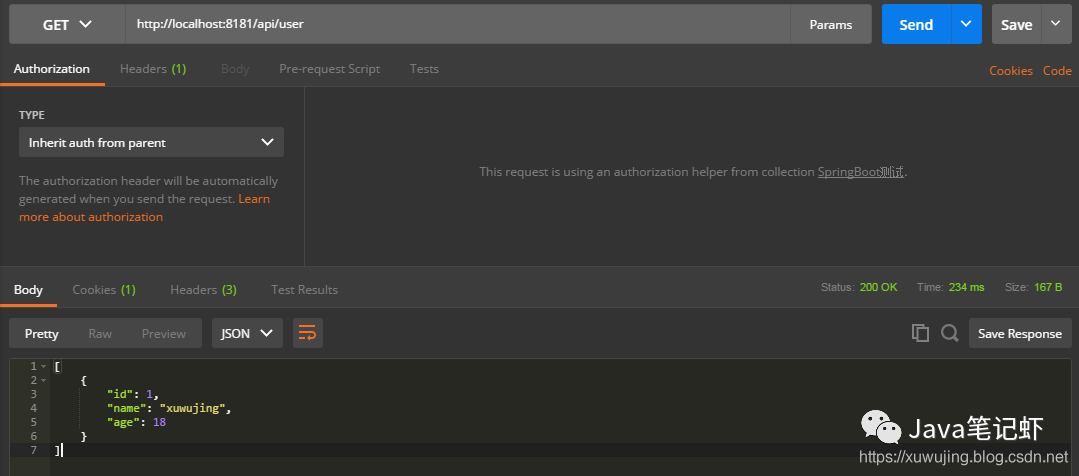
可以看到程序正常返回,并沒有因自定義的全局異常而影響。
然后我們再來測試下自定義的異常是否能夠被正確的捕獲并處理。
使用POST方式進行請求
POST http://localhost:8181/api/user
Body參數(shù)為:
{"id":1,"age":18}
返回參數(shù)為:
{"code":"-1","message":"用戶姓名不能為空!","result":null}
示例圖:
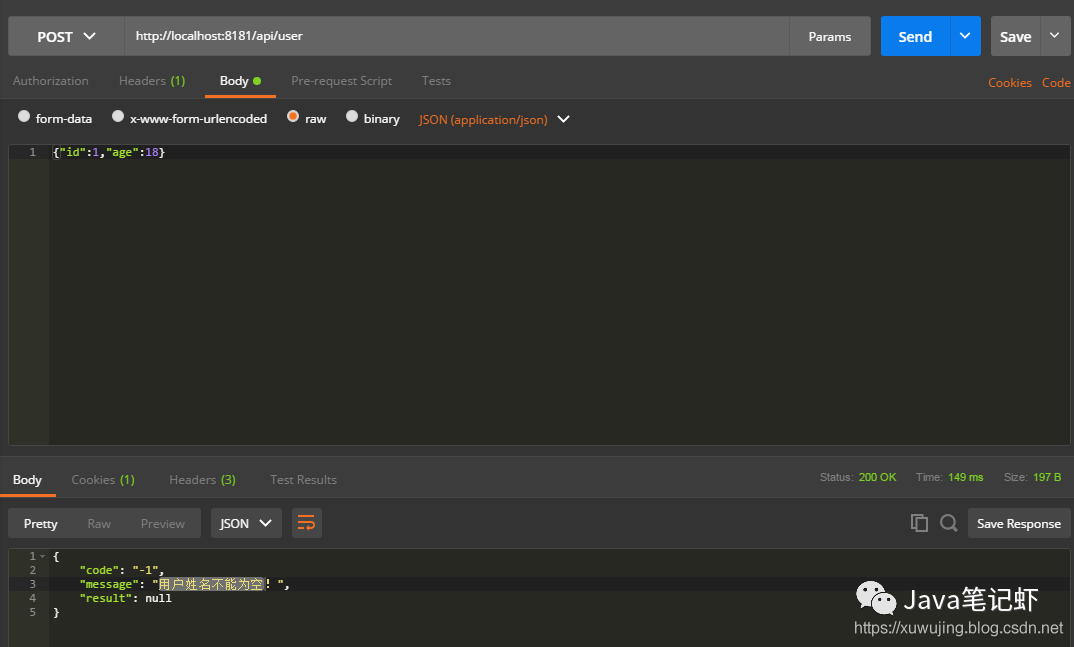
可以看出將我們拋出的異常進行數(shù)據(jù)封裝,然后將異常返回出來。
然后我們再來測試下空指針異常是否能夠被正確的捕獲并處理。在自定義全局異常中,我們除了定義空指針的異常處理,也定義最高級別之一的Exception異常,那么這里發(fā)生了空指針異常之后,它是回優(yōu)先使用哪一個呢?這里我們來測試下。
使用PUT方式進行請求。
PUT http://localhost:8181/api/user
Body參數(shù)為:
{"id":1,"age":18}
返回參數(shù)為:
{"code":"400","message":"請求的數(shù)據(jù)格式不符!","result":null}
示例圖:
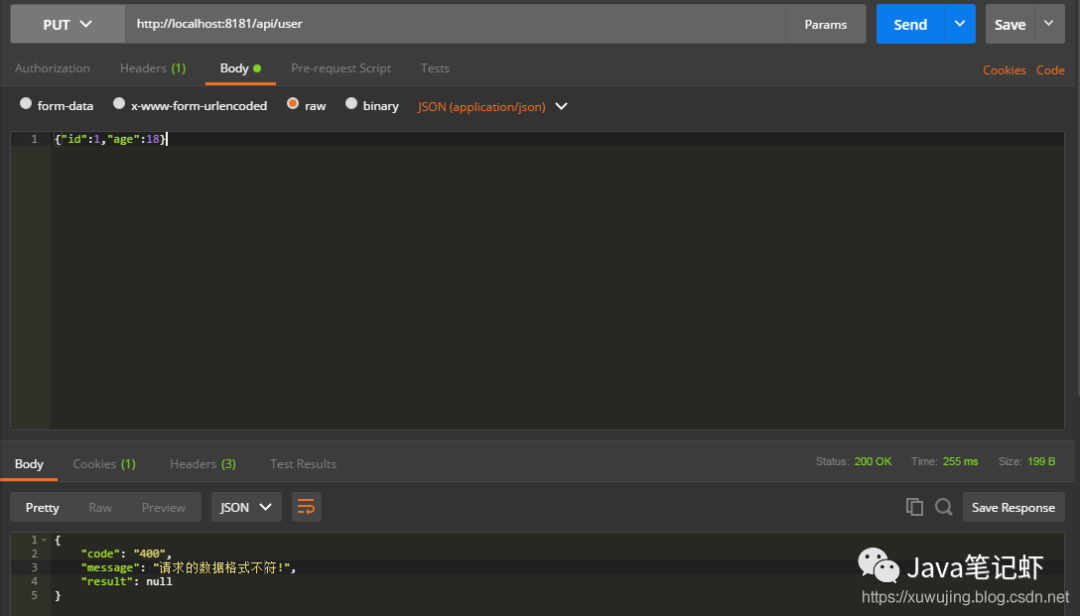
我們可以看到這里的的確是返回空指針的異常護理,可以得出全局異常處理優(yōu)先處理子類的異常。
那么我們在來試試未指定其異常的處理,看該異常是否能夠被捕獲。
使用DELETE方式進行請求。
DELETE http://localhost:8181/api/user
Body參數(shù)為:
{"id":1}
返回參數(shù)為:
{"code":"500","message":"服務(wù)器內(nèi)部錯誤!","result":null}
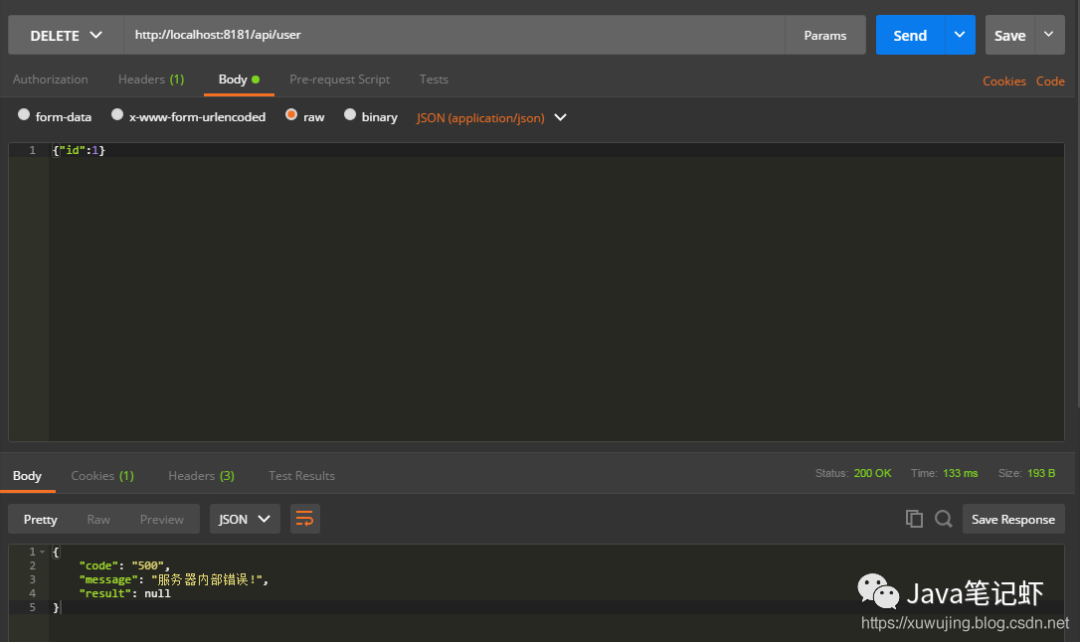
這里可以看到它使用了我們在自定義全局異常處理類中的Exception異常處理的方法。
到這里,測試就結(jié)束了。順便再說一下,自義定全局異常處理除了可以處理上述的數(shù)據(jù)格式之外,也可以處理頁面的跳轉(zhuǎn),只需在新增的異常方法的返回處理上填寫該跳轉(zhuǎn)的路徑并不使用ResponseBody 注解即可。
細(xì)心的同學(xué)也許發(fā)現(xiàn)了在GlobalExceptionHandler類中使用的是ControllerAdvice注解,而非RestControllerAdvice注解,如果是用的RestControllerAdvice注解,它會將數(shù)據(jù)自動轉(zhuǎn)換成JSON格式,這種于Controller和RestController類似,所以我們在使用全局異常處理的之后可以進行靈活的選擇處理。
其它
關(guān)于SpringBoot優(yōu)雅的全局異常處理的文章就講解到這里了,如有不妥,歡迎指正!
項目地址
SpringBoot全局異常的處理項目工程地址:
https://github.com/xuwujing/springBoot-study/tree/master/springboot-exceptionHandler
推薦閱讀
國產(chǎn)小眾瀏覽器因屏蔽視頻廣告,被索賠100萬(后續(xù))
年輕人“不講武德”:因看黃片上癮,把網(wǎng)站和786名女主播起訴了
關(guān)于程序員大白
程序員大白是一群哈工大,東北大學(xué),西湖大學(xué)和上海交通大學(xué)的碩士博士運營維護的號,大家樂于分享高質(zhì)量文章,喜歡總結(jié)知識,歡迎關(guān)注[程序員大白],大家一起學(xué)習(xí)進步!