
一文弄懂責任鏈設計模式
背景
什么是責任鏈
使用場景
結(jié)語
背景

最近,我讓團隊內(nèi)一位成員寫了一個導入功能。他使用了責任鏈模式,代碼堆的非常多,bug 也多,沒有達到我預期的效果。
實際上,針對導入功能,我認為模版方法更合適!為此,隔壁團隊也拿出我們的案例,進行了集體 code review。
學好設計模式,且不要為了練習,強行使用!讓原本 100 行就能實現(xiàn)的功能,寫了 3000 行!對錯暫且不論,我們先一起看看責任鏈設計模式吧!
什么是責任鏈
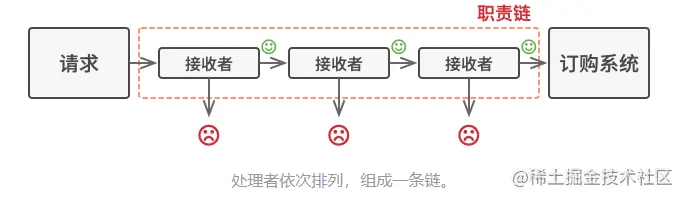
使用場景
責任鏈的使用場景還是比較多的:
多條件流程判斷:權限控制 ERP 系統(tǒng)流程審批:總經(jīng)理、人事經(jīng)理、項目經(jīng)理 Java 過濾器的底層實現(xiàn) Filter
如果不使用該設計模式,那么當需求有所改變時,就會使得代碼臃腫或者難以維護,例如下面的例子。
| 反例
假設現(xiàn)在有一個闖關游戲,進入下一關的條件是上一關的分數(shù)要高于 xx:
游戲一共 3 個關卡 進入第二關需要第一關的游戲得分大于等于 80 進入第三關需要第二關的游戲得分大于等于 90
//第一關
public class FirstPassHandler {
    public int handler(){
        System.out.println("第一關-->FirstPassHandler");
        return 80;
    }
}

//第二關
public class SecondPassHandler {
    public int handler(){
        System.out.println("第二關-->SecondPassHandler");
        return 90;
    }
}


//第三關
public class ThirdPassHandler {
    public int handler(){
        System.out.println("第三關-->ThirdPassHandler,這是最后一關啦");
        return 95;
    }
}


//客戶端
public class HandlerClient {
    public static void main(String[] args) {

        FirstPassHandler firstPassHandler = new FirstPassHandler();//第一關
        SecondPassHandler secondPassHandler = new SecondPassHandler();//第二關
        ThirdPassHandler thirdPassHandler = new ThirdPassHandler();//第三關

        int firstScore = firstPassHandler.handler();
        //第一關的分數(shù)大于等于80則進入第二關
        if(firstScore >= 80){
            int secondScore = secondPassHandler.handler();
            //第二關的分數(shù)大于等于90則進入第二關
            if(secondScore >= 90){
                thirdPassHandler.handler();
            }
        }
    }
}
if(第1關通過){
    // 第2關 游戲
    if(第2關通過){
        // 第3關 游戲
        if(第3關通過){
           // 第4關 游戲
            if(第4關通過){
                // 第5關 游戲
                if(第5關通過){
                    // 第6關 游戲
                    if(第6關通過){
                        //...
                    }
                }
            }
        }
    }
}
這種代碼不僅冗余,并且當我們要將某兩關進行調(diào)整時會對代碼非常大的改動,這種操作的風險是很高的,因此,該寫法非常糟糕。
| 初步改造
如何解決這個問題,我們可以通過鏈表將每一關連接起來,形成責任鏈的方式,第一關通過后是第二關,第二關通過后是第三關....
public class FirstPassHandler {
    /**
     * 第一關的下一關是 第二關
     */
    private SecondPassHandler secondPassHandler;

    public void setSecondPassHandler(SecondPassHandler secondPassHandler) {
        this.secondPassHandler = secondPassHandler;
    }

    //本關卡游戲得分
    private int play(){
        return 80;
    }

    public int handler(){
        System.out.println("第一關-->FirstPassHandler");
        if(play() >= 80){
            //分數(shù)>=80 并且存在下一關才進入下一關
            if(this.secondPassHandler != null){
                return this.secondPassHandler.handler();
            }
        }

        return 80;
    }
}

public class SecondPassHandler {

    /**
     * 第二關的下一關是 第三關
     */
    private ThirdPassHandler thirdPassHandler;

    public void setThirdPassHandler(ThirdPassHandler thirdPassHandler) {
        this.thirdPassHandler = thirdPassHandler;
    }

    //本關卡游戲得分
    private int play(){
        return 90;
    }

    public int handler(){
        System.out.println("第二關-->SecondPassHandler");

        if(play() >= 90){
            //分數(shù)>=90 并且存在下一關才進入下一關
            if(this.thirdPassHandler != null){
                return this.thirdPassHandler.handler();
            }
        }

        return 90;
    }
}

public class ThirdPassHandler {

    //本關卡游戲得分
    private int play(){
        return 95;
    }

    /**
     * 這是最后一關,因此沒有下一關
     */
    public int handler(){
        System.out.println("第三關-->ThirdPassHandler,這是最后一關啦");
        return play();
    }
}

public class HandlerClient {
    public static void main(String[] args) {

        FirstPassHandler firstPassHandler = new FirstPassHandler();//第一關
        SecondPassHandler secondPassHandler = new SecondPassHandler();//第二關
        ThirdPassHandler thirdPassHandler = new ThirdPassHandler();//第三關

        firstPassHandler.setSecondPassHandler(secondPassHandler);//第一關的下一關是第二關
        secondPassHandler.setThirdPassHandler(thirdPassHandler);//第二關的下一關是第三關

        //說明:因為第三關是最后一關,因此沒有下一關
        //開始調(diào)用第一關 每一個關卡是否進入下一關卡 在每個關卡中判斷
        firstPassHandler.handler();

    }
}
| 缺點
現(xiàn)有模式的缺點:
每個關卡中都有下一關的成員變量并且是不一樣的,形成鏈很不方便 代碼的擴展性非常不好
| 責任鏈改造
有了思路,我們先來簡單介紹一下責任鏈設計模式的基本組成:
抽象處理者(Handler)角色:定義一個處理請求的接口,包含抽象處理方法和一個后繼連接。 具體處理者(Concrete Handler)角色:實現(xiàn)抽象處理者的處理方法,判斷能否處理本次請求,如果可以處理請求則處理,否則將該請求轉(zhuǎn)給它的后繼者。 客戶類(Client)角色:創(chuàng)建處理鏈,并向鏈頭的具體處理者對象提交請求,它不關心處理細節(jié)和請求的傳遞過程。
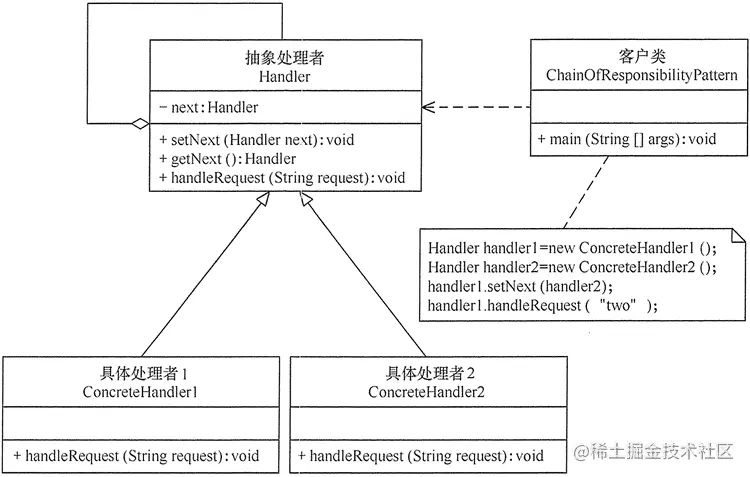
public abstract class AbstractHandler {

    /**
     * 下一關用當前抽象類來接收
     */
    protected AbstractHandler next;

    public void setNext(AbstractHandler next) {
        this.next = next;
    }

    public abstract int handler();
}

public class FirstPassHandler extends AbstractHandler{

    private int play(){
        return 80;
    }

    @Override
    public int handler(){
        System.out.println("第一關-->FirstPassHandler");
        int score = play();
        if(score >= 80){
            //分數(shù)>=80 并且存在下一關才進入下一關
            if(this.next != null){
                return this.next.handler();
            }
        }
        return score;
    }
}

public class SecondPassHandler extends AbstractHandler{

    private int play(){
        return 90;
    }

    public int handler(){
        System.out.println("第二關-->SecondPassHandler");

        int score = play();
        if(score >= 90){
            //分數(shù)>=90 并且存在下一關才進入下一關
            if(this.next != null){
                return this.next.handler();
            }
        }

        return score;
    }
}

public class ThirdPassHandler extends AbstractHandler{

    private int play(){
        return 95;
    }

    public int handler(){
        System.out.println("第三關-->ThirdPassHandler");
        int score = play();
        if(score >= 95){
            //分數(shù)>=95 并且存在下一關才進入下一關
            if(this.next != null){
                return this.next.handler();
            }
        }
        return score;
    }
}

public class HandlerClient {
    public static void main(String[] args) {

        FirstPassHandler firstPassHandler = new FirstPassHandler();//第一關
        SecondPassHandler secondPassHandler = new SecondPassHandler();//第二關
        ThirdPassHandler thirdPassHandler = new ThirdPassHandler();//第三關

        // 和上面沒有更改的客戶端代碼相比,只有這里的set方法發(fā)生變化,其他都是一樣的
        firstPassHandler.setNext(secondPassHandler);//第一關的下一關是第二關
        secondPassHandler.setNext(thirdPassHandler);//第二關的下一關是第三關

        //說明:因為第三關是最后一關,因此沒有下一關

        //從第一個關卡開始
        firstPassHandler.handler();

    }
}
| 責任鏈工廠改造
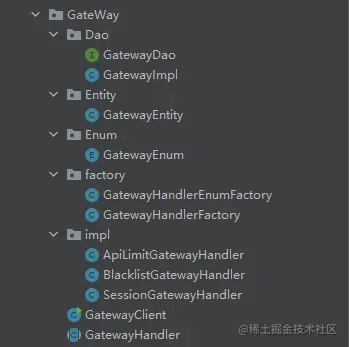
public enum GatewayEnum {
    // handlerId, 攔截者名稱,全限定類名,preHandlerId,nextHandlerId
    API_HANDLER(new GatewayEntity(1, "api接口限流", "cn.dgut.design.chain_of_responsibility.GateWay.impl.ApiLimitGatewayHandler", null, 2)),
    BLACKLIST_HANDLER(new GatewayEntity(2, "黑名單攔截", "cn.dgut.design.chain_of_responsibility.GateWay.impl.BlacklistGatewayHandler", 1, 3)),
    SESSION_HANDLER(new GatewayEntity(3, "用戶會話攔截", "cn.dgut.design.chain_of_responsibility.GateWay.impl.SessionGatewayHandler", 2, null)),
    ;

    GatewayEntity gatewayEntity;

    public GatewayEntity getGatewayEntity() {
        return gatewayEntity;
    }

    GatewayEnum(GatewayEntity gatewayEntity) {
        this.gatewayEntity = gatewayEntity;
    }
}

public class GatewayEntity {

    private String name;

    private String conference;

    private Integer handlerId;

    private Integer preHandlerId;

    private Integer nextHandlerId;
}


public interface GatewayDao {

    /**
     * 根據(jù) handlerId 獲取配置項
     * @param handlerId
     * @return
     */
    GatewayEntity getGatewayEntity(Integer handlerId);

    /**
     * 獲取第一個處理者
     * @return
     */
    GatewayEntity getFirstGatewayEntity();
}

public class GatewayImpl implements GatewayDao {

    /**
     * 初始化,將枚舉中配置的handler初始化到map中,方便獲取
     */
    private static Map<Integer, GatewayEntity> gatewayEntityMap = new HashMap<>();

    static {
        GatewayEnum[] values = GatewayEnum.values();
        for (GatewayEnum value : values) {
            GatewayEntity gatewayEntity = value.getGatewayEntity();
            gatewayEntityMap.put(gatewayEntity.getHandlerId(), gatewayEntity);
        }
    }

    @Override
    public GatewayEntity getGatewayEntity(Integer handlerId) {
        return gatewayEntityMap.get(handlerId);
    }

    @Override
    public GatewayEntity getFirstGatewayEntity() {
        for (Map.Entry<Integer, GatewayEntity> entry : gatewayEntityMap.entrySet()) {
            GatewayEntity value = entry.getValue();
            //  沒有上一個handler的就是第一個
            if (value.getPreHandlerId() == null) {
                return value;
            }
        }
        return null;
    }
}

public class GatewayHandlerEnumFactory {

    private static GatewayDao gatewayDao = new GatewayImpl();

    // 提供靜態(tài)方法,獲取第一個handler
    public static GatewayHandler getFirstGatewayHandler() {

        GatewayEntity firstGatewayEntity = gatewayDao.getFirstGatewayEntity();
        GatewayHandler firstGatewayHandler = newGatewayHandler(firstGatewayEntity);
        if (firstGatewayHandler == null) {
            return null;
        }

        GatewayEntity tempGatewayEntity = firstGatewayEntity;
        Integer nextHandlerId = null;
        GatewayHandler tempGatewayHandler = firstGatewayHandler;
        // 迭代遍歷所有handler,以及將它們鏈接起來
        while ((nextHandlerId = tempGatewayEntity.getNextHandlerId()) != null) {
            GatewayEntity gatewayEntity = gatewayDao.getGatewayEntity(nextHandlerId);
            GatewayHandler gatewayHandler = newGatewayHandler(gatewayEntity);
            tempGatewayHandler.setNext(gatewayHandler);
            tempGatewayHandler = gatewayHandler;
            tempGatewayEntity = gatewayEntity;
        }
    // 返回第一個handler
        return firstGatewayHandler;
    }

    /**
     * 反射實體化具體的處理者
     * @param firstGatewayEntity
     * @return
     */
    private static GatewayHandler newGatewayHandler(GatewayEntity firstGatewayEntity) {
        // 獲取全限定類名
        String className = firstGatewayEntity.getConference();
        try {
            // 根據(jù)全限定類名,加載并初始化該類,即會初始化該類的靜態(tài)段
            Class<?> clazz = Class.forName(className);
            return (GatewayHandler) clazz.newInstance();
        } catch (ClassNotFoundException | IllegalAccessException | InstantiationException e) {
            e.printStackTrace();
        }
        return null;
    }


}

public class GetewayClient {
    public static void main(String[] args) {
        GetewayHandler firstGetewayHandler = GetewayHandlerEnumFactory.getFirstGetewayHandler();
        firstGetewayHandler.service();
    }
}
結(jié)語
設計模式有很多,責任鏈只是其中的一種,我覺得很有意思,非常值得一學。設計模式確實是一門藝術,仍需努力呀!
推薦閱讀:
不是你需要中臺,而是一名合格的架構師(附各大廠中臺建設PPT)
論數(shù)字化轉(zhuǎn)型——轉(zhuǎn)什么,如何轉(zhuǎn)?
企業(yè)10大管理流程圖,數(shù)字化轉(zhuǎn)型從業(yè)者必備!
【中臺實踐】華為大數(shù)據(jù)中臺架構分享.pdf