向量
共 5688字,需瀏覽 12分鐘
·
2023-07-07 13:22
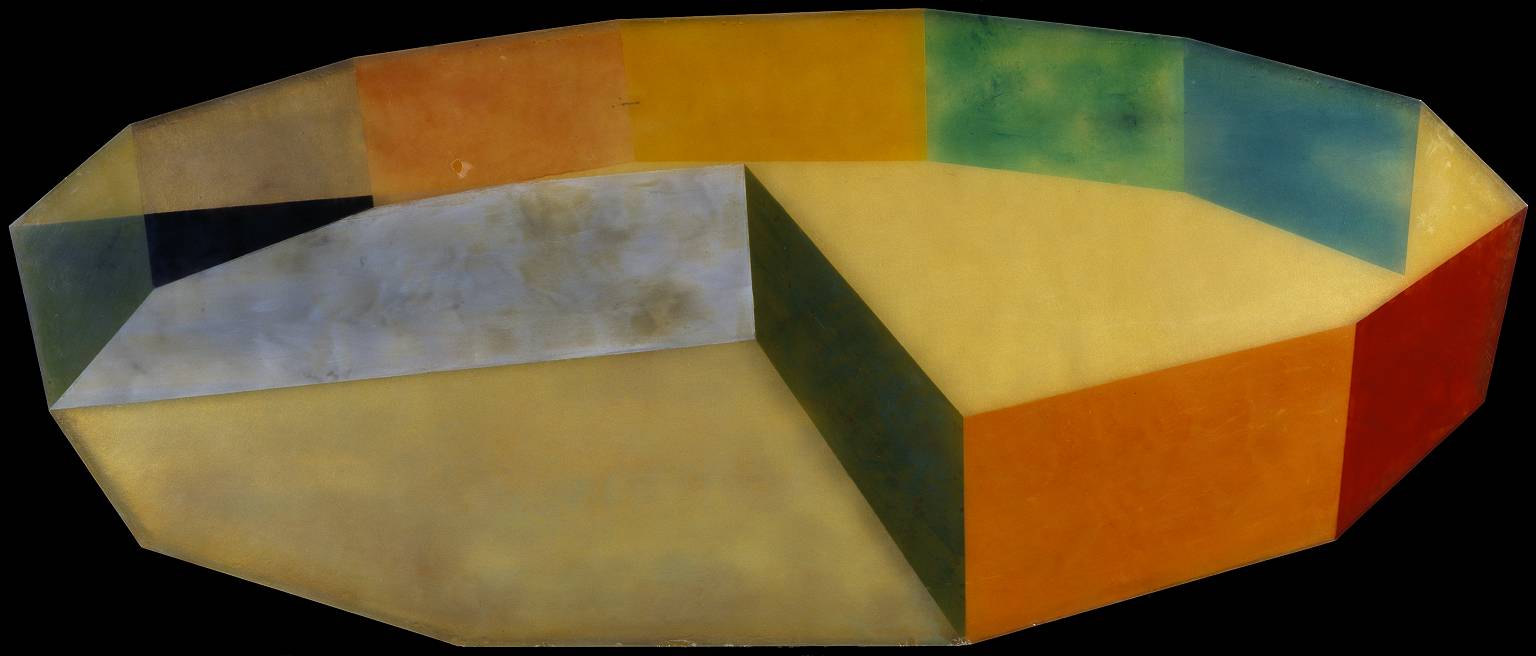
Catalogue entry Ronald Davis born 1937 T01068 Vector 1968 Not inscribed
Resin and fibreglass (dodecagon), 56 1/2 x 136 x 2 1/8 (143.5 x 345 x 5.5)
Purchased from the artist through Leo Castelli (Grant-in-Aid) 1968
Exh: Ron Davis , Leo Castelli, New York, April 1968 (no catalogue)
Lit: Annette Michelson, 'New York' in Artforum , VI, May 1968, pp.56-7, repr. p.56; Terry Fenton, 'Introduction' to exh. catalogue Ron Davis: Eight Paintings , Norman Mackenzie Art Gallery, University of Sask., Regina Campus, September-October 1969, n.p.
Repr: The Tate Gallery (London 1969), p.205 in colour; Sam Hunter, American Art of the 20th Century (New York 1972), pl. 638 in colour This is one of a series of twenty-nine large dodecagons made between January 1968 and October 1969 from the same mould, the same basic shape serving in each case as the starting-point for the exploration of a different effect of perspective and spatial ambiguity. As the title of one of them, 'Paolo', implies, this shape was chosen partly because of its resemblance to the perspective studies of mazzocchi made by Renaissance artists such as Paolo Uccello and Piero della Francesca. The titles 'Radial', 'Ring', 'Inside Light', 'Blue Float' and so on, draw attention to the particular character of the individual works. Thus the Shorter Oxford Dictionary gives one of the definitions of 'Vector' as 'An imaginary straight line joining a planet moving round a centre, of the focus of an ellipse, to that centre or focus', which relates to the line that cuts across the centre of this work. Nevertheless the spatial structure remains extremely complex and resists any definitive reading. For example, the yellow plane on the right appears in relation to the green and orange 'vertical' planes in the right foreground as part of the 'roof' of the form , while in relation to the coloured planes at the top it seems to be the 'floor'. (Annette Michelson has published an analysis of the spatial ambiguities of this and another work of the series in Artforum , loc. cit.). All these paintings were produced by brushing gel-coat resins containing pigment onto a flat formica mould, reinforcing the hardened plastic from the back, then lifting the paint surface and fibreglass backing away from the mould. The artist has summarised the stages leading up to these works as follows (letter of 21 April 1976): 'I started painting in 1959 and soon after enrolled at the San Francisco Art Institute. While at the SFAI I painted with oil on canvas - organic, painterly abstractions strongly influenced by the work of Clyfford Still. 'In 1962 I studied at the Yale-Norfolk School of Art and visited New York galleries. I was particularly impressed by the pop artists (they broke the ice for me) and Frank Stella. 'Late in 1963 I began to: (1) Use acrylic paint
(2) Use masking tape
(3) Shape the stretcher bars
(4) Use optical colour
(5) Use isometric perspective 'These paintings employed various optical illusions, garnered from such diverse sources as Persian miniatures , early Christian mosaics, Paul Klee, late Kandinsky, illustrations from "Scientific American", or even advertising billboards. 'In 1965 for my first one-man show (at the Nicholas Wilder Gallery in Los Angeles) I painted a group of monochromatic paintings, acrylic on canvas, shaped on 4in deep stretcher bars. The perimeter of these one-colour panels defined an isometric or one point perspective plane. The concept of "painting as an object" was extended to "painting as the illusion of a plane in space" - literally, on the wall. 'The year 1966 was pivotal in the development of my painting. Two point perspective was incorporated in a series of eleven paintings. The illusion of a slab divided into a nine square grid defined the irregular shape of these plastic paintings. Polyester resin plus pigments and dyes were substituted for traditional painting mediums. Liquid resin does not dry - it cures in about thirty minutes by means of a chemical heat reaction. Fiberglas cloth and mat replaced canvas as reinforcement and support for the coloured resin (paint). They were painted with a brush face down on a waxed Formica table mold. The illusionary plane nearest the viewer was masked out with tape and painted first, the furthest away was painted last. Layers of fiberglas impregnated with resin were laminated to the back of the painting. A wood stretcher bar the shape of the image was attached to the resin painting reinforced with fiberglas. (On later plastic paintings the wood was eliminated - the sides were molded as one piece onto the painting). The completed painting was peeled from the waxed mold and polished. I viewed the painting for the first time only after it was completed .... 'I made small preliminary drawings for these paintings, then cartooned these classical three-point perspective drawings in scale on the formica mold. 'In a given series of paintings one work led to another, although in such a series I tend to oscillate between a "flat" painting and a more painterly treatment'. 'Vector' is No. 65 in the artist's catalogue. Several other works from the same series are also owned by museums, as follows: 'Ring' 1968 (No. 55): Museum of Modern Art, New York
'Turn (2/3)' 1968 (No. 68): Art Institute of Chicago
'Roto' 1968 (No. 71): Los Angeles County Museum
'Five Twelfths' 1968 (No. 80): Wallraf-Richartz-Museum, Cologne
'Silver Top' 1968 (No. 95): San Francisco Museum