
聊聊Spring事務(wù)失效的12種場景,太坑了!
前言
對于從事java開發(fā)工作的同學(xué)來說,spring的事務(wù)肯定再熟悉不過了。
在某些業(yè)務(wù)場景下,如果一個請求中,需要同時寫入多張表的數(shù)據(jù)。為了保證操作的原子性(要么同時成功,要么同時失敗),避免數(shù)據(jù)不一致的情況,我們一般都會用到spring事務(wù)。
確實,spring事務(wù)用起來賊爽,就用一個簡單的注解:@Transactional,就能輕松搞定事務(wù)。我猜大部分小伙伴也是這樣用的,而且一直用一直爽。
但如果你使用不當,它也會坑你于無形。
今天我們就一起聊聊,事務(wù)失效的一些場景,說不定你已經(jīng)中招了。不信,讓我們一起看看。
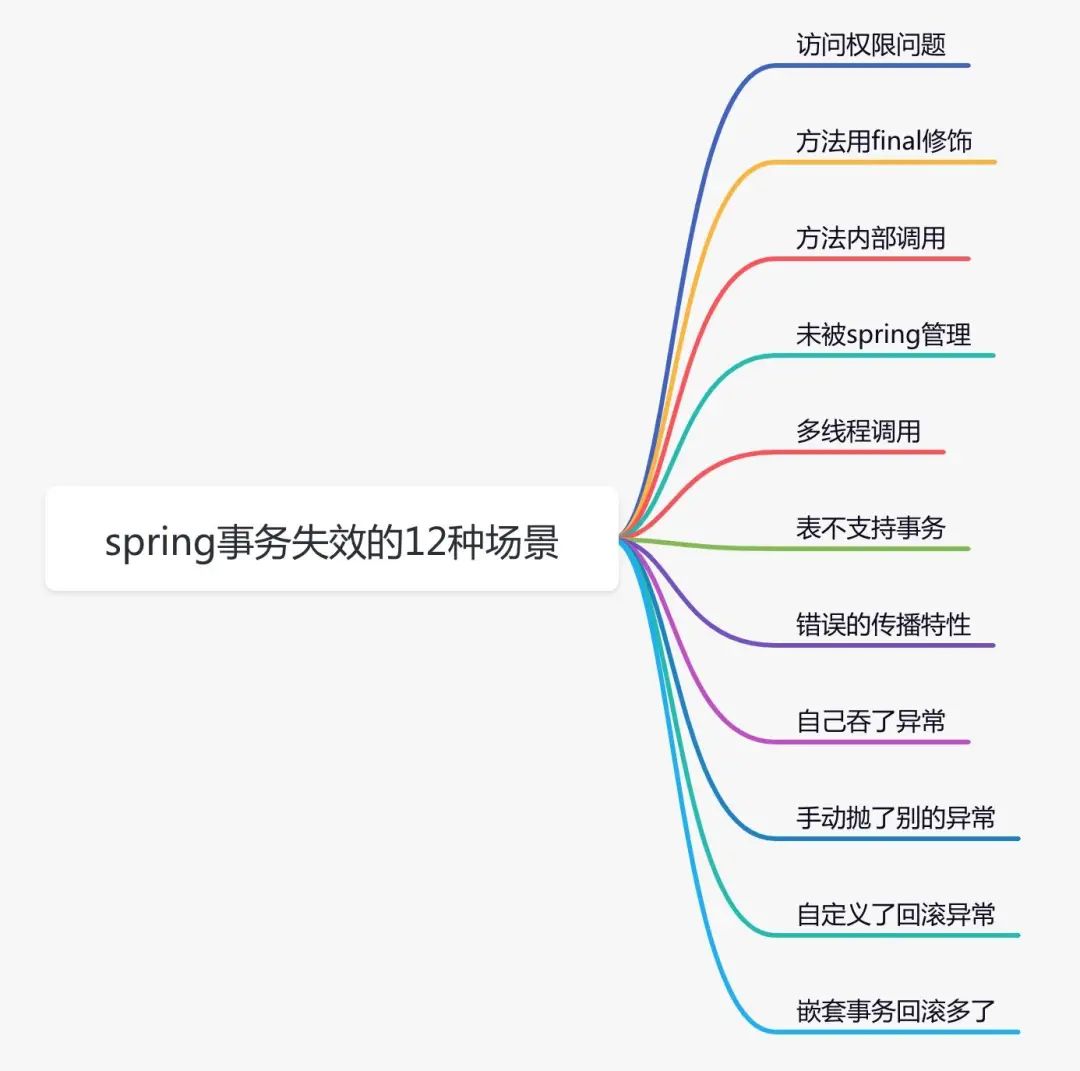
一 事務(wù)不生效
1.訪問權(quán)限問題
眾所周知,java的訪問權(quán)限主要有四種:private、default、protected、public,它們的權(quán)限從左到右,依次變大。
但如果我們在開發(fā)過程中,把有某些事務(wù)方法,定義了錯誤的訪問權(quán)限,就會導(dǎo)致事務(wù)功能出問題,例如:
@Service
public class UserService {

    @Transactional
    private void add(UserModel userModel) {
         saveData(userModel);
         updateData(userModel);
    }
}
我們可以看到add方法的訪問權(quán)限被定義成了private,這樣會導(dǎo)致事務(wù)失效,spring要求被代理方法必須是public的。
說白了,在AbstractFallbackTransactionAttributeSource類的computeTransactionAttribute方法中有個判斷,如果目標方法不是public,則TransactionAttribute返回null,即不支持事務(wù)。
protected TransactionAttribute computeTransactionAttribute(Method method, @Nullable Class<?> targetClass) {
    // Don't allow no-public methods as required.
    if (allowPublicMethodsOnly() && !Modifier.isPublic(method.getModifiers())) {
      return null;
    }

    // The method may be on an interface, but we need attributes from the target class.
    // If the target class is null, the method will be unchanged.
    Method specificMethod = AopUtils.getMostSpecificMethod(method, targetClass);

    // First try is the method in the target class.
    TransactionAttribute txAttr = findTransactionAttribute(specificMethod);
    if (txAttr != null) {
      return txAttr;
    }

    // Second try is the transaction attribute on the target class.
    txAttr = findTransactionAttribute(specificMethod.getDeclaringClass());
    if (txAttr != null && ClassUtils.isUserLevelMethod(method)) {
      return txAttr;
    }

    if (specificMethod != method) {
      // Fallback is to look at the original method.
      txAttr = findTransactionAttribute(method);
      if (txAttr != null) {
        return txAttr;
      }
      // Last fallback is the class of the original method.
      txAttr = findTransactionAttribute(method.getDeclaringClass());
      if (txAttr != null && ClassUtils.isUserLevelMethod(method)) {
        return txAttr;
      }
    }
    return null;
  }
也就是說,如果我們自定義的事務(wù)方法(即目標方法),它的訪問權(quán)限不是public,而是private、default或protected的話,spring則不會提供事務(wù)功能。
2. 方法用final修飾
有時候,某個方法不想被子類重新,這時可以將該方法定義成final的。普通方法這樣定義是沒問題的,但如果將事務(wù)方法定義成final,例如:
@Service
public class UserService {

    @Transactional
    public final void add(UserModel userModel){
        saveData(userModel);
        updateData(userModel);
    }
}
我們可以看到add方法被定義成了final的,這樣會導(dǎo)致事務(wù)失效。
為什么?
如果你看過spring事務(wù)的源碼,可能會知道spring事務(wù)底層使用了aop,也就是通過jdk動態(tài)代理或者cglib,幫我們生成了代理類,在代理類中實現(xiàn)的事務(wù)功能。
但如果某個方法用final修飾了,那么在它的代理類中,就無法重寫該方法,而添加事務(wù)功能。
注意:如果某個方法是static的,同樣無法通過動態(tài)代理,變成事務(wù)方法。
3.方法內(nèi)部調(diào)用
有時候我們需要在某個Service類的某個方法中,調(diào)用另外一個事務(wù)方法,比如:
@Service
public class UserService {

    @Autowired
    private UserMapper userMapper;

    @Transactional
    public void add(UserModel userModel) {
        userMapper.insertUser(userModel);
        updateStatus(userModel);
    }

    @Transactional
    public void updateStatus(UserModel userModel) {
        doSameThing();
    }
}
我們看到在事務(wù)方法add中,直接調(diào)用事務(wù)方法updateStatus。從前面介紹的內(nèi)容可以知道,updateStatus方法擁有事務(wù)的能力是因為spring aop生成代理了對象,但是這種方法直接調(diào)用了this對象的方法,所以updateStatus方法不會生成事務(wù)。
由此可見,在同一個類中的方法直接內(nèi)部調(diào)用,會導(dǎo)致事務(wù)失效。
那么問題來了,如果有些場景,確實想在同一個類的某個方法中,調(diào)用它自己的另外一個方法,該怎么辦呢?
3.1 新加一個Service方法
這個方法非常簡單,只需要新加一個Service方法,把@Transactional注解加到新Service方法上,把需要事務(wù)執(zhí)行的代碼移到新方法中。具體代碼如下:
@Servcie
public class ServiceA {
   @Autowired
   prvate ServiceB serviceB;

   public void save(User user) {
         queryData1();
         queryData2();
         serviceB.doSave(user);
   }
 }

 @Servcie
 public class ServiceB {

    @Transactional(rollbackFor=Exception.class)
    public void doSave(User user) {
       addData1();
       updateData2();
    }

 }
3.2 在該Service類中注入自己
如果不想再新加一個Service類,在該Service類中注入自己也是一種選擇。具體代碼如下:
@Servcie
public class ServiceA {
   @Autowired
   prvate ServiceA serviceA;

   public void save(User user) {
         queryData1();
         queryData2();
         serviceA.doSave(user);
   }

   @Transactional(rollbackFor=Exception.class)
   public void doSave(User user) {
       addData1();
       updateData2();
    }
 }
可能有些人可能會有這樣的疑問:這種做法會不會出現(xiàn)循環(huán)依賴問題?
答案:不會。
其實spring ioc內(nèi)部的三級緩存保證了它,不會出現(xiàn)循環(huán)依賴問題。但有些坑,如果你想進一步了解循環(huán)依賴問題,可以看看我之前文章《spring:我是如何解決循環(huán)依賴的?》。
3.3 通過AopContent類
在該Service類中使用AopContext.currentProxy()獲取代理對象
上面的方法2確實可以解決問題,但是代碼看起來并不直觀,還可以通過在該Service類中使用AOPProxy獲取代理對象,實現(xiàn)相同的功能。具體代碼如下:
@Servcie
public class ServiceA {

   public void save(User user) {
         queryData1();
         queryData2();
         ((ServiceA)AopContext.currentProxy()).doSave(user);
   }

   @Transactional(rollbackFor=Exception.class)
   public void doSave(User user) {
       addData1();
       updateData2();
    }
 }
4.未被spring管理
在我們平時開發(fā)過程中,有個細節(jié)很容易被忽略。即使用spring事務(wù)的前提是:對象要被spring管理,需要創(chuàng)建bean實例。
通常情況下,我們通過@Controller、@Service、@Component、@Repository等注解,可以自動實現(xiàn)bean實例化和依賴注入的功能。
當然創(chuàng)建bean實例的方法還有很多,有興趣的小伙伴可以看看我之前寫的另一篇文章《@Autowired的這些騷操作,你都知道嗎?》
如果有一天,你匆匆忙忙的開發(fā)了一個Service類,但忘了加@Service注解,比如:
//@Service
public class UserService {

    @Transactional
    public void add(UserModel userModel) {
         saveData(userModel);
         updateData(userModel);
    }
}
從上面的例子,我們可以看到UserService類沒有加@Service注解,那么該類不會交給spring管理,所以它的add方法也不會生成事務(wù)。
5.多線程調(diào)用
在實際項目開發(fā)中,多線程的使用場景還是挺多的。如果spring事務(wù)用在多線程場景中,會有問題嗎?
@Slf4j
@Service
public class UserService {

    @Autowired
    private UserMapper userMapper;
    @Autowired
    private RoleService roleService;

    @Transactional
    public void add(UserModel userModel) throws Exception {
        userMapper.insertUser(userModel);
        new Thread(() -> {
            roleService.doOtherThing();
        }).start();
    }
}

@Service
public class RoleService {

    @Transactional
    public void doOtherThing() {
        System.out.println("保存role表數(shù)據(jù)");
    }
}
從上面的例子中,我們可以看到事務(wù)方法add中,調(diào)用了事務(wù)方法doOtherThing,但是事務(wù)方法doOtherThing是在另外一個線程中調(diào)用的。
這樣會導(dǎo)致兩個方法不在同一個線程中,獲取到的數(shù)據(jù)庫連接不一樣,從而是兩個不同的事務(wù)。如果想doOtherThing方法中拋了異常,add方法也回滾是不可能的。
如果看過spring事務(wù)源碼的朋友,可能會知道spring的事務(wù)是通過數(shù)據(jù)庫連接來實現(xiàn)的。當前線程中保存了一個map,key是數(shù)據(jù)源,value是數(shù)據(jù)庫連接。
private static final ThreadLocal<Map<Object, Object>> resources =

  new NamedThreadLocal<>("Transactional resources");
我們說的同一個事務(wù),其實是指同一個數(shù)據(jù)庫連接,只有擁有同一個數(shù)據(jù)庫連接才能同時提交和回滾。如果在不同的線程,拿到的數(shù)據(jù)庫連接肯定是不一樣的,所以是不同的事務(wù)。
6.表不支持事務(wù)
周所周知,在mysql5之前,默認的數(shù)據(jù)庫引擎是myisam。
它的好處就不用多說了:索引文件和數(shù)據(jù)文件是分開存儲的,對于查多寫少的單表操作,性能比innodb更好。
有些老項目中,可能還在用它。
在創(chuàng)建表的時候,只需要把ENGINE參數(shù)設(shè)置成MyISAM即可:
CREATE TABLE `category` (
  `id` bigint NOT NULL AUTO_INCREMENT,
  `one_category` varchar(20) COLLATE utf8mb4_bin DEFAULT NULL,
  `two_category` varchar(20) COLLATE utf8mb4_bin DEFAULT NULL,
  `three_category` varchar(20) COLLATE utf8mb4_bin DEFAULT NULL,
  `four_category` varchar(20) COLLATE utf8mb4_bin DEFAULT NULL,
  PRIMARY KEY (`id`)
) ENGINE=MyISAM AUTO_INCREMENT=4 DEFAULT CHARSET=utf8mb4 COLLATE=utf8mb4_bin
myisam好用,但有個很致命的問題是:不支持事務(wù)。
如果只是單表操作還好,不會出現(xiàn)太大的問題。但如果需要跨多張表操作,由于其不支持事務(wù),數(shù)據(jù)極有可能會出現(xiàn)不完整的情況。
此外,myisam還不支持行鎖和外鍵。
所以在實際業(yè)務(wù)場景中,myisam使用的并不多。在mysql5以后,myisam已經(jīng)逐漸退出了歷史的舞臺,取而代之的是innodb。
有時候我們在開發(fā)的過程中,發(fā)現(xiàn)某張表的事務(wù)一直都沒有生效,那不一定是spring事務(wù)的鍋,最好確認一下你使用的那張表,是否支持事務(wù)。
7.未開啟事務(wù)
有時候,事務(wù)沒有生效的根本原因是沒有開啟事務(wù)。
你看到這句話可能會覺得好笑。
開啟事務(wù)不是一個項目中,最最最基本的功能嗎?
為什么還會沒有開啟事務(wù)?
沒錯,如果項目已經(jīng)搭建好了,事務(wù)功能肯定是有的。
但如果你是在搭建項目demo的時候,只有一張表,而這張表的事務(wù)沒有生效。那么會是什么原因造成的呢?
當然原因有很多,但沒有開啟事務(wù),這個原因極其容易被忽略。
如果你使用的是springboot項目,那么你很幸運。因為springboot通過DataSourceTransactionManagerAutoConfiguration類,已經(jīng)默默的幫你開啟了事務(wù)。
你所要做的事情很簡單,只需要配置spring.datasource相關(guān)參數(shù)即可。
但如果你使用的還是傳統(tǒng)的spring項目,則需要在applicationContext.xml文件中,手動配置事務(wù)相關(guān)參數(shù)。如果忘了配置,事務(wù)肯定是不會生效的。
具體配置如下信息:
<!-- 配置事務(wù)管理器 -->
<bean class="org.springframework.jdbc.datasource.DataSourceTransactionManager" id="transactionManager">
    <property name="dataSource" ref="dataSource"></property>
</bean>
<tx:advice id="advice" transaction-manager="transactionManager">
    <tx:attributes>
        <tx:method name="*" propagation="REQUIRED"/>
    </tx:attributes>
</tx:advice>
<!-- 用切點把事務(wù)切進去 -->
<aop:config>
    <aop:pointcut expression="execution(* com.susan.*.*(..))" id="pointcut"/>
    <aop:advisor advice-ref="advice" pointcut-ref="pointcut"/>
</aop:config>
默默的說一句,如果在pointcut標簽中的切入點匹配規(guī)則,配錯了的話,有些類的事務(wù)也不會生效。
二 事務(wù)不回滾
1.錯誤的傳播特性
其實,我們在使用@Transactional注解時,是可以指定propagation參數(shù)的。
該參數(shù)的作用是指定事務(wù)的傳播特性,spring目前支持7種傳播特性:
REQUIRED如果當前上下文中存在事務(wù),那么加入該事務(wù),如果不存在事務(wù),創(chuàng)建一個事務(wù),這是默認的傳播屬性值。SUPPORTS如果當前上下文存在事務(wù),則支持事務(wù)加入事務(wù),如果不存在事務(wù),則使用非事務(wù)的方式執(zhí)行。MANDATORY如果當前上下文中存在事務(wù),否則拋出異常。REQUIRES_NEW每次都會新建一個事務(wù),并且同時將上下文中的事務(wù)掛起,執(zhí)行當前新建事務(wù)完成以后,上下文事務(wù)恢復(fù)再執(zhí)行。NOT_SUPPORTED如果當前上下文中存在事務(wù),則掛起當前事務(wù),然后新的方法在沒有事務(wù)的環(huán)境中執(zhí)行。NEVER如果當前上下文中存在事務(wù),則拋出異常,否則在無事務(wù)環(huán)境上執(zhí)行代碼。NESTED如果當前上下文中存在事務(wù),則嵌套事務(wù)執(zhí)行,如果不存在事務(wù),則新建事務(wù)。
如果我們在手動設(shè)置propagation參數(shù)的時候,把傳播特性設(shè)置錯了,比如:
@Service
public class UserService {

    @Transactional(propagation = Propagation.NEVER)
    public void add(UserModel userModel) {
        saveData(userModel);
        updateData(userModel);
    }
}
我們可以看到add方法的事務(wù)傳播特性定義成了Propagation.NEVER,這種類型的傳播特性不支持事務(wù),如果有事務(wù)則會拋異常。
目前只有這三種傳播特性才會創(chuàng)建新事務(wù):REQUIRED,REQUIRES_NEW,NESTED。
2.自己吞了異常
事務(wù)不會回滾,最常見的問題是:開發(fā)者在代碼中手動try...catch了異常。比如:
@Slf4j
@Service
public class UserService {

    @Transactional
    public void add(UserModel userModel) {
        try {
            saveData(userModel);
            updateData(userModel);
        } catch (Exception e) {
            log.error(e.getMessage(), e);
        }
    }
}
這種情況下spring事務(wù)當然不會回滾,因為開發(fā)者自己捕獲了異常,又沒有手動拋出,換句話說就是把異常吞掉了。
如果想要spring事務(wù)能夠正常回滾,必須拋出它能夠處理的異常。如果沒有拋異常,則spring認為程序是正常的。
3.手動拋了別的異常
即使開發(fā)者沒有手動捕獲異常,但如果拋的異常不正確,spring事務(wù)也不會回滾。
@Slf4j
@Service
public class UserService {

    @Transactional
    public void add(UserModel userModel) throws Exception {
        try {
             saveData(userModel);
             updateData(userModel);
        } catch (Exception e) {
            log.error(e.getMessage(), e);
            throw new Exception(e);
        }
    }
}
上面的這種情況,開發(fā)人員自己捕獲了異常,又手動拋出了異常:Exception,事務(wù)同樣不會回滾。
因為spring事務(wù),默認情況下只會回滾RuntimeException(運行時異常)和Error(錯誤),對于普通的Exception(非運行時異常),它不會回滾。
4.自定義了回滾異常
在使用@Transactional注解聲明事務(wù)時,有時我們想自定義回滾的異常,spring也是支持的。可以通過設(shè)置rollbackFor參數(shù),來完成這個功能。
但如果這個參數(shù)的值設(shè)置錯了,就會引出一些莫名其妙的問題,例如:
@Slf4j
@Service
public class UserService {

    @Transactional(rollbackFor = BusinessException.class)
    public void add(UserModel userModel) throws Exception {
       saveData(userModel);
       updateData(userModel);
    }
}
如果在執(zhí)行上面這段代碼,保存和更新數(shù)據(jù)時,程序報錯了,拋了SqlException、DuplicateKeyException等異常。而BusinessException是我們自定義的異常,報錯的異常不屬于BusinessException,所以事務(wù)也不會回滾。
即使rollbackFor有默認值,但阿里巴巴開發(fā)者規(guī)范中,還是要求開發(fā)者重新指定該參數(shù)。
這是為什么呢?
因為如果使用默認值,一旦程序拋出了Exception,事務(wù)不會回滾,這會出現(xiàn)很大的bug。所以,建議一般情況下,將該參數(shù)設(shè)置成:Exception或Throwable。
5.嵌套事務(wù)回滾多了
public class UserService {

    @Autowired
    private UserMapper userMapper;

    @Autowired
    private RoleService roleService;

    @Transactional
    public void add(UserModel userModel) throws Exception {
        userMapper.insertUser(userModel);
        roleService.doOtherThing();
    }
}

@Service
public class RoleService {

    @Transactional(propagation = Propagation.NESTED)
    public void doOtherThing() {
        System.out.println("保存role表數(shù)據(jù)");
    }
}
這種情況使用了嵌套的內(nèi)部事務(wù),原本是希望調(diào)用roleService.doOtherThing方法時,如果出現(xiàn)了異常,只回滾doOtherThing方法里的內(nèi)容,不回滾 userMapper.insertUser里的內(nèi)容,即回滾保存點。。但事實是,insertUser也回滾了。
why?
因為doOtherThing方法出現(xiàn)了異常,沒有手動捕獲,會繼續(xù)往上拋,到外層add方法的代理方法中捕獲了異常。所以,這種情況是直接回滾了整個事務(wù),不只回滾單個保存點。
怎么樣才能只回滾保存點呢?
@Slf4j
@Service
public class UserService {

    @Autowired
    private UserMapper userMapper;

    @Autowired
    private RoleService roleService;

    @Transactional
    public void add(UserModel userModel) throws Exception {

        userMapper.insertUser(userModel);
        try {
            roleService.doOtherThing();
        } catch (Exception e) {
            log.error(e.getMessage(), e);
        }
    }
}
可以將內(nèi)部嵌套事務(wù)放在try/catch中,并且不繼續(xù)往上拋異常。這樣就能保證,如果內(nèi)部嵌套事務(wù)中出現(xiàn)異常,只回滾內(nèi)部事務(wù),而不影響外部事務(wù)。
三 其他
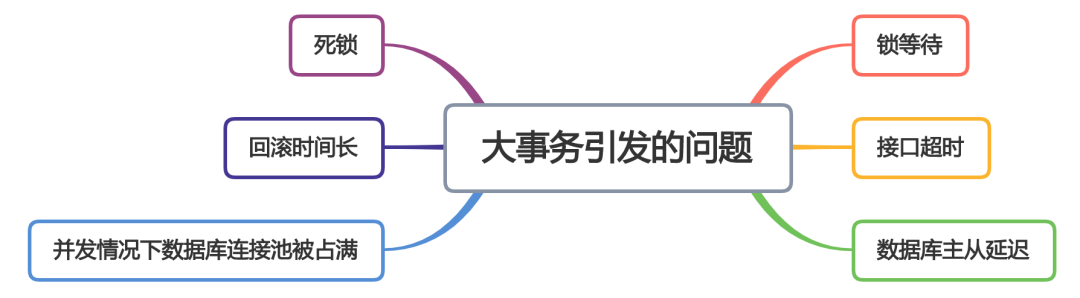
1 大事務(wù)問題
在使用spring事務(wù)時,有個讓人非常頭疼的問題,就是大事務(wù)問題。
通常情況下,我們會在方法上@Transactional注解,填加事務(wù)功能,比如:
@Service
public class UserService {

    @Autowired
    private RoleService roleService;

    @Transactional
    public void add(UserModel userModel) throws Exception {
       query1();
       query2();
       query3();
       roleService.save(userModel);
       update(userModel);
    }
}


@Service
public class RoleService {

    @Autowired
    private RoleService roleService;

    @Transactional
    public void save(UserModel userModel) throws Exception {
       query4();
       query5();
       query6();
       saveData(userModel);
    }
}
但@Transactional注解,如果被加到方法上,有個缺點就是整個方法都包含在事務(wù)當中了。
上面的這個例子中,在UserService類中,其實只有這兩行才需要事務(wù):
roleService.save(userModel);
update(userModel);
在RoleService類中,只有這一行需要事務(wù):
saveData(userModel);
現(xiàn)在的這種寫法,會導(dǎo)致所有的query方法也被包含在同一個事務(wù)當中。
如果query方法非常多,調(diào)用層級很深,而且有部分查詢方法比較耗時的話,會造成整個事務(wù)非常耗時,而從造成大事務(wù)問題。
關(guān)于大事務(wù)問題的危害,可以閱讀一下我的另一篇文章《讓人頭痛的大事務(wù)問題到底要如何解決?》,上面有詳細的講解。
2.編程式事務(wù)
上面聊的這些內(nèi)容都是基于@Transactional注解的,主要說的是它的事務(wù)問題,我們把這種事務(wù)叫做:聲明式事務(wù)。
其實,spring還提供了另外一種創(chuàng)建事務(wù)的方式,即通過手動編寫代碼實現(xiàn)的事務(wù),我們把這種事務(wù)叫做:編程式事務(wù)。例如:
   @Autowired
   private TransactionTemplate transactionTemplate;

   ...

   public void save(final User user) {
         queryData1();
         queryData2();
         transactionTemplate.execute((status) => {
            addData1();
            updateData2();
            return Boolean.TRUE;
         })
   }
在spring中為了支持編程式事務(wù),專門提供了一個類:TransactionTemplate,在它的execute方法中,就實現(xiàn)了事務(wù)的功能。
相較于@Transactional注解聲明式事務(wù),我更建議大家使用,基于TransactionTemplate的編程式事務(wù)。主要原因如下:
避免由于spring aop問題,導(dǎo)致事務(wù)失效的問題。 能夠更小粒度的控制事務(wù)的范圍,更直觀。
建議在項目中少使用@Transactional注解開啟事務(wù)。但并不是說一定不能用它,如果項目中有些業(yè)務(wù)邏輯比較簡單,而且不經(jīng)常變動,使用@Transactional注解開啟事務(wù)開啟事務(wù)也無妨,因為它更簡單,開發(fā)效率更高,但是千萬要小心事務(wù)失效的問題。
程序汪資料鏈接
堪稱神級的Spring Boot手冊,從基礎(chǔ)入門到實戰(zhàn)進階
臥槽!字節(jié)跳動《算法中文手冊》火了,完整版 PDF 開放下載!
臥槽!阿里大佬總結(jié)的《圖解Java》火了,完整版PDF開放下載!
字節(jié)跳動總結(jié)的設(shè)計模式 PDF 火了,完整版開放下載!
歡迎添加程序汪個人微信 itwang008 進粉絲群或圍觀朋友圈