
一文看懂|Linux內(nèi)核反向映射機(jī)制原理
當(dāng)內(nèi)核需要對(duì)申請(qǐng)的page進(jìn)行回收時(shí),在回收頁(yè)表前需要解除該page的映射關(guān)系,即內(nèi)核需要知道這個(gè)物理頁(yè)被映射到了哪些進(jìn)程虛擬地址空間,因此就有了反向映射機(jī)制。反向映射一般分為匿名頁(yè)映射和文件頁(yè)映射,本文先介紹匿名頁(yè)反向映射。
基本數(shù)據(jù)結(jié)構(gòu)
page結(jié)構(gòu)體中涉及反向映射的相關(guān)成員
struct page {
        。。。
        struct address_space *mapping;  /* If low bit clear, points to
                         * inode address_space, or NULL.
                         * If page mapped as anonymous
                         * memory, low bit is set, and
                         * it points to anon_vma object:
                         * see PAGE_MAPPING_ANON below.
                         */
        。。。
        /* page_deferred_list().next     -- second tail page */
    };

    /* Second double word */
    union {
        pgoff_t index;      /* Our offset within mapping. */
        。。。
            union {
                atomic_t _mapcount;
mapping
因?yàn)橹羔樧兞渴?個(gè)字節(jié),因此可以用最后兩位來(lái)區(qū)分不同的映射。對(duì)于匿名映射,最低位為PAGE_MAPPING_ANON,指向anon_vma結(jié)構(gòu)體,每個(gè)匿名頁(yè)對(duì)應(yīng)唯一的anon_vma;對(duì)于文件映射而言,指向address_space結(jié)構(gòu)體。index
表示頁(yè)偏移,對(duì)于匿名映射,index表示page在vm_areat_struct指定的虛擬內(nèi)存區(qū)域中的頁(yè)偏移;對(duì)于匿名映射,index表示物理頁(yè)中的數(shù)據(jù)在文件中的頁(yè)偏移。_mapcount
記錄該page被映射到了多少個(gè)vm_struct虛擬內(nèi)存區(qū)域。注意和mm_struct結(jié)構(gòu)體中的map_count做區(qū)分,map_count表示mm_strcut中有多少個(gè)vm_struct區(qū)域。
一般struct anon_vma稱為AV,struct anon_vma_chain稱為AVC,struct vm_area_struct稱為VMA,page找到VMA的路徑一般如下:page->AV->AVC->VMA,其中AVC起到橋梁作用,至于為何需要AVC,主要考慮當(dāng)父進(jìn)程和多個(gè)子進(jìn)程同時(shí)擁有共同的page時(shí)的查詢效率,具體對(duì)比2.6版本時(shí)的實(shí)現(xiàn)方式。
struct anon_vma
struct anon_vma {
    struct anon_vma *root;      /* Root of this anon_vma tree */
    struct rw_semaphore rwsem;  /* W: modification, R: walking the list */
    /*
     * The refcount is taken on an anon_vma when there is no
     * guarantee that the vma of page tables will exist for
     * the duration of the operation. A caller that takes
     * the reference is responsible for clearing up the
     * anon_vma if they are the last user on release
     */
    atomic_t refcount;

    /*
     * Count of child anon_vmas and VMAs which points to this anon_vma.
     *
     * This counter is used for making decision about reusing anon_vma
     * instead of forking new one. See comments in function anon_vma_clone.
     */
    unsigned degree;

    struct anon_vma *parent;    /* Parent of this anon_vma */

    /*
     * NOTE: the LSB of the rb_root.rb_node is set by
     * mm_take_all_locks() _after_ taking the above lock. So the
     * rb_root must only be read/written after taking the above lock
     * to be sure to see a valid next pointer. The LSB bit itself
     * is serialized by a system wide lock only visible to
     * mm_take_all_locks() (mm_all_locks_mutex).
     */
    struct rb_root rb_root; /* Interval tree of private "related" vmas */
};
struct anon_vma_chain
struct anon_vma_chain {
    struct vm_area_struct *vma;
    struct anon_vma *anon_vma;
    struct list_head same_vma;   /* locked by mmap_sem & page_table_lock */
    struct rb_node rb;          /* locked by anon_vma->rwsem */
    unsigned long rb_subtree_last;
#ifdef CONFIG_DEBUG_VM_RB
    unsigned long cached_vma_start, cached_vma_last;
#endif
};
struct vm_struct中相關(guān)成員
struct vm_area_struct {
    。。。
    struct list_head anon_vma_chain; /* Serialized by mmap_sem &
                                     * page_table_lock */
    struct anon_vma *anon_vma;  /* Serialized by page_table_lock */
    。。。
}
上面幾個(gè)結(jié)構(gòu)體的關(guān)系大致如下:
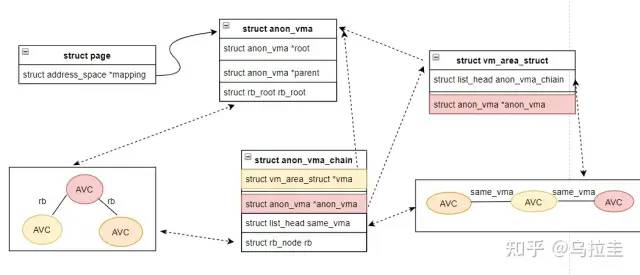
page通過(guò)mapping找到VMA,VMA 遍歷自己管理的紅黑樹(shù)rb_root,找到樹(shù)上的每個(gè)節(jié)點(diǎn)AVC,AVC通過(guò)成員指針anon_vma找到對(duì)應(yīng)的VMA,這個(gè)過(guò)程就完成了頁(yè)表映射查找。需要注意的幾點(diǎn):
1.VMA中也有鏈表anon_vma_chain管理各個(gè)AVC,這里主要用在父子進(jìn)程之間的管理,下文會(huì)詳細(xì)介紹。
2.VMA中有成員指針成員anon_vma,同時(shí)AVC中也有成員指針anon_vma,VAC起到橋梁作用所以可以指向VMA和AVC,那VMA中為何又需要指向AV呢?進(jìn)程創(chuàng)建的流程中一般都是新建AV,然后創(chuàng)建AVC及AMV,然后調(diào)用anon_vma_chain_link建立三者之間的關(guān)系,但是當(dāng)一個(gè)VMA沒(méi)有對(duì)應(yīng)頁(yè)的時(shí)候,此時(shí)觸發(fā)pagefault,這里可以快速判斷VMA有沒(méi)有對(duì)應(yīng)的page。
常用接口
anon_vma_chain_link
1.將VAC中的vma和anon_vma分別指向VMA和AV;
2.將AVC加入到VMA的anon_vma_chain鏈表上;
3.將AVC加入到AV的rb_root紅黑樹(shù)上,通常都是通過(guò)遍歷這個(gè)紅黑樹(shù)找到所有的AVC;
static void anon_vma_chain_link(struct vm_area_struct *vma,
                struct anon_vma_chain *avc,
                struct anon_vma *anon_vma)
{
    avc->vma = vma;
    avc->anon_vma = anon_vma;
    list_add(&avc->same_vma, &vma->anon_vma_chain);
    anon_vma_interval_tree_insert(avc, &anon_vma->rb_root);
}
代碼實(shí)現(xiàn)
反向映射跟父子進(jìn)程的寫時(shí)拷貝有關(guān)系,所以先從父子進(jìn)程創(chuàng)建時(shí)對(duì)AV,AVC,VMA的創(chuàng)建開(kāi)始講。
1.父進(jìn)程創(chuàng)建匿名頁(yè)面
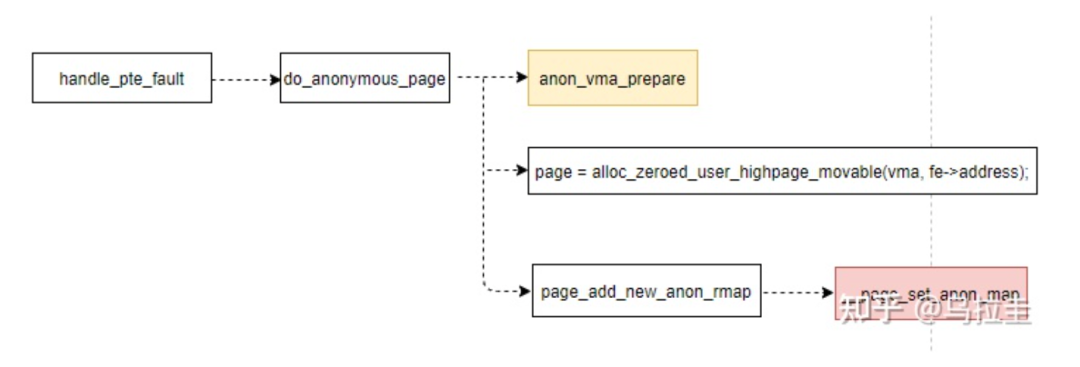
當(dāng)觸發(fā)pagefault的時(shí)候走到handle_pte_fault中,anon_vma_prepare中負(fù)責(zé)創(chuàng)建AVC和AV并建立彼此的關(guān)系;真正將創(chuàng)建的page與av關(guān)聯(lián)在__page_set_anon_map中完成。這樣的話父進(jìn)程新建的page在自己的反向映射中的關(guān)系就算完成了。
int anon_vma_prepare(struct vm_area_struct *vma)
{
    struct anon_vma *anon_vma = vma->anon_vma;
    struct anon_vma_chain *avc;
    。。。
    if (unlikely(!anon_vma)) {
        struct mm_struct *mm = vma->vm_mm;
        struct anon_vma *allocated;
        avc = anon_vma_chain_alloc(GFP_KERNEL);
        。。。
        anon_vma = find_mergeable_anon_vma(vma);
        allocated = NULL;
        if (!anon_vma) {
            anon_vma = anon_vma_alloc();
            。。。
            allocated = anon_vma;
        }
        anon_vma_lock_write(anon_vma);
        /* page_table_lock to protect against threads */
        spin_lock(&mm->page_table_lock);
        if (likely(!vma->anon_vma)) {
            vma->anon_vma = anon_vma;
            anon_vma_chain_link(vma, avc, anon_vma);
            /* vma reference or self-parent link for new root */
            anon_vma->degree++;
            allocated = NULL;
            avc = NULL;
        }
        spin_unlock(&mm->page_table_lock);
        anon_vma_unlock_write(anon_vma);
        。。。
    }
    return 0;
    。。。
}
static void __page_set_anon_rmap(struct page *page,
    struct vm_area_struct *vma, unsigned long address, int exclusive)
{
    struct anon_vma *anon_vma = vma->anon_vma;
    。。。
    anon_vma = (void *) anon_vma + PAGE_MAPPING_ANON;
    page->mapping = (struct address_space *) anon_vma;
    page->index = linear_page_index(vma, address);
}
至于index的含義看linear_page_index的實(shí)現(xiàn)應(yīng)該就明白了。
static inline pgoff_t linear_page_index(struct vm_area_struct *vma,
                    unsigned long address)
{
    pgoff_t pgoff;
    if (unlikely(is_vm_hugetlb_page(vma)))
        return linear_hugepage_index(vma, address);
    pgoff = (address - vma->vm_start) >> PAGE_SHIFT;
    pgoff += vma->vm_pgoff;
    return pgoff;
}
2.父進(jìn)程創(chuàng)建子進(jìn)程
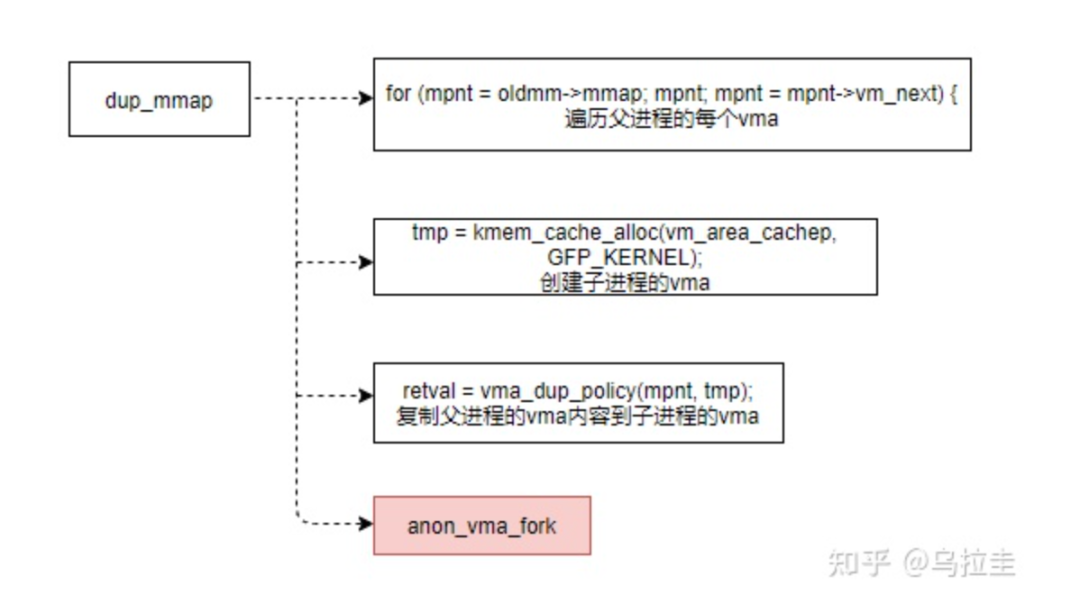
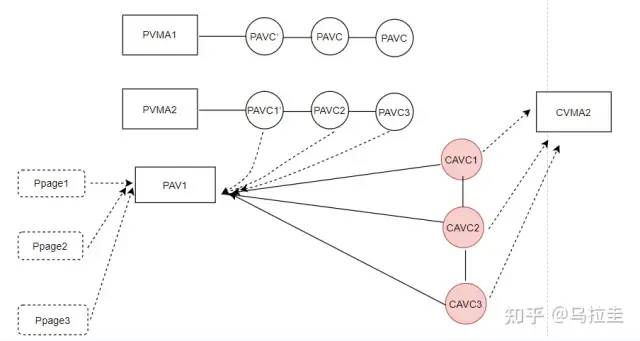
當(dāng)父進(jìn)程創(chuàng)建子進(jìn)程的時(shí)候,子進(jìn)程會(huì)復(fù)制父進(jìn)程的VMA作為自己的進(jìn)程地址空間,并且父子進(jìn)程共享相同的page,知道子進(jìn)程往自己的地址空間寫數(shù)據(jù),這就是所謂的COW。這種情況需要完成兩件事情:1.子進(jìn)程需要繼承父進(jìn)程的AVC,AV,VMA及三者之間的關(guān)系;2.創(chuàng)建自己的AV,AVC,VMA。
以上實(shí)現(xiàn)流程在dup_mm->dup_mmap->anon_vma_fork中完成。
dup_mmap中就是組個(gè)創(chuàng)建子進(jìn)程的vma,并復(fù)制父進(jìn)程對(duì)應(yīng)vma的信息
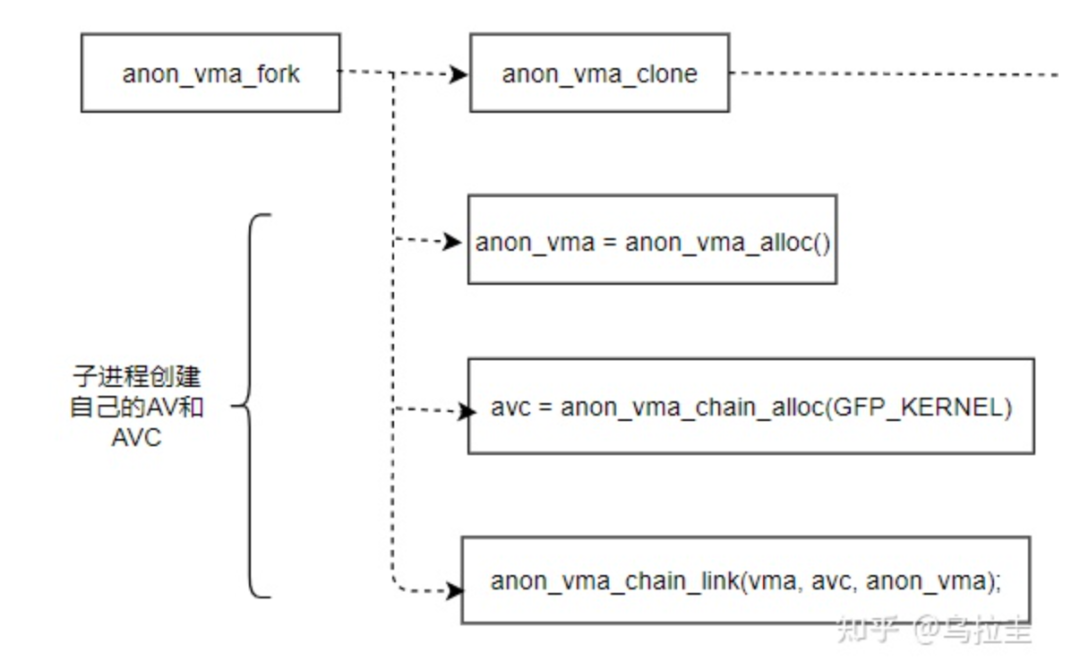
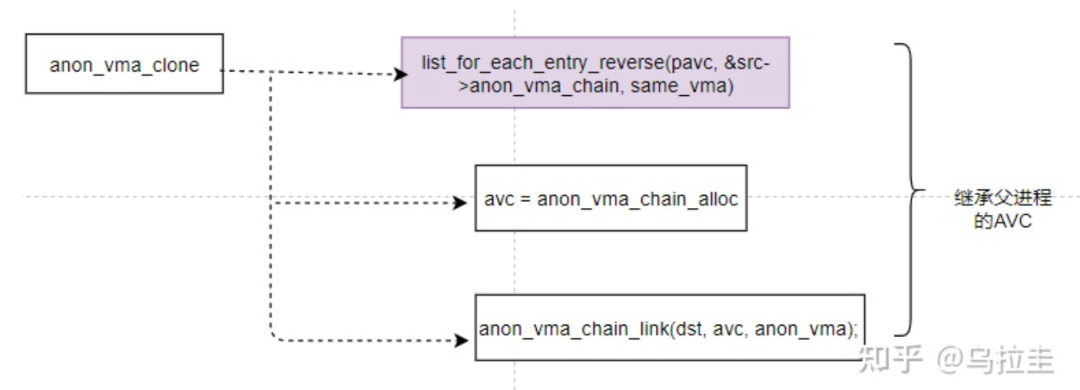
anon_vma_clone中新建了AVC,將子進(jìn)程的VMA關(guān)聯(lián)到父進(jìn)程的AV中,所以父進(jìn)程AV的rb樹(shù)上就有了子進(jìn)程的AVC,通過(guò)遍歷父進(jìn)程AV的rb樹(shù)就能找到子進(jìn)程的VMA。一個(gè)VMA可以包含多個(gè)page,但是該區(qū)域內(nèi)的所有page只需要一個(gè)AV來(lái)反向映射即可。
具體anon_vma_clone代碼如下
int anon_vma_clone(struct vm_area_struct *dst, struct vm_area_struct *src)
{
    struct anon_vma_chain *avc, *pavc;
    struct anon_vma *root = NULL;

    list_for_each_entry_reverse(pavc, &src->anon_vma_chain, same_vma) {
        struct anon_vma *anon_vma;

        avc = anon_vma_chain_alloc(GFP_NOWAIT | __GFP_NOWARN);
        if (unlikely(!avc)) {
            unlock_anon_vma_root(root);
            root = NULL;
            avc = anon_vma_chain_alloc(GFP_KERNEL);
            if (!avc)
                goto enomem_failure;
        }
        anon_vma = pavc->anon_vma;
        root = lock_anon_vma_root(root, anon_vma);
        anon_vma_chain_link(dst, avc, anon_vma);

        /*
         * Reuse existing anon_vma if its degree lower than two,
         * that means it has no vma and only one anon_vma child.
         *
         * Do not chose parent anon_vma, otherwise first child
         * will always reuse it. Root anon_vma is never reused:
         * it has self-parent reference and at least one child.
         */
        if (!dst->anon_vma && anon_vma != src->anon_vma &&
                anon_vma->degree < 2)
            dst->anon_vma = anon_vma;
    }
    if (dst->anon_vma)
        dst->anon_vma->degree++;
    unlock_anon_vma_root(root);
    return 0;
3.子進(jìn)程發(fā)生cow,創(chuàng)建自己的匿名頁(yè)面
當(dāng)新創(chuàng)建的子進(jìn)程寫數(shù)據(jù)時(shí)觸發(fā)pagefault,在wp_page_copy中會(huì)創(chuàng)建新的page,此時(shí)創(chuàng)建的AV和AVC管理子進(jìn)程自己的VMA
if (fe->flags & FAULT_FLAG_WRITE) {
        if (!pte_write(entry))
            return do_wp_page(fe, entry);
        entry = pte_mkdirty(entry);
}
4.頁(yè)面回收,解除映射
物理頁(yè)回收時(shí)通過(guò)調(diào)用try_to_unmap解除一個(gè)page的頁(yè)表映射。對(duì)于匿名頁(yè)面解除映射而言,走
try_to_unmap->rmap_walk->rmap_walk_anon流程。
int rmap_walk(struct page *page, struct rmap_walk_control *rwc)
{
    if (unlikely(PageKsm(page)))
        return rmap_walk_ksm(page, rwc);
    else if (PageAnon(page))
        return rmap_walk_anon(page, rwc, false);
    else
        return rmap_walk_file(page, rwc, false);
}
static int rmap_walk_anon(struct page *page, struct rmap_walk_control *rwc,
        bool locked)
{
    struct anon_vma *anon_vma;
    pgoff_t pgoff;
    struct anon_vma_chain *avc;
    int ret = SWAP_AGAIN;

    if (locked) {
        anon_vma = page_anon_vma(page);
        /* anon_vma disappear under us? */
        VM_BUG_ON_PAGE(!anon_vma, page);
    } else {
        anon_vma = rmap_walk_anon_lock(page, rwc);
    }
    。。。
    pgoff = page_to_pgoff(page);
    // 遍歷AV的紅黑樹(shù),找到所有的AVC
    anon_vma_interval_tree_foreach(avc, &anon_vma->rb_root, pgoff, pgoff) {
        // 通過(guò)AVC找到VMA
        struct vm_area_struct *vma = avc->vma;
        // address為該page對(duì)應(yīng)的起始地址
        unsigned long address = vma_address(page, vma);
        。。。
        ret = rwc->rmap_one(page, vma, address, rwc->arg);
        。。。
}
rmap_one指向try_to_umap_one,該函數(shù)內(nèi)容比較復(fù)雜,這里只截取了頁(yè)表項(xiàng)解除的操作。
static int try_to_unmap_one(struct page *page, struct vm_area_struct *vma,
             unsigned long address, void *arg)
{
    struct mm_struct *mm = vma->vm_mm;
    pte_t *pte;
    pte_t pteval;
    spinlock_t *ptl;
    int ret = SWAP_AGAIN;
    struct rmap_private *rp = arg;
    enum ttu_flags flags = rp->flags;

    pte = page_check_address(page, mm, address, &ptl,
                 PageTransCompound(page));
    。。。
    /* Nuke the page table entry. */
    flush_cache_page(vma, address, page_to_pfn(page));
    if (should_defer_flush(mm, flags)) {
        /*
         * We clear the PTE but do not flush so potentially a remote
         * CPU could still be writing to the page. If the entry was
         * previously clean then the architecture must guarantee that
         * a clear->dirty transition on a cached TLB entry is written
         * through and traps if the PTE is unmapped.
         */
        pteval = ptep_get_and_clear(mm, address, pte);

        set_tlb_ubc_flush_pending(mm, page, pte_dirty(pteval));
    } else {
        pteval = ptep_clear_flush(vma, address, pte);
    }
    。。。
}
參考
《深入理解linux內(nèi)核》
linux kernel4.9
原文:https://zhuanlan.zhihu.com/p/361173109