
Springboot中如何優(yōu)雅的進(jìn)行字段校驗(yàn)
點(diǎn)擊上方“程序員大白”,選擇“星標(biāo)”公眾號(hào)
重磅干貨,第一時(shí)間送達(dá)


來(lái)源:juejin.cn/post/6913735652806754311
前段時(shí)間提交代碼審核,同事提了一個(gè)代碼規(guī)范缺陷:參數(shù)校驗(yàn)應(yīng)該放在controller層。到底應(yīng)該如何做參數(shù)校驗(yàn)?zāi)?/strong>
Controller層 VS Service層
去網(wǎng)上查閱了一些資料,一般推薦與業(yè)務(wù)無(wú)關(guān)的放在Controller層中進(jìn)行校驗(yàn),而與業(yè)務(wù)有關(guān)的放在Service層中進(jìn)行校驗(yàn)。那么如何將參數(shù)校驗(yàn)寫的優(yōu)雅美觀呢,如果都是if - else,就感覺代碼寫的很low,還好有輪子可以使用
常用校驗(yàn)工具類
使用Hibernate Validate
引入依賴
<dependency>
    <groupId>org.hibernate</groupId>
    <artifactId>hibernate-validator</artifactId>
    <version>4.3.1.Final</version>
</dependency>
常用注解說(shuō)明
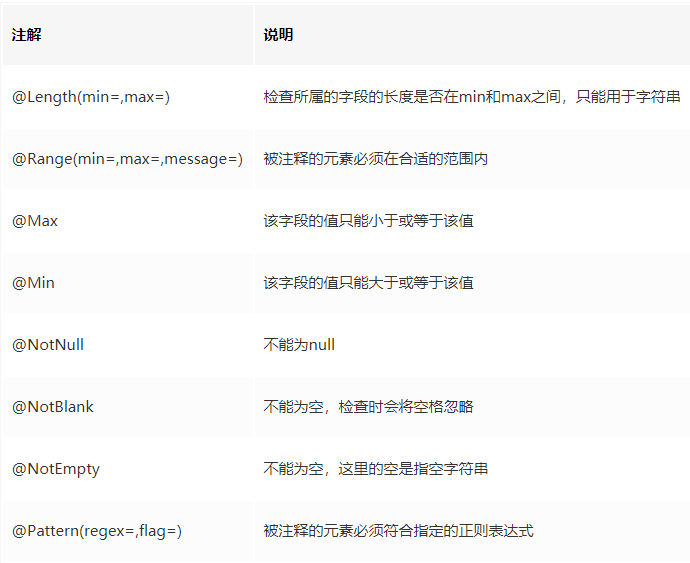
使用姿勢(shì)
需要搭配在Controller中搭配@Validated或@Valid注解一起使用,@Validated和@Valid注解區(qū)別不是很大,一般情況下任選一個(gè)即可,區(qū)別如下:
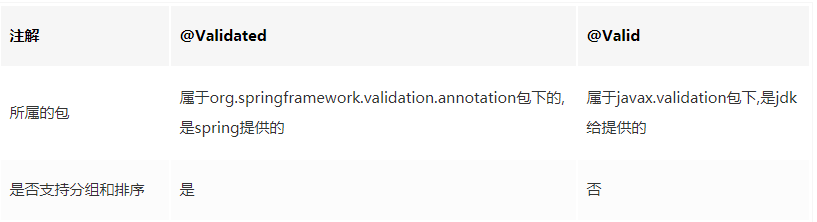
雖然@Validated比@Valid更加強(qiáng)大,在@Valid之上提供了分組功能和驗(yàn)證排序功能,不過(guò)在實(shí)際項(xiàng)目中一直沒有用到過(guò)
Hibernate-validate框架中的注解是需要加在實(shí)體中一起使用的
定義一個(gè)實(shí)體
public class DataSetSaveVO {
    //唯一標(biāo)識(shí)符為空
    @NotBlank(message = "user uuid is empty")
    //用戶名稱只能是字母和數(shù)字
    @Pattern(regexp = "^[a-z0-9]+$", message = "user names can only be alphabetic and numeric")
    @Length(max = 48, message = "user uuid length over 48 byte")
    private String userUuid;

    //數(shù)據(jù)集名稱只能是字母和數(shù)字
    @Pattern(regexp = "^[A-Za-z0-9]+$", message = "data set names can only be letters and Numbers")
    //文件名稱過(guò)長(zhǎng)
    @Length(max = 48, message = "file name too long")
    //文件名稱為空
    @NotBlank(message = "file name is empty")
    private String name;

    //數(shù)據(jù)集描述最多為256字節(jié)
    @Length(max = 256, message = "data set description length over 256 byte")
    //數(shù)據(jù)集描述為空
    @NotBlank(message = "data set description is null")
    private String description;
}
說(shuō)明:message字段為不符合校驗(yàn)規(guī)則時(shí)拋出的異常信息
Controller層中的方法
@PostMapping
public ResponseVO createDataSet(@Valid @RequestBody DataSetSaveVO dataSetVO) {
    return ResponseUtil.success(dataSetService.saveDataSet(dataSetVO));
}
說(shuō)明:在校驗(yàn)的實(shí)體DataSetSaveVO旁邊添加@Valid或@Validated注解
使用commons-lang3
引入依賴
<dependency>
    <groupId>org.apache.commons</groupId>
    <artifactId>commons-lang3</artifactId>
    <version>3.4</version>
</dependency>
常用方法說(shuō)明
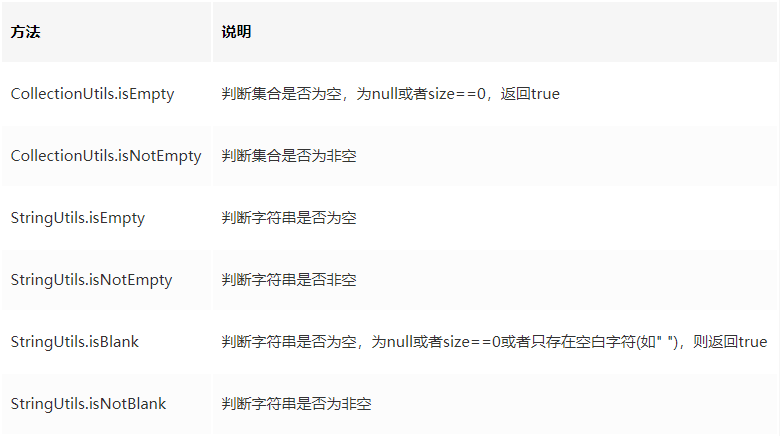
測(cè)試代碼
//StringUtils.isEmpty
System.out.println(StringUtils.isEmpty(""));  //true
System.out.println(StringUtils.isEmpty("  "));  //false
//StringUtils.isNotEmpty
System.out.println(StringUtils.isNotEmpty(""));  //false

//StringUtils.isBlank
System.out.println(StringUtils.isBlank(""));  //true
System.out.println(StringUtils.isBlank(" "));  //true
//StringUtils.isNotBlank
System.out.println(StringUtils.isNotBlank(" "));  //false

List<Integer> emptyList = new ArrayList<>();
List<Integer> nullList = null;
List<Integer> notEmptyList = new ArrayList<>();
notEmptyList.add(1);

//CollectionUtils.isEmpty
System.out.println(CollectionUtils.isEmpty(emptyList));   //true
System.out.println(CollectionUtils.isEmpty(nullList));   //true
System.out.println(CollectionUtils.isEmpty(notEmptyList));   //false

//CollectionUtils.isNotEmpty
System.out.println(CollectionUtils.isNotEmpty(emptyList));   //false
System.out.println(CollectionUtils.isNotEmpty(nullList));   //false
System.out.println(CollectionUtils.isNotEmpty(notEmptyList));   //true
自定義注解
當(dāng)上面的方面都無(wú)法滿足校驗(yàn)的需求以后,可以考慮使用自定義注解,如何寫一個(gè)自定義注解,可以參考之前寫的文章:Spring自定義注解從入門到精通
推薦閱讀
國(guó)產(chǎn)小眾瀏覽器因屏蔽視頻廣告,被索賠100萬(wàn)(后續(xù))
年輕人“不講武德”:因看黃片上癮,把網(wǎng)站和786名女主播起訴了
關(guān)于程序員大白
程序員大白是一群哈工大,東北大學(xué),西湖大學(xué)和上海交通大學(xué)的碩士博士運(yùn)營(yíng)維護(hù)的號(hào),大家樂于分享高質(zhì)量文章,喜歡總結(jié)知識(shí),歡迎關(guān)注[程序員大白],大家一起學(xué)習(xí)進(jìn)步!