
SynapseMLMicrosoft Machine Learning for Apache Spark

Microsoft Machine Learning for Apache Spark






MMLSpark is an ecosystem of tools aimed towards expanding the distributed computing framework Apache Spark in several new directions. MMLSpark adds many deep learning and data science tools to the Spark ecosystem, including seamless integration of Spark Machine Learning pipelines with Microsoft Cognitive Toolkit (CNTK), LightGBM and OpenCV. These tools enable powerful and highly-scalable predictive and analytical models for a variety of datasources.
MMLSpark also brings new networking capabilities to the Spark Ecosystem. With the HTTP on Spark project, users can embed any web service into their SparkML models. In this vein, MMLSpark provides easy to use SparkML transformers for a wide variety of Microsoft Cognitive Services. For production grade deployment, the Spark Serving project enables high throughput, sub-millisecond latency web services, backed by your Spark cluster.
MMLSpark requires Scala 2.11, Spark 2.4+, and Python 3.5+. See the API documentation for Scala and for PySpark.
Table of Contents
Projects
 |
 |
 |
 |
|---|---|---|---|
| Vowpal Wabbit on Spark | The Cognitive Services on Spark | LightGBM on Spark | Spark Serving |
| Fast, Sparse, and Effective Text Analytics | Leverage the Microsoft Cognitive Services at Unprecedented Scales in your existing SparkML pipelines | Train Gradient Boosted Machines with LightGBM | Serve any Spark Computation as a Web Service with Sub-Millisecond Latency |
 |
 |
 |
 |
|---|---|---|---|
| HTTP on Spark | CNTK on Spark | Model Interpretation on Spark | Spark Binding Autogeneration |
| An Integration Between Spark and the HTTP Protocol, enabling Distributed Microservice Orchestration | Distributed Deep Learning with the Microsoft Cognitive Toolkit | Distributed, Model Agnostic, Interpretations for Classifiers | Automatically Generate Spark bindings for PySpark and SparklyR |
 |
 |
 |
|---|---|---|
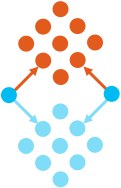
| Isolation Forest on Spark | CyberML | Conditional KNN |
| Distributed Nonlinear Outlier Detection | Machine Learning Tools for Cyber Security | Scalable KNN Models with Conditional Queries |
Examples
- Create a deep image classifier with transfer learning (example 9)
- Fit a LightGBM classification or regression model on a biochemical dataset (example 3), to learn more check out the LightGBM documentation page.
- Deploy a deep network as a distributed web service with MMLSpark Serving
- Use web services in Spark with HTTP on Apache Spark
- Use Bi-directional LSTMs from Keras for medical entity extraction (example 8)
- Create a text analytics system on Amazon book reviews (example 4)
- Perform distributed hyperparameter tuning to identify Breast Cancer (example 5)
- Easily ingest images from HDFS into Spark
DataFrame(example 6) - Use OpenCV on Spark to manipulate images (example 7)
- Train classification and regression models easily via implicit featurization of data (example 1)
- Train and evaluate a flight delay prediction system (example 2)
- Finding anomalous data access patterns using the Access Anomalies package of CyberML (example 11)
- Model interpretation (example 12, example 13, example 14)
See our notebooks for all examples.
A short example
Below is an excerpt from a simple example of using a pre-trained CNN to classify images in the CIFAR-10 dataset. View the whole source code in notebook example 9.
...
import mmlspark
# Initialize CNTKModel and define input and output columns
cntkModel = mmlspark.cntk.CNTKModel() \
  .setInputCol("images").setOutputCol("output") \
  .setModelLocation(modelFile)
# Train on dataset with internal spark pipeline
scoredImages = cntkModel.transform(imagesWithLabels)
...
See other sample notebooks as well as the MMLSpark documentation for Scala and PySpark.
Setup and installation
Python
To try out MMLSpark on a Python (or Conda) installation you can get Spark installed via pip with pip install pyspark. You can then use pyspark as in the above example, or from python:
import pyspark
spark = pyspark.sql.SparkSession.builder.appName("MyApp") \
            .config("spark.jars.packages", "com.microsoft.ml.spark:mmlspark_2.11:1.0.0-rc3") \
            .config("spark.jars.repositories", "https://mmlspark.azureedge.net/maven") \
            .getOrCreate()
import mmlspark
SBT
If you are building a Spark application in Scala, add the following lines to your build.sbt:
resolvers += "MMLSpark" at "https://mmlspark.azureedge.net/maven"
libraryDependencies += "com.microsoft.ml.spark" %% "mmlspark" % "1.0.0-rc3"
Spark package
MMLSpark can be conveniently installed on existing Spark clusters via the --packages option, examples:
spark-shell --packages com.microsoft.ml.spark:mmlspark_2.11:1.0.0-rc3
pyspark --packages com.microsoft.ml.spark:mmlspark_2.11:1.0.0-rc3
spark-submit --packages com.microsoft.ml.spark:mmlspark_2.11:1.0.0-rc3 MyApp.jar
This can be used in other Spark contexts too. For example, you can use MMLSpark in AZTK by adding it to the .aztk/spark-defaults.conf file.
Databricks
To install MMLSpark on the Databricks cloud, create a new library from Maven coordinates in your workspace.
For the coordinates use: com.microsoft.ml.spark:mmlspark_2.11:1.0.0-rc3 with the resolver: https://mmlspark.azureedge.net/maven. Ensure this library is attached to your target cluster(s).
Finally, ensure that your Spark cluster has at least Spark 2.4 and Scala 2.11.
You can use MMLSpark in both your Scala and PySpark notebooks. To get started with our example notebooks import the following databricks archive:
https://mmlspark.blob.core.windows.net/dbcs/MMLSparkExamplesv1.0.0-rc3.dbc
Apache Livy and HDInsight
To install MMLSpark from within a Jupyter notebook served by Apache Livy the following configure magic can be used. You will need to start a new session after this configure cell is executed.
Excluding certain packages from the library may be necessary due to current issues with Livy 0.5
%%configure -f
{
    "name": "mmlspark",
    "conf": {
        "spark.jars.packages": "com.microsoft.ml.spark:mmlspark_2.11:1.0.0-rc3",
        "spark.jars.repositories": "https://mmlspark.azureedge.net/maven",
        "spark.jars.excludes": "org.scala-lang:scala-reflect,org.apache.spark:spark-tags_2.11,org.scalactic:scalactic_2.11,org.scalatest:scalatest_2.11"
    }
}
Docker
The easiest way to evaluate MMLSpark is via our pre-built Docker container. To do so, run the following command:
docker run -it -p 8888:8888 -e ACCEPT_EULA=yes mcr.microsoft.com/mmlspark/release
Navigate to http://localhost:8888/ in your web browser to run the sample notebooks. See the documentation for more on Docker use.
To read the EULA for using the docker image, run \
docker run -it -p 8888:8888 mcr.microsoft.com/mmlspark/release eula
GPU VM Setup
MMLSpark can be used to train deep learning models on GPU nodes from a Spark application. See the instructions for setting up an Azure GPU VM.
Building from source
MMLSpark has recently transitioned to a new build infrastructure. For detailed developer docs please see the Developer Readme
If you are an existing mmlspark developer, you will need to reconfigure your development setup. We now support platform independent development and better integrate with intellij and SBT. If you encounter issues please reach out to our support email!
R (Beta)
To try out MMLSpark using the R autogenerated wrappers see our instructions. Note: This feature is still under development and some necessary custom wrappers may be missing.
Papers
Learn More
-
Visit our website.
-
Watch our keynote demos at the Spark+AI Summit 2019, the Spark+AI European Summit 2018, and the Spark+AI Summit 2018.
-
See how MMLSpark is used to help endangered species.
-
Explore generative adversarial artwork in our collaboration with The MET and MIT.
-
Explore our collaboration with Apache Spark on image analysis.
Contributing & feedback
This project has adopted the Microsoft Open Source Code of Conduct. For more information see the Code of Conduct FAQ or contact [email protected] with any additional questions or comments.
See CONTRIBUTING.md for contribution guidelines.
To give feedback and/or report an issue, open a GitHub Issue.
Other relevant projects
Apache?, Apache Spark, and Spark? are either registered trademarks or trademarks of the Apache Software Foundation in the United States and/or other countries.