
CompletableFuture:讓你的代碼免受阻塞之苦
點擊下方“IT牧場”,選擇“設(shè)為星標”

來源:https://juejin.cn/post/6844904024332828685
通過閱讀本篇文章你將了解到:
CompletableFuture的使用 CompletableFure異步和同步的性能測試 已經(jīng)有了Future為什么仍需要在JDK1.8中引入CompletableFuture CompletableFuture的應用場景 對CompletableFuture的使用優(yōu)化
場景說明
查詢所有商店某個商品的價格并返回,并且查詢商店某個商品的價格的API為同步 一個Shop類,提供一個名為getPrice的同步方法
店鋪類:Shop.java
public?class?Shop?{
????private?Random?random?=?new?Random();
????/**
?????*?根據(jù)產(chǎn)品名查找價格
?????*?*/
????public?double?getPrice(String?product)?{
????????return?calculatePrice(product);
????}

????/**
?????*?計算價格
?????*
?????*?@param?product
?????*?@return
?????*?*/
????private?double?calculatePrice(String?product)?{
????????delay();
????????//random.nextDouble()隨機返回折扣
????????return?random.nextDouble()?*?product.charAt(0)?+?product.charAt(1);
????}

????/**
?????*?通過睡眠模擬其他耗時操作
?????*?*/
????private?void?delay()?{
????????try?{
????????????Thread.sleep(1000);
????????}?catch?(InterruptedException?e)?{
????????????e.printStackTrace();
????????}
????}
}
查詢商品的價格為同步方法,并通過sleep方法模擬其他操作。這個場景模擬了當需要調(diào)用第三方API,但第三方提供的是同步API,在無法修改第三方API時如何設(shè)計代碼調(diào)用提高應用的性能和吞吐量,這時候可以使用CompletableFuture類
CompletableFuture使用
Completable是Future接口的實現(xiàn)類,在JDK1.8中引入
CompletableFuture的創(chuàng)建:
說明:
兩個重載方法之間的區(qū)別 => 后者可以傳入自定義Executor,前者是默認的,使用的ForkJoinPool supplyAsync和runAsync方法之間的區(qū)別 => 前者有返回值,后者無返回值 Supplier是函數(shù)式接口,因此該方法需要傳入該接口的實現(xiàn)類,追蹤源碼會發(fā)現(xiàn)在run方法中會調(diào)用該接口的方法。因此使用該方法創(chuàng)建CompletableFuture對象只需重寫Supplier中的get方法,在get方法中定義任務即可。又因為函數(shù)式接口可以使用Lambda表達式,和new創(chuàng)建CompletableFuture對象相比代碼會簡潔不少 使用new方法
CompletableFuture?futurePrice?=?new?CompletableFuture<>(); 使用CompletableFuture#completedFuture靜態(tài)方法創(chuàng)建
public?static??CompletableFuture?completedFuture(U?value)?{
????return?new?CompletableFuture((value?==?null)???NIL?:?value);
}
參數(shù)的值為任務執(zhí)行完的結(jié)果,一般該方法在實際應用中較少應用
使用 CompletableFuture#supplyAsync靜態(tài)方法創(chuàng)建 supplyAsync有兩個重載方法:
//方法一
public?static??CompletableFuture?supplyAsync(Supplier?supplier)?{
????return?asyncSupplyStage(asyncPool,?supplier);
}
//方法二
public?static??CompletableFuture?supplyAsync(Supplier?supplier,
???????????????????????????????????????????????????Executor?executor)?{
????return?asyncSupplyStage(screenExecutor(executor),?supplier);
}
使用CompletableFuture#runAsync靜態(tài)方法創(chuàng)建 runAsync有兩個重載方法
//方法一
public?static?CompletableFuture?runAsync(Runnable?runnable)? {
????return?asyncRunStage(asyncPool,?runnable);
}
//方法二
public?static?CompletableFuture?runAsync(Runnable?runnable,?Executor?executor)? {
????return?asyncRunStage(screenExecutor(executor),?runnable);
}結(jié)果的獲取:?對于結(jié)果的獲取CompltableFuture類提供了四種方式
//方式一
public?T?get()
//方式二
public?T?get(long?timeout,?TimeUnit?unit)
//方式三
public?T?getNow(T?valueIfAbsent)
//方式四
public?T?join()
說明:
示例:
get()和get(long timeout, TimeUnit unit) => 在Future中就已經(jīng)提供了,后者提供超時處理,如果在指定時間內(nèi)未獲取結(jié)果將拋出超時異常 getNow => 立即獲取結(jié)果不阻塞,結(jié)果計算已完成將返回結(jié)果或計算過程中的異常,如果未計算完成將返回設(shè)定的valueIfAbsent值 join => 方法里不會拋出異常
public?class?AcquireResultTest?{
??public?static?void?main(String[]?args)?throws?ExecutionException,?InterruptedException?{
??????//getNow方法測試
??????CompletableFuture?cp1?=?CompletableFuture.supplyAsync(()?->?{
??????????try?{
??????????????Thread.sleep(60?*?1000?*?60?);
??????????}?catch?(InterruptedException?e)?{
??????????????e.printStackTrace();
??????????}
??
??????????return?"hello?world";
??????});
??
??????System.out.println(cp1.getNow("hello?h2t"));
??
??????//join方法測試
??????CompletableFuture?cp2?=?CompletableFuture.supplyAsync((()->?1?/?0));
??????System.out.println(cp2.join());
??
??????//get方法測試
??????CompletableFuture?cp3?=?CompletableFuture.supplyAsync((()->?1?/?0));
??????System.out.println(cp3.get());
??}
}
說明:
第一個執(zhí)行結(jié)果為hello h2t,因為要先睡上1分鐘結(jié)果不能立即獲取
join方法獲取結(jié)果方法里不會拋異常,但是執(zhí)行結(jié)果會拋異常,拋出的異常為CompletionException
get方法獲取結(jié)果方法里將拋出異常,執(zhí)行結(jié)果拋出的異常為ExecutionException
異常處理:?使用靜態(tài)方法創(chuàng)建的CompletableFuture對象無需顯示處理異常,使用new創(chuàng)建的對象需要調(diào)用completeExceptionally方法設(shè)置捕獲到的異常,舉例說明:
CompletableFuture?completableFuture?=?new?CompletableFuture();
new?Thread(()?->?{
???try?{
???????//doSomething,調(diào)用complete方法將其他方法的執(zhí)行結(jié)果記錄在completableFuture對象中
???????completableFuture.complete(null);
???}?catch?(Exception?e)?{
???????//異常處理
???????completableFuture.completeExceptionally(e);
????}
}).start();
同步方法Pick異步方法查詢所有店鋪某個商品價格
店鋪為一個列表:
private?static?List?shopList?=?Arrays.asList(
????????new?Shop("BestPrice"),
????????new?Shop("LetsSaveBig"),
????????new?Shop("MyFavoriteShop"),
????????new?Shop("BuyItAll")
);
同步方法:
private?static?List?findPriceSync(String?product)? {
????return?shopList.stream()
????????????.map(shop?->?String.format("%s?price?is?%.2f",
????????????????????shop.getName(),?shop.getPrice(product)))??//格式轉(zhuǎn)換
????????????.collect(Collectors.toList());
}
異步方法:
private?static?List?findPriceAsync(String?product)? {
????List>?completableFutureList?=?shopList.stream()
????????????//轉(zhuǎn)異步執(zhí)行
????????????.map(shop?->?CompletableFuture.supplyAsync(
????????????????????()?->?String.format("%s?price?is?%.2f",
????????????????????????????shop.getName(),?shop.getPrice(product))))??//格式轉(zhuǎn)換
????????????.collect(Collectors.toList());
????return?completableFutureList.stream()
????????????.map(CompletableFuture::join)??//獲取結(jié)果不會拋出異常
????????????.collect(Collectors.toList());
}
性能測試結(jié)果:
Find?Price?Sync?Done?in?4141
Find?Price?Async?Done?in?1033
異步執(zhí)行效率提高四倍
為什么仍需要CompletableFuture
在JDK1.8以前,通過調(diào)用線程池的submit方法可以讓任務以異步的方式運行,該方法會返回一個Future對象,通過調(diào)用get方法獲取異步執(zhí)行的結(jié)果:
private?static?List?findPriceFutureAsync(String?product)? {
????ExecutorService?es?=?Executors.newCachedThreadPool();
????List>?futureList?=?shopList.stream().map(shop?->?es.submit(()?->?String.format("%s?price?is?%.2f",
????????????shop.getName(),?shop.getPrice(product)))).collect(Collectors.toList());
????return?futureList.stream()
????????????.map(f?->?{
????????????????String?result?=?null;
????????????????try?{
????????????????????result?=?f.get();
????????????????}?catch?(InterruptedException?e)?{
????????????????????e.printStackTrace();
????????????????}?catch?(ExecutionException?e)?{
????????????????????e.printStackTrace();
????????????????}
????????????????return?result;
????????????}).collect(Collectors.toList());
}
既生瑜何生亮,為什么仍需要引入CompletableFuture?對于簡單的業(yè)務場景使用Future完全沒有,但是想將多個異步任務的計算結(jié)果組合起來,后一個異步任務的計算結(jié)果需要前一個異步任務的值等等,使用Future提供的那點API就囊中羞澀,處理起來不夠優(yōu)雅,這時候還是讓CompletableFuture以聲明式的方式優(yōu)雅的處理這些需求。而且在Future編程中想要拿到Future的值然后拿這個值去做后續(xù)的計算任務,只能通過輪詢的方式去判斷任務是否完成這樣非常占CPU并且代碼也不優(yōu)雅,用偽代碼表示如下:
while(future.isDone())?{
????result?=?future.get();
????doSomrthingWithResult(result);
}?
但CompletableFuture提供了API幫助我們實現(xiàn)這樣的需求
其他API介紹
whenComplete計算結(jié)果的處理:
對前面計算結(jié)果進行處理,無法返回新值 提供了三個方法:
//方法一
public?CompletableFuture?whenComplete(BiConsumersuper?T,??super?Throwable>?action)
//方法二
public?CompletableFuture?whenCompleteAsync(BiConsumersuper?T,??super?Throwable>?action)
//方法三
public?CompletableFuture?whenCompleteAsync(BiConsumersuper?T,??super?Throwable>?action,?Executor?executor)
說明:
BiFunction fn參數(shù) => 定義對結(jié)果的處理 Executor executor參數(shù) => 自定義線程池 以async結(jié)尾的方法將會在一個新的線程中執(zhí)行組合操作
示例:
public?class?WhenCompleteTest?{
????public?static?void?main(String[]?args)?{
????????CompletableFuture?cf1?=?CompletableFuture.supplyAsync(()?->?"hello");
????????CompletableFuture?cf2?=?cf1.whenComplete((v,?e)?->
????????????????System.out.println(String.format("value:%s,?exception:%s",?v,?e)));
????????System.out.println(cf2.join());
????}
}
thenApply轉(zhuǎn)換:
將前面計算結(jié)果的的CompletableFuture傳遞給thenApply,返回thenApply處理后的結(jié)果。可以認為通過thenApply方法實現(xiàn)CompletableFuture至CompletableFuture的轉(zhuǎn)換。白話一點就是將CompletableFuture的計算結(jié)果作為thenApply方法的參數(shù),返回thenApply方法處理后的結(jié)果 提供了三個方法:
//方法一
public??CompletableFuture?thenApply(
????Functionsuper?T,??extends?U>?fn)?{
????return?uniApplyStage(null,?fn);
}

//方法二
public??CompletableFuture?thenApplyAsync(
????Functionsuper?T,??extends?U>?fn)?{
????return?uniApplyStage(asyncPool,?fn);
}

//方法三
public??CompletableFuture?thenApplyAsync(
????Functionsuper?T,??extends?U>?fn,?Executor?executor)?{
????return?uniApplyStage(screenExecutor(executor),?fn);
}
說明:
Function fn參數(shù) => 對前一個CompletableFuture 計算結(jié)果的轉(zhuǎn)化操作 Executor executor參數(shù) => 自定義線程池 以async結(jié)尾的方法將會在一個新的線程中執(zhí)行組合操作 示例:
public?class?ThenApplyTest?{
????public?static?void?main(String[]?args)?throws?ExecutionException,?InterruptedException?{
????????CompletableFuture?result?=?CompletableFuture.supplyAsync(ThenApplyTest::randomInteger).thenApply((i)?->?i?*?8);
????????System.out.println(result.get());
????}

????public?static?Integer?randomInteger()?{
????????return?10;
????}
}
這里將前一個CompletableFuture計算出來的結(jié)果擴大八倍
thenAccept結(jié)果處理:
thenApply也可以歸類為對結(jié)果的處理,thenAccept和thenApply的區(qū)別就是沒有返回值 提供了三個方法:
//方法一
public?CompletableFuture?thenAccept(Consumersuper?T>?action) ?{
????return?uniAcceptStage(null,?action);
}
//方法二
public?CompletableFuture?thenAcceptAsync(Consumersuper?T>?action) ?{
????return?uniAcceptStage(asyncPool,?action);
}
//方法三
public?CompletableFuture?thenAcceptAsync(Consumersuper?T>?action,
???????????????????????????????????????????????Executor?executor) ?{
????return?uniAcceptStage(screenExecutor(executor),?action);
}
說明:
Consumer action參數(shù) => 對前一個CompletableFuture計算結(jié)果的操作 Executor executor參數(shù) => 自定義線程池 同理以async結(jié)尾的方法將會在一個新的線程中執(zhí)行組合操作 示例:
public?class?ThenAcceptTest?{
????public?static?void?main(String[]?args)?{
????????CompletableFuture.supplyAsync(ThenAcceptTest::getList).thenAccept(strList?->?strList.stream()
????????????????.forEach(m?->?System.out.println(m)));
????}
????public?static?List?getList()? {
????????return?Arrays.asList("a",?"b",?"c");
????}
}
將前一個CompletableFuture計算出來的結(jié)果打印出來
thenCompose異步結(jié)果流水化:
thenCompose方法可以將兩個異步操作進行流水操作 提供了三個方法:
//方法一
public??CompletableFuture?thenCompose(
????Functionsuper?T,???extends?CompletionStage>?fn)?{
????return?uniComposeStage(null,?fn);
}

//方法二
public??CompletableFuture?thenComposeAsync(
????Functionsuper?T,???extends?CompletionStage>?fn)?{
????return?uniComposeStage(asyncPool,?fn);
}

//方法三
public??CompletableFuture?thenComposeAsync(
????Functionsuper?T,???extends?CompletionStage>?fn,
????Executor?executor)?{
????return?uniComposeStage(screenExecutor(executor),?fn);
}
說明:
Function> fn參數(shù) => 當前CompletableFuture計算結(jié)果的執(zhí)行Executor executor參數(shù) => 自定義線程池 同理以async結(jié)尾的方法將會在一個新的線程中執(zhí)行組合操作 示例:
public?class?ThenComposeTest?{
????public?static?void?main(String[]?args)?throws?ExecutionException,?InterruptedException?{
????????CompletableFuture?result?=?CompletableFuture.supplyAsync(ThenComposeTest::getInteger)
????????????????.thenCompose(i?->?CompletableFuture.supplyAsync(()?->?i?*?10));
????????System.out.println(result.get());
????}

????private?static?int?getInteger()?{
????????return?666;
????}

????private?static?int?expandValue(int?num)?{
????????return?num?*?10;
????}
}
執(zhí)行流程圖:
thenCombine組合結(jié)果:
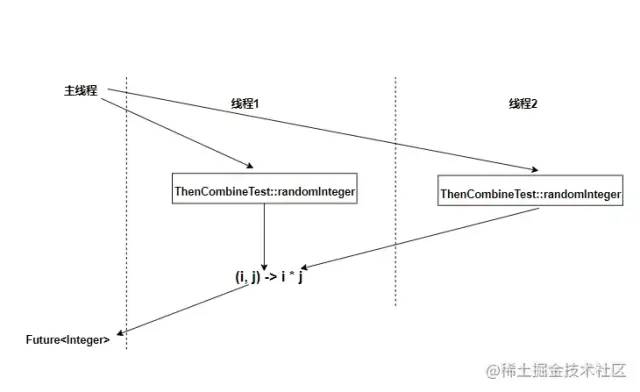
thenCombine方法將兩個無關(guān)的CompletableFuture組合起來,第二個Completable并不依賴第一個Completable的結(jié)果 提供了三個方法:
//方法一
public??CompletableFuture?thenCombine(?
????CompletionStage?other,
????BiFunctionsuper?T,??super?U,??extends?V>?fn) ?{
????return?biApplyStage(null,?other,?fn);
}
??//方法二
??public??CompletableFuture?thenCombineAsync(
??????CompletionStage?other,
??????BiFunctionsuper?T,??super?U,??extends?V>?fn) ?{
??????return?biApplyStage(asyncPool,?other,?fn);
??}
??//方法三
??public??CompletableFuture?thenCombineAsync(
??????CompletionStage?other,
??????BiFunctionsuper?T,??super?U,??extends?V>?fn,?Executor?executor) ?{
??????return?biApplyStage(screenExecutor(executor),?other,?fn);
??}
說明:
CompletionStage other參數(shù) => 新的CompletableFuture的計算結(jié)果 BiFunction fn參數(shù) => 定義了兩個CompletableFuture對象完成計算后如何合并結(jié)果,該參數(shù)是一個函數(shù)式接口,因此可以使用Lambda表達式 Executor executor參數(shù) => 自定義線程池 同理以async結(jié)尾的方法將會在一個新的線程中執(zhí)行組合操作
示例:
public?class?ThenCombineTest?{
????private?static?Random?random?=?new?Random();
????public?static?void?main(String[]?args)?throws?ExecutionException,?InterruptedException?{
????????CompletableFuture?result?=?CompletableFuture.supplyAsync(ThenCombineTest::randomInteger).thenCombine(
????????????????CompletableFuture.supplyAsync(ThenCombineTest::randomInteger),?(i,?j)?->?i?*?j
????????);

????????System.out.println(result.get());
????}

????public?static?Integer?randomInteger()?{
????????return?random.nextInt(100);
????}
}
將兩個線程計算出來的值做一個乘法在返回 執(zhí)行流程圖:
allOf&anyOf組合多個CompletableFuture:
方法介紹:
//allOf
public?static?CompletableFuture?allOf(CompletableFuture...?cfs)? {
????return?andTree(cfs,?0,?cfs.length?-?1);
}
//anyOf
public?static?CompletableFuture{
????return?orTree(cfs,?0,?cfs.length?-?1);
}
說明:
allOf => 所有的CompletableFuture都執(zhí)行完后執(zhí)行計算。 anyOf => 任意一個CompletableFuture執(zhí)行完后就會執(zhí)行計算
示例:
allOf方法測試
public?class?AllOfTest?{
??public?static?void?main(String[]?args)?throws?ExecutionException,?InterruptedException?{
??????CompletableFuture?future1?=?CompletableFuture.supplyAsync(()?->?{
??????????System.out.println("hello");
??????????return?null;
??????});
??????CompletableFuture?future2?=?CompletableFuture.supplyAsync(()?->?{
??????????System.out.println("world");?return?null;
??????});
??????CompletableFuture?result?=?CompletableFuture.allOf(future1,?future2);
??????System.out.println(result.get());
??}
}
allOf方法沒有返回值,適合沒有返回值并且需要前面所有任務執(zhí)行完畢才能執(zhí)行后續(xù)任務的應用場景
anyOf方法測試
public?class?AnyOfTest?{
??private?static?Random?random?=?new?Random();
??public?static?void?main(String[]?args)?throws?ExecutionException,?InterruptedException?{
??????CompletableFuture?future1?=?CompletableFuture.supplyAsync(()?->?{
??????????randomSleep();
??????????System.out.println("hello");
??????????return?"hello";});
??????CompletableFuture?future2?=?CompletableFuture.supplyAsync(()?->?{
??????????randomSleep();
??????????System.out.println("world");
??????????return?"world";
??????});
??????CompletableFuture 兩個線程都會將結(jié)果打印出來,但是get方法只會返回最先完成任務的結(jié)果。該方法比較適合只要有一個返回值就可以繼續(xù)執(zhí)行其他任務的應用場景
注意點
很多方法都提供了異步實現(xiàn)【帶async后綴】,但是需小心謹慎使用這些異步方法,因為異步意味著存在上下文切換,可能性能不一定比同步好。如果需要使用異步的方法,先做測試,用測試數(shù)據(jù)說話!!!
CompletableFuture的應用場景
存在IO密集型的任務可以選擇CompletableFuture,IO部分交由另外一個線程去執(zhí)行。Logback、Log4j2異步日志記錄的實現(xiàn)原理就是新起了一個線程去執(zhí)行IO操作,這部分可以以CompletableFuture.runAsync(()->{ioOperation();})的方式去調(diào)用。如果是CPU密集型就不推薦使用了推薦使用并行流
優(yōu)化空間
supplyAsync執(zhí)行任務底層實現(xiàn):
public?static??CompletableFuture?supplyAsync(Supplier?supplier)?{
????return?asyncSupplyStage(asyncPool,?supplier);
}
static??CompletableFuture?asyncSupplyStage(Executor?e,?Supplier?f)?{
????if?(f?==?null)?throw?new?NullPointerException();
????CompletableFuture?d?=?new?CompletableFuture();
????e.execute(new?AsyncSupply(d,?f));
????return?d;
}
底層調(diào)用的是線程池去執(zhí)行任務,而CompletableFuture中默認線程池為ForkJoinPool
private?static?final?Executor?asyncPool?=?useCommonPool??
????????ForkJoinPool.commonPool()?:?new?ThreadPerTaskExecutor();
ForkJoinPool線程池的大小取決于CPU的核數(shù)。CPU密集型任務線程池大小配置為CPU核心數(shù)就可以了,但是IO密集型,線程池的大小由**CPU數(shù)量 * CPU利用率 * (1 + 線程等待時間/線程CPU時間)**確定。而CompletableFuture的應用場景就是IO密集型任務,因此默認的ForkJoinPool一般無法達到最佳性能,我們需自己根據(jù)業(yè)務創(chuàng)建線程池
干貨分享
最近將個人學習筆記整理成冊,使用PDF分享。關(guān)注我,回復如下代碼,即可獲得百度盤地址,無套路領(lǐng)取!
?001:《Java并發(fā)與高并發(fā)解決方案》學習筆記;?002:《深入JVM內(nèi)核——原理、診斷與優(yōu)化》學習筆記;?003:《Java面試寶典》?004:《Docker開源書》?005:《Kubernetes開源書》?006:《DDD速成(領(lǐng)域驅(qū)動設(shè)計速成)》?007:全部?008:加技術(shù)群討論
加個關(guān)注不迷路
喜歡就點個"在看"唄^_^