
FP8 量化:原理、實(shí)現(xiàn)與誤差分析


2.1 浮點(diǎn)數(shù)表示法:
在計(jì)算機(jī)中我們使用符號(hào)位、指數(shù)、底數(shù)三部分表示一個(gè)浮點(diǎn)數(shù)。符號(hào)位只占用1bit,用來表達(dá)數(shù)的正負(fù),0-表示整數(shù),1-表示負(fù)數(shù)。這也意味著在浮點(diǎn)數(shù)中0有兩種表達(dá)方式:
接下來我們討論浮點(diǎn)表示中的指數(shù)部分:
最后我們討論浮點(diǎn)數(shù)中的底數(shù)部分:

2.2 數(shù)的浮點(diǎn)量化
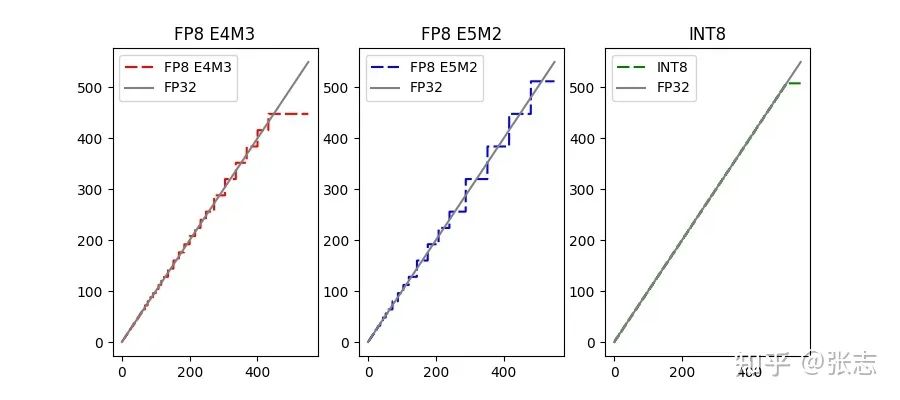
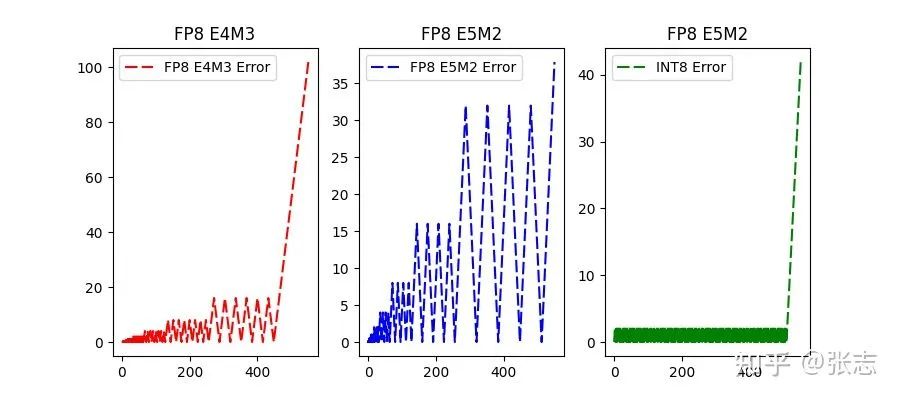
2.3 FP32 到 FP8 的數(shù)據(jù)格式轉(zhuǎn)換
Unscaled FP32 = FP32 / scale
FP8 = Convert(Unscaled FP32)
當(dāng) Unscaled FP32 數(shù)據(jù)已經(jīng)超出 FP8 的表示范圍,即 Unscaled FP32 的幅值大于 448,那么直接進(jìn)行截?cái)啵藭r(shí)為浮點(diǎn)上溢出。
當(dāng) Unscaled FP32 數(shù)據(jù)范圍在 FP8 的表示范圍內(nèi),且幅值大于 FP8 能夠表達(dá)的最小值,此時(shí)需要移去多余的底數(shù)位,并對(duì)底數(shù)進(jìn)行四舍五入。
當(dāng) Unscaled FP32 數(shù)據(jù)小于 FP8 能夠表達(dá)的最小值,此時(shí)浮點(diǎn)下溢出,只需判斷能否四舍五入為 (0 0000 001),若不能則直接為0。
union FPConvertHelper {
    float value;
    uint32_t data;
};

template<typename Dtype, typename Stype, typename Otype>
__device__ __inline__
float QuantizeScalarFloating(
    const Dtype value, const Stype scale, const Otype offset,
    const int exponent, const int mantissa,
    const float clip_min, const float clip_max,
    const Rounding rounding){
    /**
     * PPQ Quantization Function implementation.
     * This function convert an float value to low-precision float
     */
    FPConvertHelper helper; FPConvertHelper rounding_helper;
    helper.value = static_cast<float>(value) / scale;
    // Following code will Split float32 into sign, exp, mantissa
    /* IEEE 754 Standard: 1 bit sign, 8 bit exponent, 23 bit mantissa */

    /* In binary 10000000 00000000 00000000 00000000 = 0x80000000 in Hex */
    /* In binary 01111111 10000000 00000000 00000000 = 0x7F800000 in Hex */
    /* In binary 00000000 01111111 11111111 11111111 = 0x007FFFFF in Hex */

    /* Tool: https://www.h-schmidt.net/FloatConverter/IEEE754.html */

    uint32_t fp32_sign    = helper.data & 0x80000000;
    int32_t fp32_exp      = helper.data & 0x7F800000;
    int32_t fp32_mantissa = helper.data & 0x007FFFFF;
    int32_t exponent_min  = -(1 << (exponent - 1)) + mantissa;
    int32_t exponent_max  = (1 << (exponent - 1));

    // Float Overflow.
    if (value > clip_max) return clip_max;
    if (value < clip_min) return clip_min;

    // Following code will process Float underflow
    /* Float underflow means fp32_exp is smaller than exponent_min          */
    /* Where exponent_min is the minimum exponent value of quantized float. */
    /* For FP8 E4M3, the minimum exponent value should be -9.               */
 if (((fp32_exp >> 23) - 127) < exponent_min){
        if (((fp32_exp >> 23) - 127) == (exponent_min - 1)){
            // there is a chance to round
            rounding_helper.data = (fp32_mantissa & 0x007FFFFF) + 0x3F800000;
            if (_round2int(rounding_helper.value - 1, rounding)) {
                helper.data = fp32_sign + ((exponent_min + 127) << 23) + (1 << (23 - mantissa));
                return helper.value;
            }
        }
        return 0.0f;
 }
    if ((fp32_exp >> 23) - 127 > exponent_max){
        if (fp32_sign) return clip_min;
        else return clip_max;
    }

    /* high precision mantissa convert to low precision mantissa requires rounding                         */
    /* Here we apply a tricky method to round mantissa:                                                    */
    /* We create another float, which sign = 0, exponent = 127, mantissa = fp32_mantissa << (23 - mantissa) */
    /* Then we directly round this float to int, result here is what we want, you can prove it by yourself */
    rounding_helper.data = ((fp32_mantissa << (mantissa)) & 0x007FFFFF) + 0x3F800000;
    uint32_t round_bit = _round2int(rounding_helper.value - 1, rounding);

    // process mantissa
    fp32_mantissa = ((fp32_mantissa >> (23 - mantissa)) + round_bit) << (23 - mantissa);
    helper.data = fp32_sign + fp32_mantissa + fp32_exp;

    return CLIP<float>(helper.value + offset, clip_min, clip_max);
}

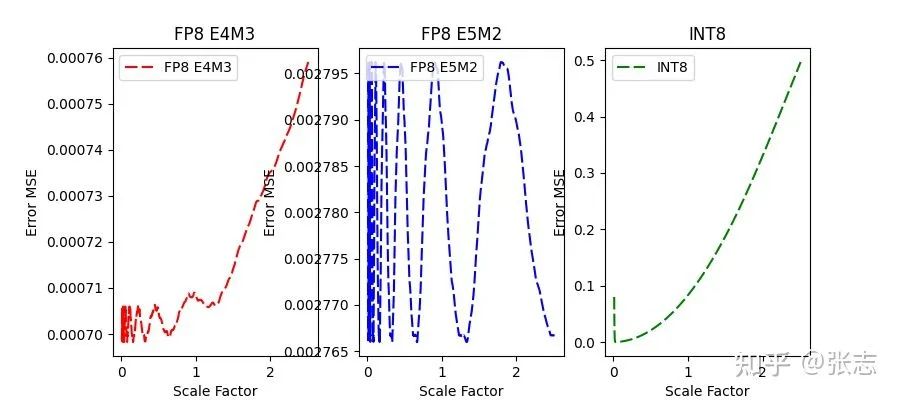
| FP8 E4M3 | FP8 E5M2 | INT8 |
|---|---|---|
| 0.06% | 0.2% | 0.008% |

| INT8 | FP8 | |
|---|---|---|
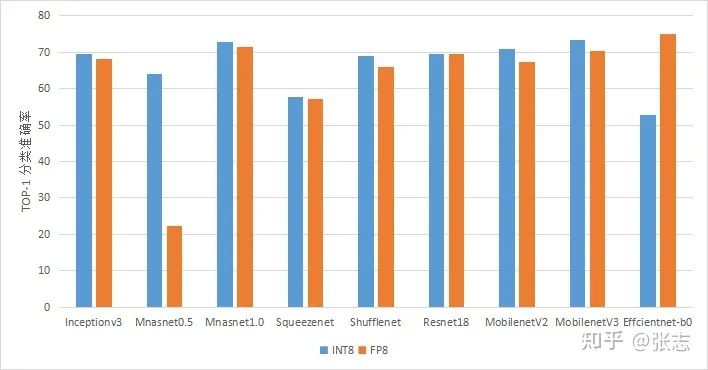
| Inceptionv3 | 69.4 | 68.2 |
| mnasnet | 63.9 | 22.3 |
| mnasnet | 72.8 | 71.3 |
| squeezenet | 57.8 | 57.1 |
| shufflenet | 68.8 | 66.0 |
| resnet18 | 69.6 | 69.4 |
| mobilenetv2 | 70.9 | 67.2 |
| mobilenetv3 | 73.3 | 70.3 |
| efficientnet-b0 | 52.8 | 74.9 |
FP8的量化并不精確
FP8的量化具有良好的寬容度,我們期待他在QAT中取得更好的表現(xiàn)
FP8良好的寬容度可以量化一些奇怪的網(wǎng)絡(luò),例如Effcientnet。
· https://github.com/openppl-public/ppq/tree/master/ppq
· https://github.com/openppl-public/ppq/pull/274
· https://www.graphcore.ai/posts/graphcore-and-amd-propose-8-bit-fp-ai-standard-with-qualcomm-support
· 本文部分內(nèi)容翻譯自:https://arxiv.org/pdf/2209.05433.pdf
推薦閱讀
輔助模塊加速收斂,精度大幅提升!移動(dòng)端實(shí)時(shí)的NanoDet-Plus來了!
SSD的torchvision版本實(shí)現(xiàn)詳解
機(jī)器學(xué)習(xí)算法工程師
一個(gè)用心的公眾號(hào)
