
Java Bean 轉(zhuǎn) Map 的那些坑
1
有些業(yè)務(wù)場(chǎng)景下需要將 Java Bean 轉(zhuǎn)成 Map 再使用。
本以為很簡(jiǎn)單場(chǎng)景,但是坑很多。
2
2.0 測(cè)試對(duì)象
import lombok.Data;

import java.util.Date;

@Data
public class MockObject extends  MockParent{

    private Integer aInteger;

    private Long aLong;

    private Double aDouble;

    private Date aDate;
}
父類(lèi)
import lombok.Data;

@Data
public class MockParent {
    private Long parent;
}
2.1 JSON 反序列化了類(lèi)型丟失
2.1.1 問(wèn)題復(fù)現(xiàn)
將 Java Bean 轉(zhuǎn) Map 最常見(jiàn)的手段就是使用 JSON 框架,如 fastjson 、 gson、jackson 等。
但使用 JSON 將 Java Bean 轉(zhuǎn) Map 會(huì)導(dǎo)致部分?jǐn)?shù)據(jù)類(lèi)型丟失。
如使用 fastjson ,當(dāng)屬性為 Long 類(lèi)型但數(shù)字小于 Integer 最大值時(shí),反序列成 Map 之后,將變?yōu)? Integer 類(lèi)型。
maven 依賴(lài):
<!-- https://mvnrepository.com/artifact/com.alibaba/fastjson -->
<dependency>
    <groupId>com.alibaba</groupId>
    <artifactId>fastjson</artifactId>
    <version>2.0.8</version>
</dependency>
示例代碼:
import com.alibaba.fastjson.JSON;
import com.alibaba.fastjson.TypeReference;

import java.util.Date;
import java.util.Map;

public class JsonDemo {

    public static void main(String[] args) {
        MockObject mockObject = new MockObject();
        mockObject.setAInteger(1);
        mockObject.setALong(2L);
        mockObject.setADate(new Date());
        mockObject.setADouble(3.4D);
        mockObject.setParent(3L);

       String json = JSON.toJSONString(mockObject);

        Map<String,Object> map =  JSON.parseObject(json, new TypeReference<Map<String,Object>>(){});

        System.out.println(map);
    }
}
結(jié)果打印:
{"parent":3,"ADouble":3.4,"ALong":2,"AInteger":1,"ADate":1657299916477}
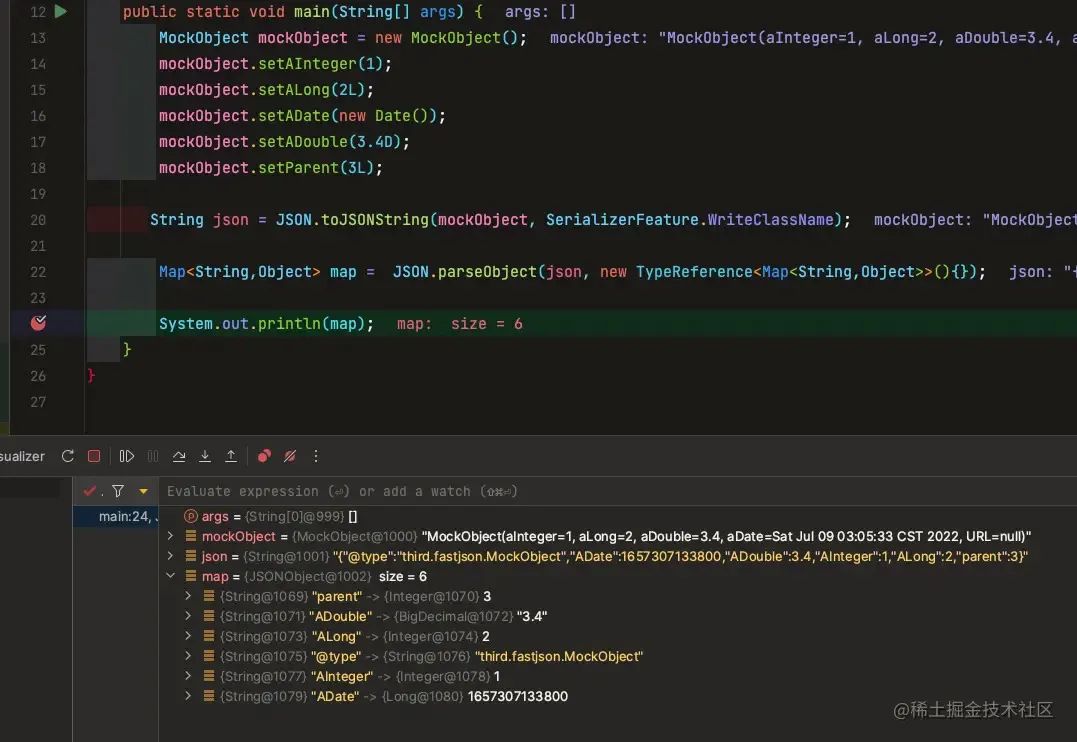
調(diào)試截圖:
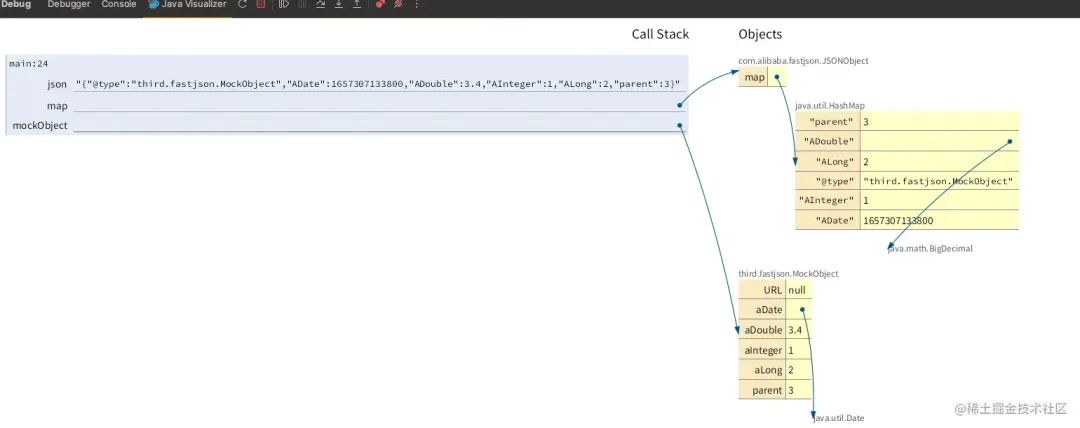
通過(guò) Java Visualizer 插件進(jìn)行可視化查看:
2.2.2 問(wèn)題描述
存在兩個(gè)問(wèn)題:
通過(guò) fastjson 將 Java Bean 轉(zhuǎn)為 Map ,類(lèi)型會(huì)發(fā)生轉(zhuǎn)變。如 Long 變成 Integer ,Date 變成 Long,Double 變成 Decimal 類(lèi)型等。
在某些場(chǎng)景下,Map 的 key 并非和屬性名完全對(duì)應(yīng),像是通過(guò) get set 方法“推斷”出來(lái)的屬性名。
2.2 BeanMap 轉(zhuǎn)換屬性名錯(cuò)誤
2.2.1 commons-beanutils 的 BeanMap
maven 版本:
<!-- https://mvnrepository.com/artifact/commons-beanutils/commons-beanutils -->
<dependency>
    <groupId>commons-beanutils</groupId>
    <artifactId>commons-beanutils</artifactId>
    <version>1.9.4</version>
</dependency>
代碼示例:
import org.apache.commons.beanutils.BeanMap;
import third.fastjson.MockObject;

import java.util.Date;

public class BeanUtilsDemo {
    public static void main(String[] args) {
        MockObject mockObject = new MockObject();
        mockObject.setAInteger(1);
        mockObject.setALong(2L);
        mockObject.setADate(new Date());
        mockObject.setADouble(3.4D);
        mockObject.setParent(3L);

        BeanMap beanMap = new BeanMap(mockObject);
        System.out.println(beanMap);
    }
}
調(diào)試截圖:
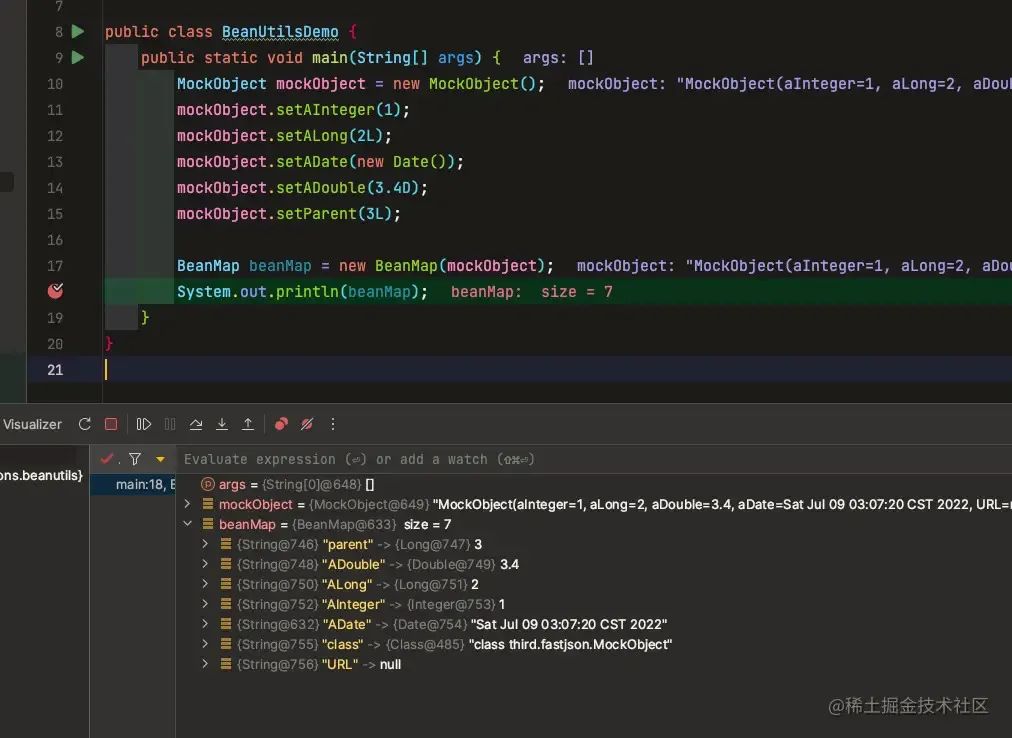 存在和 cglib 一樣的問(wèn)題,雖然類(lèi)型沒(méi)問(wèn)題但是屬性名還是不對(duì)。
原因分析:
   /**
     * Constructs a new <code>BeanMap</code> that operates on the
     * specified bean.  If the given bean is <code>null</code>, then
     * this map will be empty.
     *
     * @param bean  the bean for this map to operate on
     */
    public BeanMap(final Object bean) {
        this.bean = bean;
        initialise();
    }
關(guān)鍵代碼:
    private void initialise() {
        if(getBean() == null) {
            return;
        }

        final Class<? extends Object>  beanClass = getBean().getClass();
        try {
            //BeanInfo beanInfo = Introspector.getBeanInfo( bean, null );
            final BeanInfo beanInfo = Introspector.getBeanInfo( beanClass );
            final PropertyDescriptor[] propertyDescriptors = beanInfo.getPropertyDescriptors();
            if ( propertyDescriptors != null ) {
                for (final PropertyDescriptor propertyDescriptor : propertyDescriptors) {
                    if ( propertyDescriptor != null ) {
                        final String name = propertyDescriptor.getName();
                        final Method readMethod = propertyDescriptor.getReadMethod();
                        final Method writeMethod = propertyDescriptor.getWriteMethod();
                        final Class<? extends Object> aType = propertyDescriptor.getPropertyType();

                        if ( readMethod != null ) {
                            readMethods.put( name, readMethod );
                        }
                        if ( writeMethod != null ) {
                            writeMethods.put( name, writeMethod );
                        }
                        types.put( name, aType );
                    }
                }
            }
        }
        catch ( final IntrospectionException e ) {
            logWarn(  e );
        }
    }
調(diào)試一下就會(huì)發(fā)現(xiàn),問(wèn)題出在 BeanInfo 里面 PropertyDescriptor 的 name 不正確。
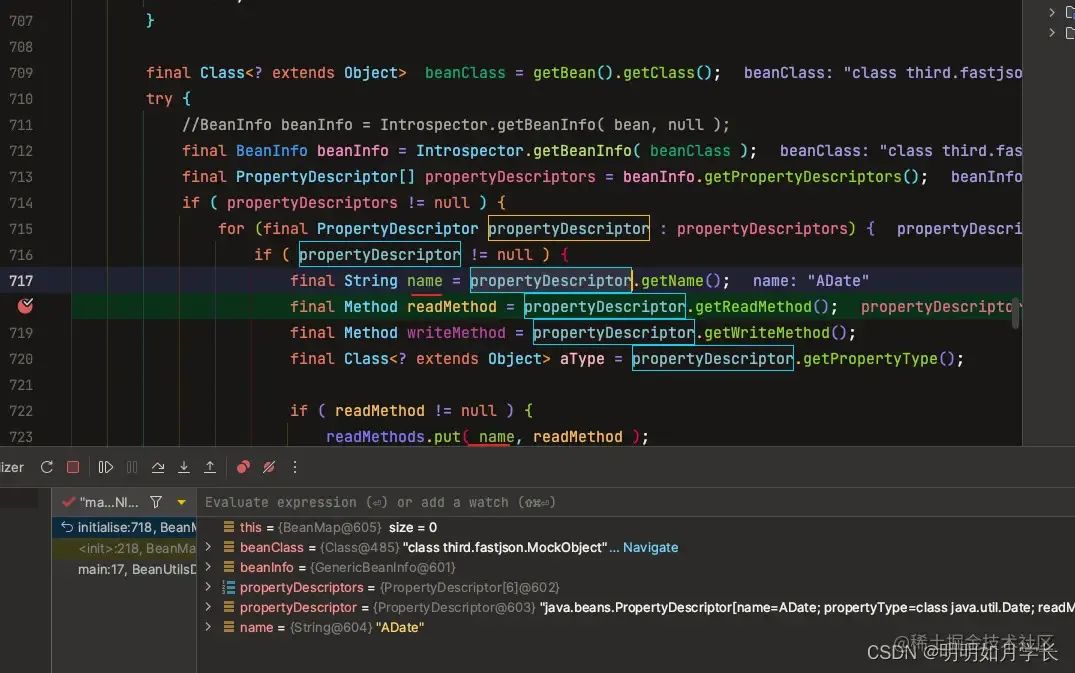
經(jīng)過(guò)分析會(huì)發(fā)現(xiàn) java.beans.Introspector#getTargetPropertyInfo 方法是字段解析的關(guān)鍵
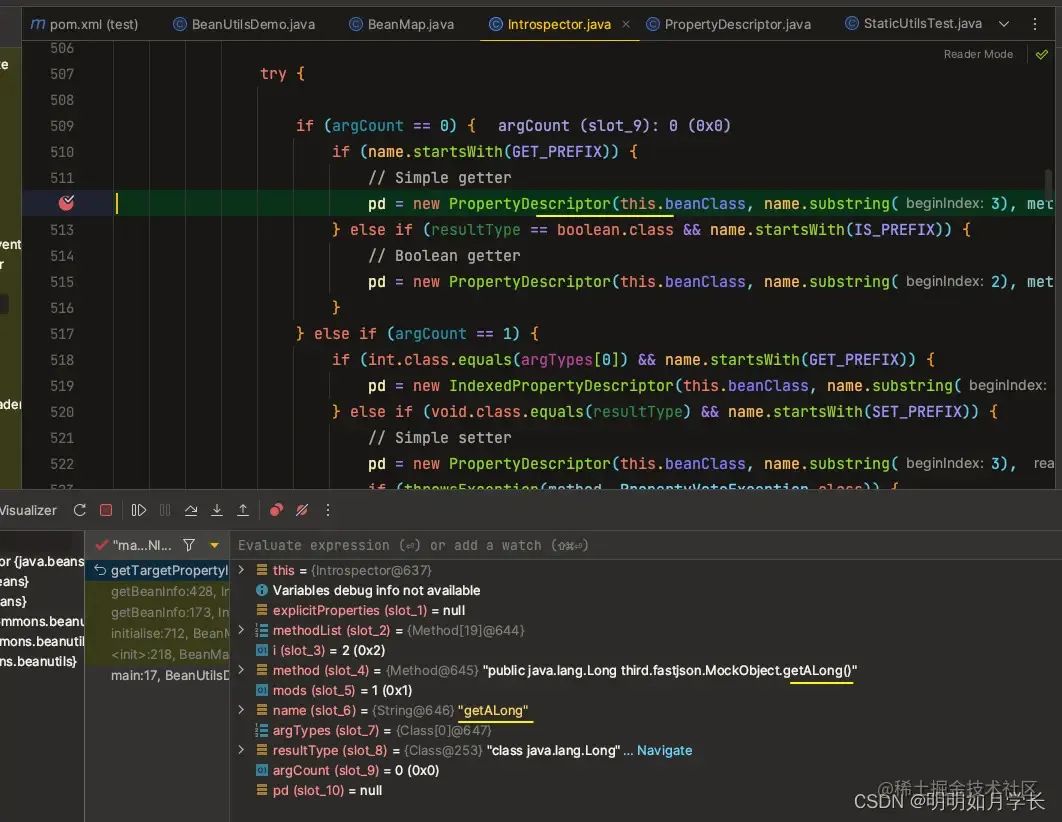 對(duì)于無(wú)參的以 get 開(kāi)頭的方法名從
 index =3 處截取,如 getALong 截取后為 ALong, 如 getADouble 截取后為 ADouble。
然后去構(gòu)造 PropertyDescriptor:
/**
     * Creates <code>PropertyDescriptor</code> for the specified bean
     * with the specified name and methods to read/write the property value.
     *
     * @param bean   the type of the target bean
     * @param base   the base name of the property (the rest of the method name)
     * @param read   the method used for reading the property value
     * @param write  the method used for writing the property value
     * @exception IntrospectionException if an exception occurs during introspection
     *
     * @since 1.7
     */
    PropertyDescriptor(Class<?> bean, String base, Method read, Method write) throws IntrospectionException {
        if (bean == null) {
            throw new IntrospectionException("Target Bean class is null");
        }
        setClass0(bean);
        setName(Introspector.decapitalize(base));
        setReadMethod(read);
        setWriteMethod(write);
        this.baseName = base;
    }
底層使用 java.beans.Introspector#decapitalize 進(jìn)行解析:
   /**
     * Utility method to take a string and convert it to normal Java variable
     * name capitalization.  This normally means converting the first
     * character from upper case to lower case, but in the (unusual) special
     * case when there is more than one character and both the first and
     * second characters are upper case, we leave it alone.
     * <p>
     * Thus "FooBah" becomes "fooBah" and "X" becomes "x", but "URL" stays
     * as "URL".
     *
     * @param  name The string to be decapitalized.
     * @return  The decapitalized version of the string.
     */
    public static String decapitalize(String name) {
        if (name == null || name.length() == 0) {
            return name;
        }
        if (name.length() > 1 && Character.isUpperCase(name.charAt(1)) &&
                        Character.isUpperCase(name.charAt(0))){
            return name;
        }
        char chars[] = name.toCharArray();
        chars[0] = Character.toLowerCase(chars[0]);
        return new String(chars);
    }
從代碼中我們可以看出
當(dāng) name 的長(zhǎng)度 > 1,且第一個(gè)字符和第二個(gè)字符都大寫(xiě)時(shí),直接返回參數(shù)作為 PropertyDescriptor name。否則將 name 轉(zhuǎn)為首字母小寫(xiě)
這種處理本意是為了不讓屬性為類(lèi)似 URL 這種縮略詞轉(zhuǎn)為 uRL ,結(jié)果“誤傷”了我們這種場(chǎng)景。
2.2.2 使用 cglib 的 BeanMap
cglib 依賴(lài)
<!-- https://mvnrepository.com/artifact/cglib/cglib -->
   <dependency>
            <groupId>cglib</groupId>
            <artifactId>cglib-nodep</artifactId>
            <version>3.2.12</version>
   </dependency>
代碼示例:
import net.sf.cglib.beans.BeanMap;
import third.fastjson.MockObject;

import java.util.Date;

public class BeanMapDemo {

    public static void main(String[] args) {

        MockObject mockObject = new MockObject();
        mockObject.setAInteger(1);
        mockObject.setALong(2L);
        mockObject.setADate(new Date());
        mockObject.setADouble(3.4D);
        mockObject.setParent(3L);


        BeanMap beanMapp = BeanMap.create(mockObject);

        System.out.println(beanMapp);
    }
}
結(jié)果展示:
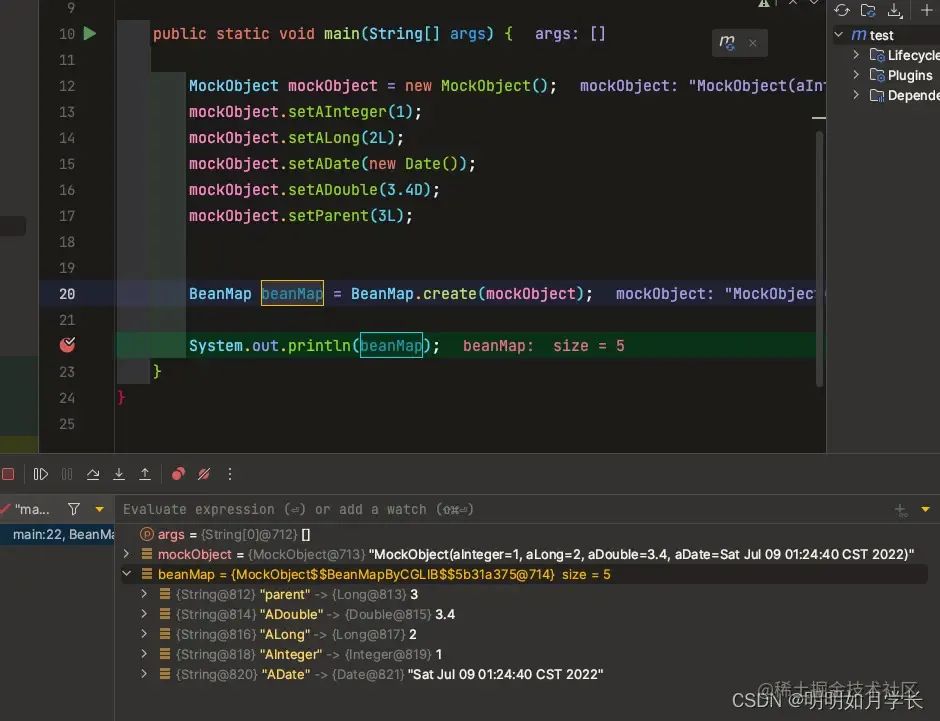
我們發(fā)現(xiàn)類(lèi)型對(duì)了,但是屬性名依然不對(duì)。
關(guān)鍵代碼:net.sf.cglib.core.ReflectUtils#getBeanGetters底層也會(huì)用到 java.beans.Introspector#decapitalize 所以屬性名存在一樣的問(wèn)題就不足為奇了。
3
3.1 解決方案
解決方案有很多,本文提供一個(gè)基于 dubbo的解決方案。
maven 依賴(lài):
<!-- https://mvnrepository.com/artifact/org.apache.dubbo/dubbo -->
<dependency>
    <groupId>org.apache.dubbo</groupId>
    <artifactId>dubbo</artifactId>
    <version>3.0.9</version>
</dependency>
示例代碼:
import org.apache.dubbo.common.utils.PojoUtils;
import third.fastjson.MockObject;

import java.util.Date;

public class DubboPojoDemo {
    public static void main(String[] args) {
        MockObject mockObject = new MockObject();
        mockObject.setAInteger(1);
        mockObject.setALong(2L);
        mockObject.setADate(new Date());
        mockObject.setADouble(3.4D);
        mockObject.setParent(3L);

        Object generalize = PojoUtils.generalize(mockObject);

        System.out.println(generalize);
    }
}
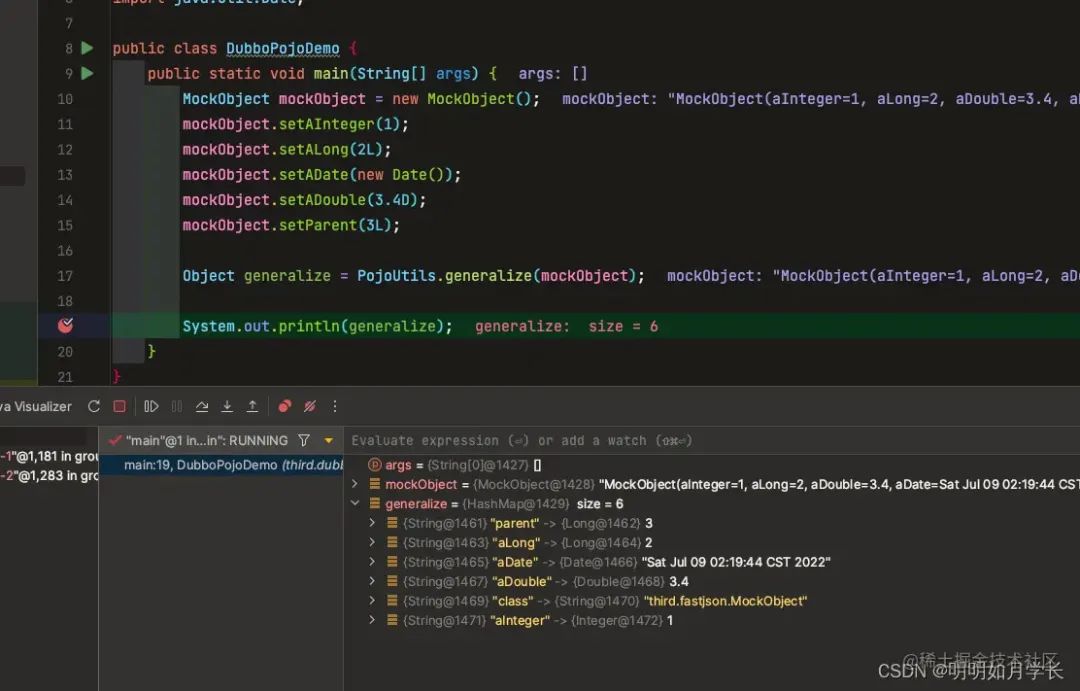
調(diào)試效果:
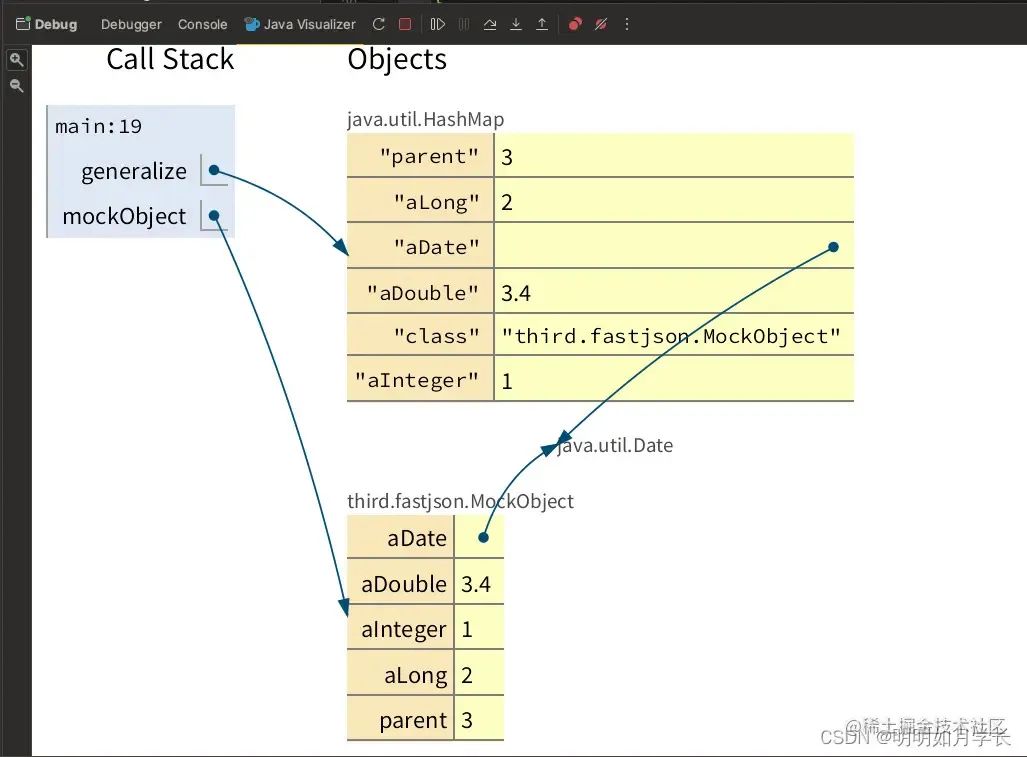
 Java Visualizer 效果:
3.2 原理解析
大家可以下載源碼來(lái)簡(jiǎn)單研究下。
https://github.com/apache/dubbo
核心代碼:org.apache.dubbo.common.utils.PojoUtils#generalize(java.lang.Object)
public static Object generalize(Object pojo) {
     eturn generalize(pojo, new IdentityHashMap());
}
關(guān)鍵代碼:
// pojo 待轉(zhuǎn)換的對(duì)象
// history 緩存 Map,提高性能
 private static Object generalize(Object pojo, Map<Object, Object> history) {
        if (pojo == null) {
            return null;
        }

         // 枚舉直接返回枚舉名
        if (pojo instanceof Enum<?>) {
            return ((Enum<?>) pojo).name();
        }

        // 枚舉數(shù)組,返回枚舉名數(shù)組
        if (pojo.getClass().isArray() && Enum.class.isAssignableFrom(pojo.getClass().getComponentType())) {
            int len = Array.getLength(pojo);
            String[] values = new String[len];
            for (int i = 0; i < len; i++) {
                values[i] = ((Enum<?>) Array.get(pojo, i)).name();
            }
            return values;
        }

        // 基本類(lèi)型返回 pojo 自身
        if (ReflectUtils.isPrimitives(pojo.getClass())) {
            return pojo;
        }

        // Class 返回 name
        if (pojo instanceof Class) {
            return ((Class) pojo).getName();
        }

        Object o = history.get(pojo);
        if (o != null) {
            return o;
        }
        history.put(pojo, pojo);

// 數(shù)組類(lèi)型,遞歸
        if (pojo.getClass().isArray()) {
            int len = Array.getLength(pojo);
            Object[] dest = new Object[len];
            history.put(pojo, dest);
            for (int i = 0; i < len; i++) {
                Object obj = Array.get(pojo, i);
                dest[i] = generalize(obj, history);
            }
            return dest;
        }
// 集合類(lèi)型遞歸
        if (pojo instanceof Collection<?>) {
            Collection<Object> src = (Collection<Object>) pojo;
            int len = src.size();
            Collection<Object> dest = (pojo instanceof List<?>) ? new ArrayList<Object>(len) : new HashSet<Object>(len);
            history.put(pojo, dest);
            for (Object obj : src) {
                dest.add(generalize(obj, history));
            }
            return dest;
        }
        // Map 類(lèi)型,直接 對(duì) key 和 value 處理
        if (pojo instanceof Map<?, ?>) {
            Map<Object, Object> src = (Map<Object, Object>) pojo;
            Map<Object, Object> dest = createMap(src);
            history.put(pojo, dest);
            for (Map.Entry<Object, Object> obj : src.entrySet()) {
                dest.put(generalize(obj.getKey(), history), generalize(obj.getValue(), history));
            }
            return dest;
        }
        Map<String, Object> map = new HashMap<String, Object>();
        history.put(pojo, map);

        // 開(kāi)啟生成 class 則寫(xiě)入 pojo 的class
        if (GENERIC_WITH_CLZ) {
            map.put("class", pojo.getClass().getName());
        }

      // 處理 get 方法
        for (Method method : pojo.getClass().getMethods()) {
            if (ReflectUtils.isBeanPropertyReadMethod(method)) {
                ReflectUtils.makeAccessible(method);
                try {
                    map.put(ReflectUtils.getPropertyNameFromBeanReadMethod(method), generalize(method.invoke(pojo), history));
                } catch (Exception e) {
                    throw new RuntimeException(e.getMessage(), e);
                }
            }
        }
        // 處理公有屬性
        for (Field field : pojo.getClass().getFields()) {
            if (ReflectUtils.isPublicInstanceField(field)) {
                try {
                    Object fieldValue = field.get(pojo);
                    // 對(duì)象已經(jīng)解析過(guò),直接從緩存里讀提高性能
                    if (history.containsKey(pojo)) {
                        Object pojoGeneralizedValue = history.get(pojo);
                        // 已經(jīng)解析過(guò)該屬性則跳過(guò)(如公有屬性,且有 get 方法的情況)
                        if (pojoGeneralizedValue instanceof Map
                            && ((Map) pojoGeneralizedValue).containsKey(field.getName())) {
                            continue;
                        }
                    }
                    if (fieldValue != null) {
                        map.put(field.getName(), generalize(fieldValue, history));
                    }
                } catch (Exception e) {
                    throw new RuntimeException(e.getMessage(), e);
                }
            }
        }
        return map;
    }
關(guān)鍵截圖

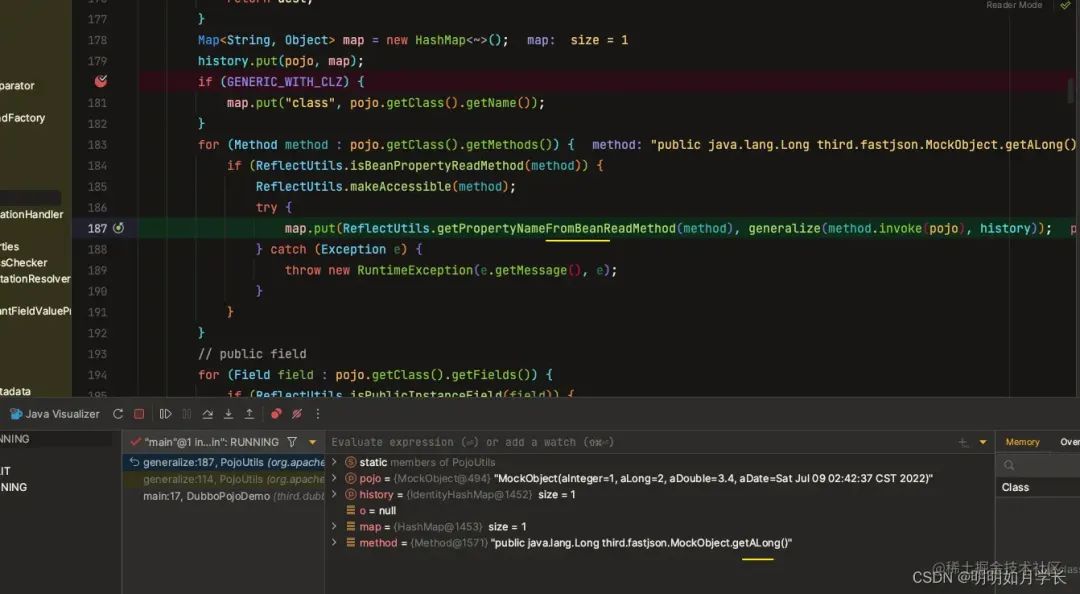
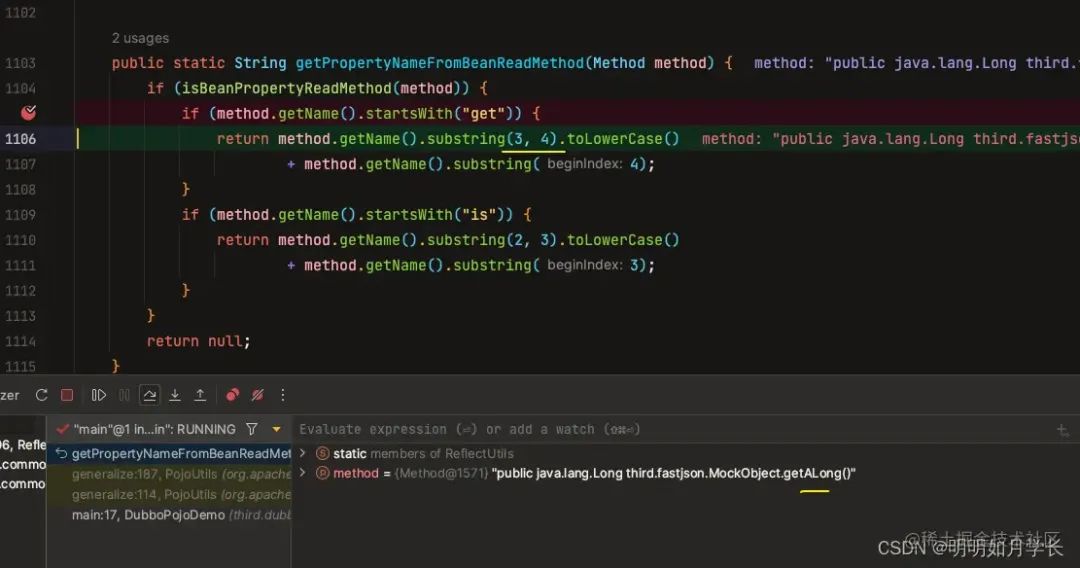
org.apache.dubbo.common.utils.ReflectUtils#getPropertyNameFromBeanReadMethod
public static String getPropertyNameFromBeanReadMethod(Method method) {
        if (isBeanPropertyReadMethod(method)) {
            // get 方法,則從 index =3 的字符小寫(xiě) + 后面的字符串
            if (method.getName().startsWith("get")) {
                return method.getName().substring(3, 4).toLowerCase()
                        + method.getName().substring(4);
            }
            // is 開(kāi)頭方法, index =2 的字符小寫(xiě) + 后面的字符串
            if (method.getName().startsWith("is")) {
                return method.getName().substring(2, 3).toLowerCase()
                        + method.getName().substring(3);
            }
        }
        return null;
    }
因此, getALong 方法對(duì)應(yīng)的屬性名被解析為 aLong。
 同時(shí),這么處理也會(huì)存在問(wèn)題。如當(dāng)屬性名叫 URL 時(shí),轉(zhuǎn)為 Map 后 key 就會(huì)被解析成 uRL。
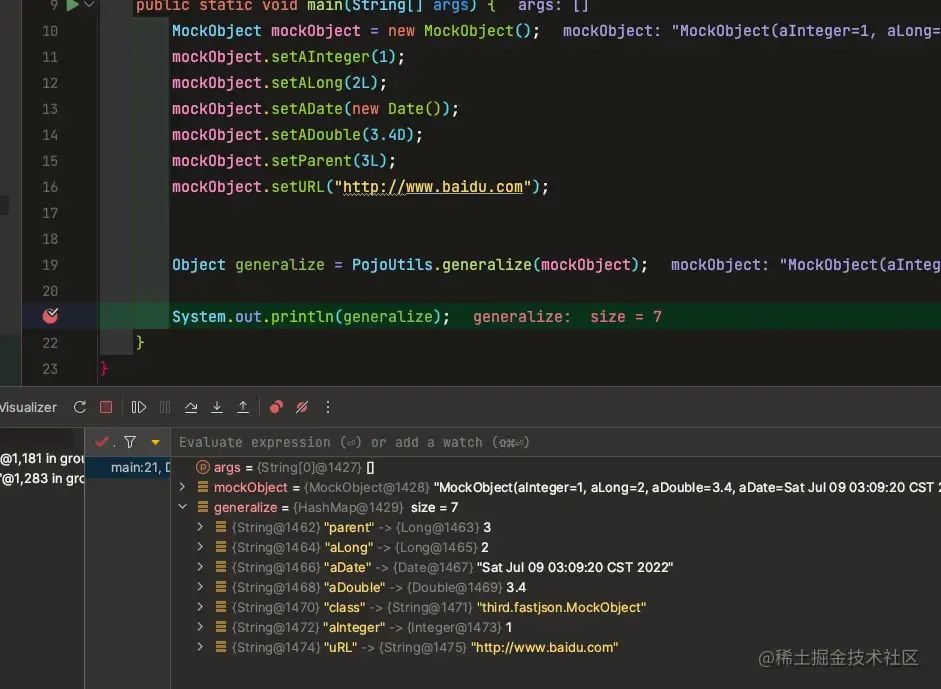 從這里看出,當(dāng)屬性名比較特殊時(shí)也很容易出問(wèn)題,但 dubbo 這個(gè)工具類(lèi)更符合我們的預(yù)期。更多細(xì)節(jié),大家可以根據(jù) DEMO 自行調(diào)試學(xué)習(xí)。
如果想嚴(yán)格和屬性保持一致,可以使用反射獲取屬性名和屬性值,加緩存機(jī)制提升解析的效率。
4
Java Bean 轉(zhuǎn) Map 的坑很多,最常見(jiàn)的就是類(lèi)型丟失和屬性名解析錯(cuò)誤的問(wèn)題。
大家在使用 JSON 框架和 Java Bean 轉(zhuǎn) Map 的框架時(shí)要特別小心。
平時(shí)使用某些框架時(shí),多寫(xiě)一些 DEMO 進(jìn)行驗(yàn)證,多讀源碼,多調(diào)試,少趟坑。