
SimpleDateFormat線程不安全的5種解決方案!

作者 | 王磊
來(lái)源 | Java中文社群(ID:javacn666)
1.什么是線程不安全?
線程不安全也叫非線程安全,是指多線程執(zhí)行中,程序的執(zhí)行結(jié)果和預(yù)期的結(jié)果不符的情況就叫著線程不安全。
線程不安全的代碼
SimpleDateFormat 就是一個(gè)典型的線程不安全事例,接下來(lái)我們動(dòng)手來(lái)實(shí)現(xiàn)一下。首先我們先創(chuàng)建 10 個(gè)線程來(lái)格式化時(shí)間,時(shí)間格式化每次傳遞的待格式化時(shí)間都是不同的,所以程序如果正確執(zhí)行將會(huì)打印 10 個(gè)不同的值,接下來(lái)我們來(lái)看具體的代碼實(shí)現(xiàn):
import java.text.SimpleDateFormat;
import java.util.Date;
import java.util.concurrent.ExecutorService;
import java.util.concurrent.Executors;

public class SimpleDateFormatExample {
    // 創(chuàng)建 SimpleDateFormat 對(duì)象
    private static SimpleDateFormat simpleDateFormat = new SimpleDateFormat("mm:ss");

    public static void main(String[] args) {
        // 創(chuàng)建線程池
        ExecutorService threadPool = Executors.newFixedThreadPool(10);
        // 執(zhí)行 10 次時(shí)間格式化
        for (int i = 0; i < 10; i++) {
            int finalI = i;
            // 線程池執(zhí)行任務(wù)
            threadPool.execute(new Runnable() {
                @Override
                public void run() {
                    // 創(chuàng)建時(shí)間對(duì)象
                    Date date = new Date(finalI * 1000);
                    // 執(zhí)行時(shí)間格式化并打印結(jié)果
                    System.out.println(simpleDateFormat.format(date));
                }
            });
        }
    }
}
我們預(yù)期的正確結(jié)果是這樣的(10 次打印的值都不同):
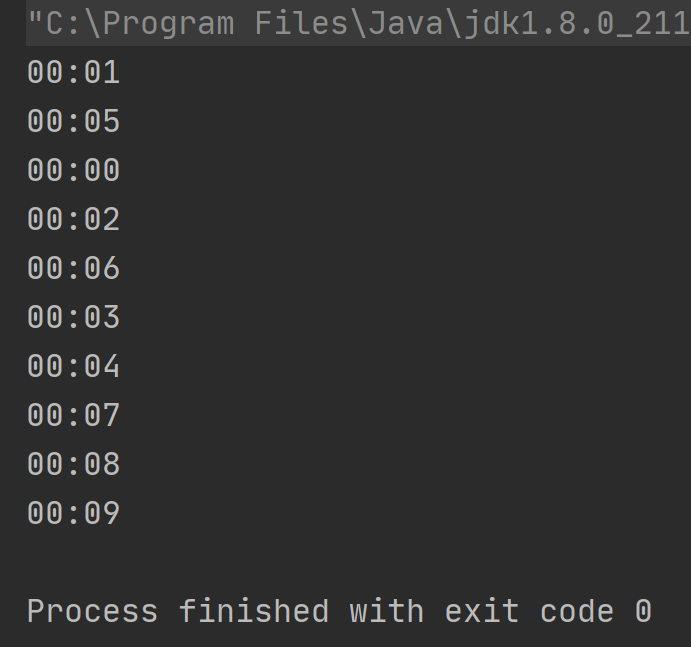
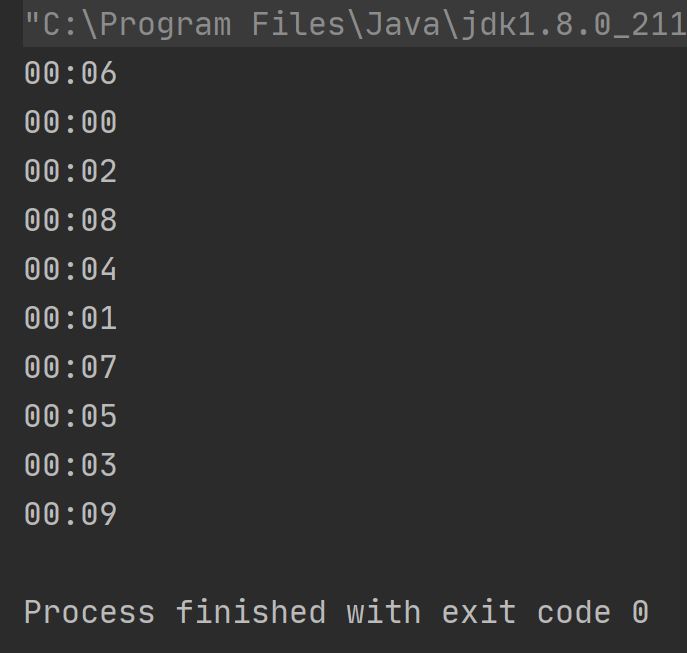
然而,以上程序的運(yùn)行結(jié)果卻是這樣的:
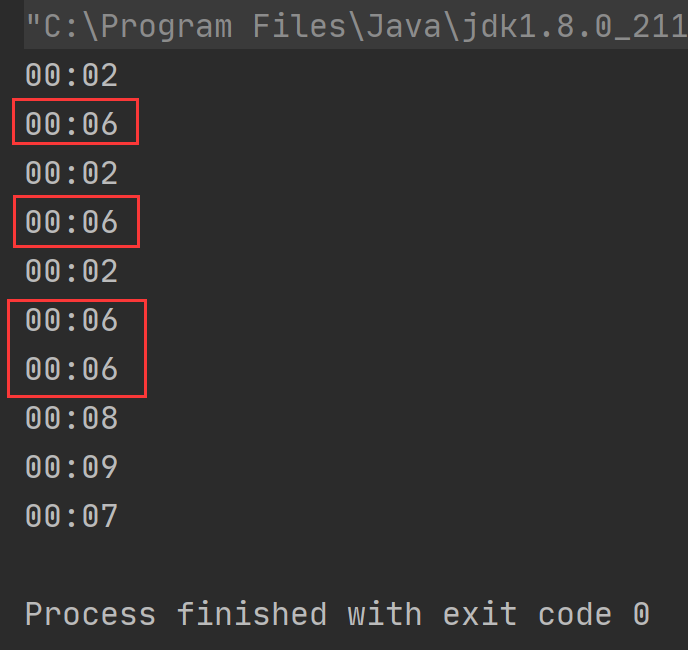
從上述結(jié)果可以看出,當(dāng)在多線程中使用 SimpleDateFormat 進(jìn)行時(shí)間格式化是線程不安全的。
2.解決方案
SimpleDateFormat 線程不安全的解決方案總共包含以下 5 種:
將 SimpleDateFormat定義為局部變量;使用 synchronized加鎖執(zhí)行;使用 Lock加鎖執(zhí)行(和解決方案 2 類似);使用 ThreadLocal;使用 JDK 8中提供的DateTimeFormat。
接下來(lái)我們分別來(lái)看每種解決方案的具體實(shí)現(xiàn)。
① SimpleDateFormat改為局部變量
將 SimpleDateFormat 定義為局部變量時(shí),因?yàn)槊總€(gè)線程都是獨(dú)享 SimpleDateFormat 對(duì)象的,相當(dāng)于將多線程程序變成“單線程”程序了,所以不會(huì)有線程不安全的問(wèn)題,具體實(shí)現(xiàn)代碼如下:
import java.text.SimpleDateFormat;
import java.util.Date;
import java.util.concurrent.ExecutorService;
import java.util.concurrent.Executors;

public class SimpleDateFormatExample {
    public static void main(String[] args) {
        // 創(chuàng)建線程池
        ExecutorService threadPool = Executors.newFixedThreadPool(10);
        // 執(zhí)行 10 次時(shí)間格式化
        for (int i = 0; i < 10; i++) {
            int finalI = i;
            // 線程池執(zhí)行任務(wù)
            threadPool.execute(new Runnable() {
                @Override
                public void run() {
                    // 創(chuàng)建 SimpleDateFormat 對(duì)象
                    SimpleDateFormat simpleDateFormat = new SimpleDateFormat("mm:ss");
                    // 創(chuàng)建時(shí)間對(duì)象
                    Date date = new Date(finalI * 1000);
                    // 執(zhí)行時(shí)間格式化并打印結(jié)果
                    System.out.println(simpleDateFormat.format(date));
                }
            });
        }
        // 任務(wù)執(zhí)行完之后關(guān)閉線程池
        threadPool.shutdown();
    }
}
以上程序的執(zhí)行結(jié)果為:

當(dāng)打印的結(jié)果都不相同時(shí),表示程序的執(zhí)行是正確的,從上述結(jié)果可以看出,將 SimpleDateFormat 定義為局部變量之后,就可以成功的解決線程不安全問(wèn)題了。
② 使用synchronized加鎖
鎖是解決線程不安全問(wèn)題最常用的手段,接下來(lái)我們先用 synchronized 來(lái)加鎖進(jìn)行時(shí)間格式化,實(shí)現(xiàn)代碼如下:
import java.text.SimpleDateFormat;
import java.util.Date;
import java.util.concurrent.ExecutorService;
import java.util.concurrent.Executors;

public class SimpleDateFormatExample2 {
    // 創(chuàng)建 SimpleDateFormat 對(duì)象
    private static SimpleDateFormat simpleDateFormat = new SimpleDateFormat("mm:ss");

    public static void main(String[] args) {
        // 創(chuàng)建線程池
        ExecutorService threadPool = Executors.newFixedThreadPool(10);
        // 執(zhí)行 10 次時(shí)間格式化
        for (int i = 0; i < 10; i++) {
            int finalI = i;
            // 線程池執(zhí)行任務(wù)
            threadPool.execute(new Runnable() {
                @Override
                public void run() {
                    // 創(chuàng)建時(shí)間對(duì)象
                    Date date = new Date(finalI * 1000);
                    // 定義格式化的結(jié)果
                    String result = null;
                    synchronized (simpleDateFormat) {
                        // 時(shí)間格式化
                        result = simpleDateFormat.format(date);
                    }
                    // 打印結(jié)果
                    System.out.println(result);
                }
            });
        }
        // 任務(wù)執(zhí)行完之后關(guān)閉線程池
        threadPool.shutdown();
    }
}
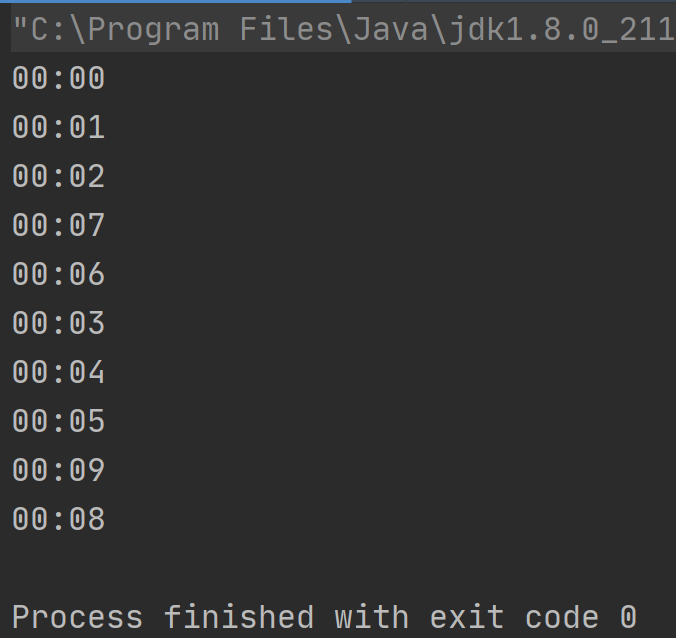
以上程序的執(zhí)行結(jié)果為:
③ 使用Lock加鎖
在 Java 語(yǔ)言中,鎖的常用實(shí)現(xiàn)方式有兩種,除了 synchronized 之外,還可以使用手動(dòng)鎖 Lock,接下來(lái)我們使用 Lock 來(lái)對(duì)線程不安全的代碼進(jìn)行改造,實(shí)現(xiàn)代碼如下:
import java.text.SimpleDateFormat;
import java.util.Date;
import java.util.concurrent.ExecutorService;
import java.util.concurrent.Executors;
import java.util.concurrent.locks.Lock;
import java.util.concurrent.locks.ReentrantLock;

/**
 * Lock 解決線程不安全問(wèn)題
 */
public class SimpleDateFormatExample3 {
    // 創(chuàng)建 SimpleDateFormat 對(duì)象
    private static SimpleDateFormat simpleDateFormat = new SimpleDateFormat("mm:ss");

    public static void main(String[] args) {
        // 創(chuàng)建線程池
        ExecutorService threadPool = Executors.newFixedThreadPool(10);
        // 創(chuàng)建 Lock 鎖
        Lock lock = new ReentrantLock();
        // 執(zhí)行 10 次時(shí)間格式化
        for (int i = 0; i < 10; i++) {
            int finalI = i;
            // 線程池執(zhí)行任務(wù)
            threadPool.execute(new Runnable() {
                @Override
                public void run() {
                    // 創(chuàng)建時(shí)間對(duì)象
                    Date date = new Date(finalI * 1000);
                    // 定義格式化的結(jié)果
                    String result = null;
                    // 加鎖
                    lock.lock();
                    try {
                        // 時(shí)間格式化
                        result = simpleDateFormat.format(date);
                    } finally {
                        // 釋放鎖
                        lock.unlock();
                    }
                    // 打印結(jié)果
                    System.out.println(result);
                }
            });
        }
        // 任務(wù)執(zhí)行完之后關(guān)閉線程池
        threadPool.shutdown();
    }
}
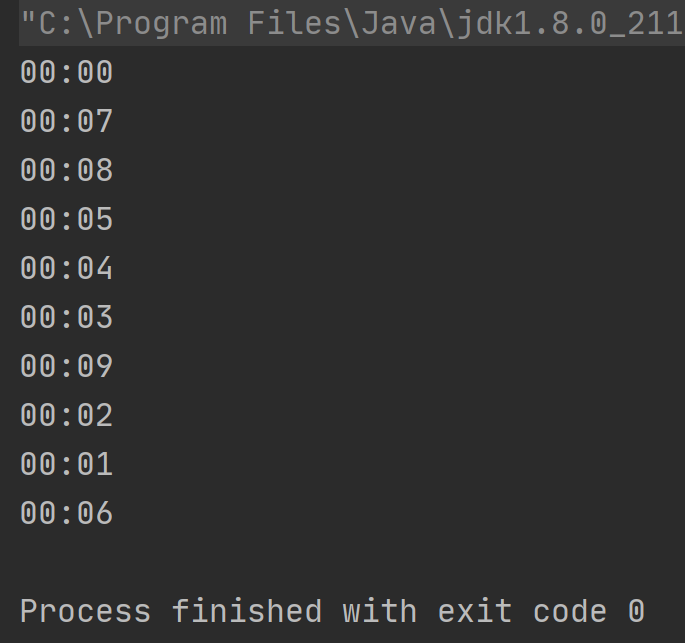
以上程序的執(zhí)行結(jié)果為:
從上述代碼可以看出,手動(dòng)鎖的寫(xiě)法相比于 synchronized 要繁瑣一些。
④ 使用ThreadLocal
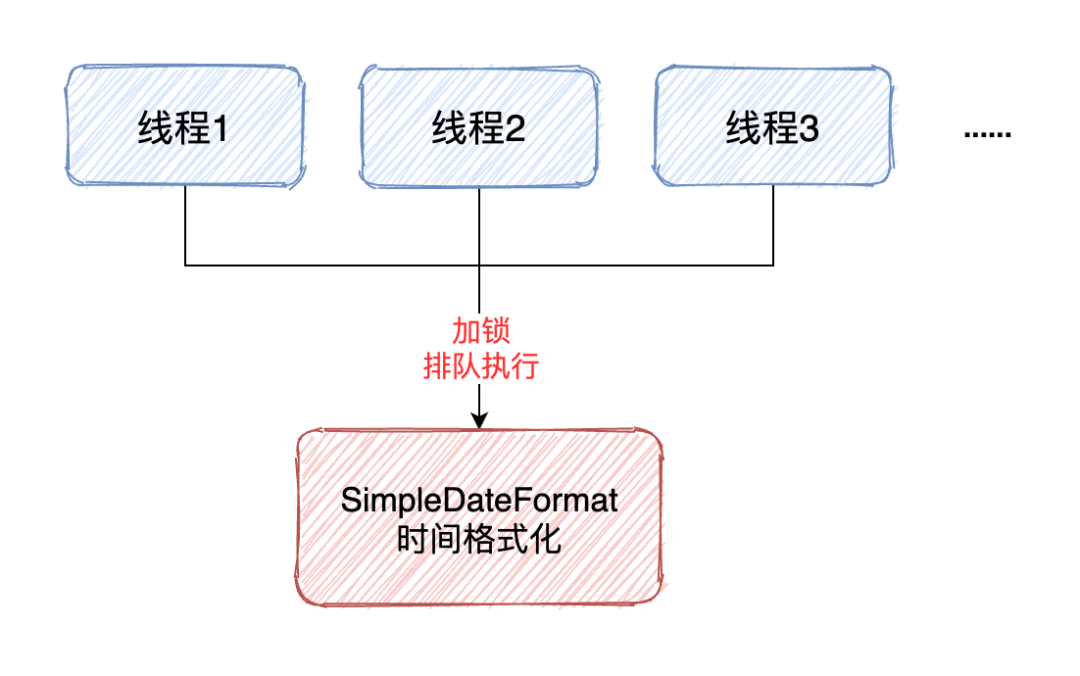
加鎖方案雖然可以正確的解決線程不安全的問(wèn)題,但同時(shí)也引入了新的問(wèn)題,加鎖會(huì)讓程序進(jìn)入排隊(duì)執(zhí)行的流程,從而一定程度的降低了程序的執(zhí)行效率,如下圖所示:
 那有沒(méi)有一種方案既能解決線程不安全的問(wèn)題,同時(shí)還可以避免排隊(duì)執(zhí)行呢?
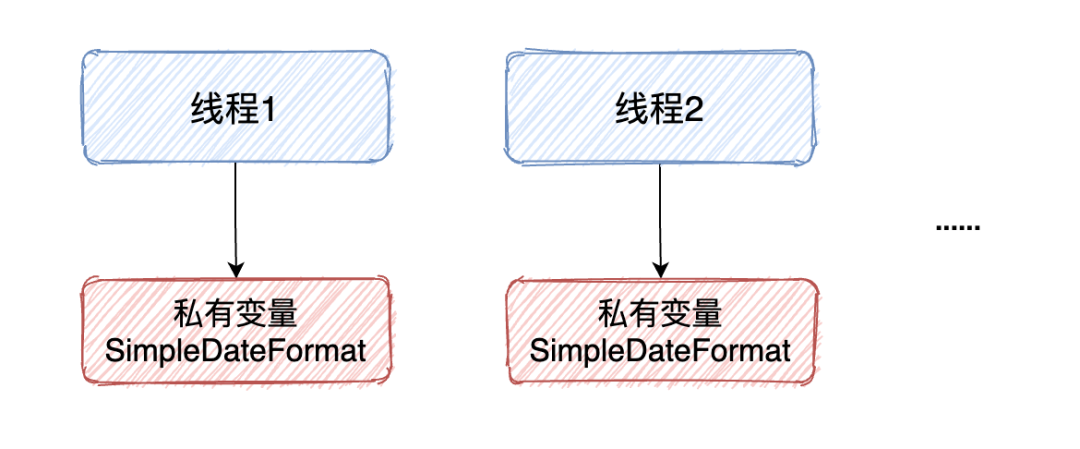
答案是有的,可以考慮使用 ThreadLocal。ThreadLocal 翻譯為中文是線程本地變量的意思,字如其人 ThreadLocal 就是用來(lái)創(chuàng)建線程的私有(本地)變量的,每個(gè)線程擁有自己的私有對(duì)象,這樣就可以避免線程不安全的問(wèn)題了,實(shí)現(xiàn)如下:
知道了實(shí)現(xiàn)方案之后,接下來(lái)我們使用具體的代碼來(lái)演示一下 ThreadLocal 的使用,實(shí)現(xiàn)代碼如下:
import java.text.SimpleDateFormat;
import java.util.Date;
import java.util.concurrent.ExecutorService;
import java.util.concurrent.Executors;

/**
 * ThreadLocal 解決線程不安全問(wèn)題
 */
public class SimpleDateFormatExample4 {
    // 創(chuàng)建 ThreadLocal 對(duì)象,并設(shè)置默認(rèn)值(new SimpleDateFormat)
    private static ThreadLocal<SimpleDateFormat> threadLocal =
            ThreadLocal.withInitial(() -> new SimpleDateFormat("mm:ss"));

    public static void main(String[] args) {
        // 創(chuàng)建線程池
        ExecutorService threadPool = Executors.newFixedThreadPool(10);
        // 執(zhí)行 10 次時(shí)間格式化
        for (int i = 0; i < 10; i++) {
            int finalI = i;
            // 線程池執(zhí)行任務(wù)
            threadPool.execute(new Runnable() {
                @Override
                public void run() {
                    // 創(chuàng)建時(shí)間對(duì)象
                    Date date = new Date(finalI * 1000);
                    // 格式化時(shí)間
                    String result = threadLocal.get().format(date);
                    // 打印結(jié)果
                    System.out.println(result);
                }
            });
        }
        // 任務(wù)執(zhí)行完之后關(guān)閉線程池
        threadPool.shutdown();
    }
}
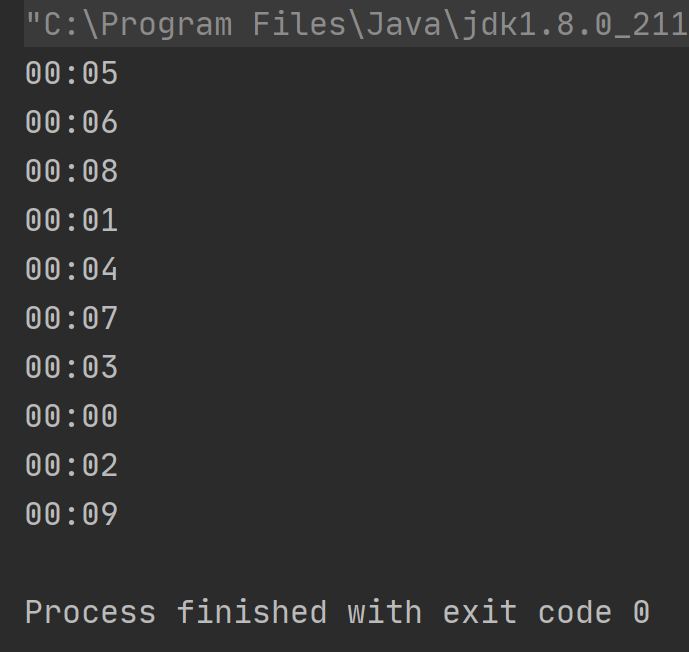
以上程序的執(zhí)行結(jié)果為:
ThreadLocal和局部變量的區(qū)別
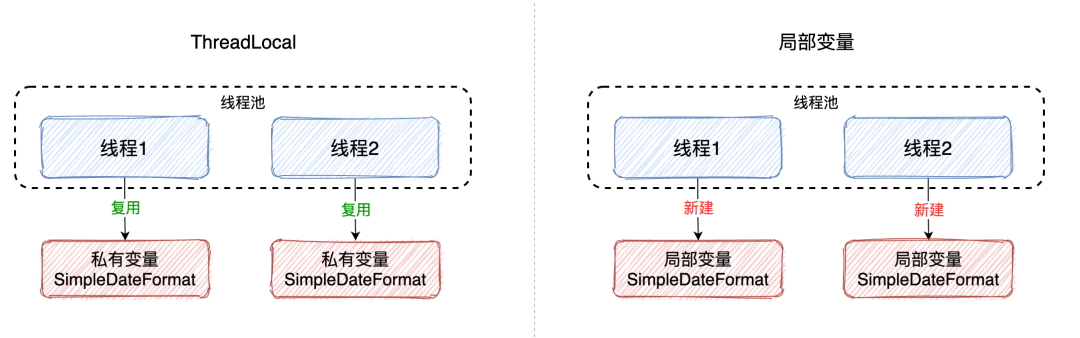
首先來(lái)說(shuō) ThreadLocal 不等于局部變量,這里的“局部變量”指的是像 2.1 示例代碼中的局部變量, ThreadLocal 和局部變量最大的區(qū)別在于:ThreadLocal 屬于線程的私有變量,如果使用的是線程池,那么 ThreadLocal 中的變量是可以重復(fù)使用的,而代碼級(jí)別的局部變量,每次執(zhí)行時(shí)都會(huì)創(chuàng)建新的局部變量,二者區(qū)別如下圖所示:
更多關(guān)于 ThreadLocal 的內(nèi)容,可以訪問(wèn)磊哥前面的文章《ThreadLocal不好用?那是你沒(méi)用對(duì)!》。
⑤ 使用DateTimeFormatter
以上 4 種解決方案都是因?yàn)?SimpleDateFormat 是線程不安全的,所以我們需要加鎖或者使用 ThreadLocal 來(lái)處理,然而,JDK 8 之后我們就有了新的選擇,如果使用的是 JDK 8+ 版本,就可以直接使用 JDK 8 中新增的、安全的時(shí)間格式化工具類 DateTimeFormatter 來(lái)格式化時(shí)間了,接下來(lái)我們來(lái)具體實(shí)現(xiàn)一下。
使用 DateTimeFormatter 必須要配合 JDK 8 中新增的時(shí)間對(duì)象 LocalDateTime 來(lái)使用,因此在操作之前,我們可以先將 Date 對(duì)象轉(zhuǎn)換成 LocalDateTime,然后再通過(guò) DateTimeFormatter 來(lái)格式化時(shí)間,具體實(shí)現(xiàn)代碼如下:
import java.time.LocalDateTime;
import java.time.ZoneId;
import java.time.format.DateTimeFormatter;
import java.util.Date;
import java.util.concurrent.ExecutorService;
import java.util.concurrent.Executors;

/**
 * DateTimeFormatter 解決線程不安全問(wèn)題
 */
public class SimpleDateFormatExample5 {
    // 創(chuàng)建 DateTimeFormatter 對(duì)象
    private static DateTimeFormatter dateTimeFormatter = DateTimeFormatter.ofPattern("mm:ss");

    public static void main(String[] args) {
        // 創(chuàng)建線程池
        ExecutorService threadPool = Executors.newFixedThreadPool(10);
        // 執(zhí)行 10 次時(shí)間格式化
        for (int i = 0; i < 10; i++) {
            int finalI = i;
            // 線程池執(zhí)行任務(wù)
            threadPool.execute(new Runnable() {
                @Override
                public void run() {
                    // 創(chuàng)建時(shí)間對(duì)象
                    Date date = new Date(finalI * 1000);
                    // 將 Date 轉(zhuǎn)換成 JDK 8 中的時(shí)間類型 LocalDateTime
                    LocalDateTime localDateTime =
                            LocalDateTime.ofInstant(date.toInstant(), ZoneId.systemDefault());
                    // 時(shí)間格式化
                    String result = dateTimeFormatter.format(localDateTime);
                    // 打印結(jié)果
                    System.out.println(result);
                }
            });
        }
        // 任務(wù)執(zhí)行完之后關(guān)閉線程池
        threadPool.shutdown();
    }
}
以上程序的執(zhí)行結(jié)果為:
3.線程不安全原因分析
要了解 SimpleDateFormat 為什么是線程不安全的?我們需要查看并分析 SimpleDateFormat 的源碼才行,那我們先從使用的方法 format 入手,源碼如下:
private StringBuffer format(Date date, StringBuffer toAppendTo,
                                FieldDelegate delegate) {
    // 注意此行代碼
    calendar.setTime(date);

    boolean useDateFormatSymbols = useDateFormatSymbols();

    for (int i = 0; i < compiledPattern.length; ) {
        int tag = compiledPattern[i] >>> 8;
        int count = compiledPattern[i++] & 0xff;
        if (count == 255) {
            count = compiledPattern[i++] << 16;
            count |= compiledPattern[i++];
        }

        switch (tag) {
            case TAG_QUOTE_ASCII_CHAR:
                toAppendTo.append((char)count);
                break;

            case TAG_QUOTE_CHARS:
                toAppendTo.append(compiledPattern, i, count);
                i += count;
                break;

            default:
                subFormat(tag, count, delegate, toAppendTo, useDateFormatSymbols);
                break;
        }
    }
    return toAppendTo;
}
也許是好運(yùn)使然,沒(méi)想到剛開(kāi)始分析第一個(gè)方法就找到了線程不安全的問(wèn)題所在。
從上述源碼可以看出,在執(zhí)行 SimpleDateFormat.format 方法時(shí),會(huì)使用 calendar.setTime 方法將輸入的時(shí)間進(jìn)行轉(zhuǎn)換,那么我們想象一下這樣的場(chǎng)景:
線程 1 執(zhí)行了 calendar.setTime(date)方法,將用戶輸入的時(shí)間轉(zhuǎn)換成了后面格式化時(shí)所需要的時(shí)間;線程 1 暫停執(zhí)行,線程 2 得到 CPU時(shí)間片開(kāi)始執(zhí)行;線程 2 執(zhí)行了 calendar.setTime(date)方法,對(duì)時(shí)間進(jìn)行了修改;線程 2 暫停執(zhí)行,線程 1 得出 CPU時(shí)間片繼續(xù)執(zhí)行,因?yàn)榫€程 1 和線程 2 使用的是同一對(duì)象,而時(shí)間已經(jīng)被線程 2 修改了,所以此時(shí)當(dāng)線程 1 繼續(xù)執(zhí)行的時(shí)候就會(huì)出現(xiàn)線程安全的問(wèn)題了。
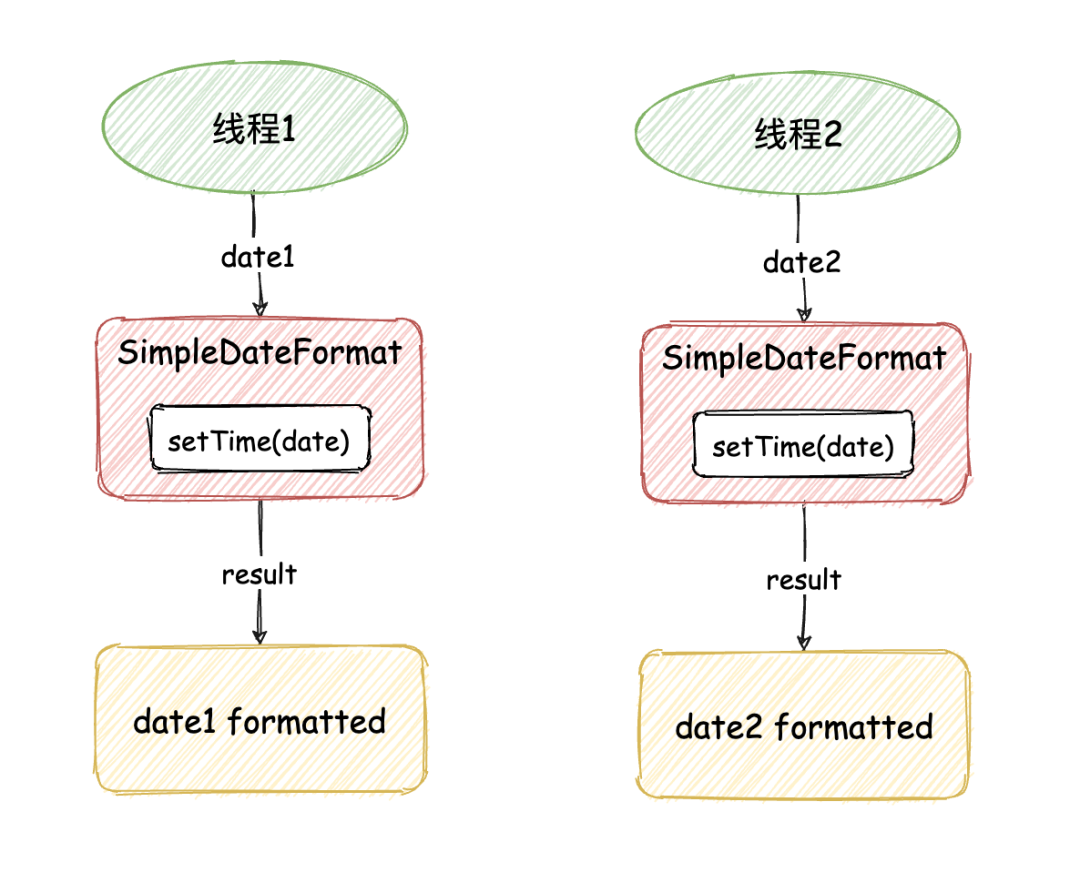
正常的情況下,程序的執(zhí)行是這樣的:
非線程安全的執(zhí)行流程是這樣的:
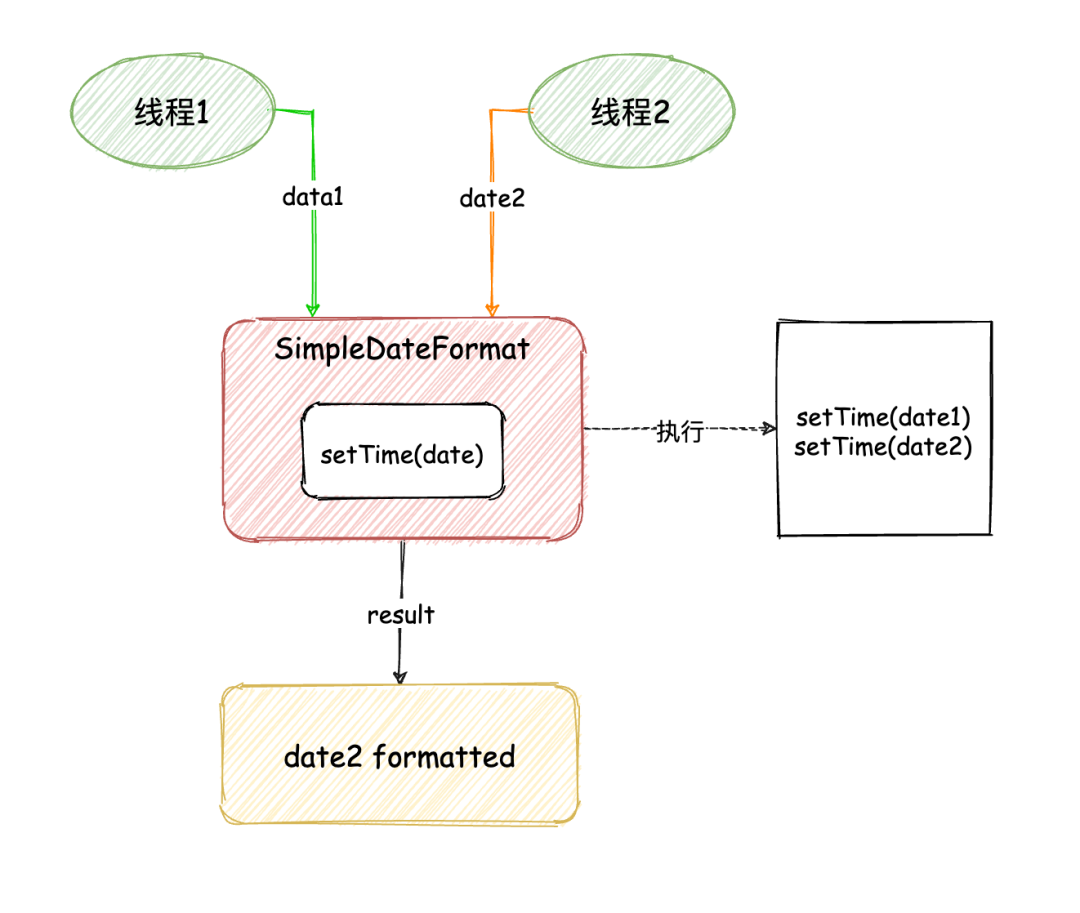 在多線程執(zhí)行的情況下,線程 1 的
 date1 和線程 2 的 date2,因?yàn)閳?zhí)行順序的問(wèn)題,最終都被格式化成 date2 formatted,而非線程 1 date1 formatted 和線程 2 date2 formatted,這樣就會(huì)導(dǎo)致線程不安全的問(wèn)題。
4.各方案優(yōu)缺點(diǎn)總結(jié)
如果使用的是 JDK 8+ 版本,可以直接使用線程安全的 DateTimeFormatter 來(lái)進(jìn)行時(shí)間格式化,如果使用的 JDK 8 以下版本或者改造老的 SimpleDateFormat 代碼,可以考慮使用 synchronized 或 ThreadLocal 來(lái)解決線程不安全的問(wèn)題。因?yàn)閷?shí)現(xiàn)方案 1 局部變量的解決方案,每次執(zhí)行的時(shí)候都會(huì)創(chuàng)建新的對(duì)象,因此不推薦使用。synchronized 的實(shí)現(xiàn)比較簡(jiǎn)單,而使用 ThreadLocal 可以避免加鎖排隊(duì)執(zhí)行的問(wèn)題。
往期推薦

ThreadLocal不好用?那是你沒(méi)用對(duì)!

Semaphore自白:限流器用我就對(duì)了!
額!Java中用戶線程和守護(hù)線程區(qū)別這么大?