
OAuth2.0授權(quán)碼模式原理與實(shí)戰(zhàn)
OAuth2.0是目前比較流行的一種開源授權(quán)協(xié)議,可以用來授權(quán)第三方應(yīng)用,允許在不將用戶名和密碼提供給第三方應(yīng)用的情況下獲取一定的用戶資源,目前很多網(wǎng)站或APP基于微信或QQ的第三方登錄方式都是基于OAuth2實(shí)現(xiàn)的。本文將基于OAuth2中的授權(quán)碼模式,采用數(shù)據(jù)庫配置方式,搭建認(rèn)證服務(wù)器與資源服務(wù)器,完成授權(quán)與資源的訪問。
流程分析
在OAuth2中,定義了4種不同的授權(quán)模式,其中授權(quán)碼模式(authorization code)功能流程相對更加完善,也被更多的系統(tǒng)采用。首先使用圖解的方式簡單了解一下它的授權(quán)流程:
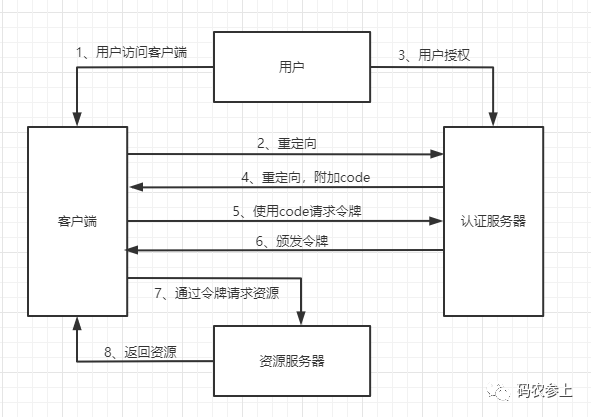
對上面的流程進(jìn)行一下說明:
1、用戶訪問客戶端
2、客戶端將用戶導(dǎo)向認(rèn)證服務(wù)器
3、用戶登錄,并對第三方客戶端進(jìn)行授權(quán)
4、認(rèn)證服務(wù)器將用戶導(dǎo)向客戶端事先指定的重定向地址,并附上一個授權(quán)碼
5、客戶端使用授權(quán)碼,向認(rèn)證服務(wù)器換取令牌
6、認(rèn)證服務(wù)器對客戶端進(jìn)行認(rèn)證以后,發(fā)放令牌
7、客戶端使用令牌,向資源服務(wù)器申請獲取資源
8、資源服務(wù)器確認(rèn)令牌,向客戶端開放資源
在對授權(quán)碼模式的流程有了一定基礎(chǔ)的情況下,我們開始動手搭建項(xiàng)目。
準(zhǔn)備工作
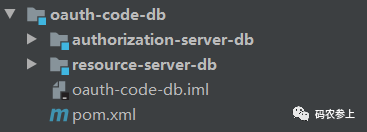
1、在Project中創(chuàng)建兩個module,采用認(rèn)證服務(wù)器和資源服務(wù)器分離的架構(gòu):
2、spring-security-oauth2是對Oauth2協(xié)議規(guī)范的一種實(shí)現(xiàn),這里可以直接使用spring-cloud-starter-oauth2,就不需要分別引入spring-security和oauth2了。在父pom中引入:
<dependency>
    <groupId>org.springframework.cloud</groupId>
    <artifactId>spring-cloud-starter-oauth2</artifactId>
</dependency>
<dependency>
    <groupId>org.springframework.boot</groupId>
    <artifactId>spring-boot-starter-web</artifactId>
</dependency>
3、數(shù)據(jù)庫建表,OAuth2需要的表結(jié)構(gòu)如下:
DROP TABLE IF EXISTS `oauth_access_token`;
CREATE TABLE `oauth_access_token`  (
  `token_id` varchar(255) CHARACTER SET utf8 COLLATE utf8_general_ci NULL DEFAULT NULL,
  `token` blob NULL,
  `authentication_id` varchar(255) CHARACTER SET utf8 COLLATE utf8_general_ci NULL DEFAULT NULL,
  `user_name` varchar(255) CHARACTER SET utf8 COLLATE utf8_general_ci NULL DEFAULT NULL,
  `client_id` varchar(255) CHARACTER SET utf8 COLLATE utf8_general_ci NULL DEFAULT NULL,
  `authentication` blob NULL,
  `refresh_token` varchar(255) CHARACTER SET utf8 COLLATE utf8_general_ci NULL DEFAULT NULL
) ENGINE = InnoDB CHARACTER SET = utf8 COLLATE = utf8_general_ci ROW_FORMAT = Dynamic;

DROP TABLE IF EXISTS `oauth_client_details`;
CREATE TABLE `oauth_client_details`  (
  `client_id` varchar(255) CHARACTER SET utf8 COLLATE utf8_general_ci NOT NULL,
  `resource_ids` varchar(255) CHARACTER SET utf8 COLLATE utf8_general_ci NULL DEFAULT NULL,
  `client_secret` varchar(255) CHARACTER SET utf8 COLLATE utf8_general_ci NULL DEFAULT NULL,
  `scope` varchar(255) CHARACTER SET utf8 COLLATE utf8_general_ci NULL DEFAULT NULL,
  `authorized_grant_types` varchar(255) CHARACTER SET utf8 COLLATE utf8_general_ci NULL DEFAULT NULL,
  `web_server_redirect_uri` varchar(255) CHARACTER SET utf8 COLLATE utf8_general_ci NULL DEFAULT NULL,
  `authorities` varchar(255) CHARACTER SET utf8 COLLATE utf8_general_ci NULL DEFAULT NULL,
  `access_token_validity` int(11) NULL DEFAULT NULL,
  `refresh_token_validity` int(11) NULL DEFAULT NULL,
  `additional_information` text CHARACTER SET utf8 COLLATE utf8_general_ci NULL,
  `autoapprove` varchar(255) CHARACTER SET utf8 COLLATE utf8_general_ci NULL DEFAULT 'false',
  PRIMARY KEY (`client_id`) USING BTREE
) ENGINE = InnoDB CHARACTER SET = utf8 COLLATE = utf8_general_ci ROW_FORMAT = Dynamic;

DROP TABLE IF EXISTS `oauth_code`;
CREATE TABLE `oauth_code`  (
  `code` varchar(255) CHARACTER SET utf8 COLLATE utf8_general_ci NULL DEFAULT NULL,
  `authentication` blob NULL
) ENGINE = InnoDB CHARACTER SET = utf8 COLLATE = utf8_general_ci ROW_FORMAT = Dynamic;

DROP TABLE IF EXISTS `oauth_refresh_token`;
CREATE TABLE `oauth_refresh_token`  (
  `token_id` varchar(255) CHARACTER SET utf8 COLLATE utf8_general_ci NULL DEFAULT NULL,
  `token` blob NULL,
  `authentication` blob NULL
) ENGINE = InnoDB CHARACTER SET = utf8 COLLATE = utf8_general_ci ROW_FORMAT = Dynamic;
oauth_access_token:存儲生成的access_token,由類JdbcTokenStore操作oauth_client_details:存儲客戶端的配置信息,由類JdbcClientDetailsService操作oauth_code:存儲服務(wù)端系統(tǒng)生成的code的值,由類JdbcAuthorizationCodeServices操作oauth_refresh_token:存儲刷新令牌的refresh_token,如果客戶端的grant_type不支持refresh_token,那么不會用到這張表,同樣由類JdbcTokenStore操作
其余spring security相關(guān)的用戶表、角色表以及權(quán)限表的表結(jié)構(gòu)在這里省略,可以在文末的Git地址中下載。
認(rèn)證服務(wù)器
認(rèn)證服務(wù)器是服務(wù)提供者專門用來處理認(rèn)證授權(quán)的服務(wù)器,主要負(fù)責(zé)獲取用戶授權(quán)并頒發(fā)token,以及完成后續(xù)的token認(rèn)證工作。認(rèn)證部分功能主要由spring security 負(fù)責(zé),授權(quán)則由oauth2負(fù)責(zé)。
1、開啟Spring Security配置
@Configuration
@EnableWebSecurity
public class WebSecurityConfig extends WebSecurityConfigurerAdapter {
    @Bean
    public BCryptPasswordEncoder passwordEncoder() {
        return new BCryptPasswordEncoder();
    }

    @Override
    @Bean
    public AuthenticationManager authenticationManagerBean() throws Exception {
        return super.authenticationManagerBean();
    }
}
通過@Configuration 和@EnableWebSecurity 開啟Spring Security配置,繼承WebSecurityConfigurerAdapter的方法,實(shí)現(xiàn)個性化配置。如果使用內(nèi)存配置用戶,可以重寫其中的configure方法進(jìn)行配置,由于我們使用數(shù)據(jù)庫中的用戶信息,所以不需要在這里進(jìn)行配置。并且采用認(rèn)證服務(wù)器和資源服務(wù)器分離,也不需要在這里對服務(wù)資源進(jìn)行權(quán)限的配置。
在類中創(chuàng)建了兩個Bean,分別是用于處理認(rèn)證請求的認(rèn)證管理器AuthenticationManager,以及配置全局統(tǒng)一使用的密碼加密方式BCryptPasswordEncoder,它們會在認(rèn)證服務(wù)中被使用。
2、開啟并配置認(rèn)證服務(wù)器
@Configuration
@EnableAuthorizationServer
public class AuthorizationServerConfig extends AuthorizationServerConfigurerAdapter {
    @Autowired
    private AuthenticationManager authenticationManager;    //認(rèn)證管理器
    @Autowired
    private BCryptPasswordEncoder passwordEncoder;//密碼加密方式
    @Autowired
    private DataSource dataSource;  // 注入數(shù)據(jù)源
    @Autowired
    private UserDetailsService userDetailsService; //自定義用戶身份認(rèn)證

    @Bean
    public ClientDetailsService jdbcClientDetailsService(){
        //將client信息存儲在數(shù)據(jù)庫中
        return new JdbcClientDetailsService(dataSource);
    }

    @Bean
    public TokenStore tokenStore(){
        //對token進(jìn)行持久化存儲在數(shù)據(jù)庫中,數(shù)據(jù)存儲在oauth_access_token和oauth_refresh_token
        return new JdbcTokenStore(dataSource);
    }

    @Bean
    public AuthorizationCodeServices authorizationCodeServices() {
        //加入對授權(quán)碼模式的支持
        return new JdbcAuthorizationCodeServices(dataSource);
    }

    @Override
    public void configure(ClientDetailsServiceConfigurer clients) throws Exception {
        //設(shè)置客戶端的配置從數(shù)據(jù)庫中讀取,存儲在oauth_client_details表
        clients.withClientDetails(jdbcClientDetailsService());
    }

    @Override
    public void configure(AuthorizationServerEndpointsConfigurer endpoints) throws Exception {
        endpoints
                .tokenStore(tokenStore())//token存儲方式
                .authenticationManager(authenticationManager)// 開啟密碼驗(yàn)證,來源于 WebSecurityConfigurerAdapter
                .userDetailsService(userDetailsService)// 讀取驗(yàn)證用戶的信息
                .authorizationCodeServices(authorizationCodeServices())
                .setClientDetailsService(jdbcClientDetailsService());
    }

    @Override
    public void configure(AuthorizationServerSecurityConfigurer security) throws Exception {
        //  配置Endpoint,允許請求,不被Spring-security攔截
        security.tokenKeyAccess("permitAll()") // 開啟/oauth/token_key 驗(yàn)證端口無權(quán)限訪問
                .checkTokenAccess("isAuthenticated()") // 開啟/oauth/check_token 驗(yàn)證端口認(rèn)證權(quán)限訪問
                .allowFormAuthenticationForClients()// 允許表單認(rèn)證
                .passwordEncoder(passwordEncoder);   // 配置BCrypt加密
    }
}
在類中,通過@EnableAuthorizationServer 注解開啟認(rèn)證服務(wù),通過繼承父類AuthorizationServerConfigurerAdapter,對以下信息進(jìn)行了配置:
ClientDetailsServiceConfigurer:配置客戶端服務(wù),這里我們通過JdbcClientDetailsService從數(shù)據(jù)庫讀取相應(yīng)的客戶端配置信息,進(jìn)入源碼可以看到客戶端信息是從表oauth_client_details中拉取。AuthorizationServerEndpointsConfigurer:用來配置授權(quán)(authorization)以及令牌(token)的訪問端點(diǎn),以及令牌服務(wù)的配置信息。該類作為一個裝載類,裝載了Endpoints所有的相關(guān)配置。AuthorizationServerSecurityConfigurer:配置令牌端點(diǎn)(endpoint)的安全約束,OAuth2開放了端點(diǎn)用于檢查令牌,/oauth/check_token和/oauth/token_key這些端點(diǎn)默認(rèn)受到保護(hù),在這里配置可被外部調(diào)用。
3、采用從數(shù)據(jù)庫中獲取用戶信息的方式進(jìn)行身份驗(yàn)證
@Service
public class UserDetailServiceImpl implements UserDetailsService {
    @Autowired
    private TbUserService userService;
    @Autowired
    private TbPermissionService permissionService;

    @Override
    public UserDetails loadUserByUsername(String userName) throws UsernameNotFoundException {
        TbUser tbUser = userService.getUserByUserName(userName);
        if (tbUser==null){
            throw new UsernameNotFoundException("username : "+userName+" is not exist");
        }

        List<GrantedAuthority> authorities=new ArrayList<>();
        //獲取用戶權(quán)限
        List<TbPermission> permissions = permissionService.getByUserId(tbUser.getId());
        permissions.forEach(permission->{
            authorities.add(new SimpleGrantedAuthority(permission.getEname()));
        });
        return new User(tbUser.getUsername(),tbUser.getPassword(),authorities);
    }
}
創(chuàng)建UserDetailServiceImpl 實(shí)現(xiàn)UserDetailsService接口,并實(shí)現(xiàn)loadUserByUsername方法,根據(jù)用戶名從數(shù)據(jù)庫查詢用戶信息及權(quán)限。
4、啟動服務(wù)
首先發(fā)起請求獲取授權(quán)碼(code),直接訪問下面的url:
http://localhost:9004/oauth/authorize?client_id=client1&redirect_uri=http://localhost:8848/nacos&response_type=code&scope=select
看一下各個參數(shù)的意義:
client_id:因?yàn)檎J(rèn)證服務(wù)器要知道是哪一個應(yīng)用在請求授權(quán),所以client_id就是認(rèn)證服務(wù)器給每個應(yīng)用分配的id
redirect_uri:重定向地址,會在這個重定向地址后面附加授權(quán)碼,讓第三方應(yīng)用獲取code
response_type:code表明采用授權(quán)碼認(rèn)證模式
scope:需要獲得哪些授權(quán),這個參數(shù)的值是由服務(wù)提供商定義的,不能隨意填寫
首先會重定向到登錄驗(yàn)證頁面,因?yàn)橹暗?code style="font-size: 14px;overflow-wrap: break-word;padding: 2px 4px;border-radius: 4px;margin-right: 2px;margin-left: 2px;color: rgb(30, 107, 184);background-color: rgba(27, 31, 35, 0.05);font-family: "Operator Mono", Consolas, Monaco, Menlo, monospace;word-break: break-all;">url中只明確了第三方應(yīng)用的身份,這里要確定第三方應(yīng)用要請求哪一個用戶的授權(quán)。輸入數(shù)據(jù)庫表tb_user中配置的用戶信息 admin/123456:
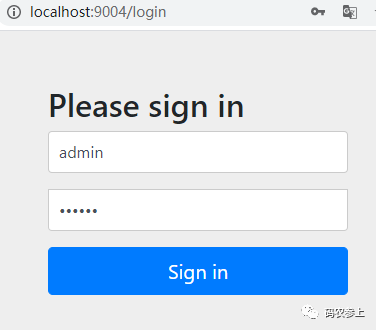
注意url中請求的參數(shù)必須和在數(shù)據(jù)庫中的表oauth_client中配置的相同,如果不存在或信息不一致都會報(bào)錯,在參數(shù)填寫錯誤時會產(chǎn)生如下報(bào)錯信息:

如果參數(shù)完全匹配,會請求用戶向請求資源的客戶端client授權(quán):
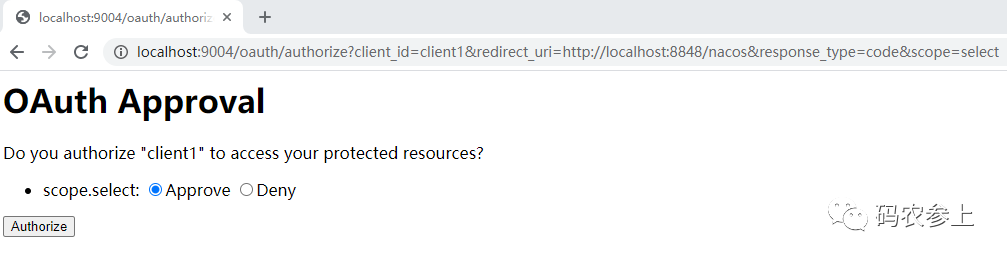
點(diǎn)擊Authorize同意授權(quán),會跳轉(zhuǎn)到redirect_uri定義的重定向地址,并在url后面附上授權(quán)碼code:

這樣,用戶的登錄和授權(quán)的操作都在瀏覽器中完成了,接下來我們需要獲取令牌,發(fā)送post請求到/oauth/token接口,使用授權(quán)碼獲取access_token。在發(fā)送請求時,需要在請求頭中包含clientId和clientSecret,并且攜帶參數(shù) grant_type、code、redirect_uri,這里會對redirect_uri做二次驗(yàn)證:
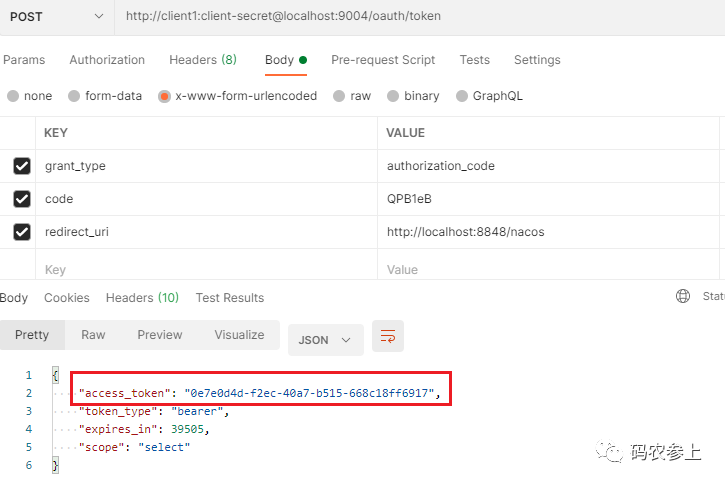
這樣,就通過/oauth/token端點(diǎn)獲取到了access_token,并一同拿到了它的令牌類型、過期時間、授權(quán)范圍信息,這個令牌將在請求資源服務(wù)器的資源時被使用。由于這個令牌在一定時間內(nèi)有效,客戶端可以在有效期內(nèi),將令牌保存在本地,避免重復(fù)申請。
資源服務(wù)器
資源服務(wù)器簡單來說就是資源的訪問入口,主要負(fù)責(zé)處理用戶數(shù)據(jù)的api調(diào)用,資源服務(wù)器中存儲了用戶數(shù)據(jù),并對外提供http服務(wù),可以將用戶數(shù)據(jù)返回給經(jīng)過身份驗(yàn)證的客戶端。資源服務(wù)器和認(rèn)證服務(wù)器可以部署在一起,也可以分離部署,我們這里采用分開部署的形式。
1、配置資源服務(wù)器
@Configuration
@EnableResourceServer
public class ResourceConfig extends ResourceServerConfigurerAdapter {
    @Bean
    public BCryptPasswordEncoder passwordEncoder() {
        return new BCryptPasswordEncoder();
    }

    @Bean
    @Primary
    public RemoteTokenServices remoteTokenServices(){
        final RemoteTokenServices tokenServices=new RemoteTokenServices();
        //設(shè)置授權(quán)服務(wù)器check_token Endpoint 完整地址
        tokenServices.setCheckTokenEndpointUrl("http://localhost:9004/oauth/check_token");
        //設(shè)置客戶端id與secret,注意:client_secret 值不能使用passwordEncoder加密
        tokenServices.setClientId("client1");
        tokenServices.setClientSecret("client-secret");
        return tokenServices;
    }

    @Override
    public void configure(HttpSecurity http) throws Exception {
        http.sessionManagement().sessionCreationPolicy(SessionCreationPolicy.IF_REQUIRED);
        http.authorizeRequests()
                .anyRequest().authenticated();
    }

    @Override
    public void configure(ResourceServerSecurityConfigurer resources) throws Exception {
        resources.resourceId("oauth2").stateless(true);
    }
}
在類中主要實(shí)現(xiàn)了以下功能:
@EnableResourceServer注解表明開啟OAuth2資源服務(wù)器,在請求資源服務(wù)器的請求前,需要通過認(rèn)證服務(wù)器獲取access_token令牌,然后在訪問資源服務(wù)器中的資源時需要攜帶令牌才能正常進(jìn)行請求通過
RemoteTokenServices實(shí)現(xiàn)自定義認(rèn)證服務(wù)器,這里配置了我們之前創(chuàng)建的認(rèn)證服務(wù)器重寫
configure(HttpSecurity http)方法,開啟所有請求需要授權(quán)才可以訪問配置資源相關(guān)設(shè)置
configure(ResourceServerSecurityConfigurer resources),這里只設(shè)置resourceId,作為該服務(wù)資源的唯一標(biāo)識
2、測試接口,負(fù)責(zé)提供用戶信息
@RestController
public class TestController {
    @GetMapping("/user/{name}")
    public User user(@PathVariable String name){
        return new User(name, 20);
    }
}
3、啟動服務(wù)
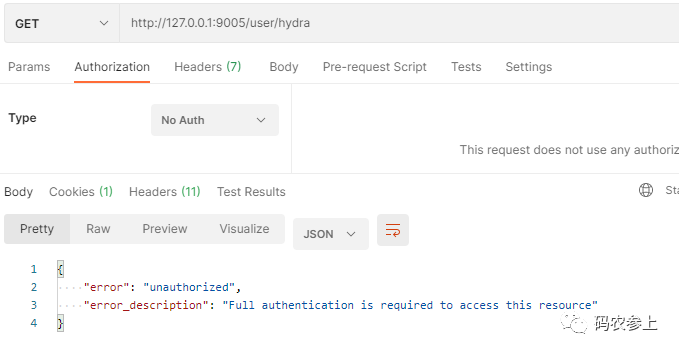
不攜帶access_token,直接訪問接口http://127.0.0.1:9005/user/hydra:
使用Postman,在Authorization中配置使用Bearer Token,并填入從認(rèn)證服務(wù)器獲取的access_token(或在Headers中的Authorization字段直接填寫Bearer 'access_token')。
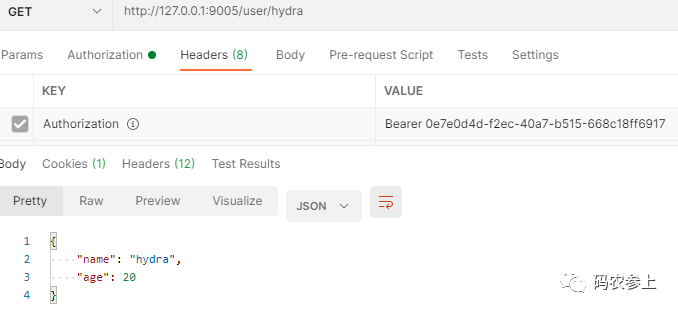
再次訪問接口,可以正常訪問接口資源,這樣就實(shí)現(xiàn)了對資源服務(wù)器內(nèi)資源的訪問,完成了認(rèn)證服務(wù)器與資源服務(wù)器的整合。
項(xiàng)目git地址:https://github.com/trunks2008/oauth2
想要搭建個人博客?這4個Java 開源博客系統(tǒng),真香 畢業(yè)設(shè)計(jì):Java簡易學(xué)生宿舍管理系統(tǒng) SpringBoot+Vue 完整的外賣系統(tǒng),手機(jī)端和后臺管理,附源碼! 帶工作流的SpringBoot后臺管理項(xiàng)目,一個企業(yè)級快速開發(fā)解決方案 哈哈哈,徒手給小區(qū)開發(fā)一套系統(tǒng)!看能換一個停車位不.... 最近面試BAT,整理一份面試資料《Java面試BAT通關(guān)手冊》,覆蓋了Java核心技術(shù)、JVM、Java并發(fā)、SSM、微服務(wù)、數(shù)據(jù)庫、數(shù)據(jù)結(jié)構(gòu)等等。 獲取方式:關(guān)注公眾號并回復(fù) java 領(lǐng)取,更多內(nèi)容陸續(xù)奉上。 明天見(??ω??)??