
用 Python 實(shí)現(xiàn)快速 Ping 一個(gè) IP 網(wǎng)段地址!
大家好,我是杰哥。
ping 命令是我們檢查網(wǎng)絡(luò)中最常用的命令,作為網(wǎng)絡(luò)人員,基本上每天都會(huì)用到,可以很好地幫助我們分析和判定網(wǎng)絡(luò)故障;
更多可查看:ping 命令的七種用法,你真的會(huì)了嗎?
如果有 10 設(shè)備,100 臺(tái)設(shè)備,1000 臺(tái)設(shè)備怎么辦?一個(gè)個(gè) ping 過(guò)去人都要瘋掉了,這種情況在大型網(wǎng)絡(luò)中我們有可能遇到,那怎么辦呢?我們今天來(lái)看下如何用 python 來(lái)實(shí)現(xiàn)批量 ping 測(cè)試主機(jī)。
代碼如下:
#!/usr/bin/python3
# -*- coding: utf-8 -*-

import os
import argparse
import socket
import struct
import select
import time


ICMP_ECHO_REQUEST = 8 # Platform specific
DEFAULT_TIMEOUT = 0.1
DEFAULT_COUNT = 4


class Pinger(object):
    """ Pings to a host -- the Pythonic way"""

    def __init__(self, target_host, count=DEFAULT_COUNT, timeout=DEFAULT_TIMEOUT):
        self.target_host = target_host
        self.count = count
        self.timeout = timeout


    def do_checksum(self, source_string):
        """  Verify the packet integritity """
        sum = 0
        max_count = (len(source_string)/2)*2
        count = 0
        while count < max_count:

            val = source_string[count + 1]*256 + source_string[count]
            sum = sum + val
            sum = sum & 0xffffffff
            count = count + 2

        if max_count<len(source_string):
            sum = sum + ord(source_string[len(source_string) - 1])
            sum = sum & 0xffffffff

        sum = (sum >> 16)  +  (sum & 0xffff)
        sum = sum + (sum >> 16)
        answer = ~sum
        answer = answer & 0xffff
        answer = answer >> 8 | (answer << 8 & 0xff00)
        return answer

    def receive_pong(self, sock, ID, timeout):
        """
        Receive ping from the socket.
        """
        time_remaining = timeout
        while True:
            start_time = time.time()
            readable = select.select([sock], [], [], time_remaining)
            time_spent = (time.time() - start_time)
            if readable[0] == []: # Timeout
                return

            time_received = time.time()
            recv_packet, addr = sock.recvfrom(1024)
            icmp_header = recv_packet[20:28]
            type, code, checksum, packet_ID, sequence = struct.unpack(
       "bbHHh", icmp_header
   )
            if packet_ID == ID:
                bytes_In_double = struct.calcsize("d")
                time_sent = struct.unpack("d", recv_packet[28:28 + bytes_In_double])[0]
                return time_received - time_sent

            time_remaining = time_remaining - time_spent
            if time_remaining <= 0:
                return


    def send_ping(self, sock,  ID):
        """
        Send ping to the target host
        """
        target_addr  =  socket.gethostbyname(self.target_host)

        my_checksum = 0

        # Create a dummy heder with a 0 checksum.
        header = struct.pack("bbHHh", ICMP_ECHO_REQUEST, 0, my_checksum, ID, 1)
        bytes_In_double = struct.calcsize("d")
        data = (192 - bytes_In_double) * "Q"
        data = struct.pack("d", time.time()) + bytes(data.encode('utf-8'))

        # Get the checksum on the data and the dummy header.
        my_checksum = self.do_checksum(header + data)
        header = struct.pack(
      "bbHHh", ICMP_ECHO_REQUEST, 0, socket.htons(my_checksum), ID, 1
  )
        packet = header + data
        sock.sendto(packet, (target_addr, 1))


    def ping_once(self):
        """
        Returns the delay (in seconds) or none on timeout.
        """
        icmp = socket.getprotobyname("icmp")
        try:
            sock = socket.socket(socket.AF_INET, socket.SOCK_RAW, icmp)
        except socket.error as e:
            if e.errno == 1:
                # Not superuser, so operation not permitted
                e.msg +=  "ICMP messages can only be sent from root user processes"
                raise socket.error(e.msg)
        except Exception as e:
            print("Exception: %s" %(e))

        my_ID = os.getpid() & 0xFFFF

        self.send_ping(sock, my_ID)
        delay = self.receive_pong(sock, my_ID, self.timeout)
        sock.close()
        return delay


    def ping(self):
        """
        Run the ping process
        """
        for i in range(self.count):
            print ("Ping to %s..." % self.target_host,)
            try:
                delay  =  self.ping_once()
            except socket.gaierror as e:
                print ("Ping failed. (socket error: '%s')" % e[1])
                break

            if delay  ==  None:
                print ("Ping failed. (timeout within %ssec.)" % self.timeout)
            else:
                delay = delay * 1000
                print("Get pong in %0.4fms" % delay)


if __name__ == '__main__':
    alive = []
    host_prefix = '192.168.242.'
    for i in range(1, 255):
        host = host_prefix + str(i)
        pinger = Pinger(target_host=host)

        delay = pinger.ping_once()
        if delay == None:
            print("Ping %s 失敗,超時(shí)2秒" % host)
        else:
            print("ping %s = %s ms" % (host, round(delay * 1000, 4)))
            alive.append(host)
        # time.sleep(0.5)
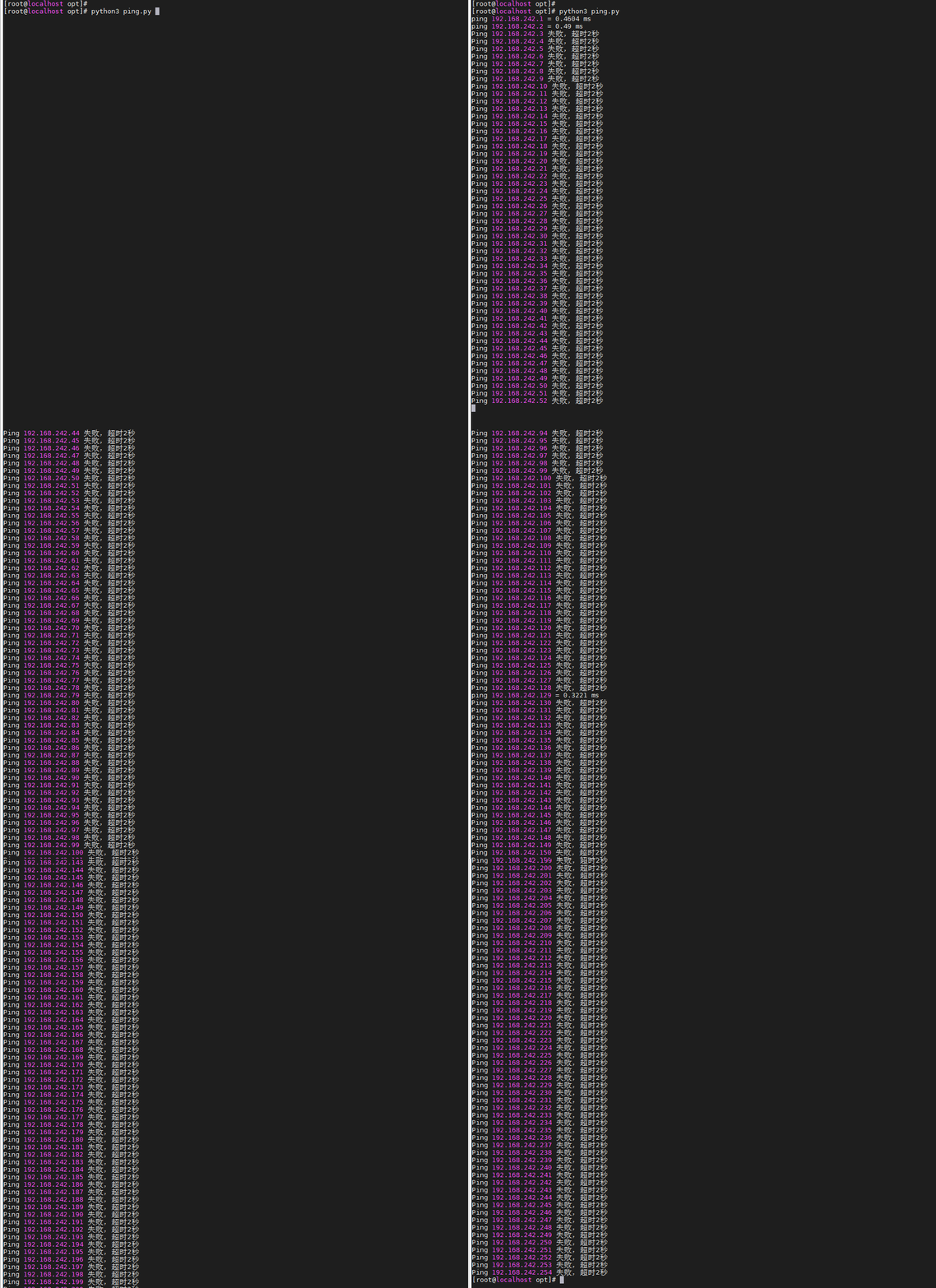
測(cè)試如下:
來(lái)源:www.yjsec.com/2020/11/07
推薦閱讀
7 個(gè)日常實(shí)用的 Shell 拿來(lái)就用腳本實(shí)例!
原創(chuàng) | 7 個(gè)非常實(shí)用的 Shell 拿來(lái)就用腳本實(shí)例!
原創(chuàng) | 超硬核!11 個(gè)非常實(shí)用的 Python 和 Shell 拿來(lái)就用腳本實(shí)例!
杰哥的另一個(gè)公眾號(hào),主要分享關(guān)于個(gè)人成長(zhǎng)經(jīng)歷的那點(diǎn)事,歡迎您的關(guān)注。

評(píng)論
圖片
表情