支付寶:多線(xiàn)程事務(wù)怎么回滾?說(shuō)用 @Transactional 可以回去等通知...
 來(lái)源:blog.csdn.net/weixin_43225491/article/details/117705686
- 背景介紹
- 公用的類(lèi)和方法
- 示例事務(wù)不成功操作
背景介紹
1,最近有一個(gè)大數(shù)據(jù)量插入的操作入庫(kù)的業(yè)務(wù)場(chǎng)景,需要先做一些其他修改操作,然后在執(zhí)行插入操作,由于插入數(shù)據(jù)可能會(huì)很多,用到多線(xiàn)程去拆分?jǐn)?shù)據(jù)并行處理來(lái)提高響應(yīng)時(shí)間,如果有一個(gè)線(xiàn)程執(zhí)行失敗,則全部回滾。
2,在spring中可以使用@Transactional注解去控制事務(wù),使出現(xiàn)異常時(shí)會(huì)進(jìn)行回滾,在多線(xiàn)程中,這個(gè)注解則不會(huì)生效,如果主線(xiàn)程需要先執(zhí)行一些修改數(shù)據(jù)庫(kù)的操作,當(dāng)子線(xiàn)程在進(jìn)行處理出現(xiàn)異常時(shí),主線(xiàn)程修改的數(shù)據(jù)則不會(huì)回滾,導(dǎo)致數(shù)據(jù)錯(cuò)誤。
3,下面用一個(gè)簡(jiǎn)單示例演示多線(xiàn)程事務(wù)。
公用的類(lèi)和方法
      /**
 * 平均拆分list方法.
 * @param source
 * @param n
 * @param <T>
 * @return
 */
public static <T> List<List<T>> averageAssign(List<T> source,int n){
    List<List<T>> result=new ArrayList<List<T>>();
    int remaider=source.size()%n;
    int number=source.size()/n;
    int offset=0;//偏移量
    for(int i=0;i<n;i++){
        List<T> value=null;
        if(remaider>0){
            value=source.subList(i*number+offset, (i+1)*number+offset+1);
            remaider--;
            offset++;
        }else{
            value=source.subList(i*number+offset, (i+1)*number+offset);
        }
        result.add(value);
    }
    return result;
}
/**  線(xiàn)程池配置
 * @version V1.0
 */
public class ExecutorConfig {
    private static int maxPoolSize = Runtime.getRuntime().availableProcessors();
    private volatile static ExecutorService executorService;
    public static ExecutorService getThreadPool() {
        if (executorService == null){
            synchronized (ExecutorConfig.class){
                if (executorService == null){
                    executorService =  newThreadPool();
                }
            }
        }
        return executorService;
    }

    private static  ExecutorService newThreadPool(){
        int queueSize = 500;
        int corePool = Math.min(5, maxPoolSize);
        return new ThreadPoolExecutor(corePool, maxPoolSize, 10000L, TimeUnit.MILLISECONDS,
            new LinkedBlockingQueue<>(queueSize),new ThreadPoolExecutor.AbortPolicy());
    }
    private ExecutorConfig(){}
}
/** 獲取sqlSession
 * @author 86182
 * @version V1.0
 */
@Component
public class SqlContext {
    @Resource
    private SqlSessionTemplate sqlSessionTemplate;

    public SqlSession getSqlSession(){
        SqlSessionFactory sqlSessionFactory = sqlSessionTemplate.getSqlSessionFactory();
        return sqlSessionFactory.openSession();
    }
}
示例事務(wù)不成功操作
        /**
 * 測(cè)試多線(xiàn)程事務(wù).
 * @param employeeDOList
 */
@Override
@Transactional
public void saveThread(List<EmployeeDO> employeeDOList) {
    try {
        //先做刪除操作,如果子線(xiàn)程出現(xiàn)異常,此操作不會(huì)回滾
        this.getBaseMapper().delete(null);
        //獲取線(xiàn)程池
        ExecutorService service = ExecutorConfig.getThreadPool();
        //拆分?jǐn)?shù)據(jù),拆分5份
        List<List<EmployeeDO>> lists=averageAssign(employeeDOList, 5);
        //執(zhí)行的線(xiàn)程
        Thread []threadArray = new Thread[lists.size()];
        //監(jiān)控子線(xiàn)程執(zhí)行完畢,再執(zhí)行主線(xiàn)程,要不然會(huì)導(dǎo)致主線(xiàn)程關(guān)閉,子線(xiàn)程也會(huì)隨著關(guān)閉
        CountDownLatch countDownLatch = new CountDownLatch(lists.size());
        AtomicBoolean atomicBoolean = new AtomicBoolean(true);
        for (int i =0;i<lists.size();i++){
            if (i==lists.size()-1){
                atomicBoolean.set(false);
            }
            List<EmployeeDO> list  = lists.get(i);
            threadArray[i] =  new Thread(() -> {
                try {
                 //最后一個(gè)線(xiàn)程拋出異常
                    if (!atomicBoolean.get()){
                        throw new ServiceException("001","出現(xiàn)異常");
                    }
                    //批量添加,mybatisPlus中自帶的batch方法
                    this.saveBatch(list);
                }finally {
                    countDownLatch.countDown();
                }

            });
        }
        for (int i = 0; i <lists.size(); i++){
            service.execute(threadArray[i]);
        }
        //當(dāng)子線(xiàn)程執(zhí)行完畢時(shí),主線(xiàn)程再往下執(zhí)行
        countDownLatch.await();
        System.out.println("添加完畢");
    }catch (Exception e){
        log.info("error",e);
        throw new ServiceException("002","出現(xiàn)異常");
    }finally {
         connection.close();
     }
}
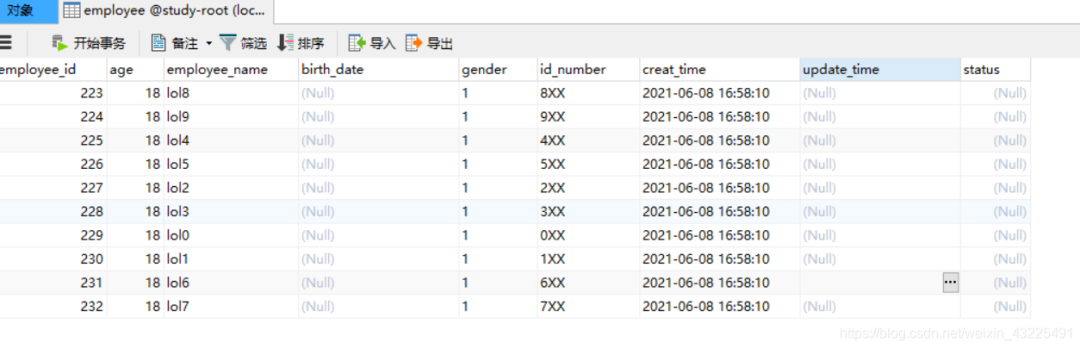
數(shù)據(jù)庫(kù)中存在一條數(shù)據(jù):

      //測(cè)試用例
@RunWith(SpringRunner.class)
@SpringBootTest(classes = { ThreadTest01.class, MainApplication.class})
public class ThreadTest01 {

    @Resource
    private EmployeeBO employeeBO;

    /**
     *   測(cè)試多線(xiàn)程事務(wù).
     * @throws InterruptedException
     */
    @Test
    public  void MoreThreadTest2() throws InterruptedException {
        int size = 10;
        List<EmployeeDO> employeeDOList = new ArrayList<>(size);
        for (int i = 0; i<size;i++){
            EmployeeDO employeeDO = new EmployeeDO();
            employeeDO.setEmployeeName("lol"+i);
            employeeDO.setAge(18);
            employeeDO.setGender(1);
            employeeDO.setIdNumber(i+"XX");
            employeeDO.setCreatTime(Calendar.getInstance().getTime());
            employeeDOList.add(employeeDO);
        }
        try {
            employeeBO.saveThread(employeeDOList);
            System.out.println("添加成功");
        }catch (Exception e){
            e.printStackTrace();
        }
    }
}
測(cè)試結(jié)果:
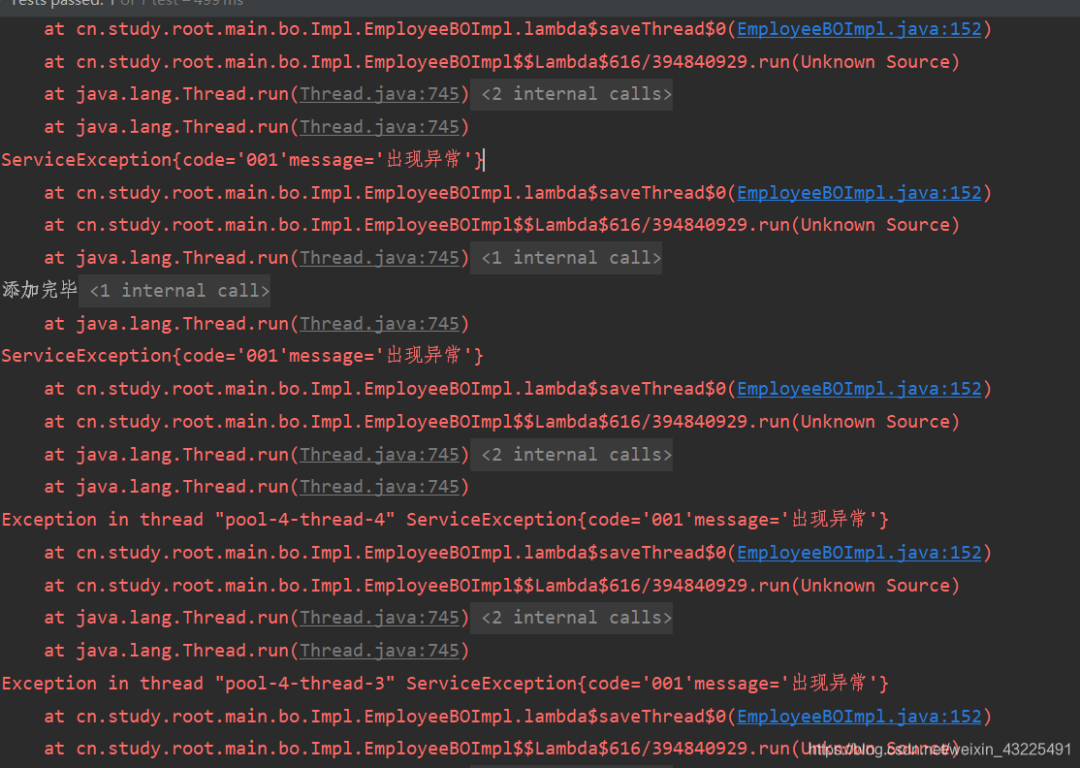

可以發(fā)現(xiàn)子線(xiàn)程組執(zhí)行時(shí),有一個(gè)線(xiàn)程執(zhí)行失敗,其他線(xiàn)程也會(huì)拋出異常,但是主線(xiàn)程中執(zhí)行的刪除操作,沒(méi)有回滾,@Transactional注解沒(méi)有生效。
使用sqlSession控制手動(dòng)提交事務(wù)
       @Resource
  SqlContext sqlContext;
 /**
 * 測(cè)試多線(xiàn)程事務(wù).
 * @param employeeDOList
 */
@Override
public void saveThread(List<EmployeeDO> employeeDOList) throws SQLException {
    // 獲取數(shù)據(jù)庫(kù)連接,獲取會(huì)話(huà)(內(nèi)部自有事務(wù))
    SqlSession sqlSession = sqlContext.getSqlSession();
    Connection connection = sqlSession.getConnection();
    try {
        // 設(shè)置手動(dòng)提交
        connection.setAutoCommit(false);
        //獲取mapper
        EmployeeMapper employeeMapper = sqlSession.getMapper(EmployeeMapper.class);
        //先做刪除操作
        employeeMapper.delete(null);
        //獲取執(zhí)行器
        ExecutorService service = ExecutorConfig.getThreadPool();
        List<Callable<Integer>> callableList  = new ArrayList<>();
        //拆分list
        List<List<EmployeeDO>> lists=averageAssign(employeeDOList, 5);
        AtomicBoolean atomicBoolean = new AtomicBoolean(true);
        for (int i =0;i<lists.size();i++){
            if (i==lists.size()-1){
                atomicBoolean.set(false);
            }
            List<EmployeeDO> list  = lists.get(i);
            //使用返回結(jié)果的callable去執(zhí)行,
            Callable<Integer> callable = () -> {
                //讓最后一個(gè)線(xiàn)程拋出異常
                if (!atomicBoolean.get()){
                    throw new ServiceException("001","出現(xiàn)異常");
                }
              return employeeMapper.saveBatch(list);
            };
            callableList.add(callable);
        }
        //執(zhí)行子線(xiàn)程
       List<Future<Integer>> futures = service.invokeAll(callableList);
        for (Future<Integer> future:futures) {
        //如果有一個(gè)執(zhí)行不成功,則全部回滾
            if (future.get()<=0){
                connection.rollback();
                 return;
            }
        }
        connection.commit();
        System.out.println("添加完畢");
    }catch (Exception e){
        connection.rollback();
        log.info("error",e);
        throw new ServiceException("002","出現(xiàn)異常");
    }finally {
         connection.close();
     }
}
// sql
<insert id="saveBatch" parameterType="List">
 INSERT INTO
 employee (employee_id,age,employee_name,birth_date,gender,id_number,creat_time,update_time,status)
 values
     <foreach collection="list" item="item" index="index" separator=",">
     (
     #{item.employeeId},
     #{item.age},
     #{item.employeeName},
     #{item.birthDate},
     #{item.gender},
     #{item.idNumber},
     #{item.creatTime},
     #{item.updateTime},
     #{item.status}
         )
     </foreach>
 </insert>
數(shù)據(jù)庫(kù)中一條數(shù)據(jù):

測(cè)試結(jié)果:拋出異常,
 圖片
圖片
刪除操作的數(shù)據(jù)回滾了,數(shù)據(jù)庫(kù)中的數(shù)據(jù)依舊存在,說(shuō)明事務(wù)成功了。

成功操作示例:
       @Resource
SqlContext sqlContext;
/**
 * 測(cè)試多線(xiàn)程事務(wù).
 * @param employeeDOList
 */
@Override
public void saveThread(List<EmployeeDO> employeeDOList) throws SQLException {
    // 獲取數(shù)據(jù)庫(kù)連接,獲取會(huì)話(huà)(內(nèi)部自有事務(wù))
    SqlSession sqlSession = sqlContext.getSqlSession();
    Connection connection = sqlSession.getConnection();
    try {
        // 設(shè)置手動(dòng)提交
        connection.setAutoCommit(false);
        EmployeeMapper employeeMapper = sqlSession.getMapper(EmployeeMapper.class);
        //先做刪除操作
        employeeMapper.delete(null);
        ExecutorService service = ExecutorConfig.getThreadPool();
        List<Callable<Integer>> callableList  = new ArrayList<>();
        List<List<EmployeeDO>> lists=averageAssign(employeeDOList, 5);
        for (int i =0;i<lists.size();i++){
            List<EmployeeDO> list  = lists.get(i);
            Callable<Integer> callable = () -> employeeMapper.saveBatch(list);
            callableList.add(callable);
        }
        //執(zhí)行子線(xiàn)程
       List<Future<Integer>> futures = service.invokeAll(callableList);
        for (Future<Integer> future:futures) {
            if (future.get()<=0){
                connection.rollback();
                 return;
            }
        }
        connection.commit();
        System.out.println("添加完畢");
    }catch (Exception e){
        connection.rollback();
        log.info("error",e);
        throw new ServiceException("002","出現(xiàn)異常");
       // throw new ServiceException(ExceptionCodeEnum.EMPLOYEE_SAVE_OR_UPDATE_ERROR);
    }
}
測(cè)試結(jié)果:

數(shù)據(jù)庫(kù)中數(shù)據(jù):
刪除的刪除了,添加的添加成功了,測(cè)試成功。