
玩轉(zhuǎn)Java8 Stream,代碼效率飛升
點擊上方“碼農(nóng)突圍”,馬上關(guān)注 這里是碼農(nóng)充電第一站,回復(fù)“666”,獲取一份專屬大禮包 真愛,請設(shè)置“星標(biāo)”或點個“在看”
文章來源:http://b.nxw.so/1rlrOw
概述
分類
具體用法
概述
Stream 是 Java8 中處理集合的關(guān)鍵抽象概念,它可以指定你希望對集合進(jìn)行的操作,可以執(zhí)行非常復(fù)雜的查找、過濾和映射數(shù)據(jù)等操作。
使用 Stream API 對集合數(shù)據(jù)進(jìn)行操作,就類似于使用 SQL 執(zhí)行的數(shù)據(jù)庫查詢。也可以使用 Stream API 來并行執(zhí)行操作。
簡而言之,Stream API 提供了一種高效且易于使用的處理數(shù)據(jù)的方式。
特點如下:
不是數(shù)據(jù)結(jié)構(gòu),不會保存數(shù)據(jù)。
不會修改原來的數(shù)據(jù)源,它會將操作后的數(shù)據(jù)保存到另外一個對象中。(保留意見:畢竟 peek 方法可以修改流中元素)
惰性求值,流在中間處理過程中,只是對操作進(jìn)行了記錄,并不會立即執(zhí)行,需要等到執(zhí)行終止操作的時候才會進(jìn)行實際的計算。
分類
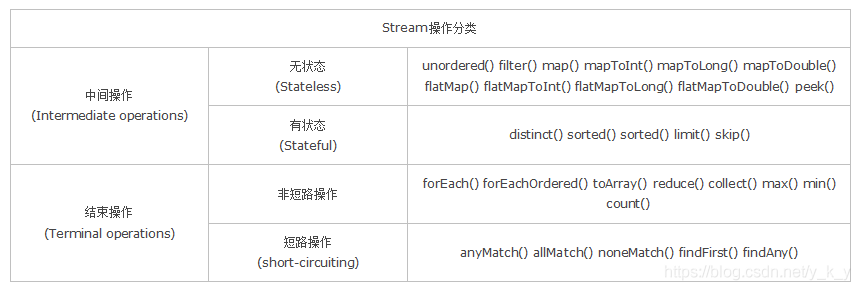
如上圖:
無狀態(tài):指元素的處理不受之前元素的影響
有狀態(tài):指該操作只有拿到所有元素之后才能繼續(xù)下去
非短路操作:指必須處理所有元素才能得到最終結(jié)果
短路操作:指遇到某些符合條件的元素就可以得到最終結(jié)果,如 A || B,只要 A 為 true,則無需判斷 B 的結(jié)果
具體用法
| 流的常用創(chuàng)建方法
使用 Collection 下的 stream() 和 parallelStream() 方法:
List<String> list = new ArrayList<>();
Stream<String> stream = list.stream(); //獲取一個順序流
Stream<String> parallelStream = list.parallelStream(); //獲取一個并行流
使用 Arrays 中的 stream() 方法,將數(shù)組轉(zhuǎn)成流:
Integer[] nums = new Integer[10];
Stream<Integer> stream = Arrays.stream(nums);
使用Stream中的靜態(tài)方法:of()、iterate()、generate()
Stream<Integer> stream = Stream.of(1,2,3,4,5,6);

Stream<Integer> stream2 = Stream.iterate(0, (x) -> x + 2).limit(6);
stream2.forEach(System.out::println); // 0 2 4 6 8 10

Stream<Double> stream3 = Stream.generate(Math::random).limit(2);
stream3.forEach(System.out::println);
使用 BufferedReader.lines() 方法,將每行內(nèi)容轉(zhuǎn)成流:
BufferedReader reader = new BufferedReader(new FileReader("F:\\test_stream.txt"));
Stream<String> lineStream = reader.lines();
lineStream.forEach(System.out::println);
使用 Pattern.splitAsStream() 方法,將字符串分隔成流:
Pattern pattern = Pattern.compile(",");
Stream<String> stringStream = pattern.splitAsStream("a,b,c,d");
stringStream.forEach(System.out::println);
| 流的中間操作
篩選與切片:
filter:過濾流中的某些元素
limit(n):獲取 n 個元素
skip(n):跳過 n 元素,配合 limit(n) 可實現(xiàn)分頁
distinct:通過流中元素的 hashCode() 和 equals() 去除重復(fù)元素
Stream<Integer> stream = Stream.of(6, 4, 6, 7, 3, 9, 8, 10, 12, 14, 14);

Stream<Integer> newStream = stream.filter(s -> s > 5) //6 6 7 9 8 10 12 14 14
        .distinct() //6 7 9 8 10 12 14
        .skip(2) //9 8 10 12 14
        .limit(2); //9 8
newStream.forEach(System.out::println);
映射:
map:接收一個函數(shù)作為參數(shù),該函數(shù)會被應(yīng)用到每個元素上,并將其映射成一個新的元素。
flatMap:接收一個函數(shù)作為參數(shù),將流中的每個值都換成另一個流,然后把所有流連接成一個流。
List<String> list = Arrays.asList("a,b,c", "1,2,3");

//將每個元素轉(zhuǎn)成一個新的且不帶逗號的元素
Stream<String> s1 = list.stream().map(s -> s.replaceAll(",", ""));
s1.forEach(System.out::println); // abc  123

Stream<String> s3 = list.stream().flatMap(s -> {
    //將每個元素轉(zhuǎn)換成一個stream
    String[] split = s.split(",");
    Stream<String> s2 = Arrays.stream(split);
    return s2;
});
s3.forEach(System.out::println); // a b c 1 2 3
排序:
sorted():自然排序,流中元素需實現(xiàn) Comparable 接口
sorted(Comparator com):定制排序,自定義 Comparator 排序器
List<String> list = Arrays.asList("aa", "ff", "dd");
//String 類自身已實現(xiàn)Compareable接口
list.stream().sorted().forEach(System.out::println);// aa dd ff

Student s1 = new Student("aa", 10);
Student s2 = new Student("bb", 20);
Student s3 = new Student("aa", 30);
Student s4 = new Student("dd", 40);
List<Student> studentList = Arrays.asList(s1, s2, s3, s4);

//自定義排序:先按姓名升序,姓名相同則按年齡升序
studentList.stream().sorted(
        (o1, o2) -> {
            if (o1.getName().equals(o2.getName())) {
                return o1.getAge() - o2.getAge();
            } else {
                return o1.getName().compareTo(o2.getName());
            }
        }
).forEach(System.out::println);
消費:
peek:如同于 map,能得到流中的每一個元素。但 map 接收的是一個 Function 表達(dá)式,有返回值;而 peek 接收的是 Consumer 表達(dá)式,沒有返回值。
Student s1 = new Student("aa", 10);
Student s2 = new Student("bb", 20);
List<Student> studentList = Arrays.asList(s1, s2);

studentList.stream()
        .peek(o -> o.setAge(100))
        .forEach(System.out::println);

//結(jié)果:
Student{name='aa', age=100}
Student{name='bb', age=100}
| 流的終止操作
匹配、聚合操作:
allMatch:接收一個 Predicate 函數(shù),當(dāng)流中每個元素都符合該斷言時才返回 true,否則返回 false
noneMatch:接收一個 Predicate 函數(shù),當(dāng)流中每個元素都不符合該斷言時才返回 true,否則返回 false
anyMatch:接收一個 Predicate 函數(shù),只要流中有一個元素滿足該斷言則返回 true,否則返回 false
findFirst:返回流中第一個元素
findAny:返回流中的任意元素
count:返回流中元素的總個數(shù)
max:返回流中元素最大值
min:返回流中元素最小值
List<Integer> list = Arrays.asList(1, 2, 3, 4, 5);

boolean allMatch = list.stream().allMatch(e -> e > 10); //false
boolean noneMatch = list.stream().noneMatch(e -> e > 10); //true
boolean anyMatch = list.stream().anyMatch(e -> e > 4);  //true

Integer findFirst = list.stream().findFirst().get(); //1
Integer findAny = list.stream().findAny().get(); //1

long count = list.stream().count(); //5
Integer max = list.stream().max(Integer::compareTo).get(); //5
Integer min = list.stream().min(Integer::compareTo).get(); //1
規(guī)約操作:
①Optional<T> reduce(BinaryOperator<T> accumulator):第一次執(zhí)行時,accumulator 函數(shù)的第一個參數(shù)為流中的第一個元素,第二個參數(shù)為流中元素的第二個元素。
第二次執(zhí)行時,第一個參數(shù)為第一次函數(shù)執(zhí)行的結(jié)果,第二個參數(shù)為流中的第三個元素;依次類推。
②T reduce(T identity, BinaryOperator<T> accumulator):流程跟上面一樣,只是第一次執(zhí)行時,accumulator 函數(shù)的第一個參數(shù)為 identity,而第二個參數(shù)為流中的第一個元素。
③<U> U reduce(U identity,BiFunction<U, ? super T, U> accumulator,BinaryOperator<U> combiner):在串行流(stream)中,該方法跟第二個方法一樣,即第三個參數(shù) combiner 不會起作用。
在并行流(parallelStream)中,我們知道流被 fork join 出多個線程進(jìn)行執(zhí)行,此時每個線程的執(zhí)行流程就跟第二個方法 reduce(identity,accumulator)一樣。
而第三個參數(shù) combiner 函數(shù),則是將每個線程的執(zhí)行結(jié)果當(dāng)成一個新的流,然后使用第一個方法 reduce(accumulator)流程進(jìn)行規(guī)約。
//經(jīng)過測試,當(dāng)元素個數(shù)小于24時,并行時線程數(shù)等于元素個數(shù),當(dāng)大于等于24時,并行時線程數(shù)為16
List<Integer> list = Arrays.asList(1, 2, 3, 4, 5, 6, 7, 8, 9, 10, 11, 12, 13, 14, 15, 16, 17, 18, 19, 20, 21, 22, 23, 24);

Integer v = list.stream().reduce((x1, x2) -> x1 + x2).get();
System.out.println(v);   // 300

Integer v1 = list.stream().reduce(10, (x1, x2) -> x1 + x2);
System.out.println(v1);  //310

Integer v2 = list.stream().reduce(0,
        (x1, x2) -> {
            System.out.println("stream accumulator: x1:" + x1 + "  x2:" + x2);
            return x1 - x2;
        },
        (x1, x2) -> {
            System.out.println("stream combiner: x1:" + x1 + "  x2:" + x2);
            return x1 * x2;
        });
System.out.println(v2); // -300

Integer v3 = list.parallelStream().reduce(0,
        (x1, x2) -> {
            System.out.println("parallelStream accumulator: x1:" + x1 + "  x2:" + x2);
            return x1 - x2;
        },
        (x1, x2) -> {
            System.out.println("parallelStream combiner: x1:" + x1 + "  x2:" + x2);
            return x1 * x2;
        });
System.out.println(v3); //197474048
收集操作:
collect:接收一個 Collector 實例,將流中元素收集成另外一個數(shù)據(jù)結(jié)構(gòu)。
Collector<T, A, R> 是一個接口,有以下 5 個抽象方法:
Supplier<A> supplier():創(chuàng)建一個結(jié)果容器 A
BiConsumer<A, T> accumulator():消費型接口,第一個參數(shù)為容器 A,第二個參數(shù)為流中元素 T。
BinaryOperator<A> combiner():函數(shù)接口,該參數(shù)的作用跟上一個方法(reduce)中的 combiner 參數(shù)一樣,將并行流中各個子進(jìn)程的運行結(jié)果(accumulator 函數(shù)操作后的容器 A)進(jìn)行合并。
Function<A, R> finisher():函數(shù)式接口,參數(shù)為:容器 A,返回類型為:collect 方法最終想要的結(jié)果 R。
Set<Characteristics> characteristics():返回一個不可變的 Set 集合,用來表明該 Collector 的特征。
CONCURRENT:表示此收集器支持并發(fā)。(官方文檔還有其他描述,暫時沒去探索,故不作過多翻譯)
UNORDERED:表示該收集操作不會保留流中元素原有的順序。
IDENTITY_FINISH:表示 finisher 參數(shù)只是標(biāo)識而已,可忽略。
Collector 工具庫:Collectors
Student s1 = new Student("aa", 10,1);
Student s2 = new Student("bb", 20,2);
Student s3 = new Student("cc", 10,3);
List<Student> list = Arrays.asList(s1, s2, s3);

//裝成list
List<Integer> ageList = list.stream().map(Student::getAge).collect(Collectors.toList()); // [10, 20, 10]

//轉(zhuǎn)成set
Set<Integer> ageSet = list.stream().map(Student::getAge).collect(Collectors.toSet()); // [20, 10]

//轉(zhuǎn)成map,注:key不能相同,否則報錯
Map<String, Integer> studentMap = list.stream().collect(Collectors.toMap(Student::getName, Student::getAge)); // {cc=10, bb=20, aa=10}

//字符串分隔符連接
String joinName = list.stream().map(Student::getName).collect(Collectors.joining(",", "(", ")")); // (aa,bb,cc)

//聚合操作
//1.學(xué)生總數(shù)
Long count = list.stream().collect(Collectors.counting()); // 3
//2.最大年齡 (最小的minBy同理)
Integer maxAge = list.stream().map(Student::getAge).collect(Collectors.maxBy(Integer::compare)).get(); // 20
//3.所有人的年齡
Integer sumAge = list.stream().collect(Collectors.summingInt(Student::getAge)); // 40
//4.平均年齡
Double averageAge = list.stream().collect(Collectors.averagingDouble(Student::getAge)); // 13.333333333333334
// 帶上以上所有方法
DoubleSummaryStatistics statistics = list.stream().collect(Collectors.summarizingDouble(Student::getAge));
System.out.println("count:" + statistics.getCount() + ",max:" + statistics.getMax() + ",sum:" + statistics.getSum() + ",average:" + statistics.getAverage());

//分組
Map<Integer, List<Student>> ageMap = list.stream().collect(Collectors.groupingBy(Student::getAge));
//多重分組,先根據(jù)類型分再根據(jù)年齡分
Map<Integer, Map<Integer, List<Student>>> typeAgeMap = list.stream().collect(Collectors.groupingBy(Student::getType, Collectors.groupingBy(Student::getAge)));

//分區(qū)
//分成兩部分,一部分大于10歲,一部分小于等于10歲
Map<Boolean, List<Student>> partMap = list.stream().collect(Collectors.partitioningBy(v -> v.getAge() > 10));

//規(guī)約
Integer allAge = list.stream().map(Student::getAge).collect(Collectors.reducing(Integer::sum)).get(); //40
Collectors.toList() 解析:
//toList 源碼
public static <T> Collector<T, ?, List<T>> toList() {
    return new CollectorImpl<>((Supplier<List<T>>) ArrayList::new, List::add,
            (left, right) -> {
                left.addAll(right);
                return left;
            }, CH_ID);
}

//為了更好地理解,我們轉(zhuǎn)化一下源碼中的lambda表達(dá)式
public <T> Collector<T, ?, List<T>> toList() {
    Supplier<List<T>> supplier = () -> new ArrayList();
    BiConsumer<List<T>, T> accumulator = (list, t) -> list.add(t);
    BinaryOperator<List<T>> combiner = (list1, list2) -> {
        list1.addAll(list2);
        return list1;
    };
    Function<List<T>, List<T>> finisher = (list) -> list;
    Set<Collector.Characteristics> characteristics = Collections.unmodifiableSet(EnumSet.of(Collector.Characteristics.IDENTITY_FINISH));

    return new Collector<T, List<T>, List<T>>() {
        @Override
        public Supplier supplier() {
            return supplier;
        }

        @Override
        public BiConsumer accumulator() {
            return accumulator;
        }

        @Override
        public BinaryOperator combiner() {
            return combiner;
        }

        @Override
        public Function finisher() {
            return finisher;
        }

        @Override
        public Set<Characteristics> characteristics() {
            return characteristics;
        }
    };

}
(完)
碼農(nóng)突圍資料鏈接
1、臥槽!字節(jié)跳動《算法中文手冊》火了,完整版 PDF 開放下載!
2、計算機基礎(chǔ)知識總結(jié)與操作系統(tǒng) PDF 下載
3、艾瑪,終于來了!《LeetCode Java版題解》.PDF
4、Github 10K+,《LeetCode刷題C/C++版答案》出爐.PDF歡迎添加魚哥個人微信:smartfish2020,進(jìn)粉絲群或圍觀朋友圈