萬(wàn)字詳解本地緩存之王 Caffeine
作者:Albe
原文鏈接(底部鏈接可直達(dá)):
https://albenw.github.io/posts/a4ae1aa2/

概要
Caffeine[1]是一個(gè)高性能,高命中率,低內(nèi)存占用,near optimal 的本地緩存,簡(jiǎn)單來(lái)說(shuō)它是 Guava Cache 的優(yōu)化加強(qiáng)版,有些文章把 Caffeine 稱為“新一代的緩存”、“現(xiàn)代緩存之王”。
本文將重點(diǎn)講解 Caffeine 的高性能設(shè)計(jì),以及對(duì)應(yīng)部分的源碼分析。
與 Guava Cache 比較
如果你對(duì) Guava Cache 還不理解的話,可以點(diǎn)擊這里[2]來(lái)看一下我之前寫(xiě)過(guò)關(guān)于 Guava Cache 的文章。
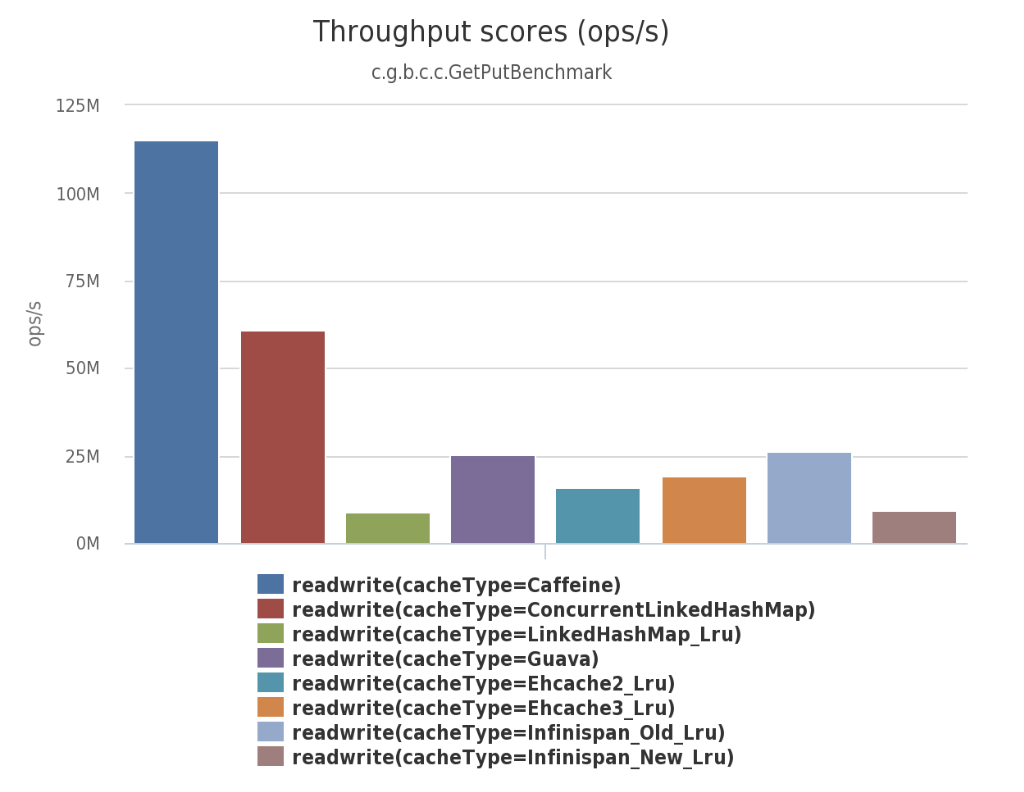
大家都知道,Spring5 即將放棄掉 Guava Cache 作為緩存機(jī)制,而改用 Caffeine 作為新的本地 Cache 的組件,這對(duì)于 Caffeine 來(lái)說(shuō)是一個(gè)很大的肯定。為什么 Spring 會(huì)這樣做呢?其實(shí)在 Caffeine 的Benchmarks[3]里給出了好靚仔的數(shù)據(jù),對(duì)讀和寫(xiě)的場(chǎng)景,還有跟其他幾個(gè)緩存工具進(jìn)行了比較,Caffeine 的性能都表現(xiàn)很突出。
使用 Caffeine
Caffeine 為了方便大家使用以及從 Guava Cache 切換過(guò)來(lái)(很有針對(duì)性啊~),借鑒了 Guava Cache 大部分的概念(諸如核心概念Cache、LoadingCache、CacheLoader、CacheBuilder等等),對(duì)于 Caffeine 的理解只要把它當(dāng)作 Guava Cache 就可以了。
使用上,大家只要把 Caffeine 的包引進(jìn)來(lái),然后換一下 cache 的實(shí)現(xiàn)類,基本應(yīng)該就沒(méi)問(wèn)題了。這對(duì)與已經(jīng)使用過(guò) Guava Cache 的同學(xué)來(lái)說(shuō)沒(méi)有任何難度,甚至還有一點(diǎn)熟悉的味道,如果你之前沒(méi)有使用過(guò) Guava Cache,可以查看 Caffeine 的官方 API 說(shuō)明文檔[4],其中Population,Eviction,Removal,Refresh,Statistics,Cleanup,Policy等等這些特性都是跟 Guava Cache 基本一樣的。
下面給出一個(gè)例子說(shuō)明怎樣創(chuàng)建一個(gè) Cache:
private?static?LoadingCache?cache?=?Caffeine.newBuilder()
????????????//最大個(gè)數(shù)限制
????????????.maximumSize(256L)
????????????//初始化容量
????????????.initialCapacity(1)
????????????//訪問(wèn)后過(guò)期(包括讀和寫(xiě))
????????????.expireAfterAccess(2,?TimeUnit.DAYS)
????????????//寫(xiě)后過(guò)期
????????????.expireAfterWrite(2,?TimeUnit.HOURS)
????????????//寫(xiě)后自動(dòng)異步刷新
????????????.refreshAfterWrite(1,?TimeUnit.HOURS)
????????????//記錄下緩存的一些統(tǒng)計(jì)數(shù)據(jù),例如命中率等
????????????.recordStats()
????????????//cache對(duì)緩存寫(xiě)的通知回調(diào)
????????????.writer(new?CacheWriter()?{
????????????????@Override
????????????????public?void?write(@NonNull?Object?key,?@NonNull?Object?value)?{
????????????????????log.info("key={},?CacheWriter?write",?key);
????????????????}

????????????????@Override
????????????????public?void?delete(@NonNull?Object?key,?@Nullable?Object?value,?@NonNull?RemovalCause?cause)?{
????????????????????log.info("key={},?cause={},?CacheWriter?delete",?key,?cause);
????????????????}
????????????})
????????????//使用CacheLoader創(chuàng)建一個(gè)LoadingCache
????????????.build(new?CacheLoader()?{
????????????????//同步加載數(shù)據(jù)
????????????????@Nullable
????????????????@Override
????????????????public?String?load(@NonNull?String?key)?throws?Exception?{
????????????????????return?"value_"?+?key;
????????????????}

????????????????//異步加載數(shù)據(jù)
????????????????@Nullable
????????????????@Override
????????????????public?String?reload(@NonNull?String?key,?@NonNull?String?oldValue)?throws?Exception?{
????????????????????return?"value_"?+?key;
????????????????}
????????????});
更多從 Guava Cache 遷移過(guò)來(lái)的使用說(shuō)明,請(qǐng)看這里[5]
Caffeine 的高性能設(shè)計(jì)
判斷一個(gè)緩存的好壞最核心的指標(biāo)就是命中率,影響緩存命中率有很多因素,包括業(yè)務(wù)場(chǎng)景、淘汰策略、清理策略、緩存容量等等。如果作為本地緩存, 它的性能的情況,資源的占用也都是一個(gè)很重要的指標(biāo)。下面
我們來(lái)看看 Caffeine 在這幾個(gè)方面是怎么著手的,如何做優(yōu)化的。
(注:本文不會(huì)分析 Caffeine 全部源碼,只會(huì)對(duì)核心設(shè)計(jì)的實(shí)現(xiàn)進(jìn)行分析,但我建議讀者把 Caffeine 的源碼都涉獵一下,有個(gè) overview 才能更好理解本文。如果你看過(guò) Guava Cache 的源碼也行,代碼的數(shù)據(jù)結(jié)構(gòu)和處理邏輯很類似的。
源碼基于:caffeine-2.8.0.jar)
W-TinyLFU 整體設(shè)計(jì)
上面說(shuō)到淘汰策略是影響緩存命中率的因素之一,一般比較簡(jiǎn)單的緩存就會(huì)直接用到 LFU(Least Frequently Used,即最不經(jīng)常使用) 或者LRU(Least Recently Used,即最近最少使用) ,而 Caffeine 就是使用了 W-TinyLFU 算法。
W-TinyLFU 看名字就能大概猜出來(lái),它是 LFU 的變種,也是一種緩存淘汰算法。那為什么要使用 W-TinyLFU 呢?
LRU 和 LFU 的缺點(diǎn)
LRU 實(shí)現(xiàn)簡(jiǎn)單,在一般情況下能夠表現(xiàn)出很好的命中率,是一個(gè)“性價(jià)比”很高的算法,平時(shí)也很常用。雖然 LRU 對(duì)突發(fā)性的稀疏流量(sparse bursts)表現(xiàn)很好,但同時(shí)也會(huì)產(chǎn)生緩存污染,舉例來(lái)說(shuō),如果偶然性的要對(duì)全量數(shù)據(jù)進(jìn)行遍歷,那么“歷史訪問(wèn)記錄”就會(huì)被刷走,造成污染。 如果數(shù)據(jù)的分布在一段時(shí)間內(nèi)是固定的話,那么 LFU 可以達(dá)到最高的命中率。但是 LFU 有兩個(gè)缺點(diǎn),第一,它需要給每個(gè)記錄項(xiàng)維護(hù)頻率信息,每次訪問(wèn)都需要更新,這是個(gè)巨大的開(kāi)銷;第二,對(duì)突發(fā)性的稀疏流量無(wú)力,因?yàn)榍捌诮?jīng)常訪問(wèn)的記錄已經(jīng)占用了緩存,偶然的流量不太可能會(huì)被保留下來(lái),而且過(guò)去的一些大量被訪問(wèn)的記錄在將來(lái)也不一定會(huì)使用上,這樣就一直把“坑”占著了。
無(wú)論 LRU 還是 LFU 都有其各自的缺點(diǎn),不過(guò),現(xiàn)在已經(jīng)有很多針對(duì)其缺點(diǎn)而改良、優(yōu)化出來(lái)的變種算法。
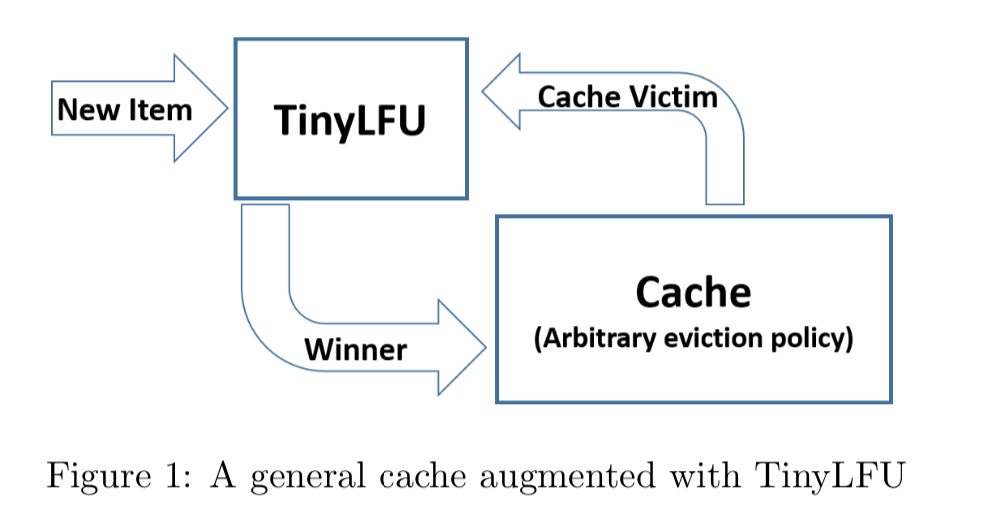
TinyLFU
TinyLFU 就是其中一個(gè)優(yōu)化算法,它是專門為了解決 LFU 上述提到的兩個(gè)問(wèn)題而被設(shè)計(jì)出來(lái)的。
解決第一個(gè)問(wèn)題是采用了 Count–Min Sketch 算法。
解決第二個(gè)問(wèn)題是讓記錄盡量保持相對(duì)的“新鮮”(Freshness Mechanism),并且當(dāng)有新的記錄插入時(shí),可以讓它跟老的記錄進(jìn)行“PK”,輸者就會(huì)被淘汰,這樣一些老的、不再需要的記錄就會(huì)被剔除。
下圖是 TinyLFU 設(shè)計(jì)圖(來(lái)自官方)
統(tǒng)計(jì)頻率 Count–Min Sketch 算法
如何對(duì)一個(gè) key 進(jìn)行統(tǒng)計(jì),但又可以節(jié)省空間呢?(不是簡(jiǎn)單的使用HashMap,這太消耗內(nèi)存了),注意哦,不需要精確的統(tǒng)計(jì),只需要一個(gè)近似值就可以了,怎么樣,這樣場(chǎng)景是不是很熟悉,如果你是老司機(jī),或許已經(jīng)聯(lián)想到布隆過(guò)濾器(Bloom Filter)的應(yīng)用了。
沒(méi)錯(cuò),將要介紹的 Count–Min Sketch 的原理跟 Bloom Filter 一樣,只不過(guò) Bloom Filter 只有 0 和 1 的值,那么你可以把 Count–Min Sketch 看作是“數(shù)值”版的 Bloom Filter。
更多關(guān)于 Count–Min Sketch 的介紹請(qǐng)自行搜索。
在 TinyLFU 中,近似頻率的統(tǒng)計(jì)如下圖所示:
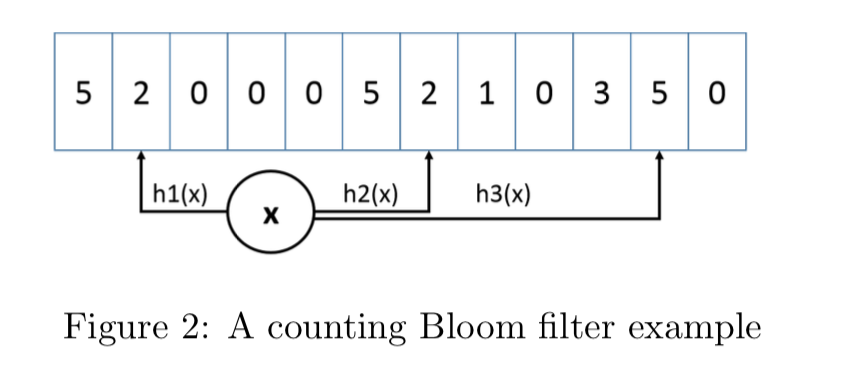
對(duì)一個(gè) key 進(jìn)行多次 hash 函數(shù)后,index 到多個(gè)數(shù)組位置后進(jìn)行累加,查詢時(shí)取多個(gè)值中的最小值即可。
Caffeine 對(duì)這個(gè)算法的實(shí)現(xiàn)在FrequencySketch類。但 Caffeine 對(duì)此有進(jìn)一步的優(yōu)化,例如 Count–Min Sketch 使用了二維數(shù)組,Caffeine 只是用了一個(gè)一維的數(shù)組;再者,如果是數(shù)值類型的話,這個(gè)數(shù)需要用 int 或 long 來(lái)存儲(chǔ),但是 Caffeine 認(rèn)為緩存的訪問(wèn)頻率不需要用到那么大,只需要 15 就足夠,一般認(rèn)為達(dá)到 15 次的頻率算是很高的了,而且 Caffeine 還有另外一個(gè)機(jī)制來(lái)使得這個(gè)頻率進(jìn)行衰退減半(下面就會(huì)講到)。如果最大是 15 的話,那么只需要 4 個(gè) bit 就可以滿足了,一個(gè) long 有 64bit,可以存儲(chǔ) 16 個(gè)這樣的統(tǒng)計(jì)數(shù),Caffeine 就是這樣的設(shè)計(jì),使得存儲(chǔ)效率提高了 16 倍。
Caffeine 對(duì)緩存的讀寫(xiě)(afterRead和afterWrite方法)都會(huì)調(diào)用onAccesss 方法,而onAccess方法里有一句:
frequencySketch().increment(key);
這句就是追加記錄的頻率,下面我們看看具體實(shí)現(xiàn)
//FrequencySketch的一些屬性

//種子數(shù)
static?final?long[]?SEED?=?{?//?A?mixture?of?seeds?from?FNV-1a,?CityHash,?and?Murmur3
????0xc3a5c85c97cb3127L,?0xb492b66fbe98f273L,?0x9ae16a3b2f90404fL,?0xcbf29ce484222325L};
static?final?long?RESET_MASK?=?0x7777777777777777L;
static?final?long?ONE_MASK?=?0x1111111111111111L;

int?sampleSize;
//為了快速根據(jù)hash值得到table的index值的掩碼
//table的長(zhǎng)度size一般為2的n次方,而tableMask為size-1,這樣就可以通過(guò)&操作來(lái)模擬取余操作,速度快很多,老司機(jī)都知道
int?tableMask;
//存儲(chǔ)數(shù)據(jù)的一維long數(shù)組
long[]?table;
int?size;

/**
?*?Increments?the?popularity?of?the?element?if?it?does?not?exceed?the?maximum?(15).?The?popularity
?*?of?all?elements?will?be?periodically?down?sampled?when?the?observed?events?exceeds?a?threshold.
?*?This?process?provides?a?frequency?aging?to?allow?expired?long?term?entries?to?fade?away.
?*
?*?@param?e?the?element?to?add
?*/
public?void?increment(@NonNull?E?e)?{
??if?(isNotInitialized())?{
????return;
??}

??//根據(jù)key的hashCode通過(guò)一個(gè)哈希函數(shù)得到一個(gè)hash值
??//本來(lái)就是hashCode了,為什么還要再做一次hash?怕原來(lái)的hashCode不夠均勻分散,再打散一下。
??int?hash?=?spread(e.hashCode());
??//這句光看有點(diǎn)難理解
??//就如我剛才說(shuō)的,Caffeine把一個(gè)long的64bit劃分成16個(gè)等分,每一等分4個(gè)bit。
??//這個(gè)start就是用來(lái)定位到是哪一個(gè)等分的,用hash值低兩位作為隨機(jī)數(shù),再左移2位,得到一個(gè)小于16的值
??int?start?=?(hash?&?3)?<2;

??//indexOf方法的意思就是,根據(jù)hash值和不同種子得到table的下標(biāo)index
??//這里通過(guò)四個(gè)不同的種子,得到四個(gè)不同的下標(biāo)index
??int?index0?=?indexOf(hash,?0);
??int?index1?=?indexOf(hash,?1);
??int?index2?=?indexOf(hash,?2);
??int?index3?=?indexOf(hash,?3);

??//根據(jù)index和start(+1,?+2,?+3)的值,把table[index]對(duì)應(yīng)的等分追加1
??//這個(gè)incrementAt方法有點(diǎn)難理解,看我下面的解釋
??boolean?added?=?incrementAt(index0,?start);
??added?|=?incrementAt(index1,?start?+?1);
??added?|=?incrementAt(index2,?start?+?2);
??added?|=?incrementAt(index3,?start?+?3);

??//這個(gè)reset等下說(shuō)
??if?(added?&&?(++size?==?sampleSize))?{
????reset();
??}
}

/**
?*?Increments?the?specified?counter?by?1?if?it?is?not?already?at?the?maximum?value?(15).
?*
?*?@param?i?the?table?index?(16?counters)
?*?@param?j?the?counter?to?increment
?*?@return?if?incremented
?*/
boolean?incrementAt(int?i,?int?j)?{
??//這個(gè)j表示16個(gè)等分的下標(biāo),那么offset就是相當(dāng)于在64位中的下標(biāo)(這個(gè)自己想想)
??int?offset?=?j?<2;
??//上面提到Caffeine把頻率統(tǒng)計(jì)最大定為15,即0xfL
??//mask就是在64位中的掩碼,即1111后面跟很多個(gè)0
??long?mask?=?(0xfL?<??//如果&的結(jié)果不等于15,那么就追加1。等于15就不會(huì)再加了
??if?((table[i]?&?mask)?!=?mask)?{
????table[i]?+=?(1L?<????return?true;
??}
??return?false;
}

/**
?*?Returns?the?table?index?for?the?counter?at?the?specified?depth.
?*
?*?@param?item?the?element's?hash
?*?@param?i?the?counter?depth
?*?@return?the?table?index
?*/
int?indexOf(int?item,?int?i)?{
??long?hash?=?SEED[i]?*?item;
??hash?+=?hash?>>>?32;
??return?((int)?hash)?&?tableMask;
}

/**
?*?Applies?a?supplemental?hash?function?to?a?given?hashCode,?which?defends?against?poor?quality
?*?hash?functions.
?*/
int?spread(int?x)?{
??x?=?((x?>>>?16)?^?x)?*?0x45d9f3b;
??x?=?((x?>>>?16)?^?x)?*?0x45d9f3b;
??return?(x?>>>?16)?^?x;
}
知道了追加方法,那么讀取方法frequency就很容易理解了。
/**
?*?Returns?the?estimated?number?of?occurrences?of?an?element,?up?to?the?maximum?(15).
?*
?*?@param?e?the?element?to?count?occurrences?of
?*?@return?the?estimated?number?of?occurrences?of?the?element;?possibly?zero?but?never?negative
?*/
@NonNegative
public?int?frequency(@NonNull?E?e)?{
??if?(isNotInitialized())?{
????return?0;
??}

??//得到hash值,跟上面一樣
??int?hash?=?spread(e.hashCode());
??//得到等分的下標(biāo),跟上面一樣
??int?start?=?(hash?&?3)?<2;
??int?frequency?=?Integer.MAX_VALUE;
??//循環(huán)四次,分別獲取在table數(shù)組中不同的下標(biāo)位置
??for?(int?i?=?0;?i?4;?i++)?{
????int?index?=?indexOf(hash,?i);
????//這個(gè)操作就不多說(shuō)了,其實(shí)跟上面incrementAt是一樣的,定位到table[index]?+?等分的位置,再根據(jù)mask取出計(jì)數(shù)值
????int?count?=?(int)?((table[index]?>>>?((start?+?i)?<2))?&?0xfL);
????//取四個(gè)中的較小值
????frequency?=?Math.min(frequency,?count);
??}
??return?frequency;
}
通過(guò)代碼和注釋或者讀者可能難以理解,下圖是我畫(huà)出來(lái)幫助大家理解的結(jié)構(gòu)圖。
注意紫色虛線框,其中藍(lán)色小格就是需要計(jì)算的位置:

保新機(jī)制
為了讓緩存保持“新鮮”,剔除掉過(guò)往頻率很高但之后不經(jīng)常的緩存,Caffeine 有一個(gè) Freshness Mechanism。做法很簡(jiǎn)答,就是當(dāng)整體的統(tǒng)計(jì)計(jì)數(shù)(當(dāng)前所有記錄的頻率統(tǒng)計(jì)之和,這個(gè)數(shù)值內(nèi)部維護(hù))達(dá)到某一個(gè)值時(shí),那么所有記錄的頻率統(tǒng)計(jì)除以 2。
從上面的代碼
//size變量就是所有記錄的頻率統(tǒng)計(jì)之,即每個(gè)記錄加1,這個(gè)size都會(huì)加1
//sampleSize一個(gè)閾值,從FrequencySketch初始化可以看到它的值為maximumSize的10倍
if?(added?&&?(++size?==?sampleSize))?{
??????reset();
}
看到reset方法就是做這個(gè)事情
/**?Reduces?every?counter?by?half?of?its?original?value.?*/
void?reset()?{
??int?count?=?0;
??for?(int?i?=?0;?i?????count?+=?Long.bitCount(table[i]?&?ONE_MASK);
????table[i]?=?(table[i]?>>>?1)?&?RESET_MASK;
??}
??size?=?(size?>>>?1)?-?(count?>>>?2);
}
關(guān)于這個(gè) reset 方法,為什么是除以 2,而不是其他,及其正確性,在最下面的參考資料的 TinyLFU 論文中 3.3 章節(jié)給出了數(shù)學(xué)證明,大家有興趣可以看看。
增加一個(gè) Window?
Caffeine 通過(guò)測(cè)試發(fā)現(xiàn) TinyLFU 在面對(duì)突發(fā)性的稀疏流量(sparse bursts)時(shí)表現(xiàn)很差,因?yàn)樾碌挠涗洠╪ew items)還沒(méi)來(lái)得及建立足夠的頻率就被剔除出去了,這就使得命中率下降。
于是 Caffeine 設(shè)計(jì)出一種新的 policy,即 Window Tiny LFU(W-TinyLFU),并通過(guò)實(shí)驗(yàn)和實(shí)踐發(fā)現(xiàn) W-TinyLFU 比 TinyLFU 表現(xiàn)的更好。
W-TinyLFU 的設(shè)計(jì)如下所示(兩圖等價(jià)):
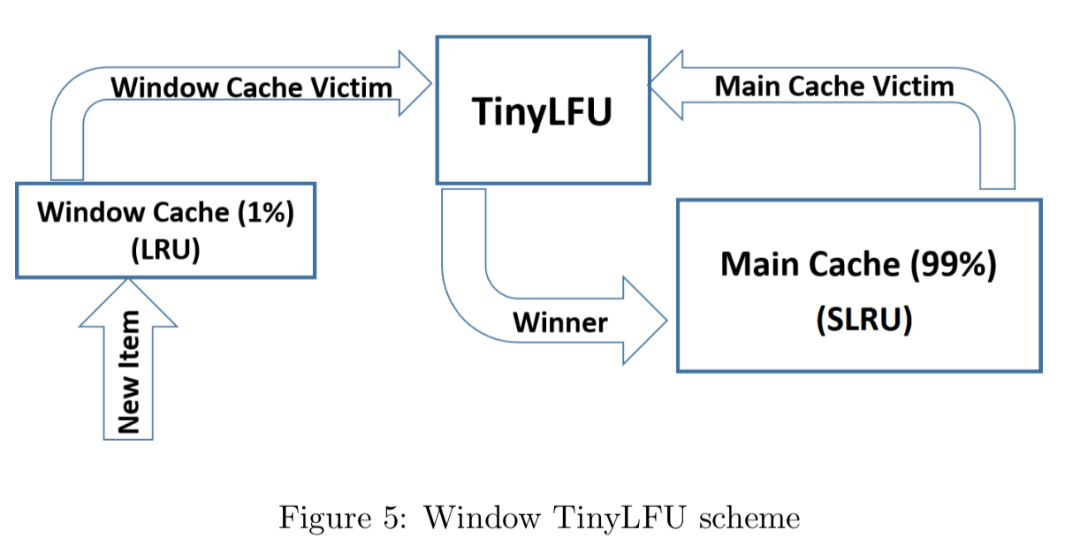
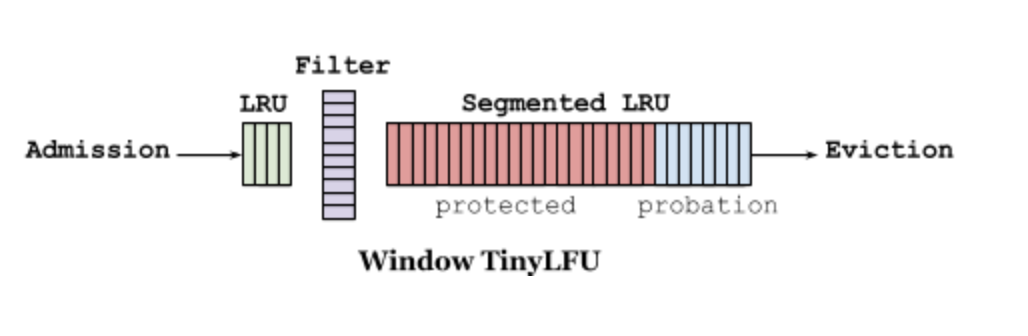
它主要包括兩個(gè)緩存模塊,主緩存是 SLRU(Segmented LRU,即分段 LRU),SLRU 包括一個(gè)名為 protected 和一個(gè)名為 probation 的緩存區(qū)。通過(guò)增加一個(gè)緩存區(qū)(即 Window Cache),當(dāng)有新的記錄插入時(shí),會(huì)先在 window 區(qū)呆一下,就可以避免上述說(shuō)的 sparse bursts 問(wèn)題。
淘汰策略(eviction policy)
當(dāng) window 區(qū)滿了,就會(huì)根據(jù) LRU 把 candidate(即淘汰出來(lái)的元素)放到 probation 區(qū),如果 probation 區(qū)也滿了,就把 candidate 和 probation 將要淘汰的元素 victim,兩個(gè)進(jìn)行“PK”,勝者留在 probation,輸者就要被淘汰了。
而且經(jīng)過(guò)實(shí)驗(yàn)發(fā)現(xiàn)當(dāng) window 區(qū)配置為總?cè)萘康?1%,剩余的 99%當(dāng)中的 80%分給 protected 區(qū),20%分給 probation 區(qū)時(shí),這時(shí)整體性能和命中率表現(xiàn)得最好,所以 Caffeine 默認(rèn)的比例設(shè)置就是這個(gè)。
不過(guò)這個(gè)比例 Caffeine 會(huì)在運(yùn)行時(shí)根據(jù)統(tǒng)計(jì)數(shù)據(jù)(statistics)去動(dòng)態(tài)調(diào)整,如果你的應(yīng)用程序的緩存隨著時(shí)間變化比較快的話,那么增加 window 區(qū)的比例可以提高命中率,相反緩存都是比較固定不變的話,增加 Main Cache 區(qū)(protected 區(qū) +probation 區(qū))的比例會(huì)有較好的效果。
下面我們看看上面說(shuō)到的淘汰策略是怎么實(shí)現(xiàn)的:
一般緩存對(duì)讀寫(xiě)操作后都有后續(xù)的一系列“維護(hù)”操作,Caffeine 也不例外,這些操作都在maintenance方法,我們將要說(shuō)到的淘汰策略也在里面。
這方法比較重要,下面也會(huì)提到,所以這里只先說(shuō)跟“淘汰策略”有關(guān)的evictEntries和climb。
/**
???*?Performs?the?pending?maintenance?work?and?sets?the?state?flags?during?processing?to?avoid
???*?excess?scheduling?attempts.?The?read?buffer,?write?buffer,?and?reference?queues?are
???*?drained,?followed?by?expiration,?and?size-based?eviction.
???*
???*?@param?task?an?additional?pending?task?to?run,?or?{@code?null}?if?not?present
???*/
??@GuardedBy("evictionLock")
??void?maintenance(@Nullable?Runnable?task)?{
????lazySetDrainStatus(PROCESSING_TO_IDLE);

????try?{
??????drainReadBuffer();

??????drainWriteBuffer();
??????if?(task?!=?null)?{
????????task.run();
??????}

??????drainKeyReferences();
??????drainValueReferences();

??????expireEntries();
??????//把符合條件的記錄淘汰掉
??????evictEntries();
??????//動(dòng)態(tài)調(diào)整window區(qū)和protected區(qū)的大小
??????climb();
????}?finally?{
??????if?((drainStatus()?!=?PROCESSING_TO_IDLE)?||?!casDrainStatus(PROCESSING_TO_IDLE,?IDLE))?{
????????lazySetDrainStatus(REQUIRED);
??????}
????}
??}
//最大的個(gè)數(shù)限制
long?maximum;
//當(dāng)前的個(gè)數(shù)
long?weightedSize;
//window區(qū)的最大限制
long?windowMaximum;
//window區(qū)當(dāng)前的個(gè)數(shù)
long?windowWeightedSize;
//protected區(qū)的最大限制
long?mainProtectedMaximum;
//protected區(qū)當(dāng)前的個(gè)數(shù)
long?mainProtectedWeightedSize;
//下一次需要調(diào)整的大小(還需要進(jìn)一步計(jì)算)
double?stepSize;
//window區(qū)需要調(diào)整的大小
long?adjustment;
//命中計(jì)數(shù)
int?hitsInSample;
//不命中的計(jì)數(shù)
int?missesInSample;
//上一次的緩存命中率
double?previousSampleHitRate;

final?FrequencySketch?sketch;
//window區(qū)的LRU?queue(FIFO)
final?AccessOrderDeque>?accessOrderWindowDeque;
//probation區(qū)的LRU?queue(FIFO)
final?AccessOrderDeque>?accessOrderProbationDeque;
//protected區(qū)的LRU?queue(FIFO)
final?AccessOrderDeque>?accessOrderProtectedDeque;
以及默認(rèn)比例設(shè)置(意思看注釋)
/**?The?initial?percent?of?the?maximum?weighted?capacity?dedicated?to?the?main?space.?*/
static?final?double?PERCENT_MAIN?=?0.99d;
/**?The?percent?of?the?maximum?weighted?capacity?dedicated?to?the?main's?protected?space.?*/
static?final?double?PERCENT_MAIN_PROTECTED?=?0.80d;
/**?The?difference?in?hit?rates?that?restarts?the?climber.?*/
static?final?double?HILL_CLIMBER_RESTART_THRESHOLD?=?0.05d;
/**?The?percent?of?the?total?size?to?adapt?the?window?by.?*/
static?final?double?HILL_CLIMBER_STEP_PERCENT?=?0.0625d;
/**?The?rate?to?decrease?the?step?size?to?adapt?by.?*/
static?final?double?HILL_CLIMBER_STEP_DECAY_RATE?=?0.98d;
/**?The?maximum?number?of?entries?that?can?be?transfered?between?queues.?*/
重點(diǎn)來(lái)了,evictEntries和climb方法:
/**?Evicts?entries?if?the?cache?exceeds?the?maximum.?*/
@GuardedBy("evictionLock")
void?evictEntries()?{
??if?(!evicts())?{
????return;
??}
??//淘汰window區(qū)的記錄
??int?candidates?=?evictFromWindow();
??//淘汰Main區(qū)的記錄
??evictFromMain(candidates);
}
/**
?*?Evicts?entries?from?the?window?space?into?the?main?space?while?the?window?size?exceeds?a
?*?maximum.
?*
?*?@return?the?number?of?candidate?entries?evicted?from?the?window?space
?*/
//根據(jù)W-TinyLFU,新的數(shù)據(jù)都會(huì)無(wú)條件的加到admission?window
//但是window是有大小限制,所以要“定期”做一下“維護(hù)”
@GuardedBy("evictionLock")
int?evictFromWindow()?{
??int?candidates?=?0;
??//查看window?queue的頭部節(jié)點(diǎn)
??Node?node?=?accessOrderWindowDeque().peek();
??//如果window區(qū)超過(guò)了最大的限制,那么就要把“多出來(lái)”的記錄做處理
??while?(windowWeightedSize()?>?windowMaximum())?{
????//?The?pending?operations?will?adjust?the?size?to?reflect?the?correct?weight
????if?(node?==?null)?{
??????break;
????}
????//下一個(gè)節(jié)點(diǎn)
????Node?next?=?node.getNextInAccessOrder();
????if?(node.getWeight()?!=?0)?{
??????//把node定位在probation區(qū)
??????node.makeMainProbation();
??????//從window區(qū)去掉
??????accessOrderWindowDeque().remove(node);
??????//加入到probation?queue,相當(dāng)于把節(jié)點(diǎn)移動(dòng)到probation區(qū)(晉升了)
??????accessOrderProbationDeque().add(node);
??????candidates++;
??????//因?yàn)橐瞥艘粋€(gè)節(jié)點(diǎn),所以需要調(diào)整window的size
??????setWindowWeightedSize(windowWeightedSize()?-?node.getPolicyWeight());
????}
????//處理下一個(gè)節(jié)點(diǎn)
????node?=?next;
??}
??return?candidates;
}
evictFromMain方法:
/**
?*?Evicts?entries?from?the?main?space?if?the?cache?exceeds?the?maximum?capacity.?The?main?space
?*?determines?whether?admitting?an?entry?(coming?from?the?window?space)?is?preferable?to?retaining
?*?the?eviction?policy's?victim.?This?is?decision?is?made?using?a?frequency?filter?so?that?the
?*?least?frequently?used?entry?is?removed.
?*
?*?The?window?space?candidates?were?previously?placed?in?the?MRU?position?and?the?eviction
?*?policy's?victim?is?at?the?LRU?position.?The?two?ends?of?the?queue?are?evaluated?while?an
?*?eviction?is?required.?The?number?of?remaining?candidates?is?provided?and?decremented?on
?*?eviction,?so?that?when?there?are?no?more?candidates?the?victim?is?evicted.
?*
?*?@param?candidates?the?number?of?candidate?entries?evicted?from?the?window?space
?*/
//根據(jù)W-TinyLFU,從window晉升過(guò)來(lái)的要跟probation區(qū)的進(jìn)行“PK”,勝者才能留下
@GuardedBy("evictionLock")
void?evictFromMain(int?candidates)?{
??int?victimQueue?=?PROBATION;
??//victim是probation?queue的頭部
??Node?victim?=?accessOrderProbationDeque().peekFirst();
??//candidate是probation?queue的尾部,也就是剛從window晉升來(lái)的
??Node?candidate?=?accessOrderProbationDeque().peekLast();
??//當(dāng)cache不夠容量時(shí)才做處理
??while?(weightedSize()?>?maximum())?{
????//?Stop?trying?to?evict?candidates?and?always?prefer?the?victim
????if?(candidates?==?0)?{
??????candidate?=?null;
????}

????//對(duì)candidate為null且victim為bull的處理
????if?((candidate?==?null)?&&?(victim?==?null))?{
??????if?(victimQueue?==?PROBATION)?{
????????victim?=?accessOrderProtectedDeque().peekFirst();
????????victimQueue?=?PROTECTED;
????????continue;
??????}?else?if?(victimQueue?==?PROTECTED)?{
????????victim?=?accessOrderWindowDeque().peekFirst();
????????victimQueue?=?WINDOW;
????????continue;
??????}

??????//?The?pending?operations?will?adjust?the?size?to?reflect?the?correct?weight
??????break;
????}

????//對(duì)節(jié)點(diǎn)的weight為0的處理
????if?((victim?!=?null)?&&?(victim.getPolicyWeight()?==?0))?{
??????victim?=?victim.getNextInAccessOrder();
??????continue;
????}?else?if?((candidate?!=?null)?&&?(candidate.getPolicyWeight()?==?0))?{
??????candidate?=?candidate.getPreviousInAccessOrder();
??????candidates--;
??????continue;
????}

????//?Evict?immediately?if?only?one?of?the?entries?is?present
????if?(victim?==?null)?{
??????@SuppressWarnings("NullAway")
??????Node?previous?=?candidate.getPreviousInAccessOrder();
??????Node?evict?=?candidate;
??????candidate?=?previous;
??????candidates--;
??????evictEntry(evict,?RemovalCause.SIZE,?0L);
??????continue;
????}?else?if?(candidate?==?null)?{
??????Node?evict?=?victim;
??????victim?=?victim.getNextInAccessOrder();
??????evictEntry(evict,?RemovalCause.SIZE,?0L);
??????continue;
????}

????//?Evict?immediately?if?an?entry?was?collected
????K?victimKey?=?victim.getKey();
????K?candidateKey?=?candidate.getKey();
????if?(victimKey?==?null)?{
??????@NonNull?Node?evict?=?victim;
??????victim?=?victim.getNextInAccessOrder();
??????evictEntry(evict,?RemovalCause.COLLECTED,?0L);
??????continue;
????}?else?if?(candidateKey?==?null)?{
??????candidates--;
??????@NonNull?Node?evict?=?candidate;
??????candidate?=?candidate.getPreviousInAccessOrder();
??????evictEntry(evict,?RemovalCause.COLLECTED,?0L);
??????continue;
????}

????//放不下的節(jié)點(diǎn)直接處理掉
????if?(candidate.getPolicyWeight()?>?maximum())?{
??????candidates--;
??????Node?evict?=?candidate;
??????candidate?=?candidate.getPreviousInAccessOrder();
??????evictEntry(evict,?RemovalCause.SIZE,?0L);
??????continue;
????}

????//根據(jù)節(jié)點(diǎn)的統(tǒng)計(jì)頻率frequency來(lái)做比較,看看要處理掉victim還是candidate
????//admit是具體的比較規(guī)則,看下面
????candidates--;
????//如果candidate勝出則淘汰victim
????if?(admit(candidateKey,?victimKey))?{
??????Node?evict?=?victim;
??????victim?=?victim.getNextInAccessOrder();
??????evictEntry(evict,?RemovalCause.SIZE,?0L);
??????candidate?=?candidate.getPreviousInAccessOrder();
????}?else?{
??????//如果是victim勝出,則淘汰candidate
??????Node?evict?=?candidate;
??????candidate?=?candidate.getPreviousInAccessOrder();
??????evictEntry(evict,?RemovalCause.SIZE,?0L);
????}
??}
}

/**
?*?Determines?if?the?candidate?should?be?accepted?into?the?main?space,?as?determined?by?its
?*?frequency?relative?to?the?victim.?A?small?amount?of?randomness?is?used?to?protect?against?hash
?*?collision?attacks,?where?the?victim's?frequency?is?artificially?raised?so?that?no?new?entries
?*?are?admitted.
?*
?*?@param?candidateKey?the?key?for?the?entry?being?proposed?for?long?term?retention
?*?@param?victimKey?the?key?for?the?entry?chosen?by?the?eviction?policy?for?replacement
?*?@return?if?the?candidate?should?be?admitted?and?the?victim?ejected
?*/
@GuardedBy("evictionLock")
boolean?admit(K?candidateKey,?K?victimKey)?{
??//分別獲取victim和candidate的統(tǒng)計(jì)頻率
??//frequency這個(gè)方法的原理和實(shí)現(xiàn)上面已經(jīng)解釋了
??int?victimFreq?=?frequencySketch().frequency(victimKey);
??int?candidateFreq?=?frequencySketch().frequency(candidateKey);
??//誰(shuí)大誰(shuí)贏
??if?(candidateFreq?>?victimFreq)?{
????return?true;

????//如果相等,candidate小于5都當(dāng)輸了
??}?else?if?(candidateFreq?<=?5)?{
????//?The?maximum?frequency?is?15?and?halved?to?7?after?a?reset?to?age?the?history.?An?attack
????//?exploits?that?a?hot?candidate?is?rejected?in?favor?of?a?hot?victim.?The?threshold?of?a?warm
????//?candidate?reduces?the?number?of?random?acceptances?to?minimize?the?impact?on?the?hit?rate.
????return?false;
??}
??//如果相等且candidate大于5,則隨機(jī)淘汰一個(gè)
??int?random?=?ThreadLocalRandom.current().nextInt();
??return?((random?&?127)?==?0);
}
climb方法主要是用來(lái)調(diào)整 window size 的,使得 Caffeine 可以適應(yīng)你的應(yīng)用類型(如 OLAP 或 OLTP)表現(xiàn)出最佳的命中率。
下圖是官方測(cè)試的數(shù)據(jù):

我們看看 window size 的調(diào)整是怎么實(shí)現(xiàn)的。
調(diào)整時(shí)用到的默認(rèn)比例數(shù)據(jù):
//與上次命中率之差的閾值
static?final?double?HILL_CLIMBER_RESTART_THRESHOLD?=?0.05d;
//步長(zhǎng)(調(diào)整)的大小(跟最大值maximum的比例)
static?final?double?HILL_CLIMBER_STEP_PERCENT?=?0.0625d;
//步長(zhǎng)的衰減比例
static?final?double?HILL_CLIMBER_STEP_DECAY_RATE?=?0.98d;
??/**?Adapts?the?eviction?policy?to?towards?the?optimal?recency?/?frequency?configuration.?*/
//climb方法的主要作用就是動(dòng)態(tài)調(diào)整window區(qū)的大小(相應(yīng)的,main區(qū)的大小也會(huì)發(fā)生變化,兩個(gè)之和為100%)。
//因?yàn)閰^(qū)域的大小發(fā)生了變化,那么區(qū)域內(nèi)的數(shù)據(jù)也可能需要發(fā)生相應(yīng)的移動(dòng)。
@GuardedBy("evictionLock")
void?climb()?{
??if?(!evicts())?{
????return;
??}
??//確定window需要調(diào)整的大小
??determineAdjustment();
??//如果protected區(qū)有溢出,把溢出部分移動(dòng)到probation區(qū)。因?yàn)橄旅娴牟僮饔锌赡苄枰{(diào)整到protected區(qū)。
??demoteFromMainProtected();
??long?amount?=?adjustment();
??if?(amount?==?0)?{
????return;
??}?else?if?(amount?>?0)?{
????//增加window的大小
????increaseWindow();
??}?else?{
????//減少window的大小
????decreaseWindow();
??}
}
下面分別展開(kāi)每個(gè)方法來(lái)解釋:
/**?Calculates?the?amount?to?adapt?the?window?by?and?sets?{@link?#adjustment()}?accordingly.?*/
@GuardedBy("evictionLock")
void?determineAdjustment()?{
??//如果frequencySketch還沒(méi)初始化,則返回
??if?(frequencySketch().isNotInitialized())?{
????setPreviousSampleHitRate(0.0);
????setMissesInSample(0);
????setHitsInSample(0);
????return;
??}
??//總請(qǐng)求量?=?命中?+?miss
??int?requestCount?=?hitsInSample()?+?missesInSample();
??//沒(méi)達(dá)到sampleSize則返回
??//默認(rèn)下sampleSize = 10?* maximum。用sampleSize來(lái)判斷緩存是否足夠”熱“。
??if?(requestCount?????return;
??}

??//命中率的公式?=?命中?/?總請(qǐng)求
??double?hitRate?=?(double)?hitsInSample()?/?requestCount;
??//命中率的差值
??double?hitRateChange?=?hitRate?-?previousSampleHitRate();
??//本次調(diào)整的大小,是由命中率的差值和上次的stepSize決定的
??double?amount?=?(hitRateChange?>=?0)???stepSize()?:?-stepSize();
??//下次的調(diào)整大小:如果命中率的之差大于0.05,則重置為0.065 * maximum,否則按照0.98來(lái)進(jìn)行衰減
??double?nextStepSize?=?(Math.abs(hitRateChange)?>=?HILL_CLIMBER_RESTART_THRESHOLD)
????????HILL_CLIMBER_STEP_PERCENT?*?maximum()?*?(amount?>=?0???1?:?-1)
??????:?HILL_CLIMBER_STEP_DECAY_RATE?*?amount;
??setPreviousSampleHitRate(hitRate);
??setAdjustment((long)?amount);
??setStepSize(nextStepSize);
??setMissesInSample(0);
??setHitsInSample(0);
}

/**?Transfers?the?nodes?from?the?protected?to?the?probation?region?if?it?exceeds?the?maximum.?*/

//這個(gè)方法比較簡(jiǎn)單,減少protected區(qū)溢出的部分
@GuardedBy("evictionLock")
void?demoteFromMainProtected()?{
??long?mainProtectedMaximum?=?mainProtectedMaximum();
??long?mainProtectedWeightedSize?=?mainProtectedWeightedSize();
??if?(mainProtectedWeightedSize?<=?mainProtectedMaximum)?{
????return;
??}

??for?(int?i?=?0;?i?????if?(mainProtectedWeightedSize?<=?mainProtectedMaximum)?{
??????break;
????}

????Node?demoted?=?accessOrderProtectedDeque().poll();
????if?(demoted?==?null)?{
??????break;
????}
????demoted.makeMainProbation();
????accessOrderProbationDeque().add(demoted);
????mainProtectedWeightedSize?-=?demoted.getPolicyWeight();
??}
??setMainProtectedWeightedSize(mainProtectedWeightedSize);
}

/**
?*?Increases?the?size?of?the?admission?window?by?shrinking?the?portion?allocated?to?the?main
?*?space.?As?the?main?space?is?partitioned?into?probation?and?protected?regions?(80%?/?20%),?for
?*?simplicity?only?the?protected?is?reduced.?If?the?regions?exceed?their?maximums,?this?may?cause
?*?protected?items?to?be?demoted?to?the?probation?region?and?probation?items?to?be?demoted?to?the
?*?admission?window.
?*/

//增加window區(qū)的大小,這個(gè)方法比較簡(jiǎn)單,思路就像我上面說(shuō)的
@GuardedBy("evictionLock")
void?increaseWindow()?{
??if?(mainProtectedMaximum()?==?0)?{
????return;
??}

??long?quota?=?Math.min(adjustment(),?mainProtectedMaximum());
??setMainProtectedMaximum(mainProtectedMaximum()?-?quota);
??setWindowMaximum(windowMaximum()?+?quota);
??demoteFromMainProtected();

??for?(int?i?=?0;?i?????Node?candidate?=?accessOrderProbationDeque().peek();
????boolean?probation?=?true;
????if?((candidate?==?null)?||?(quota???????candidate?=?accessOrderProtectedDeque().peek();
??????probation?=?false;
????}
????if?(candidate?==?null)?{
??????break;
????}

????int?weight?=?candidate.getPolicyWeight();
????if?(quota???????break;
????}

????quota?-=?weight;
????if?(probation)?{
??????accessOrderProbationDeque().remove(candidate);
????}?else?{
??????setMainProtectedWeightedSize(mainProtectedWeightedSize()?-?weight);
??????accessOrderProtectedDeque().remove(candidate);
????}
????setWindowWeightedSize(windowWeightedSize()?+?weight);
????accessOrderWindowDeque().add(candidate);
????candidate.makeWindow();
??}

??setMainProtectedMaximum(mainProtectedMaximum()?+?quota);
??setWindowMaximum(windowMaximum()?-?quota);
??setAdjustment(quota);
}

/**?Decreases?the?size?of?the?admission?window?and?increases?the?main's?protected?region.?*/
//同上increaseWindow差不多,反操作
@GuardedBy("evictionLock")
void?decreaseWindow()?{
??if?(windowMaximum()?<=?1)?{
????return;
??}

??long?quota?=?Math.min(-adjustment(),?Math.max(0,?windowMaximum()?-?1));
??setMainProtectedMaximum(mainProtectedMaximum()?+?quota);
??setWindowMaximum(windowMaximum()?-?quota);

??for?(int?i?=?0;?i?????Node?candidate?=?accessOrderWindowDeque().peek();
????if?(candidate?==?null)?{
??????break;
????}

????int?weight?=?candidate.getPolicyWeight();
????if?(quota???????break;
????}

????quota?-=?weight;
????setMainProtectedWeightedSize(mainProtectedWeightedSize()?+?weight);
????setWindowWeightedSize(windowWeightedSize()?-?weight);
????accessOrderWindowDeque().remove(candidate);
????accessOrderProbationDeque().add(candidate);
????candidate.makeMainProbation();
??}

??setMainProtectedMaximum(mainProtectedMaximum()?-?quota);
??setWindowMaximum(windowMaximum()?+?quota);
??setAdjustment(-quota);
}
以上,是 Caffeine 的 W-TinyLFU 策略的設(shè)計(jì)原理及代碼實(shí)現(xiàn)解析。
異步的高性能讀寫(xiě)
一般的緩存每次對(duì)數(shù)據(jù)處理完之后(讀的話,已經(jīng)存在則直接返回,不存在則 load 數(shù)據(jù),保存,再返回;寫(xiě)的話,則直接插入或更新),但是因?yàn)橐S護(hù)一些淘汰策略,則需要一些額外的操作,諸如:
計(jì)算和比較數(shù)據(jù)的是否過(guò)期 統(tǒng)計(jì)頻率(像 LFU 或其變種) 維護(hù) read queue 和 write queue 淘汰符合條件的數(shù)據(jù) 等等。。。
這種數(shù)據(jù)的讀寫(xiě)伴隨著緩存狀態(tài)的變更,Guava Cache 的做法是把這些操作和讀寫(xiě)操作放在一起,在一個(gè)同步加鎖的操作中完成,雖然 Guava Cache 巧妙地利用了 JDK 的 ConcurrentHashMap(分段鎖或者無(wú)鎖 CAS)來(lái)降低鎖的密度,達(dá)到提高并發(fā)度的目的。但是,對(duì)于一些熱點(diǎn)數(shù)據(jù),這種做法還是避免不了頻繁的鎖競(jìng)爭(zhēng)。Caffeine 借鑒了數(shù)據(jù)庫(kù)系統(tǒng)的 WAL(Write-Ahead Logging)思想,即先寫(xiě)日志再執(zhí)行操作,這種思想同樣適合緩存的,執(zhí)行讀寫(xiě)操作時(shí),先把操作記錄在緩沖區(qū),然后在合適的時(shí)機(jī)異步、批量地執(zhí)行緩沖區(qū)中的內(nèi)容。但在執(zhí)行緩沖區(qū)的內(nèi)容時(shí),也是需要在緩沖區(qū)加上同步鎖的,不然存在并發(fā)問(wèn)題,只不過(guò)這樣就可以把對(duì)鎖的競(jìng)爭(zhēng)從緩存數(shù)據(jù)轉(zhuǎn)移到對(duì)緩沖區(qū)上。
ReadBuffer
在 Caffeine 的內(nèi)部實(shí)現(xiàn)中,為了很好的支持不同的 Features(如 Eviction,Removal,Refresh,Statistics,Cleanup,Policy 等等),擴(kuò)展了很多子類,它們共同的父類是BoundedLocalCache,而readBuffer就是作為它們共有的屬性,即都是用一樣的 readBuffer,看定義:
final?Buffer>?readBuffer;

readBuffer?=?evicts()?||?collectKeys()?||?collectValues()?||?expiresAfterAccess()
??????????new?BoundedBuffer<>()
????????:?Buffer.disabled();
上面提到 Caffeine 對(duì)每次緩存的讀操作都會(huì)觸發(fā)afterRead
/**
?*?Performs?the?post-processing?work?required?after?a?read.
?*
?*?@param?node?the?entry?in?the?page?replacement?policy
?*?@param?now?the?current?time,?in?nanoseconds
?*?@param?recordHit?if?the?hit?count?should?be?incremented
?*/
void?afterRead(Node?node,?long?now,?boolean?recordHit) ?{
??if?(recordHit)?{
????statsCounter().recordHits(1);
??}
??//把記錄加入到readBuffer
??//判斷是否需要立即處理readBuffer
??//注意這里無(wú)論offer是否成功都可以走下去的,即允許寫(xiě)入readBuffer丟失,因?yàn)檫@個(gè)
??boolean?delayable?=?skipReadBuffer()?||?(readBuffer.offer(node)?!=?Buffer.FULL);
??if?(shouldDrainBuffers(delayable))?{
????scheduleDrainBuffers();
??}
??refreshIfNeeded(node,?now);
}
?/**
???*?Returns?whether?maintenance?work?is?needed.
???*
???*?@param?delayable?if?draining?the?read?buffer?can?be?delayed
???*/
??//caffeine用了一組狀態(tài)來(lái)定義和管理“維護(hù)”的過(guò)程
??boolean?shouldDrainBuffers(boolean?delayable)?{
????switch?(drainStatus())?{
??????case?IDLE:
????????return?!delayable;
??????case?REQUIRED:
????????return?true;
??????case?PROCESSING_TO_IDLE:
??????case?PROCESSING_TO_REQUIRED:
????????return?false;
??????default:
????????throw?new?IllegalStateException();
????}
??}
重點(diǎn)看BoundedBuffer
/**
?*?A?striped,?non-blocking,?bounded?buffer.
?*
?*?@author[email protected]?(Ben?Manes)
?*?@param??the?type?of?elements?maintained?by?this?buffer
?*/
final?class?BoundedBuffer<E>?extends?StripedBuffer<E>
它是一個(gè) striped、非阻塞、有界限的 buffer,繼承于StripedBuffer類。下面看看StripedBuffer的實(shí)現(xiàn):
/**
?*?A?base?class?providing?the?mechanics?for?supporting?dynamic?striping?of?bounded?buffers.?This
?*?implementation?is?an?adaption?of?the?numeric?64-bit?{@link?java.util.concurrent.atomic.Striped64}
?*?class,?which?is?used?by?atomic?counters.?The?approach?was?modified?to?lazily?grow?an?array?of
?*?buffers?in?order?to?minimize?memory?usage?for?caches?that?are?not?heavily?contended?on.
?*
?*?@author[email protected]?(Doug?Lea)
?*?@author[email protected]?(Ben?Manes)
?*/

abstract?class?StripedBuffer<E>?implements?Buffer<E>
這個(gè)StripedBuffer設(shè)計(jì)的思想是跟Striped64類似的,通過(guò)擴(kuò)展結(jié)構(gòu)把競(jìng)爭(zhēng)熱點(diǎn)分離。
具體實(shí)現(xiàn)是這樣的,StripedBuffer維護(hù)一個(gè)Buffer[]數(shù)組,每個(gè)元素就是一個(gè)RingBuffer,每個(gè)線程用自己threadLocalRandomProbe屬性作為 hash 值,這樣就相當(dāng)于每個(gè)線程都有自己“專屬”的RingBuffer,就不會(huì)產(chǎn)生競(jìng)爭(zhēng)啦,而不是用 key 的hashCode作為 hash 值,因?yàn)闀?huì)產(chǎn)生熱點(diǎn)數(shù)據(jù)問(wèn)題。
看看StripedBuffer的屬性
/**?Table?of?buffers.?When?non-null,?size?is?a?power?of?2.?*/
//RingBuffer數(shù)組
transient?volatile?Buffer?@Nullable[]?table;

//當(dāng)進(jìn)行resize時(shí),需要整個(gè)table鎖住。tableBusy作為CAS的標(biāo)記。
static?final?long?TABLE_BUSY?=?UnsafeAccess.objectFieldOffset(StripedBuffer.class,?"tableBusy");
static?final?long?PROBE?=?UnsafeAccess.objectFieldOffset(Thread.class,?"threadLocalRandomProbe");

/**?Number?of?CPUS.?*/
static?final?int?NCPU?=?Runtime.getRuntime().availableProcessors();

/**?The?bound?on?the?table?size.?*/
//table最大size
static?final?int?MAXIMUM_TABLE_SIZE?=?4?*?ceilingNextPowerOfTwo(NCPU);

/**?The?maximum?number?of?attempts?when?trying?to?expand?the?table.?*/
//如果發(fā)生競(jìng)爭(zhēng)時(shí)(CAS失敗)的嘗試次數(shù)
static?final?int?ATTEMPTS?=?3;

/**?Table?of?buffers.?When?non-null,?size?is?a?power?of?2.?*/
//核心數(shù)據(jù)結(jié)構(gòu)
transient?volatile?Buffer?@Nullable[]?table;

/**?Spinlock?(locked?via?CAS)?used?when?resizing?and/or?creating?Buffers.?*/
transient?volatile?int?tableBusy;

/**?CASes?the?tableBusy?field?from?0?to?1?to?acquire?lock.?*/
final?boolean?casTableBusy()?{
??return?UnsafeAccess.UNSAFE.compareAndSwapInt(this,?TABLE_BUSY,?0,?1);
}

/**
?*?Returns?the?probe?value?for?the?current?thread.?Duplicated?from?ThreadLocalRandom?because?of
?*?packaging?restrictions.
?*/
static?final?int?getProbe()?{
??return?UnsafeAccess.UNSAFE.getInt(Thread.currentThread(),?PROBE);
}
offer方法,當(dāng)沒(méi)初始化或存在競(jìng)爭(zhēng)時(shí),則擴(kuò)容為 2 倍。
實(shí)際是調(diào)用RingBuffer的 offer 方法,把數(shù)據(jù)追加到RingBuffer后面。
@Override
public?int?offer(E?e)?{
??int?mask;
??int?result?=?0;
??Buffer?buffer;
??//是否不存在競(jìng)爭(zhēng)
??boolean?uncontended?=?true;
??Buffer[]?buffers?=?table
??//是否已經(jīng)初始化
??if?((buffers?==?null)
??????||?(mask?=?buffers.length?-?1)?0
??????//用thread的隨機(jī)值作為hash值,得到對(duì)應(yīng)位置的RingBuffer
??????||?(buffer?=?buffers[getProbe()?&?mask])?==?null
??????//檢查追加到RingBuffer是否成功
??????||?!(uncontended?=?((result?=?buffer.offer(e))?!=?Buffer.FAILED)))?{
????//其中一個(gè)符合條件則進(jìn)行擴(kuò)容
????expandOrRetry(e,?uncontended);
??}
??return?result;
}

/**
?*?Handles?cases?of?updates?involving?initialization,?resizing,?creating?new?Buffers,?and/or
?*?contention.?See?above?for?explanation.?This?method?suffers?the?usual?non-modularity?problems?of
?*?optimistic?retry?code,?relying?on?rechecked?sets?of?reads.
?*
?*?@param?e?the?element?to?add
?*?@param?wasUncontended?false?if?CAS?failed?before?call
?*/

//這個(gè)方法比較長(zhǎng),但思路還是相對(duì)清晰的。
@SuppressWarnings("PMD.ConfusingTernary")
final?void?expandOrRetry(E?e,?boolean?wasUncontended)?{
??int?h;
??if?((h?=?getProbe())?==?0)?{
????ThreadLocalRandom.current();?//?force?initialization
????h?=?getProbe();
????wasUncontended?=?true;
??}
??boolean?collide?=?false;?//?True?if?last?slot?nonempty
??for?(int?attempt?=?0;?attempt?????Buffer[]?buffers;
????Buffer?buffer;
????int?n;
????if?(((buffers?=?table)?!=?null)?&&?((n?=?buffers.length)?>?0))?{
??????if?((buffer?=?buffers[(n?-?1)?&?h])?==?null)?{
????????if?((tableBusy?==?0)?&&?casTableBusy())?{?//?Try?to?attach?new?Buffer
??????????boolean?created?=?false;
??????????try?{?//?Recheck?under?lock
????????????Buffer[]?rs;
????????????int?mask,?j;
????????????if?(((rs?=?table)?!=?null)?&&?((mask?=?rs.length)?>?0)
????????????????&&?(rs[j?=?(mask?-?1)?&?h]?==?null))?{
??????????????rs[j]?=?create(e);
??????????????created?=?true;
????????????}
??????????}?finally?{
????????????tableBusy?=?0;
??????????}
??????????if?(created)?{
????????????break;
??????????}
??????????continue;?//?Slot?is?now?non-empty
????????}
????????collide?=?false;
??????}?else?if?(!wasUncontended)?{?//?CAS?already?known?to?fail
????????wasUncontended?=?true;??????//?Continue?after?rehash
??????}?else?if?(buffer.offer(e)?!=?Buffer.FAILED)?{
????????break;
??????}?else?if?(n?>=?MAXIMUM_TABLE_SIZE?||?table?!=?buffers)?{
????????collide?=?false;?//?At?max?size?or?stale
??????}?else?if?(!collide)?{
????????collide?=?true;
??????}?else?if?(tableBusy?==?0?&&?casTableBusy())?{
????????try?{
??????????if?(table?==?buffers)?{?//?Expand?table?unless?stale
????????????table?=?Arrays.copyOf(buffers,?n?<1);
??????????}
????????}?finally?{
??????????tableBusy?=?0;
????????}
????????collide?=?false;
????????continue;?//?Retry?with?expanded?table
??????}
??????h?=?advanceProbe(h);
????}?else?if?((tableBusy?==?0)?&&?(table?==?buffers)?&&?casTableBusy())?{
??????boolean?init?=?false;
??????try?{?//?Initialize?table
????????if?(table?==?buffers)?{
??????????@SuppressWarnings({"unchecked",?"rawtypes"})
??????????Buffer[]?rs?=?new?Buffer[1];
??????????rs[0]?=?create(e);
??????????table?=?rs;
??????????init?=?true;
????????}
??????}?finally?{
????????tableBusy?=?0;
??????}
??????if?(init)?{
????????break;
??????}
????}
??}
}
最后看看RingBuffer,注意RingBuffer是BoundedBuffer的內(nèi)部類。
/**?The?maximum?number?of?elements?per?buffer.?*/
static?final?int?BUFFER_SIZE?=?16;
//?Assume?4-byte?references?and?64-byte?cache?line?(16?elements?per?line)
//256長(zhǎng)度,但是是以16為單位,所以最多存放16個(gè)元素
static?final?int?SPACED_SIZE?=?BUFFER_SIZE?<4;
static?final?int?SPACED_MASK?=?SPACED_SIZE?-?1;
static?final?int?OFFSET?=?16;
//RingBuffer數(shù)組
final?AtomicReferenceArray?buffer;
?//插入方法
?@Override
?public?int?offer(E?e)?{
???long?head?=?readCounter;
???long?tail?=?relaxedWriteCounter();
???//用head和tail來(lái)限制個(gè)數(shù)
???long?size?=?(tail?-?head);
???if?(size?>=?SPACED_SIZE)?{
?????return?Buffer.FULL;
???}
???//tail追加16
???if?(casWriteCounter(tail,?tail?+?OFFSET))?{
?????//用tail“取余”得到下標(biāo)
?????int?index?=?(int)?(tail?&?SPACED_MASK);
?????//用unsafe.putOrderedObject設(shè)值
?????buffer.lazySet(index,?e);
?????return?Buffer.SUCCESS;
???}
???//如果CAS失敗則返回失敗
???return?Buffer.FAILED;
?}
?//用consumer來(lái)處理buffer的數(shù)據(jù)
?@Override
?public?void?drainTo(Consumer?consumer) ?{
???long?head?=?readCounter;
???long?tail?=?relaxedWriteCounter();
???//判斷數(shù)據(jù)多少
???long?size?=?(tail?-?head);
???if?(size?==?0)?{
?????return;
???}
???do?{
?????int?index?=?(int)?(head?&?SPACED_MASK);
?????E?e?=?buffer.get(index);
?????if?(e?==?null)?{
???????//?not?published?yet
???????break;
?????}
?????buffer.lazySet(index,?null);
?????consumer.accept(e);
?????//head也跟tail一樣,每次遞增16
?????head?+=?OFFSET;
???}?while?(head?!=?tail);
???lazySetReadCounter(head);
?}
注意,ring buffer 的 size(固定是 16 個(gè))是不變的,變的是 head 和 tail 而已。
總的來(lái)說(shuō)ReadBuffer有如下特點(diǎn):
使用 Striped-RingBuffer來(lái)提升對(duì) buffer 的讀寫(xiě)用 thread 的 hash 來(lái)避開(kāi)熱點(diǎn) key 的競(jìng)爭(zhēng) 允許寫(xiě)入的丟失
WriteBuffer
writeBuffer跟readBuffer不一樣,主要體現(xiàn)在使用場(chǎng)景的不一樣。本來(lái)緩存的一般場(chǎng)景是讀多寫(xiě)少的,讀的并發(fā)會(huì)更高,且 afterRead 顯得沒(méi)那么重要,允許延遲甚至丟失。寫(xiě)不一樣,寫(xiě)afterWrite不允許丟失,且要求盡量馬上執(zhí)行。Caffeine 使用MPSC(Multiple Producer / Single Consumer)作為 buffer 數(shù)組,實(shí)現(xiàn)在MpscGrowableArrayQueue類,它是仿照JCTools的MpscGrowableArrayQueue來(lái)寫(xiě)的。
MPSC 允許無(wú)鎖的高并發(fā)寫(xiě)入,但只允許一個(gè)消費(fèi)者,同時(shí)也犧牲了部分操作。
MPSC 我打算另外分析,這里不展開(kāi)了。
TimerWheel
除了支持expireAfterAccess和expireAfterWrite之外(Guava Cache 也支持這兩個(gè)特性),Caffeine 還支持expireAfter。因?yàn)?/span>expireAfterAccess和expireAfterWrite都只能是固定的過(guò)期時(shí)間,這可能滿足不了某些場(chǎng)景,譬如記錄的過(guò)期時(shí)間是需要根據(jù)某些條件而不一樣的,這就需要用戶自定義過(guò)期時(shí)間。
先看看expireAfter的用法
private?static?LoadingCache?cache?=?Caffeine.newBuilder()
????????.maximumSize(256L)
????????.initialCapacity(1)
????????//.expireAfterAccess(2,?TimeUnit.DAYS)
????????//.expireAfterWrite(2,?TimeUnit.HOURS)
????????.refreshAfterWrite(1,?TimeUnit.HOURS)
????????//自定義過(guò)期時(shí)間
????????.expireAfter(new?Expiry()?{
????????????//返回創(chuàng)建后的過(guò)期時(shí)間
????????????@Override
????????????public?long?expireAfterCreate(@NonNull?String?key,?@NonNull?String?value,?long?currentTime)?{
????????????????return?0;
????????????}

????????????//返回更新后的過(guò)期時(shí)間
????????????@Override
????????????public?long?expireAfterUpdate(@NonNull?String?key,?@NonNull?String?value,?long?currentTime,?@NonNegative?long?currentDuration)?{
????????????????return?0;
????????????}

????????????//返回讀取后的過(guò)期時(shí)間
????????????@Override
????????????public?long?expireAfterRead(@NonNull?String?key,?@NonNull?String?value,?long?currentTime,?@NonNegative?long?currentDuration)?{
????????????????return?0;
????????????}
????????})
????????.recordStats()
????????.build(new?CacheLoader()?{
????????????@Nullable
????????????@Override
????????????public?String?load(@NonNull?String?key)?throws?Exception?{
????????????????return?"value_"?+?key;
????????????}
????????});
通過(guò)自定義過(guò)期時(shí)間,使得不同的 key 可以動(dòng)態(tài)的得到不同的過(guò)期時(shí)間。
注意,我把expireAfterAccess和expireAfterWrite注釋了,因?yàn)檫@兩個(gè)特性不能跟expireAfter一起使用。
而當(dāng)使用了expireAfter特性后,Caffeine 會(huì)啟用一種叫“時(shí)間輪”的算法來(lái)實(shí)現(xiàn)這個(gè)功能。更多關(guān)于時(shí)間輪的介紹,可以看我的文章HashedWheelTimer 時(shí)間輪原理分析[6]。
好,重點(diǎn)來(lái)了,為什么要用時(shí)間輪?
對(duì)expireAfterAccess和expireAfterWrite的實(shí)現(xiàn)是用一個(gè)AccessOrderDeque雙端隊(duì)列,它是 FIFO 的,因?yàn)樗鼈兊倪^(guò)期時(shí)間是固定的,所以在隊(duì)列頭的數(shù)據(jù)肯定是最早過(guò)期的,要處理過(guò)期數(shù)據(jù)時(shí),只需要首先看看頭部是否過(guò)期,然后再挨個(gè)檢查就可以了。但是,如果過(guò)期時(shí)間不一樣的話,這需要對(duì)accessOrderQueue進(jìn)行排序&插入,這個(gè)代價(jià)太大了。于是,Caffeine 用了一種更加高效、優(yōu)雅的算法-時(shí)間輪。
時(shí)間輪的結(jié)構(gòu):
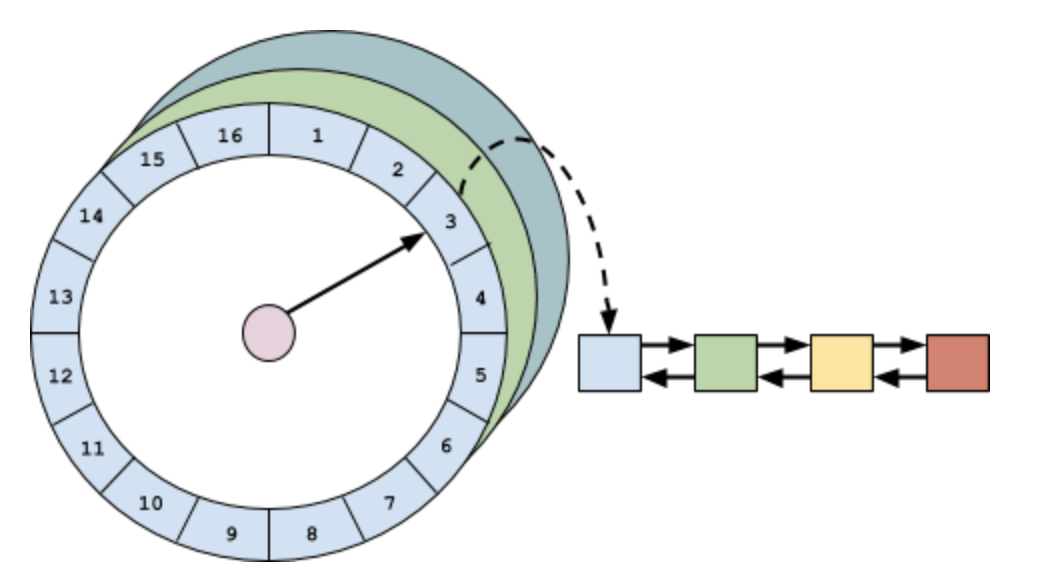
因?yàn)樵谖业膶?duì)時(shí)間輪分析的文章里已經(jīng)說(shuō)了時(shí)間輪的原理和機(jī)制了,所以我就不展開(kāi) Caffeine 對(duì)時(shí)間輪的實(shí)現(xiàn)了。
Caffeine 對(duì)時(shí)間輪的實(shí)現(xiàn)在TimerWheel,它是一種多層時(shí)間輪(hierarchical timing wheels )。
看看元素加入到時(shí)間輪的schedule方法:
/**
?*?Schedules?a?timer?event?for?the?node.
?*
?*?@param?node?the?entry?in?the?cache
?*/
public?void?schedule(@NonNull?Node?node) ?{
??Node?sentinel?=?findBucket(node.getVariableTime());
??link(sentinel,?node);
}
/**
?*?Determines?the?bucket?that?the?timer?event?should?be?added?to.
?*
?*?@param?time?the?time?when?the?event?fires
?*?@return?the?sentinel?at?the?head?of?the?bucket
?*/
Node?findBucket(long?time)? {
??long?duration?=?time?-?nanos;
??int?length?=?wheel.length?-?1;
??for?(int?i?=?0;?i?????if?(duration?1])?{
??????long?ticks?=?(time?>>>?SHIFT[i]);
??????int?index?=?(int)?(ticks?&?(wheel[i].length?-?1));
??????return?wheel[i][index];
????}
??}
??return?wheel[length][0];
}
/**?Adds?the?entry?at?the?tail?of?the?bucket's?list.?*/
void?link(Node?sentinel,?Node?node) ?{
??node.setPreviousInVariableOrder(sentinel.getPreviousInVariableOrder());
??node.setNextInVariableOrder(sentinel);
??sentinel.getPreviousInVariableOrder().setNextInVariableOrder(node);
??sentinel.setPreviousInVariableOrder(node);
}
其他
Caffeine 還有其他的優(yōu)化性能的手段,如使用軟引用和弱引用、消除偽共享、CompletableFuture異步等等。
總結(jié)
Caffeien 是一個(gè)優(yōu)秀的本地緩存,通過(guò)使用 W-TinyLFU 算法, 高性能的 readBuffer 和 WriteBuffer,時(shí)間輪算法等,使得它擁有高性能,高命中率(near optimal),低內(nèi)存占用等特點(diǎn)。
參考資料
TinyLFU 論文[7]
Design Of A Modern Cache[8]
Design Of A Modern Cache—Part Deux[9]
Caffeine 的 github[10]
參考資料
Caffeine:?https://github.com/ben-manes/caffeine
[2]這里:?https://albenw.github.io/posts/df42dc84/
[3]Benchmarks:?https://github.com/ben-manes/caffeine/wiki/Benchmarks
[4]官方API說(shuō)明文檔:?https://github.com/ben-manes/caffeine/wiki
[5]這里:?https://github.com/ben-manes/caffeine/wiki/Guava
[6]HashedWheelTimer時(shí)間輪原理分析:?https://albenw.github.io/posts/ec8df8c/
[7]TinyLFU論文:?https://arxiv.org/abs/1512.00727
[8]Design Of A Modern Cache:?http://highscalability.com/blog/2016/1/25/design-of-a-modern-cache.html
[9]Design Of A Modern Cache—Part Deux:?http://highscalability.com/blog/2019/2/25/design-of-a-modern-cachepart-deux.html
[10]Caffeine的github:?https://github.com/ben-manes/caffeine
推薦閱讀:
喜歡我可以給我設(shè)為星標(biāo)哦
好文章,我“在看”