
Spring Boot + MyBatis + MySQL 實(shí)現(xiàn)讀寫(xiě)分離!

作者 | 廢物大師兄
1、引言
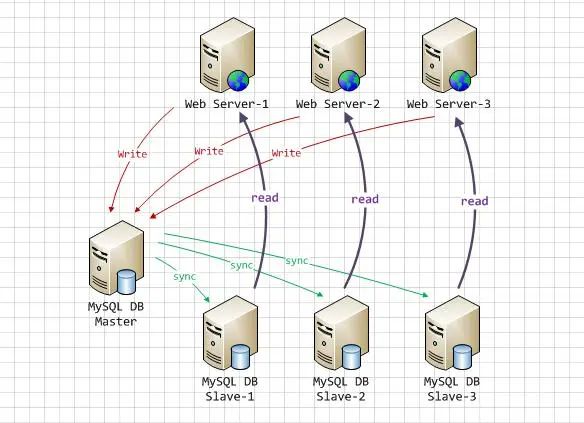
讀寫(xiě)分離要做的事情就是對(duì)于一條SQL該選擇哪個(gè)數(shù)據(jù)庫(kù)去執(zhí)行,至于誰(shuí)來(lái)做選擇數(shù)據(jù)庫(kù)這件事兒,無(wú)非兩個(gè),要么中間件幫我們做,要么程序自己做。
因此,一般來(lái)講,讀寫(xiě)分離有兩種實(shí)現(xiàn)方式。第一種是依靠中間件(比如:MyCat),也就是說(shuō)應(yīng)用程序連接到中間件,中間件幫我們做SQL分離;第二種是應(yīng)用程序自己去做分離。這里我們選擇程序自己來(lái)做,主要是利用Spring提供的路由數(shù)據(jù)源,以及AOP
然而,應(yīng)用程序?qū)用嫒プ鲎x寫(xiě)分離最大的弱點(diǎn)(不足之處)在于無(wú)法動(dòng)態(tài)增加數(shù)據(jù)庫(kù)節(jié)點(diǎn),因?yàn)閿?shù)據(jù)源配置都是寫(xiě)在配置中的,新增數(shù)據(jù)庫(kù)意味著新加一個(gè)數(shù)據(jù)源,必然改配置,并重啟應(yīng)用。當(dāng)然,好處就是相對(duì)簡(jiǎn)單。
2、AbstractRoutingDataSource
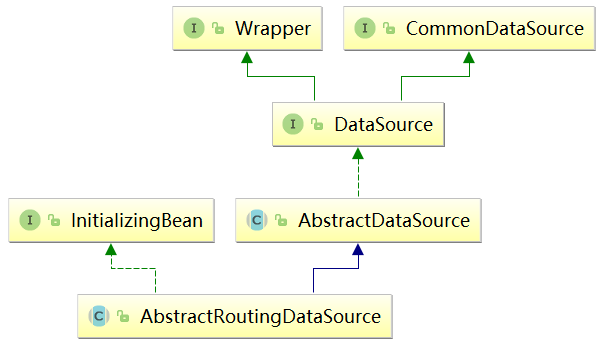
基于特定的查找key路由到特定的數(shù)據(jù)源。它內(nèi)部維護(hù)了一組目標(biāo)數(shù)據(jù)源,并且做了路由key與目標(biāo)數(shù)據(jù)源之間的映射,提供基于key查找數(shù)據(jù)源的方法。
如果您正在學(xué)習(xí)Spring Boot,推薦一個(gè)連載多年還在繼續(xù)更新的免費(fèi)教程:http://blog.didispace.com/spring-boot-learning-2x/
3.1. maven依賴
<?xml version="1.0" encoding="UTF-8"?>
<project xmlns="http://maven.apache.org/POM/4.0.0" xmlns:xsi="http://www.w3.org/2001/XMLSchema-instance"
    xsi:schemaLocation="http://maven.apache.org/POM/4.0.0 http://maven.apache.org/xsd/maven-4.0.0.xsd">
    <modelVersion>4.0.0</modelVersion>

    <groupId>com.cjs.example</groupId>
    <artifactId>cjs-datasource-demo</artifactId>
    <version>0.0.1-SNAPSHOT</version>
    <packaging>jar</packaging>

    <name>cjs-datasource-demo</name>
    <description></description>

    <parent>
        <groupId>org.springframework.boot</groupId>
        <artifactId>spring-boot-starter-parent</artifactId>
        <version>2.0.5.RELEASE</version>
        <relativePath/> <!-- lookup parent from repository -->
    </parent>

    <properties>
        <project.build.sourceEncoding>UTF-8</project.build.sourceEncoding>
        <project.reporting.outputEncoding>UTF-8</project.reporting.outputEncoding>
        <java.version>1.8</java.version>
    </properties>

    <dependencies>
        <dependency>
            <groupId>org.springframework.boot</groupId>
            <artifactId>spring-boot-starter-aop</artifactId>
        </dependency>
        <dependency>
            <groupId>org.springframework.boot</groupId>
            <artifactId>spring-boot-starter-jdbc</artifactId>
        </dependency>
        <dependency>
            <groupId>org.springframework.boot</groupId>
            <artifactId>spring-boot-starter-web</artifactId>
        </dependency>
        <dependency>
            <groupId>org.mybatis.spring.boot</groupId>
            <artifactId>mybatis-spring-boot-starter</artifactId>
            <version>1.3.2</version>
        </dependency>
        <dependency>
            <groupId>org.apache.commons</groupId>
            <artifactId>commons-lang3</artifactId>
            <version>3.8</version>
        </dependency>

        <dependency>
            <groupId>mysql</groupId>
            <artifactId>mysql-connector-java</artifactId>
            <scope>runtime</scope>
        </dependency>
        <dependency>
            <groupId>org.springframework.boot</groupId>
            <artifactId>spring-boot-starter-test</artifactId>
            <scope>test</scope>
        </dependency>
    </dependencies>

    <build>
        <plugins>
            <plugin>
                <groupId>org.springframework.boot</groupId>
                <artifactId>spring-boot-maven-plugin</artifactId>
            </plugin>


            <!--<plugin>
                <groupId>org.mybatis.generator</groupId>
                <artifactId>mybatis-generator-maven-plugin</artifactId>
                <version>1.3.5</version>
                <dependencies>
                    <dependency>
                        <groupId>mysql</groupId>
                        <artifactId>mysql-connector-java</artifactId>
                        <version>5.1.46</version>
                    </dependency>
                </dependencies>
                <configuration>
                    <configurationFile>${basedir}/src/main/resources/myBatisGeneratorConfig.xml</configurationFile>
                    <overwrite>true</overwrite>
                </configuration>
                <executions>
                    <execution>
                        <id>Generate MyBatis Artifacts</id>
                        <goals>
                            <goal>generate</goal>
                        </goals>
                    </execution>
                </executions>
            </plugin>-->

        </plugins>
    </build>
</project>
3.2. 數(shù)據(jù)源配置
application.yml
spring:
  datasource:
    master:
      jdbc-url: jdbc:mysql://192.168.102.31:3306/test
      username: root
      password: 123456
      driver-class-name: com.mysql.jdbc.Driver
    slave1:
      jdbc-url: jdbc:mysql://192.168.102.56:3306/test
      username: pig   # 只讀賬戶
      password: 123456
      driver-class-name: com.mysql.jdbc.Driver
    slave2:
      jdbc-url: jdbc:mysql://192.168.102.36:3306/test
      username: pig   # 只讀賬戶
      password: 123456
      driver-class-name: com.mysql.jdbc.Driver
多數(shù)據(jù)源配置
package com.cjs.example.config;

import com.cjs.example.bean.MyRoutingDataSource;
import com.cjs.example.enums.DBTypeEnum;
import org.springframework.beans.factory.annotation.Qualifier;
import org.springframework.boot.context.properties.ConfigurationProperties;
import org.springframework.boot.jdbc.DataSourceBuilder;
import org.springframework.context.annotation.Bean;
import org.springframework.context.annotation.Configuration;

import javax.sql.DataSource;
import java.util.HashMap;
import java.util.Map;

/**
 * 關(guān)于數(shù)據(jù)源配置,參考SpringBoot官方文檔第79章《Data Access》
 * 79. Data Access
 * 79.1 Configure a Custom DataSource
 * 79.2 Configure Two DataSources
 */

@Configuration
public class DataSourceConfig {

    @Bean
    @ConfigurationProperties("spring.datasource.master")
    public DataSource masterDataSource() {
        return DataSourceBuilder.create().build();
    }

    @Bean
    @ConfigurationProperties("spring.datasource.slave1")
    public DataSource slave1DataSource() {
        return DataSourceBuilder.create().build();
    }

    @Bean
    @ConfigurationProperties("spring.datasource.slave2")
    public DataSource slave2DataSource() {
        return DataSourceBuilder.create().build();
    }

    @Bean
    public DataSource myRoutingDataSource(@Qualifier("masterDataSource") DataSource masterDataSource,
                                          @Qualifier("slave1DataSource") DataSource slave1DataSource,
                                          @Qualifier("slave2DataSource") DataSource slave2DataSource) {
        Map<Object, Object> targetDataSources = new HashMap<>();
        targetDataSources.put(DBTypeEnum.MASTER, masterDataSource);
        targetDataSources.put(DBTypeEnum.SLAVE1, slave1DataSource);
        targetDataSources.put(DBTypeEnum.SLAVE2, slave2DataSource);
        MyRoutingDataSource myRoutingDataSource = new MyRoutingDataSource();
        myRoutingDataSource.setDefaultTargetDataSource(masterDataSource);
        myRoutingDataSource.setTargetDataSources(targetDataSources);
        return myRoutingDataSource;
    }

}
這里,我們配置了4個(gè)數(shù)據(jù)源,1個(gè)master,2兩個(gè)slave,1個(gè)路由數(shù)據(jù)源。前3個(gè)數(shù)據(jù)源都是為了生成第4個(gè)數(shù)據(jù)源,而且后續(xù)我們只用這最后一個(gè)路由數(shù)據(jù)源。
另外,如果您正在學(xué)習(xí)Spring Cloud,推薦一個(gè)連載多年還在繼續(xù)更新的免費(fèi)教程:https://blog.didispace.com/spring-cloud-learning/
package com.cjs.example.config;

import org.apache.ibatis.session.SqlSessionFactory;
import org.mybatis.spring.SqlSessionFactoryBean;
import org.springframework.context.annotation.Bean;
import org.springframework.context.annotation.Configuration;
import org.springframework.core.io.support.PathMatchingResourcePatternResolver;
import org.springframework.jdbc.datasource.DataSourceTransactionManager;
import org.springframework.transaction.PlatformTransactionManager;
import org.springframework.transaction.annotation.EnableTransactionManagement;

import javax.annotation.Resource;
import javax.sql.DataSource;

@EnableTransactionManagement
@Configuration
public class MyBatisConfig {

    @Resource(name = "myRoutingDataSource")
    private DataSource myRoutingDataSource;

    @Bean
    public SqlSessionFactory sqlSessionFactory() throws Exception {
        SqlSessionFactoryBean sqlSessionFactoryBean = new SqlSessionFactoryBean();
        sqlSessionFactoryBean.setDataSource(myRoutingDataSource);
        sqlSessionFactoryBean.setMapperLocations(new PathMatchingResourcePatternResolver().getResources("classpath:mapper/*.xml"));
        return sqlSessionFactoryBean.getObject();
    }

    @Bean
    public PlatformTransactionManager platformTransactionManager() {
        return new DataSourceTransactionManager(myRoutingDataSource);
    }
}
由于Spring容器中現(xiàn)在有4個(gè)數(shù)據(jù)源,所以我們需要為事務(wù)管理器和MyBatis手動(dòng)指定一個(gè)明確的數(shù)據(jù)源。
3.3. 設(shè)置路由key / 查找數(shù)據(jù)源
目標(biāo)數(shù)據(jù)源就是那前3個(gè)這個(gè)我們是知道的,但是使用的時(shí)候是如果查找數(shù)據(jù)源的呢?
首先,我們定義一個(gè)枚舉來(lái)代表這三個(gè)數(shù)據(jù)源
package com.cjs.example.enums;

public enum DBTypeEnum {

    MASTER, SLAVE1, SLAVE2;

}
接下來(lái),通過(guò)ThreadLocal將數(shù)據(jù)源設(shè)置到每個(gè)線程上下文中
package com.cjs.example.bean;

import com.cjs.example.enums.DBTypeEnum;

import java.util.concurrent.atomic.AtomicInteger;

public class DBContextHolder {

    private static final ThreadLocal<DBTypeEnum> contextHolder = new ThreadLocal<>();

    private static final AtomicInteger counter = new AtomicInteger(-1);

    public static void set(DBTypeEnum dbType) {
        contextHolder.set(dbType);
    }

    public static DBTypeEnum get() {
        return contextHolder.get();
    }

    public static void master() {
        set(DBTypeEnum.MASTER);
        System.out.println("切換到master");
    }

    public static void slave() {
        //  輪詢
        int index = counter.getAndIncrement() % 2;
        if (counter.get() > 9999) {
            counter.set(-1);
        }
        if (index == 0) {
            set(DBTypeEnum.SLAVE1);
            System.out.println("切換到slave1");
        }else {
            set(DBTypeEnum.SLAVE2);
            System.out.println("切換到slave2");
        }
    }

}
獲取路由key
package com.cjs.example.bean;

import org.springframework.jdbc.datasource.lookup.AbstractRoutingDataSource;
import org.springframework.lang.Nullable;

public class MyRoutingDataSource extends AbstractRoutingDataSource {
    @Nullable
    @Override
    protected Object determineCurrentLookupKey() {
        return DBContextHolder.get();
    }

}
設(shè)置路由key
默認(rèn)情況下,所有的查詢都走從庫(kù),插入/修改/刪除走主庫(kù)。我們通過(guò)方法名來(lái)區(qū)分操作類型(CRUD)
package com.cjs.example.aop;

import com.cjs.example.bean.DBContextHolder;
import org.apache.commons.lang3.StringUtils;
import org.aspectj.lang.JoinPoint;
import org.aspectj.lang.annotation.Aspect;
import org.aspectj.lang.annotation.Before;
import org.aspectj.lang.annotation.Pointcut;
import org.springframework.stereotype.Component;

@Aspect
@Component
public class DataSourceAop {

    @Pointcut("!@annotation(com.cjs.example.annotation.Master) " +
            "&& (execution(* com.cjs.example.service..*.select*(..)) " +
            "|| execution(* com.cjs.example.service..*.get*(..)))")
    public void readPointcut() {

    }

    @Pointcut("@annotation(com.cjs.example.annotation.Master) " +
            "|| execution(* com.cjs.example.service..*.insert*(..)) " +
            "|| execution(* com.cjs.example.service..*.add*(..)) " +
            "|| execution(* com.cjs.example.service..*.update*(..)) " +
            "|| execution(* com.cjs.example.service..*.edit*(..)) " +
            "|| execution(* com.cjs.example.service..*.delete*(..)) " +
            "|| execution(* com.cjs.example.service..*.remove*(..))")
    public void writePointcut() {

    }

    @Before("readPointcut()")
    public void read() {
        DBContextHolder.slave();
    }

    @Before("writePointcut()")
    public void write() {
        DBContextHolder.master();
    }


    /**
     * 另一種寫(xiě)法:if...else...  判斷哪些需要讀從數(shù)據(jù)庫(kù),其余的走主數(shù)據(jù)庫(kù)
     */
//    @Before("execution(* com.cjs.example.service.impl.*.*(..))")
//    public void before(JoinPoint jp) {
//        String methodName = jp.getSignature().getName();
//
//        if (StringUtils.startsWithAny(methodName, "get", "select", "find")) {
//            DBContextHolder.slave();
//        }else {
//            DBContextHolder.master();
//        }
//    }
}
有一般情況就有特殊情況,特殊情況是某些情況下我們需要強(qiáng)制讀主庫(kù),針對(duì)這種情況,我們定義一個(gè)主鍵,用該注解標(biāo)注的就讀主庫(kù)
package com.cjs.example.annotation;

public @interface Master {
}
例如,假設(shè)我們有一張表member
package com.cjs.example.service.impl;

import com.cjs.example.annotation.Master;
import com.cjs.example.entity.Member;
import com.cjs.example.entity.MemberExample;
import com.cjs.example.mapper.MemberMapper;
import com.cjs.example.service.MemberService;
import org.springframework.beans.factory.annotation.Autowired;
import org.springframework.stereotype.Service;
import org.springframework.transaction.annotation.Transactional;

import java.util.List;

@Service
public class MemberServiceImpl implements MemberService {

    @Autowired
    private MemberMapper memberMapper;

    @Transactional
    @Override
    public int insert(Member member) {
        return memberMapper.insert(member);
    }

    @Master
    @Override
    public int save(Member member) {
        return memberMapper.insert(member);
    }

    @Override
    public List<Member> selectAll() {
        return memberMapper.selectByExample(new MemberExample());
    }

    @Master
    @Override
    public String getToken(String appId) {
        //  有些讀操作必須讀主數(shù)據(jù)庫(kù)
        //  比如,獲取微信access_token,因?yàn)楦叻鍟r(shí)期主從同步可能延遲
        //  這種情況下就必須強(qiáng)制從主數(shù)據(jù)讀
        return null;
    }
}
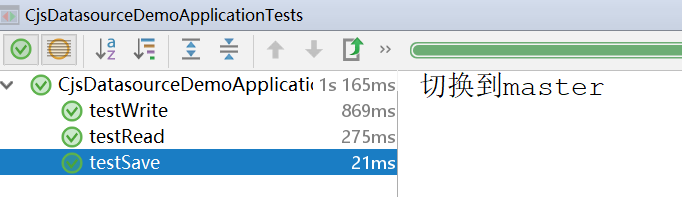
4、測(cè)試
package com.cjs.example;

import com.cjs.example.entity.Member;
import com.cjs.example.service.MemberService;
import org.junit.Test;
import org.junit.runner.RunWith;
import org.springframework.beans.factory.annotation.Autowired;
import org.springframework.boot.test.context.SpringBootTest;
import org.springframework.test.context.junit4.SpringRunner;

@RunWith(SpringRunner.class)
@SpringBootTest
public class CjsDatasourceDemoApplicationTests {

    @Autowired
    private MemberService memberService;

    @Test
    public void testWrite() {
        Member member = new Member();
        member.setName("zhangsan");
        memberService.insert(member);
    }

    @Test
    public void testRead() {
        for (int i = 0; i < 4; i++) {
            memberService.selectAll();
        }
    }

    @Test
    public void testSave() {
        Member member = new Member();
        member.setName("wangwu");
        memberService.save(member);
    }

    @Test
    public void testReadFromMaster() {
        memberService.getToken("1234");
    }

}
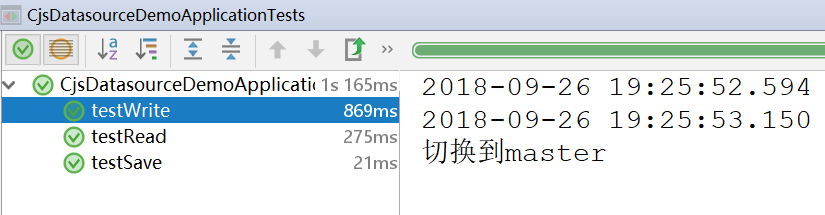
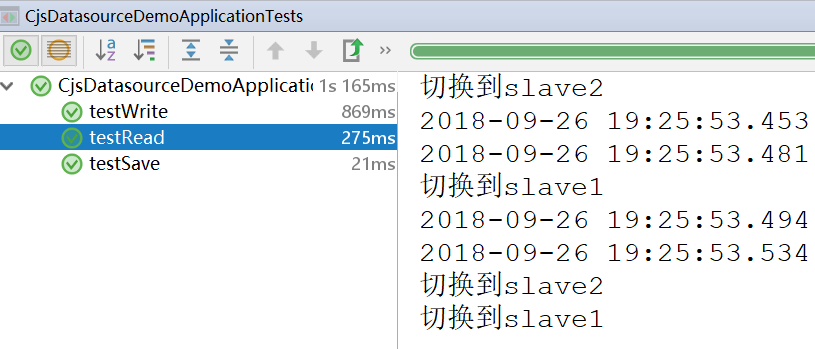
查看控制臺(tái)

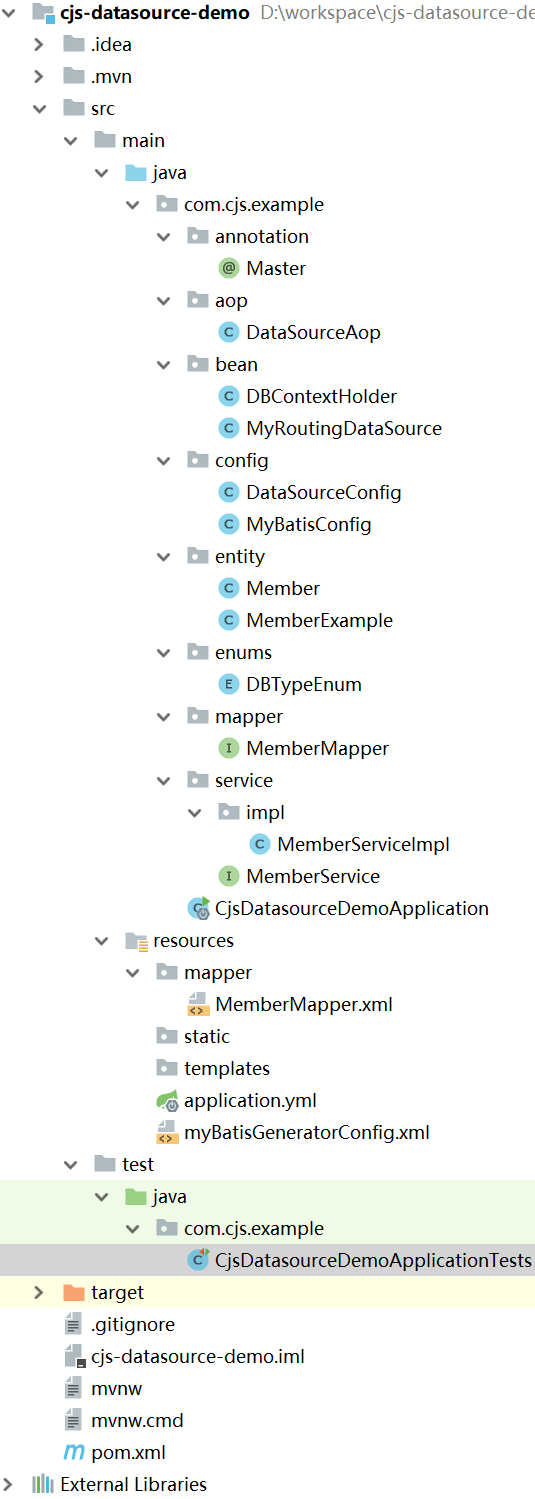
5、工程結(jié)構(gòu)
參考:
https://www.jianshu.com/p/f2f4256a2310
http://www.cnblogs.com/gl-developer/p/6170423.html
https://www.cnblogs.com/huangjuncong/p/8576935.html
https://blog.csdn.net/liu976180578/article/details/77684583
往期推薦
 技術(shù)交流群
最近有很多人問(wèn),有沒(méi)有讀者交流群,想知道怎么加入。加入方式很簡(jiǎn)單,有興趣的同學(xué),只需要點(diǎn)擊下方卡片,回復(fù)“加群“,即可免費(fèi)加入我們的高質(zhì)量技術(shù)交流群!
點(diǎn)擊閱讀原文,送你免費(fèi)Spring Boot教程!