
深入淺出線程池

1、什么是線程
2、如何創(chuàng)建線程
2.1、JAVA中創(chuàng)建線程
/*** 繼承Thread類,重寫run方法*/class MyThread extends Thread {public void run() {System.out.println("myThread..." + Thread.currentThread().getName());} }/*** 實(shí)現(xiàn)Runnable接口,實(shí)現(xiàn)run方法*/class MyRunnable implements Runnable {public void run() {System.out.println("MyRunnable..." + Thread.currentThread().getName());} }/*** 實(shí)現(xiàn)Callable接口,指定返回類型,實(shí)現(xiàn)call方法*/class MyCallable implements Callable<String> {public String call() throws Exception {return "MyCallable..." + Thread.currentThread().getName();} }
2.2、測試一下
public static void main(String[] args) throws Exception {MyThread thread = new MyThread();thread.run(); //myThread...mainthread.start(); //myThread...Thread-0MyRunnable myRunnable = new MyRunnable();Thread thread1 = new Thread(myRunnable);myRunnable.run(); //MyRunnable...mainthread1.start(); //MyRunnable...Thread-1MyCallable myCallable = new MyCallable();FutureTask<String> futureTask = new FutureTask<>(myCallable);Thread thread2 = new Thread(futureTask);thread2.start();System.out.println(myCallable.call()); //MyCallable...mainSystem.out.println(futureTask.get()); //MyCallable...Thread-2}
2.3、問題
2.4、問題分析
class Thread implements Runnable { //Thread類實(shí)現(xiàn)了Runnalbe接口,實(shí)現(xiàn)了run()方法private Runnable target;public synchronized void start() {...boolean started = false;try {start0(); //可以看到,start()方法真實(shí)的調(diào)用時(shí)start0()方法started = true;} finally {...}}private native void start0(); //start0()是一個(gè)native方法,由JVM調(diào)用底層操作系統(tǒng),開啟一個(gè)線程,由操作系統(tǒng)過統(tǒng)一調(diào)度public void run() {if (target != null) {target.run(); //操作系統(tǒng)在執(zhí)行新開啟的線程時(shí),回調(diào)Runnable接口的run()方法,執(zhí)行我們預(yù)設(shè)的線程任務(wù)}}}
2.5、總結(jié)
-
JAVA不能直接創(chuàng)建線程執(zhí)行任務(wù),而是通過創(chuàng)建Thread對象調(diào)用操作系統(tǒng)開啟線程,在由操作系 統(tǒng)回調(diào)Runnable接口的run()方法執(zhí)行任務(wù); -
實(shí)現(xiàn)Runnable的方式,將線程實(shí)際要執(zhí)行的回調(diào)任務(wù)單獨(dú)提出來了,實(shí)現(xiàn)線程的啟動與回調(diào)任務(wù) 解耦; -
實(shí)現(xiàn)Callable的方式,通過Future模式不但將線程的啟動與回調(diào)任務(wù)解耦,而且可以在執(zhí)行完成后 獲取到執(zhí)行的結(jié)果;
1、什么是多線程
2、多線程有什么好處
2.1、串行處理
public static void main(String[] args) throws Exception {System.out.println("start...");long start = System.currentTimeMillis();for (int i = 0; i < 5; i++) {Thread.sleep(2000); //每個(gè)任務(wù)執(zhí)行2秒System.out.println("task done..."); //處理執(zhí)行結(jié)果}long end = System.currentTimeMillis();System.out.println("end...,time = " + (end - start));}//執(zhí)行結(jié)果start...task done...task done...task done...task done...task done... end...,time = 10043
2.2、并行處理
public static void main(String[] args) throws Exception {System.out.println("start...");long start = System.currentTimeMillis();List<Future> list = new ArrayList<>();for (int i = 0; i < 5; i++) {Callable<String> callable = new Callable<String>() {@Overridepublic String call() throws Exception {Thread.sleep(2000); //每個(gè)任務(wù)執(zhí)行2秒return "task done...";}};FutureTask task = new FutureTask(callable);list.add(task);new Thread(task).start();}list.forEach(future -> {try {System.out.println(future.get()); //處理執(zhí)行結(jié)果 } catch (Exception e) {}});long end = System.currentTimeMillis();System.out.println("end...,time = " + (end - start));}//執(zhí)行結(jié)果start...task done...task done...task done...task done...task done... end...,time = 2005
2.3、總結(jié)
-
多線程可以把一個(gè)任務(wù)拆分為幾個(gè)子任務(wù),多個(gè)子任務(wù)可以并發(fā)執(zhí)行,每一個(gè)子任務(wù)就是一個(gè)線程。 -
多線程是為了同步完成多項(xiàng)任務(wù),不是為了提高運(yùn)行效率,而是為了提高資源使用效率來提高系統(tǒng) 的效率。
2.4、多線程的問題
1、如何設(shè)計(jì)一個(gè)線程池
1.1、線程池基本功能
-
多線程會創(chuàng)建大量的線程耗盡資源,那線程池應(yīng)該對線程數(shù)量有所限制,可以保證不會耗盡系統(tǒng)資 源; -
每次創(chuàng)建新的線程會增加創(chuàng)建時(shí)的開銷,那線程池應(yīng)該減少線程的創(chuàng)建,盡量復(fù)用已創(chuàng)建好的線 程;
1.2、線程池面臨問題
-
我們知道線程在執(zhí)行完自己的任務(wù)后就會被回收,那我們?nèi)绾螐?fù)用線程? -
我們指定了線程的最大數(shù)量,當(dāng)任務(wù)數(shù)超出線程數(shù)時(shí),我們該如何處理?
1.3、創(chuàng)新源于生活
-
最開始貨物來的時(shí)候,我們還沒有貨車,每批要運(yùn)輸?shù)呢浳镂覀兌家徺I一輛車來運(yùn)輸; -
當(dāng)貨車運(yùn)輸完成后,暫時(shí)還沒有下一批貨物到達(dá),那貨車就在倉庫停著,等有貨物來了立馬就可以 運(yùn)輸; -
當(dāng)我們有了一定數(shù)量的車后,我們認(rèn)為已經(jīng)夠用了,那后面就不再買車了,這時(shí)要是由新的貨物來 了,我們就會讓貨物先放倉庫,等有車回來再配送; -
當(dāng)618大促來襲,要配送的貨物太多,車都在路上,倉庫也都放滿了,那怎么辦呢?我們就選擇臨 時(shí)租一些車來幫忙配送,提高配送的效率; -
但是貨物還是太多,我們增加了臨時(shí)的貨車,依舊配送不過來,那這時(shí)我們就沒辦法了,只能讓發(fā)貨的客戶排隊(duì)等候或者干脆不接收了; -
大促圓滿完成后,累計(jì)的貨物已經(jīng)配送完成了,為了降低成本,我們就將臨時(shí)租的車都還了;
1.4、技術(shù)源于創(chuàng)新
-
當(dāng)任務(wù)進(jìn)來我們還沒有線程時(shí),我們就該創(chuàng)建線程執(zhí)行任務(wù); -
當(dāng)線程任務(wù)執(zhí)行完成后,線程不釋放,等著下一個(gè)任務(wù)進(jìn)來后接著執(zhí)行; -
當(dāng)創(chuàng)建的線程數(shù)量達(dá)到一定量后,新來的任務(wù)我們存起來等待空閑線程執(zhí)行,這就要求線程池有個(gè) 存任務(wù)的容器; -
當(dāng)容器存滿后,我們需要增加一些臨時(shí)的線程來提高處理效率; -
當(dāng)增加臨時(shí)線程后依舊處理不了的任務(wù),那就應(yīng)該將此任務(wù)拒絕; -
當(dāng)所有任務(wù)執(zhí)行完成后,就應(yīng)該將臨時(shí)的線程釋放掉,以免增加不必要的開銷;
2、線程池具體分析
2.1、 JAVA中的線程池是如何設(shè)計(jì)的
2.1.1、 線程池設(shè)計(jì)
public class ThreadPoolExecutor extends AbstractExecutorService {//線程池的打包控制狀態(tài),用高3位來表示線程池的運(yùn)行狀態(tài),低29位來表示線程池中工作線程的數(shù)量private final AtomicInteger ctl = new AtomicInteger(ctlOf(RUNNING, 0));//值為29,用來表示偏移量private static final int COUNT_BITS = Integer.SIZE - 3;//線程池的最大容量private static final int CAPACITY = (1 << COUNT_BITS) - 1;//線程池的運(yùn)行狀態(tài),總共有5個(gè)狀態(tài),用高3位來表示private static final int RUNNING = -1 << COUNT_BITS; //接受新任務(wù)并處理阻塞隊(duì)列中的任務(wù)private static final int SHUTDOWN = 0 << COUNT_BITS; //不接受新任務(wù)但會處理阻塞隊(duì)列中的任務(wù)private static final int STOP = 1 << COUNT_BITS; //不會接受新任務(wù),也不會處理阻塞隊(duì)列中的任務(wù),并且中斷正在運(yùn)行的任務(wù)private static final int TIDYING = 2 << COUNT_BITS; //所有任務(wù)都已終止, 工作線程數(shù)量為0,即將要執(zhí)行terminated()鉤子方法private static final int TERMINATED = 3 << COUNT_BITS; // terminated()方法已經(jīng)執(zhí)行結(jié)束//任務(wù)緩存隊(duì)列,用來存放等待執(zhí)行的任務(wù)private final BlockingQueue<Runnable> workQueue;//全局鎖,對線程池狀態(tài)等屬性修改時(shí)需要使用這個(gè)鎖private final ReentrantLock mainLock = new ReentrantLock();//線程池中工作線程的集合,訪問和修改需要持有全局鎖private final HashSet<Worker> workers = new HashSet<Worker>();// 終止條件private final Condition termination = mainLock.newCondition();//線程池中曾經(jīng)出現(xiàn)過的最大線程數(shù)private int largestPoolSize;//已完成任務(wù)的數(shù)量private long completedTaskCount;//線程工廠private volatile ThreadFactory threadFactory;//任務(wù)拒絕策略private volatile RejectedExecutionHandler handler;//線程存活時(shí)間private volatile long keepAliveTime;//是否允許核心線程超時(shí)private volatile boolean allowCoreThreadTimeOut;//核心池大小,若allowCoreThreadTimeOut被設(shè)置,核心線程全部空閑超時(shí)被回收的情況下會為0private volatile int corePoolSize;//最大池大小,不得超過CAPACITYprivate volatile int maximumPoolSize;//默認(rèn)的任務(wù)拒絕策略private static final RejectedExecutionHandler defaultHandler = new AbortPolicy();//運(yùn)行權(quán)限相關(guān)private static final RuntimePermission shutdownPerm =new RuntimePermission("modifyThread");...}
-
提供了線程創(chuàng)建、數(shù)量及存活時(shí)間等的管理; -
提供了線程池狀態(tài)流轉(zhuǎn)的管理; -
提供了任務(wù)緩存的各種容器; -
提供了多余任務(wù)的處理機(jī)制; -
提供了簡單的統(tǒng)計(jì)功能;
2.1.2、線程池構(gòu)造函數(shù)
//構(gòu)造函數(shù)public ThreadPoolExecutor(int corePoolSize, //核心線程數(shù)int maximumPoolSize, //最大允許線程數(shù)long keepAliveTime, //線程存活時(shí)間TimeUnit unit, //存活時(shí)間單位BlockingQueue<Runnable> workQueue, //任務(wù)緩存隊(duì)列ThreadFactory threadFactory, //線程工廠RejectedExecutionHandler handler) { //拒絕策略if (corePoolSize < 0 ||maximumPoolSize <= 0 ||maximumPoolSize < corePoolSize ||keepAliveTime < 0)throw new IllegalArgumentException();if (workQueue == null || threadFactory == null || handler == null)throw new NullPointerException();this.corePoolSize = corePoolSize;this.maximumPoolSize = maximumPoolSize;this.workQueue = workQueue;this.keepAliveTime = unit.toNanos(keepAliveTime);this.threadFactory = threadFactory;this.handler = handler;}
-
構(gòu)造函數(shù)告訴了我們可以怎樣去適用線程池,線程池的哪些特性是我們可以控制的;
2.1.3、線程池執(zhí)行
2.1.3.1、提交任務(wù)方法
-
public void execute(Runnable command); -
Future<?> submit(Runnable task); -
Future submit(Runnable task, T result); -
Future submit(Callable task);
public Future> submit(Runnable task) {if (task == null) throw new NullPointerException();RunnableFuture<Void> ftask = newTaskFor(task, null);execute(ftask);return ftask;}
public void execute(Runnable command) {if (command == null)throw new NullPointerException();int c = ctl.get();//第一步:創(chuàng)建核心線程if (workerCountOf(c) < corePoolSize) { //worker數(shù)量小于corePoolSizeif (addWorker(command, true)) //創(chuàng)建workerreturn;c = ctl.get();}//第二步:加入緩存隊(duì)列if (isRunning(c) && workQueue.offer(command)) { //線程池處于RUNNING狀態(tài),將任務(wù)加入workQueue任務(wù)緩存隊(duì)列int recheck = ctl.get();if (! isRunning(recheck) && remove(command)) //雙重檢查,若線程池狀態(tài)關(guān)閉了,移除任務(wù)reject(command);else if (workerCountOf(recheck) == 0) //線程池狀態(tài)正常,但是沒有線程了,創(chuàng)建workeraddWorker(null, false);}//第三步:創(chuàng)建臨時(shí)線程else if (!addWorker(command, false))reject(command);}
-
核心線程數(shù)量不足就創(chuàng)建核心線程; -
核心線程滿了就加入緩存隊(duì)列; -
緩存隊(duì)列滿了就增加非核心線程; -
非核心線程也滿了就拒絕任務(wù);
2.1.3.2、創(chuàng)建線程
private boolean addWorker(Runnable firstTask, boolean core) {retry:for (;;) {int c = ctl.get();int rs = runStateOf(c);//等價(jià)于:rs>=SHUTDOWN && (rs != SHUTDOWN || firstTask != null || workQueue.isEmpty())//線程池已關(guān)閉,并且無需執(zhí)行緩存隊(duì)列中的任務(wù),則不創(chuàng)建if (rs >= SHUTDOWN &&! (rs == SHUTDOWN &&firstTask == null &&! workQueue.isEmpty()))return false;for (;;) {int wc = workerCountOf(c);if (wc >= CAPACITY ||wc >= (core ? corePoolSize : maximumPoolSize))return false;if (compareAndIncrementWorkerCount(c)) //CAS增加線程數(shù)break retry;c = ctl.get(); // Re-read ctlif (runStateOf(c) != rs)continue retry;// else CAS failed due to workerCount change; retry inner loop}}//上面的流程走完,就可以真實(shí)開始創(chuàng)建線程了boolean workerStarted = false;boolean workerAdded = false;Worker w = null;try {w = new Worker(firstTask); //這里創(chuàng)建了線程final Thread t = w.thread;if (t != null) {final ReentrantLock mainLock = this.mainLock;mainLock.lock();try {// Recheck while holding lock.// Back out on ThreadFactory failure or if// shut down before lock acquired.int rs = runStateOf(ctl.get());if (rs < SHUTDOWN ||(rs == SHUTDOWN && firstTask == null)) {if (t.isAlive()) // precheck that t is startablethrow new IllegalThreadStateException();workers.add(w); //這里將線程加入到線程池中int s = workers.size();if (s > largestPoolSize)largestPoolSize = s;workerAdded = true;}} finally {mainLock.unlock();}if (workerAdded) {t.start(); //添加成功,啟動線程workerStarted = true;}}} finally {if (! workerStarted)addWorkerFailed(w); //添加線程失敗操作}return workerStarted;}
-
增加線程數(shù); -
創(chuàng)建線程Worker實(shí)例加入線程池; -
加入完成開啟線程; -
啟動失敗則回滾增加流程;
2.1.3.3、工作線程的實(shí)現(xiàn)
private final class Worker //Worker類是ThreadPoolExecutor的內(nèi)部類extends AbstractQueuedSynchronizerimplements Runnable{final Thread thread; //持有實(shí)際線程Runnable firstTask; //worker所對應(yīng)的第一個(gè)任務(wù),可能為空volatile long completedTasks; //記錄執(zhí)行任務(wù)數(shù)Worker(Runnable firstTask) {setState(-1); // inhibit interrupts until runWorkerthis.firstTask = firstTask;this.thread = getThreadFactory().newThread(this);}public void run() {runWorker(this); //當(dāng)前線程調(diào)用ThreadPoolExecutor中的runWorker方法,在這里實(shí)現(xiàn)的線程復(fù)用}...繼承AQS,實(shí)現(xiàn)了不可重入鎖...}
-
此類持有一個(gè)工作線程,不斷處理拿到的新任務(wù),持有的線程即為可復(fù)用的線程; -
此類可看作一個(gè)適配類,在run()方法中真實(shí)調(diào)用runWorker()方法不斷獲取新任務(wù),完成線程復(fù)用;
final void runWorker(Worker w) { //ThreadPoolExecutor中的runWorker方法,在這里實(shí)現(xiàn)的線程復(fù)用Thread wt = Thread.currentThread();Runnable task = w.firstTask;w.firstTask = null;w.unlock(); // allow interruptsboolean completedAbruptly = true; //標(biāo)識線程是否異常終止try {while (task != null || (task = getTask()) != null) { //這里會不斷從任務(wù)隊(duì)列獲取任務(wù)并執(zhí)行w.lock();//線程是否需要中斷if ((runStateAtLeast(ctl.get(), STOP) ||(Thread.interrupted() &&runStateAtLeast(ctl.get(), STOP))) &&!wt.isInterrupted())wt.interrupt();try {beforeExecute(wt, task); //執(zhí)行任務(wù)前的Hook方法,可自定義Throwable thrown = null;try {task.run(); //執(zhí)行實(shí)際的任務(wù)} catch (RuntimeException x) {thrown = x; throw x;} catch (Error x) {thrown = x; throw x;} catch (Throwable x) {thrown = x; throw new Error(x);} finally {afterExecute(task, thrown); //執(zhí)行任務(wù)后的Hook方法,可自定義}} finally {task = null; //執(zhí)行完成后,將當(dāng)前線程中的任務(wù)制空,準(zhǔn)備執(zhí)行下一個(gè)任務(wù)w.completedTasks++;w.unlock();}}completedAbruptly = false;} finally {processWorkerExit(w, completedAbruptly); //線程執(zhí)行完成后的清理工作}}
-
循環(huán)從緩存隊(duì)列中獲取新的任務(wù),直到?jīng)]有任務(wù)為止; -
使用worker持有的線程真實(shí)執(zhí)行任務(wù); -
任務(wù)都執(zhí)行完成后的清理工作;
2.1.3.5、隊(duì)列中獲取待執(zhí)行任務(wù)
private Runnable getTask() {boolean timedOut = false; //標(biāo)識當(dāng)前線程是否超時(shí)未能獲取到task對象for (;;) {int c = ctl.get();int rs = runStateOf(c);// Check if queue empty only if necessary.if (rs >= SHUTDOWN && (rs >= STOP || workQueue.isEmpty())) {decrementWorkerCount();return null;}int wc = workerCountOf(c);// Are workers subject to culling?boolean timed = allowCoreThreadTimeOut || wc > corePoolSize;if ((wc > maximumPoolSize || (timed && timedOut))&& (wc > 1 || workQueue.isEmpty())) {if (compareAndDecrementWorkerCount(c)) //若線程存活時(shí)間超時(shí),則CAS減去線程數(shù)量return null;continue;}try {Runnable r = timed ?workQueue.poll(keepAliveTime, TimeUnit.NANOSECONDS) : //允許超時(shí)回收則阻塞等待workQueue.take(); //不允許則直接獲取,沒有就返回nullif (r != null)return r;timedOut = true;} catch (InterruptedException retry) {timedOut = false;}}}
2.1.3.6、清理工作
private void processWorkerExit(Worker w, boolean completedAbruptly) {if (completedAbruptly) // If abrupt, then workerCount wasn't adjusteddecrementWorkerCount();final ReentrantLock mainLock = this.mainLock;mainLock.lock();try {completedTaskCount += w.completedTasks;workers.remove(w); //移除執(zhí)行完成的線程} finally {mainLock.unlock();}tryTerminate(); //每次回收完一個(gè)線程后都嘗試終止線程池int c = ctl.get();if (runStateLessThan(c, STOP)) { //到這里說明線程池沒有終止if (!completedAbruptly) {int min = allowCoreThreadTimeOut ? 0 : corePoolSize;if (min == 0 && ! workQueue.isEmpty())min = 1;if (workerCountOf(c) >= min)return; // replacement not needed}addWorker(null, false); //異常終止線程的話,需要在常見一個(gè)線程}}
-
真實(shí)完成線程池線程的回收; -
調(diào)用嘗試終止線程池; -
保證線程池正常運(yùn)行;
2.1.3.7、嘗試終止線程池
final void tryTerminate() {for (;;) {int c = ctl.get();//若線程池正在執(zhí)行、線程池已終止、線程池還需要執(zhí)行緩存隊(duì)列中的任務(wù)時(shí),返回if (isRunning(c) ||runStateAtLeast(c, TIDYING) ||(runStateOf(c) == SHUTDOWN && ! workQueue.isEmpty()))return;//執(zhí)行到這里,線程池為SHUTDOWN且無待執(zhí)行任務(wù) 或 STOP 狀態(tài)if (workerCountOf(c) != 0) {interruptIdleWorkers(ONLY_ONE); //只中斷一個(gè)線程return;}//執(zhí)行到這里,線程池已經(jīng)沒有可用線程了,可以終止了final ReentrantLock mainLock = this.mainLock;mainLock.lock();try {if (ctl.compareAndSet(c, ctlOf(TIDYING, 0))) { //CAS設(shè)置線程池終止try {terminated(); //執(zhí)行鉤子方法} finally {ctl.set(ctlOf(TERMINATED, 0)); //這里將線程池設(shè)為終態(tài)termination.signalAll();}return;}} finally {mainLock.unlock();}// else retry on failed CAS}}
-
實(shí)際嘗試終止線程池; -
終止成功則調(diào)用鉤子方法,并且將線程池置為終態(tài)。
2.2、JAVA線程池總結(jié)
2.2.1、主要功能
線程數(shù)量及存活時(shí)間的管理;
待處理任務(wù)的存儲功能;
線程復(fù)用機(jī)制功能;
任務(wù)超量的拒絕功能;
2.2.2、擴(kuò)展功能
-
簡單的執(zhí)行結(jié)果統(tǒng)計(jì)功能; -
提供線程執(zhí)行異常處理機(jī)制; -
執(zhí)行前后處理流程自定義; -
提供線程創(chuàng)建方式的自定義;
2.2.3、流程總結(jié)
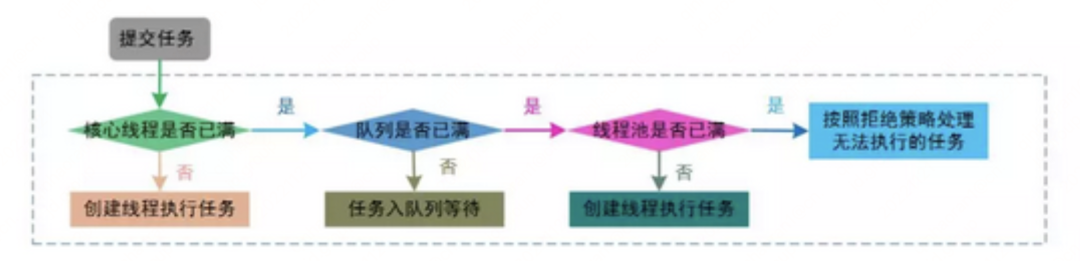
2.3、JAVA線程池使用
public static void main(String[] args) throws Exception {//創(chuàng)建線程池ThreadPoolExecutor threadPoolExecutor = new ThreadPoolExecutor(5, 10, 100, TimeUnit.SECONDS, new ArrayBlockingQueue(5));//加入4個(gè)任務(wù),小于核心線程,應(yīng)該只有4個(gè)核心線程,隊(duì)列為0for (int i = 0; i < 4; i++) {threadPoolExecutor.submit(new MyRunnable());}System.out.println("worker count = " + threadPoolExecutor.getPoolSize()); //worker count = 4System.out.println("queue size = " + threadPoolExecutor.getQueue().size()); //queue size = 0//再加4個(gè)任務(wù),超過核心線程,但是沒有超過核心線程 + 緩存隊(duì)列容量,應(yīng)該5個(gè)核心線程,隊(duì)列為3for (int i = 0; i < 4; i++) {threadPoolExecutor.submit(new MyRunnable());}System.out.println("worker count = " + threadPoolExecutor.getPoolSize()); //worker count = 5System.out.println("queue size = " + threadPoolExecutor.getQueue().size()); //queue size = 3//再加4個(gè)任務(wù),隊(duì)列滿了,應(yīng)該5個(gè)熱核心線程,隊(duì)列5個(gè),非核心線程2個(gè)for (int i = 0; i < 4; i++) {threadPoolExecutor.submit(new MyRunnable());}System.out.println("worker count = " + threadPoolExecutor.getPoolSize()); //worker count = 7System.out.println("queue size = " + threadPoolExecutor.getQueue().size()); //queue size = 5//再加4個(gè)任務(wù),核心線程滿了,應(yīng)該5個(gè)熱核心線程,隊(duì)列5個(gè),非核心線程5個(gè),最后一個(gè)拒絕for (int i = 0; i < 4; i++) {try {threadPoolExecutor.submit(new MyRunnable());} catch (Exception e) {e.printStackTrace(); //java.util.concurrent.RejectedExecutionException}}System.out.println("worker count = " + threadPoolExecutor.getPoolSize()); //worker count = 10System.out.println("queue size = " + threadPoolExecutor.getQueue().size()); //queue size = 5System.out.println(threadPoolExecutor.getTaskCount()); //共執(zhí)行15個(gè)任務(wù)//執(zhí)行完成,休眠15秒,非核心線程釋放,應(yīng)該5個(gè)核心線程,隊(duì)列為0Thread.sleep(1500);System.out.println("worker count = " + threadPoolExecutor.getPoolSize()); //worker count = 5System.out.println("queue size = " + threadPoolExecutor.getQueue().size()); //queue size = 0//關(guān)閉線程池threadPoolExecutor.shutdown();}?
評論
圖片
表情