
前端應(yīng)該掌握的編譯基礎(chǔ)(基于 babel)
作者:陳大魚頭 github: KRISACHAN
開(kāi)發(fā)息息相關(guān)
雖然 Babel 團(tuán)隊(duì)在各種哭窮,但是 Babel 始終是我們前端在開(kāi)發(fā)中不可或缺的重要工具。 雖然我們只是 API 調(diào)用工,但是多了解一些總是會(huì)有好處的嘛 ??????
什么是編譯器?
編譯器(compiler)是一種計(jì)算機(jī)程序,它會(huì)將某種編程語(yǔ)言寫成的源代碼(原始語(yǔ)言)轉(zhuǎn)換成另一種編程語(yǔ)言(目標(biāo)語(yǔ)言)。
源代碼(source code)→ 預(yù)處理器(preprocessor)→ 編譯器(compiler)→ 匯編程序(assembler)→ 目標(biāo)代碼(object code)→ 鏈接器(linker)→ 可執(zhí)行文件(executables),最后打包好的文件就可以給電腦去判讀運(yùn)行了。
什么是解釋器?
解釋器(英語(yǔ):interpreter),是一種計(jì)算機(jī)程序,能夠把解釋型語(yǔ)言解釋執(zhí)行。解釋器就像一位“中間人”。解釋器邊解釋邊執(zhí)行,因此依賴于解釋器的程序運(yùn)行速度比較緩慢。解釋器的好處是它不需要重新編譯整個(gè)程序,從而減輕了每次程序更新后編譯的負(fù)擔(dān)。相對(duì)的編譯器一次性將所有源代碼編譯成二進(jìn)制文件,執(zhí)行時(shí)無(wú)需依賴編譯器或其他額外的程序。
跟編譯器的區(qū)別就是一個(gè)是邊編譯邊執(zhí)行,一個(gè)是編譯完才執(zhí)行。
高級(jí)語(yǔ)言編譯器步驟
輸入源程序字符流 詞法分析 語(yǔ)法分析 語(yǔ)義分析 中間代碼生成 機(jī)器無(wú)關(guān)代碼優(yōu)化 代碼生成 機(jī)器相關(guān)代碼優(yōu)化 目標(biāo)代碼生成
V8 編譯 JS 代碼的過(guò)程
生成抽象語(yǔ)法樹(shù)(AST)和執(zhí)行上下文 第一階段是分詞(tokenize),又稱為詞法分析 第二階段是解析(parse),又稱為語(yǔ)法分析 生成字節(jié)碼 字節(jié)碼就是介于 AST 和機(jī)器碼之間的一種代碼。但是與特定類型的機(jī)器碼無(wú)關(guān),字節(jié)碼需要通過(guò)解釋器將其轉(zhuǎn)換為機(jī)器碼后才能執(zhí)行。 執(zhí)行代碼
JS 執(zhí)行代碼的過(guò)程
執(zhí)行全局代碼時(shí),創(chuàng)建全局上下文 調(diào)用函數(shù)時(shí),創(chuàng)建函數(shù)上下文 使用 eval 函數(shù)時(shí),創(chuàng)建 eval 上下文 執(zhí)行局部代碼時(shí),創(chuàng)建局部上下文
關(guān)于 Babel
Babel ,又名 Babel.js。 是一個(gè)用于 web 開(kāi)發(fā),且自由開(kāi)源的 JavaScript 編譯器、轉(zhuǎn)譯器。
Babel 的編譯流程:

圖片來(lái)源:透過(guò)製作 Babel-plugin 初訪 AST
Parse
Babel 的第一步就是將源碼轉(zhuǎn)換為抽象語(yǔ)法樹(shù)(AST)
const babel = require('@babel/core');
const { parseAsync } = babel;
const parseCode = async (code = '', options = {}) => {
  const res = await parseAsync(code, options);
};
parseCode(`
  const a = 1;
`)
可通過(guò) https://astexplorer.net/ 在線查看具體結(jié)果
這一步會(huì)將收集到的的代碼,通過(guò) 詞法分析(Lexical analysis) 跟 語(yǔ)法分析(Parsing) 兩個(gè)階段將代碼轉(zhuǎn)換成 AST
詞法分析(Lexical analysis)
詞法分析會(huì)將代碼轉(zhuǎn)為 token ,可以理解為是對(duì)每個(gè)不可分割單詞元的描述,例如 const 就會(huì)轉(zhuǎn)換成下面這樣:
Token {
    type:
        TokenType {
        label: 'const',
        keyword: 'const',
        beforeExpr: false,
        startsExpr: false,
        rightAssociative: false,
        isLoop: false,
        isAssign: false,
        prefix: false,
        postfix: false,
        binop: null,
        updateContext: null
    },
    value: 'const',
    start: 5,
    end: 10,
    loc:
    SourceLocation {
        start: Position { line: 2, column: 4 },
        end: Position { line: 2, column: 9 },
        filename: undefined,
        identifierName: undefined
    }
}
type 就是 對(duì) token 的描述,如果想要查看 bebal 生成的 token,我們可以在 options 里寫入:
parserOpts: {
  tokens: true
}
關(guān)于 @babel/parser 更多配置,可查看:https://babeljs.io/docs/en/babel-parser#options
語(yǔ)法分析(Parsing)
語(yǔ)法分析則是將上述的 token 轉(zhuǎn)換成對(duì)應(yīng)的 ast 結(jié)構(gòu)
所以我們就可以看到這樣的一段樹(shù)狀結(jié)構(gòu)(過(guò)濾部分信息)
{
    "type": "VariableDeclaration",
    "start": 0,
    "end": 14,
    "loc": {
        "start": {
            "line": 1,
            "column": 0
        },
        "end": {
            "line": 1,
            "column": 14
        }
    },
    "declarations": [
        {
            "type": "VariableDeclarator",
            "start": 6,
            "end": 13,
            "loc": {
                "start": {
                    "line": 1,
                    "column": 6
                },
                "end": {
                    "line": 1,
                    "column": 13
                }
            },
            "id": {
                "type": "Identifier",
                "start": 6,
                "end": 9,
                "loc": {
                    "start": {
                        "line": 1,
                        "column": 6
                    },
                    "end": {
                        "line": 1,
                        "column": 9
                    },
                    "identifierName": "abc"
                },
                "name": "abc"
            },
            "init": {
                "type": "NumericLiteral",
                "start": 12,
                "end": 13,
                "loc": {
                    "start": {
                        "line": 1,
                        "column": 12
                    },
                    "end": {
                        "line": 1,
                        "column": 13
                    }
                },
                "extra": {
                    "rawValue": 1,
                    "raw": "1"
                },
                "value": 1
            }
        }
    ],
    "kind": "const"
}
這樣與 type 同級(jí)的結(jié)構(gòu)就叫 節(jié)點(diǎn)(Node) , loc ,start ,end 則是位置信息
Transform
Babel 的第二步就是遍歷 AST,并調(diào)用 transform 以訪問(wèn)者模式進(jìn)行修改
export default function (babel) {
  const { types: t } = babel;

  return {
    name: "ast-transform", // not required
    visitor: {
      Identifier(path) {
        path.node.name = path.node.name.split('').reverse().join('');
      }
    }
  };
}
通過(guò)執(zhí)行上述的 transform ,我們可以有:
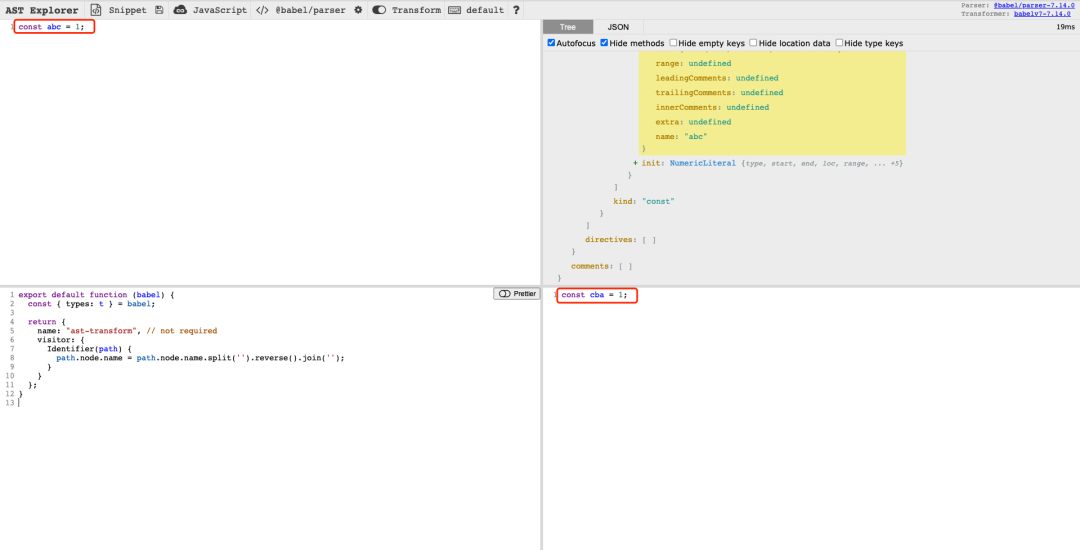
上述功能也可通過(guò) https://astexplorer.net/ 在線查看
Generate
Babel 的第三步就是把轉(zhuǎn)換后的 AST 打印成目標(biāo)代碼,并生成 sourcemap
開(kāi)發(fā)一個(gè) babel 插件
前置知識(shí) - 訪問(wèn)者模式
訪問(wèn)者模式: 在訪問(wèn)者模式(Visitor Pattern)中,我們使用了一個(gè)訪問(wèn)者類,它改變了元素類的執(zhí)行算法。通過(guò)這種方式,元素的執(zhí)行算法可以隨著訪問(wèn)者改變而改變。這種類型的設(shè)計(jì)模式屬于行為型模式。根據(jù)模式,元素對(duì)象已接受訪問(wèn)者對(duì)象,這樣訪問(wèn)者對(duì)象就可以處理元素對(duì)象上的操作。
知道你們不想看文字描述,所以直接上代碼!
class 漢堡包 {
    accept(fatBoyVisitor) {
        fatBoyVisitor.visit(this);
    }
};

class 薯?xiàng)l {
    accept(fatBoyVisitor) {
        fatBoyVisitor.visit(this);
    }
};

class 炸雞 {
    accept(fatBoyVisitor) {
        fatBoyVisitor.visit(this);
    }
};

class FatBoy {
    constructor(foods) {
        this.foods = foods;
    }

    accept(fatBoyFoodVisitor) {
        this.foods.forEach(food => {
            food.accept(fatBoyFoodVisitor);
        });
    }
};

class FatBoyFoodVisitor {
    visit(food) {
        console.log(`肥宅吃了${food.constructor.name}`);
    }
};

const fatBoy = new FatBoy([new 漢堡包(), new 薯?xiàng)l(), new 炸雞()]);
fatBoy.accept(new FatBoyFoodVisitor());
最終輸出結(jié)果是:
肥宅吃了漢堡包
肥宅吃了薯?xiàng)l
肥宅吃了炸雞
babel-plugin-transform-object-assign 源碼
import { declare } from "@babel/helper-plugin-utils";

export default declare(api => {
  api.assertVersion(7);

  return {
    name: "transform-object-assign",

    visitor: {
      CallExpression: function(path, file) {
        if (path.get("callee").matchesPattern("Object.assign")) {
          path.node.callee = file.addHelper("extends");
        }
      },
    },
  };
});
上面的就是 babel-plugin-transform-object-assign 的源碼。
declare:是一個(gè)用于簡(jiǎn)化創(chuàng)建 transformer 的工具函數(shù) assertVersion:檢查當(dāng)前 babel 的大版本 name:當(dāng)前插件的名字 visitor:對(duì)外提供修改內(nèi)容的訪問(wèn)者 CallExpression:函數(shù)調(diào)用的 type,每一句代碼都會(huì)生成對(duì)應(yīng)的type,例如最上面的函數(shù)名abc則對(duì)應(yīng)的是一個(gè)Identifier類型,如果需要修改某一個(gè)type的代碼,則在里面創(chuàng)建對(duì)應(yīng)的type訪問(wèn)者進(jìn)行修改即可。
具體生成的代碼如下:
// input
const a = Object.assign({ a: 1 }, { b: 2 });

// output
"use strict";

function _extends() { _extends = Object.assign || function (target) { for (var i = 1; i < arguments.length; i++) { var source = arguments[i]; for (var key in source) { if (Object.prototype.hasOwnProperty.call(source, key)) { target[key] = source[key]; } } } return target; }; return _extends.apply(this, arguments); }

const a = _extends({
  a: 1
}, {
  b: 2
});
Babel 插件實(shí)戰(zhàn) - 清除 console 源碼
先上代碼:
const babel = require('@babel/core');
const get = require('lodash/get');
const eq = require('lodash/eq');

const { transformAsync } = babel;

const removeConsole = rootPath => ({
    visitor: {
        ExpressionStatement: path => {
            const name = get(path, 'node.expression.callee.object.name');
            const CONSOLE_PREFIX = 'console';
            if (!eq(name, CONSOLE_PREFIX)) {
                return;
            };
            path.remove();
        },
    }
});

const transformCode = async (code = '') => {
    const res = await transformAsync(code, {
        plugins: [
            removeConsole,
        ],
    });

    console.log(res.code);
};

transformCode(`
    const a = 10;
    console.group('嚶嚶嚶');
    console.log(a);
    console.groupEnd();
`);
輸出結(jié)果:
const a = 10;
上面的功能就是我們?cè)诼暶髡Z(yǔ)句類型 ExpressionStatement 中實(shí)現(xiàn)的。
node.expression 對(duì)應(yīng)的是當(dāng)前類型里的子表達(dá)式,在這個(gè)場(chǎng)景里,它的 type === 'CallExpression'。
callee 對(duì)應(yīng)的就是一個(gè)調(diào)用函數(shù)類型,在這個(gè)場(chǎng)景里,它的 type === 'MemberExpression'。
object 對(duì)應(yīng)的就是當(dāng)前調(diào)用函數(shù)的前置對(duì)象,它的 type === 'Identifier',name 則是 console。
所以我們的實(shí)現(xiàn)就很簡(jiǎn)單了,只要 name === 'console' ,我們就可以通過(guò)內(nèi)部暴露的 remove 方法直接刪除當(dāng)前代碼。
Babel 插件實(shí)戰(zhàn) - 新的語(yǔ)法
總所周知,JS 不能這么寫
# python
arr = [1, 2, 3]
print(arr[-1]) # 3
print(arr[len(arr) - 1]) # 3
但是我們可以用魔法打敗魔法
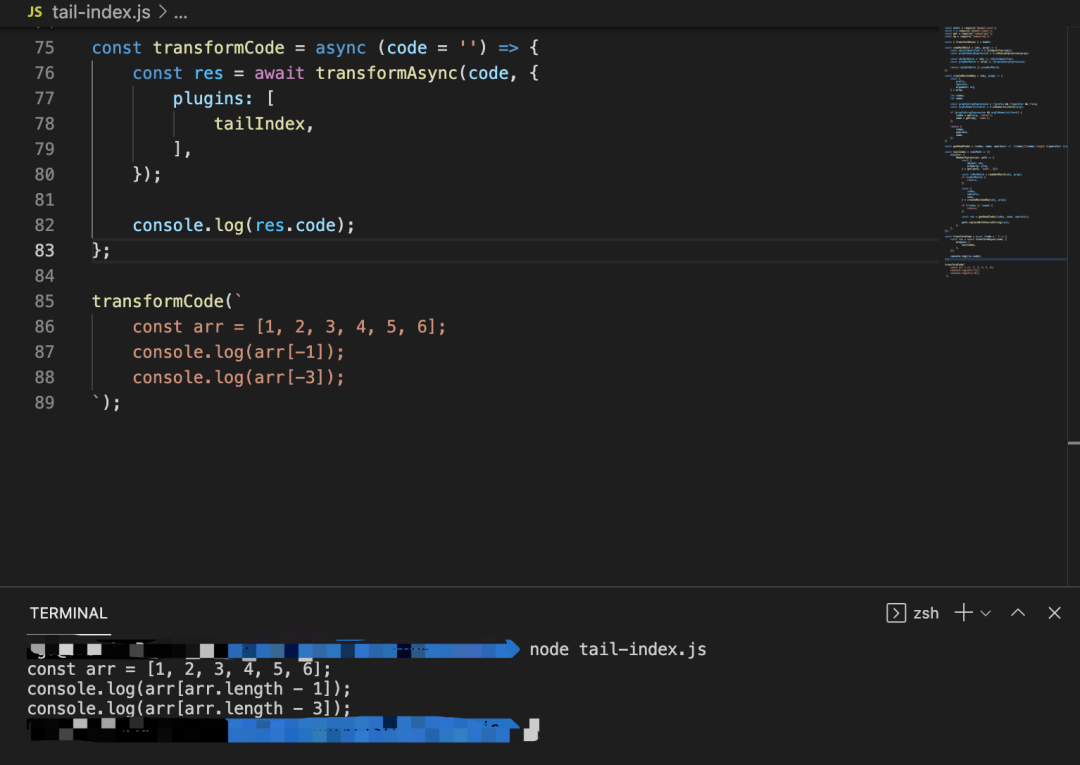
作為一個(gè)兇起來(lái)連自己都可以編譯的語(yǔ)言,這有多難呢~
具體實(shí)現(xiàn)如下:
const babel = require('@babel/core');
const get = require('lodash/get');
const tailIndex = rootPath => ({
    visitor: {
        MemberExpression: path => {
            const {
                object: obj,
                property: prop,
            } = get(path, 'node', {});

            const isNotMatch = codeNotMatch(obj, prop);
            if (isNotMatch) {
                return;
            };

            const {
                index,
                operator,
                name,
            } = createMatchedKeys(obj, prop);

            if (!index || !name) {
                return;
            };

            const res = genHeadIndex(index, name, operator);

            path.replaceWithSourceString(res);
        },
    },
});
MemberExpression 就是當(dāng)前要處理的語(yǔ)句類型。
codeNotMatch 是我們自己實(shí)現(xiàn)的函數(shù),用于判斷 node.object 跟 node.property 是否合法,具體實(shí)現(xiàn)如下:
const t = require('@babel/types');

const codeNotMatch = (obj, prop) => {
    const objIsIdentifier = t.isIdentifier(obj);
    const propIsUnaryExpression = t.isUnaryExpression(prop);

    const objNotMatch = !obj || !objIsIdentifier;
    const propNotMatch = !prop || !propIsUnaryExpression;

    return objNotMatch || propNotMatch;
};
這里的 require('@babel/types') 是 babel 的一個(gè)工具包,這里面我們運(yùn)用了它的語(yǔ)句判斷能力。這種 isXXX 的大體實(shí)現(xiàn)如下:
function isIdentifier(node, opts) {
  if (!node) return false;
  const nodeType = node.type;
  if (nodeType === 具體類型) {
    if (typeof opts === "undefined") {
      return true;
    } else {
      return shallowEqual(node, opts);
    }
  }
  return false;
}
上面的 shallowEqual 實(shí)現(xiàn)如下:
function shallowEqual(actual, expected) {
  const keys = Object.keys(expected);

  for (const key of keys) {
    if (actual[key] !== expected[key]) {
      return false;
    }
  }

  return true;
}
createMatchedKeys 用于創(chuàng)建最終匹配的字符,即需要將 -1 改為 .length - 1 的形式,所以具體實(shí)現(xiàn)如下:
const createMatchedKeys = (obj, prop) => {
    const {
        prefix,
        operator,
        argument: arg
    } = prop;

    let index;
    let name;

    const propIsArrayExpression = !!prefix && !!operator && !!arg;
    const argIsNumericLiteral = t.isNumericLiteral(arg);

    if (propIsArrayExpression && argIsNumericLiteral) {
        index = get(arg, 'value');
        name = get(obj, 'name');
    };

    return {
        index,
        operator,
        name,
    };
};
這里面一路判斷,匹配即可。
所以當(dāng)我們拿到下標(biāo) ,操作符 跟 數(shù)組名 之后,直接組合成最終要生成的代碼即可,即有:
const genHeadIndex = (index, name, operator) => `${name}[${name}.length ${operator} ${index}]`;
最后我們直接替換源碼即可,怎么替換呢,babel 有通過(guò)訪問(wèn)者模式返回 replaceWithSourceString 方法進(jìn)行硬編碼替換。。。
替換的邏輯就是先通過(guò) babel.parse 將要替換的代碼生成 ast,然后從 loc 到具體的 node 進(jìn)行替換。
一個(gè)新語(yǔ)法,就這么完成啦~
參考資料
透過(guò)製作 Babel-plugin 初訪 AST 詞法分析(Lexical analysis) 語(yǔ)法分析(Parsing) https://babeljs.io/docs/en/babel-parser#options https://astexplorer.net/ https://github.com/babel/babel https://github.com/babel/minify 『1W7字中高級(jí)前端面試必知必會(huì)』終極版 Babel 插件手冊(cè)