
一文搞定 Spring Bean 的創(chuàng)建全過程!

1.1 Spring測(cè)試環(huán)境搭建
Spring模塊概覽,綠色是模塊,Spring中八大模塊,黑色表示該模塊包含的jar包(組件)。例如我們想要用IOC容器,也就是綠色的CoreContainer,我們需要導(dǎo)入Beans,Core,Context,SpEL(spring-expression)四個(gè)包。
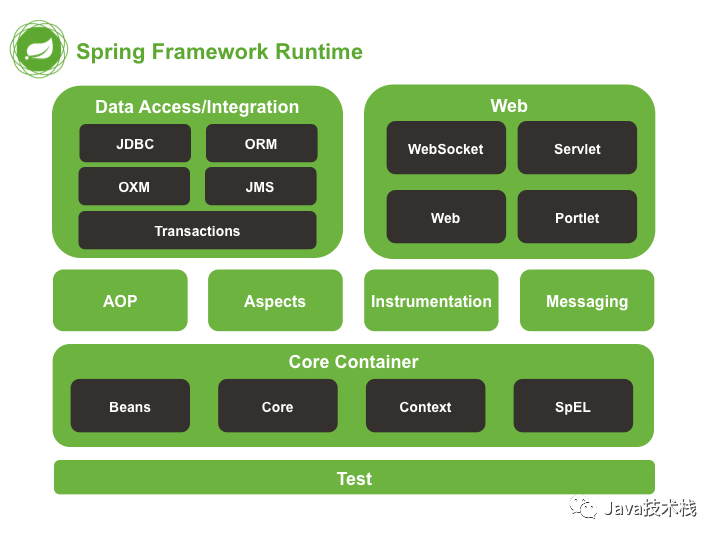
Spring模塊概覽
Test:測(cè)試相關(guān) Core Container:IOC容器 AOP:面向切面編程 Aspects:切面 Instrumenttation:跟JDK關(guān)聯(lián),一般不用 Messaging:消息服務(wù),一般不用 Data Access/Integration:數(shù)據(jù)訪問與集成(JDBC訪問,Transaction事務(wù),ORM對(duì)象關(guān)系映射,OXM和XML映射一般不用,JMS為Java消息服務(wù)Java-message-service一般不用) Web:Web服務(wù)(WebSocket網(wǎng)絡(luò)通信協(xié)議,Servlet, Web,Portlet一般不用)
最偷懶的方式,是直接導(dǎo)入Spring-Framework。但是可能導(dǎo)入不必要的包,導(dǎo)致項(xiàng)目打包后比較大
由于Spring-Content中的ApplicationContent是整個(gè)IOC的入口。我們導(dǎo)入Spring-context包即可
<!-- https://mvnrepository.com/artifact/org.springframework/spring-context -->
<dependency>
    <groupId>org.springframework</groupId>
    <artifactId>spring-context</artifactId>
    <version>5.2.3.RELEASE</version>
</dependency>
我們導(dǎo)入spring-content后,默認(rèn)會(huì)導(dǎo)入該組件的依賴jar,spring-content底層的依賴可以看到,實(shí)際上我們是導(dǎo)入了Core Container模塊:
  <dependencies>
    <dependency>
      <groupId>org.springframework</groupId>
      <artifactId>spring-aop</artifactId>
      <version>5.2.3.RELEASE</version>
      <scope>compile</scope>
    </dependency>
    <dependency>
      <groupId>org.springframework</groupId>
      <artifactId>spring-beans</artifactId>
      <version>5.2.3.RELEASE</version>
      <scope>compile</scope>
    </dependency>
    <dependency>
      <groupId>org.springframework</groupId>
      <artifactId>spring-core</artifactId>
      <version>5.2.3.RELEASE</version>
      <scope>compile</scope>
    </dependency>
    <dependency>
      <groupId>org.springframework</groupId>
      <artifactId>spring-expression</artifactId>
      <version>5.2.3.RELEASE</version>
      <scope>compile</scope>
    </dependency>
  </dependencies>
新建Spring配置文件spring.xml:
<?xml version="1.0" encoding="UTF-8"?>
<beans xmlns="http://www.springframework.org/schema/beans"
       xmlns:xsi="http://www.w3.org/2001/XMLSchema-instance"
       xsi:schemaLocation="http://www.springframework.org/schema/beans http://www.springframework.org/schema/beans/spring-beans.xsd">

    <!--注冊(cè)一個(gè)對(duì)象,spring回自動(dòng)創(chuàng)建這個(gè)對(duì)象-->
    <!--
    一個(gè)bean標(biāo)簽就表示一個(gè)對(duì)象
    id:這個(gè)對(duì)象的唯一標(biāo)識(shí)
    class:注冊(cè)對(duì)象的完全限定名
    -->
    <bean id="hello" class="com.xiaodai.service.Hello">
        <!--使用property標(biāo)簽給對(duì)象的屬性賦值
        name:表示屬性的名稱
        value:表示屬性的值
        -->
        <property name="id" value="1"></property>
        <property name="name" value="zhangsan"></property>
        <property name="age" value="18"></property>
    </bean>
</beans>
編寫測(cè)試類:
import com.xiaodai.service.Hello;
import org.springframework.context.ApplicationContext;
import org.springframework.context.support.ClassPathXmlApplicationContext;

public class Test {

    public static void main(String[] args) {
        ApplicationContext applicationContext = new ClassPathXmlApplicationContext("spring.xml");
        Hello hello = applicationContext.getBean("hello", Hello.class);
        System.out.println(hello.getName());

    }

}
1.2 Debug容器創(chuàng)建過程
從測(cè)試類的new ClassPathXmlApplicationContext("spring.xml")開始debug,進(jìn)入ClassPathXmlApplicationContext,可以看到:
 public ClassPathXmlApplicationContext(
   String[] configLocations, boolean refresh, @Nullable ApplicationContext parent)
   throws BeansException {

  super(parent);
  // 設(shè)置配置文件路徑
  setConfigLocations(configLocations);
  if (refresh) {
          // 核心步驟
   refresh();
  }
 }
加載配置文件后,進(jìn)入refresh()方法,該方法是容器初始化的核心步驟。該方法包含十三個(gè)方法:
        @Override
 public void refresh() throws BeansException, IllegalStateException {
  synchronized (this.startupShutdownMonitor) {
   // Prepare this context for refreshing.
   /**
    * 準(zhǔn)備刷新,做一些最基本的準(zhǔn)備化工作
   **/
   prepareRefresh();

   // Tell the subclass to refresh the internal bean factory.
   /**
    * 獲得一個(gè)刷新的bean容器,實(shí)質(zhì)就是獲取工廠。
    * 加載xml等配置文件,用該文件產(chǎn)生的BeanDefinition來創(chuàng)建一個(gè)工廠
   **/
   ConfigurableListableBeanFactory beanFactory = obtainFreshBeanFactory();

   // Prepare the bean factory for use in this context.
   /**
    * 準(zhǔn)備bean工廠
   **/
   prepareBeanFactory(beanFactory);

   try {
    // Allows post-processing of the bean factory in context subclasses.
    // 后置增強(qiáng),方便擴(kuò)展
    postProcessBeanFactory(beanFactory);

    // Invoke factory processors registered as beans in the context.
    // 實(shí)例化并且執(zhí)行BeanFactoryPostProcessors
    invokeBeanFactoryPostProcessors(beanFactory);

    // Register bean processors that intercept bean creation.
    // 實(shí)例化并且注冊(cè)所有的BeanPostProcessor
    registerBeanPostProcessors(beanFactory);

    // Initialize message source for this context.
    // 國際化設(shè)置,一般用不到
    initMessageSource();

    // Initialize event multicaster for this context.
    // 初始化應(yīng)用程序的多波器和廣播器
    initApplicationEventMulticaster();

    // Initialize other special beans in specific context subclasses.
    // 空方法,預(yù)留給子類做擴(kuò)展
    onRefresh();

    // Check for listener beans and register them.
    // 注冊(cè)監(jiān)聽器
    registerListeners();

    // Instantiate all remaining (non-lazy-init) singletons.
    // 工作中常用,面試常問。實(shí)例化所有非懶加載的實(shí)例對(duì)象
    finishBeanFactoryInitialization(beanFactory);

    // Last step: publish corresponding event.
    // 完成刷新
    finishRefresh();
   }

   catch (BeansException ex) {
    if (logger.isWarnEnabled()) {
     logger.warn("Exception encountered during context initialization - " +
       "cancelling refresh attempt: " + ex);
    }

    // Destroy already created singletons to avoid dangling resources.
    destroyBeans();

    // Reset 'active' flag.
    cancelRefresh(ex);

    // Propagate exception to caller.
    throw ex;
   }

   finally {
    // Reset common introspection caches in Spring's core, since we
    // might not ever need metadata for singleton beans anymore...
    resetCommonCaches();
   }
  }
 }
1.3 AbstractApplicationContext的refresh()包含的13個(gè)方法分析
結(jié)合概覽圖一個(gè)一個(gè)方法分析:
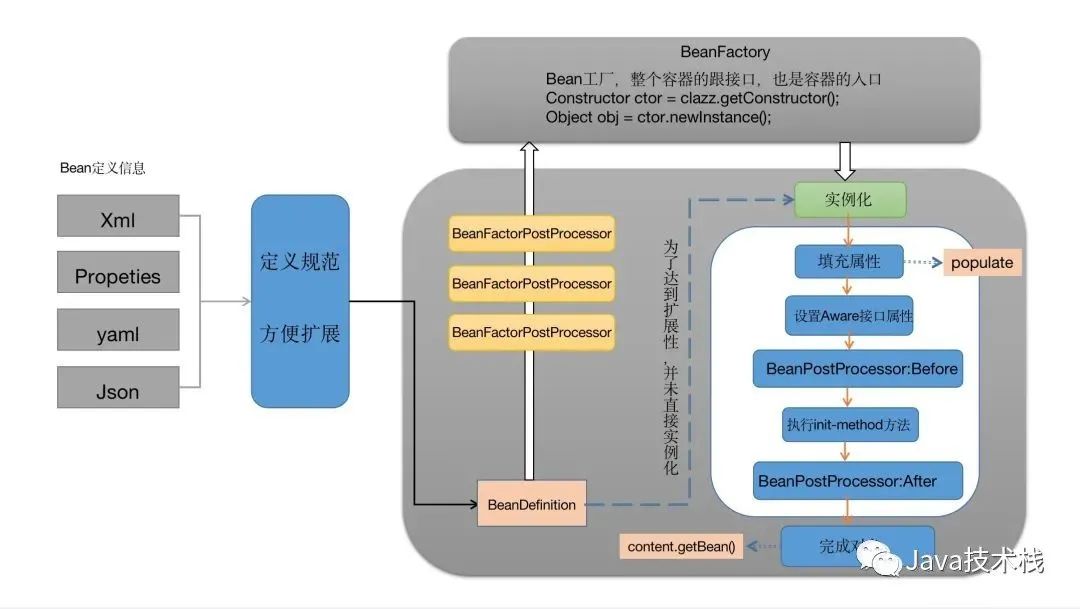
Bean工廠實(shí)例化Bean概覽圖
方法1:prepareRefresh() => 準(zhǔn)備工作
準(zhǔn)備刷新,做一些最基本的準(zhǔn)備化工作
 protected void prepareRefresh() {
  // Switch to active.
  // 設(shè)置開始時(shí)間
  this.startupDate = System.currentTimeMillis();
  // 關(guān)閉狀態(tài)設(shè)置為false
  this.closed.set(false);
  // 活躍狀態(tài)設(shè)置為true
  this.active.set(true);

        // 打印日志
  if (logger.isDebugEnabled()) {
   if (logger.isTraceEnabled()) {
    logger.trace("Refreshing " + this);
   }
   else {
    logger.debug("Refreshing " + getDisplayName());
   }
  }

  // Initialize any placeholder property sources in the context environment.
  // 初始化屬性資源
  initPropertySources();

  // Validate that all properties marked as required are resolvable:
  // see ConfigurablePropertyResolver#setRequiredProperties
  // 獲取環(huán)境信息,驗(yàn)證屬性信息
  getEnvironment().validateRequiredProperties();

  // Store pre-refresh
  // 存儲(chǔ)預(yù)刷新的一些應(yīng)用信息的監(jiān)聽器
  ApplicationListeners...
  if (this.earlyApplicationListeners == null) {
   this.earlyApplicationListeners = new LinkedHashSet<>(this.applicationListeners);
  }
  else {
   // Reset local application listeners to pre-refresh state.
   this.applicationListeners.clear();
   this.applicationListeners.addAll(this.earlyApplicationListeners);
  }

  // Allow for the collection of early ApplicationEvents,
  // to be published once the multicaster is available...
  // 創(chuàng)建一些監(jiān)聽器事件的集合
  this.earlyApplicationEvents = new LinkedHashSet<>();
 }
總結(jié):1.設(shè)置啟動(dòng)事件 2.設(shè)置關(guān)閉活躍的狀態(tài) 3.獲取環(huán)境對(duì)象并設(shè)置屬性值 4.設(shè)置監(jiān)聽器以及需要發(fā)布事件的集合。
重要的點(diǎn):
獲取環(huán)境信息,驗(yàn)證屬性信息,getEnvironment().validateRequiredProperties(); 存儲(chǔ)預(yù)刷新的一些應(yīng)用信息的監(jiān)聽器,在Spring中是空實(shí)現(xiàn),但是SpringBoot中,是有具體的值的
方法2:obtainFreshBeanFactory() => 獲得一個(gè)刷新的bean容器
獲得一個(gè)刷新的bean容器,實(shí)質(zhì)就是獲取工廠。創(chuàng)建容器對(duì)象DefaultListableBeanFactory;加載xml配置文件的屬性到當(dāng)前的工廠中,最重要的就是BeanDefinition
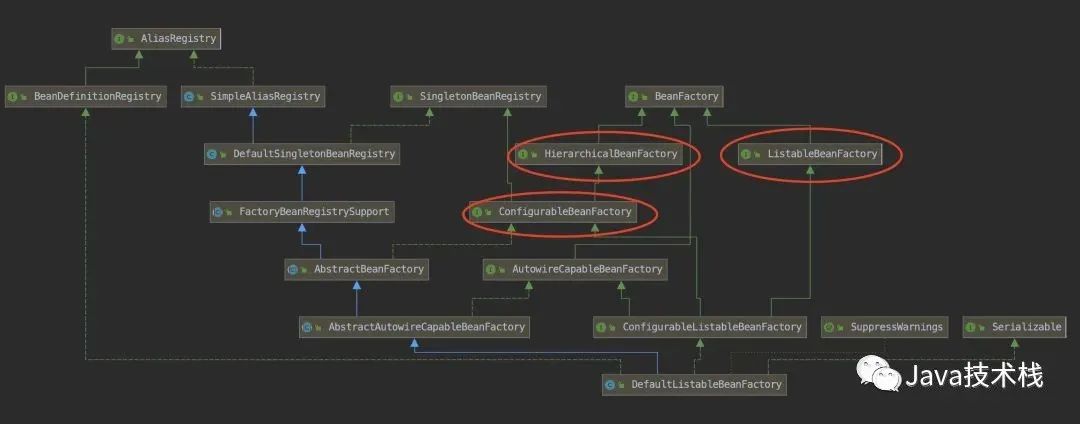
Bean工廠實(shí)例繼承關(guān)系圖
AbstractRefreshableApplicationContext:
    // 只要進(jìn)到這個(gè)方法,那么我們創(chuàng)建的一定是一個(gè)新的工廠
 @Override
 protected final void refreshBeanFactory() throws BeansException {
  if (hasBeanFactory()) {
      // 如果存在先銷毀,后關(guān)閉
   destroyBeans();
   closeBeanFactory();
  }
  try {
      // 創(chuàng)建bean工廠,這里使用的就是DefaultListableBeanFactory。此時(shí)創(chuàng)建的工廠里面的屬性值都是默認(rèn)值
   DefaultListableBeanFactory beanFactory = createBeanFactory();
   // 序列化id
   beanFactory.setSerializationId(getId());
   // 設(shè)置一些屬性值
   customizeBeanFactory(beanFactory);
   // 加載bean的定義屬性值。該方法有很多重載,非常復(fù)雜,核心是do操作
   // 完成配置文件或者配置類文件的加載
   loadBeanDefinitions(beanFactory);
   synchronized (this.beanFactoryMonitor) {
    this.beanFactory = beanFactory;
   }
  }
  catch (IOException ex) {
   throw new ApplicationContextException("I/O error parsing bean definition source for " + getDisplayName(), ex);
  }
 }
方法3:prepareBeanFactory(beanFactory) => 準(zhǔn)備(初始化)Bean工廠
為方法2拿到的工廠,設(shè)置某些具體的值
 protected void prepareBeanFactory(ConfigurableListableBeanFactory beanFactory) {
  // Tell the internal bean factory to use the context's class loader etc.
  // 為bean工廠設(shè)置類加載器
  beanFactory.setBeanClassLoader(getClassLoader());
  // 設(shè)置SPEL解析器
  beanFactory.setBeanExpressionResolver(new StandardBeanExpressionResolver(beanFactory.getBeanClassLoader()));
  beanFactory.addPropertyEditorRegistrar(new ResourceEditorRegistrar(this, getEnvironment()));

  // Configure the bean factory with context callbacks.
  // 添加一個(gè)BeanPostProcessor
  beanFactory.addBeanPostProcessor(new ApplicationContextAwareProcessor(this));
  // 忽略對(duì)應(yīng)接口的實(shí)現(xiàn)
  beanFactory.ignoreDependencyInterface(EnvironmentAware.class);
  beanFactory.ignoreDependencyInterface(EmbeddedValueResolverAware.class);
  beanFactory.ignoreDependencyInterface(ResourceLoaderAware.class);
  beanFactory.ignoreDependencyInterface(ApplicationEventPublisherAware.class);
  beanFactory.ignoreDependencyInterface(MessageSourceAware.class);
  beanFactory.ignoreDependencyInterface(ApplicationContextAware.class);

  // BeanFactory interface not registered as resolvable type in a plain factory.
  // MessageSource registered (and found for autowiring) as a bean.
        // 注冊(cè)一些依賴
  beanFactory.registerResolvableDependency(BeanFactory.class, beanFactory);
  beanFactory.registerResolvableDependency(ResourceLoader.class, this);
  beanFactory.registerResolvableDependency(ApplicationEventPublisher.class, this);
  beanFactory.registerResolvableDependency(ApplicationContext.class, this);

  // Register early post-processor for detecting inner beans as
  // ApplicationListeners添加一個(gè)BeanPostProcessor增強(qiáng)器
  ApplicationListeners.
  beanFactory.addBeanPostProcessor(new ApplicationListenerDetector(this));

  // Detect a LoadTimeWeaver and prepare for weaving, if found.
  if (beanFactory.containsBean(LOAD_TIME_WEAVER_BEAN_NAME)) {
   beanFactory.addBeanPostProcessor(new LoadTimeWeaverAwareProcessor(beanFactory));
   // Set a temporary ClassLoader for type matching.
   beanFactory.setTempClassLoader(new ContextTypeMatchClassLoader(beanFactory.getBeanClassLoader()));
  }

  // Register default environment beans.
  if (!beanFactory.containsLocalBean(ENVIRONMENT_BEAN_NAME)) {
   beanFactory.registerSingleton(ENVIRONMENT_BEAN_NAME, getEnvironment());
  }
  if (!beanFactory.containsLocalBean(SYSTEM_PROPERTIES_BEAN_NAME)) {
   beanFactory.registerSingleton(SYSTEM_PROPERTIES_BEAN_NAME, getEnvironment().getSystemProperties());
  }
  if (!beanFactory.containsLocalBean(SYSTEM_ENVIRONMENT_BEAN_NAME)) {
   beanFactory.registerSingleton(SYSTEM_ENVIRONMENT_BEAN_NAME, getEnvironment().getSystemEnvironment());
  }
 }
方法4:postProcessBeanFactory(beanFactory) => 后置增強(qiáng)Bean(擴(kuò)展實(shí)現(xiàn))
空方法,方便擴(kuò)展
方法5:invokeBeanFactoryPostProcessors(beanFactory) => 執(zhí)行BFPP
實(shí)例化并且執(zhí)行BeanFactoryPostProcessors
 /**
  * Instantiate and invoke all registered BeanFactoryPostProcessor beans,
  * respecting explicit order if given.
  * <p>Must be called before singleton instantiation.
  * 單例對(duì)象之前一定調(diào)用,因?yàn)閱卫齜ean創(chuàng)建后就只有一份
  */
 protected void invokeBeanFactoryPostProcessors(ConfigurableListableBeanFactory beanFactory) {
  PostProcessorRegistrationDelegate.invokeBeanFactoryPostProcessors(beanFactory, getBeanFactoryPostProcessors());

  // Detect a LoadTimeWeaver and prepare for weaving, if found in the meantime
  // (e.g. through an @Bean method registered by ConfigurationClassPostProcessor)
  if (beanFactory.getTempClassLoader() == null && beanFactory.containsBean(LOAD_TIME_WEAVER_BEAN_NAME)) {
   beanFactory.addBeanPostProcessor(new LoadTimeWeaverAwareProcessor(beanFactory));
   beanFactory.setTempClassLoader(new ContextTypeMatchClassLoader(beanFactory.getBeanClassLoader()));
  }
 }
方法6:registerBeanPostProcessors(beanFactory) => 注冊(cè)BPP
實(shí)例化并且注冊(cè)所有的BeanPostProcessor。實(shí)例化Bean之前的準(zhǔn)備工作
 /**
  * Instantiate and register all BeanPostProcessor beans,
  * respecting explicit order if given.
  * <p>Must be called before any instantiation of application beans.
  */
 protected void registerBeanPostProcessors(ConfigurableListableBeanFactory beanFactory) {
  PostProcessorRegistrationDelegate.registerBeanPostProcessors(beanFactory, this);
 }
方法7:initMessageSource() => 國際化設(shè)置
方法8:initApplicationEventMulticaster() => 初始化應(yīng)用程序的多波器和廣播器
也屬于準(zhǔn)備工作
方法9:onRefresh() => 預(yù)留給子類做擴(kuò)展
空方法
方法10:registerListeners() => 注冊(cè)監(jiān)聽器
也屬于準(zhǔn)備工作
 /**
  * Add beans that implement ApplicationListener as listeners.
  * Doesn't affect other listeners, which can be added without being beans.
  */
 protected void registerListeners() {
  // Register statically specified listeners first.
  for (ApplicationListener<?> listener : getApplicationListeners()) {
   getApplicationEventMulticaster().addApplicationListener(listener);
  }

  // Do not initialize FactoryBeans here: We need to leave all regular beans
  // uninitialized to let post-processors apply to them!
  String[] listenerBeanNames = getBeanNamesForType(ApplicationListener.class, true, false);
  for (String listenerBeanName : listenerBeanNames) {
   getApplicationEventMulticaster().addApplicationListenerBean(listenerBeanName);
  }

  // Publish early application events now that we finally have a multicaster...
  Set<ApplicationEvent> earlyEventsToProcess = this.earlyApplicationEvents;
  this.earlyApplicationEvents = null;
  if (earlyEventsToProcess != null) {
   for (ApplicationEvent earlyEvent : earlyEventsToProcess) {
    getApplicationEventMulticaster().multicastEvent(earlyEvent);
   }
  }
 }
方法11:finishBeanFactoryInitialization(beanFactory) => 實(shí)例化所有單例對(duì)象
面試常問,工作常用。過程比較復(fù)雜
 /**
  * Finish the initialization of this context's bean factory,
  * initializing all remaining singleton beans.
  */
 protected void finishBeanFactoryInitialization(ConfigurableListableBeanFactory beanFactory) {
  // Initialize conversion service for this context.
  /**
   * 把類型轉(zhuǎn)化操作,設(shè)置到當(dāng)前的beanFactory里面去
  **/
  if (beanFactory.containsBean(CONVERSION_SERVICE_BEAN_NAME) &&
    beanFactory.isTypeMatch(CONVERSION_SERVICE_BEAN_NAME, ConversionService.class)) {
   beanFactory.setConversionService(
     beanFactory.getBean(CONVERSION_SERVICE_BEAN_NAME, ConversionService.class));
  }

  // Register a default embedded value resolver if no bean post-processor
  // (such as a PropertyPlaceholderConfigurer bean) registered any before:
  // at this point, primarily for resolution in annotation attribute values.
  /**
   * 判斷當(dāng)前的beanFactory有沒有內(nèi)置的值處理器
  **/
  if (!beanFactory.hasEmbeddedValueResolver()) {
   beanFactory.addEmbeddedValueResolver(strVal -> getEnvironment().resolvePlaceholders(strVal));
  }

  // Initialize LoadTimeWeaverAware beans early to allow for registering their transformers early.
  /**
   * 織入Aware
  **/
  String[] weaverAwareNames = beanFactory.getBeanNamesForType(LoadTimeWeaverAware.class, false, false);
  for (String weaverAwareName : weaverAwareNames) {
   getBean(weaverAwareName);
  }

  // Stop using the temporary ClassLoader for type matching.
  // 設(shè)置類加載器
  beanFactory.setTempClassLoader(null);

  // Allow for caching all bean definition metadata, not expecting further changes.
  /**
   * 凍結(jié):某些bean不需要進(jìn)行修改操作了,放入
  **/
  beanFactory.freezeConfiguration();

  // Instantiate all remaining (non-lazy-init) singletons.
  /**
   * 實(shí)例化所有非懶加載的實(shí)例對(duì)象(重要)
  **/
  beanFactory.preInstantiateSingletons();
 }
實(shí)例化所有非懶加載的實(shí)例對(duì)象方法:
 @Override
 public void preInstantiateSingletons() throws BeansException {
  if (logger.isTraceEnabled()) {
   logger.trace("Pre-instantiating singletons in " + this);
  }

  // Iterate over a copy to allow for init methods which in turn register new bean definitions.
  // While this may not be part of the regular factory bootstrap, it does otherwise work fine.
  /**
   * 拿到所有注冊(cè)bean的名稱
   **/
  List<String> beanNames = new ArrayList<>(this.beanDefinitionNames);

  // Trigger initialization of all non-lazy singleton beans...
  // 循環(huán)去創(chuàng)建我們需要的單例對(duì)象
  for (String beanName : beanNames) {
      // 拿到bean的定義信息,就是我們?cè)趚ml配置文件里面指定的一些屬性
   RootBeanDefinition bd = getMergedLocalBeanDefinition(beanName);
   // 是否是抽象的,是否是單例的,是否是懶加載的
   if (!bd.isAbstract() && bd.isSingleton() && !bd.isLazyInit()) {
       // 判斷當(dāng)前類是否實(shí)現(xiàn)了factoryBean接口。一般沒實(shí)現(xiàn),直接進(jìn)入下面的getBean
    if (isFactoryBean(beanName)) {
     Object bean = getBean(FACTORY_BEAN_PREFIX + beanName);
     if (bean instanceof FactoryBean) {
      final FactoryBean<?> factory = (FactoryBean<?>) bean;
      boolean isEagerInit;
      if (System.getSecurityManager() != null && factory instanceof SmartFactoryBean) {
       isEagerInit = AccessController.doPrivileged((PrivilegedAction<Boolean>)
           ((SmartFactoryBean<?>) factory)::isEagerInit,
         getAccessControlContext());
      }
      else {
       isEagerInit = (factory instanceof SmartFactoryBean &&
         ((SmartFactoryBean<?>) factory).isEagerInit());
      }
      if (isEagerInit) {
       getBean(beanName);
      }
     }
    }
    else {
        // 通過beanName。拿到bean
     getBean(beanName);
    }
   }
  }

  // Trigger post-initialization callback for all applicable beans...
  for (String beanName : beanNames) {
   Object singletonInstance = getSingleton(beanName);
   if (singletonInstance instanceof SmartInitializingSingleton) {
    final SmartInitializingSingleton smartSingleton = (SmartInitializingSingleton) singletonInstance;
    if (System.getSecurityManager() != null) {
     AccessController.doPrivileged((PrivilegedAction<Object>) () -> {
      smartSingleton.afterSingletonsInstantiated();
      return null;
     }, getAccessControlContext());
    }
    else {
     smartSingleton.afterSingletonsInstantiated();
    }
   }
  }
 }
重要方法:
getMergedLocalBeanDefinition
 /**
  * Return a merged RootBeanDefinition, traversing the parent bean definition
  * if the specified bean corresponds to a child bean definition.
  * @param beanName the name of the bean to retrieve the merged definition for
  * @return a (potentially merged) RootBeanDefinition for the given bean
  * @throws NoSuchBeanDefinitionException if there is no bean with the given name
  * @throws BeanDefinitionStoreException in case of an invalid bean definition
  */
  // 返回一個(gè)合并好的RootBeanDefinition。整合子類和父類
 protected RootBeanDefinition getMergedLocalBeanDefinition(String beanName) throws BeansException {
  // Quick check on the concurrent map first, with minimal locking.
  RootBeanDefinition mbd = this.mergedBeanDefinitions.get(beanName);
  if (mbd != null && !mbd.stale) {
   return mbd;
  }
  return getMergedBeanDefinition(beanName, getBeanDefinition(beanName));
 }
getBean() => doGetBean()
 /**
  * Return an instance, which may be shared or independent, of the specified bean.
  * @param name the name of the bean to retrieve
  * @param requiredType the required type of the bean to retrieve
  * @param args arguments to use when creating a bean instance using explicit arguments
  * (only applied when creating a new instance as opposed to retrieving an existing one)
  * @param typeCheckOnly whether the instance is obtained for a type check,
  * not for actual use
  * @return an instance of the bean
  * @throws BeansException if the bean could not be created
  */
 @SuppressWarnings("unchecked")
 protected <T> T doGetBean(final String name, @Nullable final Class<T> requiredType,
   @Nullable final Object[] args, boolean typeCheckOnly) throws BeansException {

        // 獲取beanName
  final String beanName = transformedBeanName(name);
  Object bean;

  // Eagerly check singleton cache for manually registered singletons.
  // 單例檢查,如果一級(jí),二級(jí),三級(jí)緩存中存在該Bean,直接獲取到了
  Object sharedInstance = getSingleton(beanName);
  if (sharedInstance != null && args == null) {
   if (logger.isTraceEnabled()) {
    if (isSingletonCurrentlyInCreation(beanName)) {
     logger.trace("Returning eagerly cached instance of singleton bean '" + beanName +
       "' that is not fully initialized yet - a consequence of a circular reference");
    }
    else {
     logger.trace("Returning cached instance of singleton bean '" + beanName + "'");
    }
   }
   bean = getObjectForBeanInstance(sharedInstance, name, beanName, null);
  }

  else {
   // Fail if we're already creating this bean instance:
   // We're assumably within a circular reference.
   // 如果是單例對(duì)象的話,嘗試解決循環(huán)依賴問題
   if (isPrototypeCurrentlyInCreation(beanName)) {
    throw new BeanCurrentlyInCreationException(beanName);
   }

   // Check if bean definition exists in this factory.
   // 獲取父類容器
   BeanFactory parentBeanFactory = getParentBeanFactory();
   if (parentBeanFactory != null && !containsBeanDefinition(beanName)) {
    // Not found -> check parent.
    String nameToLookup = originalBeanName(name);
    if (parentBeanFactory instanceof AbstractBeanFactory) {
     return ((AbstractBeanFactory) parentBeanFactory).doGetBean(
       nameToLookup, requiredType, args, typeCheckOnly);
    }
    else if (args != null) {
     // Delegation to parent with explicit args.
     return (T) parentBeanFactory.getBean(nameToLookup, args);
    }
    else if (requiredType != null) {
     // No args -> delegate to standard getBean method.
     return parentBeanFactory.getBean(nameToLookup, requiredType);
    }
    else {
     return (T) parentBeanFactory.getBean(nameToLookup);
    }
   }

            // 標(biāo)志位。如果不是類型檢查,表示要?jiǎng)?chuàng)建bean,此處在集合中做一個(gè)記錄
   if (!typeCheckOnly) {
    markBeanAsCreated(beanName);
   }

   try {
       // 獲取beanDefinition
    final RootBeanDefinition mbd = getMergedLocalBeanDefinition(beanName);
    // 檢測(cè)beanDefinition
    checkMergedBeanDefinition(mbd, beanName, args);

    // Guarantee initialization of beans that the current bean depends on.
    // 檢查當(dāng)前的bean是否有其他依賴的bean
    String[] dependsOn = mbd.getDependsOn();
    if (dependsOn != null) {
        // 如果有依賴的bean,我們要先遞歸解決其他依賴的bean
     for (String dep : dependsOn) {
      if (isDependent(beanName, dep)) {
       throw new BeanCreationException(mbd.getResourceDescription(), beanName,
         "Circular depends-on relationship between '" + beanName + "' and '" + dep + "'");
      }
      registerDependentBean(dep, beanName);
      try {
       getBean(dep);
      }
      catch (NoSuchBeanDefinitionException ex) {
       throw new BeanCreationException(mbd.getResourceDescription(), beanName,
         "'" + beanName + "' depends on missing bean '" + dep + "'", ex);
      }
     }
    }

    // Create bean instance.
    // 是否是單例的
    if (mbd.isSingleton()) {
     sharedInstance = getSingleton(beanName, () -> {
      try {
       return createBean(beanName, mbd, args);
      }
      catch (BeansException ex) {
       // Explicitly remove instance from singleton cache: It might have been put there
       // eagerly by the creation process, to allow for circular reference resolution.
       // Also remove any beans that received a temporary reference to the bean.
       destroySingleton(beanName);
       throw ex;
      }
     });
     bean = getObjectForBeanInstance(sharedInstance, name, beanName, mbd);
    }

    else if (mbd.isPrototype()) {
     // It's a prototype -> create a new instance.
     Object prototypeInstance = null;
     try {
      beforePrototypeCreation(beanName);
      prototypeInstance = createBean(beanName, mbd, args);
     }
     finally {
      afterPrototypeCreation(beanName);
     }
     bean = getObjectForBeanInstance(prototypeInstance, name, beanName, mbd);
    }

    else {
     String scopeName = mbd.getScope();
     final Scope scope = this.scopes.get(scopeName);
     if (scope == null) {
      throw new IllegalStateException("No Scope registered for scope name '" + scopeName + "'");
     }
     try {
      Object scopedInstance = scope.get(beanName, () -> {
       beforePrototypeCreation(beanName);
       try {
        return createBean(beanName, mbd, args);
       }
       finally {
        afterPrototypeCreation(beanName);
       }
      });
      bean = getObjectForBeanInstance(scopedInstance, name, beanName, mbd);
     }
     catch (IllegalStateException ex) {
      throw new BeanCreationException(beanName,
        "Scope '" + scopeName + "' is not active for the current thread; consider " +
        "defining a scoped proxy for this bean if you intend to refer to it from a singleton",
        ex);
     }
    }
   }
   catch (BeansException ex) {
    cleanupAfterBeanCreationFailure(beanName);
    throw ex;
   }
  }

  // Check if required type matches the type of the actual bean instance.
  if (requiredType != null && !requiredType.isInstance(bean)) {
   try {
    T convertedBean = getTypeConverter().convertIfNecessary(bean, requiredType);
    if (convertedBean == null) {
     throw new BeanNotOfRequiredTypeException(name, requiredType, bean.getClass());
    }
    return convertedBean;
   }
   catch (TypeMismatchException ex) {
    if (logger.isTraceEnabled()) {
     logger.trace("Failed to convert bean '" + name + "' to required type '" +
       ClassUtils.getQualifiedName(requiredType) + "'", ex);
    }
    throw new BeanNotOfRequiredTypeException(name, requiredType, bean.getClass());
   }
  }
  return (T) bean;
 }
getSingleton
 /**
  * Return the (raw) singleton object registered under the given name,
  * creating and registering a new one if none registered yet.
  * @param beanName the name of the bean
  * @param singletonFactory the ObjectFactory to lazily create the singleton
  * with, if necessary
  * @return the registered singleton object
  */
 public Object getSingleton(String beanName, ObjectFactory<?> singletonFactory) {
  Assert.notNull(beanName, "Bean name must not be null");
  synchronized (this.singletonObjects) {
   Object singletonObject = this.singletonObjects.get(beanName);
   if (singletonObject == null) {
    if (this.singletonsCurrentlyInDestruction) {
     throw new BeanCreationNotAllowedException(beanName,
       "Singleton bean creation not allowed while singletons of this factory are in destruction " +
       "(Do not request a bean from a BeanFactory in a destroy method implementation!)");
    }
    if (logger.isDebugEnabled()) {
     logger.debug("Creating shared instance of singleton bean '" + beanName + "'");
    }
    beforeSingletonCreation(beanName);
    boolean newSingleton = false;
    boolean recordSuppressedExceptions = (this.suppressedExceptions == null);
    if (recordSuppressedExceptions) {
     this.suppressedExceptions = new LinkedHashSet<>();
    }
    try {
        // 實(shí)際上就是調(diào)用了CreateBean
     singletonObject = singletonFactory.getObject();
     newSingleton = true;
    }
    catch (IllegalStateException ex) {
     // Has the singleton object implicitly appeared in the meantime ->
     // if yes, proceed with it since the exception indicates that state.
     singletonObject = this.singletonObjects.get(beanName);
     if (singletonObject == null) {
      throw ex;
     }
    }
    catch (BeanCreationException ex) {
     if (recordSuppressedExceptions) {
      for (Exception suppressedException : this.suppressedExceptions) {
       ex.addRelatedCause(suppressedException);
      }
     }
     throw ex;
    }
    finally {
     if (recordSuppressedExceptions) {
      this.suppressedExceptions = null;
     }
     afterSingletonCreation(beanName);
    }
    if (newSingleton) {
     addSingleton(beanName, singletonObject);
    }
   }
   return singletonObject;
  }
 }
doCreateBean => 通過上方法的singletonObject = singletonFactory.getObject();進(jìn)入的
 /**
  * Actually create the specified bean. Pre-creation processing has already happened
  * at this point, e.g. checking {@code postProcessBeforeInstantiation} callbacks.
  * <p>Differentiates between default bean instantiation, use of a
  * factory method, and autowiring a constructor.
  * @param beanName the name of the bean
  * @param mbd the merged bean definition for the bean
  * @param args explicit arguments to use for constructor or factory method invocation
  * @return a new instance of the bean
  * @throws BeanCreationException if the bean could not be created
  * @see #instantiateBean
  * @see #instantiateUsingFactoryMethod
  * @see #autowireConstructor
  */
 protected Object doCreateBean(final String beanName, final RootBeanDefinition mbd, final @Nullable Object[] args)
   throws BeanCreationException {

  // Instantiate the bean.
  BeanWrapper instanceWrapper = null;
  if (mbd.isSingleton()) {
   instanceWrapper = this.factoryBeanInstanceCache.remove(beanName);
  }
  if (instanceWrapper == null) {
      /**
       * 核心的創(chuàng)建實(shí)例化Bean的過程
      **/
   instanceWrapper = createBeanInstance(beanName, mbd, args);
  }
  final Object bean = instanceWrapper.getWrappedInstance();
  Class<?> beanType = instanceWrapper.getWrappedClass();
  if (beanType != NullBean.class) {
   mbd.resolvedTargetType = beanType;
  }

  // Allow post-processors to modify the merged bean definition.
  synchronized (mbd.postProcessingLock) {
   if (!mbd.postProcessed) {
    try {
     applyMergedBeanDefinitionPostProcessors(mbd, beanType, beanName);
    }
    catch (Throwable ex) {
     throw new BeanCreationException(mbd.getResourceDescription(), beanName,
       "Post-processing of merged bean definition failed", ex);
    }
    mbd.postProcessed = true;
   }
  }

  // Eagerly cache singletons to be able to resolve circular references
  // even when triggered by lifecycle interfaces like BeanFactoryAware.
  boolean earlySingletonExposure = (mbd.isSingleton() && this.allowCircularReferences &&
    isSingletonCurrentlyInCreation(beanName));

  /**
   * 解決循環(huán)依賴。使用三級(jí)緩存
  **/
  if (earlySingletonExposure) {
   if (logger.isTraceEnabled()) {
    logger.trace("Eagerly caching bean '" + beanName +
      "' to allow for resolving potential circular references");
   }
   addSingletonFactory(beanName, () -> getEarlyBeanReference(beanName, mbd, bean));
  }

  // Initialize the bean instance.
  Object exposedObject = bean;
  try {
      /**
       * 填充屬性,上文的實(shí)例化只是默認(rèn)屬性值。填充屬性是初始化的第一步,第二步是執(zhí)行init方法
      **/
   populateBean(beanName, mbd, instanceWrapper);
   /**
    * 執(zhí)行init方法
   **/
   exposedObject = initializeBean(beanName, exposedObject, mbd);
  }
  catch (Throwable ex) {
   if (ex instanceof BeanCreationException && beanName.equals(((BeanCreationException) ex).getBeanName())) {
    throw (BeanCreationException) ex;
   }
   else {
    throw new BeanCreationException(
      mbd.getResourceDescription(), beanName, "Initialization of bean failed", ex);
   }
  }

  if (earlySingletonExposure) {
   Object earlySingletonReference = getSingleton(beanName, false);
   if (earlySingletonReference != null) {
    if (exposedObject == bean) {
     exposedObject = earlySingletonReference;
    }
    else if (!this.allowRawInjectionDespiteWrapping && hasDependentBean(beanName)) {
     String[] dependentBeans = getDependentBeans(beanName);
     Set<String> actualDependentBeans = new LinkedHashSet<>(dependentBeans.length);
     for (String dependentBean : dependentBeans) {
      if (!removeSingletonIfCreatedForTypeCheckOnly(dependentBean)) {
       actualDependentBeans.add(dependentBean);
      }
     }
     if (!actualDependentBeans.isEmpty()) {
      throw new BeanCurrentlyInCreationException(beanName,
        "Bean with name '" + beanName + "' has been injected into other beans [" +
        StringUtils.collectionToCommaDelimitedString(actualDependentBeans) +
        "] in its raw version as part of a circular reference, but has eventually been " +
        "wrapped. This means that said other beans do not use the final version of the " +
        "bean. This is often the result of over-eager type matching - consider using " +
        "'getBeanNamesOfType' with the 'allowEagerInit' flag turned off, for example.");
     }
    }
   }
  }

  // Register bean as disposable.
  try {
      /**
       * 需要銷毀的時(shí)候,銷毀的鉤子函數(shù)
      **/
   registerDisposableBeanIfNecessary(beanName, bean, mbd);
  }
  catch (BeanDefinitionValidationException ex) {
   throw new BeanCreationException(
     mbd.getResourceDescription(), beanName, "Invalid destruction signature", ex);
  }

  return exposedObject;
 }
面試題:為甚么循環(huán)依賴的解決要使用三級(jí)緩存?關(guān)注公眾號(hào)Java技術(shù)棧回復(fù)面試獲取 Spring 系列面試題及答案。
createBeanInstance => 核心的創(chuàng)建和實(shí)例化bean的過程,由doCreateBean調(diào)用
大量的反射出現(xiàn)在該方法中,用來創(chuàng)建對(duì)象
 /**
  * Create a new instance for the specified bean, using an appropriate instantiation strategy:
  * factory method, constructor autowiring, or simple instantiation.
  * @param beanName the name of the bean
  * @param mbd the bean definition for the bean
  * @param args explicit arguments to use for constructor or factory method invocation
  * @return a BeanWrapper for the new instance
  * @see #obtainFromSupplier
  * @see #instantiateUsingFactoryMethod
  * @see #autowireConstructor
  * @see #instantiateBean
  */
 protected BeanWrapper createBeanInstance(String beanName, RootBeanDefinition mbd, @Nullable Object[] args) {
  // Make sure bean class is actually resolved at this point.
  Class<?> beanClass = resolveBeanClass(mbd, beanName);

  if (beanClass != null && !Modifier.isPublic(beanClass.getModifiers()) && !mbd.isNonPublicAccessAllowed()) {
   throw new BeanCreationException(mbd.getResourceDescription(), beanName,
     "Bean class isn't public, and non-public access not allowed: " + beanClass.getName());
  }

  Supplier<?> instanceSupplier = mbd.getInstanceSupplier();
  if (instanceSupplier != null) {
   return obtainFromSupplier(instanceSupplier, beanName);
  }

  if (mbd.getFactoryMethodName() != null) {
   return instantiateUsingFactoryMethod(beanName, mbd, args);
  }

  // Shortcut when re-creating the same bean...
  boolean resolved = false;
  boolean autowireNecessary = false;
  if (args == null) {
   synchronized (mbd.constructorArgumentLock) {
    if (mbd.resolvedConstructorOrFactoryMethod != null) {
     resolved = true;
     autowireNecessary = mbd.constructorArgumentsResolved;
    }
   }
  }
  if (resolved) {
   if (autowireNecessary) {
    return autowireConstructor(beanName, mbd, null, null);
   }
   else {
    return instantiateBean(beanName, mbd);
   }
  }

  // Candidate constructors for autowiring?
  // 構(gòu)造器
  Constructor<?>[] ctors = determineConstructorsFromBeanPostProcessors(beanClass, beanName);
  if (ctors != null || mbd.getResolvedAutowireMode() == AUTOWIRE_CONSTRUCTOR ||
    mbd.hasConstructorArgumentValues() || !ObjectUtils.isEmpty(args)) {
   return autowireConstructor(beanName, mbd, ctors, args);
  }

  // Preferred constructors for default construction?
  ctors = mbd.getPreferredConstructors();
  if (ctors != null) {
   return autowireConstructor(beanName, mbd, ctors, null);
  }

  // No special handling: simply use no-arg constructor.
  /**
   * 默認(rèn)無參構(gòu)造
   **/
  return instantiateBean(beanName, mbd);
 }
instantiateBean(beanName, mbd) => 默認(rèn)無參構(gòu)造
 /**
  * Instantiate the given bean using its default constructor.
  * @param beanName the name of the bean
  * @param mbd the bean definition for the bean
  * @return a BeanWrapper for the new instance
  */
 protected BeanWrapper instantiateBean(final String beanName, final RootBeanDefinition mbd) {
  try {
   Object beanInstance;
   final BeanFactory parent = this;
   if (System.getSecurityManager() != null) {
    beanInstance = AccessController.doPrivileged((PrivilegedAction<Object>) () ->
            // 實(shí)例化只會(huì)分配內(nèi)存空間,設(shè)置默認(rèn)值
      getInstantiationStrategy().instantiate(mbd, beanName, parent),
      getAccessControlContext());
   }
   else {
    beanInstance = getInstantiationStrategy().instantiate(mbd, beanName, parent);
   }
   BeanWrapper bw = new BeanWrapperImpl(beanInstance);
   initBeanWrapper(bw);
   return bw;
  }
  catch (Throwable ex) {
   throw new BeanCreationException(
     mbd.getResourceDescription(), beanName, "Instantiation of bean failed", ex);
  }
 }
instantiate
 @Override
 public Object instantiate(RootBeanDefinition bd, @Nullable String beanName, BeanFactory owner) {
  // Don't override the class with CGLIB if no overrides.
  if (!bd.hasMethodOverrides()) {
   Constructor<?> constructorToUse;
   synchronized (bd.constructorArgumentLock) {
    constructorToUse = (Constructor<?>) bd.resolvedConstructorOrFactoryMethod;
    if (constructorToUse == null) {
     final Class<?> clazz = bd.getBeanClass();
     if (clazz.isInterface()) {
      throw new BeanInstantiationException(clazz, "Specified class is an interface");
     }
     try {
      if (System.getSecurityManager() != null) {
       constructorToUse = AccessController.doPrivileged(
         (PrivilegedExceptionAction<Constructor<?>>) clazz::getDeclaredConstructor);
      }
      else {
       constructorToUse = clazz.getDeclaredConstructor();
      }
      bd.resolvedConstructorOrFactoryMethod = constructorToUse;
     }
     catch (Throwable ex) {
      throw new BeanInstantiationException(clazz, "No default constructor found", ex);
     }
    }
   }
   return BeanUtils.instantiateClass(constructorToUse);
  }
  else {
   // Must generate CGLIB subclass.
   return instantiateWithMethodInjection(bd, beanName, owner);
  }
 }
BeanUtils.instantiateClass => 通過構(gòu)造器反射創(chuàng)建bean
 /**
  * Convenience method to instantiate a class using the given constructor.
  * <p>Note that this method tries to set the constructor accessible if given a
  * non-accessible (that is, non-public) constructor, and supports Kotlin classes
  * with optional parameters and default values.
  * @param ctor the constructor to instantiate
  * @param args the constructor arguments to apply (use {@code null} for an unspecified
  * parameter, Kotlin optional parameters and Java primitive types are supported)
  * @return the new instance
  * @throws BeanInstantiationException if the bean cannot be instantiated
  * @see Constructor#newInstance
  */
 public static <T> T instantiateClass(Constructor<T> ctor, Object... args) throws BeanInstantiationException {
  Assert.notNull(ctor, "Constructor must not be null");
  try {
   ReflectionUtils.makeAccessible(ctor);
   if (KotlinDetector.isKotlinReflectPresent() && KotlinDetector.isKotlinType(ctor.getDeclaringClass())) {
    return KotlinDelegate.instantiateClass(ctor, args);
   }
   else {
    Class<?>[] parameterTypes = ctor.getParameterTypes();
    Assert.isTrue(args.length <= parameterTypes.length, "Can't specify more arguments than constructor parameters");
    Object[] argsWithDefaultValues = new Object[args.length];
    for (int i = 0 ; i < args.length; i++) {
     if (args[i] == null) {
      Class<?> parameterType = parameterTypes[i];
      argsWithDefaultValues[i] = (parameterType.isPrimitive() ? DEFAULT_TYPE_VALUES.get(parameterType) : null);
     }
     else {
      argsWithDefaultValues[i] = args[i];
     }
    }
    return ctor.newInstance(argsWithDefaultValues);
   }
  }
  catch (InstantiationException ex) {
   throw new BeanInstantiationException(ctor, "Is it an abstract class?", ex);
  }
  catch (IllegalAccessException ex) {
   throw new BeanInstantiationException(ctor, "Is the constructor accessible?", ex);
  }
  catch (IllegalArgumentException ex) {
   throw new BeanInstantiationException(ctor, "Illegal arguments for constructor", ex);
  }
  catch (InvocationTargetException ex) {
   throw new BeanInstantiationException(ctor, "Constructor threw exception", ex.getTargetException());
  }
 }
方法12:finishRefresh() => 完成刷新
 /**
  * Finish the refresh of this context, invoking the LifecycleProcessor's
  * onRefresh() method and publishing the
  * {@link org.springframework.context.event.ContextRefreshedEvent}.
  */
 protected void finishRefresh() {
  // Clear context-level resource caches (such as ASM metadata from scanning).
  //
  clearResourceCaches();

  // Initialize lifecycle processor for this context.
  initLifecycleProcessor();

  // Propagate refresh to lifecycle processor first.
  getLifecycleProcessor().onRefresh();

  // Publish the final event.
  publishEvent(new ContextRefreshedEvent(this));

  // Participate in LiveBeansView MBean, if active.
  LiveBeansView.registerApplicationContext(this);
 }
方法13:resetCommonCaches() => 緩存重置
 /**
  * Reset Spring's common reflection metadata caches, in particular the
  * {@link ReflectionUtils}, {@link AnnotationUtils}, {@link ResolvableType}
  * and {@link CachedIntrospectionResults} caches.
  * @since 4.2
  * @see ReflectionUtils#clearCache()
  * @see AnnotationUtils#clearCache()
  * @see ResolvableType#clearCache()
  * @see CachedIntrospectionResults#clearClassLoader(ClassLoader)
  */
 protected void resetCommonCaches() {
  ReflectionUtils.clearCache();
  AnnotationUtils.clearCache();
  ResolvableType.clearCache();
  CachedIntrospectionResults.clearClassLoader(getClassLoader());
 }
最后回顧整個(gè)流程概覽圖:

1. 字符串拼接還在用StringBuilder?快試試Java8中的StringJoiner吧,真香!
2. SpringBoot啟動(dòng)時(shí)讓方法自動(dòng)執(zhí)行的幾種實(shí)現(xiàn)方式
最近面試BAT,整理一份面試資料《Java面試BATJ通關(guān)手冊(cè)》,覆蓋了Java核心技術(shù)、JVM、Java并發(fā)、SSM、微服務(wù)、數(shù)據(jù)庫、數(shù)據(jù)結(jié)構(gòu)等等。
獲取方式:點(diǎn)“在看”,關(guān)注公眾號(hào)并回復(fù) Java 領(lǐng)取,更多內(nèi)容陸續(xù)奉上。
文章有幫助的話,在看,轉(zhuǎn)發(fā)吧。
謝謝支持喲 (*^__^*)