
Java 調(diào)用第三方接口,實戰(zhàn)來了!
在項目開發(fā)中經(jīng)常會遇到調(diào)用第三方接口的情況,比如說調(diào)用第三方的天氣預(yù)報接口。
1、準(zhǔn)備工作:
在項目的工具包下導(dǎo)入HttpClientUtil這個工具類,或者也可以使用Spring框架的restTemplate來調(diào)用,上面有調(diào)用接口的方法【分為Get和Post方式的有參和無參調(diào)用】:
package?com.njsc.credit.util;
?
import?java.io.IOException;
import?java.net.URI;
import?java.util.ArrayList;
import?java.util.List;
import?java.util.Map;
?
import?org.apache.http.NameValuePair;
import?org.apache.http.client.entity.UrlEncodedFormEntity;
import?org.apache.http.client.methods.CloseableHttpResponse;
import?org.apache.http.client.methods.HttpGet;
import?org.apache.http.client.methods.HttpPost;
import?org.apache.http.client.utils.URIBuilder;
import?org.apache.http.entity.ContentType;
import?org.apache.http.entity.StringEntity;
import?org.apache.http.impl.client.CloseableHttpClient;
import?org.apache.http.impl.client.HttpClients;
import?org.apache.http.message.BasicNameValuePair;
import?org.apache.http.util.EntityUtils;
?
public?class?HttpClientUtil?{
?
?/**
??*?帶參數(shù)的get請求
??*?@param?url
??*?@param?param
??*?@return?String
??*/
?public?static?String?doGet(String?url,?Map?param)?{
??//?創(chuàng)建Httpclient對象
??CloseableHttpClient?httpclient?=?HttpClients.createDefault();
?
??String?resultString?=?"";
??CloseableHttpResponse?response?=?null;
??try?{
???//?創(chuàng)建uri
???URIBuilder?builder?=?new?URIBuilder(url);
???if?(param?!=?null)?{
????for?(String?key?:?param.keySet())?{
?????builder.addParameter(key,?param.get(key));
????}
???}
???URI?uri?=?builder.build();
???//?創(chuàng)建http?GET請求
???HttpGet?httpGet?=?new?HttpGet(uri);
???//?執(zhí)行請求
???response?=?httpclient.execute(httpGet);
???//?判斷返回狀態(tài)是否為200
???if?(response.getStatusLine().getStatusCode()?==?200)?{
????resultString?=?EntityUtils.toString(response.getEntity(),?"UTF-8");
???}
??}?catch?(Exception?e)?{
???e.printStackTrace();
??}?finally?{
???try?{
????if?(response?!=?null)?{
?????response.close();
????}
????httpclient.close();
???}?catch?(IOException?e)?{
????e.printStackTrace();
???}
??}
??return?resultString;
?}
?
?/**
??*?不帶參數(shù)的get請求
??*?@param?url
??*?@return?String
??*/
?public?static?String?doGet(String?url)?{
??return?doGet(url,?null);
?}
?
?/**
??*?帶參數(shù)的post請求
??*?@param?url
??*?@param?param
??*?@return?String
??*/
?public?static?String?doPost(String?url,?Map?param)?{
??//?創(chuàng)建Httpclient對象
??CloseableHttpClient?httpClient?=?HttpClients.createDefault();
??CloseableHttpResponse?response?=?null;
??String?resultString?=?"";
??try?{
???//?創(chuàng)建Http?Post請求
???HttpPost?httpPost?=?new?HttpPost(url);
???//?創(chuàng)建參數(shù)列表
???if?(param?!=?null)?{
????List?paramList?=?new?ArrayList<>();
????for?(String?key?:?param.keySet())?{
?????paramList.add(new?BasicNameValuePair(key,?param.get(key)));
????}
????//?模擬表單
????UrlEncodedFormEntity?entity?=?new?UrlEncodedFormEntity(paramList);
????httpPost.setEntity(entity);
???}
???//?執(zhí)行http請求
???response?=?httpClient.execute(httpPost);
???resultString?=?EntityUtils.toString(response.getEntity(),?"utf-8");
??}?catch?(Exception?e)?{
???e.printStackTrace();
??}?finally?{
???try?{
????response.close();
???}?catch?(IOException?e)?{
????e.printStackTrace();
???}
??}
??return?resultString;
?}
?
?/**
??*?不帶參數(shù)的post請求
??*?@param?url
??*?@return?String
??*/
?public?static?String?doPost(String?url)?{
??return?doPost(url,?null);
?}
?
?/**
??*?傳送json類型的post請求
??*?@param?url
??*?@param?json
??*?@return?String
??*/
?public?static?String?doPostJson(String?url,?String?json)?{
??//?創(chuàng)建Httpclient對象
??CloseableHttpClient?httpClient?=?HttpClients.createDefault();
??CloseableHttpResponse?response?=?null;
??String?resultString?=?"";
??try?{
???//?創(chuàng)建Http?Post請求
???HttpPost?httpPost?=?new?HttpPost(url);
???//?創(chuàng)建請求內(nèi)容
???StringEntity?entity?=?new?StringEntity(json,?ContentType.APPLICATION_JSON);
???httpPost.setEntity(entity);
???//?執(zhí)行http請求
???response?=?httpClient.execute(httpPost);
???resultString?=?EntityUtils.toString(response.getEntity(),?"utf-8");
??}?catch?(Exception?e)?{
???e.printStackTrace();
??}?finally?{
???try?{
????response.close();
???}?catch?(IOException?e)?{
????e.printStackTrace();
???}
??}
??return?resultString;
?}
}
2、創(chuàng)建url和訪問key 以及參數(shù)等:
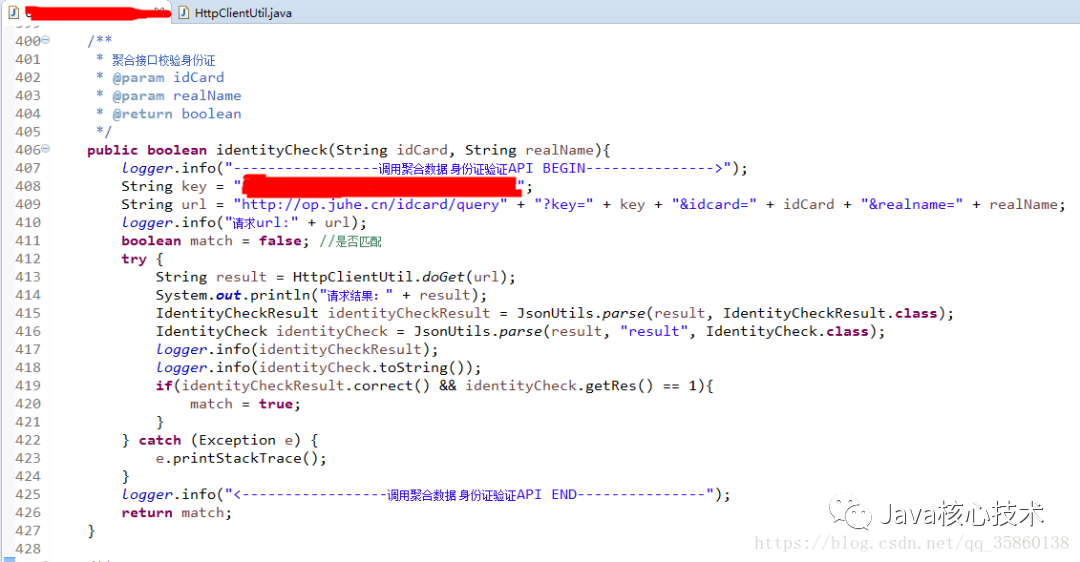
代碼如下:
/**
?*?聚合接口校驗身份證
?*?@param?idCard
?*?@param?realName
?*?@return?boolean
?*/
public?boolean?identityCheck(String?idCard,?String?realName){
?logger.info("-----------------調(diào)用聚合數(shù)據(jù)?身份證驗證API?BEGIN--------------->");
?String?key?=?"XXXXXXXXXXXXXXXXXXXXXXXXXXXXXXXXX";
?String?url?=?"http://op.juhe.cn/idcard/query"?+?"?key="?+?key?+?"&idcard="?+?idCard?+?"&realname="?+?realName;
?logger.info("請求url:"?+?url);
?boolean?match?=?false;?//是否匹配
?try?{
??String?result?=?HttpClientUtil.doGet(url);
??System.out.println("請求結(jié)果:"?+?result);
??IdentityCheckResult?identityCheckResult?=?JsonUtils.parse(result,?IdentityCheckResult.class);
??IdentityCheck?identityCheck?=?JsonUtils.parse(result,?"result",?IdentityCheck.class);
??logger.info(identityCheckResult);
??logger.info(identityCheck.toString());
??if(identityCheckResult.correct()?&&?identityCheck.getRes()?==?1){
???match?=?true;
??}
?}?catch?(Exception?e)?{
??e.printStackTrace();
?}
?logger.info("<-----------------調(diào)用聚合數(shù)據(jù)?身份證驗證API?END---------------");
?return?match;
}
3、請求這個第三方接口:
使用HttpClientUtil工具類中的doGet方法來請求URL,得到結(jié)果,現(xiàn)在大多數(shù)是一個json字符串,類型為String。
4、根據(jù)接口返回數(shù)據(jù)格式來解析數(shù)據(jù):
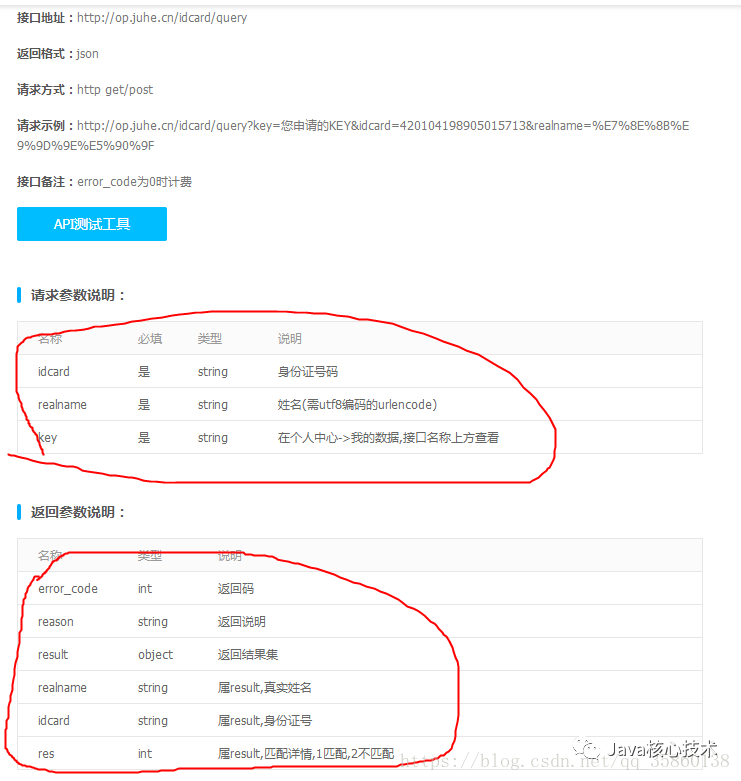
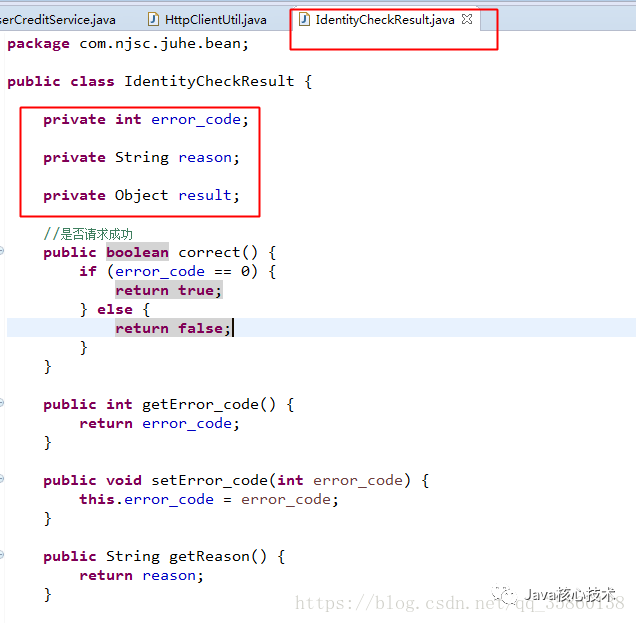
可以看到,返回參數(shù)有六個,所以在項目中新建一個bean,包含以上六個字段,用來接住返回數(shù)據(jù),如下:
因為接口返回的數(shù)據(jù)是一個json的字符串,類型實際上是一個String字符串,要解析數(shù)據(jù),用工具類JsonUtils的parse方法將字符串轉(zhuǎn)換為Java對象,JsonUtils的代碼如下:
package?com.eqianxian.commons.utils.json;
?
import?java.util.List;
import?java.util.Map;
?
import?com.alibaba.fastjson.JSON;
import?com.alibaba.fastjson.JSONObject;
import?com.alibaba.fastjson.serializer.PropertyFilter;
import?com.alibaba.fastjson.serializer.SerializerFeature;
?
/**
?*?在系統(tǒng)中統(tǒng)一使用這個,以方便將來切換不同的JSON生成工具
?*?
?*?@author?KelvinZ
?*?
?*/
public?class?JsonUtils?{
?public?static?final?int?TYPE_FASTJSON?=?0;
?public?static?final?int?TYPE_GSON?=?1;
?
?/**
??*?
??*?對象轉(zhuǎn)化為json字符串
??*?
??*?@param?obj?待轉(zhuǎn)化對象
??*?@return?代表該對象的Json字符串
??*/
?public?static?final?String?toJson(final?Object?obj)?{
??return?JSON.toJSONString(obj);
??//?return?gson.toJson(obj);
?}
?
?/**
??*?
??*?對象轉(zhuǎn)化為json字符串
??*?
??*?@param?obj?待轉(zhuǎn)化對象
??*?@return?代表該對象的Json字符串
??*/
?public?static?final?String?toJson(final?Object?obj,?SerializerFeature...?features)?{
??return?JSON.toJSONString(obj,?features);
??//?return?gson.toJson(obj);
?}
?
?/**
??*?對象轉(zhuǎn)化為json字符串并格式化
??*?
??*?@param?obj
??*?@param?format?是否要格式化
??*?@return
??*/
?public?static?final?String?toJson(final?Object?obj,?final?boolean?format)?{
??return?JSON.toJSONString(obj,?format);
?}
?
?/**
??*?對象對指定字段進(jìn)行過濾處理,生成json字符串
??*?
??*?@param?obj
??*?@param?fields?過濾處理字段
??*?@param?ignore?true做忽略處理,false做包含處理
??*?@param?features?json特征,為null忽略
??*?@return
??*/
?public?static?final?String?toJson(final?Object?obj,?final?String[]?fields,?final?boolean?ignore,
???SerializerFeature...?features)?{
??if?(fields?==?null?||?fields.length????return?toJson(obj);
??}
??if?(features?==?null)
???features?=?new?SerializerFeature[]?{?SerializerFeature.QuoteFieldNames?};
??return?JSON.toJSONString(obj,?new?PropertyFilter()?{
???@Override
???public?boolean?apply(Object?object,?String?name,?Object?value)?{
????for?(int?i?=?0;?i??????if?(name.equals(fields[i]))?{
??????return?!ignore;
?????}
????}
????return?ignore;
???}
??},?features);
?}
?
?/**
??*?
??*?解析json字符串中某路徑的值
??*?
??*?@param?json
??*?@param?path
??*?@return
??*/
?@SuppressWarnings("unchecked")
?public?static?final??E?parse(final?String?json,?final?String?path)?{
??String[]?keys?=?path.split(",");
??JSONObject?obj?=?JSON.parseObject(json);
??for?(int?i?=?0;?i????obj?=?obj.getJSONObject(keys[i]);
??}
??return?(E)?obj.get(keys[keys.length?-?1]);
?}
?
?/**
??*?
??*?json字符串解析為對象
??*?
??*?@param?json?代表一個對象的Json字符串
??*?@param?clazz?指定目標(biāo)對象的類型,即返回對象的類型
??*?@return?從json字符串解析出來的對象
??*/
?public?static?final??T?parse(final?String?json,?final?Class?clazz)?{
??return?JSON.parseObject(json,?clazz);
?}
?
?/**
??*?
??*?json字符串解析為對象
??*?
??*?@param?json?json字符串
??*?@param?path?逗號分隔的json層次結(jié)構(gòu)
??*?@param?clazz?目標(biāo)類
??*/
?public?static?final??T?parse(final?String?json,?final?String?path,?final?Class?clazz)?{
??String[]?keys?=?path.split(",");
??JSONObject?obj?=?JSON.parseObject(json);
??for?(int?i?=?0;?i????obj?=?obj.getJSONObject(keys[i]);
??}
??String?inner?=?obj.getString(keys[keys.length?-?1]);
??return?parse(inner,?clazz);
?}
?
?/**
??*?將制定的對象經(jīng)過字段過濾處理后,解析成為json集合
??*?
??*?@param?obj
??*?@param?fields
??*?@param?ignore
??*?@param?clazz
??*?@param?features
??*?@return
??*/
?public?static?final??List?parseArray(final?Object?obj,?final?String[]?fields,?boolean?ignore,
???final?Class?clazz,?final?SerializerFeature...?features)?{
??String?json?=?toJson(obj,?fields,?ignore,?features);
??return?parseArray(json,?clazz);
?}
?
?/**
??*?
??*?從json字符串中解析出一個對象的集合,被解析字符串要求是合法的集合類型
??*?(形如:["k1":"v1","k2":"v2",..."kn":"vn"])
??*?
??*?@param?json?-?[key-value-pair...]
??*?@param?clazz
??*?@return
??*/
?public?static?final??List?parseArray(final?String?json,?final?Class?clazz)?{
??return?JSON.parseArray(json,?clazz);
?}
?
?/**
??*?
??*?從json字符串中按照路徑尋找,并解析出一個對象的集合,例如:
??*?類Person有一個屬性name,要從以下json中解析出其集合:
??*?{
??*??"page_info":{
??*???"items":{
??*????"item":[{"name":"KelvinZ"},{"name":"Jobs"},...{"name":"Gates"}]
??*??}
??*?}
??*?使用方法:parseArray(json, "page_info,items,item",?Person.class),
??*?將根據(jù)指定路徑,正確的解析出所需集合,排除外層干擾
??*?
??*?@param?json?json字符串
??*?@param?path?逗號分隔的json層次結(jié)構(gòu)
??*?@param?clazz?目標(biāo)類
??*?@return
??*/
?public?static?final??List?parseArray(final?String?json,?final?String?path,?final?Class?clazz)?{
??String[]?keys?=?path.split(",");
??JSONObject?obj?=?JSON.parseObject(json);
??for?(int?i?=?0;?i????obj?=?obj.getJSONObject(keys[i]);
??}
??String?inner?=?obj.getString(keys[keys.length?-?1]);
??List?ret?=?parseArray(inner,?clazz);
??return?ret;
?}
?
?/**
??*?
??*?有些json的常見格式錯誤這里可以處理,以便給后續(xù)的方法處理
??*?常見錯誤:使用了\"?或者?"{?或者?}",騰訊的頁面中常見這種格式
??*?
??*?@param?invalidJson?包含非法格式的json字符串
??*?@return
??*/
?public?static?final?String?correctJson(final?String?invalidJson)?{
??String?content?=?invalidJson.replace("\\\"",?"\"").replace("\"{",?"{").replace("}\"",?"}");
??return?content;
?}
?
?/**
??*?格式化Json
??*?
??*?@param?json
??*?@return
??*/
?public?static?final?String?formatJson(String?json)?{
??Map?map?=?(Map)?JSON.parse(json);
??return?JSON.toJSONString(map,?true);
?}
?
?/**
??*?獲取json串中的子json
??*?
??*?@param?json
??*?@param?path
??*?@return
??*/
?public?static?final?String?getSubJson(String?json,?String?path)?{
??String[]?keys?=?path.split(",");
??JSONObject?obj?=?JSON.parseObject(json);
??for?(int?i?=?0;?i????obj?=?obj.getJSONObject(keys[i]);
???System.out.println(obj.toJSONString());
??}
??return?obj?!=?null???obj.getString(keys[keys.length?-?1])?:?null;
?}
?
}
來源:https://blog.csdn.net/qq_35860138/article/details/82967727
ps:如果您覺文章有用,動動小手點個在看,點個贊再走吧
-END-
?關(guān)注公眾號:Java后端編程,回復(fù)下面關(guān)鍵字?
要Java學(xué)習(xí)完整路線,回復(fù)??路線?
缺Java入門視頻,回復(fù):?視頻?
要Java面試經(jīng)驗,回復(fù)??面試?
缺Java項目,回復(fù):?項目?
進(jìn)Java粉絲群:?加群?
PS:如果覺得我的分享不錯,歡迎大家隨手點贊、在看。
(完) 加我"微信"?獲取一份 最新Java面試題資料 請備注:666,不然不通過~
最近好文
最近面試BAT,整理一份面試資料《Java面試BAT通關(guān)手冊》,覆蓋了Java核心技術(shù)、JVM、Java并發(fā)、SSM、微服務(wù)、數(shù)據(jù)庫、數(shù)據(jù)結(jié)構(gòu)等等。 獲取方式:關(guān)注公眾號并回復(fù)?java?領(lǐng)取,更多內(nèi)容陸續(xù)奉上。 明天見(??ω??)??
評論
圖片
表情