
Spring中的重試功能!嗯,有點(diǎn)東西
來源:https://albenw.github.io/posts/69a9647f/
概要
Spring實(shí)現(xiàn)了一套重試機(jī)制,功能簡單實(shí)用。Spring Retry是從Spring Batch獨(dú)立出來的一個(gè)功能,已經(jīng)廣泛應(yīng)用于Spring Batch,Spring Integration, Spring for Apache Hadoop等Spring項(xiàng)目。 本文將講述如何使用Spring Retry及其實(shí)現(xiàn)原理。
背景
重試,其實(shí)我們其實(shí)很多時(shí)候都需要的,為了保證容錯(cuò)性,可用性,一致性等。一般用來應(yīng)對(duì)外部系統(tǒng)的一些不可預(yù)料的返回、異常等,特別是網(wǎng)絡(luò)延遲,中斷等情況。還有在現(xiàn)在流行的微服務(wù)治理框架中,通常都有自己的重試與超時(shí)配置,比如dubbo可以設(shè)置retries=1,timeout=500調(diào)用失敗只重試1次,超過500ms調(diào)用仍未返回則調(diào)用失敗。 如果我們要做重試,要為特定的某個(gè)操作做重試功能,則要硬編碼,大概邏輯基本都是寫個(gè)循環(huán),根據(jù)返回或異常,計(jì)數(shù)失敗次數(shù),然后設(shè)定退出條件。 這樣做,且不說每個(gè)操作都要寫這種類似的代碼,而且重試邏輯和業(yè)務(wù)邏輯混在一起,給維護(hù)和擴(kuò)展帶來了麻煩。 從面向?qū)ο蟮慕嵌葋砜矗覀儜?yīng)該把重試的代碼獨(dú)立出來。
使用介紹
基本使用
先舉個(gè)例子:
@Configuration
@EnableRetry
public class Application {

    @Bean
    public RetryService retryService(){
        return new RetryService();
    }

    public static void main(String[] args) throws Exception{
        ApplicationContext applicationContext = new AnnotationConfigApplicationContext("springretry");
        RetryService service1 = applicationContext.getBean("service", RetryService.class);
        service1.service();
    }
}

@Service("service")
public class RetryService {

    @Retryable(value = IllegalAccessException.class, maxAttempts = 5,
            backoff= @Backoff(value = 1500, maxDelay = 100000, multiplier = 1.2))
    public void service() throws IllegalAccessException {
        System.out.println("service method...");
        throw new IllegalAccessException("manual exception");
    }

    @Recover
    public void recover(IllegalAccessException e){
        System.out.println("service retry after Recover => " + e.getMessage());
    }

}
@EnableRetry - 表示開啟重試機(jī)制
@Retryable - 表示這個(gè)方法需要重試,它有很豐富的參數(shù),可以滿足你對(duì)重試的需求
@Backoff - 表示重試中的退避策略
@Recover - 兜底方法,即多次重試后還是失敗就會(huì)執(zhí)行這個(gè)方法
Spring-Retry 的功能豐富在于其重試策略和退避策略,還有兜底,監(jiān)聽器等操作。
然后每個(gè)注解里面的參數(shù),都是很簡單的,大家看一下就知道是什么意思,怎么用了,我就不多講了。
重試策略
看一下Spring Retry自帶的一些重試策略,主要是用來判斷當(dāng)方法調(diào)用異常時(shí)是否需要重試。(下文原理部分會(huì)深入分析實(shí)現(xiàn))
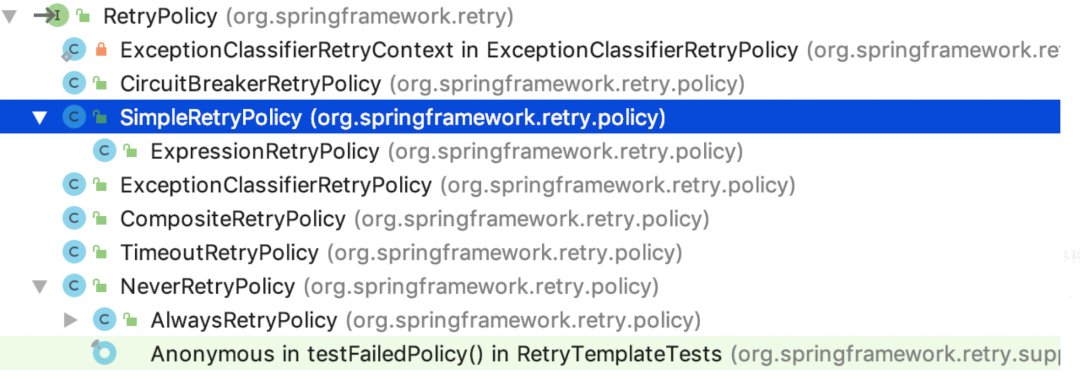
SimpleRetryPolicy 默認(rèn)最多重試3次 TimeoutRetryPolicy 默認(rèn)在1秒內(nèi)失敗都會(huì)重試 ExpressionRetryPolicy 符合表達(dá)式就會(huì)重試 CircuitBreakerRetryPolicy 增加了熔斷的機(jī)制,如果不在熔斷狀態(tài),則允許重試 CompositeRetryPolicy 可以組合多個(gè)重試策略 NeverRetryPolicy 從不重試(也是一種重試策略哈) AlwaysRetryPolicy 總是重試
….等等
退避策略
看一下退避策略,退避是指怎么去做下一次的重試,在這里其實(shí)就是等待多長時(shí)間。(下文原理部分會(huì)深入分析實(shí)現(xiàn))
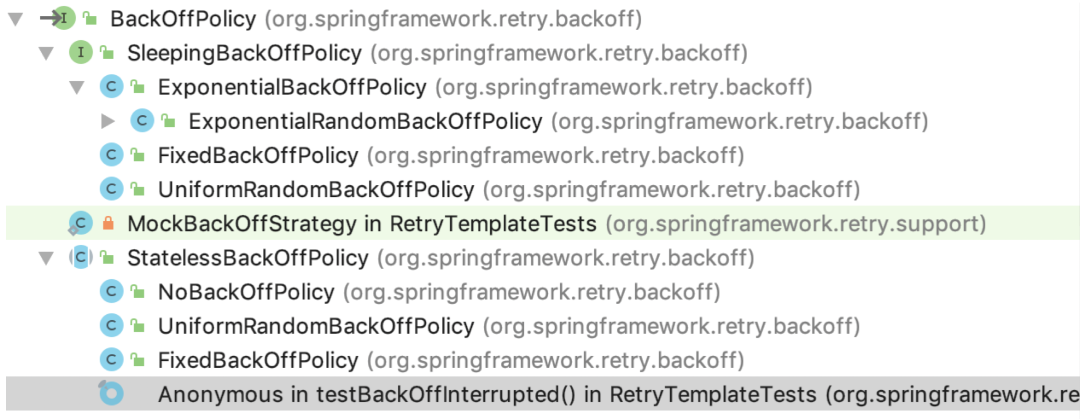
FixedBackOffPolicy 默認(rèn)固定延遲1秒后執(zhí)行下一次重試 ExponentialBackOffPolicy 指數(shù)遞增延遲執(zhí)行重試,默認(rèn)初始0.1秒,系數(shù)是2,那么下次延遲0.2秒,再下次就是延遲0.4秒,如此類推,最大30秒。 ExponentialRandomBackOffPolicy 在上面那個(gè)策略上增加隨機(jī)性 UniformRandomBackOffPolicy 這個(gè)跟上面的區(qū)別就是,上面的延遲會(huì)不停遞增,這個(gè)只會(huì)在固定的區(qū)間隨機(jī) StatelessBackOffPolicy 這個(gè)說明是無狀態(tài)的,所謂無狀態(tài)就是對(duì)上次的退避無感知,從它下面的子類也能看出來
原理
原理部分我想分開兩部分來講,一是重試機(jī)制的切入點(diǎn),即它是如何使得你的代碼實(shí)現(xiàn)重試功能的;二是重試機(jī)制的詳細(xì),包括重試的邏輯以及重試策略和退避策略的實(shí)現(xiàn)。
切入點(diǎn)
@EnableRetry
@Target(ElementType.TYPE)
@Retention(RetentionPolicy.RUNTIME)
@EnableAspectJAutoProxy(proxyTargetClass = false)
@Import(RetryConfiguration.class)
@Documented
public @interface EnableRetry {

 /**
  * Indicate whether subclass-based (CGLIB) proxies are to be created as opposed
  * to standard Java interface-based proxies. The default is {@code false}.
  *
  * @return whether to proxy or not to proxy the class
  */
 boolean proxyTargetClass() default false;

}
我們可以看到
@EnableAspectJAutoProxy(proxyTargetClass = false)
這個(gè)并不陌生,就是打開Spring AOP功能。 重點(diǎn)看看
@Import(RetryConfiguration.class)
@Import相當(dāng)于注冊這個(gè)Bean
我們看看這個(gè)RetryConfiguration是個(gè)什么東西
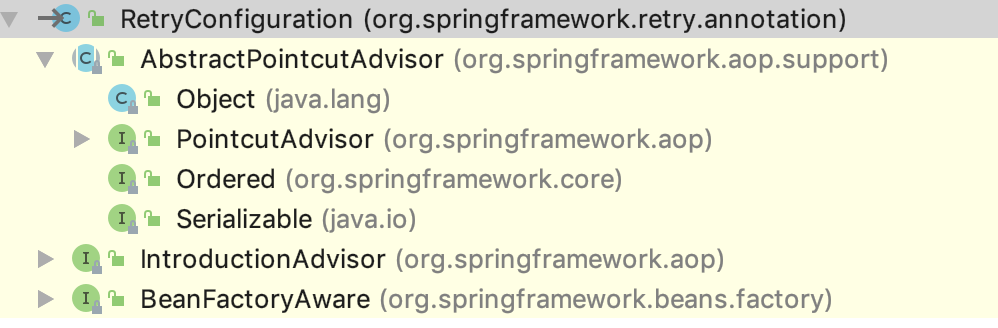
它是一個(gè)AbstractPointcutAdvisor,它有一個(gè)pointcut和一個(gè)advice。我們知道,在IOC過程中會(huì)根據(jù)PointcutAdvisor類來對(duì)Bean進(jìn)行Pointcut的過濾,然后生成對(duì)應(yīng)的AOP代理類,用advice來加強(qiáng)處理。
看看RetryConfiguration的初始化:
@PostConstruct
 public void init() {
  Set<Class<? extends Annotation>> retryableAnnotationTypes = new LinkedHashSet<Class<? extends Annotation>>(1);
  retryableAnnotationTypes.add(Retryable.class);
        //創(chuàng)建pointcut
  this.pointcut = buildPointcut(retryableAnnotationTypes);
        //創(chuàng)建advice
  this.advice = buildAdvice();
  if (this.advice instanceof BeanFactoryAware) {
   ((BeanFactoryAware) this.advice).setBeanFactory(beanFactory);
  }
 }
protected Pointcut buildPointcut(Set<Class<? extends Annotation>> retryAnnotationTypes) {
  ComposablePointcut result = null;
  for (Class<? extends Annotation> retryAnnotationType : retryAnnotationTypes) {
   Pointcut filter = new AnnotationClassOrMethodPointcut(retryAnnotationType);
   if (result == null) {
    result = new ComposablePointcut(filter);
   }
   else {
    result.union(filter);
   }
  }
  return result;
 }
上面代碼用到了AnnotationClassOrMethodPointcut,其實(shí)它最終還是用到了AnnotationMethodMatcher來根據(jù)注解進(jìn)行切入點(diǎn)的過濾。這里就是@Retryable注解了。
//創(chuàng)建advice對(duì)象,即攔截器
   protected Advice buildAdvice() {
    //下面關(guān)注這個(gè)對(duì)象
 AnnotationAwareRetryOperationsInterceptor interceptor = new AnnotationAwareRetryOperationsInterceptor();
 if (retryContextCache != null) {
  interceptor.setRetryContextCache(retryContextCache);
 }
 if (retryListeners != null) {
  interceptor.setListeners(retryListeners);
 }
 if (methodArgumentsKeyGenerator != null) {
  interceptor.setKeyGenerator(methodArgumentsKeyGenerator);
 }
 if (newMethodArgumentsIdentifier != null) {
  interceptor.setNewItemIdentifier(newMethodArgumentsIdentifier);
 }
 if (sleeper != null) {
  interceptor.setSleeper(sleeper);
 }
 return interceptor;
}
AnnotationAwareRetryOperationsInterceptor
繼承關(guān)系
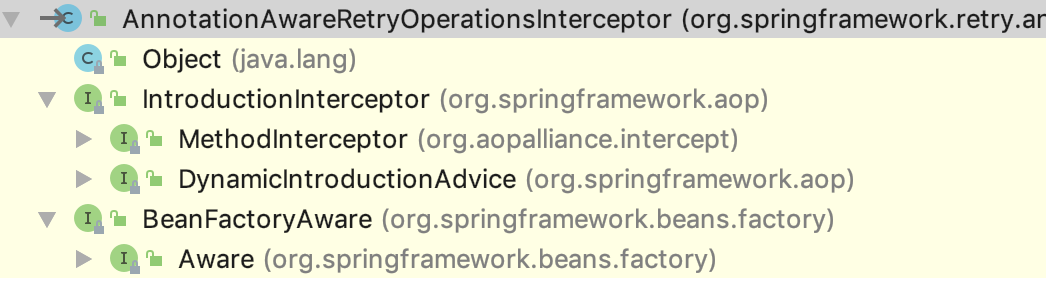
可以看出AnnotationAwareRetryOperationsInterceptor是一個(gè)MethodInterceptor,在創(chuàng)建AOP代理過程中如果目標(biāo)方法符合pointcut的規(guī)則,它就會(huì)加到interceptor列表中,然后做增強(qiáng),我們看看invoke方法做了什么增強(qiáng)。
@Override
 public Object invoke(MethodInvocation invocation) throws Throwable {
  MethodInterceptor delegate = getDelegate(invocation.getThis(), invocation.getMethod());
  if (delegate != null) {
   return delegate.invoke(invocation);
  }
  else {
   return invocation.proceed();
  }
 }
這里用到了委托,主要是需要根據(jù)配置委托給具體“有狀態(tài)”的interceptor還是“無狀態(tài)”的interceptor。
private MethodInterceptor getDelegate(Object target, Method method) {
  if (!this.delegates.containsKey(target) || !this.delegates.get(target).containsKey(method)) {
   synchronized (this.delegates) {
    if (!this.delegates.containsKey(target)) {
     this.delegates.put(target, new HashMap<Method, MethodInterceptor>());
    }
    Map<Method, MethodInterceptor> delegatesForTarget = this.delegates.get(target);
    if (!delegatesForTarget.containsKey(method)) {
     Retryable retryable = AnnotationUtils.findAnnotation(method, Retryable.class);
     if (retryable == null) {
      retryable = AnnotationUtils.findAnnotation(method.getDeclaringClass(), Retryable.class);
     }
     if (retryable == null) {
      retryable = findAnnotationOnTarget(target, method);
     }
     if (retryable == null) {
      return delegatesForTarget.put(method, null);
     }
     MethodInterceptor delegate;
     //支持自定義MethodInterceptor,而且優(yōu)先級(jí)最高
     if (StringUtils.hasText(retryable.interceptor())) {
      delegate = this.beanFactory.getBean(retryable.interceptor(), MethodInterceptor.class);
     }
     else if (retryable.stateful()) {
                     //得到“有狀態(tài)”的interceptor
      delegate = getStatefulInterceptor(target, method, retryable);
     }
     else {
                     //得到“無狀態(tài)”的interceptor
      delegate = getStatelessInterceptor(target, method, retryable);
     }
     delegatesForTarget.put(method, delegate);
    }
   }
  }
  return this.delegates.get(target).get(method);
 }
getStatefulInterceptor和getStatelessInterceptor都是差不多,我們先看看比較簡單的getStatelessInterceptor。
private MethodInterceptor getStatelessInterceptor(Object target, Method method, Retryable retryable) {
  //生成一個(gè)RetryTemplate
  RetryTemplate template = createTemplate(retryable.listeners());
  //生成retryPolicy
  template.setRetryPolicy(getRetryPolicy(retryable));
  //生成backoffPolicy
  template.setBackOffPolicy(getBackoffPolicy(retryable.backoff()));
  return RetryInterceptorBuilder.stateless()
    .retryOperations(template)
    .label(retryable.label())
    .recoverer(getRecoverer(target, method))
    .build();
 }
具體生成retryPolicy和backoffPolicy的規(guī)則,我們等下再回頭來看。
RetryInterceptorBuilder其實(shí)就是為了生成RetryOperationsInterceptor。RetryOperationsInterceptor也是一個(gè)MethodInterceptor,我們來看看它的invoke方法。
public Object invoke(final MethodInvocation invocation) throws Throwable {

  String name;
  if (StringUtils.hasText(label)) {
   name = label;
  } else {
   name = invocation.getMethod().toGenericString();
  }
  final String label = name;

  //定義了一個(gè)RetryCallback,其實(shí)看它的doWithRetry方法,調(diào)用了invocation的proceed()方法,是不是有點(diǎn)眼熟,這就是AOP的攔截鏈調(diào)用,如果沒有攔截鏈,那就是對(duì)原來方法的調(diào)用。
  RetryCallback<Object, Throwable> retryCallback = new RetryCallback<Object, Throwable>() {

   public Object doWithRetry(RetryContext context) throws Exception {

    context.setAttribute(RetryContext.NAME, label);

    /*
     * If we don't copy the invocation carefully it won't keep a reference to
     * the other interceptors in the chain. We don't have a choice here but to
     * specialise to ReflectiveMethodInvocation (but how often would another
     * implementation come along?).
     */
    if (invocation instanceof ProxyMethodInvocation) {
     try {
      return ((ProxyMethodInvocation) invocation).invocableClone().proceed();
     }
     catch (Exception e) {
      throw e;
     }
     catch (Error e) {
      throw e;
     }
     catch (Throwable e) {
      throw new IllegalStateException(e);
     }
    }
    else {
     throw new IllegalStateException(
       "MethodInvocation of the wrong type detected - this should not happen with Spring AOP, " +
         "so please raise an issue if you see this exception");
    }
   }

  };

  if (recoverer != null) {
   ItemRecovererCallback recoveryCallback = new ItemRecovererCallback(
     invocation.getArguments(), recoverer);
   return this.retryOperations.execute(retryCallback, recoveryCallback);
  }
  //最終還是進(jìn)入到retryOperations的execute方法,這個(gè)retryOperations就是在之前的builder set進(jìn)來的RetryTemplate。
  return this.retryOperations.execute(retryCallback);

 }
無論是RetryOperationsInterceptor還是StatefulRetryOperationsInterceptor,最終的攔截處理邏輯還是調(diào)用到RetryTemplate的execute方法,從名字也看出來,RetryTemplate作為一個(gè)模板類,里面包含了重試統(tǒng)一邏輯。不過,我看這個(gè)RetryTemplate并不是很“模板”,因?yàn)樗鼪]有很多可以擴(kuò)展的地方。
重試邏輯及策略實(shí)現(xiàn)
上面介紹了Spring Retry利用了AOP代理使重試機(jī)制對(duì)業(yè)務(wù)代碼進(jìn)行“入侵”。下面我們繼續(xù)看看重試的邏輯做了什么。 RetryTemplate的doExecute方法。
protected <T, E extends Throwable> T doExecute(RetryCallback<T, E> retryCallback,
   RecoveryCallback<T> recoveryCallback, RetryState state)
   throws E, ExhaustedRetryException {

  RetryPolicy retryPolicy = this.retryPolicy;
  BackOffPolicy backOffPolicy = this.backOffPolicy;

  //新建一個(gè)RetryContext來保存本輪重試的上下文
  RetryContext context = open(retryPolicy, state);
  if (this.logger.isTraceEnabled()) {
   this.logger.trace("RetryContext retrieved: " + context);
  }

  // Make sure the context is available globally for clients who need
  // it...
  RetrySynchronizationManager.register(context);

  Throwable lastException = null;

  boolean exhausted = false;
  try {

   //如果有注冊RetryListener,則會(huì)調(diào)用它的open方法,給調(diào)用者一個(gè)通知。
   boolean running = doOpenInterceptors(retryCallback, context);

   if (!running) {
    throw new TerminatedRetryException(
      "Retry terminated abnormally by interceptor before first attempt");
   }

   // Get or Start the backoff context...
   BackOffContext backOffContext = null;
   Object resource = context.getAttribute("backOffContext");

   if (resource instanceof BackOffContext) {
    backOffContext = (BackOffContext) resource;
   }

   if (backOffContext == null) {
    backOffContext = backOffPolicy.start(context);
    if (backOffContext != null) {
     context.setAttribute("backOffContext", backOffContext);
    }
   }

   //判斷能否重試,就是調(diào)用RetryPolicy的canRetry方法來判斷。
   //這個(gè)循環(huán)會(huì)直到原方法不拋出異常,或不需要再重試
   while (canRetry(retryPolicy, context) && !context.isExhaustedOnly()) {

    try {
     if (this.logger.isDebugEnabled()) {
      this.logger.debug("Retry: count=" + context.getRetryCount());
     }
     //清除上次記錄的異常
     lastException = null;
     //doWithRetry方法,一般來說就是原方法
     return retryCallback.doWithRetry(context);
    }
    catch (Throwable e) {
     //原方法拋出了異常
     lastException = e;

     try {
      //記錄異常信息
      registerThrowable(retryPolicy, state, context, e);
     }
     catch (Exception ex) {
      throw new TerminatedRetryException("Could not register throwable",
        ex);
     }
     finally {
      //調(diào)用RetryListener的onError方法
      doOnErrorInterceptors(retryCallback, context, e);
     }
     //再次判斷能否重試
     if (canRetry(retryPolicy, context) && !context.isExhaustedOnly()) {
      try {
       //如果可以重試則走退避策略
       backOffPolicy.backOff(backOffContext);
      }
      catch (BackOffInterruptedException ex) {
       lastException = e;
       // back off was prevented by another thread - fail the retry
       if (this.logger.isDebugEnabled()) {
        this.logger
          .debug("Abort retry because interrupted: count="
            + context.getRetryCount());
       }
       throw ex;
      }
     }

     if (this.logger.isDebugEnabled()) {
      this.logger.debug(
        "Checking for rethrow: count=" + context.getRetryCount());
     }

     if (shouldRethrow(retryPolicy, context, state)) {
      if (this.logger.isDebugEnabled()) {
       this.logger.debug("Rethrow in retry for policy: count="
         + context.getRetryCount());
      }
      throw RetryTemplate.<E>wrapIfNecessary(e);
     }

    }

    /*
     * A stateful attempt that can retry may rethrow the exception before now,
     * but if we get this far in a stateful retry there's a reason for it,
     * like a circuit breaker or a rollback classifier.
     */
    if (state != null && context.hasAttribute(GLOBAL_STATE)) {
     break;
    }
   }

   if (state == null && this.logger.isDebugEnabled()) {
    this.logger.debug(
      "Retry failed last attempt: count=" + context.getRetryCount());
   }

   exhausted = true;
   //重試結(jié)束后如果有兜底R(shí)ecovery方法則執(zhí)行,否則拋異常
   return handleRetryExhausted(recoveryCallback, context, state);

  }
  catch (Throwable e) {
   throw RetryTemplate.<E>wrapIfNecessary(e);
  }
  finally {
   //處理一些關(guān)閉邏輯
   close(retryPolicy, context, state, lastException == null || exhausted);
   //調(diào)用RetryListener的close方法
   doCloseInterceptors(retryCallback, context, lastException);
   RetrySynchronizationManager.clear();
  }

 }
主要核心重試邏輯就是上面的代碼了,看上去還是挺簡單的。
在上面,我們漏掉了RetryPolicy的canRetry方法和BackOffPolicy的backOff方法,以及這兩個(gè)Policy是怎么來的。
我們回頭看看getStatelessInterceptor方法中的getRetryPolicy和getRetryPolicy方法。
private RetryPolicy getRetryPolicy(Annotation retryable) {
  Map<String, Object> attrs = AnnotationUtils.getAnnotationAttributes(retryable);
  @SuppressWarnings("unchecked")
  Class<? extends Throwable>[] includes = (Class<? extends Throwable>[]) attrs.get("value");
  String exceptionExpression = (String) attrs.get("exceptionExpression");
  boolean hasExpression = StringUtils.hasText(exceptionExpression);
  if (includes.length == 0) {
   @SuppressWarnings("unchecked")
   Class<? extends Throwable>[] value = (Class<? extends Throwable>[]) attrs.get("include");
   includes = value;
  }
  @SuppressWarnings("unchecked")
  Class<? extends Throwable>[] excludes = (Class<? extends Throwable>[]) attrs.get("exclude");
  Integer maxAttempts = (Integer) attrs.get("maxAttempts");
  String maxAttemptsExpression = (String) attrs.get("maxAttemptsExpression");
  if (StringUtils.hasText(maxAttemptsExpression)) {
   maxAttempts = PARSER.parseExpression(resolve(maxAttemptsExpression), PARSER_CONTEXT)
     .getValue(this.evaluationContext, Integer.class);
  }
  if (includes.length == 0 && excludes.length == 0) {
   SimpleRetryPolicy simple = hasExpression ? new ExpressionRetryPolicy(resolve(exceptionExpression))
               .withBeanFactory(this.beanFactory)
              : new SimpleRetryPolicy();
   simple.setMaxAttempts(maxAttempts);
   return simple;
  }
  Map<Class<? extends Throwable>, Boolean> policyMap = new HashMap<Class<? extends Throwable>, Boolean>();
  for (Class<? extends Throwable> type : includes) {
   policyMap.put(type, true);
  }
  for (Class<? extends Throwable> type : excludes) {
   policyMap.put(type, false);
  }
  boolean retryNotExcluded = includes.length == 0;
  if (hasExpression) {
   return new ExpressionRetryPolicy(maxAttempts, policyMap, true, exceptionExpression, retryNotExcluded)
     .withBeanFactory(this.beanFactory);
  }
  else {
   return new SimpleRetryPolicy(maxAttempts, policyMap, true, retryNotExcluded);
  }
 }
嗯~,代碼不難,這里簡單做一下總結(jié)好了。就是通過@Retryable注解中的參數(shù),來判斷具體使用文章開頭說到的哪個(gè)重試策略,是SimpleRetryPolicy還是ExpressionRetryPolicy等。
private BackOffPolicy getBackoffPolicy(Backoff backoff) {
  long min = backoff.delay() == 0 ? backoff.value() : backoff.delay();
  if (StringUtils.hasText(backoff.delayExpression())) {
   min = PARSER.parseExpression(resolve(backoff.delayExpression()), PARSER_CONTEXT)
     .getValue(this.evaluationContext, Long.class);
  }
  long max = backoff.maxDelay();
  if (StringUtils.hasText(backoff.maxDelayExpression())) {
   max = PARSER.parseExpression(resolve(backoff.maxDelayExpression()), PARSER_CONTEXT)
     .getValue(this.evaluationContext, Long.class);
  }
  double multiplier = backoff.multiplier();
  if (StringUtils.hasText(backoff.multiplierExpression())) {
   multiplier = PARSER.parseExpression(resolve(backoff.multiplierExpression()), PARSER_CONTEXT)
     .getValue(this.evaluationContext, Double.class);
  }
  if (multiplier > 0) {
   ExponentialBackOffPolicy policy = new ExponentialBackOffPolicy();
   if (backoff.random()) {
    policy = new ExponentialRandomBackOffPolicy();
   }
   policy.setInitialInterval(min);
   policy.setMultiplier(multiplier);
   policy.setMaxInterval(max > min ? max : ExponentialBackOffPolicy.DEFAULT_MAX_INTERVAL);
   if (this.sleeper != null) {
    policy.setSleeper(this.sleeper);
   }
   return policy;
  }
  if (max > min) {
   UniformRandomBackOffPolicy policy = new UniformRandomBackOffPolicy();
   policy.setMinBackOffPeriod(min);
   policy.setMaxBackOffPeriod(max);
   if (this.sleeper != null) {
    policy.setSleeper(this.sleeper);
   }
   return policy;
  }
  FixedBackOffPolicy policy = new FixedBackOffPolicy();
  policy.setBackOffPeriod(min);
  if (this.sleeper != null) {
   policy.setSleeper(this.sleeper);
  }
  return policy;
 }
嗯~,一樣的味道。就是通過@Backoff注解中的參數(shù),來判斷具體使用文章開頭說到的哪個(gè)退避策略,是FixedBackOffPolicy還是UniformRandomBackOffPolicy等。
那么每個(gè)RetryPolicy都會(huì)重寫canRetry方法,然后在RetryTemplate判斷是否需要重試。 我們看看SimpleRetryPolicy的
@Override
 public boolean canRetry(RetryContext context) {
  Throwable t = context.getLastThrowable();
  //判斷拋出的異常是否符合重試的異常
  //還有,是否超過了重試的次數(shù)
  return (t == null || retryForException(t)) && context.getRetryCount() < maxAttempts;
 }
同樣,我們看看FixedBackOffPolicy的退避方法。
protected void doBackOff() throws BackOffInterruptedException {
  try {
   //就是sleep固定的時(shí)間
   sleeper.sleep(backOffPeriod);
  }
  catch (InterruptedException e) {
   throw new BackOffInterruptedException("Thread interrupted while sleeping", e);
  }
 }
至此,重試的主要原理以及邏輯大概就是這樣了。
RetryContext
我覺得有必要說說RetryContext,先看看它的繼承關(guān)系。
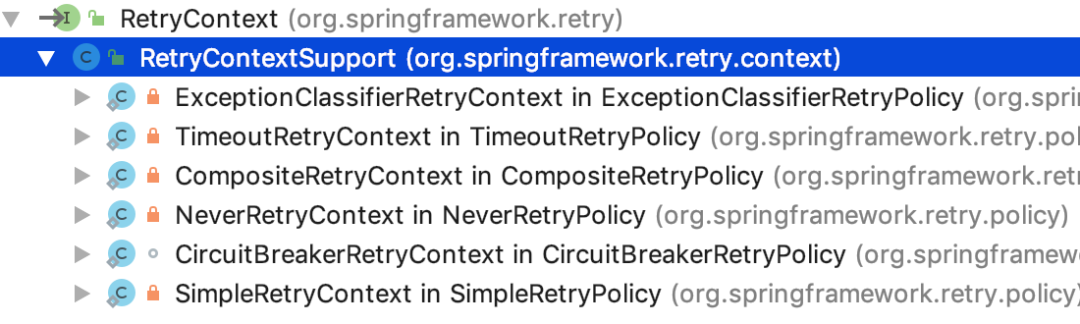
可以看出對(duì)每一個(gè)策略都有對(duì)應(yīng)的Context。
在Spring Retry里,其實(shí)每一個(gè)策略都是單例來的。我剛開始直覺是對(duì)每一個(gè)需要重試的方法都會(huì)new一個(gè)策略,這樣重試策略之間才不會(huì)產(chǎn)生沖突,但是一想就知道這樣就可能多出了很多策略對(duì)象出來,增加了使用者的負(fù)擔(dān),這不是一個(gè)好的設(shè)計(jì)。Spring Retry采用了一個(gè)更加輕量級(jí)的做法,就是針對(duì)每一個(gè)需要重試的方法只new一個(gè)上下文Context對(duì)象,然后在重試時(shí),把這個(gè)Context傳到策略里,策略再根據(jù)這個(gè)Context做重試,而且Spring Retry還對(duì)這個(gè)Context做了cache。這樣就相當(dāng)于對(duì)重試的上下文做了優(yōu)化。
總結(jié)
Spring Retry通過AOP機(jī)制來實(shí)現(xiàn)對(duì)業(yè)務(wù)代碼的重試”入侵“,RetryTemplate中包含了核心的重試邏輯,還提供了豐富的重試策略和退避策略。
參考資料
http://www.10tiao.com/html/164/201705/2652898434/1.html https://www.jianshu.com/p/58e753ca0151 https://paper.tuisec.win/detail/90bd660fad92183