
<kbd id="afajh"><form id="afajh"></form></kbd>
<strong id="afajh"><dl id="afajh"></dl></strong>
    <del id="afajh"><form id="afajh"></form></del>
        1. <th id="afajh"><progress id="afajh"></progress></th>
          <b id="afajh"><abbr id="afajh"></abbr></b>
          <th id="afajh"><progress id="afajh"></progress></th>

          一文掌握 C++ 智能指針的使用

          共 1274字,需瀏覽 3分鐘

           ·

          2021-10-20 18:57

          來自:現(xiàn)代 C++ 教程:高速上手 C++ 11/14/17/20

          鏈接:https://changkun.de/modern-cpp/zh-cn/05-pointers/index.html

          RAII 與引用計數(shù)

          了解?Objective-C/Swift?的程序員應該知道引用計數(shù)的概念。引用計數(shù)這種計數(shù)是為了防止內存泄露而產(chǎn)生的。


          基本想法是對于動態(tài)分配的對象,進行引用計數(shù),每當增加一次對同一個對象的引用,那么引用對象的引用計數(shù)就會增加一次, 每刪除一次引用,引用計數(shù)就會減一,當一個對象的引用計數(shù)減為零時,就自動刪除指向的堆內存。


          在傳統(tǒng)C++中,『記得』手動釋放資源,總不是最佳實踐。因為我們很有可能就忘記了去釋放資源而導致泄露。所以通常的做法是對于一個對象而言,我們在構造函數(shù)的時候申請空間,而在析構函數(shù)(在離開作用域時調用)的時候釋放空間, 也就是我們常說的 RAII 資源獲取即初始化技術。


          凡事都有例外,我們總會有需要將對象在自由存儲上分配的需求,在傳統(tǒng) C++ 里我們只好使用 new 和 delete 去 『記得』對資源進行釋放。C++11 引入了智能指針的概念,使用了引用計數(shù)的想法,讓程序員不再需要關心手動釋放內存


          這些智能指針就包括?std::shared_ptr std::unique_ptr std::weak_ptr,使用它們需要包含頭文件


          注意:引用計數(shù)不是垃圾回收,引用計數(shù)能夠盡快收回不再被使用的對象,同時在回收的過程中也不會造成長時間的等待, 更能夠清晰明確的表明資源的生命周期。


          std::shared_ptr


          std::shared_ptr 是一種智能指針,它能夠記錄多少個 shared_ptr 共同指向一個對象,從而消除顯式的調用 delete,當引用計數(shù)變?yōu)榱愕臅r候就會將對象自動刪除。


          但還不夠,因為使用 std::shared_ptr 仍然需要使用 new 來調用,這使得代碼出現(xiàn)了某種程度上的不對稱。


          std::make_shared 就能夠用來消除顯式的使用 new,所以 std::make_shared 會分配創(chuàng)建傳入?yún)?shù)中的對象, 并返回這個對象類型的 std::shared_ptr 指針。例如:

          #include 
          #include
          void foo(std::shared_ptr<int> i)
          {
          (*i)++;
          }
          int main()
          {
          // auto pointer = new int(10); // illegal, no direct assignment
          // Constructed a std::shared_ptr
          auto pointer = std::make_shared<int>(10);
          foo(pointer);
          std::cout << *pointer << std::endl; // 11
          // The shared_ptr will be destructed before leaving the scope
          return 0;
          }

          std::shared_ptr 可以通過 get() 方法來獲取原始指針,通過 reset() 來減少一個引用計數(shù), 并通過 use_count() 來查看一個對象的引用計數(shù)。例如:

          auto pointer = std::make_shared<int>(10);
          auto pointer2 = pointer; // 引用計數(shù)+1
          auto pointer3 = pointer; // 引用計數(shù)+1
          int *p = pointer.get(); // 這樣不會增加引用計數(shù)
          std::cout << "pointer.use_count() = " << pointer.use_count() << std::endl; // 3
          std::cout << "pointer2.use_count() = " << pointer2.use_count() << std::endl; // 3
          std::cout << "pointer3.use_count() = " << pointer3.use_count() << std::endl; // 3

          pointer2.reset();
          std::cout << "reset pointer2:" << std::endl;
          std::cout << "pointer.use_count() = " << pointer.use_count() << std::endl; // 2
          std::cout << "pointer2.use_count() = " << pointer2.use_count() << std::endl; // 0, pointer2 已 reset
          std::cout << "pointer3.use_count() = " << pointer3.use_count() << std::endl; // 2
          pointer3.reset();
          std::cout << "reset pointer3:" << std::endl;
          std::cout << "pointer.use_count() = " << pointer.use_count() << std::endl; // 1
          std::cout << "pointer2.use_count() = " << pointer2.use_count() << std::endl; // 0
          std::cout << "pointer3.use_count() = " << pointer3.use_count() << std::endl; // 0, pointer3 已 reset


          std::unique_ptr


          std::unique_ptr?是一種獨占的智能指針,它禁止其他智能指針與其共享同一個對象,從而保證代碼的安全:

          std::unique_ptr<int> pointer = std::make_unique<int>(10); // make_unique 從 C++14 引入
          std::unique_ptr<int> pointer2 = pointer; // 非法

          make_unique 并不復雜,C++11 沒有提供 std::make_unique,可以自行實現(xiàn):

          template<typename T, typename ...Args>
          std::unique_ptr make_unique( Args&& ...args ) {
          return std::unique_ptr( new T( std::forward(args)... ) );
          }

          至于為什么沒有提供,C++ 標準委員會主席 Herb Sutter 在他的博客中提到原因是因為『被他們忘記了』。


          既然是獨占,換句話說就是不可復制。但是,我們可以利用 std::move 將其轉移給其他的 unique_ptr,例如:

          #include 
          #include

          struct Foo {
          Foo() { std::cout << "Foo::Foo" << std::endl; }
          ~Foo() { std::cout << "Foo::~Foo" << std::endl; }
          void foo() { std::cout << "Foo::foo" << std::endl; }
          };

          void f(const Foo &) {
          std::cout << "f(const Foo&)" << std::endl;
          }

          int main() {
          std::unique_ptr p1(std::make_unique());
          // p1 不空, 輸出
          if (p1) p1->foo();
          {
          std::unique_ptr p2(std::move(p1));
          // p2 不空, 輸出
          f(*p2);
          // p2 不空, 輸出
          if(p2) p2->foo();
          // p1 為空, 無輸出
          if(p1) p1->foo();
          p1 = std::move(p2);
          // p2 為空, 無輸出
          if(p2) p2->foo();
          std::cout << "p2 被銷毀" << std::endl;
          }
          // p1 不空, 輸出
          if (p1) p1->foo();
          // Foo 的實例會在離開作用域時被銷毀
          }


          std::weak_ptr


          如果你仔細思考?std::shared_ptr?就會發(fā)現(xiàn)依然存在著資源無法釋放的問題。看下面這個例子:

          struct A;
          struct B;

          struct A {
          std::shared_ptr pointer;
          ~A() {
          std::cout << "A 被銷毀" << std::endl;
          }
          };
          struct B {
          std::shared_ptr pointer;
          ~B() {
          std::cout << "B 被銷毀" << std::endl;
          }
          };
          int main() {
          auto a = std::make_shared
          ();
          auto b = std::make_shared();
          a->pointer = b;
          b->pointer = a;
          }

          運行結果是 A, B 都不會被銷毀,這是因為 a,b 內部的 pointer 同時又引用了 a,b,這使得 a,b 的引用計數(shù)均變?yōu)榱?2,而離開作用域時,a,b 智能指針被析構,卻只能造成這塊區(qū)域的引用計數(shù)減一。


          這樣就導致了?a,b?對象指向的內存區(qū)域引用計數(shù)不為零,而外部已經(jīng)沒有辦法找到這塊區(qū)域了,也就造成了內存泄露,如圖 1:
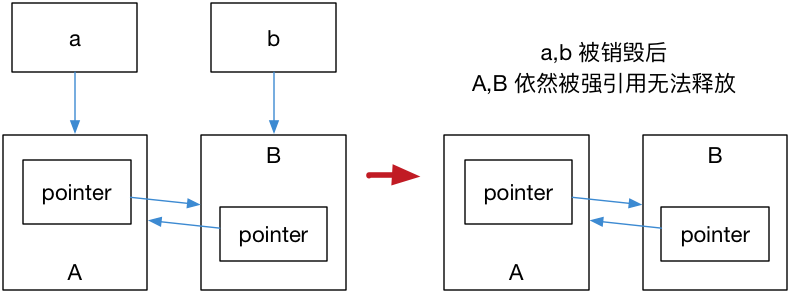

          圖 1

          解決這個問題的辦法就是使用弱引用指針?std::weak_ptr,std::weak_ptr是一種弱引用(相比較而言 std::shared_ptr 就是一種強引用)。


          弱引用不會引起引用計數(shù)增加,當換用弱引用時候,最終的釋放流程如圖 2 所示:
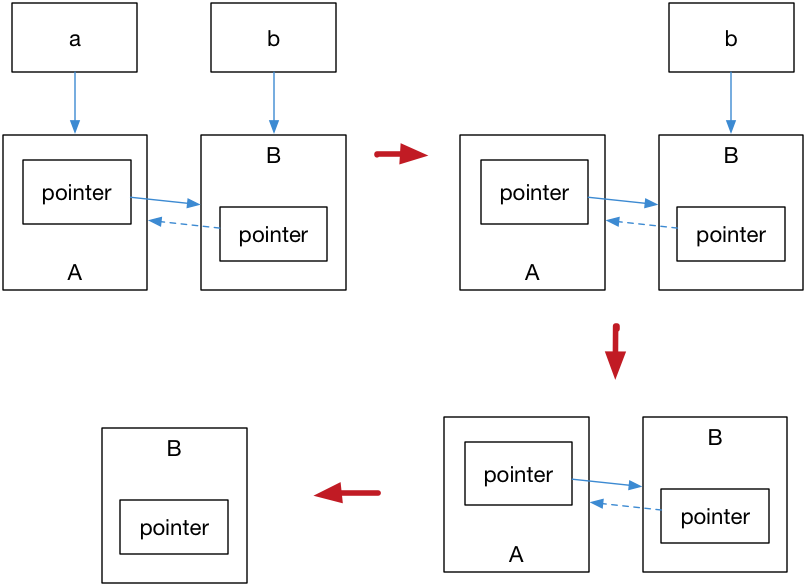

          圖 2


          在上圖中,最后一步只剩下 B,而 B 并沒有任何智能指針引用它,因此這塊內存資源也會被釋放。


          std::weak_ptr?沒有?*?運算符和?->?運算符,所以不能夠對資源進行操作,它的唯一作用就是用于檢查 std::shared_ptr 是否存在,其 expired()?方法能在資源未被釋放時,會返回 false,否則返回 true。


          總結


          智能指針這種技術并不新奇,在很多語言中都是一種常見的技術,現(xiàn)代 C++ 將這項技術引進,在一定程度上消除了?new/delete?的濫用,是一種更加成熟的編程范式。


          版權申明:內容來源網(wǎng)絡,版權歸原創(chuàng)者所有。除非無法確認,我們都會標明作者及出處,如有侵權煩請告知,我們會立即刪除并表示歉意。謝謝!

          瀏覽 36
          點贊
          評論
          收藏
          分享

          手機掃一掃分享

          分享
          舉報
          評論
          圖片
          表情
          推薦
          點贊
          評論
          收藏
          分享

          手機掃一掃分享

          分享
          舉報
          <kbd id="afajh"><form id="afajh"></form></kbd>
          <strong id="afajh"><dl id="afajh"></dl></strong>
            <del id="afajh"><form id="afajh"></form></del>
                1. <th id="afajh"><progress id="afajh"></progress></th>
                  <b id="afajh"><abbr id="afajh"></abbr></b>
                  <th id="afajh"><progress id="afajh"></progress></th>
                  啪啪啪免费视频网站 | 午夜偷拍在线 | 欧美性爱无码 | 永久免费的啪网站免费 | 亚洲A∨无码无在线观看 |