
POI 神器如何操作 Excel ?
點(diǎn)擊上方 藍(lán)字 關(guān)注我們!

每天 11 點(diǎn)更新文章,餓了點(diǎn)外賣,點(diǎn)擊 ??《無門檻外賣優(yōu)惠券,每天免費(fèi)領(lǐng)!》

1、POI是什么
Apache POI - the Java API for Microsoft Documents,顧名思義,Apache的三方包,用來操作微軟office文檔的,多數(shù)時(shí)候用來操作excel,所以這里就以excel方面來說明。
需要引入兩個(gè)包,maven地址如下(version 3.9):
<dependency>
    <groupId>org.apache.poi</groupId>
    <artifactId>poi</artifactId>
    <version>3.9</version>
</dependency>


<dependency>
    <groupId>org.apache.poi</groupId>
    <artifactId>poi-ooxml</artifactId>
    <version>3.9</version>
</dependency>
POI的組件列表中,針對excel的主要是HSSF和XSSF組件,前者針對97-2007的通用版excel,即后綴xls;后者針對2007或更高版的excel,即后綴xlsx。
官方概要如下:
HSSF is the POI Project's pure Java implementation of the Excel '97(-2007) file format.
XSSF is the POI Project's pure Java implementation of the Excel 2007 OOXML (.xlsx) file format.
2、POI核心類
面向?qū)ο竺嫦驅(qū)ο螅热蝗绱耍匀蝗フ艺乙恍┠鼙硎緀xcel中內(nèi)容的類。
2.1 工作簿 Workbook
創(chuàng)建或維護(hù)Excel工作簿的所有類的超接口,Workbook,屬于org.apache.poi.ss.usermodel包。
其下有兩個(gè)實(shí)現(xiàn)類:
HSSFWorkbook : 有讀取.xls 格式和寫入Microsoft Excel文件的方法。它與微軟Office97-2003版本兼容 XSSFWorkbook : 有讀寫Microsoft Excel和OpenOffice的XML文件的格式.xls或.xlsx的方法。它與MS-Office版本2007或更高版本兼容
所以在針對不同版本的excel時(shí),需要對應(yīng)以上使用不同的Workbook。構(gòu)造函數(shù)中,常用的:
HSSFWorkbook
HSSFWorkbook()
HSSFWorkbook(java.io.InputStream s)
XSSFWorkbook
XSSFWorkbook()
XSSFWorkbook(java.io.File file)
XSSFWorkbook(java.io.InputStream is)
2.2 標(biāo)簽頁 Sheet
HSSFSheet 和 XSSFSheet 都是Sheet接口的實(shí)現(xiàn)類,Sheet可以使用Workbook的兩個(gè)方法獲得:
workbook.createSheet();
workbook.createSheet(String sheetName);
2.3 行 Row
同理,Row是 HSSFRow 和 XSSFRow 的接口,通過Sheet獲取:
sheet.createRow(int rownum);
2.4 單元格 Cell
同理,Cell是 HSSFCell 和 XSSFCell 的接口,通過Row獲取:
row.createCell(int column);
row.createCell(int column, int type);
3、創(chuàng)建和讀取
其實(shí)如果能理解面向?qū)ο螅秃芎唵瘟耍硗獍ㄗ煮w,公式,超鏈接等,都有對應(yīng)的封裝類,此處只提出了核心的幾個(gè),需要了解更多的需要自行展開。
例子的話,直接從別人教程里摘出來吧,另,讀取的workbook,可以debug瞅瞅內(nèi)容。關(guān)注公從號(hào)Java技術(shù)棧,回復(fù):工具,可以獲取更多工具系列干貨。
3.1 創(chuàng)建空白工作簿
import java.io.*;
import org.apache.poi.xssf.usermodel.*;
public class CreateWorkBook
{
   public static void main(String[] args)throws Exception
   {

      XSSFWorkbook workbook = new XSSFWorkbook();

      FileOutputStream out = new FileOutputStream(
      new File("createworkbook.xlsx"));

      workbook.write(out);
      out.close();
      System.out.println("
      createworkbook.xlsx written successfully");
   }
}
3.2 打開現(xiàn)有的工作簿
import java.io.*;
import org.apache.poi.xssf.usermodel.*;
public class OpenWorkBook
{
   public static void main(String args[])throws Exception
   {
      File file = new File("openworkbook.xlsx");
      FileInputStream fIP = new FileInputStream(file);

      XSSFWorkbook workbook = new XSSFWorkbook(fIP);
      if(file.isFile() && file.exists())
      {
         System.out.println(
         "openworkbook.xlsx file open successfully.");
      }
      else
      {
         System.out.println(
         "Error to open openworkbook.xlsx file.");
      }
   }
}
3.3、任意對象List轉(zhuǎn)至為Excel文檔
可用注解定義標(biāo)簽名和列名,寫了個(gè)方法,可以將某個(gè)類的List轉(zhuǎn)換為對應(yīng)的Excel文檔,列名如果在不使用注解的情況下默認(rèn)為屬性名:
推薦閱讀:Java 中初始化 List 集合的 6 種方式!
類:
@Excel(name = "學(xué)生標(biāo)簽頁")
public class Student {

    @Excel(name = "姓名")
    private String name;

    private boolean male;

    @Excel(name = "身高")
    private int height;

    public String getName() {
        return name;
    }

    public void setName(String name) {
        this.name = name;
    }

    public boolean isMale() {
        return male;
    }

    public void setMale(boolean male) {
        this.male = male;
    }

    public int getHeight() {
        return height;
    }

    public void setHeight(int height) {
        this.height = height;
    }
}
測試方法:
public static void main(String[] args) {
    List<Student> list = new ArrayList<Student>();
    Student student1 = new Student();
    student1.setName("小紅");
    student1.setMale(false);
    student1.setHeight(167);

    Student student2 = new Student();
    student2.setName("小明");
    student2.setMale(true);
    student2.setHeight(185);

    list.add(student1);
    list.add(student2);

    File file = new File("C:/Users/Dulk/Desktop/1314.xls");
    createExcel(list, file);
}
輸出結(jié)果:
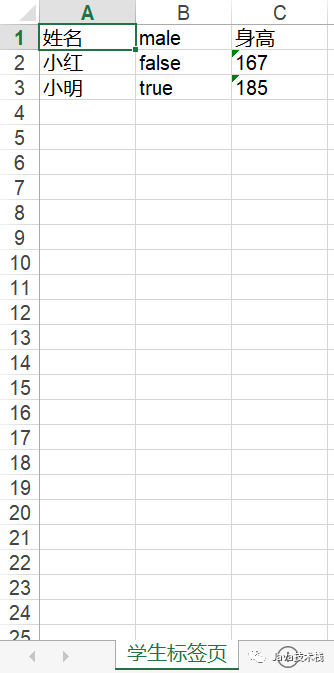
注解:
import java.lang.annotation.Retention;
import java.lang.annotation.RetentionPolicy;


@Retention(RetentionPolicy.RUNTIME)
public @interface Excel {

    public String name() default "";
}
方法:
import org.apache.log4j.Logger;
import org.apache.poi.hssf.usermodel.HSSFWorkbook;
import org.apache.poi.ss.usermodel.Cell;
import org.apache.poi.ss.usermodel.Row;
import org.apache.poi.ss.usermodel.Sheet;
import org.apache.poi.ss.usermodel.Workbook;
import org.apache.poi.xssf.usermodel.XSSFWorkbook;

import java.io.File;
import java.io.FileInputStream;
import java.io.FileNotFoundException;
import java.io.FileOutputStream;
import java.io.IOException;
import java.io.InputStream;
import java.io.OutputStream;
import java.lang.reflect.Field;
import java.lang.reflect.InvocationTargetException;
import java.lang.reflect.Method;
import java.util.ArrayList;
import java.util.List;


public class ExcelUtil {
    private static Logger log = Logger.getLogger(ExcelUtil.class);


    public static Workbook gainWorkbook(File file) throws ExcelException {
        if (!isExcel(file)) {
            throw new ExcelException("文件不是Excel類型");
        }

        if (!file.exists()) {
            try {
                OutputStream os = new FileOutputStream(file);
                Workbook workbook = isOlderEdition(file) ? new HSSFWorkbook() : new XSSFWorkbook();
                workbook.write(os);
                log.debug("文件不存在,新建該Excel文件");
                os.close();

            } catch (FileNotFoundException e) {
                e.printStackTrace();
            } catch (IOException e) {
                e.printStackTrace();
            }
        }

        try {
            InputStream is = new FileInputStream(file);
            return isOlderEdition(file) ? new HSSFWorkbook(is) : new XSSFWorkbook(is);

        } catch (FileNotFoundException e) {
            e.printStackTrace();
        } catch (IOException e) {
            e.printStackTrace();
        }

        return null;
    }


    private static boolean isOlderEdition(File file) {
        return file.getName().matches(".+\\.(?i)xls");
    }


    private static boolean isExcel(File file) {
        String fileName = file.getName();
        String regXls = ".+\\.(?i)xls";
        String regXlsx = ".+\\.(?i)xlsx";
        return fileName.matches(regXls) || fileName.matches(regXlsx);
    }


    public static <E> Workbook createExcel(List<E> list, File file) {
        String sheetName = "default";
        if (list.size() == 0) {
            return null;
        }

        Workbook workbook = null;
        try {
            Class clazz = list.get(0).getClass();
            Field[] fields = clazz.getDeclaredFields();
            if (clazz.isAnnotationPresent(Excel.class)) {
                Excel excel = (Excel) clazz.getAnnotation(Excel.class);
                sheetName = excel.name();
            }

            workbook = gainWorkbook(file);
            Sheet sheet = workbook.createSheet(sheetName);

            Row line = sheet.createRow(0);
            for (int k = 0; k < fields.length; k++) {
                Cell cell = line.createCell(k);
                String columnName = fields[k].getName();
                if (fields[k].isAnnotationPresent(Excel.class)) {
                    Excel excel = fields[k].getAnnotation(Excel.class);
                    columnName = excel.name();
                }
                cell.setCellValue(columnName);
            }

            for (int i = 1; i <= list.size(); i++) {
                Row row = sheet.createRow(i);
                for (int j = 1; j <= fields.length; j++) {
                    Cell cell = row.createCell(j - 1);
                    String fieldName = fields[j - 1].getName();
                    String fieldFirstLetterUpper = fieldName.substring(0, 1).toUpperCase();
                    String prefix = "get";
                    if ("boolean".equals(fields[j - 1].getType().getName())) {
                        prefix = "is";
                    }
                    String methodName = prefix + fieldFirstLetterUpper + fieldName.substring(1);
                    Method method = clazz.getMethod(methodName);
                    cell.setCellValue(String.valueOf(method.invoke(list.get(i - 1))));
                }
            }
            log.debug("List讀入完畢");
            OutputStream os = new FileOutputStream(file);
            workbook.write(os);
            os.close();

        } catch (ExcelException e) {
            e.printStackTrace();
        } catch (InvocationTargetException e) {
            e.printStackTrace();
        } catch (NoSuchMethodException e) {
            e.printStackTrace();
        } catch (IllegalAccessException e) {
            e.printStackTrace();
        } catch (FileNotFoundException e) {
            e.printStackTrace();
        } catch (IOException e) {
            e.printStackTrace();
        }
        return workbook;
    }
}
參考鏈接:www.yiibai.com/apache_poi/apache_poi_core_classes.html
往期推薦
看完文章,餓了點(diǎn)外賣,點(diǎn)擊 ??《無門檻外賣優(yōu)惠券,每天免費(fèi)領(lǐng)!》
END
若覺得文章對你有幫助,隨手轉(zhuǎn)發(fā)分享,也是我們繼續(xù)更新的動(dòng)力。
長按二維碼,掃掃關(guān)注哦
?「C語言中文網(wǎng)」官方公眾號(hào),關(guān)注手機(jī)閱讀教程 ?
目前收集的資料包括: Java,Python,C/C++,Linux,PHP,go,C#,QT,git/svn,人工智能,大數(shù)據(jù),單片機(jī),算法,小程序,易語言,安卓,ios,PPT,軟件教程,前端,軟件測試,簡歷,畢業(yè)設(shè)計(jì),公開課 等分類,資源在不斷更新中...