
AI芯片發(fā)展現(xiàn)狀及前景分析

         來源:專知


         本文約3500字,建議閱讀9分鐘
         本文對AI芯片的現(xiàn)狀和未來可能的技術方向做了調研和分析。
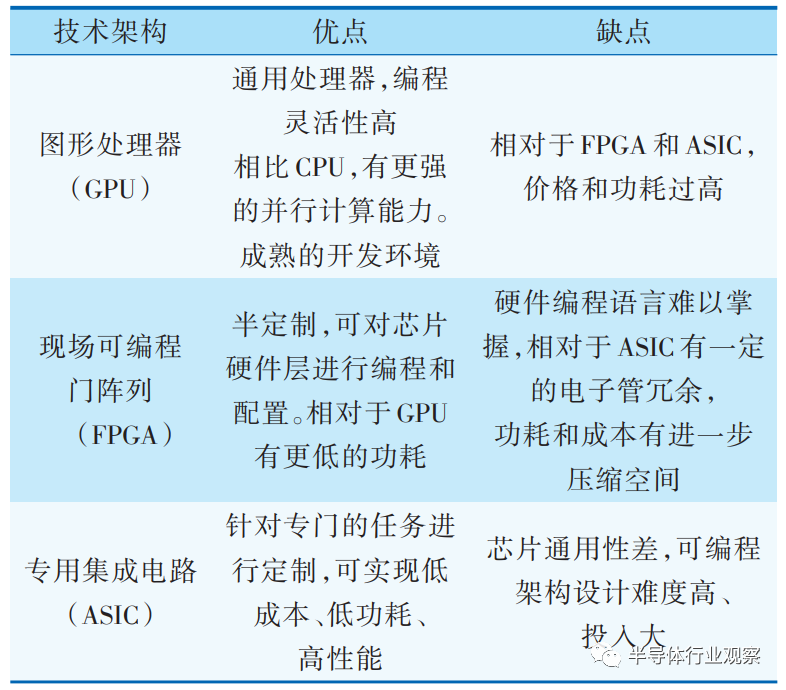
(2)深度學習算法中參與計算的數(shù)據(jù)和模型參數(shù)很多,數(shù)據(jù)量龐大,導致內存帶寬成為了整個系統(tǒng)的一個瓶頸“,Memory Wall”也是需要優(yōu)化和突破的主要問題[13]。
參考文獻:
[1] LECUN Y,BOTTOU L,BENGIO Y,et al. Gradient-based learning applied to document recognition[J]. Proceedings of the IEEE,1998,86( 11) : 2278-2324.
[2] KRIZHEVSKY A, SUTSKEVER I, HINTON G E. Imagenet classification with deep convolutional neural networks[C]// Proceedings of the 25th International Conference on Neural Information Processing Systems.ACM, 2012: 1097-1105.
[3] VINCENT P,LAROCHELLE H,BENGIO Y,et al. Extracting and composing robust features wi- h denoising autoencoders[C]// Proc of the 25th International Conference on Machine Learning. ACM Press,2008: 1096- 1103.
[4] VINCENT P,LAROCHELLE H,LAJOIE I,et al. Stacked denoising autoencoders: learning useful representations in a deep network with a local denoising criterion [J]. Journal of Machine Learning Research,2010,11( 12) : 3371-3408.
[5] 施羽暇 . 人工智能芯片技術研究[J]. 電信網(wǎng)技術, 2016, 12(12) : 11-13. SHI Y X. Research on artificial intelligence process chip technology[J]. Telecommunication network technology, 2016, 12(12) : 11-13.
[6] 清華大學 . 人工智能芯片技術白皮書 (2018)[R/OL]. (2018-12-11) [2010-01-20]. https://www.tsinghua.edu.cn/ publish/thunews/9659/2018/20181217102627644168087/ 20181217102627644168087_.html. Tsinghua University. 2018 White Paper on AI Chip Technologies[R/OL]. (2018-12-11)[2010-01-20]. https://www. tsinghua.edu.cn/publish/thunews/9659/2018/2018121710 2627644168087/20181217102627644168087_.html.
[7] BENGIO Y. Learning deep architectures for AI[J]. Foundations and Trends in Machine Learning,2009,2(1) : 1- 127.
[8] HINTON G E. Learning distributed representations of concepts[C]// Proc of the 8th Annual Conference of the Cognitive Science Society. 1986: 1-12.
[9] 尹首一, 郭珩, 魏少軍 . 人工智能芯片發(fā)展的現(xiàn)狀及 趨勢[J]. 科技導報, 2018, 17: 45-51. YIN S Y, GUO H, WEI S J. Present situation and future trend of artificial intelligence chips[J]. Science & Technology Review, 2018, 17: 45-51.
[10] 湯煒偉 . AI 安防芯片的發(fā)展現(xiàn)狀與前景分析[J]. 中 國安防, 2018, 7: 47-50. TANG W W. Analysis of the development and Prospect of AI security chip[J]. China Security&Protection, 2018, 7: 47-50.
[11] 尹首一 . 人工智能芯片概述[J]. 微納電子與智能制 造, 2019, 2: 7-11. YIN S Y. Overview of artificial intelligence chip[J]. Micro/nano Electronics and Intelligent Manufacturing, 2019, 2: 7-11.
[12] 譚洪賀,余凱 . 端側 AI 芯片的挑戰(zhàn)和展望[J]. 人工智 能, 2018, 2: 113-121. TAN H H,YU K. The challenge and prospect of edge AI chip[J]. Artificial Intelligence, 2018, 2: 113-121.
[13] 邱賜云, 李禮, 張歡, 等 . 大數(shù)據(jù)時代——從馮 · 諾依 曼到計算存儲融合[J]. 計算機科學, 2018, 45(2): 71- 75. QIU C Y, LI L, Z H, et al. Age of big data: from von neumann to computing storage fusion[J]. Computer Science, 2018, 45(2): 71-75.
[14] 趙正平 . 納電子學與神經(jīng)形態(tài)芯片的新進展[J]. 微納 電子技術, 2018, 55(1): 1-5. ZHAO Z P. New progress of nanoelectronics and neuromorphic chips[J]. Micronanoelectronic Technology, 2018, 55(1): 1-5