
Shell文本處理三劍客:grep、sed、awk
來(lái)源:https://blog.csdn.net/Z_Date/article/details/107829161
來(lái)源:https://blog.csdn.net/Z_Date/article/details/107829161
grep、sed、awk我們叫他們?nèi)齽停莆账鼈兛梢愿玫倪\(yùn)維,提升工作效率,即使不是運(yùn)維,對(duì)我們處理數(shù)據(jù)都是非常方便的~就很多數(shù)據(jù)處理來(lái)講,寫程序肯定是也能處理的,但是遠(yuǎn)沒(méi)有已經(jīng)存在特定功能的命令更高效,我們只需要操作命令即可。通過(guò)本文可以講解三劍客的一些基礎(chǔ)知識(shí)和實(shí)用,希望大家可以自己動(dòng)手敲,畢竟自己體會(huì)過(guò)的印象更深刻,后面還會(huì)持續(xù)更新。。。
grep
簡(jiǎn)介
grep是一款強(qiáng)大的文本搜索工具,支持正則表達(dá)式。
全稱( global search regular expression(RE) and print out the line)
語(yǔ)法:grep [option]... PATTERN [FILE]...
常用:
usage:?grep?[-abcDEFGHhIiJLlmnOoqRSsUVvwxZ]?[-A?num]?[-B?num]?[-C[num]]
?[-e?pattern]?[-f?file]?[--binary-files=value]?[--color=when]
?[--context[=num]]?[--directories=action]?[--label]?[--line-buffered]
?[--null]?[pattern]?[file?...]
常用參數(shù):
????????????-v????????取反
????????????-i????????忽略大小寫
????????????-c????????符合條件的行數(shù)
????????????-n????????輸出的同時(shí)打印行號(hào)
????????????^*????????以*開頭?????????
????????????*$?????????以*結(jié)尾?
????????????^$?????????空行?
實(shí)際使用
準(zhǔn)備好一個(gè)小故事txt:
[root@iz2ze76ybn73dvwmdij06zz?~]#?cat?monkey
One?day,a?little?monkey?is?playing?by?the?well.一天,有只小猴子在井邊玩兒.
He?looks?in?the well and shouts :它往井里一瞧,高喊道:
“Oh!My?god!The?moon?has?fallen?into?the?well!”?“噢!我的天!月亮掉到井里頭啦!”
An?older?monkeys?runs?over,takes?a?look,and?says,一只大猴子跑來(lái)一看,說(shuō),
“Goodness?me!The?moon?is?really?in?the?water!”?“糟啦!月亮掉在井里頭啦!”
And?olderly?monkey?comes?over.老猴子也跑過(guò)來(lái).
He is very surprised as well and cries out:他也非常驚奇,喊道:
“The?moon?is?in?the?well.”?“糟了,月亮掉在井里頭了!”
A?group?of?monkeys?run?over?to?the?well?.一群猴子跑到井邊來(lái),
They?look?at?the?moon?in?the well and shout:他們看到井里的月亮,喊道:
“The?moon?did?fall?into?the?well!Come?on!Let’get?it?out!”
“月亮掉在井里頭啦!快來(lái)!讓我們把它撈起來(lái)!”
Then,the?oldest?monkey?hangs?on?the?tree?up?side?down?,with?his?feet?on?the?branch?.
然后,老猴子倒掛在大樹上,
And?he?pulls?the?next?monkey’s?feet?with?his?hands.拉住大猴子的腳,
All?the?other?monkeys?follow?his?suit,其他的猴子一個(gè)個(gè)跟著,
And?they?join?each?other?one?by?one?down?to?the?moon?in?the?well.
它們一只連著一只直到井里.
Just?before?they?reach?the?moon,the?oldest?monkey?raises?his?head?and?happens?to?see?the?moon?in?the?sky,正好他們摸到月亮的時(shí)候,老猴子抬頭發(fā)現(xiàn)月亮掛在天上呢
He?yells?excitedly?“Don’t?be?so?foolish!The?moon?is?still?in?the?sky!”
它興奮地大叫:“別蠢了!月亮還好好地掛在天上呢!
直接查找符合條件的行
[root@iz2ze76ybn73dvwmdij06zz?~]#?grep?moon?monkey
“Oh!My?god!The?moon?has?fallen?into?the?well!”?“噢!我的天!月亮掉到井里頭啦!”
“Goodness?me!The?moon?is?really?in?the?water!”?“糟啦!月亮掉在井里頭啦!”
“The?moon?is?in?the?well.”?“糟了,月亮掉在井里頭了!”
They?look?at?the?moon?in?the well and shout:他們看到井里的月亮,喊道:
“The?moon?did?fall?into?the?well!Come?on!Let’get?it?out!”
And?they?join?each?other?one?by?one?down?to?the?moon?in?the?well.
Just?before?they?reach?the?moon,the?oldest?monkey?raises?his?head?and?happens?to?see?the?moon?in?the?sky,正好他們摸到月亮的時(shí)候,老猴子抬頭發(fā)現(xiàn)月亮掛在天上呢
He?yells?excitedly?“Don’t?be?so?foolish!The?moon?is?still?in?the?sky!”
查找反向符合條件的行
[root@iz2ze76ybn73dvwmdij06zz?~]#?grep?-v??moon?monkey
One?day,a?little?monkey?is?playing?by?the?well.一天,有只小猴子在井邊玩兒.
He?looks?in?the well and shouts :它往井里一瞧,高喊道:
An?older?monkeys?runs?over,takes?a?look,and?says,一只大猴子跑來(lái)一看,說(shuō),
And?olderly?monkey?comes?over.老猴子也跑過(guò)來(lái).
He is very surprised as well and cries out:他也非常驚奇,喊道:
A?group?of?monkeys?run?over?to?the?well?.一群猴子跑到井邊來(lái),
“月亮掉在井里頭啦!快來(lái)!讓我們把它撈起來(lái)!”
Then,the?oldest?monkey?hangs?on?the?tree?up?side?down?,with?his?feet?on?the?branch?.
然后,老猴子倒掛在大樹上,
And?he?pulls?the?next?monkey’s?feet?with?his?hands.拉住大猴子的腳,
All?the?other?monkeys?follow?his?suit,其他的猴子一個(gè)個(gè)跟著,
它們一只連著一只直到井里.
它興奮地大叫:“別蠢了!月亮還好好地掛在天上呢!”
直接查找符合條件的行數(shù)
[root@iz2ze76ybn73dvwmdij06zz?~]#?grep?-c??moon?monkey
8
忽略大小寫查找符合條件的行數(shù)
先來(lái)看一下直接查找的結(jié)果
[root@iz2ze76ybn73dvwmdij06zz?~]#?grep?my?monkey
忽略大小寫查看
[root@iz2ze76ybn73dvwmdij06zz?~]#?grep?-i?my?monkey
“Oh!My?god!The?moon?has?fallen?into?the?well!”?“噢!我的天!月亮掉到井里頭啦!”
查找符合條件的行并輸出行號(hào)
[root@iz2ze76ybn73dvwmdij06zz?~]#?grep?-n?monkey?monkey
1:One?day,a?little?monkey?is?playing?by?the?well.一天,有只小猴子在井邊玩兒.
4:An?older?monkeys?runs?over,takes?a?look,and?says,一只大猴子跑來(lái)一看,說(shuō),
6:And?olderly?monkey?comes?over.老猴子也跑過(guò)來(lái).
9:A?group?of?monkeys?run?over?to?the?well?.一群猴子跑到井邊來(lái),
13:Then,the?oldest?monkey?hangs?on?the?tree?up?side?down?,with?his?feet?on?the?branch?.
15:And?he?pulls?the?next?monkey’s?feet?with?his?hands.拉住大猴子的腳,
16:All?the?other?monkeys?follow?his?suit,其他的猴子一個(gè)個(gè)跟著,
19:Just?before?they?reach?the?moon,the?oldest?monkey?raises?his?head?and?happens?to?see?the?moon?in?the?sky,正好他們摸到月亮的時(shí)候,老猴子抬頭發(fā)現(xiàn)月亮掛在天上呢
查找開頭是J的行
[root@iz2ze76ybn73dvwmdij06zz?~]#?grep?'^J'?monkey
Just?before?they?reach?the?moon,the?oldest?monkey?raises?his?head?and?happens?to?see?the?moon?in?the?sky,正好他們摸到月亮的時(shí)候,老猴子抬頭發(fā)現(xiàn)月亮掛在天上呢
查找結(jié)尾是呢的行
[root@iz2ze76ybn73dvwmdij06zz?~]#?grep?"呢$"?monkey
Just?before?they?reach?the?moon,the?oldest?monkey?raises?his?head?and?happens?to?see?the?moon?in?the?sky,正好他們摸到月亮的時(shí)候,老猴子抬頭發(fā)現(xiàn)月亮掛在天上呢
大家可以grep --help,查看更多相關(guān)的命令,這里就不一一演示了。
小結(jié)
有了強(qiáng)大的網(wǎng)絡(luò)以后,很多東西都可以在網(wǎng)上找到,但是基礎(chǔ)的一定要自己 熟練掌握,才回在遇到事情的時(shí)候不慌。
sed
sed是一種流編輯器,是一款處理文本比較優(yōu)秀的工具,可以結(jié)合正則表達(dá)式一起使用。
sed執(zhí)行過(guò)程
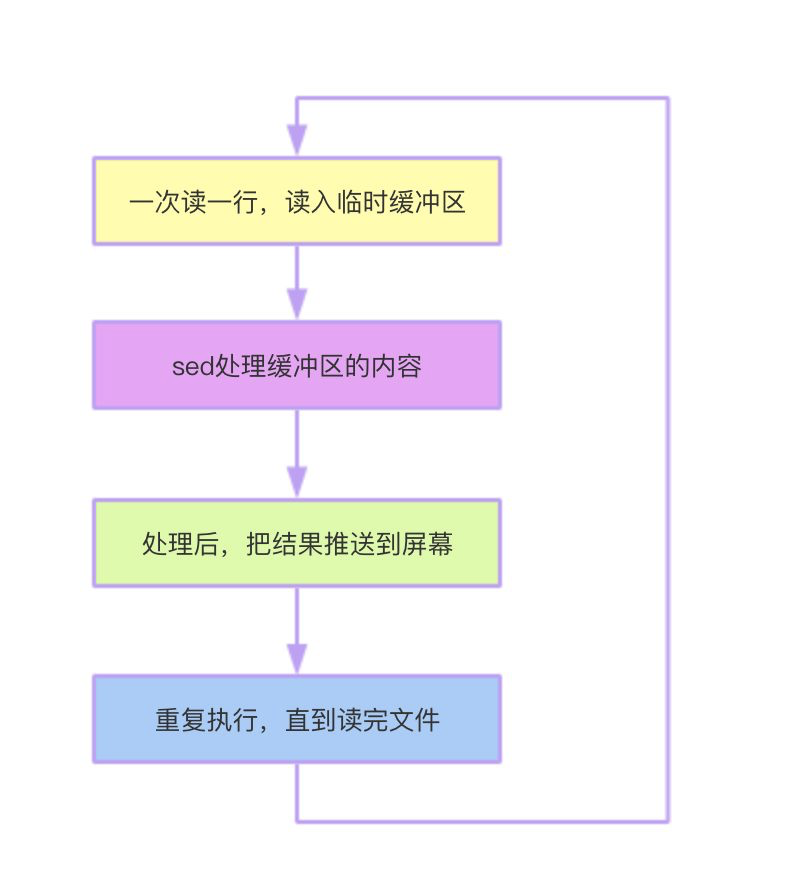
sed命令
命令: sed
語(yǔ)法 : ?sed [選項(xiàng)]... {命令集} [輸入文件]...
常用命令:
????????????d??刪除選擇的行????
????????????s???查找????
????????????y??替換
????????????i???當(dāng)前行前面插入一行
????????????a??當(dāng)前行后面插入一行
????????????p??打印行???????
????????????q??退出?????

?替換符:

????????????數(shù)字?:替換第幾處????
????????????g?:??全局替換????
????????????\1:??子串匹配標(biāo)記,前面搜索可以用元字符集\(..\)
????????????&:??保留搜索刀的字符用來(lái)替換其他字符
操作:
替換
查看文件:
???happy?cat?word
Twinkle,?twinkle,?little?star
How?I?wonder?what?you?are
Up?above?the?world?so?high
Like?a?diamond?in?the?sky
When?the?blazing?sun?is?gone
替換:
???happy?sed?'s/little/big/'?word
Twinkle,?twinkle,?big?star
How?I?wonder?what?you?are
Up?above?the?world?so?high
Like?a?diamond?in?the?sky
When?the?blazing?sun?is?gone
查看文本:
???happy?cat?word1
Oh?if?there's?one?thing?to?be?taught
it's?dreams?are?made?to?be?caught
and?friends?can?never?be?bought
Doesn't?matter?how?long?it's?been
I?know?you'll?always?jump?in
'Cause?we?don't?know?how?to?quit
全局替換:
???happy?sed?'s/to/can/g'?word1
Oh?if?there's?one?thing?can?be?taught
it's?dreams?are?made?can?be?caught
and?friends?can?never?be?bought
Doesn't?matter?how?long?it's?been
I?know?you'll?always?jump?in
'Cause?we?don't?know?how?can?quit
按行替換(替換2到最后一行)
???happy?sed?'2,$s/to/can/'?word1
Oh?if?there's?one?thing?to?be?taught
it's?dreams?are?made?can?be?caught
and?friends?can?never?be?bought
Doesn't?matter?how?long?it's?been
I?know?you'll?always?jump?in
'Cause?we?don't?know?how?can?quit
刪除:
查看文本:
???happy?cat?word
Twinkle,?twinkle,?little?star
How?I?wonder?what?you?are
Up?above?the?world?so?high
Like?a?diamond?in?the?sky
When?the?blazing?sun?is?gone
刪除:
???happy?sed?'2d'?word
Twinkle,?twinkle,?little?star
Up?above?the?world?so?high
Like?a?diamond?in?the?sky
When?the?blazing?sun?is?gone
顯示行號(hào):
???happy?sed?'=;2d'?word
1
Twinkle,?twinkle,?little?star
2
3
Up?above?the?world?so?high
4
Like?a?diamond?in?the?sky
5
When?the?blazing?sun?is?gone
刪除第2行到第四行:
???happy?sed?'=;2,4d'?word
1
Twinkle,?twinkle,?little?star
2
3
4
5
When?the?blazing?sun?is?gone
添加行:
向前插入:
???happy?echo?"hello"?|?sed?'i\kitty'
kitty
hello
向后插入:
???happy?echo?"kitty"?|?sed?'i\hello'
hello
kitty
修改行:
替換第二行為hello kitty
???happy?sed?'2c\hello?kitty'?word
Twinkle,?twinkle,?little?star
hello?kitty
Up?above?the?world?so?high
Like?a?diamond?in?the?sky
When?the?blazing?sun?is?gone
替換第二行到最后一行為hello kitty
???happy?sed?'2,$c\hello?kitty'?word
Twinkle,?twinkle,?little?star
hello?kitty
寫入行
把帶star的行寫入c文件中,c提前創(chuàng)建
???happy?sed?-n?'/star/w?c'?word
???happy?cat?c
Twinkle,?twinkle,?little?star
退出
打印3行后,退出sed
???happy?sed?'3q'?word
Twinkle,?twinkle,?little?star
How?I?wonder?what?you?are
Up?above?the?world?so?high
awk
名字由來(lái)
創(chuàng)始人 Alfred Aho 、Peter Weinberger 和 Brian Kernighan 姓氏的首個(gè)字母。
強(qiáng)大的文本處理工具
比起sed和grep,awk不僅僅是一個(gè)小工具,也可以算得上一種小型的編程語(yǔ)言了,支持if判斷分支和while循環(huán)語(yǔ)句還有它的內(nèi)置函數(shù)等,是一個(gè)要比grep和sed更強(qiáng)大的文本處理工具,但也就意味著要學(xué)習(xí)的東西更多了。
下面來(lái)說(shuō)一下awk的一些基礎(chǔ)概念以及實(shí)際操作。
語(yǔ)法
常用
Usage: awk [POSIX or GNU style options] -f progfile [--] file ...
Usage: awk [POSIX or GNU style options] [--] 'program' file ...
域
類似數(shù)據(jù)庫(kù)列的概念,但它是按照序號(hào)來(lái)指定的,比如我要第一個(gè)列就是2,依此類推。$0就是輸出整個(gè)文本的內(nèi)容。默認(rèn)用空格作為分隔符,當(dāng)然你可以自己通過(guò)-F設(shè)置適合自己情況的分隔符。
提前自己編了一段數(shù)據(jù),學(xué)生以及學(xué)生成績(jī)數(shù)據(jù)表。
| 列數(shù) | 名稱 | 描述 |
|---|---|---|
| 1 | Name | 姓名 |
| 2 | Math | 數(shù)學(xué) |
| 3 | Chinese | 語(yǔ)文 |
| 4 | English | 英語(yǔ) |
| 5 | History | 歷史 |
| 6 | Sport | 體育 |
| 8 | Grade | 班級(jí) |
"Name ? ? Math ?Chinese ?English History ?Sport grade 輸出整個(gè)文本
[root@iz2ze76ybn73dvwmdij06zz?~]#?awk?'{print?$0}'?students_store
Xiaoka??????????60???80????40????90???77??class-1
Yizhihua????????70????66???50????80???90??class-1
kerwin??????????80????90???60????70???60??class-2
Fengzheng???????90????78????62???40???62??class-2
輸出第一列(姓名列)
[root@iz2ze76ybn73dvwmdij06zz?~]#?awk?'{print?$1}'?students_store
Xiaoka
Yizhihua
kerwin
Fengzheng
模式&動(dòng)作
awk?'{[pattern]?action}'?{filenames}??
模式
pattern 可以是
條件語(yǔ)句 正則
模式的兩個(gè)特殊字段 BEGIN 和 END (不指定時(shí)匹配或打印行數(shù))
BEGIN :一般用來(lái)打印列名稱。
END : 一般用來(lái)打印總結(jié)性質(zhì)的字符。
動(dòng)作
action 在{}內(nèi)指定,一般用來(lái)打印,也可以是一個(gè)代碼段。
示例
給上面的文本加入標(biāo)題頭:
[root@iz2ze76ybn73dvwmdij06zz?~]#??awk?'BEGIN?{print?"Name?????Math??Chinese??English?History??Sport?grade\n----------------------------------------------"}?{print?$0}'?students_store

Name?????????Math??Chinese??English?History??Sport??grade
----------------------------------------------------------
Xiaoka???????60????80???????40??????90?????77????class-1
Yizhihua?????70????66???????50??????80?????90????class-1
kerwin???????80????90???????60??????70?????60????class-2
Fengzheng????90????78???????62??????40?????62????class-2
僅打印姓名、數(shù)學(xué)成績(jī)、班級(jí)信息,再加一個(gè)文尾(再接再厲):
[root@iz2ze76ybn73dvwmdij06zz?~]#?awk?'BEGIN?{print?"Name???Math??grade\n---------------------"}?{print?$1?2?"\t"?$7}?END?{print?"continue?to?exert?oneself"}'?students_store

Name?????Math??grade
---------------------
Xiaoka???60???class-1
Yizhihua?70???class-1
kerwin???80???class-2
Fengzheng?90??class-2
continue?to?exert?oneself
結(jié)合正則
像grep和sed也是支持正則表達(dá)式的。這邊就不介紹正則表達(dá)式了,如果有興趣,我單出一個(gè)文章。
使用方法:
符號(hào) ~ ?后接正則表達(dá)式
此時(shí)我們?cè)偌尤胍粭l后來(lái)的新同學(xué),并且沒(méi)有分班。
先來(lái)看下現(xiàn)在的數(shù)據(jù)
[root@iz2ze76ybn73dvwmdij06zz?~]#?cat?students_store
Xiaoka???????60???80????40????90???77??class-1
Yizhihua?????70????66???50????80???90??class-1
kerwin???????80????90???60????70???60??class-2
Fengzheng????90????78???62????40???62??class-2
xman?????????-?????-?????-?????-???-????-
模糊匹配|查詢已經(jīng)分班的學(xué)生
[root@iz2ze76ybn73dvwmdij06zz?~]#?awk?'$0?~/class/'?students_store
Xiaoka???????60???80????40????90???77??class-1
Yizhihua?????70????66???50????80???90??class-1
kerwin???????80????90???60?????70??60??class-2
Fengzheng????90????78???62?????40??62??class-2
精準(zhǔn)匹配|查詢1班的學(xué)生
[root@iz2ze76ybn73dvwmdij06zz?~]#?awk?'$7=="class-1"?{print?$0}'??students_store
Xiaoka???????60???80????40????90???77??class-1
Yizhihua?????70????66???50????80???90??class-1
反向匹配|查詢不是1班的學(xué)生
[root@iz2ze76ybn73dvwmdij06zz?~]#?awk?'$7!="class-1"?{print?$0}'??students_store
kerwin???????80????90???60?????70???60??class-2
Fengzheng????90????78????62?????40??62?class-2
xman?????????-?????-?????-?????-???-????-
比較操作
查詢數(shù)學(xué)大于80的
[root@iz2ze76ybn73dvwmdij06zz?~]#?awk?'$2>60?{print?$0}'??students_store
Yizhihua?????70????66???50????80???90??class-1
kerwin???????80????90???60?????70???60??class-2
Fengzheng????90????78????62?????40??62?class-2
查詢數(shù)學(xué)大于英語(yǔ)成績(jī)的
[root@iz2ze76ybn73dvwmdij06zz?~]#?awk?'$2?>?$4??{print?$0}'??students_store
Xiaoka???????60???80????40????90???77??class-1
Yizhihua?????70????66???50????80???90??class-1
kerwin???????80????90???60????70???60??class-2
Fengzheng????90????78????62???40???62??class-2
匹配指定字符中的任意字符
在加一列專業(yè),讓我們來(lái)看看憨憨們的專業(yè),順便給最后一個(gè)新來(lái)的同學(xué)分個(gè)班吧。
然后再來(lái)看下此時(shí)的數(shù)據(jù)。
[root@iz2ze76ybn73dvwmdij06zz?~]#?cat?students_store
Xiaoka???????60???80????40????90???77??class-1??Java
Yizhihua?????70????66???50????80???90??class-1??java
kerwin???????80????90???60?????70???60??class-2?Java
Fengzheng????90????78????62?????40??62?class-2??java
xman?????????-?????-?????-?????-???-????class-3?php
或關(guān)系匹配|查詢1班和3班的學(xué)生
root@iz2ze76ybn73dvwmdij06zz?~]#?awk?'$0?~/(class-1|class-3)/'?students_store
Xiaoka???????60???80????40????90???77??class-1??Java
Yizhihua?????70????66???50????80???90??class-1??java
xman?????????-?????-?????-?????-???-???class-3?php
任意字符匹配|名字第二個(gè)字母是
字符解釋:
^ : 字段或記錄的開頭。
. : 任意字符。
root@iz2ze76ybn73dvwmdij06zz?~]#?awk?'$0?~/(class-1|class-3)/'?students_store
Xiaoka???????60???80????40????90???77??class-1??Java
Yizhihua?????70????66???50????80???90??class-1??java
xman?????????-?????-?????-?????-???-????class-3?php
復(fù)合表達(dá)式
&& AND
的關(guān)系,必同時(shí)滿足才行哦~
查詢數(shù)學(xué)成績(jī)大于60并且語(yǔ)文成績(jī)也大于60的童鞋。
[root@iz2ze76ybn73dvwmdij06zz?~]#?awk?'{?if?($2?>?60?&&?$3?>?60)?print?$0}'?students_store
Yizhihua?????70????66???50????80???90??class-1??java
kerwin???????80????90???60????70???60??class-2??Java
Fengzheng????90????78????62???40???62??class-2??java
|| ?OR
查詢數(shù)學(xué)大于80或者語(yǔ)文大于80的童鞋。
[root@iz2ze76ybn73dvwmdij06zz?~]#??awk?'{?if?($2?>?80?||?$4?>?80)?print?$0}'?students_store
Fengzheng????90????78????62?????40??62?class-2??java
printf 格式化輸出
除了能達(dá)到功能以外,一個(gè)好看的格式也是必不可少的,因此格式化的輸出看起來(lái)會(huì)更舒服哦~
語(yǔ)法
printf ([格式],參數(shù))
printf %x(格式) 具體參數(shù) x代表具體格式
| 符號(hào) | 說(shuō)明 |
|---|---|
| - | 左對(duì)齊 |
| Width | 域的步長(zhǎng) |
| .prec | 最大字符串長(zhǎng)度或小數(shù)點(diǎn)右邊位數(shù) |
格式轉(zhuǎn)化符
其實(shí)和其他語(yǔ)言大同小異的
常用格式
| 符號(hào) | 描述 |
|---|---|
| %c | ASCII |
| %d | 整數(shù) |
| %o | 八進(jìn)制 |
| %x | 十六進(jìn)制數(shù) |
| %f | 浮點(diǎn)數(shù) |
| %e | 浮點(diǎn)數(shù)(科學(xué)記數(shù)法) |
| % s | 字符串 |
| %g | 決定使用浮點(diǎn)轉(zhuǎn)化e/f |
具體操作示例
ASCII碼?
[root@iz2ze76ybn73dvwmdij06zz?~]#?echo?"66"?|?awk?'{printf?"%c\n",$0}'
B
浮點(diǎn)數(shù)
[root@iz2ze76ybn73dvwmdij06zz?~]#?awk?'BEGIN?{printf?"%f\n",100}'
100.000000
16進(jìn)制數(shù)
[root@iz2ze76ybn73dvwmdij06zz?~]#?awk?'BEGIN?{printf?"%x",996}'
3e4
更多操作,小伙伴有興趣可以挨個(gè)試試~
內(nèi)置變量
頻率較高常用內(nèi)置變量
NF :記錄瀏覽域的個(gè)數(shù),在記錄被讀后設(shè)置。
NR :已讀的記錄數(shù)。
FS : 設(shè)置輸入域分隔符
A R G C :命令行參數(shù)個(gè)數(shù),支持命令行傳入。
RS : 控制記錄分隔符
FIlENAME : awk當(dāng)前讀文件的名稱
操作
輸出學(xué)生成績(jī)表和域個(gè)數(shù)以及已讀記錄數(shù)。
[root@iz2ze76ybn73dvwmdij06zz?~]#?awk?'{print?$0,?NF?,?NR}'?students_store
Xiaoka???????60???80????40????90???77??class-1??Java?8?1
Yizhihua?????70????66???50????80???90??class-1??java?8?2
kerwin???????80????90???60?????70??60??class-2??Java?8?3
Fengzheng????90????78???62?????40??62??class-2??java?8?4
xman?????????-?????-?????-?????-???-???class-3??php??8?5
內(nèi)置函數(shù)
常用函數(shù)
length(s) ?返回s長(zhǎng)度
index(s,t) 返回s中字符串t第一次出現(xiàn)的位置
match (s,r) s中是否包含r字符串
split(s,a,fs) 在fs上將s分成序列a
gsub(r,s) 用s代替r,范圍全文本
gsub(r,s,t) 范圍t中,s代替r
substr(s,p) 返回字符串s從第p個(gè)位置開始后面的部分(下標(biāo)是從1 開始算的,大家可以自己試試)
substr(s,p,n) 返回字符串s從第p個(gè)位置開始后面n個(gè)字符串的部分
操作
length
[root@iz2ze76ybn73dvwmdij06zz?~]#?awk?'BEGIN?{print?length("?hello,im?xiaoka")}'
16
index
[root@iz2ze76ybn73dvwmdij06zz?~]#?awk?'BEGIN?{print?index("xiaoka","ok")}'
4
match
[root@iz2ze76ybn73dvwmdij06zz?~]#?awk?'BEGIN?{print?match("Java小咖秀","va小")}'
3
gsub
[root@iz2ze76ybn73dvwmdij06zz?~]#?awk?'gsub("Xiaoka","xk")?{print?$0}'?students_store
xk???????60???80????40????90???77??class-1??Java
substr(s,p)
[root@iz2ze76ybn73dvwmdij06zz?~]#?awk?'BEGIN?{print?substr("xiaoka",3)}'
aoka
substr(s,p,n)
[root@iz2ze76ybn73dvwmdij06zz?~]#?awk?'BEGIN?{print?substr("xiaoka",3,2)}'
ao
split
[root@iz2ze76ybn73dvwmdij06zz?~]#?str="java,xiao,ka,xiu"
[root@iz2ze76ybn73dvwmdij06zz?~]#?awk?'BEGIN{split('"\"$str\""',ary,",");?for(i?in?ary)?{if(ary[i]>1)?print?ary[i]}}'
xiu
java
xiao
ka
awk腳本
前面說(shuō)過(guò)awk是可以說(shuō)是一個(gè)小型編程語(yǔ)言。如果命令比較短我們可以直接在命令行執(zhí)行,當(dāng)命令行比較長(zhǎng)的時(shí)候,可以使用腳本來(lái)處理,比命令行的可讀性更高,還可以加上注釋。
寫一個(gè)完整的awk腳本并執(zhí)行步驟
1.先創(chuàng)建一個(gè)awk文件
[root@iz2ze76ybn73dvwmdij06zz?~]#?vim?printname.awk
2.腳本第一行要指定解釋器
#!/usr/bin/awk?-f
3.編寫腳本內(nèi)容,打印一下名稱
[root@iz2ze76ybn73dvwmdij06zz?~]#?cat?printname.awk
#!/usr/bin/awk?-f
#可以加注釋了,哈哈
BEGIN?{?print?"my?name?is?Java小咖秀"}
4.既然是腳本,必不可少的可執(zhí)行權(quán)限安排上~
[root@iz2ze76ybn73dvwmdij06zz?~]#?chmod?+x?printname.awk
[root@iz2ze76ybn73dvwmdij06zz?~]#?ll?printname.awk
-rwxr-xr-x?1?root?root?60?7月???1?15:23?printname.awk
5.有了可執(zhí)行權(quán)限,我們來(lái)執(zhí)行下看結(jié)果
[root@iz2ze76ybn73dvwmdij06zz?~]#?./printname.awk
my?name?is?Java小咖秀
了解了寫awk腳本的步驟以后大家就可以自己去寫一波了~
- END -
精彩文章推薦:
Java 應(yīng)用運(yùn)維最常見的3個(gè)問(wèn)題排查思路
SSH只能用于遠(yuǎn)程Linux主機(jī)?那說(shuō)明你見識(shí)太短了!
10 個(gè)Linux Awk文本處理經(jīng)典案例
Nginx實(shí)現(xiàn)高效負(fù)載均衡器就是這么簡(jiǎn)單!
部署一套完整的Kubernetes高可用集群(二進(jìn)制)
點(diǎn)亮,服務(wù)器三年不宕機(jī)
