Spring 如何整合Mybatis,源碼不難嘛!

Java技術(shù)棧
www.javastack.cn
關(guān)注閱讀更多優(yōu)質(zhì)文章
Spring整合Mybatis會(huì)進(jìn)行如下的配置(條條大路通羅馬,方式不唯一)。
private?static?final?String?ONE_MAPPER_BASE_PACKAGE?=?"com.XXX.dao.mapper.one";
@Bean
public?MapperScannerConfigurer?oneMapperScannerConfigurer()?{
????MapperScannerConfigurer?mapperScannerConfigurer?=?new?MapperScannerConfigurer();
????mapperScannerConfigurer.setBasePackage(ONE_MAPPER_BASE_PACKAGE);
????mapperScannerConfigurer.
????????????????setSqlSessionFactoryBeanName("oneSqlSessionFactoryBean");
????return?mapperScannerConfigurer;
}
@Primary
@Bean(name="oneSqlSessionFactoryBean")
public?SqlSessionFactoryBean?oneSqlSessionFactoryBean(?@Qualifier("oneDataSource")?DruidDataSource?oneDataSource)?{
????return?getSqlSessionFactoryBeanDruid(oneDataSource,ONE_MAPPER_XML);
}
短短不到20行代碼,就完成了Spring整合Mybatis。
Amazing!!!
這背后到底發(fā)生了什么?
還要從MapperScannerConfigurer 和SqlSessionFactoryBean 著手。
MapperScannerConfigurer
類(lèi)注釋
beanDefinitionRegistryPostProcessor從 base package遞歸搜索接口,將它們注冊(cè)為MapperFactoryBean。注意接口必須包含至少一個(gè)方法,其實(shí)現(xiàn)類(lèi)將被忽略。
1.0.1以前是對(duì)BeanFactoryPostProcessor進(jìn)行擴(kuò)展,1.0.2以后是對(duì) BeanDefinitionRegistryPostProcessor進(jìn)行擴(kuò)展,具體原因請(qǐng)查閱https://jira.springsource.org/browse/SPR-8269
basePackage可以配置多個(gè),使用逗號(hào)或者分號(hào)分割。
通過(guò)annotationClass或markerInterface,可以設(shè)置指定掃描的接口。默認(rèn)情況下這個(gè)2個(gè)屬性為空,basePackage下的所有接口將被掃描。
MapperScannerConfigurer為它創(chuàng)建的bean自動(dòng)注入SqlSessionFactory或SqlSessionTemplate如果存在多個(gè)SqlSessionFactory,需要設(shè)置sqlSessionFactoryBeanName或sqlSessionTemplateBeanName來(lái)指定具體注入的sqlSessionFactory或sqlSessionTemplate。
不能傳入有占位符的對(duì)象(例如:包含數(shù)據(jù)庫(kù)的用戶(hù)名和密碼占位符的對(duì)象)。可以使用beanName,將實(shí)際的對(duì)象創(chuàng)建推遲到所有占位符替換完成后。注意MapperScannerConfigurer支持它自己的屬性使用占位符,使用${property}這個(gè)種格式。
類(lèi)圖找關(guān)鍵方法

從類(lèi)圖上看MapperScannerConfigurer實(shí)現(xiàn)了BeanDefinitionRegistryPostProcessor, InitializingBean, ApplicationContextAware, BeanNameAware接口。各個(gè)接口具體含義如下:
ApplicationContextAware:當(dāng)spring容器初始化后,會(huì)自動(dòng)注入ApplicationContext
BeanNameAware :設(shè)置當(dāng)前Bean在Spring中的名字
InitializingBean接口只包括afterPropertiesSet方法,在初始化bean的時(shí)候會(huì)執(zhí)行
BeanDefinitionRegistryPostProcessor:對(duì)BeanFactoryPostProcessor的擴(kuò)展,允許在BeanFactoryPostProcessor執(zhí)行前注冊(cè)多個(gè)bean的定義。需要擴(kuò)展的方法為postProcessBeanDefinitionRegistry。
查詢(xún),MapperScannerConfigurer的afterPropertiesSet方法如下,無(wú)具體擴(kuò)展信息。
@Override?
public?void?afterPropertiesSet()?throws?Exception?{
notNull(this.basePackage,?"Property?'basePackage'?is?required");?
}
結(jié)合MapperScannerConfigurer的注釋與類(lèi)圖分析,確定其核心方法為:postProcessBeanDefinitionRegistry。
現(xiàn)在都是 Spring Boot 天下了,這個(gè)倉(cāng)庫(kù)推給大家學(xué)習(xí)下:https://github.com/javastacks/spring-boot-best-practice
postProcessBeanDefinitionRegistry分析
@Override
public?void?postProcessBeanDefinitionRegistry(
????????????????????BeanDefinitionRegistry?registry)?{
??if?(this.processPropertyPlaceHolders)?{
??????//1.?占位符屬性處理
????processPropertyPlaceHolders();
??}

??ClassPathMapperScanner?scanner?=?new?ClassPathMapperScanner(registry);
??scanner.setAddToConfig(this.addToConfig);
??scanner.setAnnotationClass(this.annotationClass);
??scanner.setMarkerInterface(this.markerInterface);
??scanner.setSqlSessionFactory(this.sqlSessionFactory);
??scanner.setSqlSessionTemplate(this.sqlSessionTemplate);
??scanner.setSqlSessionFactoryBeanName(this.sqlSessionFactoryBeanName);
??scanner.setSqlSessionTemplateBeanName(this.sqlSessionTemplateBeanName);
??scanner.setResourceLoader(this.applicationContext);
??scanner.setBeanNameGenerator(this.nameGenerator);
??//2.設(shè)置過(guò)濾器
??scanner.registerFilters();
??//3.掃描java文件
??scanner.scan(StringUtils.tokenizeToStringArray(this.basePackage,?
??????????ConfigurableApplicationContext.CONFIG_LOCATION_DELIMITERS));
}
從源碼中看到除了processPropertyPlaceHolders外,其他工作都委托了ClassPathMapperScanner。關(guān)注公眾號(hào)Java技術(shù)棧回復(fù)spring獲取一份完整Spring系列教程。
processPropertyPlaceHolders處理占位符
之前說(shuō)BeanDefinitionRegistryPostProcessor在BeanFactoryPostProcessor執(zhí)行前調(diào)用,
這就意味著Spring處理占位符的類(lèi)PropertyResourceConfigurer還沒(méi)有執(zhí)行!
那MapperScannerConfigurer是如何支撐自己的屬性使用占位符的呢?這一切的答案都在processPropertyPlaceHolders這個(gè)方法中。
private?void?processPropertyPlaceHolders()?{
??Map?prcs?=
???????applicationContext.getBeansOfType(PropertyResourceConfigurer.class);
??if?(!prcs.isEmpty()?&&?applicationContext?
??????????????????????instanceof?GenericApplicationContext)?{
????BeanDefinition?mapperScannerBean?=?
????????????((GenericApplicationContext)?applicationContext)
????????????????????????.getBeanFactory().getBeanDefinition(beanName);
????//?PropertyResourceConfigurer?沒(méi)有暴露方法直接替換占位符,
????//?創(chuàng)建一個(gè)?BeanFactory包含MapperScannerConfigurer
????//?然后執(zhí)行BeanFactory后處理即可
????DefaultListableBeanFactory?factory?=?new?DefaultListableBeanFactory();
????factory.registerBeanDefinition(beanName,?mapperScannerBean);

????for?(PropertyResourceConfigurer?prc?:?prcs.values())?{
??????prc.postProcessBeanFactory(factory);
????}
????PropertyValues?values?=?mapperScannerBean.getPropertyValues();
????this.basePackage?=?updatePropertyValue("basePackage",?values);
????this.sqlSessionFactoryBeanName?=
????????????updatePropertyValue("sqlSessionFactoryBeanName",?values);
????this.sqlSessionTemplateBeanName?=?
????????????updatePropertyValue("sqlSessionTemplateBeanName",?values);
??}
}
看完processPropertyPlaceHolders,可以總結(jié) MapperScannerConfigurer支持它自己的屬性使用占位符的方式
找到所有已經(jīng)注冊(cè)的PropertyResourceConfigurer類(lèi)型的Bean
使用new DefaultListableBeanFactory()來(lái)模擬Spring環(huán)境,將MapperScannerConfigurer注冊(cè)到這個(gè)BeanFactory中,執(zhí)行BeanFactory的后處理,來(lái)替換占位符。
ClassPathMapperScanner的registerFilters方法
MapperScannerConfigurer的類(lèi)注釋中有一條:
通過(guò)annotationClass或markerInterface,可以設(shè)置指定掃描的接口,默認(rèn)情況下這個(gè)2個(gè)屬性為空,basePackage下的所有接口將被掃描。
scanner.registerFilters(),就是對(duì)annotationClass和markerInterface的設(shè)置。
public?void?registerFilters()?{
??boolean?acceptAllInterfaces?=?true;

??//?如果指定了annotationClass,
??if?(this.annotationClass?!=?null)?{
????addIncludeFilter(new?AnnotationTypeFilter(this.annotationClass));
????acceptAllInterfaces?=?false;
??}
??//?重寫(xiě)AssignableTypeFilter以忽略實(shí)際標(biāo)記接口上的匹配項(xiàng)
??if?(this.markerInterface?!=?null)?{
????addIncludeFilter(new?AssignableTypeFilter(this.markerInterface)?{
??????@Override
??????protected?boolean?matchClassName(String?className)?{
????????return?false;
??????}
????});
????acceptAllInterfaces?=?false;
??}

??if?(acceptAllInterfaces)?{
????//?默認(rèn)處理所有接口
????addIncludeFilter(new?TypeFilter()?{
??????@Override
??????public?boolean?match(
??????MetadataReader?metadataReader,?
??????MetadataReaderFactory?metadataReaderFactory)?throws?IOException?{
????????return?true;
??????}
????});
??}

??//?不包含以package-info結(jié)尾的java文件
??//?package-info.java包級(jí)文檔和包級(jí)別注釋
??addExcludeFilter(new?TypeFilter()?{
????@Override
????public?boolean?match(MetadataReader?metadataReader,?
????MetadataReaderFactory?metadataReaderFactory)?throws?IOException?{
??????String?className?=?metadataReader.getClassMetadata().getClassName();
??????return?className.endsWith("package-info");
????}
??});
}
雖然設(shè)置了過(guò)濾器,如何在掃描中起作用就要看scanner.scan方法了。
ClassPathMapperScanner的scan方法
public?int?scan(String...?basePackages)?{
???int?beanCountAtScanStart?=?this.registry.getBeanDefinitionCount();
???doScan(basePackages);
???//?注冊(cè)注解配置處理器
???if?(this.includeAnnotationConfig)?{
??????AnnotationConfigUtils
??????????????????.registerAnnotationConfigProcessors(this.registry);
???}
???return?(this.registry.getBeanDefinitionCount()?-?beanCountAtScanStart);
}
doScan方法如下:
public?Set?doScan(String...?basePackages)?{
??Set?beanDefinitions?=?super.doScan(basePackages);
??if?(beanDefinitions.isEmpty())?{
????logger.warn("No?MyBatis?mapper?was?found?in?'"?
????????????????+?Arrays.toString(basePackages)?
????????????????+?"'?package.?Please?check?your?configuration.");
??}?else?{
????processBeanDefinitions(beanDefinitions);
??}
??return?beanDefinitions;
}
位于ClassPathMapperScanner的父類(lèi)ClassPathBeanDefinitionScanner的doScan方法,就是掃描包下的所有java文件轉(zhuǎn)換為BeanDefinition(實(shí)際是ScannedGenericBeanDefinition)。
processBeanDefinitions就是將之前的BeanDefinition轉(zhuǎn)換為MapperFactoryBean的BeanDefinition。
至于過(guò)濾器如何生效(即annotationClass或markerInterface)呢?關(guān)注公眾號(hào)Java技術(shù)棧回復(fù)spring獲取一份完整Spring系列教程。
我一路追蹤源碼

終于在ClassPathScanningCandidateComponentProvider的isCandidateComponent找到了對(duì)過(guò)濾器的處理
protected?boolean?isCandidateComponent(MetadataReader?metadataReader)?throws?IOException?{
???for?(TypeFilter?tf?:?this.excludeFilters)?{
??????if?(tf.match(metadataReader,?this.metadataReaderFactory))?{
?????????return?false;
??????}
???}
???for?(TypeFilter?tf?:?this.includeFilters)?{
??????if?(tf.match(metadataReader,?this.metadataReaderFactory))?{
?????????return?isConditionMatch(metadataReader);
??????}
???}
???return?false;
}
總結(jié)MapperScannerConfigurer的作用
MapperScannerConfigurer實(shí)現(xiàn)了beanDefinitionRegistryPostProcessor的postProcessBeanDefinitionRegistry方法。
從指定的 basePackage的目錄遞歸搜索接口,將它們注冊(cè)為MapperFactoryBean。現(xiàn)在都是 Spring Boot 天下了,這個(gè)倉(cāng)庫(kù)推給大家學(xué)習(xí)下:https://github.com/javastacks/spring-boot-best-practice
SqlSessionFactoryBean
類(lèi)注釋
創(chuàng)建Mybatis的SqiSessionFactory,用于Spring上下文中進(jìn)行共享。
SqiSessionFactory可以通過(guò)依賴(lài)注入到與mybatis的daos中。
datasourcetransactionmanager,jtatransactionmanager與sqlsessionfactory想結(jié)合實(shí)現(xiàn)事務(wù)。
類(lèi)圖找關(guān)鍵方法
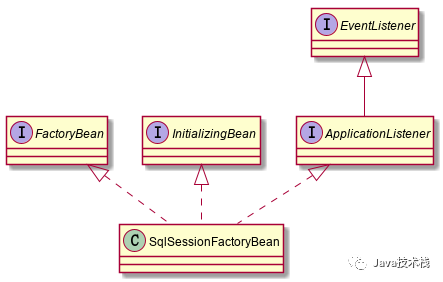
SqlSessionFactoryBean實(shí)現(xiàn)了ApplicationListener ,InitializingBean,F(xiàn)actoryBean接口,各個(gè)接口的說(shuō)明如下:
ApplicationListener 用于監(jiān)聽(tīng)Spring的事件
InitializingBean接口只包括afterPropertiesSet方法,在初始化bean的時(shí)候會(huì)執(zhí)行
FactoryBean:返回的對(duì)象不是指定類(lèi)的一個(gè)實(shí)例,其返回的是該FactoryBean的getObject方法所返回的對(duì)象
應(yīng)該重點(diǎn)關(guān)注afterPropertiesSet和getObject的方法。
關(guān)鍵方法分析
afterPropertiesSet方法
public?void?afterPropertiesSet()?throws?Exception?{
??notNull(dataSource,?"Property?'dataSource'?is?required");
??notNull(sqlSessionFactoryBuilder,?
??????????????"Property?'sqlSessionFactoryBuilder'?is?required");
??state((configuration?==?null?&&?configLocation?==?null)?
??????????||?!(configuration?!=?null?&&?configLocation?!=?null),
??"Property?'configuration'?and?'configLocation'?can?not?specified?with?together");
??this.sqlSessionFactory?=?buildSqlSessionFactory();
}
buildSqlSessionFactory看方法名稱(chēng)就知道在這里進(jìn)行了SqlSessionFactory的創(chuàng)建,具體源碼不在贅述。
getObject方法
public?SqlSessionFactory?getObject()?throws?Exception?{
??if?(this.sqlSessionFactory?==?null)?{
????afterPropertiesSet();
??}
??return?this.sqlSessionFactory;
}
總結(jié)SqlSessionFactoryBean
實(shí)現(xiàn)了InitializingBean的afterPropertiesSet,在其中創(chuàng)建了Mybatis的SqlSessionFactory
實(shí)現(xiàn)了FactoryBean的getObject 返回創(chuàng)建好的sqlSessionFactory。
疑問(wèn)
看完這SqlSessionFactoryBean和MapperScannerConfigurer之后,不知道你是否有疑問(wèn)!一般在Spring中使用Mybatis的方式如下:
ApplicationContext?context=new?AnnotationConfigApplicationContext();
UsrMapper??usrMapper=context.getBean("usrMapper");
實(shí)際上調(diào)用的是
sqlSession.getMapper(UsrMapper.class);
SqlSessionFactoryBean創(chuàng)建了Mybatis的SqlSessionFactory。MapperScannerConfigurer將接口轉(zhuǎn)換為了MapperFactoryBean。那又哪里調(diào)用的sqlSession.getMapper(UsrMapper.class)呢???
MapperFactoryBean是這一切的答案(MapperFactoryBean:注意看我的名字---Mapper的工廠!!)
MapperFactoryBean說(shuō)明
類(lèi)注釋
能夠注入MyBatis映射接口的BeanFactory。它可以設(shè)置SqlSessionFactory或預(yù)配置的SqlSessionTemplate。
注意這個(gè)工廠僅僅注入接口不注入實(shí)現(xiàn)類(lèi)
類(lèi)圖找關(guān)鍵方法
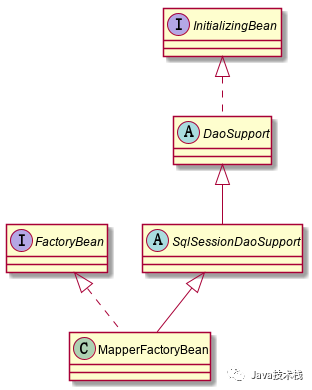
看類(lèi)圖,又看到了InitializingBean和FactoryBean!!!
InitializingBean接口只包括afterPropertiesSet方法,在初始化bean的時(shí)候會(huì)執(zhí)行
FactoryBean:返回的對(duì)象不是指定類(lèi)的一個(gè)實(shí)例,其返回的是該FactoryBean的getObject方法所返回的對(duì)象
再次重點(diǎn)關(guān)注afterPropertiesSet和getObject的實(shí)現(xiàn)!
關(guān)鍵方法分析
DaoSupport類(lèi)中有afterPropertiesSet的實(shí)現(xiàn)如下:
public?final?void?afterPropertiesSet()
?????throws?IllegalArgumentException,?BeanInitializationException?{
????this.checkDaoConfig();
????try?{
????????this.initDao();
????}?catch?(Exception?var2)?{
????????throw
?????????new?BeanInitializationException(
?????????????????????????????"Initialization?of?DAO?failed",??var2);
????}
}
initDao是個(gè)空實(shí)現(xiàn),checkDaoConfig在MapperFactoryBean中有實(shí)現(xiàn)如下:
protected?void?checkDaoConfig()?{
??super.checkDaoConfig();

??notNull(this.mapperInterface,?"Property?'mapperInterface'?is?required");

??Configuration?configuration?=?getSqlSession().getConfiguration();
??if?(this.addToConfig?&&?!configuration.hasMapper(this.mapperInterface))?{
????try?{
??????configuration.addMapper(this.mapperInterface);
????}?catch?(Exception?e)?{
??????logger.error("Error?while?adding?the?mapper?'"?+?this.mapperInterface?+?"'?to?configuration.",?e);
??????throw?new?IllegalArgumentException(e);
????}?finally?{
??????ErrorContext.instance().reset();
????}
??}
}
關(guān)鍵的語(yǔ)句是configuration.addMapper(this.mapperInterface),將接口添加到Mybatis的配置中。
getObject方法超級(jí)簡(jiǎn)單,就是調(diào)用了sqlSession.getMapper(UsrMapper.class);
public?T?getObject()?throws?Exception?{
????return?getSqlSession().getMapper(this.mapperInterface);?
}
總結(jié)MapperFactoryBean
實(shí)現(xiàn)了InitializingBean的afterPropertiesSet方法,在其中將mapper接口設(shè)置到mybatis的配置中。
實(shí)現(xiàn)了FactoryBean的getObject 方法,調(diào)用了sqlSession.getMapper,返回mapper對(duì)象。
總結(jié)
Spring整合Mybatis核心3類(lèi):
MapperScannerConfigurer
實(shí)現(xiàn)了beanDefinitionRegistryPostProcessor的postProcessBeanDefinitionRegistry方法,在其中從指定的 basePackage的目錄遞歸搜索接口,將它們注冊(cè)為MapperFactoryBean類(lèi)型的BeanDefinition
SqlSessionFactoryBean
實(shí)現(xiàn)了InitializingBean的afterPropertiesSet,在其中創(chuàng)建了Mybatis的SqlSessionFactory。
實(shí)現(xiàn)了FactoryBean的getObject 返回創(chuàng)建好的sqlSessionFactory。
MapperFactoryBean
實(shí)現(xiàn)了InitializingBean的afterPropertiesSet方法,將mapper接口設(shè)置到mybatis的配置中。
實(shí)現(xiàn)了FactoryBean的getObject 方法,調(diào)用了sqlSession.getMapper,返回mapper對(duì)象。
作者:溫安適
來(lái)源:https://my.oschina.net/floor/blog/3125371




關(guān)注Java技術(shù)棧看更多干貨