綜述:PyTorch的量化

極市導(dǎo)讀
?本文詳細(xì)介紹了PyTorch對量化的支持的三種方式:模型訓(xùn)練完畢后的動(dòng)態(tài)量化,模型訓(xùn)練完畢后的靜態(tài)量化,模型訓(xùn)練中開啟量化。?>>加入極市CV技術(shù)交流群,走在計(jì)算機(jī)視覺的最前沿
背景
在深度學(xué)習(xí)中,量化指的是使用更少的bit來存儲(chǔ)原本以浮點(diǎn)數(shù)存儲(chǔ)的tensor,以及使用更少的bit來完成原本以浮點(diǎn)數(shù)完成的計(jì)算。這么做的好處主要有如下幾點(diǎn):
更少的模型體積,接近4倍的減少;
可以更快的計(jì)算,由于更少的內(nèi)存訪問和更快的int8計(jì)算,可以快2~4倍。
一個(gè)量化后的模型,其部分或者全部的tensor操作會(huì)使用int類型來計(jì)算,而不是使用量化之前的float類型。當(dāng)然,量化還需要底層硬件支持,x86 CPU(支持AVX2)、ARM CPU、Google TPU、Nvidia Volta/Turing/Ampere、Qualcomm DSP這些主流硬件都對量化提供了支持。
PyTorch 1.1的時(shí)候開始添加torch.qint8 dtype、torch.quantize_linear轉(zhuǎn)換函數(shù)來開始對量化提供有限的實(shí)驗(yàn)性支持。PyTorch 1.3開始正式支持量化,在可量化的Tensor之外,PyTorch開始支持CNN中最常見的operator的量化操作,包括:
Tensor上的函數(shù): view, clone, resize, slice, add, multiply, cat, mean, max, sort, topk;
常見的模塊(在torch.nn.quantized中):Conv2d, Linear, Avgpool2d, AdaptiveAvgpool2d, MaxPool2d, AdaptiveMaxPool2d, Interpolate, Upsample;
為了量化后還維持更高準(zhǔn)確率的合并操作(在torch.nn.intrinsic中):ConvReLU2d, ConvBnReLU2d, ConvBn2d,LinearReLU,add_relu。
在PyTorch 1.4的時(shí)候,PyTorch添加了nn.quantized.Conv3d,與此同時(shí),torchvision 0.5開始提供量化版本的 ResNet、ResNext、MobileNetV2、GoogleNet、InceptionV3和ShuffleNetV2。到PyTorch 1.5的時(shí)候,QNNPACK添加了對dynamic quantization的支持,也就為量化版的LSTM在手機(jī)平臺(tái)上使用提供了支撐——也就是添加了對PyTorch mobile的dynamic quantization的支持;增加了量化版本的sigmoid、leaky relu、batch_norm、BatchNorm2d、 Avgpool3d、quantized_hardtanh、quantized ELU activation、quantized Upsample3d、quantized batch_norm3d、 batch_norm3d + relu operators的fused、quantized hardsigmoid。
在PyTorch 1.6的時(shí)候,添加了quantized Conv1d、quantized hardswish、quantized layernorm、quantized groupnorm、quantized instancenorm、quantized reflection_pad1d、quantized adaptive avgpool、quantized channel shuffle op、Quantized Threshold;添加ConvBn3d, ConvBnReLU3d, BNReLU2d, BNReLU3d;per-channel的量化得到增強(qiáng);添加對LSTMCell、RNNCell、GRUCell的Dynamic quantization支持;在nn.DataParallel 和 nn.DistributedDataParallel中可以使用Quantization aware training;支持CUDA上的quantized tensor。
到目前的最新版本的PyTorch 1.7,又添加了Embedding 和EmbeddingBag quantization、aten::repeat、aten::apend、tensor的stack、tensor的fill_、per channel affine quantized tensor的clone、1D batch normalization、N-Dimensional constant padding、CELU operator、FP16 quantization的支持。
PyTorch對量化的支持目前有如下三種方式:
Post Training Dynamic Quantization,模型訓(xùn)練完畢后的動(dòng)態(tài)量化;
Post Training Static Quantization,模型訓(xùn)練完畢后的靜態(tài)量化;
QAT(Quantization Aware Training),模型訓(xùn)練中開啟量化。
在開始這三部分之前,Gemfield先介紹下最基礎(chǔ)的Tensor的量化。
Tensor的量化
PyTorch為了實(shí)現(xiàn)量化,首先就得需要具備能夠表示量化數(shù)據(jù)的Tensor,這就是從PyTorch 1.1之后引入的Quantized Tensor。Quantized Tensor可以存儲(chǔ) int8/uint8/int32類型的數(shù)據(jù),并攜帶有scale、zero_point這些參數(shù)。把一個(gè)標(biāo)準(zhǔn)的float Tensor轉(zhuǎn)換為量化Tensor的步驟如下:
> x = torch.rand(2,3, dtype=torch.float32)> xtensor([[0.6839, 0.4741, 0.7451],[0.9301, 0.1742, 0.6835]])> xq = torch.quantize_per_tensor(x, scale = 0.5, zero_point = 8, dtype=torch.quint8)tensor([[0.5000, 0.5000, 0.5000],[1.0000, 0.0000, 0.5000]], size=(2, 3), dtype=torch.quint8,quantization_scheme=torch.per_tensor_affine, scale=0.5, zero_point=8)> xq.int_repr()tensor([[ 9, 9, 9],[10, 8, 9]], dtype=torch.uint8)
quantize_per_tensor函數(shù)就是使用給定的scale和zp來把一個(gè)float tensor轉(zhuǎn)化為quantized tensor,后文你還會(huì)遇到這個(gè)函數(shù)。通過上面這幾個(gè)數(shù)的變化,你可以感受到,量化tensor,也就是xq,和fp32 tensor的關(guān)系大概就是:
xq = round(x / scale + zero_point)scale這個(gè)縮放因子和zero_point是兩個(gè)參數(shù),建立起了fp32 tensor到量化tensor的映射關(guān)系。scale體現(xiàn)了映射中的比例關(guān)系,而zero_point則是零基準(zhǔn),也就是fp32中的零在量化tensor中的值。因?yàn)楫?dāng)x為零的時(shí)候,上述xq就變成了:
xq = round(zero_point) = zero_point現(xiàn)在xq已經(jīng)是一個(gè)量化tensor了,我們可以把xq在反量化回來,如下所示:
# xq is a quantized tensor with data represented as quint8> xdq = xq.dequantize()> xdqtensor([[0.5000, 0.5000, 0.5000],[1.0000, 0.0000, 0.5000]])
dequantize函數(shù)就是quantize_per_tensor的反義詞,把一個(gè)量化tensor轉(zhuǎn)換為float tensor。也就是:
xdq = (xq - zero_point) * scalexdq和x的值已經(jīng)出現(xiàn)了偏差的事實(shí)告訴了我們兩個(gè)道理:
量化會(huì)有精度損失;
我們這里隨便選取的scale和zp太爛,選擇合適的scale和zp可以有效降低精度損失。不信你把scale和zp分別換成scale = 0.0036, zero_point = 0試試。
而在PyTorch中,選擇合適的scale和zp的工作就由各種observer來完成。
Tensor的量化支持兩種模式:per tensor 和 per channel。Per tensor 是說一個(gè)tensor里的所有value按照同一種方式去scale和offset;per channel是對于tensor的某一個(gè)維度(通常是channel的維度)上的值按照一種方式去scale和offset,也就是一個(gè)tensor里有多種不同的scale和offset的方式(組成一個(gè)vector),如此以來,在量化的時(shí)候相比per tensor的方式會(huì)引入更少的錯(cuò)誤。PyTorch目前支持conv2d()、conv3d()、linear()的per channel量化。
Post Training Dynamic Quantization
這種量化方式經(jīng)常縮略前面的兩個(gè)單詞從而稱之為Dynamic Quantization,中文為動(dòng)態(tài)量化。這是什么意思呢?你看到全稱中的兩個(gè)關(guān)鍵字了嗎:Post、Dynamic:
Post:也就是訓(xùn)練完成后再量化模型的權(quán)重參數(shù);
Dynamic:也就是網(wǎng)絡(luò)在前向推理的時(shí)候動(dòng)態(tài)的量化float32類型的輸入。
Dynamic Quantization使用下面的API來完成模型的量化:
torch.quantization.quantize_dynamic(model, qconfig_spec=None, dtype=torch.qint8, mapping=None, inplace=False)quantize_dynamic這個(gè)API把一個(gè)float model轉(zhuǎn)換為dynamic quantized model,也就是只有權(quán)重被量化的model,dtype參數(shù)可以取值 float16 或者 qint8。當(dāng)對整個(gè)模型進(jìn)行轉(zhuǎn)換時(shí),默認(rèn)只對以下的op進(jìn)行轉(zhuǎn)換:
Linear
LSTM
LSTMCell
RNNCell
GRUCell
為啥呢?因?yàn)閐ynamic quantization只是把權(quán)重參數(shù)進(jìn)行量化,而這些layer一般參數(shù)數(shù)量很大,在整個(gè)模型中參數(shù)量占比極高,因此邊際效益高。對其它layer進(jìn)行dynamic quantization幾乎沒有實(shí)際的意義。
再來說說這個(gè)API的第二個(gè)參數(shù):qconfig_spec:
qconfig_spec指定了一組qconfig,具體就是哪個(gè)op對應(yīng)哪個(gè)qconfig ;
每個(gè)qconfig是QConfig類的實(shí)例,封裝了兩個(gè)observer;
這兩個(gè)observer分別是activation的observer和weight的observer;
但是動(dòng)態(tài)量化使用的是QConfig子類QConfigDynamic的實(shí)例,該實(shí)例實(shí)際上只封裝了weight的observer;
activate就是post process,就是op forward之后的后處理,但在動(dòng)態(tài)量化中不包含;
observer用來根據(jù)四元組(min_val,max_val,qmin, qmax)來計(jì)算2個(gè)量化的參數(shù):scale和zero_point;
qmin、qmax是算法提前確定好的,min_val和max_val是從輸入數(shù)據(jù)中觀察到的,所以起名叫observer。
當(dāng)qconfig_spec為None的時(shí)候就是默認(rèn)行為,如果想要改變默認(rèn)行為,則可以:
qconfig_spec賦值為一個(gè)set,比如:{nn.LSTM, nn.Linear},意思是指定當(dāng)前模型中的哪些layer要被dynamic quantization;
qconfig_spec賦值為一個(gè)dict,key為submodule的name或type,value為QConfigDynamic實(shí)例(其包含了特定的Observer,比如MinMaxObserver、MovingAverageMinMaxObserver、PerChannelMinMaxObserver、MovingAveragePerChannelMinMaxObserver、HistogramObserver)。
事實(shí)上,當(dāng)qconfig_spec為None的時(shí)候,quantize_dynamic API就會(huì)使用如下的默認(rèn)值:
qconfig_spec = {: default_dynamic_qconfig,: default_dynamic_qconfig,: default_dynamic_qconfig,: default_dynamic_qconfig,: default_dynamic_qconfig,: default_dynamic_qconfig,}
這就是Gemfield剛才提到的動(dòng)態(tài)量化只量化Linear和RNN變種的真相。而default_dynamic_qconfig是QConfigDynamic的一個(gè)實(shí)例,使用如下的參數(shù)進(jìn)行構(gòu)造:
default_dynamic_qconfig = QConfigDynamic(activation=default_dynamic_quant_observer, weight=default_weight_observer)default_dynamic_quant_observer = PlaceholderObserver.with_args(dtype=torch.float, compute_dtype=torch.quint8)default_weight_observer = MinMaxObserver.with_args(dtype=torch.qint8, qscheme=torch.per_tensor_symmetric)
其中,用于activation的PlaceholderObserver 就是個(gè)占位符,啥也不做;而用于weight的MinMaxObserver就是記錄輸入tensor中的最大值和最小值,用來計(jì)算scale和zp。
對于一個(gè)默認(rèn)行為下的quantize_dynamic調(diào)用,你的模型會(huì)經(jīng)歷什么變化呢?Gemfield使用一個(gè)小網(wǎng)絡(luò)來演示下:
class CivilNet(nn.Module):def __init__(self):super(CivilNet, self).__init__()gemfieldin = 1gemfieldout = 1self.conv = nn.Conv2d(gemfieldin, gemfieldout, kernel_size=1, stride=1, padding=0, groups=1, bias=False)self.fc = nn.Linear(3, 2,bias=False)self.relu = nn.ReLU(inplace=False)def forward(self, x):x = self.conv(x)x = self.fc(x)x = self.relu(x)return x
原始網(wǎng)絡(luò)和動(dòng)態(tài)量化后的網(wǎng)絡(luò)如下所示:
#原始網(wǎng)絡(luò)CivilNet((conv): Conv2d(1, 1, kernel_size=(1, 1), stride=(1, 1), bias=False)(fc): Linear(in_features=3, out_features=2, bias=False)(relu): ReLU())#quantize_dynamic 后CivilNet((conv): Conv2d(1, 1, kernel_size=(1, 1), stride=(1, 1), bias=False)(fc): DynamicQuantizedLinear(in_features=3, out_features=2, dtype=torch.qint8, qscheme=torch.per_tensor_affine)(relu): ReLU())
可以看到,除了Linear,其它op都沒有變動(dòng)。而Linear被轉(zhuǎn)換成了DynamicQuantizedLinear,DynamicQuantizedLinear就是torch.nn.quantized.dynamic.modules.linear.Linear類。沒錯(cuò),quantize_dynamic API的本質(zhì)就是檢索模型中op的type,如果某個(gè)op的type屬于字典DEFAULT_DYNAMIC_QUANT_MODULE_MAPPINGS的key,那么,這個(gè)op將被替換為key對應(yīng)的value:
# Default map for swapping dynamic modulesDEFAULT_DYNAMIC_QUANT_MODULE_MAPPINGS = {nn.GRUCell: nnqd.GRUCell,nn.Linear: nnqd.Linear,nn.LSTM: nnqd.LSTM,nn.LSTMCell: nnqd.LSTMCell,nn.RNNCell: nnqd.RNNCell,}
這里,nnqd.Linear就是DynamicQuantizedLinear就是torch.nn.quantized.dynamic.modules.linear.Linear。但是,type從key換為value,那這個(gè)新的type如何實(shí)例化呢?更重要的是,實(shí)例化新的type一定是要用之前的權(quán)重參數(shù)的呀。沒錯(cuò),以Linear為例,該邏輯定義在 nnqd.Linear的from_float()方法中,通過如下方式實(shí)例化:
new_mod = mapping[type(mod)].from_float(mod)from_float做的事情主要就是:
使用MinMaxObserver計(jì)算模型中op權(quán)重參數(shù)中tensor的最大值最小值(這個(gè)例子中只有Linear op),縮小量化時(shí)原始值的取值范圍,提高量化的精度;
通過上述步驟中得到四元組中的min_val和max_val,再結(jié)合算法確定的qmin, qmax計(jì)算出scale和zp,參考前文“Tensor的量化”小節(jié),計(jì)算得到量化后的weight,這個(gè)量化過程有torch.quantize_per_tensor和torch.quantize_per_channel兩種,默認(rèn)是前者(因?yàn)閝chema默認(rèn)是torch.per_tensor_affine);
實(shí)例化nnqd.Linear,然后使用qlinear.set_weight_bias將量化后的weight和原始的bias設(shè)置到新的layer上。其中最后一步還涉及到weight和bias的打包,在源代碼中是這樣的:
#ifdef USE_FBGEMMif (ctx.qEngine() == at::QEngine::FBGEMM) {return PackedLinearWeight::prepack(std::move(weight), std::move(bias));}#endif#ifdef USE_PYTORCH_QNNPACKif (ctx.qEngine() == at::QEngine::QNNPACK) {return PackedLinearWeightsQnnp::prepack(std::move(weight), std::move(bias));}#endifTORCH_CHECK(false,"Didn't find engine for operation quantized::linear_prepack ",toString(ctx.qEngine()));
也就是說依賴FBGEMM、QNNPACK這些backend。量化完后的模型在推理的時(shí)候有什么不一樣的呢?在原始網(wǎng)絡(luò)中,從輸入到最終輸出是這么計(jì)算的:
#inputtorch.Tensor([[[[-1,-2,-3],[1,2,3]]]])#經(jīng)過卷積后(權(quán)重為torch.Tensor([[[[-0.7867]]]]))torch.Tensor([[[[ 0.7867, 1.5734, 2.3601],[-0.7867, -1.5734, -2.3601]]]])#經(jīng)過fc后(權(quán)重為torch.Tensor([[ 0.4097, -0.2896, -0.4931], [-0.3738, -0.5541, 0.3243]]) )torch.Tensor([[[[-1.2972, -0.4004], [1.2972, 0.4004]]]])#經(jīng)過relu后torch.Tensor([[[[0.0000, 0.0000],[1.2972, 0.4004]]]])
而在動(dòng)態(tài)量化模型中,上述過程就變成了:
inputtorch.Tensor([[[[-1,-2,-3],[1,2,3]]]])#經(jīng)過卷積后(權(quán)重為torch.Tensor([[[[-0.7867]]]]))torch.Tensor([[[[ 0.7867, 1.5734, 2.3601],[-0.7867, -1.5734, -2.3601]]]])#經(jīng)過fc后(權(quán)重為torch.Tensor([[ 0.4085, -0.2912, -0.4911],[-0.3737, -0.5563, 0.3259]], dtype=torch.qint8,scale=0.0043458822183310986,zero_point=0) )torch.Tensor([[[[-1.3038, -0.3847], [1.2856, 0.3969]]]])#經(jīng)過relu后torch.Tensor([[[[0.0000, 0.0000], [1.2856, 0.3969]]]])
所以關(guān)鍵點(diǎn)就是這里的Linear op了,因?yàn)槠渌黲p和量化之前是一模一樣的。你可以看到Linear權(quán)重的scale為0.0043458822183310986,zero_point為0。scale和zero_point怎么來的呢?由其使用的observer計(jì)算得到的,具體來說就是默認(rèn)的MinMaxObserver,它是怎么工作的呢?還記得前面說過的observer負(fù)責(zé)根據(jù)四元組來計(jì)算scale和zp吧:
在各種observer中,計(jì)算權(quán)重的scale和zp離不開這四個(gè)變量:min_val,max_val,qmin, qmax,分別代表op權(quán)重?cái)?shù)據(jù)/input tensor數(shù)據(jù)分布的最小值和最大值,以及量化后的取值范圍的最小、最大值。qmin和qmax的值好確定,基本就是8個(gè)bit能表示的范圍,這里取的分別是-128和127(更詳細(xì)的計(jì)算方式將會(huì)在下文的“靜態(tài)量化”章節(jié)中描述);Linear op的權(quán)重為torch.Tensor([[ 0.4097, -0.2896, -0.4931], [-0.3738, -0.5541, 0.3243]]),因此其min_val和max_val分別為-0.5541 和 0.4097,在這個(gè)上下文中,max_val將進(jìn)一步取這倆絕對值的最大值。由此我們就可以得到:
scale = max_val / (float(qmax - qmin) / 2) = 0.5541 / ((127 + 128) / 2) = 0.004345882...
zp = 0
scale和zp的計(jì)算細(xì)節(jié)還會(huì)在下文的“靜態(tài)量化”章節(jié)中更詳細(xì)的描述。從上面我們可以得知,權(quán)重部分的量化是“靜態(tài)”的,是提前就轉(zhuǎn)換完畢的,而之所以叫做“動(dòng)態(tài)”量化,就在于前向推理的時(shí)候動(dòng)態(tài)的把input的float tensor轉(zhuǎn)換為量化tensor。
在forward的時(shí)候,nnqd.Linear會(huì)調(diào)用torch.ops.quantized.linear_dynamic函數(shù),輸入正是上面(pack好后的)量化后的權(quán)重和float的bias,而torch.ops.quantized.linear_dynamic函數(shù)最終會(huì)被PyTorch分發(fā)到C++中的apply_dynamic_impl函數(shù),在這里,或者使用FBGEMM的實(shí)現(xiàn)(x86-64設(shè)備),或者使用QNNPACK的實(shí)現(xiàn)(ARM設(shè)備上):
at::Tensor PackedLinearWeight::apply_dynamic_impl(at::Tensor input, bool reduce_range) {...fbgemm::xxxx...}at::Tensor PackedLinearWeightsQnnp::apply_dynamic_impl(at::Tensor input) {...qnnpack::qnnpackLinearDynamic(xxxx)...}
等等,input還是float32的啊,這怎么運(yùn)算嘛。別急,在上述的apply_dynamic_impl函數(shù)中,會(huì)使用下面的邏輯對輸入進(jìn)行量化:
Tensor q_input = at::quantize_per_tensor(input_contig, q_params.scale, q_params.zero_point, c10::kQUInt8);也就是說,動(dòng)態(tài)量化的本質(zhì)就藏身于此:基于運(yùn)行時(shí)對數(shù)據(jù)范圍的觀察,來動(dòng)態(tài)確定對輸入進(jìn)行量化時(shí)的scale值。這就確保 input tensor的scale因子能夠基于輸入數(shù)據(jù)進(jìn)行優(yōu)化,從而獲得顆粒度更細(xì)的信息。
而模型的參數(shù)則是提前就轉(zhuǎn)換為了INT8的格式(在使用quantize_dynamic API的時(shí)候)。這樣,當(dāng)輸入也被量化后,網(wǎng)絡(luò)中的運(yùn)算就使用向量化的INT8指令來完成。而在當(dāng)前l(fā)ayer輸出的時(shí)候,我們還需要把結(jié)果再重新轉(zhuǎn)換為float32——re-quantization的scale值是依據(jù)input、 weight和output scale來確定的,定義如下:
requant_scale = input_scale_fp32 * weight_scale_fp32 / output_scale_fp32
實(shí)際上,在apply_dynamic_impl函數(shù)中,requant_scales就是這么實(shí)現(xiàn)的:
auto output_scale = 1.fauto inverse_output_scale = 1.f /output_scale;requant_scales[i] = (weight_scales_data[i] * input_scale) * inverse_output_scale;
這就是為什么在前面Gemfield提到過,經(jīng)過量化版的fc的輸出為torch.Tensor([[[[-1.3038, -0.3847], [1.2856, 0.3969]]]]),已經(jīng)變回正常的float tensor了。所以動(dòng)態(tài)量化模型的前向推理過程可以概括如下:
#原始的模型,所有的tensor和計(jì)算都是浮點(diǎn)型previous_layer_fp32 -- linear_fp32 -- activation_fp32 -- next_layer_fp32/linear_weight_fp32#動(dòng)態(tài)量化后的模型,Linear和LSTM的權(quán)重是int8previous_layer_fp32 -- linear_int8_w_fp32_inp -- activation_fp32 -- next_layer_fp32/linear_weight_int8
總結(jié)下來,我們可以這么說:Post Training Dynamic Quantization,簡稱為Dynamic Quantization,也就是動(dòng)態(tài)量化,或者叫作Weight-only的量化,是提前把模型中某些op的參數(shù)量化為INT8,然后在運(yùn)行的時(shí)候動(dòng)態(tài)的把輸入量化為INT8,然后在當(dāng)前op輸出的時(shí)候再把結(jié)果requantization回到float32類型。動(dòng)態(tài)量化默認(rèn)只適用于Linear以及RNN的變種。
Post Training Static Quantization
與其介紹post training static quantization是什么,我們不如先來說明下它和dynamic quantization的相同點(diǎn)和區(qū)別是什么。相同點(diǎn)就是,都是把網(wǎng)絡(luò)的權(quán)重參數(shù)轉(zhuǎn)從float32轉(zhuǎn)換為int8;不同點(diǎn)是,需要把訓(xùn)練集或者和訓(xùn)練集分布類似的數(shù)據(jù)喂給模型(注意沒有反向傳播),然后通過每個(gè)op輸入的分布特點(diǎn)來計(jì)算activation的量化參數(shù)(scale和zp)——稱之為Calibrate(定標(biāo))。是的,靜態(tài)量化包含有activation了,也就是post process,也就是op forward之后的后處理。為什么靜態(tài)量化需要activation呢?因?yàn)殪o態(tài)量化的前向推理過程自(始+1)至(終-1)都是INT計(jì)算,activation需要確保一個(gè)op的輸入符合下一個(gè)op的輸入。
PyTorch會(huì)使用五部曲來完成模型的靜態(tài)量化:
1,fuse_model
合并一些可以合并的layer。這一步的目的是為了提高速度和準(zhǔn)確度:
fuse_modules(model, modules_to_fuse, inplace=False, fuser_func=fuse_known_modules, fuse_custom_config_dict=None)比如給fuse_modules傳遞下面的參數(shù)就會(huì)合并網(wǎng)絡(luò)中的conv1、bn1、relu1:
torch.quantization.fuse_modules(gemfield_model, [['conv1', 'bn1', 'relu1']], inplace=True)一旦合并成功,那么原始網(wǎng)絡(luò)中的conv1就會(huì)被替換為新的合并后的module(因?yàn)槠涫莑ist中的第一個(gè)元素),而bn1、relu1(list中剩余的元素)會(huì)被替換為nn.Identity(),這個(gè)模塊是個(gè)占位符,直接輸出輸入。舉個(gè)例子,對于下面的一個(gè)小網(wǎng)絡(luò):
class CivilNet(nn.Module):def __init__(self):super(CivilNet, self).__init__()syszuxin = 1syszuxout = 1self.conv = nn.Conv2d(syszuxin, syszuxout, kernel_size=1, stride=1, padding=0, groups=1, bias=False)self.fc = nn.Linear(3, 2,bias=False)self.relu = nn.ReLU(inplace=False)def forward(self, x):x = self.conv(x)x = self.fc(x)x = self.relu(x)return x
網(wǎng)絡(luò)結(jié)構(gòu)如下:
CivilNet((conv): Conv2d(1, 1, kernel_size=(1, 1), stride=(1, 1), bias=False)(fc): Linear(in_features=3, out_features=2, bias=False)(relu): ReLU())
經(jīng)過torch.quantization.fuse_modules(c, [['fc',?'relu']], inplace=True)后,網(wǎng)絡(luò)變成了:
CivilNet((conv): Conv2d(1, 1, kernel_size=(1, 1), stride=(1, 1), bias=False)(fc): LinearReLU((0): Linear(in_features=3, out_features=2, bias=False)(1): ReLU())(relu): Identity())
modules_to_fuse參數(shù)的list可以包含多個(gè)item list,或者是submodule的op list也可以,比如:[ ['conv1', 'bn1', 'relu1'], ['submodule.conv', 'submodule.relu']]。有的人會(huì)說了,我要fuse的module被Sequential封裝起來了,如何傳參?參考下面的代碼:
torch.quantization.fuse_modules(a_sequential_module, ['0', '1', '2'], inplace=True)不是什么類型的op都可以參與合并,也不是什么樣的順序都可以參與合并。就目前來說,截止到pytorch 1.7.1,只有如下的op和順序才可以:
Convolution, Batch normalization
Convolution, Batch normalization, Relu
Convolution, Relu
Linear, Relu
Batch normalization, Relu
實(shí)際上,這個(gè)mapping關(guān)系就定義在DEFAULT_OP_LIST_TO_FUSER_METHOD中:
DEFAULT_OP_LIST_TO_FUSER_METHOD : Dict[Tuple, Union[nn.Sequential, Callable]] = {nn.BatchNorm1d): fuse_conv_bn,nn.BatchNorm1d, nn.ReLU): fuse_conv_bn_relu,nn.BatchNorm2d): fuse_conv_bn,nn.BatchNorm2d, nn.ReLU): fuse_conv_bn_relu,nn.BatchNorm3d): fuse_conv_bn,nn.BatchNorm3d, nn.ReLU): fuse_conv_bn_relu,nn.ReLU): nni.ConvReLU1d,nn.ReLU): nni.ConvReLU2d,nn.ReLU): nni.ConvReLU3d,nn.ReLU): nni.LinearReLU,nn.ReLU): nni.BNReLU2d,nn.ReLU): nni.BNReLU3d,}
2,設(shè)置qconfig
qconfig是要設(shè)置到模型或者模型的子module上的。前文Gemfield就已經(jīng)說過,qconfig是QConfig的一個(gè)實(shí)例,QConfig這個(gè)類就是維護(hù)了兩個(gè)observer,一個(gè)是activation所使用的observer,一個(gè)是op權(quán)重所使用的observer。
#如果要部署在x86 server上gemfield_model.qconfig = torch.quantization.get_default_qconfig('fbgemm')#如果要部署在ARM上gemfield_model.qconfig = torch.quantization.get_default_qconfig('qnnpack')
如果是x86和arm之外呢?抱歉,目前不支持。實(shí)際上,這里的get_default_qconfig函數(shù)的實(shí)現(xiàn)如下所示:
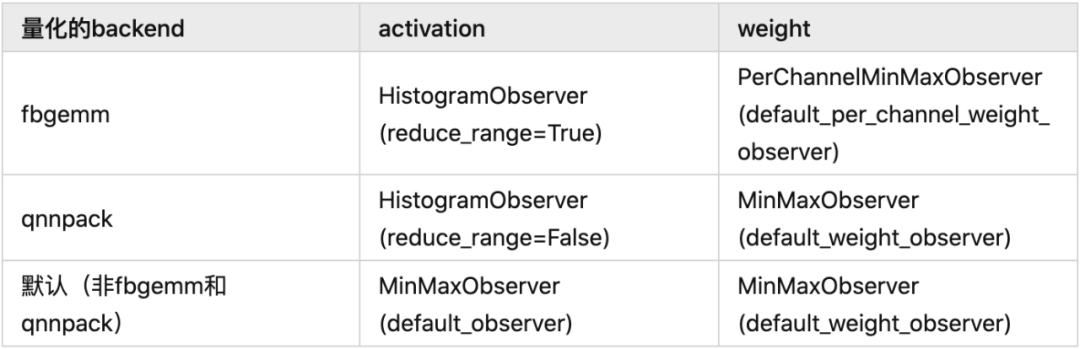
def get_default_qconfig(backend='fbgemm'):if backend == 'fbgemm':qconfig = QConfig(activation=HistogramObserver.with_args(reduce_range=True),weight=default_per_channel_weight_observer)elif backend == 'qnnpack':qconfig = QConfig(activation=HistogramObserver.with_args(reduce_range=False),weight=default_weight_observer)else:qconfig = default_qconfigreturn qconfig
default_qconfig實(shí)際上是QConfig(activation=default_observer, weight=default_weight_observer),所以gemfield這里總結(jié)了一個(gè)表格:
3,prepare
prepare調(diào)用是通過如下API完成的:
gemfield_model_prepared = torch.quantization.prepare(gemfield_model)prepare用來給每個(gè)子module插入Observer,用來收集和定標(biāo)數(shù)據(jù)。以activation的observer為例,就是期望其觀察輸入數(shù)據(jù)得到四元組中的min_val和max_val,至少觀察個(gè)幾百個(gè)迭代的數(shù)據(jù)吧,然后由這四元組得到scale和zp這兩個(gè)參數(shù)的值。
module上安插activation的observer是怎么實(shí)現(xiàn)的呢?還記得zhuanlan.zhihu.com/p/53一文中說過的“_forward_hooks是通過register_forward_hook來完成注冊的。這些hooks是在forward完之后被調(diào)用的......”嗎?沒錯(cuò),CivilNet模型中的Conv2d、Linear、ReLU、QuantStub這些module的_forward_hooks上都被插入了activation的HistogramObserver,當(dāng)這些子module計(jì)算完畢后,結(jié)果會(huì)被立刻送到其_forward_hooks中的HistogramObserver進(jìn)行觀察。
這一步完成后,CivilNet網(wǎng)絡(luò)就被改造成了:
CivilNet((conv): Conv2d(1, 1, kernel_size=(1, 1), stride=(1, 1), bias=False(activation_post_process): HistogramObserver())(fc): Linear(in_features=3, out_features=2, bias=False(activation_post_process): HistogramObserver())(relu): ReLU((activation_post_process): HistogramObserver())(quant): QuantStub((activation_post_process): HistogramObserver())(dequant): DeQuantStub())
4,喂數(shù)據(jù)
這一步不是訓(xùn)練。是為了獲取數(shù)據(jù)的分布特點(diǎn),來更好的計(jì)算activation的scale和zp。至少要喂上幾百個(gè)迭代的數(shù)據(jù)。
#至少觀察個(gè)幾百迭代for data in data_loader:gemfield_model_prepared(data)
5,轉(zhuǎn)換模型
第四步完成后,各個(gè)op權(quán)重的四元組(min_val,max_val,qmin, qmax)中的min_val,max_val已經(jīng)有了,各個(gè)op activation的四元組(min_val,max_val,qmin, qmax)中的min_val,max_val也已經(jīng)觀察出來了。那么在這一步我們將調(diào)用convert API:
gemfield_model_prepared_int8 = torch.quantization.convert(gemfield_model_prepared)這個(gè)過程和dynamic量化類似,本質(zhì)就是檢索模型中op的type,如果某個(gè)op的type屬于字典DEFAULT_STATIC_QUANT_MODULE_MAPPINGS的key(注意字典和動(dòng)態(tài)量化的不一樣了),那么,這個(gè)op將被替換為key對應(yīng)的value:
DEFAULT_STATIC_QUANT_MODULE_MAPPINGS = {QuantStub: nnq.Quantize,DeQuantStub: nnq.DeQuantize,: nnq.BatchNorm2d,: nnq.BatchNorm3d,: nnq.Conv1d,: nnq.Conv2d,: nnq.Conv3d,: nnq.ConvTranspose1d,: nnq.ConvTranspose2d,: nnq.ELU,: nnq.Embedding,: nnq.EmbeddingBag,: nnq.GroupNorm,: nnq.Hardswish,: nnq.InstanceNorm1d,: nnq.InstanceNorm2d,: nnq.InstanceNorm3d,: nnq.LayerNorm,: nnq.LeakyReLU,: nnq.Linear,: nnq.ReLU6,# Wrapper Modules:: nnq.QFunctional,# Intrinsic modules:: nniq.BNReLU2d,: nniq.BNReLU3d,: nniq.ConvReLU1d,: nniq.ConvReLU2d,: nniq.ConvReLU3d,: nniq.LinearReLU,: nnq.Conv1d,: nnq.Conv2d,: nniq.ConvReLU1d,: nniq.ConvReLU2d,: nniq.ConvReLU2d,: nniq.LinearReLU,# QAT modules:: nnq.Linear,: nnq.Conv2d,}
替換的過程也和dynamic一樣,使用from_float() API,這個(gè)API會(huì)使用前面的四元組信息計(jì)算出op權(quán)重和op activation的scale和zp,然后用于量化。動(dòng)態(tài)量化”章節(jié)時(shí)Gemfield說過要再詳細(xì)介紹下scale和zp的計(jì)算過程,好了,就在這里。這個(gè)計(jì)算過程覆蓋了如下的幾個(gè)問題:
QuantStub的scale和zp是怎么來的(靜態(tài)量化需要插入QuantStub,后文有說明)?
conv activation的scale和zp是怎么來的?
conv weight的scale和zp是怎么來的?
fc activation的scale和zp是怎么來的?
fc weight的scale和zp是怎么來的?
relu activation的scale和zp是怎么來的?
relu weight的...等等,relu沒有weight。
我們就從conv來說起吧,還記得前面說過的Observer嗎?分為activation和weight兩種。以Gemfield這里使用的fbgemm后端為例,activation默認(rèn)的observer是HistogramObserver、weight默認(rèn)的observer是PerChannelMinMaxObserver。而計(jì)算scale和zp所需的四元組都是這些observer觀察出來的呀(好吧,其中兩個(gè))。
在convert API調(diào)用中,pytorch會(huì)將Conv2d op替換為對應(yīng)的QuantizedConv2d,在這個(gè)替換的過程中會(huì)計(jì)算QuantizedConv2d activation的scale和zp以及QuantizedConv2d weight的scale和zp。在各種observer中,計(jì)算scale和zp離不開這四個(gè)變量:min_val,max_val,qmin, qmax,分別代表輸入的數(shù)據(jù)/權(quán)重的數(shù)據(jù)分布的最小值和最大值,以及量化后的取值范圍的最小、最大值。qmin和qmax的值好確定,基本就是8個(gè)bit能表示的范圍,在pytorch中,qmin和qmax是使用如下方式確定的:
if self.dtype == torch.qint8:if self.reduce_range:qmin, qmax = -64, 63else:qmin, qmax = -128, 127else:if self.reduce_range:qmin, qmax = 0, 127else:qmin, qmax = 0, 255
比如conv的activation的observer(quint8)是HistogramObserver,又是reduce_range的,因此其qmin,qmax = 0 ,127,而conv的weight(qint8)是PerChannelMinMaxObserver,不是reduce_range的,因此其qmin, qmax = -128, 127。那么min_val,max_val又是怎么確定的呢?對于HistogramObserver,其由輸入數(shù)據(jù) + 權(quán)重值根據(jù)L2Norm(An approximation for L2 error minimization)確定;對于PerChannelMinMaxObserver來說,其由輸入數(shù)據(jù)的最小值和最大值確定,比如在上述的例子中,值就是-0.7898和-0.7898。既然現(xiàn)在conv weight的min_val,max_val,qmin, qmax 分別為 -0.7898、-0.7898、-128、 127,那如何得到scale和zp呢?PyTorch就是用下面的邏輯進(jìn)行計(jì)算的:
#qscheme 是 torch.per_tensor_symmetric 或者torch.per_channel_symmetric時(shí)max_val = torch.max(-min_val, max_val)scale = max_val / (float(qmax - qmin) / 2)scale = torch.max(scale, torch.tensor(self.eps, device=device, dtype=scale.dtype))if self.dtype == torch.quint8:zero_point = zero_point.new_full(zero_point.size(), 128)#qscheme 是 torch.per_tensor_affine時(shí)scale = (max_val - min_val) / float(qmax - qmin)scale = torch.max(scale, torch.tensor(self.eps, device=device, dtype=scale.dtype))zero_point = qmin - torch.round(min_val / scale)zero_point = torch.max(zero_point, torch.tensor(qmin, device=device, dtype=zero_point.dtype))zero_point = torch.min(zero_point, torch.tensor(qmax, device=device, dtype=zero_point.dtype))
由此conv2d weight的謎團(tuán)就被我們解開了:
scale = 0.7898 / ((127 + 128)/2 ) = 0.0062
zp = 0
再說說QuantStub的scale和zp是如何計(jì)算的。QuantStub使用的是HistogramObserver,根據(jù)輸入從[-3,3]的分布,HistogramObserver計(jì)算得到min_val、max_val分別是-3、2.9971,而qmin和qmax又分別是0、127,其schema為per_tensor_affine,因此套用上面的per_tensor_affine邏輯可得:
scale = (2.9971 + 3) / (127 - 0) = 0.0472
zp = 0 - round(-3 /0.0472) = 64
其它計(jì)算同理,不再贅述。有了scale和zp,就有了量化版本的module,上面那個(gè)CivilNet網(wǎng)絡(luò),經(jīng)過靜態(tài)量化后,網(wǎng)絡(luò)的變化如下所示:
#原始的CivilNet網(wǎng)絡(luò):CivilNet((conv): Conv2d(1, 1, kernel_size=(1, 1), stride=(1, 1), bias=False)(fc): Linear(in_features=3, out_features=2, bias=False)(relu): ReLU())#靜態(tài)量化后的CivilNet網(wǎng)絡(luò):CivilNet((conv): QuantizedConv2d(1, 1, kernel_size=(1, 1), stride=(1, 1), scale=0.0077941399067640305, zero_point=0, bias=False)(fc): QuantizedLinear(in_features=3, out_features=2, scale=0.002811126410961151, zero_point=14, qscheme=torch.per_channel_affine)(relu): QuantizedReLU())
靜態(tài)量化模型如何推理?
我們知道,在PyTorch的網(wǎng)絡(luò)中,前向推理邏輯都是實(shí)現(xiàn)在了每個(gè)op的forward函數(shù)中(參考:Gemfield:詳解Pytorch中的網(wǎng)絡(luò)構(gòu)造)(https://zhuanlan.zhihu.com/p/53927068)。而在convert完成后,所有的op被替換成了量化版本的op,那么量化版本的op的forward會(huì)有什么不一樣的呢?還記得嗎?動(dòng)態(tài)量化中可是只量化了op的權(quán)重哦,輸入的量化所需的scale的值是在推理過程中動(dòng)態(tài)計(jì)算出來的。而靜態(tài)量化中,統(tǒng)統(tǒng)都是提前就計(jì)算好的。我們來看一個(gè)典型的靜態(tài)量化模型的推理過程:
import torchimport torch.nn as nnclass CivilNet(nn.Module):def __init__(self):super(CivilNet, self).__init__()in_planes = 1out_planes = 1self.conv = nn.Conv2d(in_planes, out_planes, kernel_size=1, stride=1, padding=0, groups=1, bias=False)self.fc = nn.Linear(3, 2,bias=False)self.relu = nn.ReLU(inplace=False)self.quant = QuantStub()self.dequant = DeQuantStub()def forward(self, x):x = self.quant(x)x = self.conv(x)x = self.fc(x)x = self.relu(x)x = self.dequant(x)return x
網(wǎng)絡(luò)forward的開始和結(jié)束還必須安插QuantStub和DeQuantStub,如上所示。否則運(yùn)行時(shí)會(huì)報(bào)錯(cuò):RuntimeError: Could not run 'quantized::conv2d.new' with arguments from the 'CPU' backend. 'quantized::conv2d.new' is only available for these backends: [QuantizedCPU]。
QuantStub在observer階段會(huì)記錄參數(shù)值,DeQuantStub在prepare階段相當(dāng)于Identity;而在convert API調(diào)用過程中,會(huì)分別被替換為nnq.Quantize和nnq.DeQuantize。在這個(gè)章節(jié)要介紹的推理過程中,QuantStub,也就是nnq.Quantize在做什么工作呢?如下所示:
def forward(self, X):return torch.quantize_per_tensor(X, float(self.scale), int(self.zero_point), self.dtype)
是不是呼應(yīng)了前文中的“tensor的量化”章節(jié)?這里的scale和zero_point的計(jì)算方式前文也剛介紹過。而nnq.DeQuantize做了什么呢?很簡單,把量化tensor反量化回來。
def forward(self, Xq):return Xq.dequantize()
是不是又呼應(yīng)了前文中的“tensor的量化”章節(jié)?我們就以上面的CivilNet網(wǎng)絡(luò)為例,當(dāng)在靜態(tài)量化后的模型進(jìn)行前向推理和原始的模型的區(qū)別是什么呢?假設(shè)網(wǎng)絡(luò)的輸入為torch.Tensor([[[[-1,-2,-3],[1,2,3]]]]):
c = CivilNet()t = torch.Tensor([[[[-1,-2,-3],[1,2,3]]]])c(t)
假設(shè)conv的權(quán)重為torch.Tensor([[[[-0.7867]]]]),假設(shè)fc的權(quán)重為torch.Tensor([[ 0.4097, -0.2896, -0.4931], [-0.3738, -0.5541, 0.3243]]),那么在原始的CivilNet前向中,從輸入到輸出的過程依次為:
#inputtorch.Tensor([[[[-1,-2,-3],[1,2,3]]]])#經(jīng)過卷積后(權(quán)重為torch.Tensor([[[[-0.7867]]]]))torch.Tensor([[[[ 0.7867, 1.5734, 2.3601],[-0.7867, -1.5734, -2.3601]]]])#經(jīng)過fc后(權(quán)重為torch.Tensor([[ 0.4097, -0.2896, -0.4931], [-0.3738, -0.5541, 0.3243]]) )torch.Tensor([[[[-1.2972, -0.4004], [1.2972, 0.4004]]]])#經(jīng)過relu后torch.Tensor([[[[0.0000, 0.0000],[1.2972, 0.4004]]]])
而在靜態(tài)量化的模型前向中,總體情況如下:
inputtorch.Tensor([[[[-1,-2,-3],[1,2,3]]]])#QuantStub后 (scale=tensor([0.0472]), zero_point=tensor([64]))tensor([[[[-0.9916, -1.9833, -3.0221],[ 0.9916, 1.9833, 3.0221]]]],dtype=torch.quint8, scale=0.04722102731466293, zero_point=64)#經(jīng)過卷積后(權(quán)重為torch.Tensor([[[[-0.7898]]]], dtype=torch.qint8, scale=0.0062, zero_point=0))conv activation(輸入)的scale為0.03714831545948982,zp為64torch.Tensor([[[[ 0.7801, 1.5602, 2.3775],[-0.7801, -1.5602, -2.3775]]]], scale=0.03714831545948982, zero_point=64)#經(jīng)過fc后(權(quán)重為torch.Tensor([[ 0.4100, -0.2901, -0.4951],[-0.3737, -0.5562, 0.3259]], dtype=torch.qint8, scale=tensor([0.0039, 0.0043]),zero_point=tensor([0, 0])) )fc activation(輸入)的scale為0.020418135449290276, zp為64torch.Tensor([[[[-1.3068, -0.3879],[ 1.3068, 0.3879]]]], dtype=torch.quint8, scale=0.020418135449290276, zero_point=64)#經(jīng)過relu后torch.Tensor([[[[0.0000, 0.0000],[1.3068, 0.3879]]]], dtype=torch.quint8, scale=0.020418135449290276, zero_point=64)#經(jīng)過DeQuantStub后torch.Tensor([[[[0.0000, 0.0000],[1.3068, 0.3879]]]])
Gemfield這里用原始的python語句來分步驟來介紹下。首先是QuantStub的工作:
import torchimport torch.nn.quantized as nnq#輸入> x = torch.Tensor([[[[-1,-2,-3],[1,2,3]]]])> xtensor([[[[-1., -2., -3.],[ 1., 2., 3.]]]])#經(jīng)過QuantStub> xq = torch.quantize_per_tensor(x, scale = 0.0472, zero_point = 64, dtype=torch.quint8)> xqtensor([[[[-0.9912, -1.9824, -3.0208],[ 0.9912, 1.9824, 3.0208]]]], size=(1, 1, 2, 3),dtype=torch.quint8, quantization_scheme=torch.per_tensor_affine,scale=0.0472, zero_point=64)> xq.int_repr()tensor([[[[ 43, 22, 0],[ 85, 106, 128]]]], dtype=torch.uint8)
我們特意在網(wǎng)絡(luò)前面安插的QuantStub完成了自己的使命,其scale = 0.0472、zero_point = 64是靜態(tài)量化完畢后就已經(jīng)知道的,然后通過quantize_per_tensor調(diào)用把輸入的float tensor轉(zhuǎn)換為了量化tensor,然后送給接下來的Conv2d——量化版本的Conv2d:
> c = nnq.Conv2d(1,1,1)> weight = torch.Tensor([[[[-0.7898]]]])> qweight = torch.quantize_per_channel(weight, scales=torch.Tensor([0.0062]).to(torch.double), zero_points = torch.Tensor([0]).to(torch.int64), axis=0, dtype=torch.qint8)> c.set_weight_bias(qweight, None)> c.scale = 0.03714831545948982> c.zero_point = 64> x = c(xq)> xtensor([[[[ 0.7801, 1.5602, 2.3775],[-0.7801, -1.5602, -2.3775]]]], size=(1, 1, 2, 3),dtype=torch.quint8, quantization_scheme=torch.per_tensor_affine,scale=0.03714831545948982, zero_point=64)
同理,Conv2d的權(quán)重的scale=0.0062、zero_points=0是靜態(tài)量化完畢就已知的,其activation的scale = 0.03714831545948982、zero_point = 64也是量化完畢已知的。然后送給nnq.Conv2d的forward函數(shù)(參考:zhuanlan.zhihu.com/p/53),其forward邏輯為:
def forward(self, input):return ops.quantized.conv2d(input, self._packed_params, self.scale, self.zero_point)
Conv2d計(jì)算完了,我們停下來反省一下。如果是按照浮點(diǎn)數(shù)計(jì)算,那么-0.7898 * -0.9912 大約是0.7828,但這里使用int8的計(jì)算方式得到的值是0.7801,這說明已經(jīng)在引入誤差了(大約為0.34%的誤差)。這也是前面gemfield說的使用fuse_modules可以提高精度的原因,因?yàn)槊恳粚佣紩?huì)引入類似的誤差。
后面Linear的計(jì)算同理,其forward邏輯為:
def forward(self, x):return torch.ops.quantized.linear(x, self._packed_params._packed_params, self.scale, self.zero_point)
可以看到,所有以量化方式計(jì)算完的值現(xiàn)在需要經(jīng)過activation的計(jì)算。這是靜態(tài)量化和動(dòng)態(tài)量化的本質(zhì)區(qū)別之一:op和op之間不再需要轉(zhuǎn)換回到float tensor了。通過上面的分析,我們可以把靜態(tài)量化模型的前向推理過程概括為如下的形式:
#原始的模型,所有的tensor和計(jì)算都是浮點(diǎn)型previous_layer_fp32 -- linear_fp32 -- activation_fp32 -- next_layer_fp32/linear_weight_fp32#靜態(tài)量化的模型,權(quán)重和輸入都是int8previous_layer_int8 -- linear_with_activation_int8 -- next_layer_int8/linear_weight_int8
最后再來描述下動(dòng)態(tài)量化和靜態(tài)量化的最大區(qū)別:
靜態(tài)量化的float輸入必經(jīng)QuantStub變?yōu)閕nt,此后到輸出之前都是int;
動(dòng)態(tài)量化的float輸入是經(jīng)動(dòng)態(tài)計(jì)算的scale和zp量化為int,op輸出時(shí)轉(zhuǎn)換回float。
QAT(Quantization Aware Training
前面兩種量化方法都有一個(gè)post關(guān)鍵字,意思是模型訓(xùn)練完畢后所做的量化。而QAT則不一樣,是指在訓(xùn)練過程中就開啟了量化功能。
QAT需要五部曲,說到這里,你可能想到了靜態(tài)量化,那不妨對比著來看。
1,設(shè)置qconfig
在設(shè)置qconfig之前,模型首先設(shè)置為訓(xùn)練模式,這很容易理解,因?yàn)镼AT的著力點(diǎn)就是T嘛:
cnet = CivilNet()cnet.train()
使用get_default_qat_qconfig API來給要QAT的網(wǎng)絡(luò)設(shè)置qconfig:
cnet.qconfig = torch.quantization.get_default_qat_qconfig('fbgemm')不過,這個(gè)qconfig和靜態(tài)量化中的可不一樣啊。前文說過qconfig維護(hù)了兩個(gè)observer,activation的和權(quán)重的。QAT的qconfig中,activation和權(quán)重的observer都變成了FakeQuantize(和observer是has a的關(guān)系,也即包含一個(gè)observer),并且參數(shù)不一樣(qmin、qmax、schema,dtype,qschema,reduce_range這些參數(shù)),如下所示:
#activation的observer的參數(shù)=MovingAverageMinMaxObserver,quant_min=0,quant_max=255,reduce_range=True)#權(quán)重的observer的參數(shù)=MovingAveragePerChannelMinMaxObserver,quant_min=-128,quant_max=127,dtype=torch.qint8,qscheme=torch.per_channel_symmetric,reduce_range=False,ch_axis=0)
這里FakeQuantize包含的observer是MovingAverageMinMaxObserver,繼承自前面提到過的MinMaxObserver,但是求最小值和最大值的方法有點(diǎn)區(qū)別,使用的是如下公式:
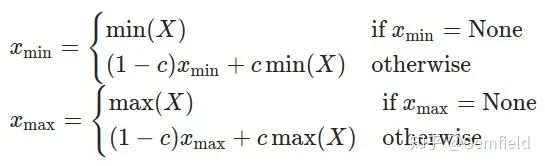
Xmin、Xmax是當(dāng)前運(yùn)行中正在求解和最終求解的最小值、最大值;
X是當(dāng)前輸入的tensor;
c是一個(gè)常數(shù),PyTorch中默認(rèn)為0.01,也就是最新一次的極值由上一次貢獻(xiàn)99%,當(dāng)前的tensor貢獻(xiàn)1%。
MovingAverageMinMaxObserver在求min、max的方式和其基類MinMaxObserver有所區(qū)別之外,scale和zero_points的計(jì)算則是一致的。那么在包含了上述的observer之后,F(xiàn)akeQuantize的作用又是什么呢?看下面的步驟。
2,fuse_modules
和靜態(tài)量化一樣,不再贅述。
3,prepare_qat
在靜態(tài)量化中,我們這一步使用的是prepare API,而在QAT這里使用的是prepare_qat API。最重要的區(qū)別有兩點(diǎn):
prepare_qat要把qconfig安插到每個(gè)op上,qconfig的內(nèi)容本身就不同,參考五部曲中的第一步;
prepare_qat 中需要多做一步轉(zhuǎn)換子module的工作,需要inplace的把模型中的一些子module替換了,替換的邏輯就是從DEFAULT_QAT_MODULE_MAPPINGS的key替換為value,這個(gè)字典的定義如下:
# Default map for swapping float module to qat modulesDEFAULT_QAT_MODULE_MAPPINGS : Dict[Callable, Any] = {nn.Conv2d: nnqat.Conv2d,nn.Linear: nnqat.Linear,# Intrinsic modules:nni.ConvBn1d: nniqat.ConvBn1d,nni.ConvBn2d: nniqat.ConvBn2d,nni.ConvBnReLU1d: nniqat.ConvBnReLU1d,nni.ConvBnReLU2d: nniqat.ConvBnReLU2d,nni.ConvReLU2d: nniqat.ConvReLU2d,nni.LinearReLU: nniqat.LinearReLU}
因此,同靜態(tài)量化的prepare相比,prepare_qat在多插入fake_quants、又替換了nn.Conv2d、nn.Linear之后,CivilNet網(wǎng)絡(luò)就被改成了如下的樣子:
CivilNet((conv): QATConv2d(1, 1, kernel_size=(1, 1), stride=(1, 1), bias=False(activation_post_process): FakeQuantize(fake_quant_enabled=tensor([1], dtype=torch.uint8), observer_enabled=tensor([1], dtype=torch.uint8), scale=tensor([1.]), zero_point=tensor([0])(activation_post_process): MovingAverageMinMaxObserver(min_val=tensor([]), max_val=tensor([])))(weight_fake_quant): FakeQuantize(fake_quant_enabled=tensor([1], dtype=torch.uint8), observer_enabled=tensor([1], dtype=torch.uint8), scale=tensor([1.]), zero_point=tensor([0])(activation_post_process): MovingAveragePerChannelMinMaxObserver(min_val=tensor([]), max_val=tensor([]))))(fc): QATLinear(in_features=3, out_features=2, bias=False(activation_post_process): FakeQuantize(fake_quant_enabled=tensor([1], dtype=torch.uint8), observer_enabled=tensor([1], dtype=torch.uint8), scale=tensor([1.]), zero_point=tensor([0])(activation_post_process): MovingAverageMinMaxObserver(min_val=tensor([]), max_val=tensor([])))(weight_fake_quant): FakeQuantize(fake_quant_enabled=tensor([1], dtype=torch.uint8), observer_enabled=tensor([1], dtype=torch.uint8), scale=tensor([1.]), zero_point=tensor([0])(activation_post_process): MovingAveragePerChannelMinMaxObserver(min_val=tensor([]), max_val=tensor([]))))(relu): ReLU((activation_post_process): FakeQuantize(fake_quant_enabled=tensor([1], dtype=torch.uint8), observer_enabled=tensor([1], dtype=torch.uint8), scale=tensor([1.]), zero_point=tensor([0])(activation_post_process): MovingAverageMinMaxObserver(min_val=tensor([]), max_val=tensor([]))))(quant): QuantStub((activation_post_process): FakeQuantize(fake_quant_enabled=tensor([1], dtype=torch.uint8), observer_enabled=tensor([1], dtype=torch.uint8), scale=tensor([1.]), zero_point=tensor([0])(activation_post_process): MovingAverageMinMaxObserver(min_val=tensor([]), max_val=tensor([]))))(dequant): DeQuantStub())
4,喂數(shù)據(jù)
和靜態(tài)量化完全不同,在QAT中這一步是用來訓(xùn)練的。我們知道,在PyTorch的網(wǎng)絡(luò)中,前向推理邏輯都是實(shí)現(xiàn)在了每個(gè)op的forward函數(shù)中(參考:Gemfield:詳解Pytorch中的網(wǎng)絡(luò)構(gòu)造)(https://zhuanlan.zhihu.com/p/53927068)。而在prepare_qat中,所有的op被替換成了QAT版本的op,那么這些op的forward函數(shù)有什么特別的地方呢?
Conv2d被替換為了QATConv2d:
def forward(self, input):return self.activation_post_process(self._conv_forward(input, self.weight_fake_quant(self.weight)))
Linear被替換為了QATLinear:
def forward(self, input):return self.activation_post_process(F.linear(input, self.weight_fake_quant(self.weight), self.bias))
ReLU還是那個(gè)ReLU,不說了。總之,你可以看出來,每個(gè)op的輸入都需要經(jīng)過self.weight_fake_quant來處理下,輸出又都需要經(jīng)過self.activation_post_process來處理下,這兩個(gè)都是FakeQuantize的實(shí)例,只是里面包含的observer不一樣。以Conv2d為例:
#conv2dweight=functools.partial(<class 'torch.quantization.fake_quantize.FakeQuantize'>,observer=<class 'torch.quantization.observer.MovingAveragePerChannelMinMaxObserver'>,quant_min=-128, quant_max=127, dtype=torch.qint8,qscheme=torch.per_channel_symmetric, reduce_range=False, ch_axis=0))activation=functools.partial(<class 'torch.quantization.fake_quantize.FakeQuantize'>,observer=<class 'torch.quantization.observer.MovingAverageMinMaxObserver'>,quant_min=0, quant_max=255, reduce_range=True)
而FakeQuantize的forward函數(shù)如下所示:
def forward(self, X):if self.observer_enabled[0] == 1:#使用移動(dòng)平均算法計(jì)算scale和zpif self.fake_quant_enabled[0] == 1:X = torch.fake_quantize_per_channel_or_tensor_affine(X...)return X
FakeQuantize中的fake_quantize_per_channel_or_tensor_affine實(shí)現(xiàn)了quantize和dequantize,用公式表示的話為:out = (clamp(round(x/scale + zero_point), quant_min, quant_max)-zero_point)*scale。也就是說,這是把量化的誤差引入到了訓(xùn)練loss之中呀!
這樣,在QAT中,所有的weights和activations就像上面那樣被fake quantized了,且參與模型訓(xùn)練中的前向和反向計(jì)算。float值被round成了(用來模擬的)int8值,但是所有的計(jì)算仍然是通過float來完成的。這樣以來,所有的權(quán)重在優(yōu)化過程中都能感知到量化帶來的影響,稱之為量化感知訓(xùn)練(支持cpu和cuda),精度也因此更高。
5,轉(zhuǎn)換
這一步和靜態(tài)量化一樣,不再贅述。需要注意的是,QAT中,有一些module在prepare中已經(jīng)轉(zhuǎn)換成新的module了,所以靜態(tài)量化中所使用的字典包含有如下的條目:
DEFAULT_STATIC_QUANT_MODULE_MAPPINGS = {......# QAT modules:nnqat.Linear: nnq.Linear,nnqat.Conv2d: nnq.Conv2d,}
總結(jié)下來就是:
# 原始的模型,所有的tensor和計(jì)算都是浮點(diǎn)previous_layer_fp32 -- linear_fp32 -- activation_fp32 -- next_layer_fp32/linear_weight_fp32# 訓(xùn)練過程中,fake_quants發(fā)揮作用previous_layer_fp32 -- fq -- linear_fp32 -- activation_fp32 -- fq -- next_layer_fp32/linear_weight_fp32 -- fq# 量化后的模型進(jìn)行推理,權(quán)重和輸入都是int8previous_layer_int8 -- linear_with_activation_int8 -- next_layer_int8/linear_weight_int8
總結(jié)
那么如何更方便的在你的代碼中使用PyTorch的量化功能呢?一個(gè)比較優(yōu)雅的方式就是使用deepvac規(guī)范——這是一個(gè)定義了PyTorch工程標(biāo)準(zhǔn)的項(xiàng)目:
推薦閱讀