
教你優(yōu)雅的實(shí)現(xiàn) SpringBoot 并行任務(wù)
點(diǎn)擊關(guān)注公眾號(hào),Java干貨及時(shí)送達(dá)??
Spring Boot 的定時(shí)任務(wù):
第一種:把參數(shù)配置到.properties文件中:
代碼:
package com.accord.task;

import java.text.SimpleDateFormat;
import java.util.Date;

import org.springframework.scheduling.annotation.Scheduled;
import org.springframework.stereotype.Component;

/**
 * 從配置文件加載任務(wù)信息
 * @author 王久印
 */
@Component
public class ScheduledTask {

  private static final SimpleDateFormat dateFormat = new SimpleDateFormat("HH:mm:ss");

  //@Scheduled(fixedDelayString = "${jobs.fixedDelay}")
  @Scheduled(fixedDelayString = "2000")
  public void getTask1() {
    System.out.println("任務(wù)1,從配置文件加載任務(wù)信息,當(dāng)前時(shí)間:" + dateFormat.format(new Date()));
  }

  @Scheduled(cron = "${jobs.cron}")
  public void getTask2() {
    System.out.println("任務(wù)2,從配置文件加載任務(wù)信息,當(dāng)前時(shí)間:" + dateFormat.format(new Date()));
  }
}
application.properties文件:
jobs.fixedDelay=5000
jobs.cron=0/5 * *  * * ?
SpringBootCron2Application.java中:
package com.accord;

import org.springframework.boot.SpringApplication;
import org.springframework.boot.autoconfigure.SpringBootApplication;
import org.springframework.scheduling.annotation.EnableScheduling;

@SpringBootApplication
@EnableScheduling
public class SpringBootCron2Application {
 public static void main(String[] args) {
  SpringApplication.run(SpringBootCron2Application.class, args);
 }
}
注:@EnableScheduling 這個(gè)一定要加上;否則,不會(huì)定時(shí)啟動(dòng)任務(wù)!
@Scheduled中的參數(shù)說(shuō)明:
@Scheduled(fixedRate=2000):上一次開(kāi)始執(zhí)行時(shí)間點(diǎn)后2秒再次執(zhí)行;@Scheduled(fixedDelay=2000):上一次執(zhí)行完畢時(shí)間點(diǎn)后2秒再次執(zhí)行;@Scheduled(initialDelay=1000, fixedDelay=2000):第一次延遲1秒執(zhí)行,然后在上一次執(zhí)行完畢時(shí)間點(diǎn)后2秒再次執(zhí)行;@Scheduled(cron="* * * * * ?"):按cron規(guī)則執(zhí)行。
在線(xiàn)Cron表達(dá)式生成器:http://cron.qqe2.com/
第二種定時(shí)任務(wù):?jiǎn)尉€(xiàn)程和多線(xiàn)程
1、創(chuàng)建定時(shí)任務(wù):
package com.accord.task;

import org.slf4j.Logger;
import org.slf4j.LoggerFactory;
import org.springframework.scheduling.annotation.Scheduled;
import org.springframework.stereotype.Component;

/**
 * 構(gòu)建執(zhí)行定時(shí)任務(wù)
 * @author 王久印
 * TODO
 */
@Component
public class ScheduledTask2 {

    private Logger logger = LoggerFactory.getLogger(ScheduledTask2.class);

    private int fixedDelayCount = 1;
    private int fixedRateCount = 1;
    private int initialDelayCount = 1;
    private int cronCount = 1;

    @Scheduled(fixedDelay = 5000)        //fixedDelay = 5000表示當(dāng)前方法執(zhí)行完畢5000ms后,Spring scheduling會(huì)再次調(diào)用該方法
    public void testFixDelay() {
        logger.info("===fixedDelay: 第{}次執(zhí)行方法", fixedDelayCount++);
    }

    @Scheduled(fixedRate = 5000)        //fixedRate = 5000表示當(dāng)前方法開(kāi)始執(zhí)行5000ms后,Spring scheduling會(huì)再次調(diào)用該方法
    public void testFixedRate() {
        logger.info("===fixedRate: 第{}次執(zhí)行方法", fixedRateCount++);
    }

    @Scheduled(initialDelay = 1000, fixedRate = 5000)   //initialDelay = 1000表示延遲1000ms執(zhí)行第一次任務(wù)
    public void testInitialDelay() {
        logger.info("===initialDelay: 第{}次執(zhí)行方法", initialDelayCount++);
    }

    @Scheduled(cron = "0 0/1 * * * ?")  //cron接受cron表達(dá)式,根據(jù)cron表達(dá)式確定定時(shí)規(guī)則
    public void testCron() {
        logger.info("===initialDelay: 第{}次執(zhí)行方法", cronCount++);
    }

}
使用 @Scheduled來(lái)創(chuàng)建定時(shí)任務(wù) 這個(gè)注解用來(lái)標(biāo)注一個(gè)定時(shí)任務(wù)方法。
通過(guò)看 @Scheduled源碼可以看出它支持多種參數(shù):
cron:cron表達(dá)式,指定任務(wù)在特定時(shí)間執(zhí)行; fixedDelay:表示上一次任務(wù)執(zhí)行完成后多久再次執(zhí)行,參數(shù)類(lèi)型為long,單位ms; fixedDelayString:與fixedDelay含義一樣,只是參數(shù)類(lèi)型變?yōu)镾tring; fixedRate:表示按一定的頻率執(zhí)行任務(wù),參數(shù)類(lèi)型為long,單位ms; fixedRateString: 與fixedRate的含義一樣,只是將參數(shù)類(lèi)型變?yōu)镾tring; initialDelay:表示延遲多久再第一次執(zhí)行任務(wù),參數(shù)類(lèi)型為long,單位ms; initialDelayString:與initialDelay的含義一樣,只是將參數(shù)類(lèi)型變?yōu)镾tring; zone:時(shí)區(qū),默認(rèn)為當(dāng)前時(shí)區(qū),一般沒(méi)有用到。
2、開(kāi)啟定時(shí)任務(wù):
package com.accord;

import org.springframework.boot.SpringApplication;
import org.springframework.boot.autoconfigure.SpringBootApplication;
import org.springframework.scheduling.annotation.EnableScheduling;

@SpringBootApplication
@EnableScheduling
public class SpringBootCron2Application {
 public static void main(String[] args) {
  SpringApplication.run(SpringBootCron2Application.class, args);
 }
}
注:這里的 @EnableScheduling 注解,它的作用是發(fā)現(xiàn)注解 @Scheduled的任務(wù)并由后臺(tái)執(zhí)行。沒(méi)有它的話(huà)將無(wú)法執(zhí)行定時(shí)任務(wù)。
引用官方文檔原文:
@EnableScheduling ensures that a background task executor is created. Without it, nothing gets scheduled.
3、執(zhí)行結(jié)果(單線(xiàn)程)
就完成了一個(gè)簡(jiǎn)單的定時(shí)任務(wù)模型,下面執(zhí)行springBoot觀(guān)察執(zhí)行結(jié)果:
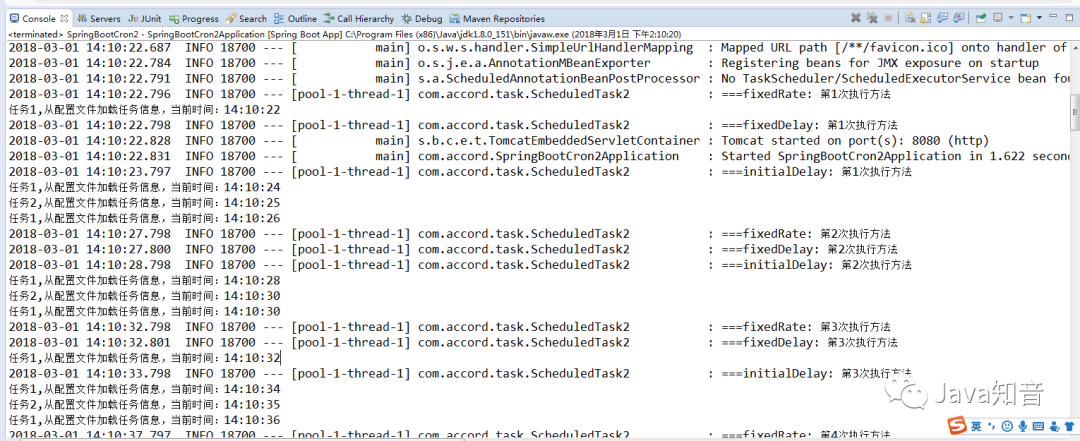
從控制臺(tái)輸入的結(jié)果中我們可以看出所有的定時(shí)任務(wù)都是在同一個(gè)線(xiàn)程池用同一個(gè)線(xiàn)程來(lái)處理的,那么我們?nèi)绾蝸?lái)并發(fā)的處理各定時(shí)任務(wù)呢,請(qǐng)繼續(xù)向下看。
4、多線(xiàn)程處理定時(shí)任務(wù):
看到控制臺(tái)輸出的結(jié)果,所有的定時(shí)任務(wù)都是通過(guò)一個(gè)線(xiàn)程來(lái)處理的,我估計(jì)是在定時(shí)任務(wù)的配置中設(shè)定了一個(gè)SingleThreadScheduledExecutor,于是我看了源碼,從ScheduledAnnotationBeanPostProcessor類(lèi)開(kāi)始一路找下去。果然,在ScheduledTaskRegistrar(定時(shí)任務(wù)注冊(cè)類(lèi))中的ScheduleTasks中又這樣一段判斷:
if (this.taskScheduler == null) {
 this.localExecutor = Executors.newSingleThreadScheduledExecutor();
 this.taskScheduler = new ConcurrentTaskScheduler(this.localExecutor);
}
這就說(shuō)明如果taskScheduler為空,那么就給定時(shí)任務(wù)做了一個(gè)單線(xiàn)程的線(xiàn)程池,正好在這個(gè)類(lèi)中還有一個(gè)設(shè)置taskScheduler的方法:
public void setScheduler(Object scheduler) {
 Assert.notNull(scheduler, "Scheduler object must not be null");
 if (scheduler instanceof TaskScheduler) {
  this.taskScheduler = (TaskScheduler) scheduler;
 }
 else if (scheduler instanceof ScheduledExecutorService) {
  this.taskScheduler = new ConcurrentTaskScheduler(((ScheduledExecutorService) scheduler));
 }
 else {
  throw new IllegalArgumentException("Unsupported scheduler type: " + scheduler.getClass());
 }
}
這樣問(wèn)題就很簡(jiǎn)單了,我們只需用調(diào)用這個(gè)方法顯式的設(shè)置一個(gè)ScheduledExecutorService就可以達(dá)到并發(fā)的效果了。我們要做的僅僅是實(shí)現(xiàn)SchedulingConfigurer接口,重寫(xiě)configureTasks方法就OK了;
package com.accord.task;

import org.springframework.context.annotation.Configuration;
import org.springframework.scheduling.annotation.SchedulingConfigurer;
import org.springframework.scheduling.config.ScheduledTaskRegistrar;

import java.util.concurrent.Executors;

/**
 * 多線(xiàn)程執(zhí)行定時(shí)任務(wù)
 * @author 王久印
 */
@Configuration
//所有的定時(shí)任務(wù)都放在一個(gè)線(xiàn)程池中,定時(shí)任務(wù)啟動(dòng)時(shí)使用不同都線(xiàn)程。
public class ScheduleConfig implements SchedulingConfigurer {
    @Override
    public void configureTasks(ScheduledTaskRegistrar taskRegistrar) {
        //設(shè)定一個(gè)長(zhǎng)度10的定時(shí)任務(wù)線(xiàn)程池
        taskRegistrar.setScheduler(Executors.newScheduledThreadPool(10));
    }
}
5、執(zhí)行結(jié)果(并發(fā))
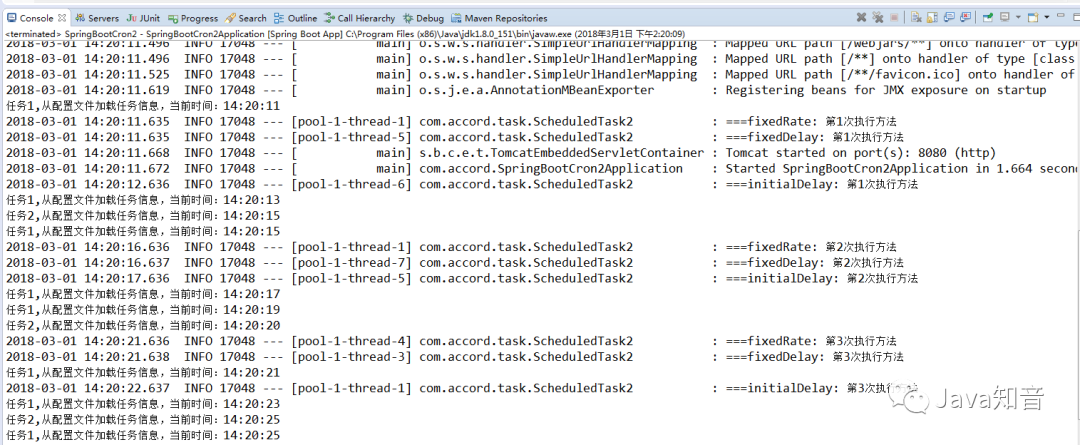
通過(guò)控制臺(tái)輸出的結(jié)果看出每個(gè)定時(shí)任務(wù)都是在通過(guò)不同的線(xiàn)程來(lái)處理了。
來(lái)源:wangjiuyin.blog.csdn.net/article/details/79411952
2. 高頻面試題 | Redis 如何實(shí)現(xiàn)庫(kù)存扣減操作?
最近面試BAT,整理一份面試資料《Java面試BATJ通關(guān)手冊(cè)》,覆蓋了Java核心技術(shù)、JVM、Java并發(fā)、SSM、微服務(wù)、數(shù)據(jù)庫(kù)、數(shù)據(jù)結(jié)構(gòu)等等。
獲取方式:點(diǎn)“在看”,關(guān)注公眾號(hào)并回復(fù) Java 領(lǐng)取,更多內(nèi)容陸續(xù)奉上。
PS:因公眾號(hào)平臺(tái)更改了推送規(guī)則,如果不想錯(cuò)過(guò)內(nèi)容,記得讀完點(diǎn)一下“在看”,加個(gè)“星標(biāo)”,這樣每次新文章推送才會(huì)第一時(shí)間出現(xiàn)在你的訂閱列表里。
點(diǎn)“在看”支持小哈呀,謝謝啦??
