
RocketMQ(十):數(shù)據(jù)存儲(chǔ)模型的設(shè)計(jì)與實(shí)現(xiàn)
消息中間件,說(shuō)是一個(gè)通信組件也沒(méi)有錯(cuò),因?yàn)樗谋韭毠ぷ魇亲鱿⒌膫鬟f。然而要做到高效的消息傳遞,很重要的一點(diǎn)是數(shù)據(jù)結(jié)構(gòu),數(shù)據(jù)結(jié)構(gòu)設(shè)計(jì)的好壞,一定程度上決定了該消息組件的性能以及能力上限。
1. 消息中間件的實(shí)現(xiàn)方式概述
消息中間件實(shí)現(xiàn)起來(lái)自然是很難的,但我們可以從某些角度,簡(jiǎn)單了說(shuō)說(shuō)實(shí)現(xiàn)思路。
它的最基本的兩個(gè)功能接口為:接收消息的發(fā)送(produce), 消息的消費(fèi)(consume). 就像一個(gè)郵遞員一樣,經(jīng)過(guò)它與不經(jīng)過(guò)它實(shí)質(zhì)性的東西沒(méi)有變化,它只是一個(gè)中介(其他功能效應(yīng),咱們拋卻不說(shuō))。
為了實(shí)現(xiàn)這兩個(gè)基本的接口,我們就得實(shí)現(xiàn)兩個(gè)最基本的能力:消息的存儲(chǔ)和查詢(xún)。存儲(chǔ)即是接收發(fā)送過(guò)來(lái)的消息,查詢(xún)則包括業(yè)務(wù)查詢(xún)與系統(tǒng)自行查詢(xún)推送。
我們先來(lái)看第一個(gè)點(diǎn):消息的存儲(chǔ)。
直接基于內(nèi)存的消息組件,可以做到非常高效的傳遞,基本上此時(shí)的消息中間件就是由幾個(gè)內(nèi)存隊(duì)列組成,只要保證這幾個(gè)隊(duì)列的安全性和實(shí)時(shí)性,就可以工作得很好了。然而基于內(nèi)存則必然意味著能力有限或者成本相當(dāng)高,所以這樣的設(shè)計(jì)適用范圍得結(jié)合業(yè)務(wù)現(xiàn)狀做下比對(duì)。
另一個(gè)就是基于磁盤(pán)的消息組件,磁盤(pán)往往意味著更大的存儲(chǔ)空間,或者某種程度上意味著無(wú)限的存儲(chǔ)空間,因?yàn)楫吘顾械拇髷?shù)據(jù)都是存放在磁盤(pán)上的,前提是系統(tǒng)需要協(xié)調(diào)好各磁盤(pán)間的數(shù)據(jù)關(guān)系。然而,磁盤(pán)也意味著性能的下降,數(shù)據(jù)存放起來(lái)更麻煩。但rocketmq借助于操作系統(tǒng)的pagecache和mmap以及順序?qū)憴C(jī)制,在讀寫(xiě)性能方面已經(jīng)非常優(yōu)化。所以,更重要的是如何設(shè)計(jì)好磁盤(pán)的數(shù)據(jù)據(jù)結(jié)構(gòu)。
然后是第二個(gè)點(diǎn):消息的查詢(xún)。
具體如何查詢(xún),則必然依賴(lài)于如何存儲(chǔ),與上面的原理類(lèi)似,不必細(xì)說(shuō)。但一般會(huì)有兩種消費(fèi)模型:推送消息模型和拉取消費(fèi)模型。即是消息中間件主動(dòng)向消費(fèi)者推送消息,或者是消費(fèi)者主動(dòng)查詢(xún)消息中間件。二者也各有優(yōu)劣,推送模型一般可以體現(xiàn)出更強(qiáng)的實(shí)時(shí)性以及保持比較小的server端存儲(chǔ)空間占用,但是也帶來(lái)了非常大的復(fù)雜度,它需要處理各種消費(fèi)異常、重試、負(fù)載均衡、上下線,這不是件小事。而拉取模型則會(huì)對(duì)消息中間件減輕許多工作,主要是省去了異常、重試、負(fù)載均衡類(lèi)的工作,將這些工作轉(zhuǎn)嫁到消費(fèi)者客戶(hù)端上。但與此同時(shí),也會(huì)對(duì)消息中間件提出更多要求,即要求能夠保留足夠長(zhǎng)時(shí)間的數(shù)據(jù),以便所有合法的消費(fèi)者都可以進(jìn)行消費(fèi)。而對(duì)于客戶(hù)端,則也需要中間件提供相應(yīng)的便利,以便可以實(shí)現(xiàn)客戶(hù)端的基本訴求,比如消費(fèi)組管理,上下線管理以及最基本的高效查詢(xún)能力。
2. rocketmq存儲(chǔ)模型設(shè)計(jì)概述
很明顯,rocketmq的初衷就是要應(yīng)對(duì)大數(shù)據(jù)的消息傳遞,所以其必然是基于磁盤(pán)的存儲(chǔ)。而其性能如上節(jié)所述,其利用操作系統(tǒng)的pagecache和mmap機(jī)制,讀寫(xiě)性能非常好,另外他使用順序?qū)憴C(jī)制,使普通磁盤(pán)也能體現(xiàn)出非常高的性能。
但是,以上幾項(xiàng),只是為高性能提供了必要的前提。但具體如何利用,還需要從重設(shè)計(jì)。畢竟,快不是目的,實(shí)現(xiàn)需求才是意義。
rocketmq中主要有四種存儲(chǔ)文件:commitlog 數(shù)據(jù)文件, consumequeue 消費(fèi)隊(duì)列文件, index 索引文件, 元數(shù)據(jù)信息文件。最后一個(gè)元數(shù)據(jù)信息文件比較簡(jiǎn)單,因其數(shù)據(jù)量小,方便操作。但針對(duì)前三個(gè)文件,都會(huì)涉及大量的數(shù)據(jù)問(wèn)題,所以必然好詳細(xì)設(shè)計(jì)其結(jié)構(gòu)。
從總體上來(lái)說(shuō),rocketmq都遵從定長(zhǎng)數(shù)據(jù)結(jié)構(gòu)存儲(chǔ),定長(zhǎng)的最大好處就在于可以快速定位位置,這是其高性能的出發(fā)點(diǎn)。定長(zhǎng)模型。
從核心上來(lái)說(shuō),commitlog文件保存了所有原始數(shù)據(jù),所有數(shù)據(jù)想要獲取,都能從或也只能從commitlog文件中獲取,由于commitlog文件保持了順序?qū)懙奶匦裕云湫阅芊浅8摺6驍?shù)據(jù)只有一份,所以也就從根本上保證了數(shù)據(jù)一致性。
而根據(jù)各業(yè)務(wù)場(chǎng)景,衍生出了consumequeue和index文件,即 consumequeue 文件是為了消費(fèi)者能夠快速獲取到相應(yīng)消息而設(shè)計(jì),而index文件則為了能夠快速搜索到消息而設(shè)計(jì)。從功能上說(shuō),consumequeue和index文件都是索引文件,只是索引的維度不同。consumequeue 是以topic和queueId維度進(jìn)行劃分的索引,而index 則是以時(shí)間和key作為劃分的索引。有了這兩個(gè)索引之后,就可以為各自的業(yè)務(wù)場(chǎng)景,提供高性能的服務(wù)了。具體其如何實(shí)現(xiàn)索引,我們稍后再講!
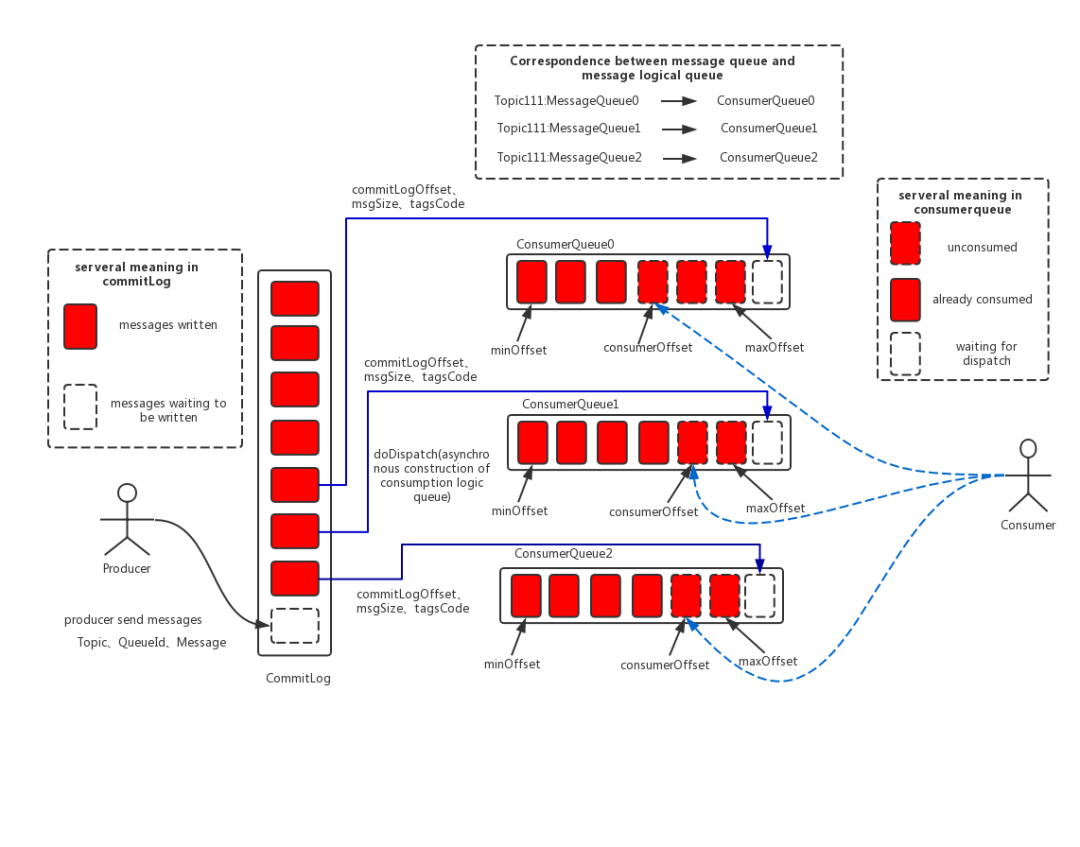
commitlog vs consumequeue 的存儲(chǔ)模型如下:
3. commitlog文件的存儲(chǔ)結(jié)構(gòu)
直接順序?qū)懙男问酱鎯?chǔ),每個(gè)文件設(shè)定固定大小,默認(rèn)是1G即: 1073741824 bytes. 寫(xiě)滿(mǎn)一個(gè)文件后,新開(kāi)一個(gè)文件寫(xiě)入。文件名就是其存儲(chǔ)的起始消息偏移量。
官方描述如下:
CommitLog:消息主體以及元數(shù)據(jù)的存儲(chǔ)主體,存儲(chǔ)Producer端寫(xiě)入的消息主體內(nèi)容,消息內(nèi)容不是定長(zhǎng)的。單個(gè)文件大小默認(rèn)1G ,文件名長(zhǎng)度為20位,左邊補(bǔ)零,剩余為起始偏移量,比如00000000000000000000代表了第一個(gè)文件,起始偏移量為0,文件大小為1G=1073741824;當(dāng)?shù)谝粋€(gè)文件寫(xiě)滿(mǎn)了,第二個(gè)文件為00000000001073741824,起始偏移量為1073741824,以此類(lèi)推。消息主要是順序?qū)懭肴罩疚募?dāng)文件滿(mǎn)了,寫(xiě)入下一個(gè)文件;
當(dāng)給定一個(gè)偏移量,要查找某條消息時(shí),只需在所有的commitlog文件中,根據(jù)其名字即可知道偏移的數(shù)據(jù)信息是否存在其中,即相當(dāng)于可基于文件實(shí)現(xiàn)一個(gè)二分查找,實(shí)際上rocketmq實(shí)現(xiàn)得更簡(jiǎn)潔,直接一次性查找即可定位:
// org.apache.rocketmq.store.CommitLog#getDatapublic SelectMappedBufferResult getData(final long offset, final boolean returnFirstOnNotFound) {int mappedFileSize = this.defaultMessageStore.getMessageStoreConfig().getMappedFileSizeCommitLog();// 1. 先在所有commitlog文件中查找到對(duì)應(yīng)所在的 commitlog 分片文件MappedFile mappedFile = this.mappedFileQueue.findMappedFileByOffset(offset, returnFirstOnNotFound);if (mappedFile != null) {// 再?gòu)脑摲制募校苿?dòng)余數(shù)的大小偏移,即可定位到要查找的消息記錄了int pos = (int) (offset % mappedFileSize);SelectMappedBufferResult result = mappedFile.selectMappedBuffer(pos);return result;}return null;}// 查找偏移所在commitlog文件的實(shí)現(xiàn)方式:// org.apache.rocketmq.store.MappedFileQueue#findMappedFileByOffset(long, boolean)// firstMappedFile.getFileFromOffset() / this.mappedFileSize 代表了第一條記錄所處的文件位置編號(hào)// offset / this.mappedFileSize 代表當(dāng)前offset所處的文件編號(hào)// 那么,兩個(gè)編號(hào)相減就是當(dāng)前offset對(duì)應(yīng)的文件編號(hào),因?yàn)榈谝粋€(gè)文件編號(hào)的相對(duì)位置是0// 但有個(gè)前提:就是每個(gè)文件存儲(chǔ)的大小必須是真實(shí)的對(duì)應(yīng)的 offset 大小之差,而實(shí)際上consumeQueue根本無(wú)法確定它存了多少offset// 也就是說(shuō),只要文件定長(zhǎng),offset用于定位 commitlog文件就是合理的int index = (int) ((offset / this.mappedFileSize) - (firstMappedFile.getFileFromOffset() / this.mappedFileSize));MappedFile targetFile = null;try {// 所以,此處可以找到 commitlog 文件對(duì)應(yīng)的 mappedFiletargetFile = this.mappedFiles.get(index);} catch (Exception ignored) {}if (targetFile != null && offset >= targetFile.getFileFromOffset()&& offset < targetFile.getFileFromOffset() + this.mappedFileSize) {return targetFile;}// 如果快速查找失敗,則退回到遍歷方式, 使用O(n)的復(fù)雜度再查找一次for (MappedFile tmpMappedFile : this.mappedFiles) {if (offset >= tmpMappedFile.getFileFromOffset()&& offset < tmpMappedFile.getFileFromOffset() + this.mappedFileSize) {return tmpMappedFile;}}
定位到具體的消息記錄位置后,如何知道要讀多少數(shù)據(jù)呢?這實(shí)際上在commitlog的數(shù)據(jù)第1個(gè)字節(jié)中標(biāo)明,只需讀出即可知道。
具體commitlog的存儲(chǔ)實(shí)現(xiàn)如下:
// org.apache.rocketmq.store.CommitLog.DefaultAppendMessageCallback#doAppend...// Initialization of storage spacethis.resetByteBuffer(msgStoreItemMemory, msgLen);// 1 TOTALSIZE, 首先將消息大小寫(xiě)入this.msgStoreItemMemory.putInt(msgLen);// 2 MAGICCODEthis.msgStoreItemMemory.putInt(CommitLog.MESSAGE_MAGIC_CODE);// 3 BODYCRCthis.msgStoreItemMemory.putInt(msgInner.getBodyCRC());// 4 QUEUEIDthis.msgStoreItemMemory.putInt(msgInner.getQueueId());// 5 FLAGthis.msgStoreItemMemory.putInt(msgInner.getFlag());// 6 QUEUEOFFSETthis.msgStoreItemMemory.putLong(queueOffset);// 7 PHYSICALOFFSETthis.msgStoreItemMemory.putLong(fileFromOffset + byteBuffer.position());// 8 SYSFLAGthis.msgStoreItemMemory.putInt(msgInner.getSysFlag());// 9 BORNTIMESTAMPthis.msgStoreItemMemory.putLong(msgInner.getBornTimestamp());// 10 BORNHOSTthis.resetByteBuffer(bornHostHolder, bornHostLength);this.msgStoreItemMemory.put(msgInner.getBornHostBytes(bornHostHolder));// 11 STORETIMESTAMPthis.msgStoreItemMemory.putLong(msgInner.getStoreTimestamp());// 12 STOREHOSTADDRESSthis.resetByteBuffer(storeHostHolder, storeHostLength);this.msgStoreItemMemory.put(msgInner.getStoreHostBytes(storeHostHolder));// 13 RECONSUMETIMESthis.msgStoreItemMemory.putInt(msgInner.getReconsumeTimes());// 14 Prepared Transaction Offsetthis.msgStoreItemMemory.putLong(msgInner.getPreparedTransactionOffset());// 15 BODYthis.msgStoreItemMemory.putInt(bodyLength);if (bodyLength > 0)this.msgStoreItemMemory.put(msgInner.getBody());// 16 TOPICthis.msgStoreItemMemory.put((byte) topicLength);this.msgStoreItemMemory.put(topicData);// 17 PROPERTIESthis.msgStoreItemMemory.putShort((short) propertiesLength);if (propertiesLength > 0)this.msgStoreItemMemory.put(propertiesData);final long beginTimeMills = CommitLog.this.defaultMessageStore.now();// Write messages to the queue bufferbyteBuffer.put(this.msgStoreItemMemory.array(), 0, msgLen);...
可以看出,commitlog的存儲(chǔ)還是比較簡(jiǎn)單的,因?yàn)槠渲饕褪秦?fù)責(zé)將接收到的所有消息,依次寫(xiě)入同一文件中。因?yàn)閷?zhuān)一所以專(zhuān)業(yè)。
4. consumequeue文件的存儲(chǔ)結(jié)構(gòu)
consumequeue作為消費(fèi)者的重要依據(jù),同樣起著非常重要的作用。消費(fèi)者在進(jìn)行消費(fèi)時(shí),會(huì)使用一些偏移量作為依據(jù)(拉取模型實(shí)現(xiàn))。而這些個(gè)偏移量,實(shí)際上就是指的consumequeue的偏移量(注意不是commitlog的偏移量)。這樣做有什么好處呢?首先,consumequeue作為索引文件,它被要求要有非常高的查詢(xún)性能,所以越簡(jiǎn)單越好。最好是能夠一次性定位到數(shù)據(jù)!
如果想一次性定位數(shù)據(jù),那么唯一的辦法是直接使用commitlog的offset。但這會(huì)帶來(lái)一個(gè)最大的問(wèn)題,就是當(dāng)我當(dāng)前消息消費(fèi)拉取完成后,下一條消息在哪里呢?如果單靠commitlog文件,那么,它必然需要將下一條消息讀入,然后再根據(jù)topic判定是不是需要的數(shù)據(jù)。如此一來(lái),就必然存在大量的commitlog文件的io問(wèn)題了。所以,這看起來(lái)是非常快速的一個(gè)解決方案,最終又變成了非常費(fèi)力的方案了。
而使用commitlog文件的offset,則好了許多。因?yàn)閏onsumequeue的文件存儲(chǔ)格式是一條消息占20字節(jié),即定長(zhǎng)。根據(jù)這20字節(jié),你可以找到commitlog的offset. 而因?yàn)閏onsumequeue本身就是按照topic/queueId進(jìn)行劃分的,所以,本次消費(fèi)完成后,下一次消費(fèi)的數(shù)據(jù)必定就在consumequeue的下一位置。如此簡(jiǎn)單快速搞得定了。具體consume的存儲(chǔ)格式,如官方描述:
ConsumeQueue:消息消費(fèi)隊(duì)列,引入的目的主要是提高消息消費(fèi)的性能,由于RocketMQ是基于主題topic的訂閱模式,消息消費(fèi)是針對(duì)主題進(jìn)行的,如果要遍歷commitlog文件中根據(jù)topic檢索消息是非常低效的。Consumer即可根據(jù)ConsumeQueue來(lái)查找待消費(fèi)的消息。其中,ConsumeQueue(邏輯消費(fèi)隊(duì)列)作為消費(fèi)消息的索引,保存了指定Topic下的隊(duì)列消息在CommitLog中的起始物理偏移量offset,消息大小size和消息Tag的HashCode值。consumequeue文件可以看成是基于topic的commitlog索引文件,故consumequeue文件夾的組織方式如下:topic/queue/file三層組織結(jié)構(gòu),具體存儲(chǔ)路徑為:$HOME/store/consumequeue/{topic}/{queueId}/{fileName}。同樣consumequeue文件采取定長(zhǎng)設(shè)計(jì),每一個(gè)條目共20個(gè)字節(jié),分別為8字節(jié)的commitlog物理偏移量、4字節(jié)的消息長(zhǎng)度、8字節(jié)tag hashcode,單個(gè)文件由30W個(gè)條目組成,可以像數(shù)組一樣隨機(jī)訪問(wèn)每一個(gè)條目,每個(gè)ConsumeQueue文件大小約5.72M;
其中fileName也是以偏移量作為命名依據(jù),因?yàn)檫@樣才能根據(jù)offset快速查找到數(shù)據(jù)所在的分片文件。
其存儲(chǔ)實(shí)現(xiàn)如下:
// org.apache.rocketmq.store.ConsumeQueue#putMessagePositionInfoprivate boolean putMessagePositionInfo(final long offset, final int size, final long tagsCode,final long cqOffset) {if (offset + size <= this.maxPhysicOffset) {log.warn("Maybe try to build consume queue repeatedly maxPhysicOffset={} phyOffset={}", maxPhysicOffset, offset);return true;}// 依次寫(xiě)入 offset + size + tagsCodethis.byteBufferIndex.flip();this.byteBufferIndex.limit(CQ_STORE_UNIT_SIZE);this.byteBufferIndex.putLong(offset);this.byteBufferIndex.putInt(size);this.byteBufferIndex.putLong(tagsCode);final long expectLogicOffset = cqOffset * CQ_STORE_UNIT_SIZE;MappedFile mappedFile = this.mappedFileQueue.getLastMappedFile(expectLogicOffset);if (mappedFile != null) {if (mappedFile.isFirstCreateInQueue() && cqOffset != 0 && mappedFile.getWrotePosition() == 0) {this.minLogicOffset = expectLogicOffset;this.mappedFileQueue.setFlushedWhere(expectLogicOffset);this.mappedFileQueue.setCommittedWhere(expectLogicOffset);this.fillPreBlank(mappedFile, expectLogicOffset);log.info("fill pre blank space " + mappedFile.getFileName() + " " + expectLogicOffset + " "+ mappedFile.getWrotePosition());}if (cqOffset != 0) {long currentLogicOffset = mappedFile.getWrotePosition() + mappedFile.getFileFromOffset();if (expectLogicOffset < currentLogicOffset) {log.warn("Build consume queue repeatedly, expectLogicOffset: {} currentLogicOffset: {} Topic: {} QID: {} Diff: {}",expectLogicOffset, currentLogicOffset, this.topic, this.queueId, expectLogicOffset - currentLogicOffset);return true;}if (expectLogicOffset != currentLogicOffset) {LOG_ERROR.warn("[BUG]logic queue order maybe wrong, expectLogicOffset: {} currentLogicOffset: {} Topic: {} QID: {} Diff: {}",expectLogicOffset,currentLogicOffset,this.topic,this.queueId,expectLogicOffset - currentLogicOffset);}}this.maxPhysicOffset = offset + size;// 將buffer寫(xiě)入 consumequeue 的 mappedFile 中return mappedFile.appendMessage(this.byteBufferIndex.array());}return false;}當(dāng)需要進(jìn)行查找進(jìn),也就會(huì)根據(jù)offset, 定位到某個(gè) consumequeue 文件,然后再根據(jù)偏移余數(shù)信息,再找到對(duì)應(yīng)記錄,取出20字節(jié),即是 commitlog信息。此處實(shí)現(xiàn)與 commitlog 的offset查找實(shí)現(xiàn)如出一轍。// 查找索引所在文件的實(shí)現(xiàn),如下:// org.apache.rocketmq.store.ConsumeQueue#getIndexBufferpublic SelectMappedBufferResult getIndexBuffer(final long startIndex) {int mappedFileSize = this.mappedFileSize;// 給到客戶(hù)端的偏移量是除以 20 之后的,也就是說(shuō) 如果上一次的偏移量是 1, 那么下一次的偏移量應(yīng)該是2// 一次性消費(fèi)多條記錄另算, 自行加減long offset = startIndex * CQ_STORE_UNIT_SIZE;if (offset >= this.getMinLogicOffset()) {// 委托給mappedFileQueue進(jìn)行查找到單個(gè)具體的consumequeue文件// 根據(jù) offset 和規(guī)范的命名,可以快速定位分片文件,如上 commitlog 的查找實(shí)現(xiàn)MappedFile mappedFile = this.mappedFileQueue.findMappedFileByOffset(offset);if (mappedFile != null) {// 再根據(jù)剩余的偏移量,直接類(lèi)似于數(shù)組下標(biāo)的形式,一次性定位到具體的數(shù)據(jù)記錄SelectMappedBufferResult result = mappedFile.selectMappedBuffer((int) (offset % mappedFileSize));return result;}}return null;}
如果想一次性消費(fèi)多條消息,則只需要依次從查找到索引記錄開(kāi)始,依次讀取多條,然后同理回查commitlog即可。即consumequeue的連續(xù),成就了commitlog的不連續(xù)。如下消息拉取實(shí)現(xiàn):
// org.apache.rocketmq.store.DefaultMessageStore#getMessage// 其中 bufferConsumeQueue 是剛剛查找出的consumequeue的起始消費(fèi)位置// 基于此文件迭代,完成多消息記錄消費(fèi)...long nextPhyFileStartOffset = Long.MIN_VALUE;long maxPhyOffsetPulling = 0;int i = 0;final int maxFilterMessageCount = Math.max(16000, maxMsgNums * ConsumeQueue.CQ_STORE_UNIT_SIZE);final boolean diskFallRecorded = this.messageStoreConfig.isDiskFallRecorded();ConsumeQueueExt.CqExtUnit cqExtUnit = new ConsumeQueueExt.CqExtUnit();for (; i < bufferConsumeQueue.getSize() && i < maxFilterMessageCount; i += ConsumeQueue.CQ_STORE_UNIT_SIZE) {// 依次取出commitlog的偏移量,數(shù)據(jù)大小,hashCode// 一次循環(huán)即是取走一條記錄,多次循環(huán)則依次往下讀取long offsetPy = bufferConsumeQueue.getByteBuffer().getLong();int sizePy = bufferConsumeQueue.getByteBuffer().getInt();long tagsCode = bufferConsumeQueue.getByteBuffer().getLong();maxPhyOffsetPulling = offsetPy;if (nextPhyFileStartOffset != Long.MIN_VALUE) {if (offsetPy < nextPhyFileStartOffset)continue;}boolean isInDisk = checkInDiskByCommitOffset(offsetPy, maxOffsetPy);if (this.isTheBatchFull(sizePy, maxMsgNums, getResult.getBufferTotalSize(), getResult.getMessageCount(),isInDisk)) {break;}boolean extRet = false, isTagsCodeLegal = true;if (consumeQueue.isExtAddr(tagsCode)) {extRet = consumeQueue.getExt(tagsCode, cqExtUnit);if (extRet) {tagsCode = cqExtUnit.getTagsCode();} else {// can't find ext content.Client will filter messages by tag also.log.error("[BUG] can't find consume queue extend file content!addr={}, offsetPy={}, sizePy={}, topic={}, group={}",tagsCode, offsetPy, sizePy, topic, group);isTagsCodeLegal = false;}}if (messageFilter != null&& !messageFilter.isMatchedByConsumeQueue(isTagsCodeLegal ? tagsCode : null, extRet ? cqExtUnit : null)) {if (getResult.getBufferTotalSize() == 0) {status = GetMessageStatus.NO_MATCHED_MESSAGE;}continue;}SelectMappedBufferResult selectResult = this.commitLog.getMessage(offsetPy, sizePy);if (null == selectResult) {if (getResult.getBufferTotalSize() == 0) {status = GetMessageStatus.MESSAGE_WAS_REMOVING;}nextPhyFileStartOffset = this.commitLog.rollNextFile(offsetPy);continue;}if (messageFilter != null&& !messageFilter.isMatchedByCommitLog(selectResult.getByteBuffer().slice(), null)) {if (getResult.getBufferTotalSize() == 0) {status = GetMessageStatus.NO_MATCHED_MESSAGE;}// release...selectResult.release();continue;}this.storeStatsService.getGetMessageTransferedMsgCount().incrementAndGet();getResult.addMessage(selectResult);status = GetMessageStatus.FOUND;nextPhyFileStartOffset = Long.MIN_VALUE;}if (diskFallRecorded) {long fallBehind = maxOffsetPy - maxPhyOffsetPulling;brokerStatsManager.recordDiskFallBehindSize(group, topic, queueId, fallBehind);}// 分配下一次讀取的offset偏移信息,同樣要除以單條索引大小nextBeginOffset = offset + (i / ConsumeQueue.CQ_STORE_UNIT_SIZE);long diff = maxOffsetPy - maxPhyOffsetPulling;long memory = (long) (StoreUtil.TOTAL_PHYSICAL_MEMORY_SIZE* (this.messageStoreConfig.getAccessMessageInMemoryMaxRatio() / 100.0));getResult.setSuggestPullingFromSlave(diff > memory);...
以上即理論的實(shí)現(xiàn),無(wú)須多言。
5. index文件的存儲(chǔ)結(jié)構(gòu)
index文件是為搜索場(chǎng)景而生的,如果沒(méi)有搜索業(yè)務(wù)需求,則這個(gè)實(shí)現(xiàn)是意義不大的。一般這種搜索,主要用于后臺(tái)查詢(xún)驗(yàn)證類(lèi)使用,或者有其他同的有妙用,不得而知。總之,一切為搜索。它更多的需要借助于時(shí)間限定,以key或者id進(jìn)行查詢(xún)。
官方描述如下:
IndexFile(索引文件)提供了一種可以通過(guò)key或時(shí)間區(qū)間來(lái)查詢(xún)消息的方法。Index文件的存儲(chǔ)位置是:$HOME \store\index\${fileName},文件名fileName是以創(chuàng)建時(shí)的時(shí)間戳命名的,固定的單個(gè)IndexFile文件大小約為400M,一個(gè)IndexFile可以保存 2000W個(gè)索引,IndexFile的底層存儲(chǔ)設(shè)計(jì)為在文件系統(tǒng)中實(shí)現(xiàn)HashMap結(jié)構(gòu),故rocketmq的索引文件其底層實(shí)現(xiàn)為hash索引。
IndexFile索引文件為用戶(hù)提供通過(guò)“按照Message Key查詢(xún)消息”的消息索引查詢(xún)服務(wù),IndexFile文件的存儲(chǔ)位置是:$HOME\store\index\${fileName},文件名fileName是以創(chuàng)建時(shí)的時(shí)間戳命名的,文件大小是固定的,等于40+500W\*4+2000W\*20= 420000040個(gè)字節(jié)大小。如果消息的properties中設(shè)置了UNIQ_KEY這個(gè)屬性,就用 topic + “#” + UNIQ_KEY的value作為 key 來(lái)做寫(xiě)入操作。如果消息設(shè)置了KEYS屬性(多個(gè)KEY以空格分隔),也會(huì)用 topic + “#” + KEY 來(lái)做索引。
其中的索引數(shù)據(jù)包含了Key Hash/CommitLog Offset/Timestamp/NextIndex offset 這四個(gè)字段,一共20 Byte。NextIndex offset 即前面讀出來(lái)的 slotValue,如果有 hash沖突,就可以用這個(gè)字段將所有沖突的索引用鏈表的方式串起來(lái)了。Timestamp記錄的是消息storeTimestamp之間的差,并不是一個(gè)絕對(duì)的時(shí)間。整個(gè)Index File的結(jié)構(gòu)如圖,40 Byte 的Header用于保存一些總的統(tǒng)計(jì)信息,4\*500W的 Slot Table并不保存真正的索引數(shù)據(jù),而是保存每個(gè)槽位對(duì)應(yīng)的單向鏈表的頭。20\*2000W 是真正的索引數(shù)據(jù),即一個(gè) Index File 可以保存 2000W個(gè)索引。
具體結(jié)構(gòu)圖如下:
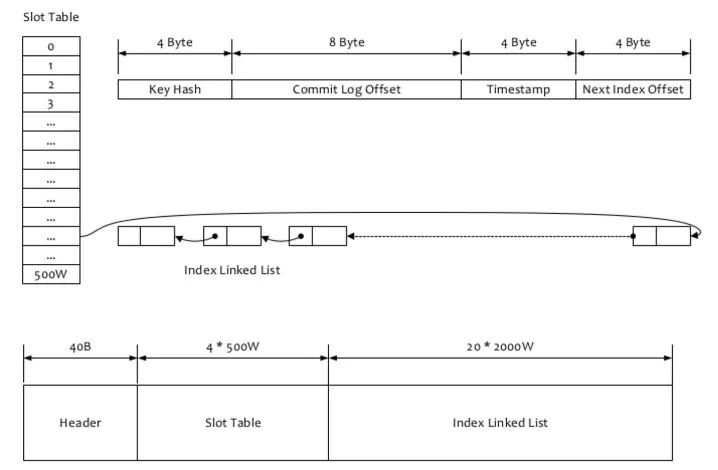
那么,如果要查找一個(gè)key, 應(yīng)當(dāng)如何查找呢?rocketmq會(huì)根據(jù)時(shí)間段找到一個(gè)index索引分版,然后再根據(jù)key做hash得到一個(gè)值,然后定位到 slotValue . 然后再?gòu)膕lotValue去取出索引數(shù)據(jù)的地址,找到索引數(shù)據(jù),然后再回查 commitlog 文件。從而得到具體的消息數(shù)據(jù)。也就是,相當(dāng)于搜索經(jīng)歷了四級(jí)查詢(xún):索引分片文件查詢(xún) -> slotValue 查詢(xún) -> 索引數(shù)據(jù)查詢(xún) -> commitlog 查詢(xún) 。?
具體查找實(shí)現(xiàn)如下:
// org.apache.rocketmq.broker.processor.QueryMessageProcessor#queryMessagepublic RemotingCommand queryMessage(ChannelHandlerContext ctx, RemotingCommand request)throws RemotingCommandException {final RemotingCommand response =RemotingCommand.createResponseCommand(QueryMessageResponseHeader.class);final QueryMessageResponseHeader responseHeader =(QueryMessageResponseHeader) response.readCustomHeader();final QueryMessageRequestHeader requestHeader =(QueryMessageRequestHeader) request.decodeCommandCustomHeader(QueryMessageRequestHeader.class);response.setOpaque(request.getOpaque());String isUniqueKey = request.getExtFields().get(MixAll.UNIQUE_MSG_QUERY_FLAG);if (isUniqueKey != null && isUniqueKey.equals("true")) {requestHeader.setMaxNum(this.brokerController.getMessageStoreConfig().getDefaultQueryMaxNum());}// 從索引文件中查詢(xún)消息final QueryMessageResult queryMessageResult =this.brokerController.getMessageStore().queryMessage(requestHeader.getTopic(),requestHeader.getKey(), requestHeader.getMaxNum(), requestHeader.getBeginTimestamp(),requestHeader.getEndTimestamp());assert queryMessageResult != null;responseHeader.setIndexLastUpdatePhyoffset(queryMessageResult.getIndexLastUpdatePhyoffset());responseHeader.setIndexLastUpdateTimestamp(queryMessageResult.getIndexLastUpdateTimestamp());if (queryMessageResult.getBufferTotalSize() > 0) {response.setCode(ResponseCode.SUCCESS);response.setRemark(null);try {FileRegion fileRegion =new QueryMessageTransfer(response.encodeHeader(queryMessageResult.getBufferTotalSize()), queryMessageResult);ctx.channel().writeAndFlush(fileRegion).addListener(new ChannelFutureListener() {@Overridepublic void operationComplete(ChannelFuture future) throws Exception {queryMessageResult.release();if (!future.isSuccess()) {log.error("transfer query message by page cache failed, ", future.cause());}}});} catch (Throwable e) {log.error("", e);queryMessageResult.release();}return null;}response.setCode(ResponseCode.QUERY_NOT_FOUND);response.setRemark("can not find message, maybe time range not correct");return response;}// org.apache.rocketmq.store.DefaultMessageStore#queryMessage@Overridepublic QueryMessageResult queryMessage(String topic, String key, int maxNum, long begin, long end) {QueryMessageResult queryMessageResult = new QueryMessageResult();long lastQueryMsgTime = end;for (int i = 0; i < 3; i++) {// 委托給 indexService 搜索記錄, 時(shí)間是必備參數(shù)QueryOffsetResult queryOffsetResult = this.indexService.queryOffset(topic, key, maxNum, begin, lastQueryMsgTime);if (queryOffsetResult.getPhyOffsets().isEmpty()) {break;}Collections.sort(queryOffsetResult.getPhyOffsets());queryMessageResult.setIndexLastUpdatePhyoffset(queryOffsetResult.getIndexLastUpdatePhyoffset());queryMessageResult.setIndexLastUpdateTimestamp(queryOffsetResult.getIndexLastUpdateTimestamp());for (int m = 0; m < queryOffsetResult.getPhyOffsets().size(); m++) {long offset = queryOffsetResult.getPhyOffsets().get(m);try {boolean match = true;MessageExt msg = this.lookMessageByOffset(offset);if (0 == m) {lastQueryMsgTime = msg.getStoreTimestamp();}if (match) {SelectMappedBufferResult result = this.commitLog.getData(offset, false);if (result != null) {int size = result.getByteBuffer().getInt(0);result.getByteBuffer().limit(size);result.setSize(size);queryMessageResult.addMessage(result);}} else {log.warn("queryMessage hash duplicate, {} {}", topic, key);}} catch (Exception e) {log.error("queryMessage exception", e);}}if (queryMessageResult.getBufferTotalSize() > 0) {break;}if (lastQueryMsgTime < begin) {break;}}return queryMessageResult;}public QueryOffsetResult queryOffset(String topic, String key, int maxNum, long begin, long end) {ListphyOffsets = new ArrayList (maxNum); long indexLastUpdateTimestamp = 0;long indexLastUpdatePhyoffset = 0;maxNum = Math.min(maxNum, this.defaultMessageStore.getMessageStoreConfig().getMaxMsgsNumBatch());try {this.readWriteLock.readLock().lock();if (!this.indexFileList.isEmpty()) {//從最后一個(gè)索引文件,依次搜索for (int i = this.indexFileList.size(); i > 0; i--) {IndexFile f = this.indexFileList.get(i - 1);boolean lastFile = i == this.indexFileList.size();if (lastFile) {indexLastUpdateTimestamp = f.getEndTimestamp();indexLastUpdatePhyoffset = f.getEndPhyOffset();}// 判定該時(shí)間段是否數(shù)據(jù)是否在該索引文件中if (f.isTimeMatched(begin, end)) {// 構(gòu)建出 key的hash, 然后查找 slotValue, 然后得以索引數(shù)據(jù), 然后將offset放入 phyOffsets 中f.selectPhyOffset(phyOffsets, buildKey(topic, key), maxNum, begin, end, lastFile);}if (f.getBeginTimestamp() < begin) {break;}if (phyOffsets.size() >= maxNum) {break;}}}} catch (Exception e) {log.error("queryMsg exception", e);} finally {this.readWriteLock.readLock().unlock();}return new QueryOffsetResult(phyOffsets, indexLastUpdateTimestamp, indexLastUpdatePhyoffset);}// org.apache.rocketmq.store.index.IndexFile#selectPhyOffsetpublic void selectPhyOffset(final ListphyOffsets, final String key, final int maxNum, final long begin, final long end, boolean lock) {if (this.mappedFile.hold()) {int keyHash = indexKeyHashMethod(key);int slotPos = keyHash % this.hashSlotNum;int absSlotPos = IndexHeader.INDEX_HEADER_SIZE + slotPos * hashSlotSize;FileLock fileLock = null;try {int slotValue = this.mappedByteBuffer.getInt(absSlotPos);if (slotValue <= invalidIndex || slotValue > this.indexHeader.getIndexCount()|| this.indexHeader.getIndexCount() <= 1) {// 超出搜索范圍,不處理} else {for (int nextIndexToRead = slotValue; ; ) {if (phyOffsets.size() >= maxNum) {break;}int absIndexPos =IndexHeader.INDEX_HEADER_SIZE + this.hashSlotNum * hashSlotSize+ nextIndexToRead * indexSize;// 依次讀出 keyHash+offset+timeDiff+nextOffsetint keyHashRead = this.mappedByteBuffer.getInt(absIndexPos);long phyOffsetRead = this.mappedByteBuffer.getLong(absIndexPos + 4);long timeDiff = (long) this.mappedByteBuffer.getInt(absIndexPos + 4 + 8);int prevIndexRead = this.mappedByteBuffer.getInt(absIndexPos + 4 + 8 + 4);if (timeDiff < 0) {break;}timeDiff *= 1000L;// 根據(jù)文件名可得到索引寫(xiě)入時(shí)間long timeRead = this.indexHeader.getBeginTimestamp() + timeDiff;boolean timeMatched = (timeRead >= begin) && (timeRead <= end);if (keyHash == keyHashRead && timeMatched) {phyOffsets.add(phyOffsetRead);}if (prevIndexRead <= invalidIndex|| prevIndexRead > this.indexHeader.getIndexCount()|| prevIndexRead == nextIndexToRead || timeRead < begin) {break;}nextIndexToRead = prevIndexRead;}}} catch (Exception e) {log.error("selectPhyOffset exception ", e);} finally {if (fileLock != null) {try {fileLock.release();} catch (IOException e) {log.error("Failed to release the lock", e);}}this.mappedFile.release();}}}
看起來(lái)挺費(fèi)勁,但真正處理起來(lái)性能還好,雖然沒(méi)有consumequeue高效,但有mmap和pagecache的加持,效率還是扛扛的。而且,搜索相對(duì)慢一些,用戶(hù)也是可以接受的嘛。畢竟這只是一個(gè)附加功能,并非核心所在。
而索引文件并沒(méi)有使用什么高效的搜索算法,而是簡(jiǎn)單從最后一個(gè)文件遍歷完成,因?yàn)闀r(shí)間戳不一定總是有規(guī)律的,與其隨意查找,還不如直接線性查找。另外,實(shí)際上對(duì)于索引重建問(wèn)題,搜索可能不一定會(huì)有效。不過(guò),我們可以通過(guò)擴(kuò)大搜索時(shí)間范圍的方式,總是能夠找到存在的數(shù)據(jù)。而且因其使用hash索引實(shí)現(xiàn),性能還是不錯(cuò)的。
另外,index索引文件與commitlog和consumequeue有一個(gè)不一樣的地方,就是它不能進(jìn)行順序?qū)懀驗(yàn)閔ash存儲(chǔ),寫(xiě)一定是任意的。且其slotValue以一些統(tǒng)計(jì)信息可能隨時(shí)發(fā)生變化,這也給順序?qū)憥?lái)了不可解決的問(wèn)題。
其具體寫(xiě)索引過(guò)程如下:
// org.apache.rocketmq.store.index.IndexFile#putKeypublic boolean putKey(final String key, final long phyOffset, final long storeTimestamp) {if (this.indexHeader.getIndexCount() < this.indexNum) {int keyHash = indexKeyHashMethod(key);int slotPos = keyHash % this.hashSlotNum;int absSlotPos = IndexHeader.INDEX_HEADER_SIZE + slotPos * hashSlotSize;FileLock fileLock = null;try {// 先嘗試?yán)lot對(duì)應(yīng)的數(shù)據(jù)// 如果為0則說(shuō)明是第一次寫(xiě)入, 否則為當(dāng)前的索引條數(shù)int slotValue = this.mappedByteBuffer.getInt(absSlotPos);if (slotValue <= invalidIndex || slotValue > this.indexHeader.getIndexCount()) {slotValue = invalidIndex;}long timeDiff = storeTimestamp - this.indexHeader.getBeginTimestamp();timeDiff = timeDiff / 1000;if (this.indexHeader.getBeginTimestamp() <= 0) {timeDiff = 0;} else if (timeDiff > Integer.MAX_VALUE) {timeDiff = Integer.MAX_VALUE;} else if (timeDiff < 0) {timeDiff = 0;}// 直接計(jì)算出本次存儲(chǔ)的索引記錄位置// 因索引條數(shù)只會(huì)依次增加,故索引數(shù)據(jù)將表現(xiàn)為順序?qū)憳幼樱饕潜WC了數(shù)據(jù)不會(huì)寫(xiě)沖突了int absIndexPos =IndexHeader.INDEX_HEADER_SIZE + this.hashSlotNum * hashSlotSize+ this.indexHeader.getIndexCount() * indexSize;// 按協(xié)議寫(xiě)入內(nèi)容即可this.mappedByteBuffer.putInt(absIndexPos, keyHash);this.mappedByteBuffer.putLong(absIndexPos + 4, phyOffset);this.mappedByteBuffer.putInt(absIndexPos + 4 + 8, (int) timeDiff);this.mappedByteBuffer.putInt(absIndexPos + 4 + 8 + 4, slotValue);// 寫(xiě)入slotValue為當(dāng)前可知的索引記錄條數(shù)// 即每次寫(xiě)入索引之后,如果存在hash沖突,那么它會(huì)寫(xiě)入自身的位置// 而此時(shí) slotValue 必定存在一個(gè)值,那就是上一個(gè)發(fā)生沖突的索引,從而形成自然的鏈表// 查找數(shù)據(jù)時(shí),只需根據(jù)slotValue即可以找到上一個(gè)寫(xiě)入的索引,這設(shè)計(jì)妙哉!// 做了2點(diǎn)關(guān)鍵性保證:1. 數(shù)據(jù)自增不沖突; 2. hash沖突自刷新; 磁盤(pán)版的hash結(jié)構(gòu)已然形成this.mappedByteBuffer.putInt(absSlotPos, this.indexHeader.getIndexCount());if (this.indexHeader.getIndexCount() <= 1) {this.indexHeader.setBeginPhyOffset(phyOffset);this.indexHeader.setBeginTimestamp(storeTimestamp);}if (invalidIndex == slotValue) {this.indexHeader.incHashSlotCount();}this.indexHeader.incIndexCount();this.indexHeader.setEndPhyOffset(phyOffset);this.indexHeader.setEndTimestamp(storeTimestamp);return true;} catch (Exception e) {log.error("putKey exception, Key: " + key + " KeyHashCode: " + key.hashCode(), e);} finally {if (fileLock != null) {try {fileLock.release();} catch (IOException e) {log.error("Failed to release the lock", e);}}}} else {log.warn("Over index file capacity: index count = " + this.indexHeader.getIndexCount()+ "; index max num = " + this.indexNum);}return false;}
rocketmq 巧妙地使用了自增結(jié)構(gòu)和hash slot, 完美實(shí)現(xiàn)一個(gè)磁盤(pán)版的hash索引。相信這也會(huì)給我們平時(shí)的工作帶來(lái)一些提示。
6. 寫(xiě)在最后
以上就是本文對(duì)rocketmq的存儲(chǔ)模型設(shè)計(jì)的解析了,通過(guò)這些解析,相信大家對(duì)其工作原理也會(huì)有質(zhì)的理解。存儲(chǔ)實(shí)際上是目前我們的許多的系統(tǒng)中的非常核心部分,因?yàn)榇蟛糠值臉I(yè)務(wù)幾乎都是在存儲(chǔ)之前做一些簡(jiǎn)單的計(jì)算。
很顯然業(yè)務(wù)很重要,但有了存儲(chǔ)的底子,還何愁業(yè)務(wù)實(shí)現(xiàn)難?

騰訊、阿里、滴滴后臺(tái)面試題匯總總結(jié) — (含答案)
面試:史上最全多線程面試題 !
最新阿里內(nèi)推Java后端面試題
JVM難學(xué)?那是因?yàn)槟銢](méi)認(rèn)真看完這篇文章

關(guān)注作者微信公眾號(hào) —《JAVA爛豬皮》
了解更多java后端架構(gòu)知識(shí)以及最新面試寶典


看完本文記得給作者點(diǎn)贊+在看哦~~~大家的支持,是作者源源不斷出文的動(dòng)力
作者:等你歸去來(lái)
出處:https://www.cnblogs.com/yougewe/p/14224366.html